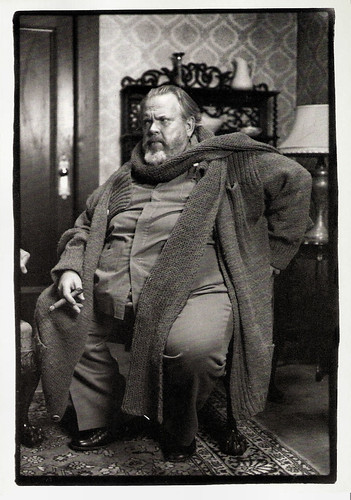
Showing posts with label Orson Welles. Show all posts

29 August 2024

The Third Man (1949)

The Third Man (1949) is a classic Film Noir directed by Sir Carol Reed and written by Graham Greene. The British film stars Joseph Cotten, Alida Valli, Trevor Howard, and Orson Welles as Harry Lime. The atmospheric use of black-and-white expressionist cinematography by Robert Krasker, harsh lighting, and subtle ‘Dutch angle’ camera technique are major features of The Third Man. The zither music by Anton Karas topped the international music charts in 1950 and brought international fame to the previously unknown performer.

Orson Welles in The Third Man (1949)
Dutch postcard by Fotoarchief Film en Toneel, no. 3505. Photo: London Films. Orson Welles in The Third Man (Carol Reed, 1949).

The Third Man
Vintage photo. Alida Valli and Joseph Cotten in The Third Man (Carol Reed, 1949).

Trevor Howard in The Third Man (1949)
Dutch postcard. Photo: Nederland Film. Trevor Howard in The Third Man (Carol Reed, 1949).

An unusual and perfect long-shot


Before writing the screenplay for The Third Man (Carol Reed, 1949), Graham Greene worked out the atmosphere, characterisation, and mood of the story by writing a novella as a treatment for the film script. He did not intend it to be read by the general public, although the novella was later published under the same name as the film. He set the film in post-war, bombed-out Vienna. In 1948, he met Elizabeth Montagu in Vienna. She gave him tours of the city, its sewers, and some of its less reputable nightclubs. She also introduced Greene to Peter Smolka, the central European correspondent for The Times of London. Smolka gave Greene stories about the black market in Vienna. In The Third Man an American, Holly Martins (Joseph Cotten) arrives in shadowy Vienna divided into French, American, British and Russian zones, each with its cadre of suspicious officials. A shortage of supplies has led to a flourishing black market. Martins is an out-of-work pulp fiction novelist, Holly Martins, who was invited by an ex-school friend, Harry Lime (Orson Welles), who has offered him a job. He soon discovers that Lime has recently died in a peculiar traffic accident.

At Lime's funeral, Martins meets two British Royal Military Police: Sergeant Paine (Bernard Lee), a fan of Martins' books, and Major Calloway (Trevor Howard). Calloway bluntly says Lime was an evil man, and advises Holly to take the next train home. Afterwards, Martins is asked by Mr Crabbin (Wilfrid Hyde-White) to lecture at a book club a few days later. He then meets a friend of Lime's, ‘Baron" Kurtz (Ernst Deutsch), who tells Martins that he and another friend, Popescu (Siegfried Breuer), carried Lime to the side of the street after the accident, and that, before he died, Lime asked them to take care of Martins and Lime's girlfriend, actress Anna Schmidt (Alida Valli). As Martins and Anna investigate Lime's death, they realise that accounts differ as to whether Lime was able to speak before his death, and whether two men carried away the body, or three. The porter at Lime's apartment (Paul Hörbiger) tells them that he saw a third man helping carry away the body. Later, the porter offers to give Martins more information, but he is murdered before Martins can talk to him again. Martins decides to stay in Vienna and investigate what happened to Harry Lime and who was the third man.

Graham Greene, who not only wrote about spies but occasionally acted as one, based the character of Harry Lime on British double agent Kim Philby. He was Greene's superior in the British Secret Intelligence Service. It was producer Alexander Korda who paired Graham Greene with director Carol Reed. The year before the two had made the thriller The Fallen Idol (1948), which scored a notable success. Korda was very keen to replicate the pairing. The Third Man was meant to be the first of a series of collaborations between Korda and another mega-producer, David O. Selznick. The collaboration did not go smoothly. Reed and Selznick fought over every detail of the film. Selznick wanted to shoot on sets and cast Noel Coward as Harry Lime. He was resistant to Reed's idea of casting Orson Welles in the role since Selznick had labelled Welles as ‘box office poison’.

Selznick was initially also cautious about Anton Karas' music and wanted an upbeat score. During the meetings between Greene and Reed with Selznick, Greene was less than impressed with Selznick. Greene later mocked Selznick's dependency, at that stage, on the drug Benzedrine, better known as ‘speed’. Reed defied convention by shooting entirely on location in Vienna, where mountains of rubble stood next to gaping bomb craters, and the ruins of the empire supported a desperate black market economy. And he insisted on Orson Welles. Reed had worked for the British Army's wartime documentary unit and preferred real locations and real local people as extras, attempting the neo-realistic style that Italian directors like Vittorio De Sica, Luchino Visconti and Roberto Rossellini were made popular at the time.

In capturing the atmosphere of the beleaguered city in his film, Reed was helped along by city officials and inhabitants. On nights when rain was unavailable to give the cobblestone streets the appropriate glistening sheen, the city would provide a fire brigade to wet things down. Reed used many residents as extras such as the often glimpsed balloon seller. For the grand final of the film, the Vienna Police had a special unit to patrol the city's sewer system, as its network of interlocking tunnels made great hiding places for criminals and stolen property. The police officers in the film were off-duty members of that unit. The final scene was also the subject of a dispute between David O. Selznick, who wanted the happy ending of the novella, and Reed, who stubbornly refused to end the film on what he felt was an artificially happy note. Graham Greene later wrote: "One of the very few major disputes between Carol Reed and myself concerned the ending, and he has been proved triumphantly right." The Third Man ends as it begins, in a cemetery, and then Calloway gives Holly a ride back to town. They pass Anna walking on the roadside. Holly asks to be let out of the jeep. He stands under a tree, waiting for her. She walks toward him, past him, and then out of frame, never looking. After a long pause, Holly lights a cigarette and wearily throws away the match. Reed kept the camera running, making it an unusual and perfect long shot.

Orson Welles in The Third Man (1949)
French postcard in the Collection Cinéma by Editions Art & Scène, Paris, 1996, no. CAN 01. Orson Welles in The Third Man (Carol Reed, 1949).

Joseph Cotten and Orson Welles in The Third Man (1949)
Chinese postcard. Joseph Cotten and Orson Welles in The Third Man (Carol Reed, 1949).

The Third Man
Publicity still of Alida Valli and Joseph Cotten in The Third Man (Carol Reed, 1949). Collection: Doctor Macro's.

He’ll have in you a dither with his zither!


Carol Reed had three separate film units working most days of production: a daytime unit, a nighttime unit and a sewer unit. Reed insisted upon directing each unit, resulting in him working 20-hour days. Orson Welles worked for one week on the film and is on screen for only about five minutes. Once he finally arrived in Vienna, Welles refused to film various scenes in the sewers. Due to his protests, various sets replicating the Vienna sewers had to be constructed by Alexander Korda on sound stages back in England. It has long been rumoured that Orson Welles wrote all of Harry Lime's dialogue and even that he took over the direction of his scenes. In a 1967 interview with Peter Bogdanovich, Welles said that his involvement was minimal: "It was Carol's picture".

That Orson Welles wrote most of Lime's dialogue was also a fabrication. Welles' contributions were Lime's grumbling about his stomach problems which were improvisations and the famous cuckoo clock spiel at the end of the Ferris wheel scene. Welles famously says: “You know what the fellow said—in Italy, for 30 years under the Borgias, they had warfare, terror, murder and bloodshed; but they produced Michelangelo, Leonardo da Vinci and the Renaissance. In Switzerland, they had brotherly love; they had 500 years of democracy and peace—and what did that produce? The cuckoo clock!” The cuckoo clock remark has later been traced back to the essayist Walter Pate and when the picture came out, the Swiss very nicely pointed out to Welles that they've never made any cuckoo clocks, as the clocks are native to the German Black Forest. Since Welles refused to be filmed in Vienna's sewers, his close-ups were shot in London Film Studios, while a body double was used for the wide shots. The resulting footage is said to be about 85% Vienna, and 15% London. In the Vienna sewer location scenes Harry's breath is visible (it was cold down there), but in the sewer scenes shot in London his breaths are not visible. The scene showing the waning moments of Lime's life in which he extends his fingers futilely towards freedom from below through a grill in a street was suggested by Welles. While he was not in Vienna at the time, the hand belonged to Carol Reed.

As the production grew difficult, Alexander Korda and David O. Selznick decided to take it one film at a time. Ironically, due to the success of the film, since both producers were at each other's throats for the credit for the film, they never collaborated again. Roger Ebert in his review of The Third Man: "Reed and his Academy Award-winning cinematographer, Robert Krasker, devised a reckless, unforgettable visual style. More shots, I suspect, are tilted than are held straight; they suggest a world out of joint. There are fantastic oblique angles. Wide-angle lenses distort faces and locations. And the bizarre lighting makes the city into an expressionist nightmare." Another asset of the film is the score. There are apocryphal stories abound Reed discovering musician Anton Karas while scouring Vienna bars and nightclubs. Reed heard Karas playing at a production party and insisted the Austrian zither player come to his hotel room and record some songs to use for the film. Later in production, Reed realised he wanted to use Karas' music for the whole film and flew Karas out to London to record the score. Additional music for the film was written by the Australian-born composer Hubert Clifford under the pseudonym of Michael Sarsfield. From 1944 until 1950 Clifford was Musical Director for Korda at London Film Productions.

By the time David O. Selznick released the film in the U.S., in February 1950, Karas’s 'Harry Lime Theme' was already an international sensation. O’Selznick capitalised on this by including the tagline, "Featuring the Famous Zither Score by Anton Karas... He’ll have in you a dither with his zither!" in the American ad campaign and trailers. Karas became a top-selling musician thanks to the film and opened a nightclub called ‘The Third Man’ in Vienna, which he ran to the end of his days. The Third Man (Carol Reed, 1949) was the most popular film in the UK in 1949. The British version featured an introductory voice-over by Carol Reed. The voice-over was necessary to explain the very unusual status of Vienna in the aftermath of World War II. However, when the film was initially distributed in America, David O. Selznick had replaced Reed’s narration with a narration read by Joseph Cotten, in character as Holly Martins. Nearly eleven minutes of film were cut in Selznick's version, to give the film a tighter pace. He cut all references to Holly Martins being an implied alcoholic and anything else that portrayed him as a less-than-heroic figure. The British version runs 104 minutes and the American version 93 minutes. Both versions have been released on video, but the most common is the longer British cut.

Joseph Cotten reprised his role as Holly Martins in the one-hour Theatre Guild on the Air radio adaptation in 1951. Orson Welles starred in the British radio series ‘The Adventures of Harry Lime‘ (1951-1952) created as a prequel to the film. The series was also broadcast in the United States as ‘The Lives of Harry Lime’. Later followed a television spin-off, the series, The Third Man (1959–1965). In the 1949 film, Harry is a charming, totally amoral character. In the 1951 radio series, he is a charming adventurer of dubious reputation who is not as immoral as people think he is. In the TV show, as played by Michael Rennie, he's a rather conservative businessman whose reputation seems to have been a case of mistaken identity. Today, you can do a canal tour in Vienna called ‘Der Dritte Man -Tour’. It visits the places where the scenes of Harry Lime being chased by the police were shot. The tunnels featured in the film are part of the Wienkanal, which channels the Wien River through central Vienna out to the Danube River. The main tunnel is the huge arched structure through which the river flows a distance of about 1.6km. The gated side passages are connections to a wet-weather sewer overflow, and the chamber with the balconies is the overflow point. The spiral staircase is one of 6 exits from the main culvert. Events are occasionally held down the tunnels in commemoration of The Third Man and its characters.

The Third Man (1949)
British postcard by Cinema. Image: French affiche by Filmsonor for The Third Man (Carol Reed, 1949) with Orson Welles. The French titel is Le troisième homme.

Joseph Cotten in The Third Man (1949)
British postcard in the Picturegoer Serie, no. W 792. Photo: British Lion. Joseph Cotten in The Third Man (Carol Reed, 1949).

Alida Valli in The Third Man
Yugoslavian postcard by Sedma Sila. Photo: Morava Film, Beograd (Belgrade). Alida Valli as Anna in The Third Man (Carol Reed, 1949).

Trevor Howard in The Third Man (1949)
Dutch postcard. Trevor Howard in The Third Man (Carol Reed, 1949).

Sources: Roger Ebert (RogerEbert.com), Wikipedia, and IMDb.

13 August 2022

Directed by Orson Welles

American actor, director, writer and producer Orson Welles (1915-1985) worked in theatre, radio and film, both in the US and in Europe. He is remembered for his innovative work in all three media, most notably Caesar (1937), a groundbreaking Broadway adaptation of 'Julius Caesar' and the debut of the Mercury Theatre, The War of the Worlds (1938), one of the most famous broadcasts in the history of radio, and Citizen Kane (1941), ranked as one of the all-time greatest films. His other films include The Magnificent Ambersons (1942), Touch of Evil (1958) and Le Procès/The Trial (1962).

Orson Welles
French postcard by Editions du Globe, no. 143. Photo: Sam Lévin.

Orson Welles in The Lady from Shanghai (1947)
British postcard by Picturegoer, London, no. W. 410. Photo: Columbia. Orson Welles in The Lady from Shanghai (Orson Welles, 1947).

His brashness and impassioned quality


George Orson Welles was born in Kenosha, Wisconsin, in 1915. He was the second son of Beatrice (née Ives) and Richard Hodgdon Head Welles. In 1919, his parents separated and moved to Chicago. His father, who made a fortune as the inventor of a popular bicycle lamp, became an alcoholic and stopped working. His brother ‘Dickie’ was institutionalised at an early age because he had learning difficulties.

Welles's mother, a beautiful concert pianist, had to support her son and herself. In 1924, Beatrice died of hepatitis in a Chicago hospital, just after Welles's ninth birthday. He was taken in by Dudley Crafts Watson. At the age of ten, Orson ran away from home with Watson's third daughter, Marjorie. They were found a week later, singing and dancing for money on a street corner in Milwaukee.

Welles' father died when Orson was 15. Maurice Bernstein, a physician from Chicago, became his guardian. His school teacher Roger Hill provided Welles with an ad hoc educational environment that proved invaluable to his creative experience, allowing Welles to perform and stage theatrical experiments and productions.

Welles was awarded a scholarship to Harvard University, but he chose to travel to Europe instead. In Ireland, he strode into the Gate Theatre in Dublin and claimed he was a Broadway star. The manager of Gate, Hilton Edwards, was impressed by his brashness and impassioned quality in his audition. Welles made his stage debut at the Gate in 1931, appearing in 'Jew Suss' as the Duke. He acted to great acclaim, word of which reached the United States.

On returning to the United States he wrote the immensely successful 'Everybody's Shakespeare'. In 1933, he toured in three off-Broadway productions with Katharine Cornell's company, including two roles in 'Romeo and Juliet'. In 1934, he shot his first film, an eight-minute short titled The Hearts of Age, and he married Chicago actress Virginia Nicholson. By 1935 Welles was supplementing his earnings in the theatre as a radio actor, working with many actors who would later form the core of his Mercury Theatre.

Orson Welles
British postcard in the Picturegoer Series, London, no. W 130. Photo: RKO Radio.

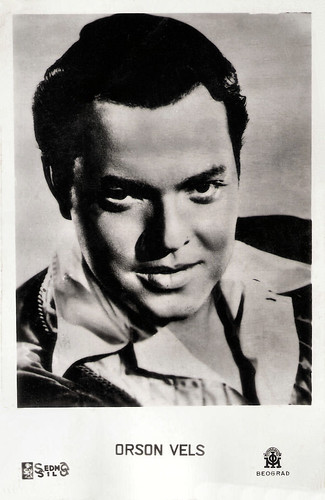
Orson Welles in Citrizen Kane (1941)
Yugoslavian postcard by Sedma Sila. Photo: IOM, Beograd. Orson Welles in Citizen Kane (Orson Welles, 1941). Caption: Orson Vels.

The Night That Panicked America


In 1936, the Federal Theatre Project (part of Roosevelt's Works Progress Administration) put unemployed theatre performers and employees to work. Orson Welles was hired by John Houseman and assigned to direct a play for the Federal Theatre Project's Negro Theatre Unit. His production of 'Macbeth' was set in the Haitian court of King Henri Christophe, with voodoo witch doctors for the three Weird Sisters. The play was received rapturously and later toured the nation.

At 20, Welles was hailed as a prodigy. A few minutes of Welles’ ‘Voodoo Macbeth’ was recorded on film in the documentary We Work Again (1937). Welles rehearsed Marc Blitzstein's political operetta, 'The Cradle Will Rock', but because of severe federal cutbacks in the Works Progress projects, the show's premiere at the Maxine Elliott Theatre was cancelled.

In a last-minute move, Welles announced to waiting ticket-holders that the show was being transferred to the Venice, twenty blocks away. Some cast, crew and audience members walked the distance on foot. Lacking the participation of the union members, 'The Cradle Will Rock' began with Blitzstein introducing the show and playing the piano accompaniment on stage with some cast members performing from the audience. This impromptu performance was well received and played at the Venice for two more weeks.

Welles and Houseman then formed the Mercury Theatre, of which Welles became the executive producer and whose repertory company eventually included the actors Agnes Moorehead, Joseph Cotten, Dolores del Río, Everett Sloane, and Erskine Sanford. The first Mercury Theatre production was William Shakespeare's tragedy 'Julius Caesar', set in a contemporary frame of fascist Italy. The production was widely acclaimed.

In the second year of the Mercury Theater, Welles shifted his interests to the radio. He adapted, directed and played 'Hamlet' for CBS and 'Les Misérables' for Mutual with great success. CBS gave the Mercury Theatre a weekly hour-long show to broadcast radio plays based on classic literary works. In 1938, their adaptation of 'The War of the Worlds' by H. G. Wells brought Welles instant fame. The combination of the news bulletin form of the performance with the between-breaks dial spinning habits of listeners from the rival more popular Edgar Bergen/Charlie McCarthy program was later reported in the media to have created widespread confusion.

Wikipedia: “Panic was reportedly spread among listeners who believed the news reports of a Martian invasion. The myth of the result created by the combination was reported as fact around the world and disparagingly mentioned by Adolf Hitler in a public speech some months later. The 1975 docudrama The Night That Panicked America was based on events centring on the production of, and events that resulted from the program.”

Orson Welles in Citizen Kane (1941)
Vintage playcard. Photo: Ernest A. Bachrach. Orson Welles in Citizen Kane (Orson Welles, 1941).

Orson Welles, Loretta Young
Dutch postcard by S. & v. H. A. Photo: M.P.E.A. Loretta Young and Orson Welles in The Stranger (Orson Welles, 1946).

The attempted suppression of Citizen Kane


Orson Welles's growing fame drew Hollywood offers, lures that the independent-minded Welles resisted at first. RKO Radio Pictures president George Schaefer eventually offered him complete artistic control and signed Welles in a two-picture deal, although Welles had a budget limit for his projects. In Hollywood, Welles toyed with various ideas for his first project.

RKO rejected Welles's first two movie proposals but agreed on the third offer, Citizen Kane (1941), for which Welles co-wrote, produced, directed and performed the lead role. Co-scriptwriter Joseph Mankiewicz based the original outline on an exposé of the life of William Randolph Hearst, whom he knew socially and came to hate, having once been great friends with Hearst's mistress, Marion Davies.

Kane's megalomania was modelled loosely on Robert McCormick, Howard Hughes and Joseph Pulitzer as Welles wanted to create a broad, complex character, intending to show him in the same scenes from several points of view. On Welles's instruction, John Houseman wrote the opening narration as a pastiche of The March of Time newsreels. Autobiographical allusions to Welles were worked in, most noticeably in the treatment of Kane's childhood and particularly, regarding his guardianship.

Once the script was complete, Welles attracted cinematographer Gregg Toland, and actors from his Mercury Theatre. After gossip columnist Hedda Hopper saw a preview screening of Citizen Kane, the attempted suppression of Citizen Kane started. Hearst's media outlets boycotted the film. They exerted enormous pressure on Hollywood, but RKO gave the film a limited release.

The film was well-received critically and garnered nine Academy Award nominations. Welles was nominated as a producer, director, writer and actor, but won only for Best Original Screenplay, shared with Mankiewicz. Today, the film is considered by most film critics and historians to be one of the classics in film history.

Orson Welles and Rita Hayworth in The Lady From Shanghai (1947)
Vintage postcard. Photo: Edward Cronenweth. Orson Welles and Rita Hayworth in The Lady From Shanghai (Orson Welles, 1947).

Orson Welles in The Lady from Shanghai (1947)
Vintage postcard. Photo: Columbia. Orson Welles in The Lady From Shanghai (Orson Welles, 1947).

A climactic confrontation scene in an amusement park funhouse


Orson Welles's second film for RKO was The Magnificent Ambersons (1942), adapted from the Pulitzer Prize-winning novel by Booth Tarkington. At RKO's request, Welles worked also on an adaptation of Eric Ambler's spy thriller, Journey into Fear (Norman Foster, 1943), co-written with Joseph Cotten. In addition to acting in the film, Welles was the producer.

Changes throughout RKO caused re-evaluations of both projects. RKO took control of The Magnificent Ambersons and ordered to edit the film into a ‘commercial’ format. They removed fifty minutes of Welles's footage, re-shot sequences, rearranged the scene order, and added a happy ending. It resulted in an expensive flop for RKO, although The Magnificent Ambersons received four Academy Award nominations including Best Picture and Best Supporting Actress for Agnes Moorehead.

Welles found no studios interested in him as a director after the disaster of The Magnificent Ambersons and worked on radio. In 1943, he married Rita Hayworth. They had one child, Rebecca Welles, and divorced five years later in 1948. In between, Welles found work as an actor in other films. He starred in the film adaptation of Jane Eyre (Robert Stevenson, 1944), trading credit as associate producer for top billing over Joan Fontaine. He had a cameo in the wartime salute Follow the Boys (A. Edward Sutherland, 1944), in which he performed his magic act ‘sawing’ Marlene Dietrich in half.

In 1946, Sam Spiegel produced The Stranger (Orson Welles, 1946), starring Edward G. Robinson, Loretta Young and Welles. The film follows the hunt for a Nazi war criminal living under an alias in the United States. Although disputes occurred during editing between Spiegel and Welles, the film was a box office success and it helped his standing with the studios.

He then filmed The Lady from Shanghai (Orson Welles, 1947) for Columbia Pictures, in which his then-estranged second wife Rita Hayworth co-starred. Cohn disliked Welles's rough-cut and ordered extensive editing and re-shoots. Approximately one hour of Welles's first cut was removed, including much of a climactic confrontation scene in an amusement park funhouse. The film was considered a disaster in America at the time of release, though the closing shootout in a hall of mirrors has since become a touchstone of Film Noir.

Welles convinced Republic Pictures to let him direct a low-budget version of Macbeth (Orson Welles, 1948). Republic initially trumpeted the film as an important work but decided it did not care for the Scottish accents and held up general release for almost a year after the early negative press reaction. In the late 1970s, a fully restored version of Macbeth was released that followed Welles's original vision.

Orson Welles
Belgian postcard by International Lotto Club, Monte-Carlo.

Orson Welles
Vintage card. Photo: Columbia.

An international smash hit


Orson Welles left Hollywood for Europe. In Italy, he starred as Cagliostro in Black Magic (Gregory Ratoff, 1948) with Akim Tamiroff. His co-star impressed Welles so much that Tamiroff would appear in four of Welles's later productions. Welles starred as Harry Lime in Carol Reed's The Third Man (1949), alongside Joseph Cotten. The film was an international smash hit.

Welles also appeared as Cesare Borgia in the Italian film Prince of Foxes (Henry King, 1949), and as the Mongol warrior Bayan in The Black Rose (Henry Hathaway, 1950), both with Tyrone Power. Welles was channelling his money from acting jobs into a self-financed film version of Shakespeare's play Othello. From 1949 to 1951, Welles filmed Othello (1952) on location in Europe and Morocco. Suzanne Cloutier co-starred as Desdemona. When it premiered at the Cannes Film Festival it won the Palme d'Or, but the film did not receive a general release in the United States until 1955.

Welles's daughter, Beatrice Welles-Smith, restored Othello in 1992 for a wide re-release. Welles played the murdered victim in Trent's Last Case (Herbert Wilcox, 1952) and the title role in the 'Lord Mountdrago' segment of Three Cases of Murder (George More O'Ferrall, 1954). Herbert Wilcox cast Welles as the antagonist in Trouble in the Glen (1954) opposite Margaret Lockwood, and John Huston cast him as Father Mapple in Moby-Dick (1956), starring Gregory Peck.

Welles's next turn as director was Mr. Arkadin (Orson Welles, 1955), filmed in France, Germany, Spain and Italy on a very limited budget. Welles played a billionaire who hires a man (Robert Arden) to delve into the secrets of his past. The film co-starred Welles's third wife, Paola Mori. Frustrated by his slow progress in the editing room, producer Louis Dolivet removed Welles from the project and finished the film without him as Confidential Report.

In 1956, Welles returned to Hollywood and guest-starred on radio and television shows. His next film role was in Man in the Shadow (Jack Arnold, 1957) for Universal Pictures, starring Jeff Chandler. Around this time period, Welles began to suffer from weight problems that would eventually cause a deterioration in his health.

Welles stayed on at Universal to co-star with Charlton Heston in Touch of Evil (Orson Welles, 1958). Originally only hired as an actor, Welles was promoted to director by Universal at the insistence of Heston. He reunited with many actors and technicians with whom he had worked in the 1940s including Joseph Cotten, Marlene Dietrich and Akim Tamiroff. Filming proceeded smoothly, but after the end of production, the studio re-edited the film, re-shot scenes, and shot new exposition scenes to clarify the plot. In 1978, a longer preview version of the film was discovered and released.

Next, Welles filmed his adaptation of Miguel de Cervantes' novel 'Don Quixote in Mexico' starring Mischa Auer as Quixote and Akim Tamiroff as Sancho Panza. While filming would continue in fits and starts for several years, Welles would never complete the project. Welles continued acting, notably in The Long, Hot Summer (Marin Ritt, 1958) and Compulsion (Richard Fleischer, 1959), but soon he returned to Europe.

Pier Paolo Pasolini and Orson Welles ayt the set of La Ricotta (1963)
Big programme card by Cineteca Bologna for Il Cinema Ritrovato, XXXVI edizione, Selezione Cinema Ritrovato Young, 30 June 2022. Pierr Paolo Pasolini and Orson Welles on the set of La Ricotta (Pier Paolo Pasolini, 1963).La Ricotta was an episode of the anthology film Ep.di.Ro.Go.Pa.G. (1963).

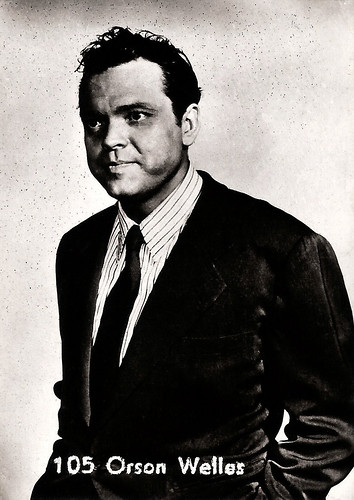
Orson Welles
Small Belgian collectors card by Belgian Chewing Gum Ltd., Antwerp, no. 105.

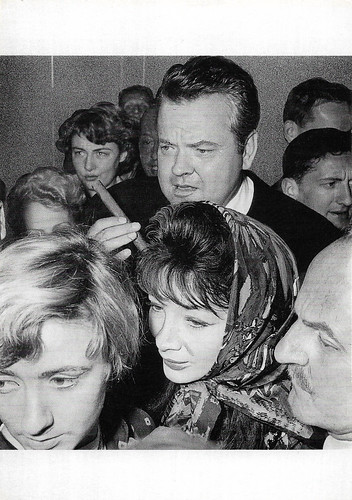
Darryl F. Zanuck, Françoise Sagan, Juliette Greco and Orson Welles
French postcard in the Collection Cinéma by Editions La Malibran, Paris, 1990, no. CF 69. Caption: Orson Welles - Françoise Sagan - Juliette Greco - Daryl Zanuck - Mai 59. On 5 May 1959, Orson Welles was photographed at the Cannes Film Festival with Francoise Sagan, Darryl F. Zanuck and Juliette Greco. Orson Welles's shown film Compulsion' (Richard Fleischers, 1959) scored a great success. Francoise Sagan was said to be negotiating with Zanuck and Welles for a film based on one of her latest novels.

Kafka


In Italy, Orson Welles directed his own scenes as King Saul in David e Golia/David and Goliath (Ferdinando Baldi, Richard Pottier, 1959). In Hong Kong, he co-starred with Curt Jürgens in Ferry to Hong Kong (Lewis Gilbert, 1959). In Paris, he co-starred in Crack in the Mirror (Richard Fleischer, 1960). In Yugoslavia, he starred in I tartari/The Tartars (Richard Thorpe, 1962) and Bitka na Neretvi/Battle of Neretva (Veljko Bulajić, 1969).

In 1962, Welles directed Le Procès/The Trial (Orson Welles, 1962), based on the novel by Franz Kafka and starring Anthony Perkins as Josef K, Jeanne Moreau and Romy Schneider. The film failed at the box office, but during the filming, he met Oja Kodar, who became his muse, star and mistress for the rest of his life.

Welles played a film director in La Ricotta (1963), Pier Paolo Pasolini's segment of the anthology film Ro.Go.Pa.G. He continued taking what work he could find acting, narrating or hosting other people's work, and began filming Campanadas a medianoche/Chimes at Midnight (Orson Welles, 1966). Filmed in Spain, it was a condensation of five Shakespeare plays, telling the story of Falstaff (Welles) and his relationship with Prince Hal (Keith Baxter).

Then followed Histoire immortelle/The Immortal Story (Orson Welles, 1968) with Jeanne Moreau, which had a successful run in French theatres. He appeared as Cardinal Wolsey in A Man for All Seasons (Fred Zinnemann, 1966) for which he won considerable acclaim. Welles began directing The Deep, based on the novel 'Dead Calm' by Charles Williams and filmed off the shore of Yugoslavia. The cast included Jeanne Moreau, Laurence Harvey and Oja Kodar.

Personally financed by Welles and Kodar, they could not obtain the funds to complete the project, and it was abandoned a few years later after the death of Harvey. The surviving footage was eventually edited and released by the Filmmuseum München. In 1969, Welles played a supporting role in John Huston's The Kremlin Letter. Drawn by the numerous offers he received to work in television and films, and upset by a tabloid scandal reporting his affair with Kodar, Welles moved back to America in 1970.

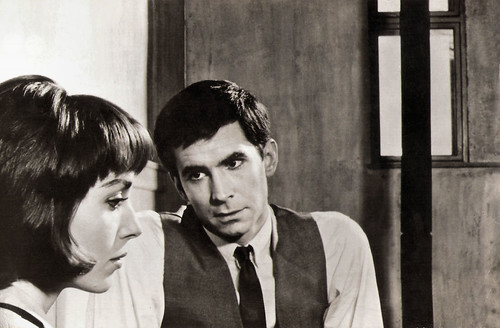
Elsa Martinelli and Anthony Perkins in Le procès (1962)
Romanian postcard by Casa Filmului Acin, no. 470. Photo: Elsa Martinelli and Anthony Perkins in Le procès/The Trial (Orson Welles, 1962). Sent by mail in 1972.

Orson Welles
French postcard by Editions F. Nugeron, no. Star 130. Photo: Air France / Distribution VU. Caption: Orson Wells (sic), Septembre 1967.

The Dreamers


In Hollywood, Orson Welles continued to self-finance his own film and television projects. While offers to act, narrate and host continued, Welles also found himself in great demand on television talk shows. His primary focus during his final years was The Other Side of the Wind, an unfinished project that was filmed intermittently between 1970 and 1976. Written by Welles, it is the story of an ageing film director (John Huston) looking for funds to complete his final film. Financed by Iranian backers, ownership of the film fell into a legal quagmire after the Shah of Iran was deposed, and disputes still prevent its release.

Welles portrayed Louis XVIII of France in Waterloo (Sergey Bondarchuk, 1970), and narrated the historical comedy Start the Revolution Without Me (Bud Yorkin, 1970). He appeared in La décade prodigieuse/Ten Days' Wonder (Claude Chabrol, 1971), co-starring with Anthony Perkins. Wikipedia: “That same year, the Academy of Motion Picture Arts and Sciences gave him an honorary award "For superlative artistry and versatility in the creation of motion pictures". Welles pretended to be out of town and sent John Huston to claim the award. Huston criticised the Academy for awarding Welles, even while they refused to give Welles any work.”

Welles played Long John Silver in Treasure Island (John Hough, 1972), an adaptation of the Robert Louis Stevenson novel. He completed F for Fake (Orson Welles, 1973), a personal essay film about art forger Elmyr de Hory and the biographer Clifford Irving, and his documentary Filming Othello (Orson Welles, 1979).

During the 1980s, Welles worked on such film projects as The Dreamers, based on two stories by Isak Dinesen. His last film appearance was in Henry Jaglom's Someone to Love (1987), released after his death.

Welles had three daughters: Chris Welles Feder (1938), with Virginia Nicholson; Rebecca Welles Manning (1944–2004), with Rita Hayworth; and Beatrice Welles (1955), with Paola Mori. His only known son, British director Michael Lindsay-Hogg (1940), is from Welles's affair with Irish actress Geraldine Fitzgerald, then the wife of Sir Edward Lindsay-Hogg, 4th baronet.

On 10 October 1985, Orson Welles appeared in his final interview on The Merv Griffin Show. He died several hours later of a heart attack at his home in Los Angeles. His estranged wife Paola Mori refused to allow most of Welles's friends to attend the funeral, limiting the mourners to just nine: herself, Welles's three daughters, Roger Hill, and three of Welles's friends, as well as the doctor who had signed Welles's death certificate.

Welles's companion for the last 20 years, Oja Kodar, was not invited, nor were either of his ex-wives. Welles's ashes were taken to Ronda, Spain, where they were buried in an old well covered by flowers, within the rural property of a long-time friend, retired bullfighter Antonio Ordóñez.

Orson Welles in Casino Royale (1967)
French postcard by Delta Productions, Montpellier, no. CP152. Orson Welles in Casino Royale (Val Guest, Ken Hughes, John Huston, 1967).

Orson Welles
American postcard by Fotofolio, New York, N.Y., no. P27. Photo: Timothy Greenfield-Sanders. Caption: Orson Welles, 1979.

Sources: Ed Stephan (IMDb), Wikipedia, and IMDb.
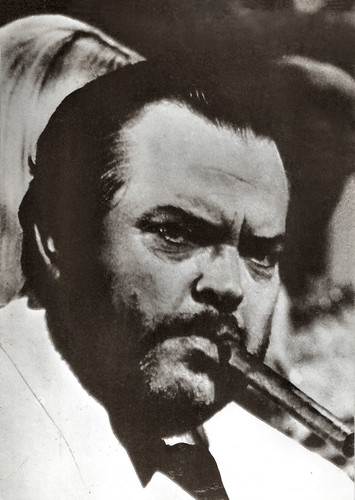
12 October 2013

Imported from the USA: Orson Welles

Today is the final day of Le Giornate del Cinema Muto and of our series of silent stars in honour of David Robinson, the great director of this silent film festival in Pordenone, Italy. The last star in our little silent cinema series is Orson Welles. Why? Last Wednesday, Le Giornate del Cinema Muto presented the world premiere of Too Much Johnson (Orson Welles, 1938), filmed two years before the celebrated American director went to Hollywood to make Citizen Kane (1941). As a member of the Mercury Theatre, Welles created this slapstick short starring Joseph Cotten, for the Theatre’s innovative 1938 production of the 19th-century play by William Gillette. Never finished, the film did not screen publicly and took on legendary status when the single known print reportedly burned. Now after 75 years, the silent comedy was recovered in Italy and finally had its screen debut.

American actor, director, writer and producer Orson Welles (1915-1985) worked in theatre, radio and film, both in the US and in Europe. He is remembered for his innovative work in all three media, most notably Caesar (1937), a ground-breaking Broadway adaptation of Julius Caesar and the debut of the Mercury Theatre; The War of the Worlds (1938), one of the most famous broadcasts in the history of radio; and Citizen Kane (1941), ranked as one of the all-time greatest films. His other films include The Magnificent Ambersons (1942), Touch of Evil (1958) and Le Procès/The Trial (1962).

Orson Welles
French postcard by Editions du Globe, no. 143. Photo: Sam Lévin.

The Hearts of Age


George Orson Welles was born in Kenosha, Wisconsin, in 1915. He was the second son of Beatrice (née Ives) and Richard Hodgdon Head Welles.

In 1919, his parents separated and moved to Chicago. His father, who made a fortune as the inventor of a popular bicycle lamp, became an alcoholic and stopped working. His brother ‘Dickie’ was institutionalized at an early age because he had learning difficulties. Welles's mother, a beautiful concert pianist, had to support her son and herself.

In 1924, Beatrice died of hepatitis in a Chicago hospital, just after Welles's ninth birthday. He was taken in by Dudley Crafts Watson. At the age of ten Orson ran away from home with Watson's third daughter, Marjorie. They were found a week later, singing and dancing for money on a street corner in Milwaukee.

Welles' father died when Orson was 15. Maurice Bernstein, a physician from Chicago, became his guardian. His school teacher Roger Hill provided Welles with an ad hoc educational environment that proved invaluable to his creative experience, allowing Welles to perform and stage theatrical experiments and productions.

Welles was awarded a scholarship to Harvard University, but he chose instead to travel to Europe. In Ireland, he strode into the Gate Theatre in Dublin and claimed he was a Broadway star.

The manager of Gate, Hilton Edwards, was impressed by his brashness and an impassioned quality in his audition. Welles made his stage debut at the Gate in 1931, appearing in Jew Suss as the Duke. He acted to great acclaim, word of which reached the United States.

On returning to the United States he wrote the immensely successful Everybody's Shakespeare. In 1933, he toured in three off-Broadway productions with Katharine Cornell's company, including two roles in Romeo and Juliet. In 1934, he shot his first film, an eight-minute short titled The Hearts of Age, and he married Chicago actress Virginia Nicholson.

By 1935 Welles was supplementing his earnings in the theatre as a radio actor, working with many actors who would later form the core of his Mercury Theatre.

Gate Theater, Dublin
Gate Theatre in 2012. Cavendish Row, Parnell Square, Dublin 1, Ireland.

The Night That Panicked America


In 1936, the Federal Theatre Project (part of Roosevelt's Works Progress Administration) put unemployed theatre performers and employees to work.

Orson Welles was hired by John Houseman and assigned to direct a play for the Federal Theatre Project's Negro Theatre Unit. His production of Macbeth was set in the Haitian court of King Henri Christophe, with voodoo witch doctors for the three Weird Sisters. The play was received rapturously and later toured the nation.

At 20, Welles was hailed as a prodigy. A few minutes of Welles’ ‘Voodoo Macbeth’ was recorded on film in the documentary We Work Again (1937).

Welles rehearsed Marc Blitzstein's political operetta, The Cradle Will Rock, but because of severe federal cutbacks in the Works Progress projects, the show's premiere at the Maxine Elliott Theatre was cancelled.

In a last-minute move, Welles announced to waiting ticket-holders that the show was being transferred to the Venice, twenty blocks away. Some cast, crew and audience members walked the distance on foot. Lacking the participation of the union members, The Cradle Will Rock began with Blitzstein introducing the show and playing the piano accompaniment on stage with some cast members performing from the audience. This impromptu performance was well received and played at the Venice for two more weeks.

Welles and Houseman then formed the Mercury Theatre, of which Welles became executive producer and whose repertory company eventually included the actors Agnes Moorehead, Joseph Cotten, Dolores del Río, Everett Sloane and Erskine Sanford.

The first Mercury Theatre production was William Shakespeare's tragedy Julius Caesar, set in a contemporary frame of fascist Italy. The production was widely acclaimed.

In the second year of the Mercury Theater, Welles shifted his interests to radio. He adapted, directed and played Hamlet for CBS and Les Misérables for Mutual with great success.

CBS gave the Mercury Theatre a weekly hour-long show to broadcast radio plays based on classic literary works.

In 1938, their adaptation of The War of the Worlds by H. G. Wells brought Welles instant fame. The combination of the news bulletin form of the performance with the between-breaks dial spinning habits of listeners from the rival more popular Edgar Bergen/Charlie McCarthy program was later reported in the media to have created widespread confusion.

Wikipedia: “Panic was reportedly spread among listeners who believed the news reports of a Martian invasion. The myth of the result created by the combination was reported as fact around the world and disparagingly mentioned by Adolf Hitler in a public speech some months later. The 1975 docudrama The Night That Panicked America was based on events centering on the production of, and events that resulted from the program.”

Dolores del Rio
Dolores del Río. German postcard by Ross Verlag, no. 3905/2, 1928-1929. Photo: Fox.

The Attempted Suppression Of Citizen Kane


Orson Welles's growing fame drew Hollywood offers, lures that the independent-minded Welles resisted at first. RKO Radio Pictures president George Schaefer eventually offered him complete artistic control and signed Welles in a two-picture deal, although Welles had a budget limit for his projects.

In Hollywood, Welles toyed with various ideas for his first project. RKO rejected Welles's first two movie proposals, but agreed on the third offer, Citizen Kane (1941), for which Welles co-wrote, produced, directed and performed the lead role.

Co-scriptwriter Joseph Mankiewicz based the original outline on an exposé of the life of William Randolph Hearst, whom he knew socially and came to hate, having once been great friends with Hearst's mistress, Marion Davies.

However, Kane's megalomania was modelled loosely on Robert McCormick, Howard Hughes and Joseph Pulitzer as Welles wanted to create a broad, complex character, intending to show him in the same scenes from several points of view.

On Welles's instruction, John Houseman wrote the opening narration as a pastiche of The March of Time newsreels.

Autobiographical allusions to Welles were worked in, most noticeably in the treatment of Kane's childhood and particularly, regarding his guardianship.

Once the script was complete, Welles attracted cinematographer Gregg Toland, and actors from his Mercury Theatre.

After gossip columnist Hedda Hopper saw a preview screening of Citizen Kane, the attempted suppression of Citizen Kane started. Hearst's media outlets boycotted the film. They exerted enormous pressure on Hollywood, but RKO gave the film a limited release.

The film was well-received critically, and garnered nine Academy Award nominations. Welles was nominated as a producer, director, writer and actor, but won only for Best Original Screenplay, shared with Mankiewicz.

Today, the film is considered by most film critics and historians to be one of the classics in film history.

Marlene Dietrich
Marlene Dietrich. Small German collector's card by Ross Verlag. Photo: Paramount.

Journey Into Fear


Orson Welles's second film for RKO was The Magnificent Ambersons (1942), adapted from the Pulitzer Prize-winning novel by Booth Tarkington.

At RKO's request, Welles worked also on an adaptation of Eric Ambler's spy thriller, Marlene Dietrich (Norman Foster, 1943), co-written with Joseph Cotten. In addition to acting in the film, Welles was the producer.

Changes throughout RKO caused re-evaluations of both projects. RKO took control of The Magnificent Ambersons, and ordered to edit the film into a ‘commercial’ format. They removed fifty minutes of Welles's footage, re-shot sequences, rearranged the scene order, and added a happy ending.

It resulted in an expensive flop for RKO, although The Magnificent Ambersons received four Academy Award nominations including Best Picture and Best Supporting Actress for Agnes Moorehead.

Welles found no studios interested in him as a director after the disaster of The Magnificent Ambersons and worked on radio.

In 1943, he married Rita Hayworth. They had one child, Rebecca Welles, and divorced five years later in 1948.

In between, Welles found work as an actor in other films. He starred in the film adaptation of Jane Eyre (Robert Stevenson, 1944), trading credit as associate producer for top billing over Joan Fontaine.

He had a cameo in the wartime salute Follow the Boys (A. Edward Sutherland, 1944), in which he performed his magic act ‘sawing’ Marlene Dietrich in half.

In 1946, Sam Spiegel produced The Stranger (Orson Welles, 1946), starring Edward G. Robinson, Loretta Young and Welles. The film follows the hunt for a Nazi war criminal living under an alias in the United States. Although disputes occurred during editing between Spiegel and Welles, the film was a box office success and it helped his standing with the studios.

He then filmed The Lady from Shanghai (Orson Welles, 1947) for Columbia Pictures, in which his then-estranged second wife Rita Hayworth co-starred.

Cohn disliked Welles's rough-cut, and ordered extensive editing and re-shoots. Approximately one hour of Welles's first cut was removed, including much of a climactic confrontation scene in an amusement park funhouse. The film was considered a disaster in America at the time of release, though the closing shootout in a hall of mirrors has since become a touchstone of film noir.

Welles convinced Republic Pictures to let him direct a low-budget version of Macbeth (Orson Welles, 1948). Republic initially trumpeted the film as an important work but decided it did not care for the Scottish accents and held up general release for almost a year after early negative press reaction.

In the late 1970s, a fully restored version of Macbeth was released that followed Welles's original vision.

Orson Welles, Loretta Young
Dutch postcard by S. & v. H. A. Photo: M.P.E.A. Publicity still for The Stranger (Orson Welles, 1946) with Loretta Young.

Harry Lime


Orson Welles left Hollywood for Europe. In Italy he starred as Cagliostro in Black Magic (Gregory Ratoff, 1948) with Akim Tamiroff. His co-star impressed Welles so much that Tamiroff would appear in four of Welles's later productions.

Welles starred as Harry Lime in Carol Reed's The Third Man (1949), alongside Joseph Cotten. The film was an international smash hit.

Welles also appeared as Cesare Borgia in the Italian film Prince of Foxes (Henry King, 1949), and as the Mongol warrior Bayan in The Black Rose (Henry Hathaway, 1950), both with Tyrone Power.

Welles was channelling his money from acting jobs into a self-financed film version of Shakespeare's play Othello. From 1949 to 1951, Welles filmed Othello (1952) on location in Europe and Morocco. Suzanne Cloutier co-starred as Desdemona.

When Othello premiered at the Cannes Film Festival it won the Palme d'Or, but the film did not receive a general release in the United States until 1955. Welles's daughter, Beatrice Welles-Smith, restored Othello in 1992 for a wide re-release.

Welles played the murdered victim in Trent's Last Case (Herbert Wilcox, 1952) and the title role in the 'Lord Mountdrago' segment of Three Cases of Murder (George More O'Ferrall, 1954). Herbert Wilcox also cast Welles as the antagonist in Trouble in the Glen (1954) opposite Margaret Lockwood, and John Huston cast him as Father Mapple in Moby-Dick (1956), starring Gregory Peck.

His next turn as director was Mr. Arkadin (Orson Welles, 1955), filmed in France, Germany, Spain and Italy on a very limited budget.

Welles played a billionaire who hires a man (Robert Arden) to delve into the secrets of his past. The film co-starred Welles's third wife, Paola Mori.

Frustrated by his slow progress in the editing room, producer Louis Dolivet removed Welles from the project and finished the film without him as Confidential Report.

In 1956, Welles returned to Hollywood and guest starred on radio and television shows. His next film role was in Man in the Shadow (Jack Arnold, 1957) for Universal Pictures, starring Jeff Chandler.

Around this time period Welles began to suffer from weight problems that would eventually cause a deterioration in his health.

Welles stayed on at Universal to co-star with Charlton Heston in Touch of Evil (Orson Welles, 1958). Originally only hired as an actor, Welles was promoted to director by Universal at the insistence of Heston.

He reunited with many actors and technicians with whom he had worked in the 1940s including Joseph Cotten, Marlene Dietrich and Akim Tamiroff.

Filming proceeded smoothly, but after the end of production, the studio re-edited the film, re-shot scenes, and shot new exposition scenes to clarify the plot. In 1978, a longer preview version of the film was discovered and released.

Next, Welles filmed his adaptation of Miguel de Cervantes' novel Don Quixote in Mexico, starring Mischa Auer as Quixote and Akim Tamiroff as Sancho Panza. While filming would continue in fits and starts for several years, Welles would never complete the project.

Welles continued acting, notably in The Long, Hot Summer (Marin Ritt, 1958) with Paul Newman, and Compulsion (Richard Fleischer, 1959), but soon he returned to Europe.

Paul Newman
Paul Newman. German postcard by Krüger, no. 902/261.

The Trial


In Italy, Orson Welles directed his own scenes as King Saul in David e Golia/David and Goliath (Ferdinando Baldi, Richard Pottier, 1959).

In Hong Kong he co-starred with Curd Jürgens in Ferry to Hong Kong (Lewis Gilbert, 1959).

In Paris he co-starred in Crack in the Mirror (Richard Fleischer, 1960).

In Yugoslavia he starred in I tartari/The Tartars (Richard Thorpe, 1962) and Bitka na Neretvi/Battle of Neretva (Veljko Bulajić, 1969).

In 1962, Welles directed Le Procès/The Trial (Orson Welles, 1962), based on the novel by Franz Kafka and starring Anthony Perkins as Josef K, Jeanne Moreau and Romy Schneider.

The film failed at the box-office, but during the filming, he met Oja Kodar, who became his muse, star and mistress for the rest of his life.

Welles played a film director in La Ricotta (1963) — Pier Paolo Pasolini's segment of the anthology film Ro.Go.Pa.G.

He continued taking what work he could find acting, narrating or hosting other people's work, and began filming Campanadas a medianoche/Chimes at Midnight (Orson Welles, 1966). Filmed in Spain, it was a condensation of five Shakespeare plays, telling the story of Falstaff (Welles) and his relationship with Prince Hal (Keith Baxter).

Then followed Histoire immortelle/The Immortal Story (Orson Welles, 1968) with Jeanne Moreau, which had a successful run in French theatres.

He appeared as Cardinal Wolsey in A Man for All Seasons (Fred Zinnemann, 1966) for which he won considerable acclaim.

Welles began directing The Deep, based on the novel Dead Calm by Charles Williams and filmed off the shore of Yugoslavia. The cast included Jeanne Moreau, Laurence Harvey and Oja Kodar.

Personally financed by Welles and Kodar, they could not obtain the funds to complete the project, and it was abandoned a few years later after the death of Harvey. The surviving footage was eventually edited and released by the Filmmuseum München.

In 1969, Welles played a supporting role in John Huston's The Kremlin Letter.

Drawn by the numerous offers he received to work in television and films, and upset by a tabloid scandal reporting his affair with Kodar, Welles moved back to America in 1970.

Jeanne Moreau
Jeanne Moreau. French postcard by E.D.U.G., no. 275. Offered by Corvisart, Epinal. Photo: Sam Lévin.

The Other Side of the Wind


In Hollywood, Orson Welles continued to self-finance his own film and television projects. While offers to act, narrate and host continued, Welles also found himself in great demand on television talk shows.

His primary focus during his final years was The Other Side of the Wind, an unfinished project that was filmed intermittently between 1970 and 1976. Written by Welles, it is the story of an aging film director (John Huston) looking for funds to complete his final film.

Financed by Iranian backers, ownership of the film fell into a legal quagmire after the Shah of Iran was deposed, and disputes still prevent its release.

Welles portrayed Louis XVIII of France in Waterloo (Sergei Bondarchuk, 1970), and narrated the historical comedy Start the Revolution Without Me (Bud Yorkin, 1970).

He appeared in La décade prodigieuse/Ten Days' Wonder (Claude Chabrol, 1971), co-starring with Anthony Perkins.

Wikipedia: “That same year, the Academy of Motion Picture Arts and Sciences gave him an honorary award "For superlative artistry and versatility in the creation of motion pictures". Welles pretended to be out of town and sent John Huston to claim the award. Huston criticized the Academy for awarding Welles, even while they refused to give Welles any work.”

Welles played Long John Silver in Treasure Island (John Hough, 1972), an adaptation of the Robert Louis Stevenson novel.

He completed F for Fake (Orson Welles, 1973), a personal essay film about art forger Elmyr de Hory and the biographer Clifford Irving, and his documentary Filming Othello (Orson Welles, 1979).

During the 1980s, Welles worked on such film projects as The Dreamers, based on two stories by Isak Dinesen.

His last film appearance was in Henry Jaglom's Someone to Love (1987), released after his death.

Welles had three daughters: Chris Welles Feder (1938), with Virginia Nicholson; Rebecca Welles Manning (1944–2004), with Rita Hayworth; and Beatrice Welles (1955), with Paola Mori. His only known son, British director Michael Lindsay-Hogg (1940), is from Welles's affair with Irish actress Geraldine Fitzgerald, then the wife of Sir Edward Lindsay-Hogg, 4th baronet.

On 10 October 1985, Orson Welles appeared on his final interview on The Merv Griffin Show. He died several hours later of a heart attack at his home in Los Angeles.

His estranged wife Paola Mori refused to allow most of Welles's friends to attend the funeral, limiting the mourners to just nine: herself, Welles's three daughters, his old teacher Roger Hill and three of Welles's friends, as well as the doctor who had signed Welles's death certificate.

Welles's companion for the last 20 years, Oja Kodar, was not invited, nor were either of his ex-wives.

Welles's ashes were taken to Ronda, Spain, where they were buried in an old well covered by flowers, within the rural property of a long-time friend, retired bullfighter Antonio Ordóñez.


Trailer for Citizen Kane (1941). Source: Agelesstrailers (YouTube).


Trailer for Touch of Evil (1958). Source: Oldhollywoodtrailers (YouTube).


Trailer for Le Procès/The Trial (1962). Source: Alessio Franco (YouTube).

This was the eighth episode of 'Imported from the USA'. Earlier episodes were dedicated to Jayne Mansfield, Josephine Baker, Lex Barker, Anna May Wong, Carroll Baker, Farley Granger, and Louise Brooks.

Sources: Ed Stephan (IMDb), Wikipedia, and IMDb.