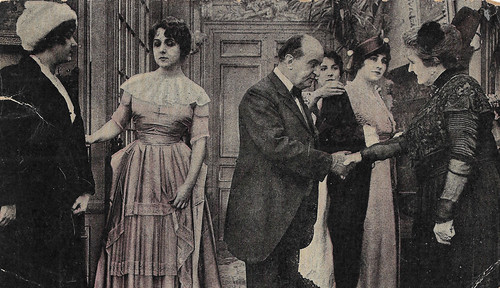
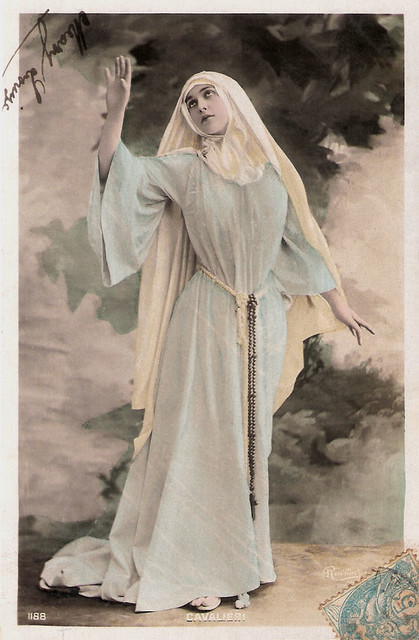
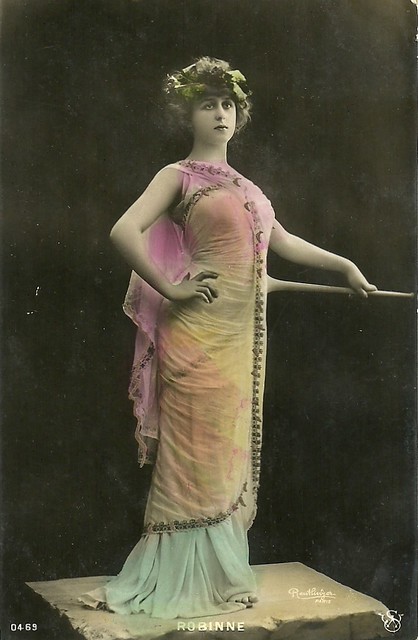
Comédie Française actress Gabrielle Robinne (1886-1980) was one of the first French film stars. The peak of her film career was in the 1910s when she starred in mundane and romantic dramas by Pathé. With her blond hair, passionate eyes and elegant posture, she was the perfect ‘femme du monde’.
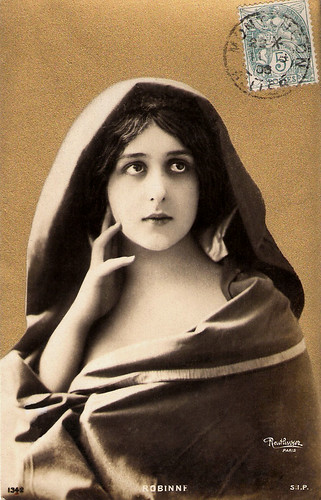
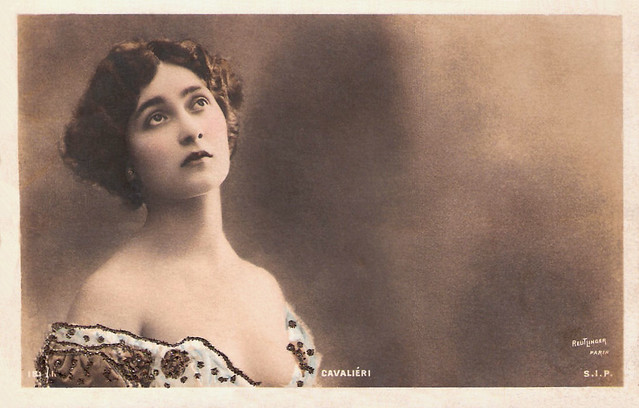
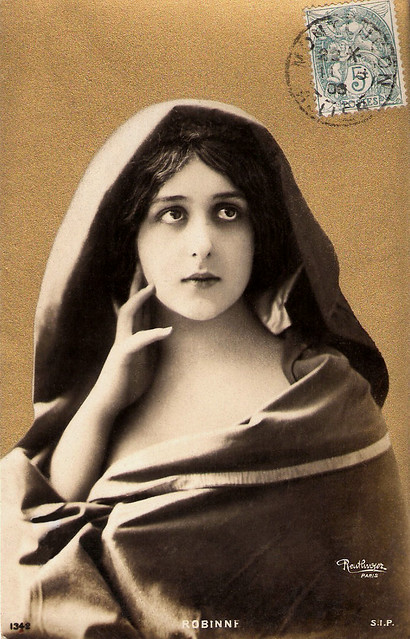
French postcard by S.I.P., no. 1342. Sent by mail in 1906. Photo: Reutlinger, Paris.
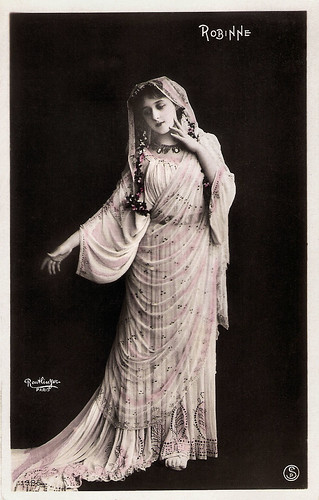
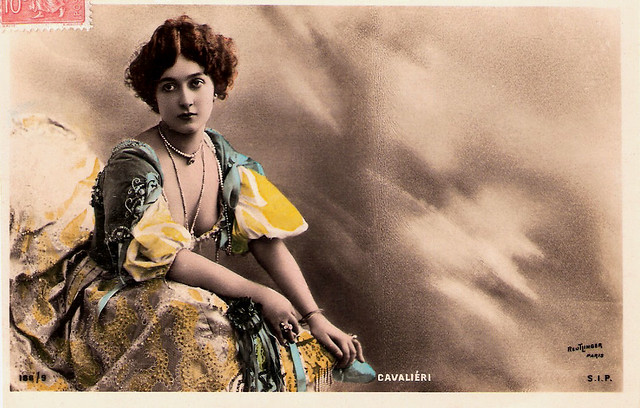
French postcard by SIP, no. 1385. Photo: Reutlinger.
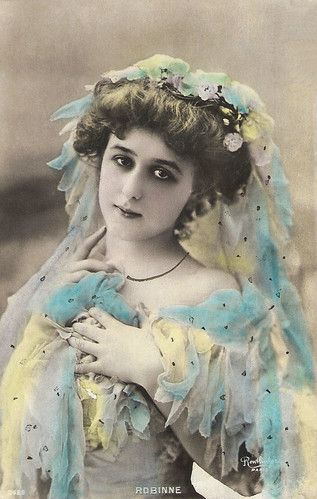
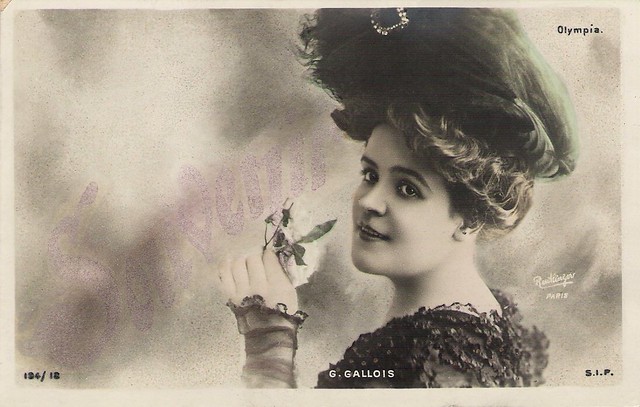
French postcard, no. 0489. Photo: Reutlinger.
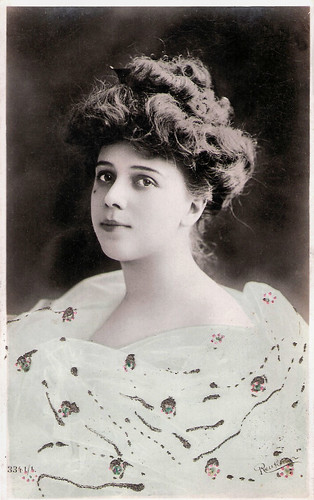
French postcard, no. 3341/1. Photo: Reutlinger.
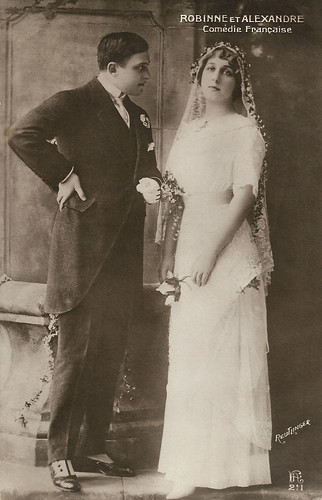
Robinne and Alexandre. French postcard by FA, no. 2:1. Photo: Reutlinger. Caption: Comédie-Française.

French postcard by Edition Pathé Frères. Photo: Félix. Caption: Mlle Robinne de la Comédie Française.
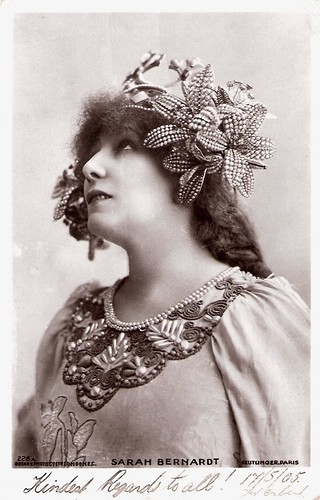
Robinne was born Gabrielle Anna Charlotte Robinne in Montluçon, France, in 1886. She was a pupil of Maurice de Féraudy at the Paris Conservatory and won the first prize at her exams. She entered the company of Sarah Bernhardt in 1904, and for a year she joined the Theatre Michel in St. Petersburg.
Robinne entered the Comédie-Française in 1907. She became a ‘societaire’ in 1924, and stayed there until 1938. In addition to her beauty, her versatility made her one of the most active and popular actresses on the French stage and screen. She was, in fact, one of the first film actresses in France, already performing in the Pathé Frères short Le troubadour / The Troubadour (Segundo de Chomón, 1906). Better remembered is that she played marchioness de Noirmontier, the mistress of the Duke (Charles LeBargy), in L’Assassinat du Duc de Guise / The Assassination of the Duke de Guise (André Calmettes, 1908).
While her roles until 1912 in short films by directors such as Albert Capellani, Georges Monca and Jean Kemm and produced by SCAGL were still few, her film performances greatly intensified in 1912. That year Robinne married the handsome actor René Alexandre. They formed a golden couple and played for years in countless films directed by René Leprince and Ferdinand Zecca, all Pathé productions, and often with Gabriel Signoret as antagonist.
Examples are Le roi de bagne / The King of the Prison (1913) with Stacia Napierkowska, La comtesse noire / The Black Countess (René Leprince, Ferdinand Zecca, 1913), La reine de Saba / The Queen of Saba (Henri Andréani, 1914), La jolie Bretonne / The Constancy of Jeanne (1914) and La lutte pour la vie / Struggle for Life (René Leprince, Ferdinand Zecca, 1914).
Robinne showed her artistic capacities best in mundane and romantic dramas, often situated in well-constructed pasts. With her blond hair, her fine traits, her slender body, passionate eyes and her elegant posture, she was the perfect embodiment of the ‘femme du monde’, to whom audiences flocked in cinemas and theatres. The Robinne-Alexandre films were so popular that Comédie Française administrator Albert Carré tried to bar his performers from playing in films – of course he didn’t manage.
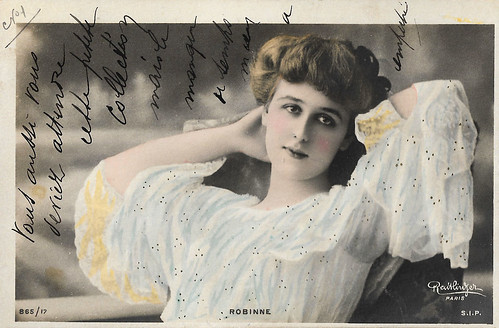
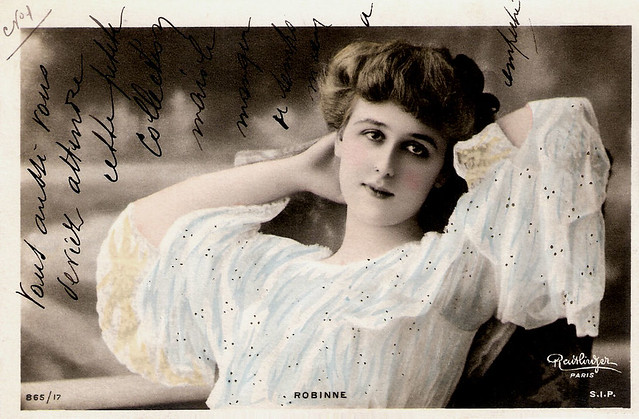
French postcard by S.I.P., no. 865/17. Sent by mail in 1904. Photo: Reutlinger, Paris.
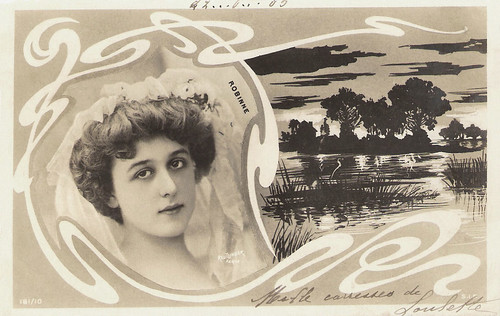
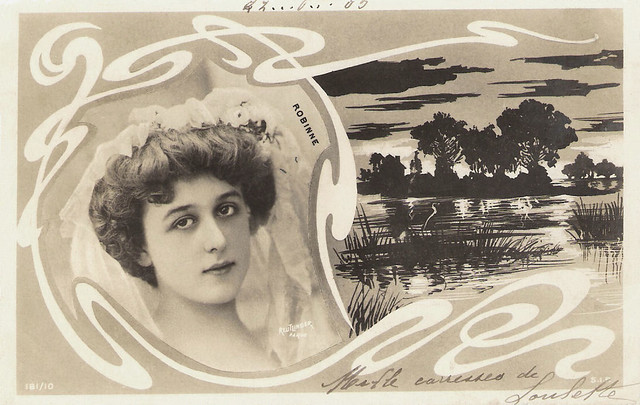
French postcard, no. 181/10. Sent by mail in 1903. Photo: Reutlinger.
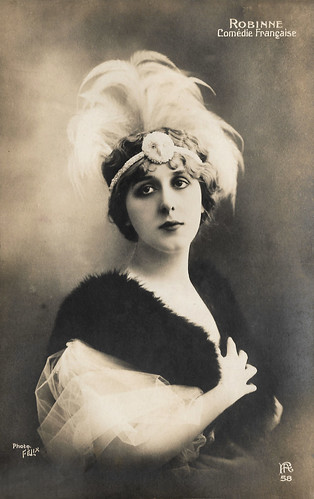
French postcard by FA, no. 58. Photo: Félix, Paris. Caption: Comédie-Française.
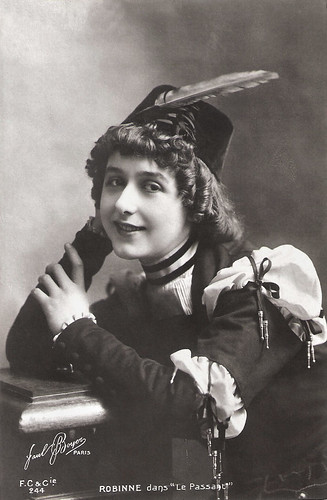
French postcard by F.C. & Cie, no. 244. Photo: Paul Boyer, Paris. Publicity still for the stage play 'Le Passant' by François Coppée (1869). Robinne played the role of Zanetto in travesty.
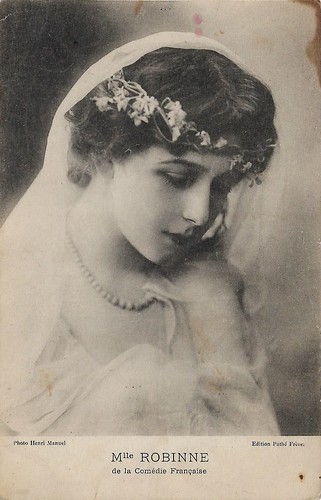
French postcard by Edition Pathé Frères. Photo: Henri Manuel. Caption: Mlle Robinne de la Comédie Française.

French collector card (big format) by Pathé Frères. Maria Fromet, Gabrielle Robinne, Eva Raynal and Jean Kemm in Le foyer perdu / The Lost Hearth (N.N., 1911), scripted by Gustave Grillet.

Spanish collector card by Reclam Films, Mallorca, card 4 of 6. Photo: Pathé Frères. Jean Dax, Gabriel Signoret, Gabrielle Robinne and René Alexandre in Le roi du bagne / The King of the Prison (René Leprince, 1913).

Spanish collector card by Reclam Films, Mallorca, card 1 of 6. Photo: Pathé Frères. Gabriel Signoret and Gabrielle Robinne Les larmes du pardon / Tears of Forgiveness (René Leprince, Ferdinand Zecca, 1914).

Spanish collector card by Chocolate Salas, Sabadell, card 6 of 6. Photo: Pathé Frères. Louis Gauthier and Gabrielle Robinne in Un million de dot / A Dowery of a Million (N.N., 1916), based on the novel 'Le Marchepied' by Daniel Riche.

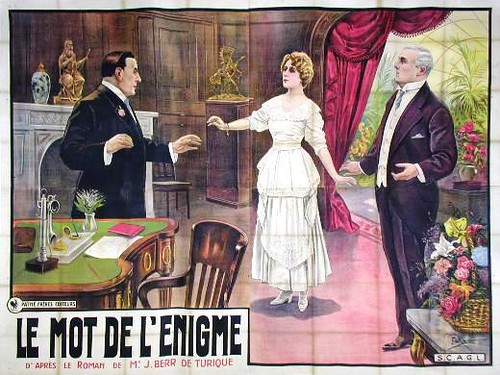
Spanish collector card by Chocolate Salas-Sabadell, card. 3 of 6. Photo: Pathé Frères. Gabrielle Robinne, Andrée Pascal and Henri Bosc in Le mot de l'énigme / The Key to the Mystery (Georges Monca, 1916). The Spanish title for the film was Celos mortales (Mortal skies).
In 1915, Robinne traded René Leprince for Georges Monca as her regular director. Between 1915 and 1917, Monca shot many films with Robinne – without Alexandre, but instead with actors like Jean Kemm and Georges Tréville. Examples are Le mot d’énigme / The Key to the Mystery (Georges Monca, 1915) and Blessure d’amour / Wound of Love (Georges Monca, 1916). Between 1917 and 1919, Robinne performed in films by various directors, such as the mystery Le dédale / The Labyrinth (Jean Kemm, 1917) and L'expiation / The Expiation (Camille de Morlhon, 1919) with Jean Angelo.
In the 1920s, she hardly played in films and focused on her stage work. Still, she had occasional leads such as in Destinée / Fate (Gaston Mouru de Lacotte, Armand Plessy, 1922), Fleur du mal / Flower of Evil (Gaston Mouru de Lacotte, 1923) and Molière, sa vie et son œuvre / Molière, His Life and His Work (Jacques de Féraudy, 1922). In the latter two films, Robinne was reunited with Alexandre. She also played a smaller part in Lucile (Georges Monca, 1927), but then disappeared from the screen for years.
It was only in the mid-1930s that Robinne returned in a short film directed by Léonce Perret, aptly titled Un soir à la Comédie Française / A Night at the Comédie Française (1934). In the late 1930s, when she left the Comédie-Française, Robinne played the tsarina-mother in the costume drama La tragédie impériale / The Imperial Tragedy (Marcel L'Herbier, 1938), about the Siberian monk Gregory Rasputin (Harry Baur) and the hold he exerted over the court of the last Russian czar, Nicholas II (Jean Worms). Again for Marcel L'Herbier, she played Duclos opposite Yvonne Printemps in the title role of Adrienne Lecouvreur (Marcel L'Herbier, 1939) based on the play by Ernest Legouve and Eugène Scribe. She also played in G.W. Pabst’s Jeunes filles en détresse / Girls in Distress (Georg Wilhelm Pabst, 1939) featuring Micheline Presle.
In the immediate postwar years, Robinne had small parts in Le capitan / The Captain (Robert Vernay, 1946), Rendez-vous à Paris / Rendezvous in Paris (Gilles Grangier, 1947) with Annie Ducaux, and Hymenée / Marriage (Emile Couzinet, 1947) with Gaby Morlay. Robinne’s last film performances were in La prostitution / Prostitution (Maurice Boutel, 1962) starring Etchika Choureau, and Le journal d’un suicide / Diary of a Suicide (Stanislas Stanojevic, 1973) with Delphine Seyrig. Gabrielle Robinne was decorated as an Officier (officer) in the Légion d'honneur (Legion of Honour). In October 1980, a restored version of L’Assassinat du Duc de Guise (1908) was shown in the old auditorium of the Palais des Arts, accompanied by the original music by Saint-Saëns. ‘Tout Paris’ was present, a crowd of film directors, actors, and critics.
A few moments before the lights went out, an announcement was made that 'Madame Robinne, de la Comédie-Française' was present as well. A standing ovation was given to the grand old lady. Leaning on a stick but with a proud look, she was clearly moved. The 94-year-old Gabrielle Robinne had come to see her (almost) first film in which she had played 72 years before. A few days later, she died in Saint-Cloud. In her natal village, Montluçon, the local theatre was named after her in 2006. The theatre had been opened in 1914, with Robinne present.
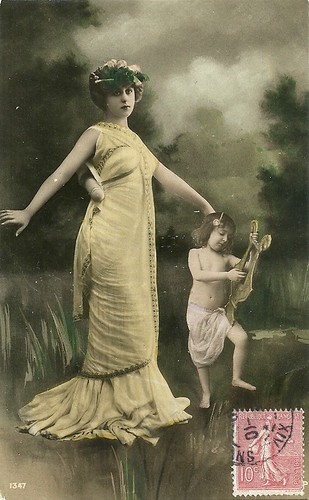
French postcard.
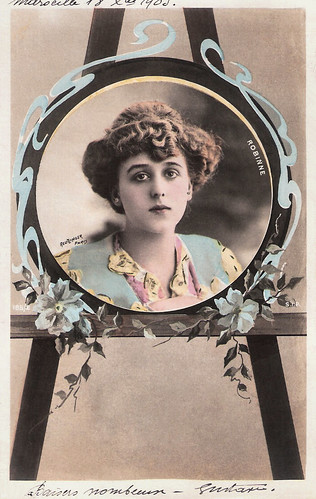
French postcard by S.I.P. no. 185/2. Photo: Reutlinger. Sent by mail in 1905.
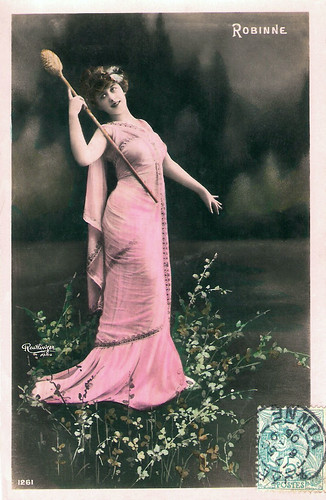
French postcard, no. 1261. Sent by mail in 1905. Photo: Reutlinger, Paris.

French postcard by S.I.P., no. 1187. Photo: Leopold Reutlinger, Paris.

French postcard by S.I.P., no. 1282. Photo: Leopold Reutlinger, Paris. Coloured stones are attached to the card. The card was mailed in 1908.
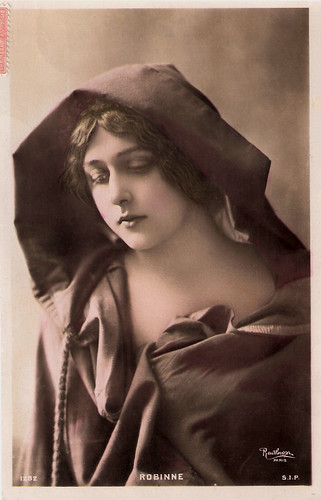
French postcard by S.I.P., no. 1282. Photo: Reutlinger.
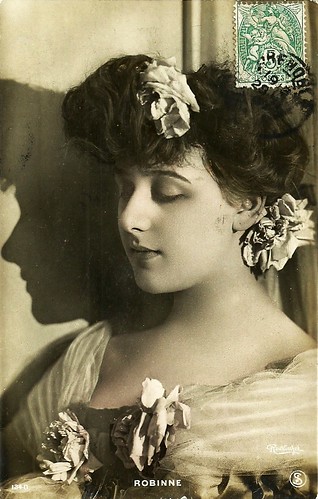
French postcard by S.I.P., no. 1348. Photo: Reutlinger.
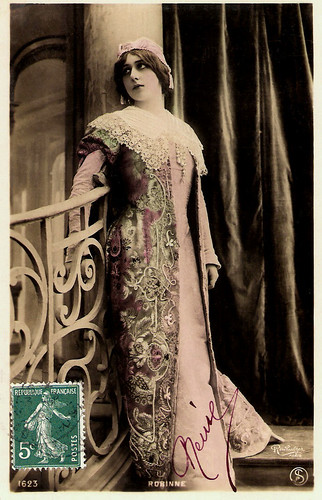
French postcard by S.I.P., no. 1623. Sent by mail in 1908. Photo: Reutlinger.
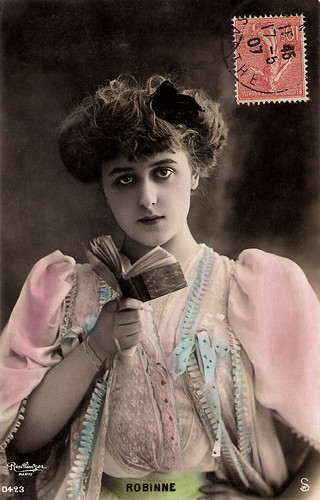
French postcard by SW, no. 0423. Sent by mail in 1907. Photo: Reutlinger.
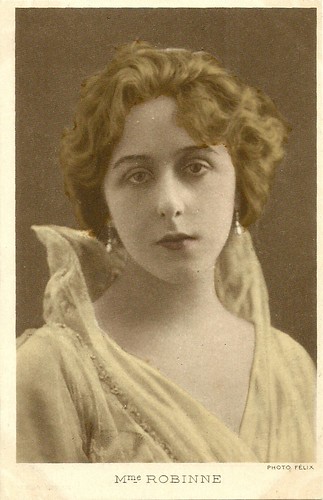
French postcard. Photo Félix.
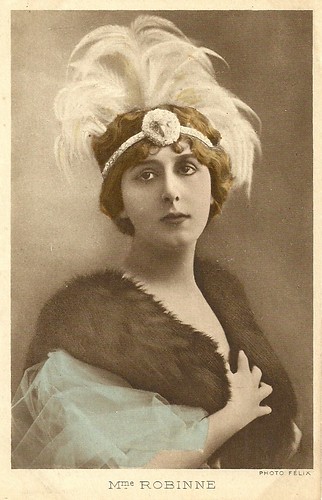
French postcard. Photo Félix.

French postcard. Photo Félix.
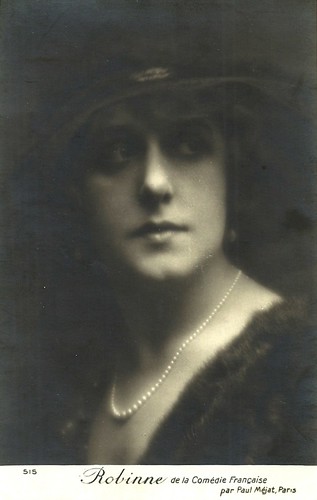
French postcard, no. 515. Photo Paul Méjat, Paris.
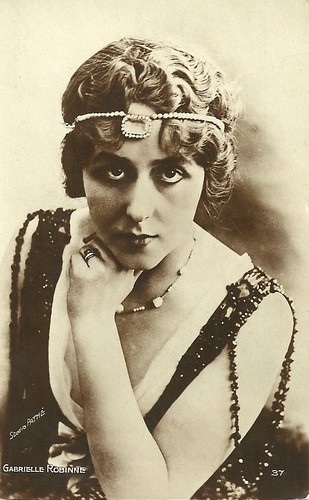
French postcard by Edition Cinémagazine, no. 32. Photo: Studio Pathé.
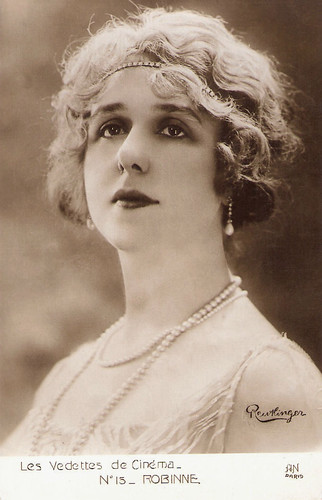
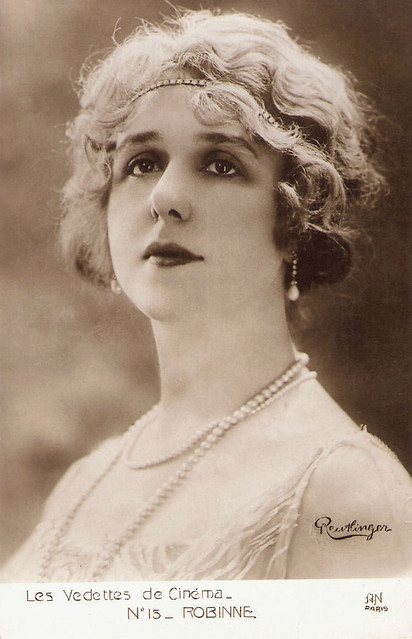
French postcard by A.N., Paris, in the series Les Vedettes du Cinéma, no. 13. Photo: Reutlinger.
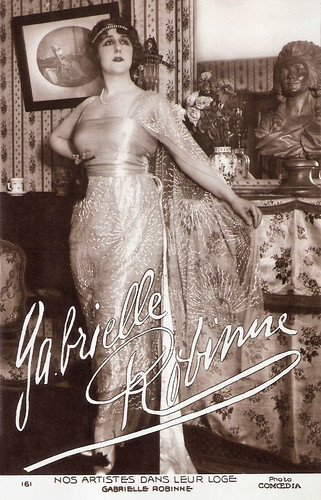
French postcard in the Nos Artistes dans leur loge series, no. 161. Photo: Comoedia.
Sources: Vittorio Martinelli (Le dive del silenzio - Italian), Wikipedia (French and German), and IMDb.
This post was last updated on 19 August 2026.
French postcard by S.I.P., no. 1342. Sent by mail in 1906. Photo: Reutlinger, Paris.
French postcard by SIP, no. 1385. Photo: Reutlinger.
French postcard, no. 0489. Photo: Reutlinger.
French postcard, no. 3341/1. Photo: Reutlinger.
Robinne and Alexandre. French postcard by FA, no. 2:1. Photo: Reutlinger. Caption: Comédie-Française.
French postcard by Edition Pathé Frères. Photo: Félix. Caption: Mlle Robinne de la Comédie Française.
Passionate eyes
Robinne was born Gabrielle Anna Charlotte Robinne in Montluçon, France, in 1886. She was a pupil of Maurice de Féraudy at the Paris Conservatory and won the first prize at her exams. She entered the company of Sarah Bernhardt in 1904, and for a year she joined the Theatre Michel in St. Petersburg.
Robinne entered the Comédie-Française in 1907. She became a ‘societaire’ in 1924, and stayed there until 1938. In addition to her beauty, her versatility made her one of the most active and popular actresses on the French stage and screen. She was, in fact, one of the first film actresses in France, already performing in the Pathé Frères short Le troubadour / The Troubadour (Segundo de Chomón, 1906). Better remembered is that she played marchioness de Noirmontier, the mistress of the Duke (Charles LeBargy), in L’Assassinat du Duc de Guise / The Assassination of the Duke de Guise (André Calmettes, 1908).
While her roles until 1912 in short films by directors such as Albert Capellani, Georges Monca and Jean Kemm and produced by SCAGL were still few, her film performances greatly intensified in 1912. That year Robinne married the handsome actor René Alexandre. They formed a golden couple and played for years in countless films directed by René Leprince and Ferdinand Zecca, all Pathé productions, and often with Gabriel Signoret as antagonist.
Examples are Le roi de bagne / The King of the Prison (1913) with Stacia Napierkowska, La comtesse noire / The Black Countess (René Leprince, Ferdinand Zecca, 1913), La reine de Saba / The Queen of Saba (Henri Andréani, 1914), La jolie Bretonne / The Constancy of Jeanne (1914) and La lutte pour la vie / Struggle for Life (René Leprince, Ferdinand Zecca, 1914).
Robinne showed her artistic capacities best in mundane and romantic dramas, often situated in well-constructed pasts. With her blond hair, her fine traits, her slender body, passionate eyes and her elegant posture, she was the perfect embodiment of the ‘femme du monde’, to whom audiences flocked in cinemas and theatres. The Robinne-Alexandre films were so popular that Comédie Française administrator Albert Carré tried to bar his performers from playing in films – of course he didn’t manage.
French postcard by S.I.P., no. 865/17. Sent by mail in 1904. Photo: Reutlinger, Paris.
French postcard, no. 181/10. Sent by mail in 1903. Photo: Reutlinger.
French postcard by FA, no. 58. Photo: Félix, Paris. Caption: Comédie-Française.
French postcard by F.C. & Cie, no. 244. Photo: Paul Boyer, Paris. Publicity still for the stage play 'Le Passant' by François Coppée (1869). Robinne played the role of Zanetto in travesty.
French postcard by Edition Pathé Frères. Photo: Henri Manuel. Caption: Mlle Robinne de la Comédie Française.
French collector card (big format) by Pathé Frères. Maria Fromet, Gabrielle Robinne, Eva Raynal and Jean Kemm in Le foyer perdu / The Lost Hearth (N.N., 1911), scripted by Gustave Grillet.
Spanish collector card by Reclam Films, Mallorca, card 4 of 6. Photo: Pathé Frères. Jean Dax, Gabriel Signoret, Gabrielle Robinne and René Alexandre in Le roi du bagne / The King of the Prison (René Leprince, 1913).
Spanish collector card by Reclam Films, Mallorca, card 1 of 6. Photo: Pathé Frères. Gabriel Signoret and Gabrielle Robinne Les larmes du pardon / Tears of Forgiveness (René Leprince, Ferdinand Zecca, 1914).
Spanish collector card by Chocolate Salas, Sabadell, card 6 of 6. Photo: Pathé Frères. Louis Gauthier and Gabrielle Robinne in Un million de dot / A Dowery of a Million (N.N., 1916), based on the novel 'Le Marchepied' by Daniel Riche.
Spanish collector card by Chocolate Salas-Sabadell, card. 3 of 6. Photo: Pathé Frères. Gabrielle Robinne, Andrée Pascal and Henri Bosc in Le mot de l'énigme / The Key to the Mystery (Georges Monca, 1916). The Spanish title for the film was Celos mortales (Mortal skies).
Grand old lady
In 1915, Robinne traded René Leprince for Georges Monca as her regular director. Between 1915 and 1917, Monca shot many films with Robinne – without Alexandre, but instead with actors like Jean Kemm and Georges Tréville. Examples are Le mot d’énigme / The Key to the Mystery (Georges Monca, 1915) and Blessure d’amour / Wound of Love (Georges Monca, 1916). Between 1917 and 1919, Robinne performed in films by various directors, such as the mystery Le dédale / The Labyrinth (Jean Kemm, 1917) and L'expiation / The Expiation (Camille de Morlhon, 1919) with Jean Angelo.
In the 1920s, she hardly played in films and focused on her stage work. Still, she had occasional leads such as in Destinée / Fate (Gaston Mouru de Lacotte, Armand Plessy, 1922), Fleur du mal / Flower of Evil (Gaston Mouru de Lacotte, 1923) and Molière, sa vie et son œuvre / Molière, His Life and His Work (Jacques de Féraudy, 1922). In the latter two films, Robinne was reunited with Alexandre. She also played a smaller part in Lucile (Georges Monca, 1927), but then disappeared from the screen for years.
It was only in the mid-1930s that Robinne returned in a short film directed by Léonce Perret, aptly titled Un soir à la Comédie Française / A Night at the Comédie Française (1934). In the late 1930s, when she left the Comédie-Française, Robinne played the tsarina-mother in the costume drama La tragédie impériale / The Imperial Tragedy (Marcel L'Herbier, 1938), about the Siberian monk Gregory Rasputin (Harry Baur) and the hold he exerted over the court of the last Russian czar, Nicholas II (Jean Worms). Again for Marcel L'Herbier, she played Duclos opposite Yvonne Printemps in the title role of Adrienne Lecouvreur (Marcel L'Herbier, 1939) based on the play by Ernest Legouve and Eugène Scribe. She also played in G.W. Pabst’s Jeunes filles en détresse / Girls in Distress (Georg Wilhelm Pabst, 1939) featuring Micheline Presle.
In the immediate postwar years, Robinne had small parts in Le capitan / The Captain (Robert Vernay, 1946), Rendez-vous à Paris / Rendezvous in Paris (Gilles Grangier, 1947) with Annie Ducaux, and Hymenée / Marriage (Emile Couzinet, 1947) with Gaby Morlay. Robinne’s last film performances were in La prostitution / Prostitution (Maurice Boutel, 1962) starring Etchika Choureau, and Le journal d’un suicide / Diary of a Suicide (Stanislas Stanojevic, 1973) with Delphine Seyrig. Gabrielle Robinne was decorated as an Officier (officer) in the Légion d'honneur (Legion of Honour). In October 1980, a restored version of L’Assassinat du Duc de Guise (1908) was shown in the old auditorium of the Palais des Arts, accompanied by the original music by Saint-Saëns. ‘Tout Paris’ was present, a crowd of film directors, actors, and critics.
A few moments before the lights went out, an announcement was made that 'Madame Robinne, de la Comédie-Française' was present as well. A standing ovation was given to the grand old lady. Leaning on a stick but with a proud look, she was clearly moved. The 94-year-old Gabrielle Robinne had come to see her (almost) first film in which she had played 72 years before. A few days later, she died in Saint-Cloud. In her natal village, Montluçon, the local theatre was named after her in 2006. The theatre had been opened in 1914, with Robinne present.
French postcard.
French postcard by S.I.P. no. 185/2. Photo: Reutlinger. Sent by mail in 1905.
French postcard, no. 1261. Sent by mail in 1905. Photo: Reutlinger, Paris.
French postcard by S.I.P., no. 1187. Photo: Leopold Reutlinger, Paris.
French postcard by S.I.P., no. 1282. Photo: Leopold Reutlinger, Paris. Coloured stones are attached to the card. The card was mailed in 1908.
French postcard by S.I.P., no. 1282. Photo: Reutlinger.
French postcard by S.I.P., no. 1348. Photo: Reutlinger.
French postcard by S.I.P., no. 1623. Sent by mail in 1908. Photo: Reutlinger.
French postcard by SW, no. 0423. Sent by mail in 1907. Photo: Reutlinger.
French postcard. Photo Félix.
French postcard. Photo Félix.
French postcard. Photo Félix.
French postcard, no. 515. Photo Paul Méjat, Paris.
French postcard by Edition Cinémagazine, no. 32. Photo: Studio Pathé.
French postcard by A.N., Paris, in the series Les Vedettes du Cinéma, no. 13. Photo: Reutlinger.
French postcard in the Nos Artistes dans leur loge series, no. 161. Photo: Comoedia.
Sources: Vittorio Martinelli (Le dive del silenzio - Italian), Wikipedia (French and German), and IMDb.
This post was last updated on 19 August 2026.