Showing posts with label Nancy Carroll. Show all posts

14 March 2024

The Kiss Before the Mirror (1933)

The American mystery thriller The Kiss Before the Mirror (1933) was adapted from the 1932 play by Ladislas Fodor and directed by James Whale. The four stars of the film were Nancy Carroll, Frank Morgan, Paul Lukas, and Gloria Stuart.

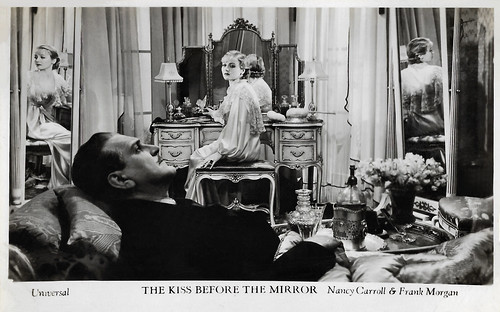
Nancy Carroll and Frank Morgan in The Kiss Before the Mirror (1933)
British postcard in the Film Weekly series. Photo: Universal. Nancy Carroll and Frank Morgan in The Kiss Before the Mirror (James Whale, 1933).

A similarity to the events described in court


Noted attorney Paul Held (Frank Morgan) is defending his friend, Walter Bernsdorf (Paul Lukas), who has been charged with the murder of his wife Lucy (Gloria Stuart) in Vienna. By Walter's account, Lucy was unfaithful to him during their marriage.

After a court hearing, Paul returns home to his wife, Maria (Nancy Carroll), and watches her as she applies makeup in front of her vanity mirror. Paul recognizes a similarity to the events Walter had described in court and notices that his wife appears to pay special attention to her makeup for reasons unconnected with her love for him. Paul kisses Maria, and she angrily repulses him, claiming he has ruined her makeup; then she casually goes out.

Like Walter before him, Paul follows his wife through the streets of Vienna and observes her meeting with a male lover (Donald Cook). This enrages Paul, and he fantasizes about murdering Maria. He also becomes obsessed with vindicating Walter by proving that his love for his wife made him crazed with jealousy when he saw her with another man.

Maria becomes uneasy because the trial hits too close to home, but she continues to visit her lover. On the final day of deliberations in Walter's trial, Paul insists that Maria be present. He makes an impassioned closing appeal in which he claims that "the more a man loves and the more he is deceived, the greater his desire for revenge" and which he concludes by revealing a gun and pointing it at Maria in the audience. She screams in horror and loses consciousness, after which Paul finishes his speech.

While the jury deliberates, Paul meets Maria in his office, where she reacts in terror. She insists she still loves him despite her affair. Walter is ultimately acquitted and warns Paul against killing Maria, which he says he will regret. Paul heeds his advice and asks Maria to leave the courthouse. Upon returning home, Paul angrily smashes Maria's vanity mirror. Maria appears behind him, and the two embrace.

Frank Morgan, Paul Lukas and Nancy Carroll in The Kiss Before the Mirror (1933)
British postcard in the Film Weekly series. Photo: Universal. Frank Morgan, Paul Lukas and Nancy Carroll in The Kiss Before the Mirror (James Whale, 1933).

Nancy Carroll, Jean Dixon and Frank Morgan in The Kiss Before the Mirror (1933)
British postcard in the Film Weekly series. Photo: Universal. Nancy Carroll, Jean Dixon and Frank Morgan in The Kiss Before the Mirror (James Whale, 1933).

The film is chock full of surprises


English film director James Whale is best remembered for his four classic horror films: Frankenstein (1931), The Old Dark House (1932), The Invisible Man (1933) and Bride of Frankenstein (1935). He also directed interesting films in other genres, including screwball comedies and musicals. The Kiss Before the Mirror (1933) is a superior mystery thriller.

In 1933, Pare Lorentz wrote in Vanity Fair: "Director Whale was fortunate in having Frank Morgan and Paul Lukas as his leading men, and Karl Freund, the best man in the business, as cameraman for A Kiss Before the Mirror. I don't know how they happened to slip Nancy Carroll into the show, but we'll dismiss that. There is a pictorial quality about the opening scenes, and a maturity in the dialogue which makes a better part of the picture seem true and important."

"The film is chock full of surprises for the viewer, almost as much in the twenty-first century as it was in 1933", writes Bruce Eder at AllMovie. "The opening minutes seem to be shaping up as a horror film, complete with the image of a stalker moving toward a house where an illicit couple (Walter Pidgeon, Gloria Stuart) are having a rendezvous - but it also almost threatens to become a musical, as the couple are each heard humming and vamping to tango as they prepare to meet, in what is just short of an erotic pre-coital ballet. And then, just as it reaches a new height of implied eroticism, it becomes something entirely different, as murderous rage explodes before the camera and the audience.

Director James Whale carries us across this rapidly shifting cinematic landscape - much of it decorated in a beautifully understated art deco style (courtesy of art director Charles D. Hall) - in seemingly effortless fashion in just the first few minutes of The Kiss Before The Mirror, and then it gets really interesting - we're introduced to an array of deceptively complex characters, of whom the most interesting, other than the pairing of Frank Morgan and Nancy Carroll as the husband-and-wife headed into dangerous straits, is the lawyer played by Jean Dixon. Amid some amazing acting and character flourishes by the two leads, and quietly flamboyant support from Charles Grapewin as a dipsomaniac law clerk, Dixon's lady lawyer must constantly differentiate between her perceptions as a lawyer and a woman; when asked which she is, she remarks that by day she is a lawyer, and by night . . . 'you'd be surprised'."

The film was the subject of a remake by director James Whale himself. Five years later, he directed the same story under the title Wives Under Suspicion (James Whale, 1938), with a different cast including Warren William and Gail Patrick and on a much smaller budget. He made a few noticeable concessions for the more militant censors of 1938. However, Hal Erickson at AllMovie liked the result: "Indeed, Wives is a "B" picture, but one wouldn't know it from the care and attention that Whale gives it. An expressionistic opening lets the viewer know that Whale is going to do his best with the budget at hand, and he keeps the film visually interesting throughout."
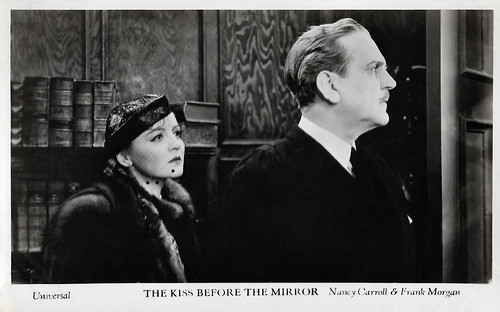
Nancy Carroll and Frank Morgan in The Kiss Before the Mirror (1933)
British postcard in the Film Weekly series. Photo: Universal. Nancy Carroll and Frank Morgan in The Kiss Before the Mirror (James Whale, 1933).

Sources: Pare Lorentz (Vanity Fair), Bruce Eder (AllMovie), Mark Deming (AllMovie), Hal Erickson (AllMovie), AFI Catalog, Wikipedia and IMDb.

20 January 2019

Nancy Carroll

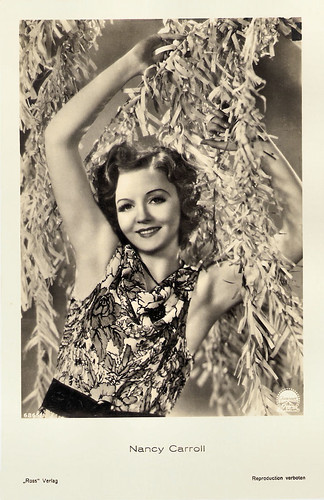
Red-haired, cupid-bow-mouthed Nancy Carroll (1903-1965) became a very popular Hollywood star upon the advent of sound film because of her singing and dancing abilities. She was reported to have received more fan mail than any of her Hollywood peers of the same era. As she expanded her acting range from flaming flapper to ditzy comedienne to sensitive heroine, she was nominated for an Oscar for The Devil's Holiday (1930).

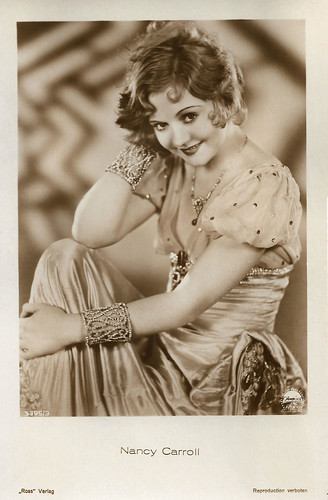
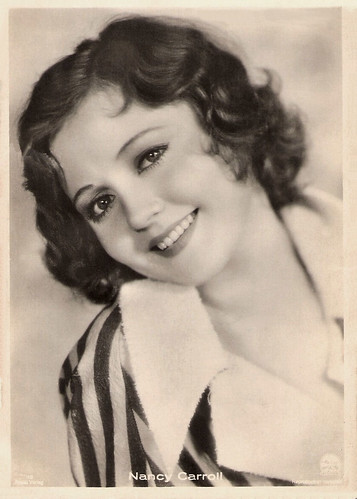
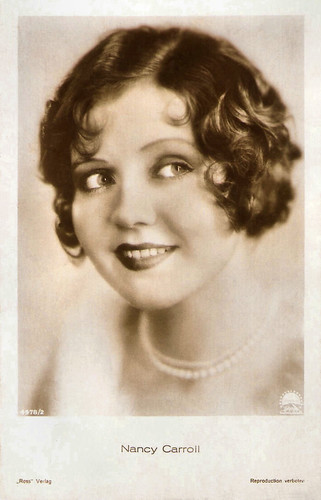
Nancy Carroll
German postcard by Ross Verlag, no. 4978/2, 1929-1930. Photo: Paramount Pictures.

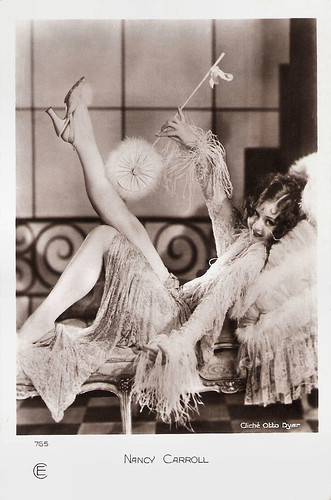
Nancy Carroll
French postcard by Cinémagazine-Edition, no. 765. Photo: Otto Dyar.

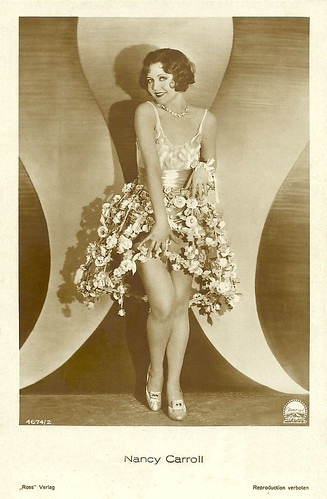
Nancy Carroll
German postcard by Ross Verlag, no. 4674/2, 1929-1930. Photo: Paramount. Collection: Didier Hanson.

Charles Rogers and Nancy Carroll in Close Harmony (1929)
German postcard by Ross Verlag, no. 4681/1, 1929-1930. Photo: Paramount. Charles Rogers and Nancy Carroll in Close Harmony (John Cromwell, A. Edward Sutherland, 1929).
>
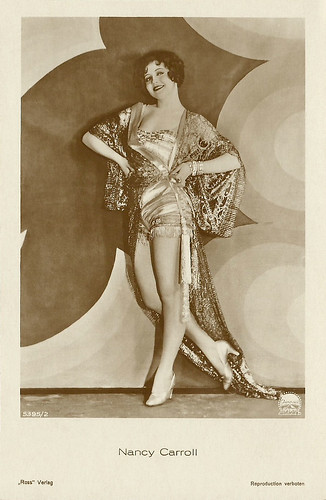
Nancy Carroll
German postcard by Ross Verlag, no. 5395/2, 1930-1931. Photo: Paramount. Collection: Didier Hanson.

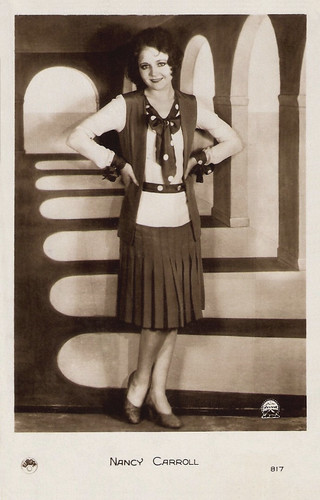
Nancy Carroll
French postcard by Europe, no. 817. Photo: Paramount.

A formidable film force


Nancy Carroll was born Ann Veronica LaHiff in New York in 1903 (some sources say 1904). She was the daughter of Thomas and Ann Lahiff, of Irish parentage. Her education came at Holy Trinity School in New York, but she left there at age 16 to work as a stenographer in the office of a lace manufacturer. She was smitten early by the acting bug and she had some limited experience on New York stages.

When she was just 14, she appeared in the silent Western Riders of the Purple Sage (Frank Lloyd, 1918), starring William Farnum. The film was not a success and the girl returned to school and did accidental acting stints. But she had tasted life in front of the camera and wanted to get back there someday. Carroll and her sister Elsie performed a dancing act in a local contest of amateur talent. This led to an acting career in Broadway musicals. After being spotted in a play on the West Coast, she finally made her 'second' film debut in Ladies Must Dress (Victor Heerman, 1927) with Virginia Valli. She impressed the right people and was signed to a contract with Paramount.

In 1928 she appeared in seven films including Manhattan Cocktail (Dorothy Arzner, 1928) with Richard Arlen, and Chicken a La King (Henry Lehrman, 1928). She established her reputation as Barbara Quayle in Easy Come, Easy Go (Frank Tuttle, 1928), a vehicle for Richard Dix. It was a big hit and made Nancy Carroll a formidable film force.

Her next film was Abie's Irish Rose (Victor Fleming, 1928), adapted from the stage version that had run on Broadway for six years. Paramount shelled out $500,000 for the film rights (the highest at that time) and cast Nancy as Rosemary Murphy. She and her co-star Charles 'Buddy' Rogers made a lovely stage couple, but other films with a similar theme caused the film did not do well at the box office.

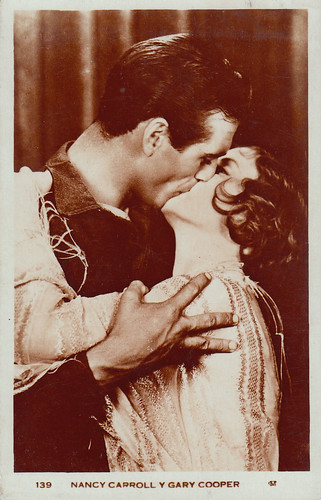
In 1929 Nancy Carroll had another big hit with her part in The Shopworn Angel (Richard Wallace, 1928) with a young Gary Cooper. Denny Jackson at IMDb:'"It was her first (partial) 'talkie' and showed the Paramount executives that she would be among those who made the successful transition from the 'silent' to an exciting new medium." Later that year, she made with Buddy Rogers Close Harmony (John Cromwell, A. Edward Sutherland, 1929), Paramount's first full talkie, and once again a hit was born. In their third pairing, she and Buddy Rogers filmed Illusion (Lothar Mendes, 1929). They were able to profit from their intense popularity, but there was a sameness to their material.

Abie's Irish Rose
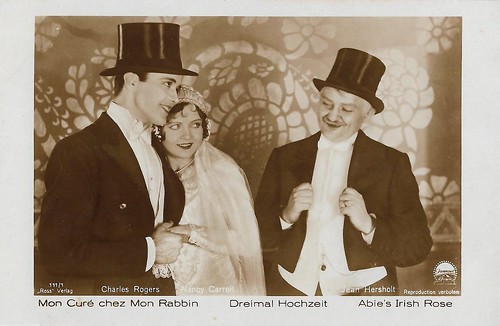
German postcard by Ross Verlag, no. 111/1. Photo: Paramount. Charles Rogers, Nancy Carroll, and Jean Hersholt in Abie's Irish Rose (Victor Fleming, 1928).

Charles Rogers and Nancy Carroll in Illusion (1929)
German postcard by Ross Verlag, no. 4969/1, 1929-1930. Photo: Paramount. Charles Rogers and Nancy Carroll in Illusion (1929).

Nancy Carroll in Laughter (1930)
German postcard by Ross Verlag, no. 5395/3, 1930-1931. Photo: Paramount Pictures. Publicity still for Laughter (Harry d'Abbadie d'Arrast, 1930).

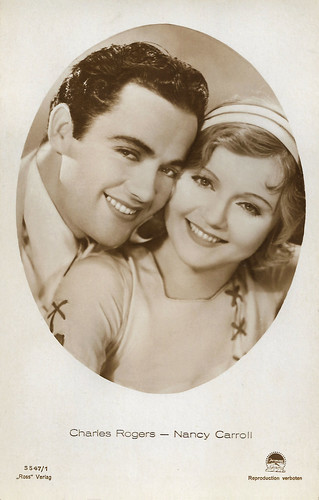
Charles Rogers and Nancy Carroll in Follow Thru (1930)
German postcard by Ross Verlag, no. 5547/1, 1930-1931. Photo: Paramount. Publicity still for Follow Thru (Lloyd Corrigan, Laurence Schwab, 1930) with Charles Rogers.

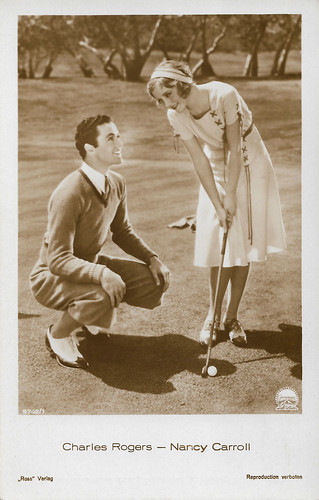
Charles Rogers and Nancy Carroll in Follow Thru (1930)
German postcard by Ross Verlag, no. 5742/1, 1930-1931. Photo: Paramount. Charles Rogers and Nancy Carroll in Follow Thru (Lloyd Corrigan, Laurence Schwab, 1930).

Nancy Carroll
German postcard by Ross Verlag, no. 6865/1, 1931-1932. Photo: Paramount.

Paramount had a genuine superstar on their hands


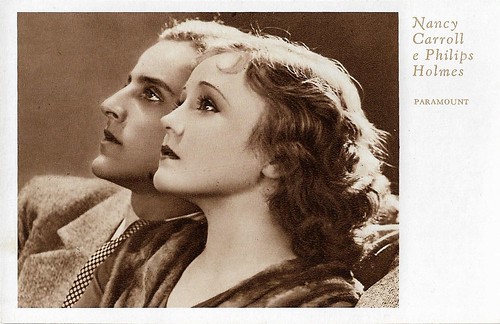
In 1929, Nancy Carroll was nominated for an Academy Award for her luminous performance as savvy city girl Hallie Hobart in the highly-acclaimed The Devil's Holiday (Edmund Goulding, 1930). She didn't win but her genuine-star status was solidified. By the time Nancy filmed Honey (Wesley Ruggles, 1930), she received more fan mail than any other Hollywood star. Paramount had a genuine superstar on their hands.

Nancy Carroll continued to be a big success throughout the first half of the 1930s. Among her best films are Laughter (Harry d'Abbadie d'Arrast, 1930) with Fredric March, the all-star revue Paramount on Parade (Edmund Goulding, Dorothy Arzner, Ernst Lubitsch, a.o., 1930), and the drama Hot Saturday (William A. Seiter, 1932) with Cary Grant in his first role as a leading man and Randolph Scott.

Notable films are also The Kiss Before the Mirror (1933) directed by James Whale, and Broken Lullaby aka The Man I Killed (Ernst Lubitsch, 1932) with John Barrymore. Then her leading lady days were over.

Her last big picture was the Deanna Durbin musical That Certain Age (Edward Ludwig, 1938). She retired after its filming and returned to the stage. In the early 1950s, she tried the infant medium of television and appeared in such series as The Aldrich Family (1950-1951), and The Egg and I (1951), starring her daughter, Patricia Kirkland.

After another interval of several years, she made some other guest appearances in such TV series as Naked City (1961) and Going My Way (1963). In 1965, Nancy Carroll failed to report to a stage performance and was found dead of a heart attack. She was 61 years old. Carroll was married three times. Her husbands were Jack Kirkland (1925–1930), Francis Bolton Mallory (1931–1935) and C.H. 'Jappe' Groen (1953–1965).

Nancy Carroll and Gary Cooper in The Shopworn Angel (1929)
Spanish postcard by MC Barcelona, no. 139. Nancy Carroll and Gary Cooper in The Shopworn Angel (Richard Wallace, 1928). Collection: Marlene Pilaete.

Nancy Carroll
Italian postcard by Cinema-Illustrazione, Milano, Series I, no. 38. Photo: Paramount.

Nancy Carroll
Italian postcard by Cinema-Illustrazione, Milano, Series, I, no. 26. Photo: Paramount.

Nancy Carroll and Phillips Holmes in The Devil's Holiday (1930)
Italian postcard by Cinema Illustrazione, Milano, series II, no. 26. Photo: Paramount. Nancy Carroll and Phillips Holmes in The Devil's Holiday (Edmund Goulding, 1930).

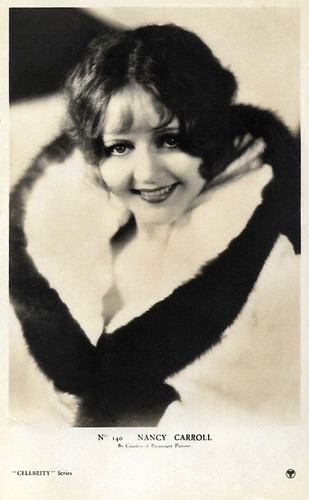
Nancy Carroll
British Real Photograph postcard in the Celebrity Series, no. 140. Photo: Paramount Pictures.

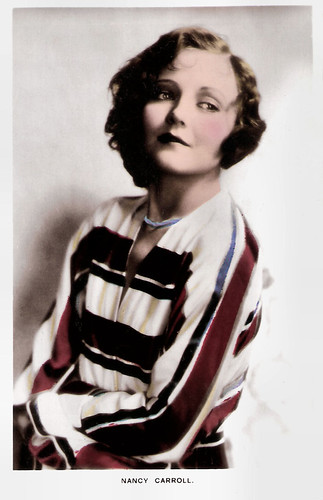
Nancy Carroll
British postcard in the Colourgraph Series, London series, no. C 13.

Nancy Carroll
German postcard by Ross Verlag in the Luxusklasse series, no. 510. Photo: Paramount.

Sources: Denny Jackson (IMDb), Jarod Hitchings (IMDb), Wikipedia and IMDb.
This post was last updated on 9 September 2023.

30 December 2018

Abie's Irish Rose (1928)

Charles 'Buddy' Rogers and Nancy Carroll are the adorable stars of the American comedy drama Abie's Irish Rose (Victor Fleming, 1928). The Paramount production was based on a popular Broadway play. Ross Verlag in Berlin published this series of four sepia postcards on the film, with the film title in three languages: in French Mon Curé chez mon Rabbin (My priest at my rabbi) and in German Dreimal Hochzeit (Three times wedding).

Abie's Irish Rose
German postcard by Ross Verlag, no. 111/1. Photo: Paramount. Publicity still of Charles Rogers, Nancy Carroll, and Jean Hersholt in Abie's Irish Rose (Victor Fleming, 1928)

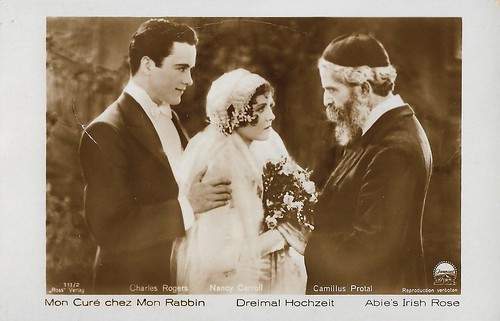
Abie's Irish Rose
German postcard by Ross Verlag, no. 111/2. Photo: Paramount. Publicity still of Charles Rogers, Nancy Carroll and Camillus Proctal in Abie's Irish Rose (Victor Fleming, 1928).

Just Married amid discord and discontent - again and again


The comedy Abie's Irish Rose (Victor Fleming, 1928) is a early talking (part-talkie) film, based on the play Abie's Irish Rose by Anne Nichols, depicting the tumult that arises with the marriage of a young Jewish man and a Catholic Irish girl. Although initially receiving poor reviews, the Broadway play was a commercial hit, running for 2,327 performances between 23 May 1922, and 1 October 1927, at the time the longest run in Broadway theatre history.

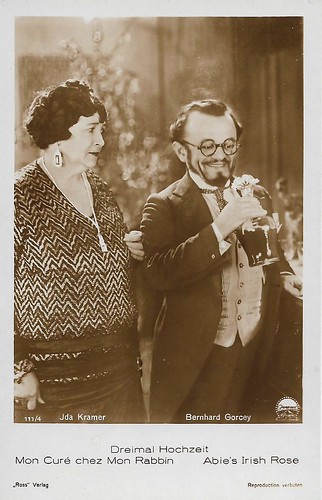
The film version of Abie's Irish Rose is quite faithful to the play. Bernard Gorcey and Ida Kramer, who played the Isaac Cohens during the original Broadway run of the show, reprised their roles in this film. During World War I, Jewish Abie Levy (Charles 'Buddy' Rogers) is wounded in combat. While recovering in a hospital, he meets Catholic Rosemary Murphy (Nancy Carroll). They fall in love, return to the United States, and get married in an Episcopal church in Jersey City.

Abie takes Rosemary to his home and to appease his father, he introduces her as his sweetheart, Rosie Murpheski. They are then married by a rabbi (Camillus Pretal). Then Rosemary's hot tempered father, Mr. Patrick Murphy (veteran actor J. Farrell MacDonald) arrives with a priest (comedian Nick Cogley of Mack Sennett's troupe at Keystone). Amid discord and discontent, the young people are married again, this time by the priest.

Disowned by both families, Rosemary and Abie are befriended only by Mr. and Mrs. Isaac Cohen (Bernard Gorcey and Ida Kramer). On Christmas Eve, the Cohens and their rabbi persuade Solomon Levy (Jean Hersholt) to see his son and his new grandchildren; the priest urges Patrick Murphy to do the same. This surprise visit begins in acrimony but ends peacefully as Rosemary presents her newborn twins: Patrick Joseph, named for her father, and Rebecca, named for Abie's dead mother, leaving both grandpas happy.

In 1946, the film was remade as Abie's Irish Rose (A. Edward Sutherland, 1946), with Richard Norris and Joanne Dru. This version, which updated the story to World War II, was produced by Bing Crosby. The film also inspired the weekly NBC radio series, Abie's Irish Rose, which ran from 24 January 1942, through 2 September 1944. Faced with listener protests about its stereotyped ethnic portrayals, the radio series was cancelled in 1945.

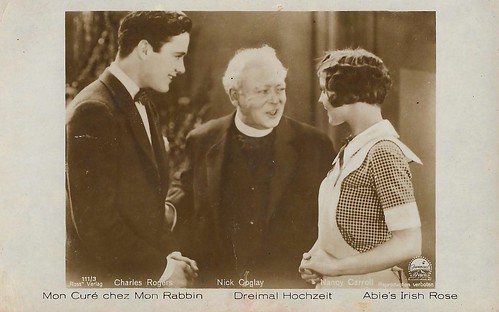
Abie's Irish Rose
German postcard by Ross Verlag, no. 111/3. Photo: Paramount. Publicity still of Charles Rogers, Nick Cogley, and Nancy Carroll in Abie's Irish Rose (Victor Fleming, 1928).

Abie's Irish Rose
German postcard by Ross Verlag, no. 111/4. Photo: Paramount. Publicity still of Ida Kramer and Bernhard Gorcey in Abie's Irish Rose (Victor Fleming, 1928).

Sources: Afi.com, Wikipedia and IMDb.