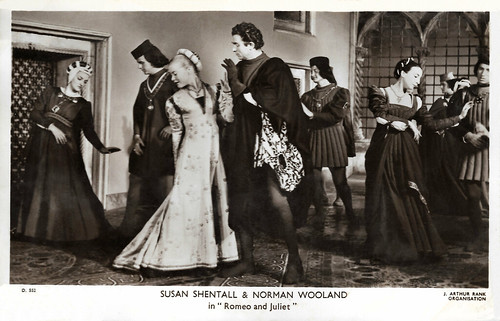
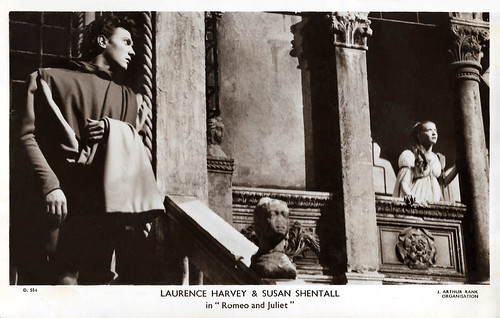
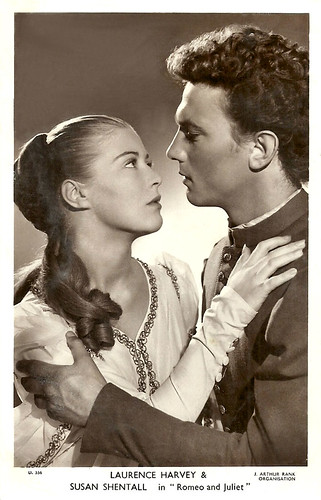
The Italian film director and screenwriter Renato Castellani made the wonderful young love trilogy of Neorealism with Sotto il sole di Roma (1948), È primavera...(1950) and Due soldi di speranza (1952). After the trilogy, Castellani won the Grand Prix in Cannes with a film adaptation of the ultimate drama of young love, Romeo and Julia (1954). Handsome Lithuanian-born actor Laurence Harvey (1928–1973) played a terrific Romeo in this film. Harvey is best known for his lead performance as a ruthless social climber in Room at the Top (1959), but there is much more to tell about his career and life.
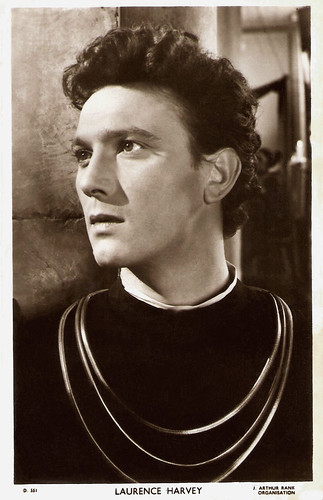
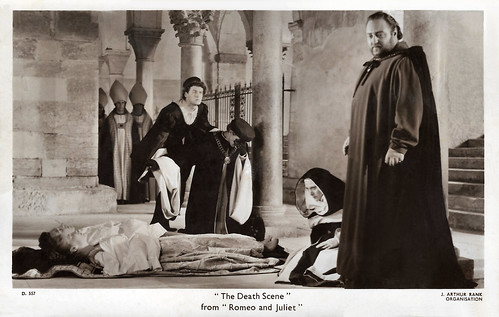
British postcard in the Picturegoer Series, London, no. D 551. Photo: J. Arthur Rank Organisation. Publicity still for Romeo and Juliet (1954).

British photo, late 1950s or early 1960s. The signature may have been printed on the photo.
Laurence Harvey was born in the town of Joniškis, Lithuania in 1928. He maintained throughout his life that his birth name was Laruschka Mischa Skikne, but it was actually Zvi Mosheh Skikne. He was the youngest of three boys born to Ella Skikne Zotnickaita and Ber Skikne, a Lithuanian Jewish family.
Aged five, his family emigrated to South Africa, where he was known as Harry Skikne. He grew up in Johannesburg, and as a teenager, he served with the entertainment unit of the South African Army during the Second World War in Egypt and Italy. After moving to London, he enrolled in the Royal Academy of Dramatic Art where he became known as Larry. After leaving RADA early, he began to perform on stage in regional theatre. He made his cinema debut as Laurence Harvey in the British horror film House of Darkness (Oswald Mitchell, 1948).
After this, the Associated British Picture Corporation (ABPC) offered him a two-year contract and he appeared in several of their lower-budget films such as the film noir Man on the Run (Lawrence Huntington, 1949) starring Derek Farr, and the narcotics crime drama Cairo Road (David MacDonald, 1950). After failing in the commercial theatre in London's West End, Harvey joined the company of the Shakespeare Memorial Theatre at Stratford-upon-Avon for the 1952 season.
His film career got a boost when he appeared in Women of Twilight (Gordon Parry, 1952) opposite René Ray. This crime drama was made by Romulus Films who signed Harvey to a long-term contract. He secured a small role in a Hollywood film, Knights of the Round Table (Richard Thorpe, 1953), and was cast with Rex Harrison in King Richard and the Crusaders (David Butler, 1954).
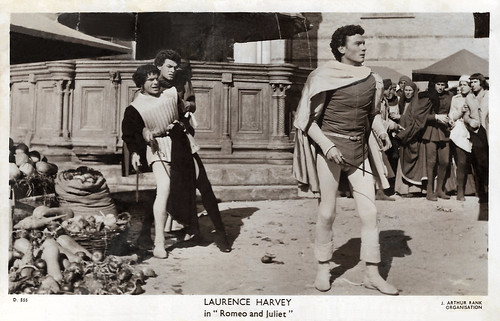
That year he also played Romeo in Renato Castellani's adaptation of William Shakespeare's Romeo and Juliet (1954), narrated by John Gielgud. Patrick Hunter at IMDb: “A very worthwhile movie, especially for Shakespeare fans. I personally think Laurence Harvey is a terrific Romeo. Yes, he's a bit of a simp, but that's the character. In fact, Harvey is the screen's best Romeo; he's a lot more passionate than Leslie Howard in the MGM version, and he speaks the verse better than either DiCaprio or Leonard Whiting in the two subsequent versions.”
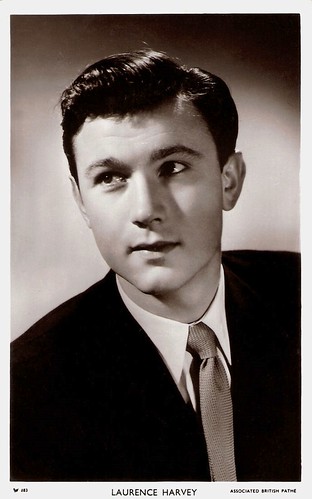
British postcard in the Picturegoer series, London, no. W 883. Photo: British Associated Pathé.
Laurence Harvey was now established as an emerging British star. He was cast as the writer Christopher Isherwood in I Am A Camera (Henry Cornelius, 1955), with Julie Harris as Sally Bowles. Later, the musical Cabaret would also be based on the same books by Christopher Isherwood.
Harvey also appeared on American TV and on Broadway. He made his Broadway debut in 1955 in the play Island of Goats. The play closed after one week, though his performance won Harvey a 1956 Theatre World Award. A hit in France was the film Three Men in a Boat (Ken Annakin, 1956) with Shirley Eaton. Harvey appeared twice more on Broadway, in 1957 with Julie Harris in William Wycherley's The Country Wife, and in William Shakespeare's Henry V in 1959, as part of the Old Vic company, which featured a young Judi Dench as Katherine, the Daughter of the King of France.
Jon C. Hopwood writes on IMDb: “The colorful Harvey, a press favorite, became notorious for his high-spending, high-living ways. He found himself frequently in debt, his travails faithfully reported by entertainment columnists. More fame was to come.“
His breakthrough to international stardom came in 1959 when he was cast as the social climber Joe Lampton in Room at the Top (Jack Clayton, 1959). The film was produced by British film-producing brothers Sir John and James Woolf of Romulus Films and Remus Films. For his performance, Harvey received a BAFTA Award nomination and a nomination for the Academy Award for Best Actor, the first person of Lithuanian descent to be nominated for an acting Oscar. His co-star, Simone Signoret, did win the Oscar for her performance. Room at the Top (1959) and Look Back in Anger (Tony Richardson, 1959) inaugurated the ‘kitchen sink’ cinema, the New Wave that revolutionized Britain’s film industry.
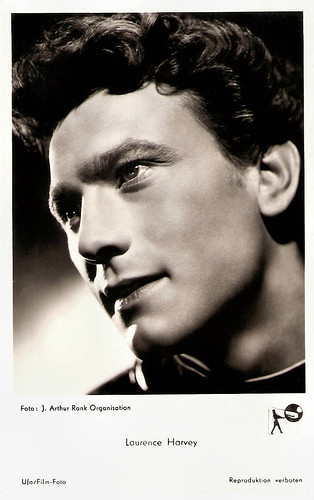
German postcard by Ufa, Berlin-Tempelhof, no. FK 1322. Photo: J. Arthur Rank Organisation. Publicity still for Romeo and Juliet (1954).
During the 1960s, Laurence Harvey appeared in several major films. He starred in Butterfield 8 (Daniel Mann, 1960) opposite Elizabeth Taylor, and John Wayne's epic The Alamo (1960), released within a month of each other. Harvey was then cast in the film version of the war drama The Long and the Short and the Tall (Leslie Norman, 1961) with Richard Todd. The role had earlier made Peter O'Toole prominent in the West End, but O'Toole was not yet established in cinema and Harvey was clearly more ‘bankable’.
Other films included Walk on the Wild Side (Edward Dmytryk, 1962) with Barbara Stanwyck, a young Jane Fonda and Capucine; the film adaptation of Tennessee Williams' Summer and Smoke (Peter Glenville, 1961) with Geraldine Page, and Darling (John Schlesinger, 1965) with Julie Christie and Dirk Bogarde.
He also appeared as a brainwashed former Korean War POW in the Cold War thriller The Manchurian Candidate (John Frankenheimer, 1962). He became very good friends with his co-star Frank Sinatra, and was a member in good standing of high society, then dubbed ‘The Jet Set’.
His career began to decline in the mid-1960s. The remake of W. Somerset Maugham's Of Human Bondage (Ken Hughes, 1964) was a failure, as was The Outrage (Martin Ritt, 1964) starring Paul Newman, a remake of Akira Kurosawa's classic Rashômon (1950). Harvey reprised his Oscar-nominated role as Joe Lampton in the sequel Life at the Top (Ted Kotcheff, 1965), but the film was not a success. Harvey returned to Britain to make the comedy The Spy with a Cold Nose (Daniel Petri, 1966) with Daliah Lavi. His last hurrah was his appearance in the spy thriller A Dandy in Aspic (1968), of which he took direction after the original director Anthony Mann died during shooting.
In settlement of a dispute with Woodfall Films over the rights to The Charge of the Light Brigade (Tony Richardson, 1968), Woodfall cast him in their version as a Russian prince. He performed as cast but was never seen as the Prince in the finished film. The only part of his performance remaining in the final cut is a brief appearance of him in the background of one shot, as an anonymous member of a theatre audience.
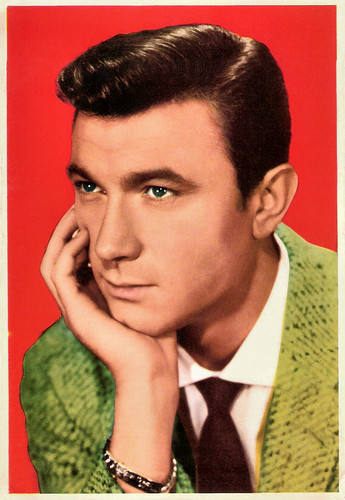
Spanish postcard by Archivo Bermejo, no. C-222. Photo: M.G.M. Publicity still for The Outrage (Martin Ritt, 1964).
Laurence Harvey played out his career largely in undistinguished films, TV work and the occasional supporting role in a major production. In The Magic Christian (Joseph McGrath, 1969), he recited Hamlet's soliloquy, almost nude and very thin.
A promising project, Orson Welles' The Deep (1970) with Jeanne Moreau, was never finished. One of his better performances from this period was in an episode of Rod Serling's TV series Night Gallery (1971).
He was also guest murderer of the week on Columbo: The Most Dangerous Match (1973) as a chess champion who murders his opponent. He directed himself in the last picture in which he appeared, Welcome to Arrow Beach (Laurence Harvey, 1974).
Harvey was married three times. In 1957 he married actress Margaret Leighton, whom he had met on the set of The Good Die Young (1954). They divorced in 1961. His second marriage in 1968 was to Joan Perry Cohn, who was 17 years his senior and the widow of film mogul Harry Cohn of Columbia Pictures. Finally, he married Paulene Stone. Harvey met Stone on the set of A Dandy in Aspic, and while still married to Cohn he became a father for the first time when Stone gave birth to a daughter, Domino, in 1969. Eventually, Harvey divorced Cohn and married Stone in 1972.
Harvey was bisexual. His long-term lover was his manager James Woolf, who had discovered Harvey in the 1950s. A heavy smoker and drinker, Laurence Harvey died from stomach cancer in 1973. He was only 45. His daughter, Domino (1969–2005), who worked as a bounty hunter, was only 35 when she died. They are buried together in Santa Barbara Cemetery in Santa Barbara, California, USA.

British postcard in the Picturegoer Series, London, no. D 555. Photo: J. Arthur Rank Organisation. Laurence Harvey as Romeo in Romeo and Juliet (1954). Left stands the wounded Mercutio (Ubaldo Zollo).
Trailer for Romeo and Juliet (1954). Source: HanseSound Musik und Film GmbH (YouTube).
Sources: Jon C. Hopwood (IMDb), Wikipedia and IMDb.
This post was last updated on 22 August 2024.
British postcard in the Picturegoer Series, London, no. D 551. Photo: J. Arthur Rank Organisation. Publicity still for Romeo and Juliet (1954).
British photo, late 1950s or early 1960s. The signature may have been printed on the photo.
A terrific Romeo
Laurence Harvey was born in the town of Joniškis, Lithuania in 1928. He maintained throughout his life that his birth name was Laruschka Mischa Skikne, but it was actually Zvi Mosheh Skikne. He was the youngest of three boys born to Ella Skikne Zotnickaita and Ber Skikne, a Lithuanian Jewish family.
Aged five, his family emigrated to South Africa, where he was known as Harry Skikne. He grew up in Johannesburg, and as a teenager, he served with the entertainment unit of the South African Army during the Second World War in Egypt and Italy. After moving to London, he enrolled in the Royal Academy of Dramatic Art where he became known as Larry. After leaving RADA early, he began to perform on stage in regional theatre. He made his cinema debut as Laurence Harvey in the British horror film House of Darkness (Oswald Mitchell, 1948).
After this, the Associated British Picture Corporation (ABPC) offered him a two-year contract and he appeared in several of their lower-budget films such as the film noir Man on the Run (Lawrence Huntington, 1949) starring Derek Farr, and the narcotics crime drama Cairo Road (David MacDonald, 1950). After failing in the commercial theatre in London's West End, Harvey joined the company of the Shakespeare Memorial Theatre at Stratford-upon-Avon for the 1952 season.
His film career got a boost when he appeared in Women of Twilight (Gordon Parry, 1952) opposite René Ray. This crime drama was made by Romulus Films who signed Harvey to a long-term contract. He secured a small role in a Hollywood film, Knights of the Round Table (Richard Thorpe, 1953), and was cast with Rex Harrison in King Richard and the Crusaders (David Butler, 1954).
That year he also played Romeo in Renato Castellani's adaptation of William Shakespeare's Romeo and Juliet (1954), narrated by John Gielgud. Patrick Hunter at IMDb: “A very worthwhile movie, especially for Shakespeare fans. I personally think Laurence Harvey is a terrific Romeo. Yes, he's a bit of a simp, but that's the character. In fact, Harvey is the screen's best Romeo; he's a lot more passionate than Leslie Howard in the MGM version, and he speaks the verse better than either DiCaprio or Leonard Whiting in the two subsequent versions.”
British postcard in the Picturegoer series, London, no. W 883. Photo: British Associated Pathé.
Notorious for his high-spending, high-living ways
Laurence Harvey was now established as an emerging British star. He was cast as the writer Christopher Isherwood in I Am A Camera (Henry Cornelius, 1955), with Julie Harris as Sally Bowles. Later, the musical Cabaret would also be based on the same books by Christopher Isherwood.
Harvey also appeared on American TV and on Broadway. He made his Broadway debut in 1955 in the play Island of Goats. The play closed after one week, though his performance won Harvey a 1956 Theatre World Award. A hit in France was the film Three Men in a Boat (Ken Annakin, 1956) with Shirley Eaton. Harvey appeared twice more on Broadway, in 1957 with Julie Harris in William Wycherley's The Country Wife, and in William Shakespeare's Henry V in 1959, as part of the Old Vic company, which featured a young Judi Dench as Katherine, the Daughter of the King of France.
Jon C. Hopwood writes on IMDb: “The colorful Harvey, a press favorite, became notorious for his high-spending, high-living ways. He found himself frequently in debt, his travails faithfully reported by entertainment columnists. More fame was to come.“
His breakthrough to international stardom came in 1959 when he was cast as the social climber Joe Lampton in Room at the Top (Jack Clayton, 1959). The film was produced by British film-producing brothers Sir John and James Woolf of Romulus Films and Remus Films. For his performance, Harvey received a BAFTA Award nomination and a nomination for the Academy Award for Best Actor, the first person of Lithuanian descent to be nominated for an acting Oscar. His co-star, Simone Signoret, did win the Oscar for her performance. Room at the Top (1959) and Look Back in Anger (Tony Richardson, 1959) inaugurated the ‘kitchen sink’ cinema, the New Wave that revolutionized Britain’s film industry.
German postcard by Ufa, Berlin-Tempelhof, no. FK 1322. Photo: J. Arthur Rank Organisation. Publicity still for Romeo and Juliet (1954).
Decline
During the 1960s, Laurence Harvey appeared in several major films. He starred in Butterfield 8 (Daniel Mann, 1960) opposite Elizabeth Taylor, and John Wayne's epic The Alamo (1960), released within a month of each other. Harvey was then cast in the film version of the war drama The Long and the Short and the Tall (Leslie Norman, 1961) with Richard Todd. The role had earlier made Peter O'Toole prominent in the West End, but O'Toole was not yet established in cinema and Harvey was clearly more ‘bankable’.
Other films included Walk on the Wild Side (Edward Dmytryk, 1962) with Barbara Stanwyck, a young Jane Fonda and Capucine; the film adaptation of Tennessee Williams' Summer and Smoke (Peter Glenville, 1961) with Geraldine Page, and Darling (John Schlesinger, 1965) with Julie Christie and Dirk Bogarde.
He also appeared as a brainwashed former Korean War POW in the Cold War thriller The Manchurian Candidate (John Frankenheimer, 1962). He became very good friends with his co-star Frank Sinatra, and was a member in good standing of high society, then dubbed ‘The Jet Set’.
His career began to decline in the mid-1960s. The remake of W. Somerset Maugham's Of Human Bondage (Ken Hughes, 1964) was a failure, as was The Outrage (Martin Ritt, 1964) starring Paul Newman, a remake of Akira Kurosawa's classic Rashômon (1950). Harvey reprised his Oscar-nominated role as Joe Lampton in the sequel Life at the Top (Ted Kotcheff, 1965), but the film was not a success. Harvey returned to Britain to make the comedy The Spy with a Cold Nose (Daniel Petri, 1966) with Daliah Lavi. His last hurrah was his appearance in the spy thriller A Dandy in Aspic (1968), of which he took direction after the original director Anthony Mann died during shooting.
In settlement of a dispute with Woodfall Films over the rights to The Charge of the Light Brigade (Tony Richardson, 1968), Woodfall cast him in their version as a Russian prince. He performed as cast but was never seen as the Prince in the finished film. The only part of his performance remaining in the final cut is a brief appearance of him in the background of one shot, as an anonymous member of a theatre audience.
Spanish postcard by Archivo Bermejo, no. C-222. Photo: M.G.M. Publicity still for The Outrage (Martin Ritt, 1964).
Guest murderer of the week
Laurence Harvey played out his career largely in undistinguished films, TV work and the occasional supporting role in a major production. In The Magic Christian (Joseph McGrath, 1969), he recited Hamlet's soliloquy, almost nude and very thin.
A promising project, Orson Welles' The Deep (1970) with Jeanne Moreau, was never finished. One of his better performances from this period was in an episode of Rod Serling's TV series Night Gallery (1971).
He was also guest murderer of the week on Columbo: The Most Dangerous Match (1973) as a chess champion who murders his opponent. He directed himself in the last picture in which he appeared, Welcome to Arrow Beach (Laurence Harvey, 1974).
Harvey was married three times. In 1957 he married actress Margaret Leighton, whom he had met on the set of The Good Die Young (1954). They divorced in 1961. His second marriage in 1968 was to Joan Perry Cohn, who was 17 years his senior and the widow of film mogul Harry Cohn of Columbia Pictures. Finally, he married Paulene Stone. Harvey met Stone on the set of A Dandy in Aspic, and while still married to Cohn he became a father for the first time when Stone gave birth to a daughter, Domino, in 1969. Eventually, Harvey divorced Cohn and married Stone in 1972.
Harvey was bisexual. His long-term lover was his manager James Woolf, who had discovered Harvey in the 1950s. A heavy smoker and drinker, Laurence Harvey died from stomach cancer in 1973. He was only 45. His daughter, Domino (1969–2005), who worked as a bounty hunter, was only 35 when she died. They are buried together in Santa Barbara Cemetery in Santa Barbara, California, USA.
British postcard in the Picturegoer Series, London, no. D 555. Photo: J. Arthur Rank Organisation. Laurence Harvey as Romeo in Romeo and Juliet (1954). Left stands the wounded Mercutio (Ubaldo Zollo).
Trailer for Romeo and Juliet (1954). Source: HanseSound Musik und Film GmbH (YouTube).
Sources: Jon C. Hopwood (IMDb), Wikipedia and IMDb.
This post was last updated on 22 August 2024.