Amleto Novelli (1885-1924) was a famous actor in Italian silent cinema. He appeared in many historical epics and starred with all the divas of Italian film. During the shooting of a film, he suddenly died at only 38.

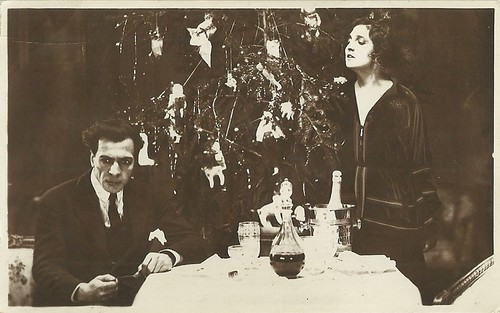
Italian postcard by Fotocelere, Turin, no. 96.
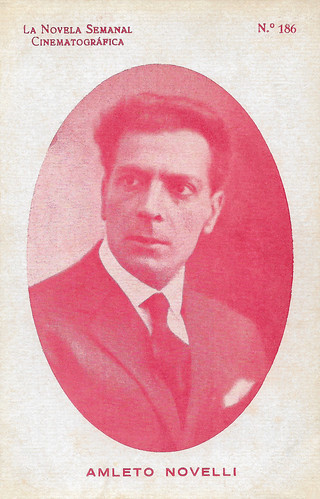
Spanish postcard by La Novela Semanal Cinematografica, no. 186.
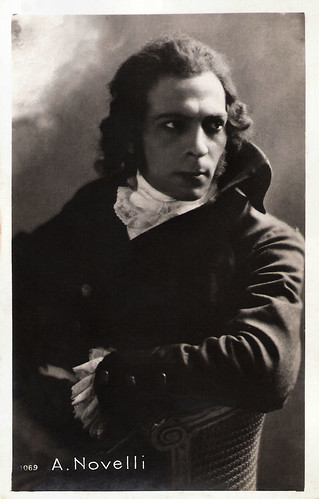
Italian postcard, no. 1069. Photo: publicity still for Madame Tallien / Madame Guillotine (Enrico Guazzoni, Mario Caserini, 1916).

Italian postcard by A. Traldi, Milano, no. 14. Photo: Fontana.
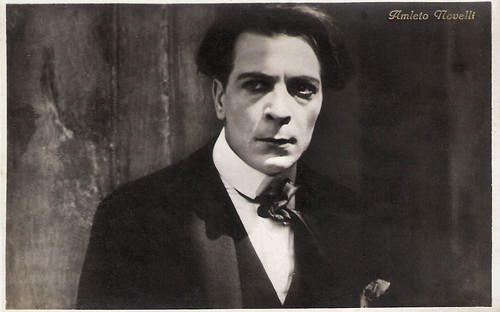
Italian postcard by G.B. Falci, Milano.
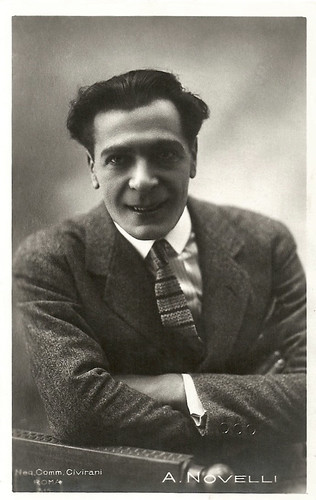
Italian postcard. Photo: Civirani, Rome.
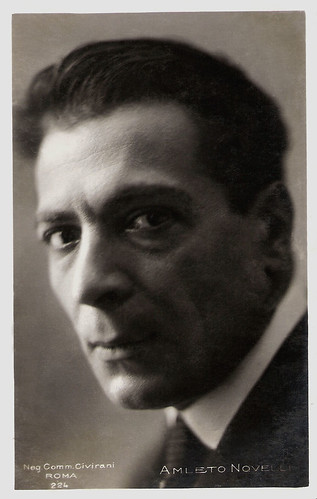
Italian postcard by E. Vettori, Bologna, no. 224. Photo: Civirani, Rome.

Italian postcard. Photo: Giulio De Virgiliis, Genova.
Born in Bologna, Italy, and an orphan at age 12, Amleto Novelli remained home, taking care of his sisters and working as a civil servant until he was 22. Stagestruck Novelli then fled to Rome in 1906 to follow his passion and become a theatre actor. Soon, he was acting amidst young and old stage actors at the Teatro Tiberino. He was soon singled out for his ardent and honest performance, which, despite his lack of classical beauty, hugely attracted audiences. His passion and inflammability would also show when people living from cinema would despise it.
From 1908, he was performing at the Roman company Società Italiana Cines, first in numerous historical shorts such as Marco Visconti (Mario Caserini, 1909) and San Sebastiano / By Order of the Emperor (Enrique Santos, 1911), and contemporary tales such as In pasto ai leoni / The Lion Tamer's Revenge (Enrique Santos, 1912), Il trabocchetto punitore / Fatal Trap Door (1912) with Ermanno Roveri and Emilio Ghione, and La rupe del Malconsiglio / Blow for Blow (1913) with Enna Saredo.
Director Enrico Guazzoni directed him in the short historical films Agrippina (Enrico Guazzoni, 1911) about Agrippina the Younger (Adele Bianchi Azzarili) and Bruto / Brutus (Enrico Guazzoni, 1911). In the latter, he portrayed Marcus Junius Brutus the Younger, one of the assassins of Julius Caesar. Bruto was moderately successful.
When feature films came along, he starred as the virile Italian man in many epics directed by Guazzoni. He played the warm, sincere, and passionate Roman hero Marcus Vinicius in Quo Vadis? (Enrico Guazzoni, 1912-1913) and it became a triumph. The film was based on the 1896 novel by Henryk Sienkiewicz. Wikipedia: "It was arguably the first blockbuster in the history of cinema, with 5,000 extras, lavish sets, and a running time of two hours, setting the standard for 'superspectacles' for decades to come." The Cines production was a major international hit and a personal triumph for Novelli.
So he soon repeated this successful performance as Marc Anthony in Marcantonio e Cleopatra / Antony and Cleopatra (Enrico Guazzoni, 1914) adapted of William Shakespeare's play of the same title, with inspiration also drawn from a poem by Pietro Cossa, and as Julius Caesar in Caio Giulio Cesare / Julius Caesar (Enrico Guazzoni, 1914) with Bruto Castellani and Pina Menichelli. Taking its inspiration from William Shakespeare's 1599 play of the same title, the film portrays the events leading up to the assassination of Julius Caesar. It was produced on an epic scale, including vast sets recreating Ancient Rome and more than 20,000 extras.
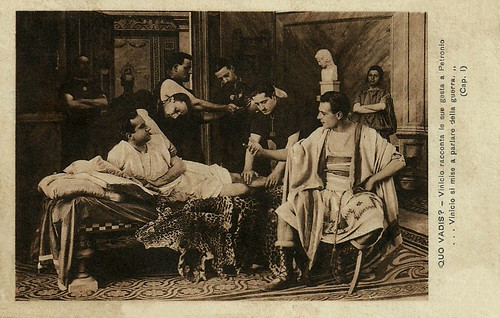
Italian postcard by Film Cines, Roma, no. 6572. Photo: Gustavo Serena as Petronius Arbiter and Amleto Novelli as Marcus Vinicius in Quo Vadis? (Enrico Guazzoni, produced 1912, released 1913).
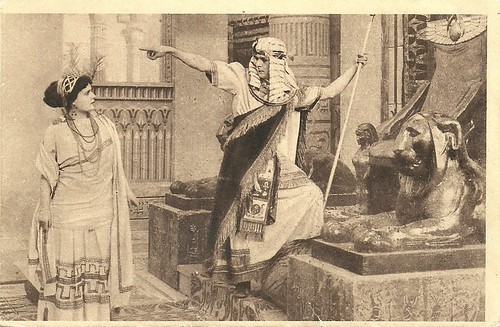
German postcard by BKWI, no. 35. Photo: Marc Anthony (Amleto Novelli), dressed as an Egyptian pharaoh, rejects his wife Octavia (Elsa Lenard) in Marcantonio e Cleopatra (Enrico Guazzoni, 1913).
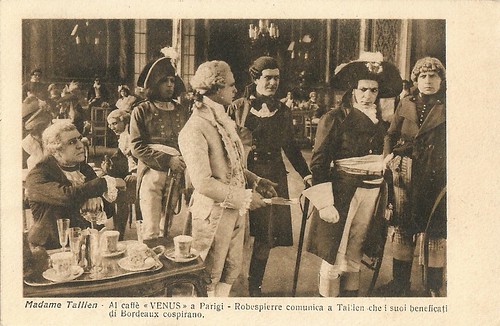
Italian postcard by IPA CT Duplex, no. 3272. Photo: Films Cines. Lyda Borelli as Terese de Fontenay / Madame Tallien, and Amleto Novelli as Tallien in Madame Tallien (Enrico Guazzoni, 1916).
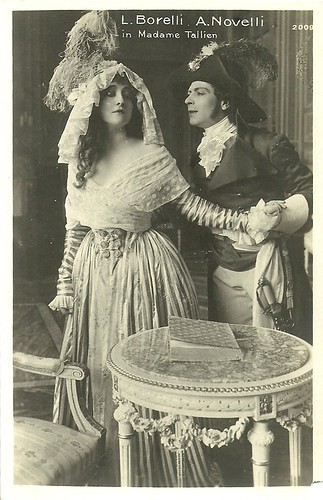
Italian postcard by Ed. Vettori, Bologna. Photo: Lyda Borelli and Amleto Novelli in Madame Tallien (Enrico Guazzoni, 1916).
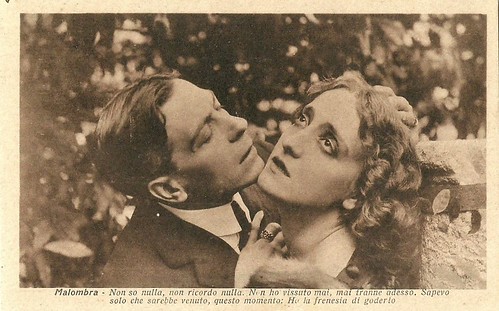
Italian postcard by IPA CT Duplex. Photo: Film Cines. Lyda Borelli and Amleto Novelli in Malombra (Carmine Gallone, 1917). Caption: I don't know anything, I remember nothing. I never lived, never apart from now. I knew only you would come, this moment. I have the frenzy to enjoy it.
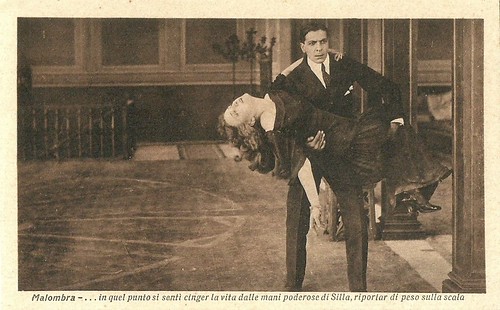
Italian postcard by IPA CT Duplex. Photo: Film Cines. Lyda Borelli and Amleto Novelli in Malombra (Carmine Gallone, 1917). Caption: ...at that moment she felt her waist held by the powerful hands of Silla, who lifted her back up the stairs.
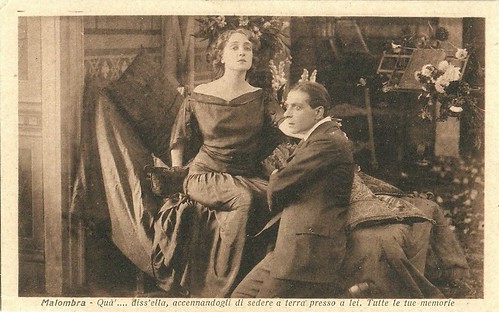
Italian postcard by IPA CT Duplex. Photo: Film Cines. Lyda Borelli and Amleto Novelli in Malombra (Carmine Gallone, 1917). Caption: Here, she said, signing him to sit down on the ground next to her. All your memories...
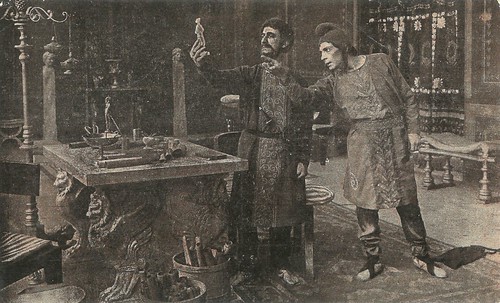
Spanish postcard for Amatller Marca Luna chocolate, series 8, no. 7. Photo: Palatino Film. Augusto Mastripietri and Amleto Novelli in Fabiola (Enrico Guazzoni, 1918).
Amleto Novelli also had a large share in the diva films as the male antagonist of Lyda Borelli in drama Marcia nuziale/The Wedding March (Carmine Gallone, 1915), Madame Tallien / Madame Guillotine (Enrico Guazzoni, Mario Caserini, 1916) and Malombra (Carmine Gallone, 1916), an adaptation of the 1881 novel Malombra by Antonio Fogazzaro.
With Pina Menichelli, he co-starred in Papà (Nino Oxilia, 1915) and Il padrone delle ferriere / The Railway Owner (Eugenio Perego, 1919), and with Francesca Bertini in Spiritismo (Camillo De Riso, 1919), La piovra / The Octopus (Edoardo Bencivenga, 1919) and L'ombra / The Shadow (Roberto Roberti, 1920).
He was the leading man of Soava Gallone in Avatar / The Magician (Carmine Gallone, 1916) and La chiamavano 'Cosetta' (Eugenio Perego, 1917), and of Maria Jacobini in La casa di vetro / The Glass House (Gennaro Righelli, 1920) and La preda / The Prey (Guglielmo Zorzi, 1921). Other divas with whom he worked were Italia Almirante and Diana Karenne.
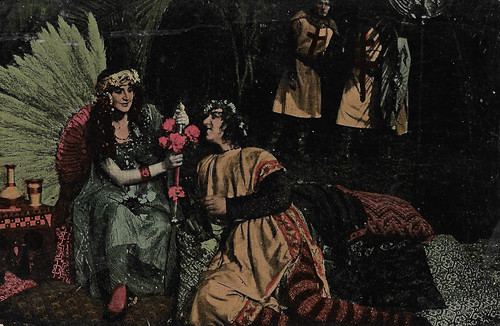
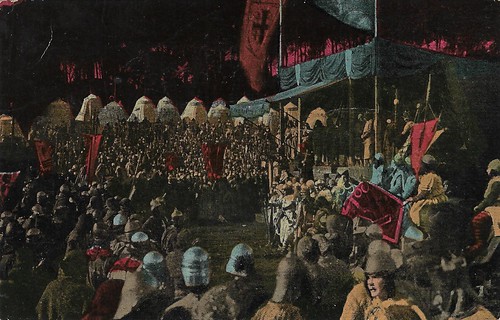
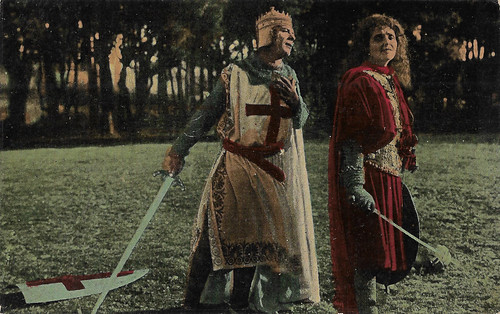
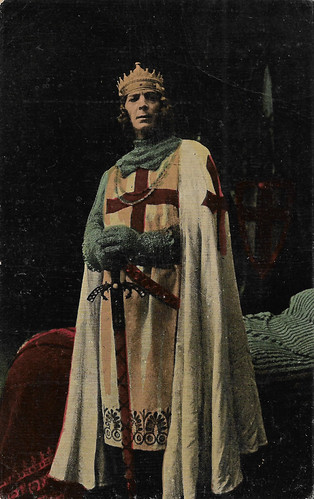
Novelli continued to act in historical epics as well. These included Christus (Giuseppe Antamoro 1915), Fabiola (Enrico Guazzoni, 1918) featuring Elena Sangro, La Gerusalemme liberata / The Crusaders (Enrico Guazzoni, 1918) with Elena Sangro, Dante nella vita e nei tempi suoi (Domenico Gaido, 1922), and Il fornaretto di Venezia (Mario Almirante, 1923).
During the shooting of La casa dei pulcini in Turin (Mario Camerini, 1924) in Turin, Novelli suddenly died. He was only 38. The cause was encephalitis, a sudden-onset inflammation of the brain. Novelli was married to Adalgisa Orlandini. Post mortem, nine (!) films with him were released, including the historical epics La congiura di San Marco (Domenico Gaido, 1924), a sequel to Il ponte dei sospiri (1921), and Marco Visconti (Aldo De Benedetti, 1925), a remake of his 1909 film. Amleto Novelli had played in over 100 Italian silent films. In his study 'Muscoli e Frac' (Muscles and Tails), Italian film historian Denis Lotti is surprised that there is no monography on Novelli. Even though his name pops up in every film historiography.

Italian postcard by Ed. G. Vettori, Bologna, no. 525. Photo: Francesca Bertini and Amleto Novelli in La piovra / The Octopus (Edoardo Bencivenga, 1919).
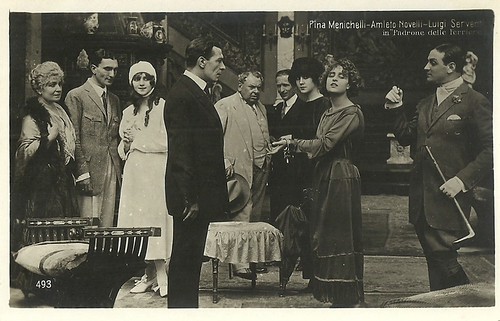
Italian postcard by Ed. G. Vettori, Bologna. Publicity still of Amleto Novelli, Pina Menichelli, and Luigi Serventi in Il padrone delle ferriere (Eugenio Perego, 1919), based on 'Le maitre des forges' by Georges Ohnet.

Italian postcard. Photo: Fert Film. Italia Almirante and Amleto Novelli in Zingari (Mario Almirante, 1920). Caption: The first encounter of Vielka (Italia Almirante) and Sindel (Amleto Novelli). The woman Novelli carries is maybe Rosetta Solari, who plays Radscia.
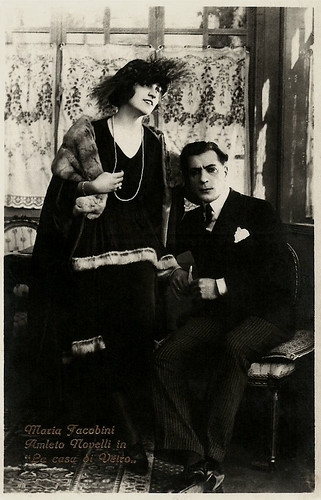
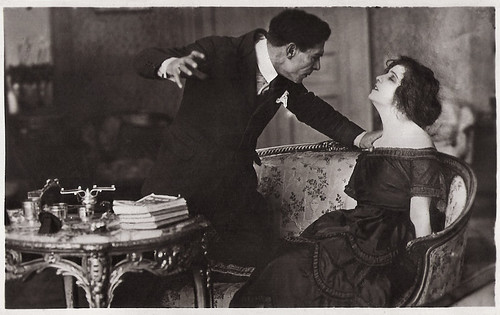
Italian postcard by G.B. Falci, Milano, no. 13. Photo: Maria Jacobini and Amleto Novelli in La casa di vetro / The Glass House (Gennaro Righelli, 1920).
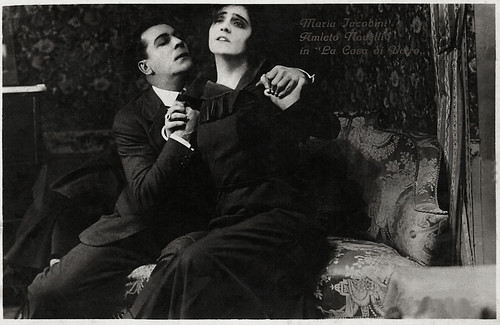
Italian postcard by Ed. G.B. Falci, Milano. Photo: Maria Jacobini and Amleto Novelli in La casa di vetro / The Glass House (Gennaro Righelli, 1920).
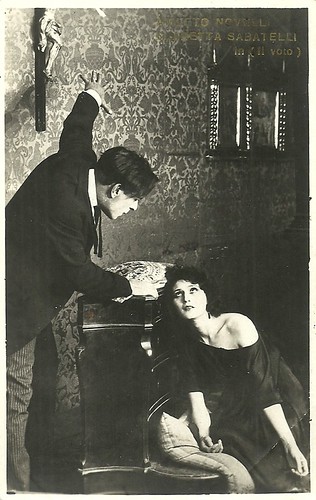
Italian postcard by G.B. Falci, Milano, no. 367. Photo: Fotominio. Claretta Sabatelli and Amleto Novelli in Il voto (Eugenio Fontana, 1921).

Italian postcard by G.B. Falci, Milano, no. 46. Photo: Fotominio. Maria Jacobini and Amleto Novelli in La preda / The Prey (Guglielmo Zorzi, 1921).

Italian postcard by G.B. Falci, Milano, no. 191. Photo: Amleto Novelli and Maria Moreno in La preda /The Prey (Guglielmo Zorzi, 1921).
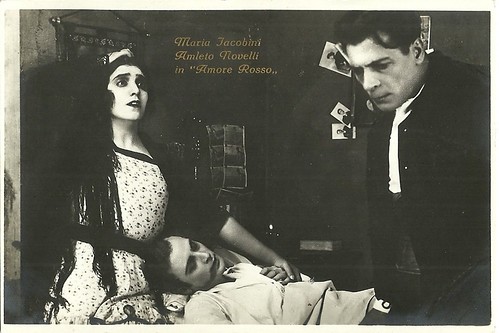
Italian postcard by G.B. Falci, Milano. Photo: Maria Jacobini, Lido Manetti and Amleto Novelli in Amore rosso / Red Love (Gennaro Righelli, 1921).
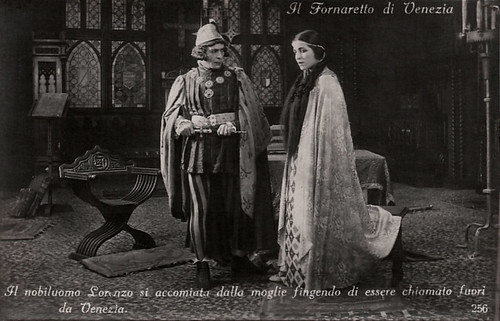
Italian postcard by G.B. Salci, Milano, no. 256. Photo: publicity still of Amleto Novelli and Nini Dinelli in Il fornaretto di Venezia (Mario Almirante 1923). Caption: The nobleman Lorenzo says farewell to his wife, pretending he is called outside of Venice.
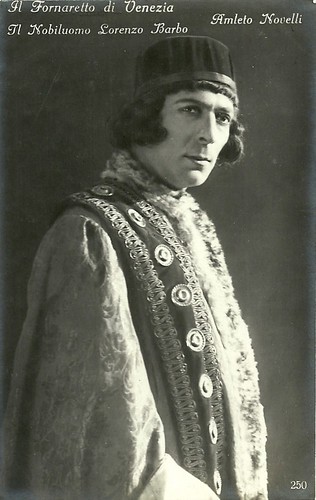
Italian postcard by G.B. Salci, Milano. Photo: Amleto Novelli as the nobleman Lorenzo Barbo in Il fornaretto di Venezia (Mario Almirante, 1923).
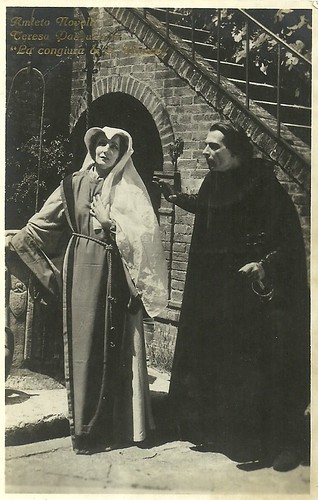
Italian postcard. Photo: Amleto Novelli (as Rolando Candiani) and Teresa Pasquali (la dogaressa) in La congiura di San Marco (Domenico Gaido, 1924), a sequel to Il ponte dei sospiri (Domenico Gaido, 1921) with Luciano Albertini. The plot deals with Rolando (Novelli), who has become the new doge and married the beautiful Leonora Dandolo (Ria Bruna). Yet, followers of the former, evil Doge, try to raise the people against Rolando. Rolando is not alone, because his loyal friend, Scalabrino (Celio Bucchi) and a woman from the people, Zanze (Bianca Stagno-Bellinicioni), help him. The film was very popular in Italy. at the time. Amleto Novelli died before the film was finished, so it was posthumously released.
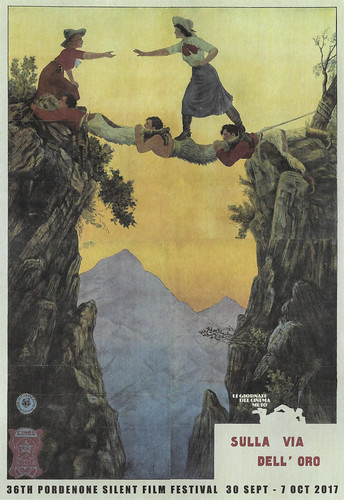
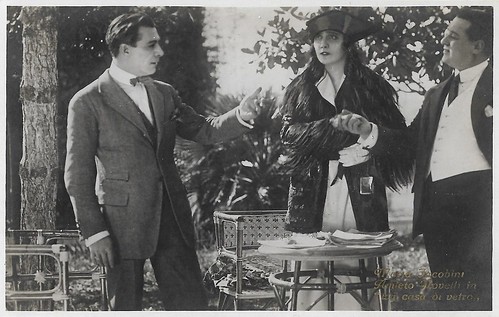
Postcard of the poster of the 36th Pordenone Silent Film Festival (Le Gionate del Cinema Muto), 30 sept - 7 oct 2017: Sulla via dell'oro / The Human Bridge (Baldassarre Negroni, 1913).
Sources: Denis Lotti (Muscoli e Frac - Italian), Sempre in penombra (Italian), Wikipedia (Italian and English) and IMDb.
This post was last updated on 3 January 2026.
Italian postcard by Fotocelere, Turin, no. 96.
Spanish postcard by La Novela Semanal Cinematografica, no. 186.
Italian postcard, no. 1069. Photo: publicity still for Madame Tallien / Madame Guillotine (Enrico Guazzoni, Mario Caserini, 1916).
Italian postcard by A. Traldi, Milano, no. 14. Photo: Fontana.
Italian postcard by G.B. Falci, Milano.
Italian postcard. Photo: Civirani, Rome.
Italian postcard by E. Vettori, Bologna, no. 224. Photo: Civirani, Rome.
Italian postcard. Photo: Giulio De Virgiliis, Genova.
Ardent and honest performance
Born in Bologna, Italy, and an orphan at age 12, Amleto Novelli remained home, taking care of his sisters and working as a civil servant until he was 22. Stagestruck Novelli then fled to Rome in 1906 to follow his passion and become a theatre actor. Soon, he was acting amidst young and old stage actors at the Teatro Tiberino. He was soon singled out for his ardent and honest performance, which, despite his lack of classical beauty, hugely attracted audiences. His passion and inflammability would also show when people living from cinema would despise it.
From 1908, he was performing at the Roman company Società Italiana Cines, first in numerous historical shorts such as Marco Visconti (Mario Caserini, 1909) and San Sebastiano / By Order of the Emperor (Enrique Santos, 1911), and contemporary tales such as In pasto ai leoni / The Lion Tamer's Revenge (Enrique Santos, 1912), Il trabocchetto punitore / Fatal Trap Door (1912) with Ermanno Roveri and Emilio Ghione, and La rupe del Malconsiglio / Blow for Blow (1913) with Enna Saredo.
Director Enrico Guazzoni directed him in the short historical films Agrippina (Enrico Guazzoni, 1911) about Agrippina the Younger (Adele Bianchi Azzarili) and Bruto / Brutus (Enrico Guazzoni, 1911). In the latter, he portrayed Marcus Junius Brutus the Younger, one of the assassins of Julius Caesar. Bruto was moderately successful.
When feature films came along, he starred as the virile Italian man in many epics directed by Guazzoni. He played the warm, sincere, and passionate Roman hero Marcus Vinicius in Quo Vadis? (Enrico Guazzoni, 1912-1913) and it became a triumph. The film was based on the 1896 novel by Henryk Sienkiewicz. Wikipedia: "It was arguably the first blockbuster in the history of cinema, with 5,000 extras, lavish sets, and a running time of two hours, setting the standard for 'superspectacles' for decades to come." The Cines production was a major international hit and a personal triumph for Novelli.
So he soon repeated this successful performance as Marc Anthony in Marcantonio e Cleopatra / Antony and Cleopatra (Enrico Guazzoni, 1914) adapted of William Shakespeare's play of the same title, with inspiration also drawn from a poem by Pietro Cossa, and as Julius Caesar in Caio Giulio Cesare / Julius Caesar (Enrico Guazzoni, 1914) with Bruto Castellani and Pina Menichelli. Taking its inspiration from William Shakespeare's 1599 play of the same title, the film portrays the events leading up to the assassination of Julius Caesar. It was produced on an epic scale, including vast sets recreating Ancient Rome and more than 20,000 extras.
Italian postcard by Film Cines, Roma, no. 6572. Photo: Gustavo Serena as Petronius Arbiter and Amleto Novelli as Marcus Vinicius in Quo Vadis? (Enrico Guazzoni, produced 1912, released 1913).
German postcard by BKWI, no. 35. Photo: Marc Anthony (Amleto Novelli), dressed as an Egyptian pharaoh, rejects his wife Octavia (Elsa Lenard) in Marcantonio e Cleopatra (Enrico Guazzoni, 1913).
Italian postcard by IPA CT Duplex, no. 3272. Photo: Films Cines. Lyda Borelli as Terese de Fontenay / Madame Tallien, and Amleto Novelli as Tallien in Madame Tallien (Enrico Guazzoni, 1916).
Italian postcard by Ed. Vettori, Bologna. Photo: Lyda Borelli and Amleto Novelli in Madame Tallien (Enrico Guazzoni, 1916).
Italian postcard by IPA CT Duplex. Photo: Film Cines. Lyda Borelli and Amleto Novelli in Malombra (Carmine Gallone, 1917). Caption: I don't know anything, I remember nothing. I never lived, never apart from now. I knew only you would come, this moment. I have the frenzy to enjoy it.
Italian postcard by IPA CT Duplex. Photo: Film Cines. Lyda Borelli and Amleto Novelli in Malombra (Carmine Gallone, 1917). Caption: ...at that moment she felt her waist held by the powerful hands of Silla, who lifted her back up the stairs.
Italian postcard by IPA CT Duplex. Photo: Film Cines. Lyda Borelli and Amleto Novelli in Malombra (Carmine Gallone, 1917). Caption: Here, she said, signing him to sit down on the ground next to her. All your memories...
Spanish postcard for Amatller Marca Luna chocolate, series 8, no. 7. Photo: Palatino Film. Augusto Mastripietri and Amleto Novelli in Fabiola (Enrico Guazzoni, 1918).
Male antagonist of the divas
Amleto Novelli also had a large share in the diva films as the male antagonist of Lyda Borelli in drama Marcia nuziale/The Wedding March (Carmine Gallone, 1915), Madame Tallien / Madame Guillotine (Enrico Guazzoni, Mario Caserini, 1916) and Malombra (Carmine Gallone, 1916), an adaptation of the 1881 novel Malombra by Antonio Fogazzaro.
With Pina Menichelli, he co-starred in Papà (Nino Oxilia, 1915) and Il padrone delle ferriere / The Railway Owner (Eugenio Perego, 1919), and with Francesca Bertini in Spiritismo (Camillo De Riso, 1919), La piovra / The Octopus (Edoardo Bencivenga, 1919) and L'ombra / The Shadow (Roberto Roberti, 1920).
He was the leading man of Soava Gallone in Avatar / The Magician (Carmine Gallone, 1916) and La chiamavano 'Cosetta' (Eugenio Perego, 1917), and of Maria Jacobini in La casa di vetro / The Glass House (Gennaro Righelli, 1920) and La preda / The Prey (Guglielmo Zorzi, 1921). Other divas with whom he worked were Italia Almirante and Diana Karenne.
Novelli continued to act in historical epics as well. These included Christus (Giuseppe Antamoro 1915), Fabiola (Enrico Guazzoni, 1918) featuring Elena Sangro, La Gerusalemme liberata / The Crusaders (Enrico Guazzoni, 1918) with Elena Sangro, Dante nella vita e nei tempi suoi (Domenico Gaido, 1922), and Il fornaretto di Venezia (Mario Almirante, 1923).
During the shooting of La casa dei pulcini in Turin (Mario Camerini, 1924) in Turin, Novelli suddenly died. He was only 38. The cause was encephalitis, a sudden-onset inflammation of the brain. Novelli was married to Adalgisa Orlandini. Post mortem, nine (!) films with him were released, including the historical epics La congiura di San Marco (Domenico Gaido, 1924), a sequel to Il ponte dei sospiri (1921), and Marco Visconti (Aldo De Benedetti, 1925), a remake of his 1909 film. Amleto Novelli had played in over 100 Italian silent films. In his study 'Muscoli e Frac' (Muscles and Tails), Italian film historian Denis Lotti is surprised that there is no monography on Novelli. Even though his name pops up in every film historiography.
Italian postcard by Ed. G. Vettori, Bologna, no. 525. Photo: Francesca Bertini and Amleto Novelli in La piovra / The Octopus (Edoardo Bencivenga, 1919).
Italian postcard by Ed. G. Vettori, Bologna. Publicity still of Amleto Novelli, Pina Menichelli, and Luigi Serventi in Il padrone delle ferriere (Eugenio Perego, 1919), based on 'Le maitre des forges' by Georges Ohnet.
Italian postcard. Photo: Fert Film. Italia Almirante and Amleto Novelli in Zingari (Mario Almirante, 1920). Caption: The first encounter of Vielka (Italia Almirante) and Sindel (Amleto Novelli). The woman Novelli carries is maybe Rosetta Solari, who plays Radscia.
Italian postcard by G.B. Falci, Milano, no. 13. Photo: Maria Jacobini and Amleto Novelli in La casa di vetro / The Glass House (Gennaro Righelli, 1920).
Italian postcard by Ed. G.B. Falci, Milano. Photo: Maria Jacobini and Amleto Novelli in La casa di vetro / The Glass House (Gennaro Righelli, 1920).
Italian postcard by G.B. Falci, Milano, no. 367. Photo: Fotominio. Claretta Sabatelli and Amleto Novelli in Il voto (Eugenio Fontana, 1921).
Italian postcard by G.B. Falci, Milano, no. 46. Photo: Fotominio. Maria Jacobini and Amleto Novelli in La preda / The Prey (Guglielmo Zorzi, 1921).
Italian postcard by G.B. Falci, Milano, no. 191. Photo: Amleto Novelli and Maria Moreno in La preda /The Prey (Guglielmo Zorzi, 1921).
Italian postcard by G.B. Falci, Milano. Photo: Maria Jacobini, Lido Manetti and Amleto Novelli in Amore rosso / Red Love (Gennaro Righelli, 1921).
Italian postcard by G.B. Salci, Milano, no. 256. Photo: publicity still of Amleto Novelli and Nini Dinelli in Il fornaretto di Venezia (Mario Almirante 1923). Caption: The nobleman Lorenzo says farewell to his wife, pretending he is called outside of Venice.
Italian postcard by G.B. Salci, Milano. Photo: Amleto Novelli as the nobleman Lorenzo Barbo in Il fornaretto di Venezia (Mario Almirante, 1923).
Italian postcard. Photo: Amleto Novelli (as Rolando Candiani) and Teresa Pasquali (la dogaressa) in La congiura di San Marco (Domenico Gaido, 1924), a sequel to Il ponte dei sospiri (Domenico Gaido, 1921) with Luciano Albertini. The plot deals with Rolando (Novelli), who has become the new doge and married the beautiful Leonora Dandolo (Ria Bruna). Yet, followers of the former, evil Doge, try to raise the people against Rolando. Rolando is not alone, because his loyal friend, Scalabrino (Celio Bucchi) and a woman from the people, Zanze (Bianca Stagno-Bellinicioni), help him. The film was very popular in Italy. at the time. Amleto Novelli died before the film was finished, so it was posthumously released.
Postcard of the poster of the 36th Pordenone Silent Film Festival (Le Gionate del Cinema Muto), 30 sept - 7 oct 2017: Sulla via dell'oro / The Human Bridge (Baldassarre Negroni, 1913).
Sources: Denis Lotti (Muscoli e Frac - Italian), Sempre in penombra (Italian), Wikipedia (Italian and English) and IMDb.
This post was last updated on 3 January 2026.