Today's film special is on the German expressionist film Metropolis (Fritz Lang, 1927). A few years ago, my son and I saw a screening in the Castro Theatre in San Francisco of a newly restored version of this Science-Fiction epic, based on Lang’s original cut of the film. We were both mesmerised by the sheer force and beauty of this silent classic. Everyone should see this film! At the time of the premiere in 1927, Ross Verlag made a series of sepia postcards for Metropolis.
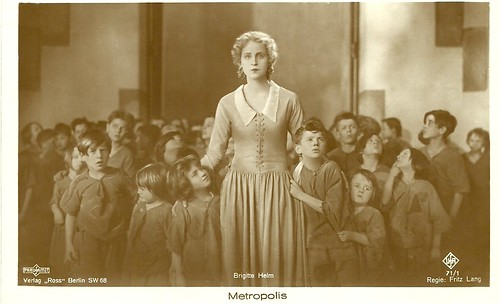
German postcard by Ross Verlag, Berlin, no. 71/1. Photo: Ufa / Parufamet. Publicity still for Metropolis (Fritz Lang, 1927) with Brigitte Helm as the good Maria. Collection: Didier Hanson.
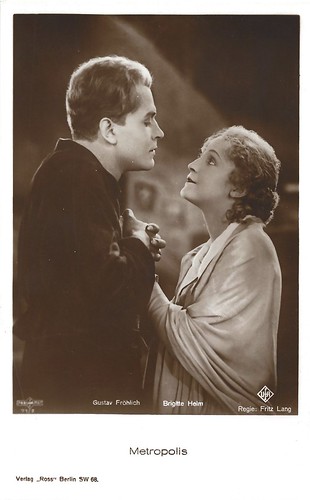
German postcard by Ross Verlag, Berlin, no. 71/2. Photo: Ufa / Parufamet. Gustav Fröhlich and Brigitte Helm in Metropolis (Fritz Lang, 1927).
German postcard by Ross Verlag, Berlin, no. 71/3. Photo: Ufa / Parufamet. Gustav Fröhlich in Metropolis (Fritz Lang, 1927).
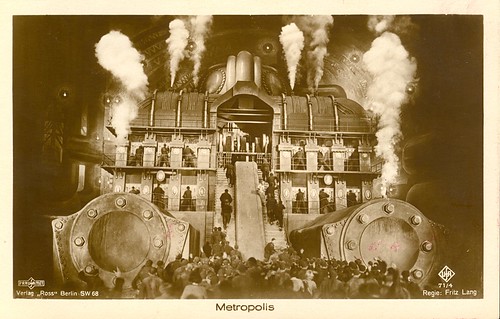
German postcard by Ross Verlag, Berlin, no. 71-4. Photo: Ufa / Parufamet. Publicity still for Metropolis (Fritz Lang, 1927). Collection: Amsterdam EYE Filmmuseum.
The first Science Fiction feature
The screenplay for Metropolis was written by Fritz Lang and his wife Thea von Harbou. It would become the first feature-length film of the science fiction genre. Metropolis is set in a futuristic urban dystopia. Wealthy industrialists rule the vast city of Metropolis from high-rise tower complexes, while a lower class of underground-dwelling workers toil constantly to operate the machines that provide its power.
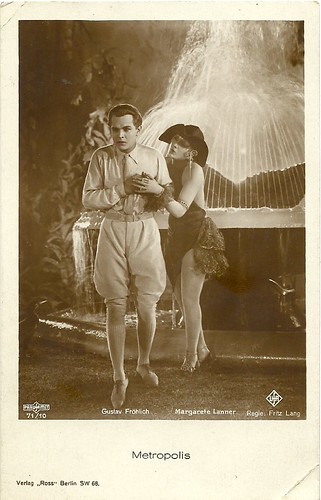
The Master of Metropolis is the ruthless Joh Fredersen (Alfred Abel), whose son Freder (Gustav Fröhlich) idles away his time in a pleasure garden with the other children of the rich.
Freder is interrupted by the arrival of a young woman named Maria (Brigitte Helm), who has brought a group of workers' children to see the privileged lifestyle led by the rich. Maria and the children are quickly ushered away, but Freder is fascinated by Maria and descends to the workers' city in an attempt to find her.
Metropolis follows the attempts of Freder and Maria to overcome the vast gulf separating the classes of their city. One of the highlights of the film is the spectacular explosion of a huge machine in the machine rooms, which causes several injuries and deaths.
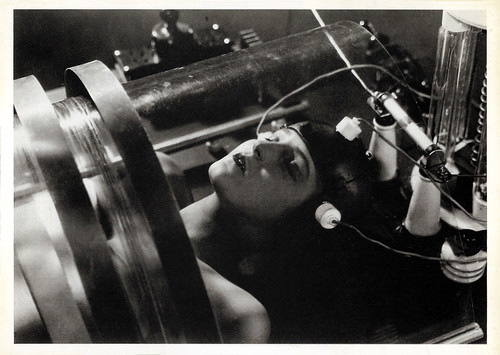
Another highlight is the creation scene of the Maschinenmensch (Machine-Human), a false Maria, which must ruin Maria's reputation among the workers. The false Maria (also Brigitte Helm) unleashes chaos throughout Metropolis, driving men to murder out of lust for her and stirring dissent amongst the workers.
German postcard by Ross Verlag, Berlin, no. 71/5. Photo: Ufa Parufamet. Brigitte Helm, Rudolf Klein-Rogge and Alfred Abel in Metropolis (Fritz Lang, 1927).
German postcard by Ross Verlag, no. 71/6. Photo: Parufamet / Ufa. Rudolf Klein-Rogge and Brigitte Helm in Metropolis (Fritz Lang, 1926). Collection: Marlene Pilaete.
German postcard by Ross Verlag, Berlin, no. 71/10. Photo: Ufa / Parufamet. Publicity still for Metropolis (Fritz Lang, 1927) with Gustav Fröhlich and Margarete Lanner. Collection: Didier Hanson.
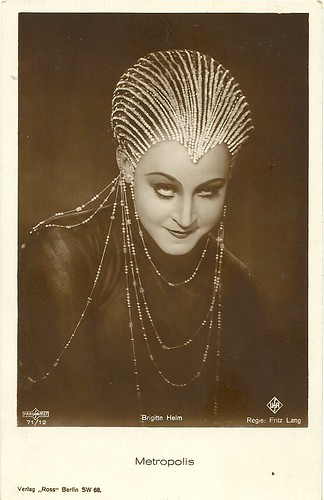
German postcard by Ross Verlag, Berlin, no. 71/12. Photo: Ufa / Parufamet. Publicity still for Metropolis (Fritz Lang, 1927) with Brigitte Helm as the false Maria. Collection: Didier Hanson.
The most expensive film
Metropolis was filmed in 1925, at a cost of approximately five million Reichsmarks. Thus, it was the most expensive film ever released up to that point. The two leading actors in the film were unknowns: nineteen-year-old Brigitte Helm had no previous film experience.
Gustav Fröhlich had only played secondary roles before landing his breakthrough role as Freder Fredersen. The part came about by chance. Fröhlich was only scheduled to play one of the workmen but four weeks after the beginning he was discovered on the set by Thea von Harbou. Fritz Lang immediately cast him in the lead because of his striking good looks.
Two new stars were born, but the film itself was met with a mixed response upon its initial release. Many critics praised its technical achievements and social metaphors while others derided its 'simplistic and naïve' presentation.
Because of its long running time and the inclusion of footage which censors found questionable, Metropolis was cut substantially after its German premiere: large portions of the film were lost over the subsequent decades.
Numerous attempts have been made to restore the film since the 1970s-80s. In 2001, the film was inscribed on UNESCO's Memory of the World Register, the first film thus distinguished. In 2008, a damaged print of Lang’s original cut of the film was found in a museum in Argentina. After a long restoration process, the film was 95% restored and shown in a limited theatrical re-release in 2010.
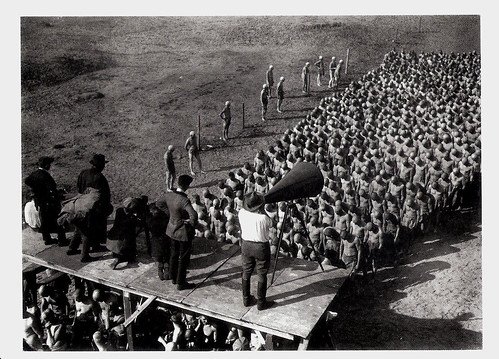
Swiss postcard by Musée de l'Elysée, Lausanne / News Productions, Baulmes, no. 55468. Photo: Horst von Harbou / Collection de la Cinemathèque française, Paris. Caption: Fritz Lang during the shooting of Metropolis, 1926.
Swiss postcard by Musée de l'Elysée, Lausanne / News Productions, Baulmes, no. 55459. Photo: Horst von Harbou, 1926 / Collection de la Cinemathèque française, Paris. Brigitte Helm in Metropolis (Fritz Lang, 1927).
Swiss postcard by Musée de l'Elysée, Lausanne / News Productions, Baulmes, no. 55458. Photo: Horst von Harbou / Collection de la Cinemathèque française, Paris. Caption: Fritz Lang during the shooting of Metropolis, 1926.
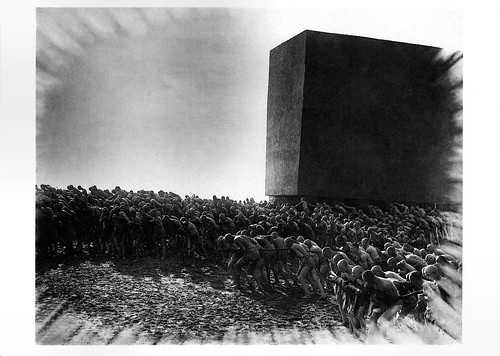
German press photo by the Stiftung Deutsche Kinemathek for the exhibition 'Kino * Movie * Cinema' (1995) in Martin-Gropius-Bau, Berlin. Design: Erich Kettelhut. Set design for Metropolis (Fritz Lang, 1927).
Swiss postcard by News Productions, Baulmes, no. 55461. Photo: Horst von Harbou / Collection de la Cinémathèque française, Paris. Publicity still for Metropolis (Fritz Lang, 1927).
Swiss postcard by News Productions, Baulmes, no. 55463. Photo: Horst von Harbou / Collection de la Cinémathèque française, Paris. Publicity still for Metropolis (Fritz Lang, 1927).
Swiss postcard by News Productions, Baulmes / CVB Publishers, no. 56536. Photo: Horst von Harbou / Collection de la Cinémathèque Suisse.Gustav Fröhlich as Freder in Metropolis (Fritz Lang, 1927). Freder, the privileged son of the master of Metropolis, appears to be crucified on a clock as he tries to stop it.
Swiss postcard by News Productions, Baulmes, no. 56538. Photo: Horst von Harbou / Collection de la Cinémathèque française, Paris. Publicity still for Metropolis (Fritz Lang, 1927).
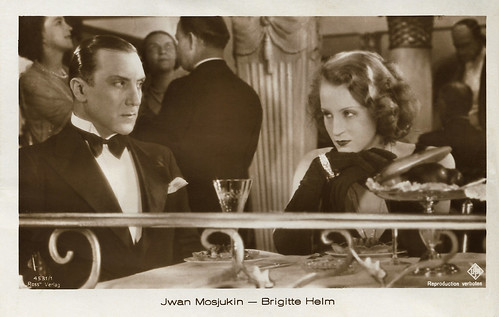
We're in Pordenone, Italy, for Le Giornate del Cinema Muto. One of the sections is 'The Canon Revisited' and the highlight for us is Manolescu - Der König der Hochstapler/Manolescu, the Prince of Adventures (Viktor Tourjansky, 1929) with Ivan Mozzhukhin. The female star is the sophisticated German actress Brigitte Helm (1906-1996). She is a legend because of her dual role as the noble Maria and as her evil double, the hypersexed robot Maria in Metropolis (Fritz Lang, 1927). After her debut in this silent science-fiction classic, she starred in over 30 films in which she often portrayed a cool, unobtainable vamp. Helm easily made the transition to sound film, but in 1935 she suddenly retired.
German postcard by Ross Verlag, no. 4531/1. Photo: Ufa. Ivan Mozzhukhin and Brigitte Helm in Manolescu - Der König der Hochstapler/Manolescu, the Prince of Adventures (Viktor Tourjansky, 1929).
German postcard by Ross Verlag, Berlin, no. 71/12. Photo: Ufa / Parufamet. Brigitte Helm in Metropolis (Fritz Lang, 1927). Collection: Didier Hanson.
German postcard by Ross Verlag, no. 1481/1, 1927-1928. Photo: Ufa.
German postcard by Ross Verlag, no. 4146/1, 1929-1930. Photo: Ufa.
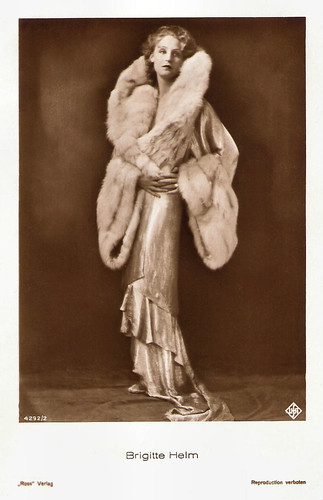
German postcard by Ross Verlag, no. 4292/2, 1929-1930. Photo: Ufa.
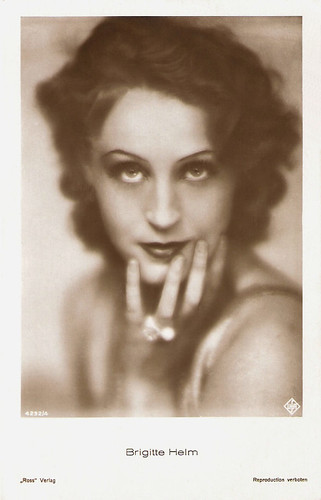
German postcard by Ross Verlag, no. 4292/4, 1929-1930. Photo: Ufa.
German postcard by Ross Verlag, no. 4876/1, 1929-1930. Photo: Ufa-Harlip.
Metropolis
Brigitte Helm was born as Brigitte Eva Gisela Schittenhelm in Berlin, Germany, in 1906 (some sources say 1908). Her father was a Prussian army officer, who left his wife a widow not long after.
Brigitte gained her acting experience in school productions but never thought of acting classes. After her school exams, she wanted to be an astronomer. But then she was discovered by the famous director Fritz Lang for the lead in Metropolis (Fritz Lang, 1927), then the most expensive German film ever made.
Her mother had sent a photograph of her beautiful 16-years-old daughter to Lang's wife, scriptwriter Thea von Harbou. Helm was invited to the set of Die Nibelungen and was given a screen test. She got the double role of the noble and virginal Maria and her evil and sensual twin, the Maschinenmensch, a robot created to urge the workers in revolting and destroying their own city.
In their 1996 obituary in The New York Times, Robert McThomas and Peter Herzog note: "The film depicts the world of 2006, a time, Lang envisioned, when a ruling class lives in decadent luxury in the loft heights of skyscrapers linked by aerial railways, while beneath the streets slave-like workers toll in unbearable conditions to sustain their masters.
But for all the steam and special effects, for many who have seen the movie in it various incarnations, including a tinted version and one accompanied by music, the most compelling lingering image is neither the towers above nor the hellish factories below. It is the staring transformation of Ms. Helm from an idealistic young woman into a barely clad creature performing a lascivious dance in a brothel." Metropolis made Brigitte Helm a star overnight.
German postcard by Ross Verlag, no. 71/6. Photo: Parufamet / Ufa. Rudolf Klein-Rogge and Brigitte Helm in Metropolis (Fritz Lang, 1926). Collection: Marlene Pilaete.
Dutch postcard by Filma. Brigitte Helm in Die Herrin von Atlantis/Lost Atlantis (Georg Wilhelm Pabst, 1932). Caption: Friday 6 December Premiere at the Tuschinski Theatre. Collection: Marlene Pilaete.
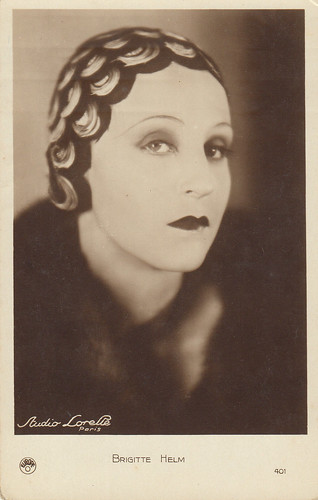
French postcard by Europe, no. 401. Photo: Studio Lorelle, Paris. Brigitte Helm in L'Argent/The Money (Marcel L’ Herbier, 1928). Collection: Marlene Pilaete.
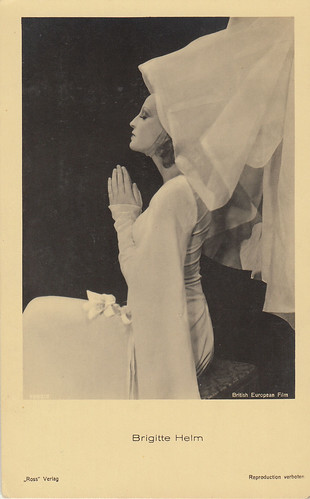
German postcard by Ross Verlag, no. 7882/1, 1932-1933. Photo: British European Film. Brigitte Helm in The Blue Danube (Herbert Wilcox, 1931). Collection: Marlene Pilaete.
Latvian postcard by EMBR, no. 1213. Photo: Ufa. Brigitte Helm and Sybille Schmitz in Ein idealer Gatte/An Ideal Husband (Herbert Selpin, 1935). Collection: Marlene Pilaete.
Italian postcard by Eliocromia Zacchetti e C. Milano, no. A57. Brigitte Helm by Nino Za. Collection: Marlene Pilaete.
Ice Queen
UFA gave Brigitte Helm a contract, and over the next 10 years, she acted in 29 German, French, and English films.
She was cast as the evil but oh so seductive protagonist in the Sci-Fi-horror film Alraune. First in the silent version of 1928, directed by Henrik Galeen.
Hal Erickson at AllMovie: "Hanns Heinz Ewers' grim science-fiction novel 'Alraune' has already been filmed twice when this version was assembled in 1928. In another of his 'mad doctor' roles, Paul Wegener plays Professor Brinken, the sociopathic scientist who combines the genes of an executed murderer with those of a prostitute.
The result is a beautiful young woman named Alraune (Brigitte Helm), who is incapable of feeling any real emotions - least of all guilt or regret. Upon attaining adulthood, Alraune sets about to seduce and destroy every male who crosses her path. Ultimately, Professor Brinken is hoist on his own petard when he falls hopelessly in love with Alraune himself."
Two years later Helm also starred in the sound version, Alraune/A Daughter of Destiny (Richard Oswald, 1930), for which the Dutch postcard lower in this post was made.
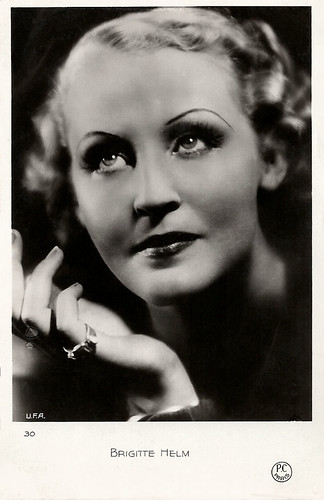
French postcard by P.C. Paris, no. 30. Photo: Ufa.
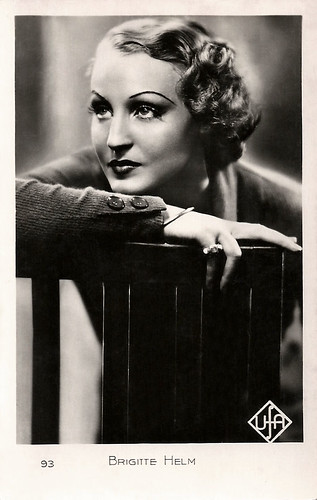
French postcard, no. 93. Photo: Ufa.
French postcard by Cine-Europe, no. 66. Photo: Studio Lorelle.
French postcard by Cine-Europe, no. 1074. Photo: Studio G.L. Manuel Frères, Paris.
French postcard, no. 51. Brigitte Helm in Spione am Werk/Spies at Work (Gerhard Lamprecht, 1933).
Mysterious Adaptability
Brigitte Helm played a helpless blind woman who is seduced by a rogue in the wartime melodrama Die Liebe der Jeanne Ney/The Love of Jeanne Ney (G.W. Pabst, 1927).
It was Brigitte Helm's first project with Georg Wilhelm Pabst, the director who could - better than any other director - bring out her mysterious adaptability. In his films Abwege/The Devious Path (1928) and L’Atlantide/Die Herrin von Atlantis/Queen of Atlantis (1932) she proved that she could perform more restrained and emotionally expressive characters.
In Abwege, she portrays a spoilt woman of the world who from sheer boredom almost destroys her own life. In L'Atlantide (1932), Helm plays a goddess, the mere sight of whom makes men crazy.
Werner Sudendorff wrote in his obituary of Helm in The Independent: "Her power is not of this world, but incomprehensible, magical. This was Helm's last really great role, a legendary mysterious sphinx of the German cinema."
These films and Marcel L'Herbier's late silent film L'Argent/The Money (Marcel L’ Herbier, 1928) allowed Helm to act outside the tired cliches she was later often subjected to by scriptwriters and producers.
French postcard by JRPR, Paris, no. 337. Photo: Studio Lorelle (Lucien Lorelle), Paris. Brigitte Helm in L'Argent/The Money (Marcel L'Herbier, 1928).
French postcard by JRPR, Paris, no. 338. Photo: Studio Lorelle, Paris. Publicity still for L'Argent/The Money (1928).
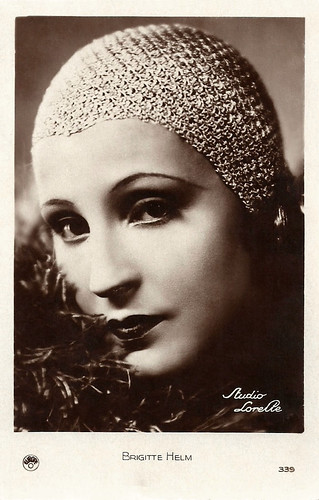
French postcard by Cine-Europe, no. 339. Photo: Studio Lorelle. Publicity still for L'Argent/The Money (1928).
Austrian postcard by Iris-Verlag, no. 5789. Photo: Studio Lorelle, Paris / Verleih Weil & Co. Publicity still for L'Argent/The Money (1928).
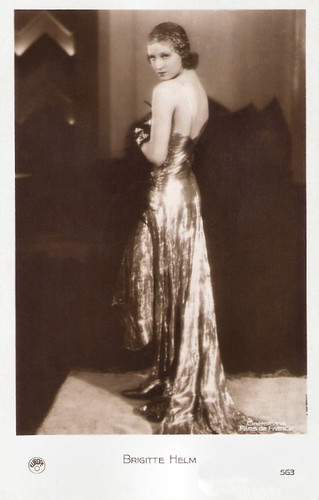
French postcard by Europe, no. 563. Photo: Cinéromans Films de France. Brigitte Helm in L'argent/The Money (Marcel L'Herbier, 1928), freely adapted from the novel by Emile Zola.
Restricting Clauses
Brigitte Helm's first sound film was the musical Die singende Stadt/City of Song (Carmine Gallone, 1930) with Jan Kiepura. She also appeared in the French and English versions of her German films.
Werner Sudendorff: "In her films of the early 1930s Brigitte Helm became the embodiment of the down-to-earth, affluent modern woman. With her slim figure and austere pre-Raphaelite profile, she seems unapproachable, a model fashion-conscious woman, under whose ice-cold outer appearance criminal energies flicker."
However, her sound films, like Gloria (Hans Behrendt, 1931), The Blue Danube (Herbert Wilcox, 1932), and Gold/L’Or (Karl Hartl, 1934), do not have the artistic cachet of her best silent films.
Her relationship with the Ufa happened to be very rocky. While the studio had made her a star and kept increasing her pay, the actress was unhappy with the material the Ufa offered her and she was annoyed about the restrictive clauses dictating her weight.
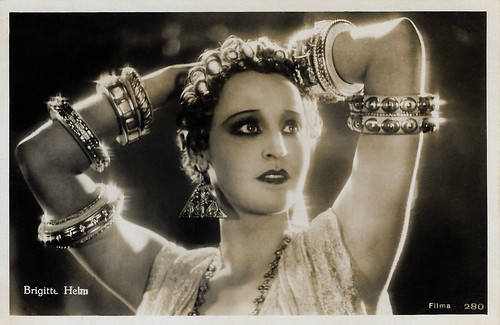
Dutch postcard by Filma, no. 280. Brigitte Helm in L'Atlantide/Die Herrin von Atlantis/Lost Atlantis (Georg Wilhelm Pabst, 1932).
Dutch postcard by Filma, no. 325.
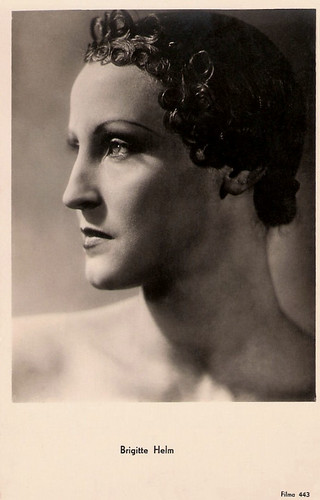
Dutch postcard by Filma, no. 443. Photo: publicity still for L’Atlantide/Queen of Atlantis (1932).
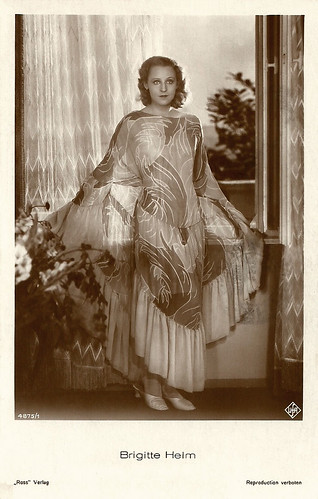
German postcard by Ross Verlag, no. 4875/1, 1929-1930. Photo: Ufa.
German postcard by Ross Verlag, no. 4875/3, 1929-1930. Photo: Ufa.
German postcard by Ross Verlag, no. 5019/2, 1930-1931. Photo: Ufa.
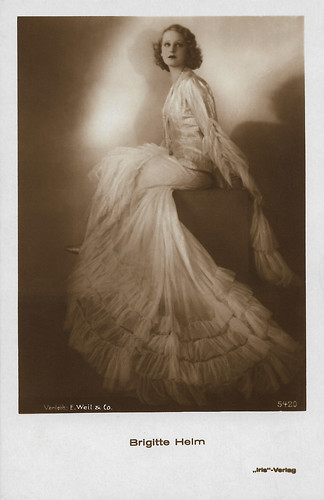
Austrian postcard by Iris Verlag, no. 5420. Photo: Verleih E. Weil & Co.
Blue Angel
Reportedly Brigitte Helm was Josef Von Sternberg's original choice for the starring role of Der Blaue Engel/The Blue Angel (1930), but the part went to Marlene Dietrich.
Helm was also James Whale's first choice for his Bride of Frankenstein (1935), but reportedly she refused to go to America.
In 1935, angered by the Nazi control of the German film industry, she didn’t extend her contract with the Ufa. Perhaps another reason for her decision were the negative press reports about her many traffic accidents and the short prison sentence as a result of it.
Her last film was Ein Idealer Gatte/An Ideal Husband (Herbert Selpin, 1935), an adaptation of the play by Oscar Wilde.
German postcard by Ross Verlag, no. 3350/1, 1928-1929. Photo: Ams-Film.
German postcard by Ross Verlag, no. 4292/3, 1929-1930. Photo: Ufa.
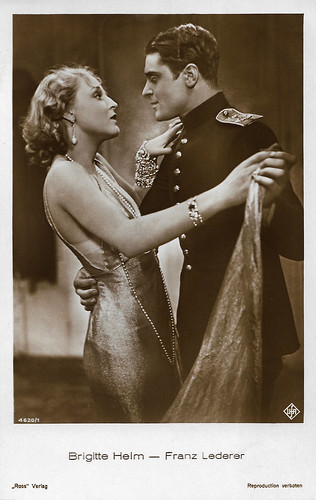
German postcard by Ross Verlag, no. 4620/1, 1929-1930. Photo: Ufa. Brigitte Helm and Franz Lederer in Die wunderbare Lüge der Nina Petrowna/The Wonderful Lies of Nina Petrovna (Hanns Schwarz, 1929).
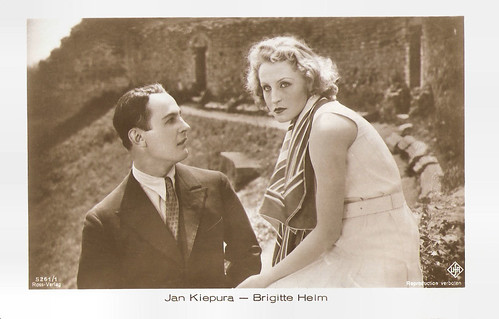
German postcard by Ross Verlag, no. 5261/1, 1930-1931. Photo: Ufa. Jan Kiepura and Brigitte Helm in Die singende Stadt/The Singing City (Carmine Gallone, 1930).
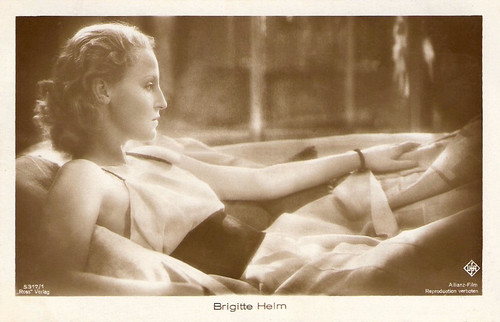
German postcard by Ross Verlag, no. 5317/1, 1930-1931. Photo: Allianz Film / Ufa.
German postcard by Ross Verlag, no. 5318/1, 1930-1931. Photo: Ufa.
Timid, Modest and Not Very Ambitious
In private, Brigitte Helm was a timid, modest, and not very ambitious personality. In 1935, after a short but prolific career of 32 films, she married Dr. Hugo Von Kunheim, a German industrialist of Jewish descent, and retired.
Bruce Eder at AllMovie: "in addition to no longer needing to pursue her acting, with which she was never 100-percent comfortable, she was repelled by the takeover of the German movie industry by the Hitler government.
Her marital status, coupled with her anti-Nazi political views, made it impossible for Helm to continue working in movies or living in Germany. From 1935 onward, the couple lived in Switzerland. After the war, they divided their time between Germany and Switzerland, but Helm chose to live quietly and remain anonymous."
The pair would raise four children. In 1968 Helm received the Filmband in Gold for “continued outstanding individual contributions to German film over the years". She steadfastly refused to appear in a film again, nor even grant an interview about her film career, but she always answered requests from her old fans for her signature.
Brigitte Helm died in 1996 in Ascona, Switzerland. In particular, her Evil Maria won't be forgotten. Apt for her is the Mae West line: "When I am good, I am very good; but when I am bad, I am better."
German collectors card in the Moderne Schönheitsgalerie Series by Ross Verlag, no 6 (of 300). Photo: Ufa. The card was a supplement to 'Edelzigarette' (precious cigarette) Kurmark.
German collectors card in the Unsere Bunten Filmbilder series by Ross Verlag, no. 5 (of 275). Photo: Ufa. The card was a supplement to 'Salem Zigaretten', Dresden.
German collectors card in the Unsere Bunten Filmbilder series by Ross Verlag for Cigarettenfabrik Josetti, Berlin, no. 7 (of 275). Photo: Ufa.
Italian postcard by Ross Verlag, no. 5501/2, 1930-1931. Distributed in Italy by Ballerini & Frattini, Florence. Photo: Ufa. Brigitte Helm in Alraune/A Daughter of Destiny (Richard Oswald, 1930).
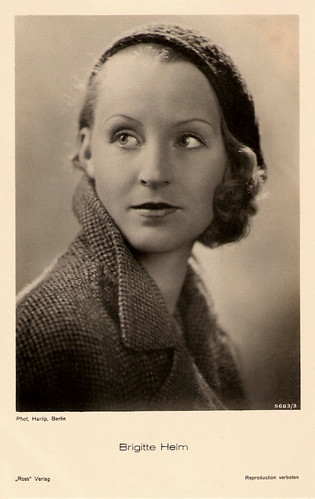
German postcard by Ross Verlag, no. 5683/3, 1930-1931. Photo: Harlip, Berlin.
German postcard by Ross Verlag, no. 6141/1, 1931-1932. Photo: Emelka. Gustav Fröhlich and Brigitte Helm in Gloria (Hans Behrendt, 1931).
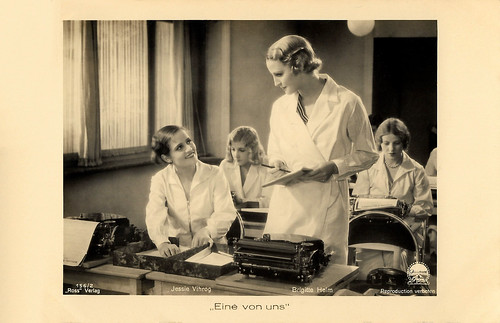
German postcard by Ross Verlag, no. 156/2. Photo: Paramount. Jessie Vihrog and Brigitte Helm in Eine von uns/One of Us (Johannes Meyer, 1932).
German postcard by Ross Verlag, no. 9081/1, 1935-1936. Photo: Ufa. Albrecht Schoenhals and Brigitte Helm in Fürst Woronzeff/Prince Woronzeff (Arthur Robison, 1934).
Dance scene from Metropolis (1927). Source: TheGuyThatSucks (YouTube).
Scene from Abwege/The Devious Path (1928). Brigitte Helm (as Mrs. Irene Beck) is woken up by her friends from the party, where she was the day before. Source: XY (YouTube).
Scene from L’Atlantide/Queen of Atlantis (1932). Source: XY (YouTube).