Showing posts with label Tony Curtis. Show all posts

16 December 2024

Spartacus (1960)

In Spartacus (1960), Kirk Douglas played his most famous role as the Thracian slave and rebel who led a revolt in the Roman empire in 73 B.C. The historical epic, written by blacklisted Dalton Trumbo, parallels 1950s American history with the House Committee on un-American Activities hearings and the civil rights movement. The film became a huge box-office success and won four Oscars. Although it is considered a classic, director Stanley Kubrick disowned the film. The clashes behind the scenes rivalled those in the film.

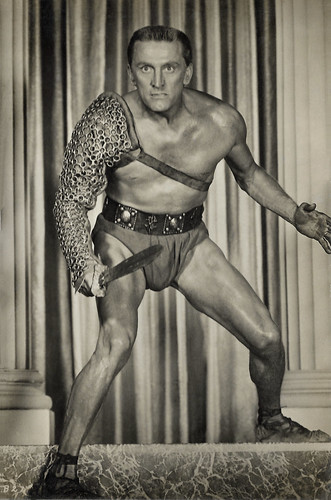
Kirk Douglas in Spartacus (1960)
Spanish postcard by Archivo Bermejo, no. 7143. Photo: Universal International, 1960. Kirk Douglas in Spartacus (Stanley Kubrick, 1960).

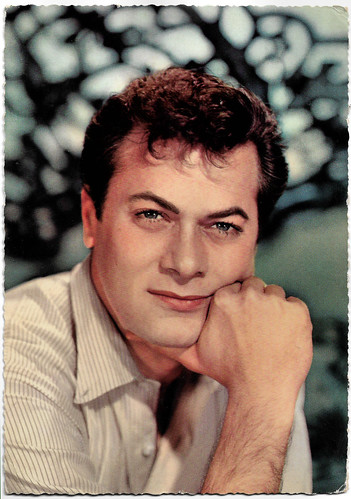
Tony Curtis in Spartacus
Yugoslavian postcard by Z.K., no. 1399. Tony Curtis in Spartacus (Stanley Kubrick, 1960).

John Gavin as Julius Caesar in Spartacus (1960)
Spanish postcard by Archivo Bermejo, no. 7206. Photo: Universal International. John Gavin as Julius Caesar in Spartacus (Stanley Kubrick, 1960).

Spartacus (1960)
British postcard in the Cinema series. French affiche for Spartacus (Stanley Kubrick, 1960).

A very rebellious slave


Spartacus (Stanley Kubrick, 1960) is based on a novel by Howard Fast about the historical slave leader Spartacus. The story is situated in 73 B.C. The Roman Republic has slid into corruption, its menial work done by slaves. The hero is a Thracian slave working in a salt mine in Libya. Spartacus (Kirk Douglas) is known as a very rebellious person and after defending an older slave one day, he is sentenced to death by starvation.

Before that happens, however, Spartacus is spotted by Roman businessman Lentulus Batiatus (Peter Ustinov) who buys him with the plan to train him as a gladiator. Amid the abuse at the gladiatorial school, Spartacus forms a quiet relationship with Varinia (Jean Simmons), a serving woman whom he refuses to rape when she is sent to 'entertain' him in his cell. One day, the school is visited by wealthy Roman senator Marcus Licinius Crassus (Laurence Olivier), who aims to become the dictator of Rome. Crassus eventually buys Varinia, and for the amusement of his companions arranges for Spartacus and others to fight to the death. When Spartacus is disarmed, his opponent, an Ethiopian named Draba (Woody Strode), spares his life in a burst of defiance. Draba attacks the Roman audience, only to be speared in the back by a guard and killed by Crassus.

When Crassus then also takes Varinia as his slave, Spartacus has had enough. He calls on all the gladiators to revolt. Batiatus flees while the gladiators overwhelm their guards and escape into the countryside. Spartacus is elected chief of the fugitives and decides to lead them out of Italy and back to their homes. He starts training an army of slaves and gladiators, which soon grows to 70,000 men. The uprising soon spreads across the Italian Peninsula involving thousands of slaves. The slaves' plan is to acquire sufficient funds to buy ships from Silesian pirates who could then transport them to other lands from Brandisium in the south.

Spartacus is successful as his army wins one victory after another. He also finds Varinia again. The Roman Senate deployed all means to stop Spartacus' army. Every attempt fails and several Senate members retreat in shame over these defeats. The Roman Senate becomes increasingly alarmed as Spartacus defeats every army sent against him. Crassus' opponent the Roman Senator Gracchus (Charles Laughton) knows that his rival will try to use the crisis as a justification for seizing control of the Roman army. To try to prevent this, Gracchus channels as much military power as possible into the hands of his own protégé, the young senator Julius Caesar (John Gavin). Although Caesar lacks Crassus' contempt for the lower classes of Rome, he mistakes the man's rigid outlook for a patrician. Thus, when Gracchus reveals that he has bribed the Silesians to get Spartacus out of Italy and rid Rome of the slave army, Caesar regards such tactics as beneath him and goes over to Crassus.

Crassus uses a bribe of his own to make the pirates abandon Spartacus and has the Roman army secretly force the rebels away from the coastline towards Rome. Amid panic that Spartacus means to sack the city, the Senate gives Crassus absolute power. Now surrounded by Roman legions, Spartacus persuades his men to die fighting. Just by rebelling and proving themselves human, he says that they have struck a blow against slavery. In the ensuing battle, most of the slave army is massacred. The Romans try to locate the rebel leader for special punishment by offering a pardon (and return to enslavement) if the men identify Spartacus. Every surviving man responds by shouting "I'm Spartacus!". Crassus has them all sentenced to death by crucifixion along the Via Appia, where the revolt began.

Tony Curtis and Kirk Douglas at the set of Spartacus (1960)
French postcard in the Entr'acte series by Éditions Asphodèle. Mâcon, no. 001/27. Photo: Tony Curtis and Kirk Douglas at the set of Spartacus (Stanley Kubrick, 1960). Caption: Tony Curtis and Kirk Douglas discuss a film shot.
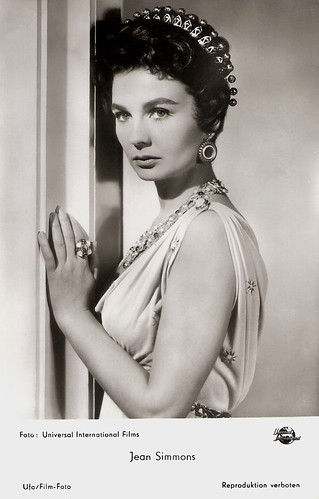
Jean Simmons in Spartacus (1960)
West German postcard by Ufa/Film-Foto, Berlin-Tempelhof, no. FK 4978. Photo: Universal International Films. Jean Simmons in Spartacus (Stanley Kubrick, 1960).

Kirk Douglas and Peter Ustinov in Spartacus (1960)
Romanian collectors card. Photo: Kirk Douglas and Peter Ustinov in Spartacus (Stanley Kubrick, 1960).
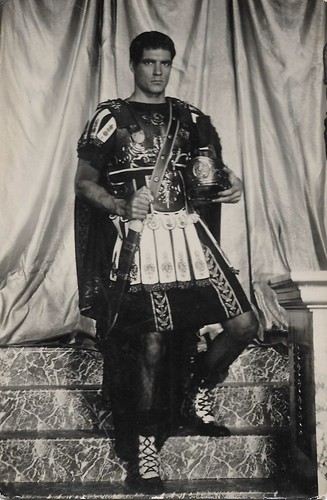
John Gavin as Julius Caesar in Spartacus (1960)
Spanish postcard by Archivo Bermejo, no. 7210. Photo: Universal International. John Gavin as Julius Caesar in the Technirama film Spartacus (Stanley Kubrick, 1960).

Laurence Olivier and Peter Ustinov at the set of Spartacus (1960)
French postcard in the Entr'acte series by Éditions Asphodèle, Mâcon, no. 004/8. Photo: Collection B. Courtel / D.R. Laurence Olivier and Peter Ustinov on the set of Spartacus (Stanley Kubrick, 1960). Caption: Contrast of eras between the clothing of Laurence Olivier and that of the director and actor Peter Ustinov.

Clashes on the set


Kirk Douglas was the star of Spartacus (196O) and he was also the co-producer of the film through his company, Bryna Productions. Douglas had an unhappy time for most of the production. First, Douglas purchased the rights to Howard Fast's novel out of his own money. Universal agreed to finance the film after Douglas told them that he had secured Laurence Olivier, Charles Laughton and Peter Ustinov to appear in it. Author Howard Fast was originally hired to adapt his own novel as a screenplay, but he had difficulty working in the format. Douglas then insisted on hiring Dalton Trumbo to adapt the film against the wishes of the other producers. Trumbo had been blacklisted as one of the Hollywood 10, and intended to use the pseudonym 'Sam Jackson'. Trumbo had been jailed for contempt of Congress in 1950, after which he had survived by writing screenplays under assumed names. After the first week of shooting, Douglas had a major falling out with the original director, Anthony Mann. Mann was fired and according to Peter Ustinov, the salt mines sequence in the final film was the only footage shot by Mann. Douglas asked thirty-year-old Stanley Kubrick, with whom he had collaborated well three years previously on Paths of Glory (Stanley Kubrick, 1957), to direct. However, he had an equally difficult time working with Kubrick. Because he was only brought in at the last minute, Kubrick felt he had too little input in the final result and later disowned the film.

There were more clashes during production. Kubrick immediately fired Sabine Bethmann, who had only worked two days on the film. He and Douglas felt that she wasn't right for the role, so she was paid $3,000 to go home. Bethmann was replaced with Jean Simmons, who had been campaigning for the role. Saul Bass' main title sequence originally ran five minutes, but was cut to three and a half at Kubrick's insistence. Cinematographer Russell Metty walked off the set, complaining that Kubrick was not letting him do his job. Metty was used to directors allowing him to call his own shots with little oversight, while Kubrick was a professional photographer who had shot some of his previous films by himself. Subsequently, Kubrick did the majority of the cinematography work. Metty complained about this up until the release of the film and even, at one point, asked to have his name removed from the credits. However, because his name was in the credits when the film won the Academy Award for Best Cinematography, it was given to Metty, although he actually didn't shoot most of it. Kubrick spent $40,000 on the over-ten-acre gladiator camp set. On the side of the set that bordered the freeway, a 125-foot asbestos curtain was erected to film the burning of the camp, which was organised with collaboration from the Los Angeles Fire and Police Departments. Studio press materials state that 5,000 uniforms and seven tons of armour were borrowed from Italian museums and that every one of Hollywood's 187 stuntmen was trained in the gladiatorial rituals of combat to the death. The production used approximately 10,500 people. Eight thousand trained troops from the Spanish were used to double as the Roman infantry. Kubrick directed the armies from the top of specially constructed towers. In July 1959, Hollywood Reporter announced that the budget had "spiralled" from $5,000,000 to $9,000,000, and according to studio press materials, the final budget was $12,000,000.

The filming was also plagued by the conflicting visions of Kurbrick and screenwriter Dalton Trumbo. Kubrick complained that the character of Spartacus had no faults nor quirks, and was completely interchangeable with any other slave gladiator. As the blacklisted Trumbo wasn't allowed on the set, Kubrick could order re-writes without much opposition. The disagreements between Kubrick and Douglas got so bad that both men reportedly went into therapy together. After shooting, Kubrick was not allowed to be present during editing. This was the only occasion on which Kubrick did not exercise such control over one of his films. Dalton Trumbo still got his way. During the shooting, he was reportedly being smuggled into the studio several times under a blanket so that he could attend screenings of a rough cut of the film. This early version was deemed a disaster, and Trumbo made elaborate notes of what he perceived to be the problem with it. These notes were subsequently used to re-edit the film into its final form, which was well received. At first, the studio did not want to give the openly communist Trumbo screen credit for his screenplay. Douglas publicly announced that Trumbo was the screenwriter of Spartacus, and President John F. Kennedy crossed American Legion picket lines to view the film, helping to end blacklisting.

Universal Pictures' advertising campaign, which began in December 1959, declared that "1960 is the year of Spartacus." The world premiere was held on 22 September 1960, at the DeMille Theatre in New York City. The film parallels 1950s American history, specifically the House Committee on un-American Activities hearings and the civil rights movement. The hearings, where witnesses were ordered under penalty of imprisonment to 'name names' of supposed Communist sympathisers, closely resemble the climactic scene when the slaves, asked by Crassus to give up their leader by pointing him out from the multitude, each stand up to proclaim, "I am Spartacus". Author Howard Fast was jailed for his refusal to testify, and wrote the novel 'Spartacus' while in prison. The comment of how slavery was a central part of American history is pointed to in the beginning in the scenes featuring Draba and Spartacus. Draba, who denies the friendship of Spartacus claiming "gladiators can have no friends", sacrifices himself by attacking Crassus rather than killing Spartacus. This scene points to the fact that Americans are indebted to the suffering of black slaves, who played a major role in building the country - a fact then never mentioned in U.S. history books. The fight to end segregation and to promote the equality of African Americans is seen in the mixing of races within the gladiator school and in the army of Spartacus, where all fight for freedom.

Spartacus (1960) won four Academy Awards: Best Supporting Actor for Peter Ustinov, Best Cinematography, Best Art Direction and Best Costume Design. At the time of the film’s release, it was the biggest moneymaker in Universal Studios' history. Although the film was disowned by its director, Spartacus (1960) is now considered a classic. The original version included a scene where Marcus Licinius Crassus (Laurence Olivier) attempts to seduce the handsome slave Antoninus (Tony Curtis) in the bath. The Production Code Administration and the Legion of Decency both objected. At one point Geoffrey Shurlock, representing the censors, suggested it would help if the reference in the scene to a preference for oysters or snails was changed to truffles and artichokes. In the end, the scene was cut, but it was put back in for the 1991 restoration. However, the soundtrack had been lost in the meantime and the dialogue had to be dubbed. Tony Curtis was able to redo his lines, but Olivier had died. Joan Plowright, his widow, remembered that Anthony Hopkins had done a dead-on impression of Olivier and she mentioned this to the restoration team. They approached Hopkins and he agreed to voice Olivier's lines in that scene. Hopkins is thanked in the credits for the restored version. In 2017, Spartacus was selected for preservation in the United States National Film Registry by the Library of Congress as being "culturally, historically, or aesthetically significant".

Kirk Douglas in Spartacus (1960), cc
West German collector card by Ufa/Film-Foto, no. 26. Photo: Universal Film. Kirk Douglas in Spartacus (Stanley Kubrick, 1960).

Laurence Olivier in Spartacus (1960)
West German collector card by Ufa/Film-Foto, no. 57. Photo: Universal Film. Laurence Olivier in Spartacus (Stanley Kubrick, 1960).

Jean Simmons in Spartacus (1960)
Dutch postcard, no. 860. Photo: Universal-Film. Jean Simmons in Spartacus (Stanley Kubrick, 1960). Collection: Geoffrey Donaldson Institute.
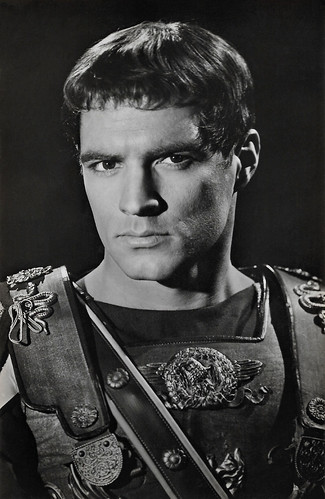
John Gavin in Spartacus (1960)
Spanish postcard by Archivo Bermejo, no. 7142. Photo: Universal International. John Gavin in Spartacus (Stanley Kubrick, 1960).
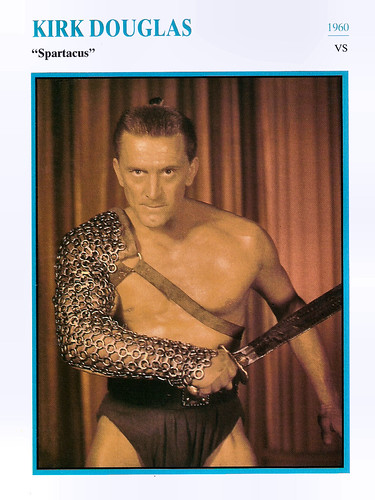
Kirk Douglas in Spartacus (1960)
Dutch collectors card in the series 'Filmsterren: een Portret' by Edito Service, 1994. Photo: Collection Christophe L. Kirk Douglas in Spartacus (Stanley Kubrick, 1960).

Sources: Wikipedia (Dutch and English) and IMDb.

20 May 2021

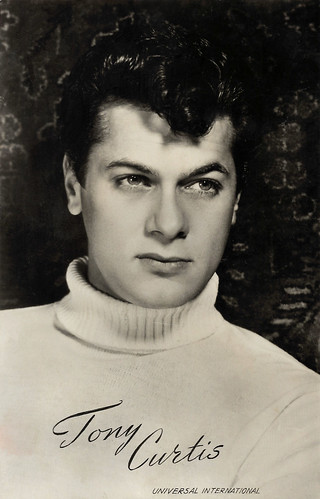
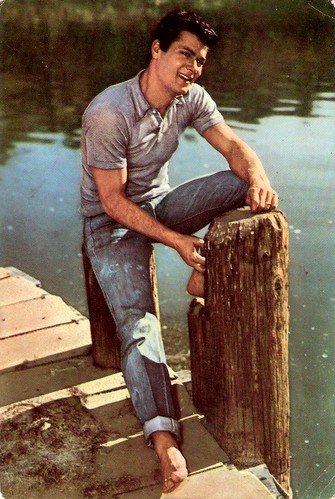
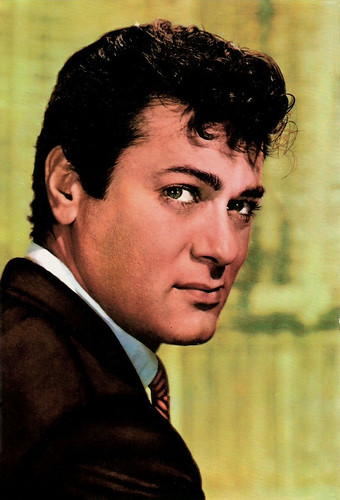
Tony Curtis

American film actor Tony Curtis (1925-2010) played a variety of roles, from light comedy, such as the musician on the run from gangsters in Some Like It Hot (Billy Wilder, 1959), to serious dramatic roles, such as an escaped convict in The Defiant Ones (Stanley Kramer, 1958), which earned him a nomination for the Academy Award for Best Actor. From 1949, he appeared in more than 100 films and made frequent television appearances.

Tony Curtis
Italian postcard by Bromofoto, Milano, no. 346. Photo: Universal International.

Tony Curtis
Dutch postcard by Uitg. Takken, Utrecht, no. 1314. Photo: Universal International.

Tony Curtis
Dutch postcard by Gebr. Spanjersberg N.V., Rotterdam, no. 1008, mailed in 1960. Photo: Universum-Film Aktiengesellschaft, Berlin-Tempelhof (UFA).

Tony Curtis
Dutch postcard by Gebr. Spanjersberg, Rotterdam. Photo: UFA.

Tony Curtis
West-German postcard by Ufa/Film-Foto, Berlin-Tempelhof. Photo: Universal International. This postcard was made for the magazine Film Freund, no. 11-1956.

Tony Curtis
West-German postcard by Kunst und Bild, Berlin, no A 1111. Photo: Paramount Pictures.

The only person you can count on is yourself


Tony Curtis was born Bernard Herschel Schwartz in 1925 in Manhattan, New York City. He was the eldest of three children of Helen (Klein) and Emanuel Schwartz, Jewish immigrants from Hungary. His mother was later in life diagnosed with schizophrenia. His brother Robert was institutionalised with the same mental illness.

Curtis had almost no formal education but was a student of the "school of hard knocks" and learned from a young age that the only person who ever had his back was himself, so he learned how to take care of both himself and his younger brother, Julius. Curtis grew up in poverty, as his father, Emanuel, who worked as a tailor, had the sole responsibility of providing for his entire family on his meagre income.

This led to constant bickering between Curtis's parents over money, and Curtis began to go to movies as a way of briefly escaping the constant worries of poverty and other family problems. The financial strain of raising two children on a meagre income became so tough that in 1935, Curtis's parents decided that their children would have a better life under the care of the state and briefly had Tony and his brother admitted to an orphanage.

During this lonely time, the only companion Curtis had was his brother, Julius, and the two became inseparable as they struggled to get used to this new way of life. Weeks later, Curtis's parents came back to reclaim custody of Tony and his brother, but by then Curtis had learned one of life's toughest lessons: the only person you can count on is yourself.

In 1938, shortly before Tony's Bar Mitzvah, tragedy struck when Tony lost the person most important to him when Julius was hit by a truck and killed. After that tragedy, Curtis's parents became convinced that formal education was the best way Tony could avoid the same never-knowing-where-your-next-meal-is-coming-from life that they had known. However, Tony rejected this because he felt that learning about literary classics and algebra wasn't going to advance him in life as much as some real hands-on life experience would.

He was to find that real-life experience a few years later when he enlisted in the Navy in 1942 after the attack on Pearl Harbor. Inspired by Cary Grant's role in Destination Tokyo (Delmer Daves, 1943) and Tyrone Power's in Crash Dive (Archie Mayo, 1943), he joined the Pacific Submarine Force. Tony spent over two years getting that life experience doing everything from working as a crewman on a submarine tender, the USS Proteus (AS-19), to honing his future craft as an actor performing as a sailor in a stage play at the Navy Signalman School in Illinois.

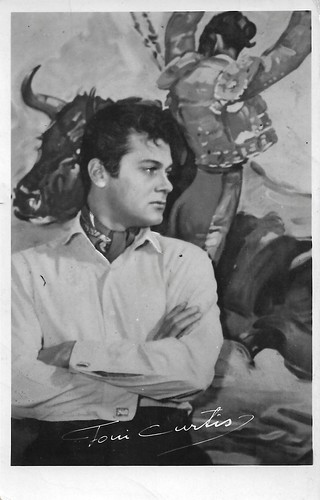
Tony Curtis
Vintage photo, ca. 1955. The poster behind Curtis is of Plaza de Toros, Cordoba. A few photos with this poster as a backdrop have been made, but we could not trace the photographer.

Tony Curtis
French postcard by Editions P.I., Paris, license holder for Ufa, no. CK-43. Photo: Universal Film, Inc.

Tony Curtis
Spanish postcard by Raker, no. 1021.

Tony Curtis
Israelian postcard by Editions de Luxe, no. 103.

Tony Curtis
Vintage collectors card by Rea Sweets of Quality, series H, no. 1. Photo: Universal.

Tony Curtis
Vintage collectors card by Rea Sweets of Quality, series H, no. 54. Photo: Universal.

Bernard Schwartz becomes Tony Curtis


In 1945, Tony Curtis was honourably discharged from the Navy, and when he realised that the GI Bill would allow him to go to acting school without paying for it, he saw that his lifelong pipe dream of being an actor might actually be achievable. Curtis auditioned for the New York Dramatic Workshop and was accepted on the strength of his audition piece, a scene from 'Dr. Jekyll and Mr. Hyde' in pantomime.

In 1947, he studied acting under the influential German stage director Erwin Piscator. His contemporaries included Elaine Stritch, Harry Belafonte, Walter Matthau, Beatrice Arthur, and Rod Steiger. He then began to pay his dues by appearing in a slew of stage productions, including 'Twelfth Night' and 'Golden Boy'. While still at college, Curtis was discovered by Joyce Selznick, a talent agent, casting director, and niece of film producer David O. Selznick.

After seeing his potential, Selznick arranged an interview for Curtis to see David O. Selznick at Universal Studios, where the 23-year-old Curtis was offered a seven-year contract. He changed his name from Bernard Schwartz to what he saw as an elegant, mysterious moniker, Tony Curtis, named after the novel 'Anthony Adverse' (1936) by Hervey Allen and a cousin of his named Janush Kertiz.

Curtis began making a name for himself by appearing in small, offbeat roles in low-budget productions. His first notable performance was a two-minute role as a rumba dancer in Criss Cross (Robert Siodmak, 1949), in which he made Burt Lancaster jealous by dancing with Yvonne De Carlo. This offbeat role resulted in Curtis's being typecast as a heavy for the next few years, such as playing a gang member in City Across the River (Maxwell Shane, 1949), starring Stephen McNally.

Curtis continued to build up a showreel by accepting any paying job, acting in some bit-part roles for the next few years. It wasn't until late 1949 that he finally got the chance to demonstrate his acting flair when he was cast in an important role in an action-Western, Sierra (Alfred E. Green, 1950) starring Audie Murphy. On the strength of his performance in that film, Curtis was finally cast in a big-budget movie, Winchester '73 (Anthony Mann, 1950). While he appears in that film only very briefly, it was a chance for him to act alongside a Hollywood legend, James Stewart.

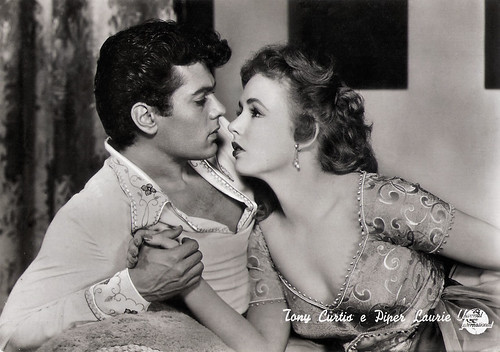
Tony Curtis and Piper Laurie, The Prince Who Was a Thief (1951)
Dutch postcard by Takken, Utrecht, no. 686. Photo: Universal International. Tony Curtis and Piper Laurie in The Prince Who Was A Thief (Rudolph Maté, 1952).

Tony Curtis and Piper Laurie in The Prince Who Was A Thief (1952)
Italian postcard by Bromofoto, Milano, no. 400. Photo: Universal International. Tony Curtis and Piper Laurie in The Prince Who Was A Thief (Rudolph Maté, 1952).

Tony Curtis (1925-2010)
Dutch postcard by Uitg. Takken, no. 1578. Photo: Universal International. Tony Curtis in The Prince Who Was a Thief (Rudolph Maté, 1952).

Tony Curtis in Flesh and Fury (1952)
Dutch postcard by Takken, no. 2086. Photo: Tony Curtis in Flesh and Fury (Joseph Pevney, 1952).

Tony Curtis
Dutch postcard, no. 19. Photo: Tony Curtis in Flesh and Fury (Joseph Pevney, 1952).

Tony Curtis
German postcard by Ufa/Film-Foto, Berlin-Templehof, no. FK 3390. Photo: Universal Film, Inc.

Swashbucklers, Film Noirs, and frantic comedies


Tony Curtis was receiving numerous fan letters, so Universal awarded him the starring role in The Prince Who Was a Thief (Rudolph Maté, 1951), a Swashbuckler set in the Middle East with Piper Laurie. It was a hit at the box office and Curtis was now established.

He followed it up with a role as a boxer in the Film Noir Flesh and Fury (Joseph Pevney, 1952), with Jan Sterling. His next films were the comedy No Room for the Groom (Douglas Sirk, 1952), and Son of Ali Baba (Kurt Neumann, 1952), another film set in the Arab world with Piper Laurie.

Curtis then teamed up with then-wife Janet Leigh in Houdini (George Marshall, 1953), in which Curtis played the title role. He reunited with Burt Lancaster in the prestigious action drama Trapeze (Carol Reed, 1956), also starring Gina Lollobrigida. It was one of the biggest hits of the year.

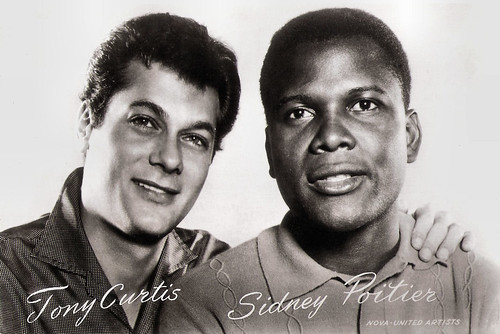
As his career developed, Tony Curtis wanted to act in films that had social relevance, ones that would challenge audiences. He achieved his first serious recognition as a dramatic actor in Sweet Smell of Success (Stanley Kramer, 1957) with co-star Burt Lancaster. The following year he was nominated for an Academy Award for Best Actor in The Defiant Ones (Stanley Kramer, 1958) alongside Sidney Poitier who was also nominated in the same category.

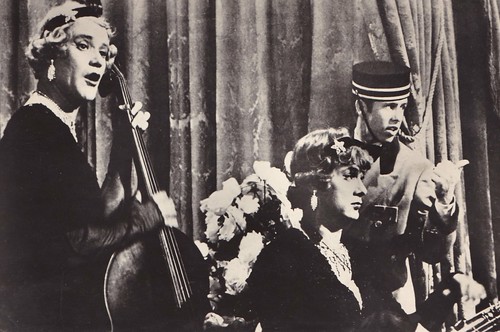
Curtis then gave what could arguably be called his best performance: three interrelated roles in the now-classic comedy Some Like It Hot (Billy Wilder, 1959) opposite Jack Lemmon and Marilyn Monroe. That was followed by Operation Petticoat (Blake Edwards, 1959) with Cary Grant. These frantic comedies displayed his impeccable comic timing. He often collaborated with Blake Edwards on later films.

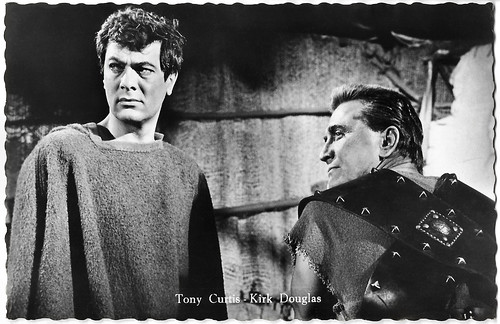
In 1960, Curtis played a supporting role in Stanley Kubrick's Spartacus (1960). He was advised against appearing as the subordinate sidekick of Spartacus, playing second fiddle to the equally famous Kirk Douglas. However, Curtis saw no problem with this because the two had recently acted together in dual leading roles in The Vikings (Richard Fleischer, 1958). Spartacus became another major hit for him.


Tony Curtis and Joanne Dru in Forbidden (1953)
Italian postcard by Rotalfoto, Milano. Photo: Universal International. Tony Curtis and Joanne Dru in Forbidden (Rudolph Maté, 1953).

Burt Lancaster, Gina Lollobrigida and Tony Curtis in Trapeze (1956)
German postcard by Kolibri-Verlag, G.m.b.H., Minden-Westf., no. 2180. Photo: Production Hecht-Lancaster. Burt Lancaster, Gina Lollobrigida and Tony Curtis in Trapeze (Carol Reed, 1956).

Tony Curtis and Sidney Potier in The Defiant Ones (1958)
Dutch postcard by Uitg. Takken, Utrecht, no. AX 3896. Photo: Nova / United Artists. Tony Curtis and Sidney Poitier in The Defiant Ones (Stanley Kramer, 1958).

Jack Lemmon and Tony Curtis in Some Like it Hot (1959)
Czech postcard by Pressfoto, Praha (Prague). Photo: Jack Lemmon and Tony Curtis in Some Like It Hot (Billy Wilder, 1959). Collection: Carla Bosch.

Tony Curtis and Kirk Douglas in Spartacus (1960)
Dutch postcard, no. 1160. Photo: Universal International. Tony Curtis and Kirk Douglas in Spartacus (Stanley Kubrick, 1960).

Tony Curtis in Spartacus
Yugoslavian postcard by Z.K., no. 1399. Tony Curtis in Spartacus (Stanley Kubrick, 1960).

Tony Curtis and Kirk Douglas at the set of Spartacus (1960)
French postcard in the Entr'acte series by Éditions Asphodèle. Mâcon, no. 001/27. Photo: Tony Curtis and Kirk Douglas at the set of Spartacus (Stanley Kubrick, 1960). Caption: Tony Curtis and Kirk Douglas discuss a film shot.

His chilling portrayal of a serial killer


Tony Curtis's stardom and film career declined considerably after 1960. Curtis took on the role of the Ukrainian Cossack Andrei in the historical action romance epic Taras Bulba (J. Lee Thompson, 1962) featuring Yul Brynner and also with German actress Christine Kaufmann, who became Curtis' second wife.

Curtis then focused on comedies such as Sex and the Single Girl (Richard Quine, 1964), with Natalie Wood; The Great Race (Blake Edwards, 1965), with Wood and Jack Lemmon, and Boeing Boeing (John Rich, 1965) a sex farce with Jerry Lewis.

His most significant dramatic part came in 1968 when he starred in the true-life drama The Boston Strangler (Richard Fleischer, 1968), which some consider his last major film role. The part reinforced his reputation as a serious actor with his chilling portrayal of serial killer Albert DeSalvo.

He later starred alongside Roger Moore in the TV series The Persuaders! (1971), with Curtis playing American millionaire Danny Wilde. The series ran twenty-four episodes.

In 2008, he published his autobiography 'American Prince: A Memoir' in which he accused many people he worked with of holding anti-Semitic views. He settled in Henderson, Nevada, where he eventually died in 2010. He was 85.

Tony Curtis was married six times and had six children. His wives were actress Janet Leigh (1951-1962), German actress Christine Kaufmann (1963-1968), Leslie Curtis (1968-1982), Andrea Savio (1984-1992), Lisa Deutsch (1993-1994), and Jill Vandenberg Curtis (1998-2019 - his death).

He was the father of Jamie Lee Curtis and Kelly Curtis (with Janet Leigh), Allegra Curtis, and Alexandra Curtis (with Christine Kaufmann), Nicholas Curtis, and Benjamin Curtis (with Leslie Curtis).

He became largely estranged from all six of his children. His son Nicholas Curtis, died of seizures due to an overdose of heroin in 1994. He disinherited all of his children from his will and left the bulk of his estate to his wife Jill Vandenberg Curtis, who was 46 years younger than he.

Happy New Year!
Spanish postcard by Archivo Bermejo, no. C 44. Photo: Universal International. Janet Leigh and Tony Curtis kiss.

Tony Curtis and Janet Leigh
Swedish postcard by Förlag Torsten G. Ericsson, Hälsingborg, no. AX 865. Photo: Metro-Goldwyn-Mayer. Janet Leigh and Tony Curtis embrace.

Tony Curtis
Dutch postcard by Takken / 't Sticht, Utrecht, no. 1593.

Tony Curtis
British postcard in the Picturegoer Series, London, no. D. 146. Photo: Universal International.

Tony Curtis
Dutch postcard by Gebr. Spanjersberg N.V., Rotterdam, no. 5430.

Tony Curtis
Dutch postcard by Gebr. Spanjersberg N.V., Rotterdam, no. 4741, licence holder for the Netherlands of Ufa, Berlin-Tempelhof. Photo: Terb-Agency / Ufa.

Tony Curtis,
Dutch postcard by Uitg. Takken, Utrecht, no. 3145. Photo: Universal Int.

Tony Curtis
Italian postcard by Rotalfoto, Milano, no. 324. Photo: Universal International.

Tony Curtis
Italian postcard by B.F.F. (Ballerini & Fratini, Firenze), no. 3054. Photo: Universal International.

Tony Curtis
German postcard by ISV, no. H 45.

Tony Curtis
German postcard by Krüger / Ufa. Photo: Ufa. Sent by mail in the Netherlands in 1966.

The Persuaders, Roger Moore, Tony Curtis
Danish postcard by Forlaget Holger Danske, no. 119. Photo: Tony Curtis and Roger Moore in The Persuaders (1971-1972).

Source: James Briggs (IMDb), Wikipedia, and IMDb.

This post was last updated on 11 November 2023.