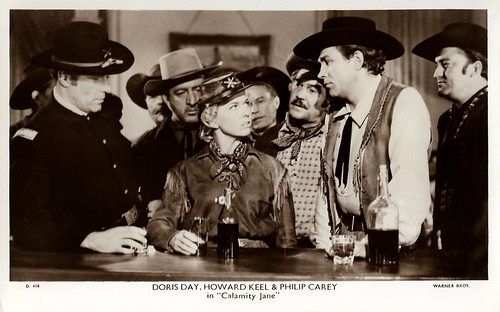
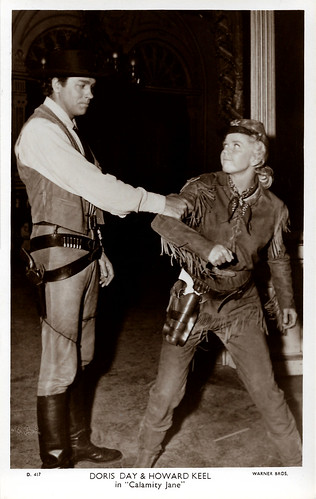
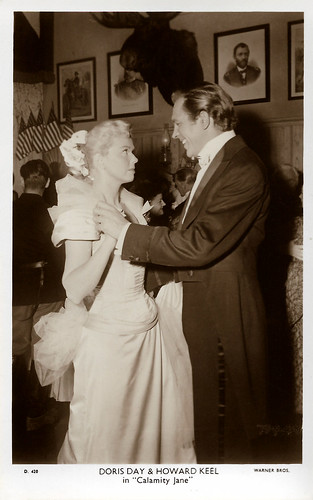
Legendary actress and singer Doris Day (1922-2019) with her blonde hair and blue eyes performed with several big bands before going solo in 1947. In the 1950s, she made a series of popular film musicals, including Calamity Jane (1953) and The Pajama Game (1957). 'Que Será, Será!' became her theme song. With Rock Hudson, she starred in the box office hit Pillow Talk (1959). On TV, she appeared in the sitcom The Doris Day Show (1968-1973).

Dutch postcard by Takken / 't Sticht, no. AX 343. Photo: Warner Bros. Doris Day and Szöke Szakall in Tea for Two (David Butler, 1950), the first film for which Doris Day received top-billing.

Dutch card. Photo: Warner Bros. Doris Day and Kirk Douglas in Young Man with a Horn (Michael Curtiz, 1950).

Dutch postcard by Takken, Utrecht, no. 748. Photo: Warner Bros. Doris Day in On Moonlight Bay (Roy Del Ruth, 1951).
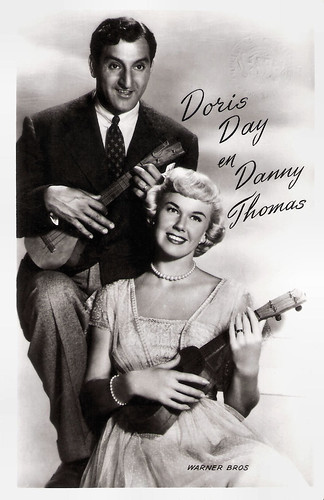
Dutch postcard by Takken, Utrecht, no. 810. Photo: Warner Bros. Doris Day with Danny Thomas in I'll See You in My Dreams (Michael Curtiz, 1951).
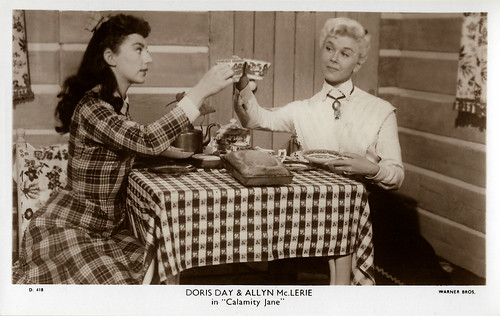
French postcard in the Picturegoer Series, London, no. D. 418. Photo: Warner Bros. Allyn McLerie and Doris Day in Calamity Jane (David Butler, 1953).
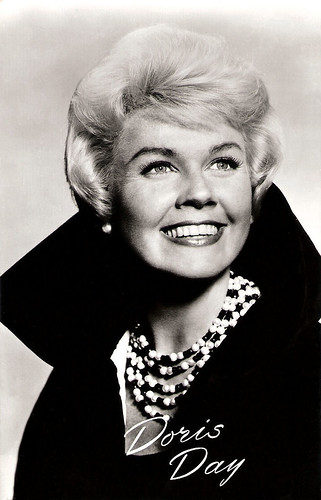
Dutch postcard by Uitg. Takken, Utrecht, no. AX 4240. Photo: Universal International. Publicity still for Pillow Talk (Michael Gordon, 1959). Collection: Geoffrey Donaldson Institute.
Doris Mary Ann Kappelhoff was born in 1922, in Cincinnati, Ohio, to Alma Sophia (Welz), a housewife, and William Joseph Kappelhoff, a music teacher and choirmaster. Her mother named her after her favourite silent film star, Doris Kenyon. She had two brothers, Richard, who died before she was born and Paul, a few years older. For many years it was uncertain whether she was born in 1922 or 1924, with Day herself reportedly believing her birth year was the latter and giving her age accordingly. It wasn't until 3 April 2017, her 95th, not 93rd, birthday, that her birth certificate was found by the Associated Press, which confirmed she was born in 1922.
Her parents divorced while she was still a child and she lived with her mother. Like most little girls, Doris liked to dance. At fourteen, she formed a dance act with a boy, Jerry Doherty, and they won $500 in a local talent contest. She and Jerry took a brief trip to Hollywood to test the waters. They felt they could succeed, so she and Jerry returned to Cincinnati to pack and make a permanent move to Hollywood. Tragically, the night before Doris was to move to Hollywood, her car was hit by a train and she badly injured her right leg. The accident ended the possibility of a dancing career. She spent her next years wheelchair-bound, but during this time began singing along with the radio. Observing her daughter sing Alma decided Doris should have singing lessons. She engaged a teacher, Grace Raine. After three lessons, Raine told Alma that young Doris had "tremendous potential". Raine was so impressed that she gave Doris three lessons a week for the price of one. Years later, Day said that Raine had the biggest effect on her singing style and career.
At age 17, Day had her first professional job as a vocalist, on the WLW radio program 'Carlin's Carnival', and in a local restaurant, Charlie Yee's Shanghai Inn. While performing on the radio, she was approached by band leader Barney Rapp. He felt that her name, Kappelhoff, was too harsh and awkward and that she should change her name to something more pleasant. The name 'Day' was suggested by Rapp from one of the songs in Doris' repertoire, 'Day by Day'. She didn't like the name at first, feeling that it sounded too much like a burlesque performer. While she was performing in Barney Rapp's band, she met trombonist Al Jorden, and they married in 1941. The marriage was extremely unhappy and there were reports of Jordan's alcoholism and abuse of the young star. They divorced within two years, not long after the birth of their son Terrence Jorden called Terry. Despondent and feeling his life had little meaning after the much-publicised divorce, Jorden later committed suicide.
After working with Rapp, Day worked with bandleaders Jimmy James, Bob Crosby, and Les Brown. The years touring with Les Brown & His Band of Renown, she later called 'the happiest times in my life'. In 1941, Day appeared as a singer in three Soundies (three-minute film clips containing a song, dance and/or band or orchestral number) with the Les Brown band. Her first hit recording was 'Sentimental Journey' in 1945. It became an anthem of the desire of World War II demobilising troops to return home. In 1946, Doris married saxophone player and former child actor George Weidler, but this union lasted less than a year. After leaving Brown to embark on a solo career, she recorded more than 650 songs from 1947 to 1967.
Day's agent talked her into taking a screen test at Warner Bros. The executives there liked what they saw and signed her to a contract. Her first starring role was in Romance on the High Seas (Michael Curtiz, Busby Berkeley, 1948), with Jack Carson and Janis Paige. The next year, she made two more films, My Dream Is Yours (Michael Curtiz, 1949) and It's a Great Feeling (David Butler, 1949). Audiences took to her beauty, terrific singing voice and bubbly personality, and she turned in fine performances in the films she made - in addition to several hit records.

Belgian postcard. Photo: Warner Bros. Kirk Douglas in Young Man with a Horn (Michael Curtiz, 1950).

Dutch postcard by Takken / 't Sticht, no. AX 631. Photo: Warner Bros. Szöke Szakall and Doris Day in Lullaby of Broadway (David Butler, 1951).

Belgian postcard. Photo: Warner Bros. Doris Day and Gordon MacRae in On Moonlight Bay (Roy Del Ruth, 1951). Collection: Marlene Pilaete.
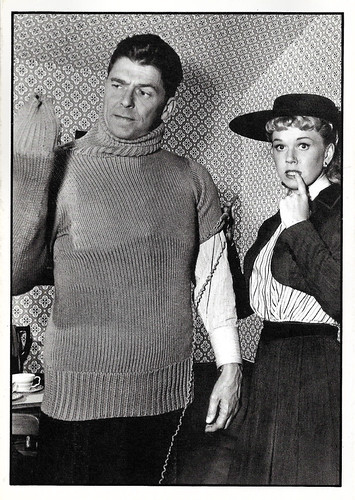
French postcard in the Entr'acte series by Éditions Asphodèle, Mâcon, no. 001/26. Ronald Reagan and Doris Day on the set of The Winning Team (Lewis Seiler, 1952). Caption: Ronald Reagan and Doris Day relax in their own way.

French postcard in the Picturegoer Series, London, no. D 421. Photo: Warner Bros. Doris Day and Howard Keel in Calamity Jane (David Butler, 1953).

French postcard in the Entr'acte series by Éditions Asphodèle, Mâcon, no. 003/86. Collection: B. Courtel / D.R. Doris Day, Bill Philips, and Frank Flanagan on the set of Lucky Me (Jack Donohue, 1954). Caption: On Doris Day's face, make-up artist Bill Philips (left) makes a final touch-up and cinematographer Frank Flanagan (right) measures the light intensity for a scene in preparation.
Doris Day made three films for Warner Bros. in 1950 and five more in 1951. She co-starred with Gordon MacRae in five nostalgic period musicals: Tea for Two (David Butler, 1950), The West Point Story (Roy Del Ruth, 1950) with James Cagney and Virginia Mayo, On Moonlight Bay (Roy Del Ruth, 1951), Starlift (Roy Del Ruth, 1951), and By the Light of the Silvery Moon (David Butler, 1953).
Her most commercially successful film for Warner was I'll See You in My Dreams (1951), which broke box-office records for 20 years. The film is a musical biography of lyricist Gus Kahn, played by Danny Thomas. It was Day's fourth film directed by Michael Curtiz. One of her few dramatic roles was in Storm Warning (Stuart Heisler, 1951) with Ginger Rogers and Ronald Reagan. She briefly dated Reagan - with whom she also co-starred in The Winning Team (1952) - shortly after his divorce from Jane Wyman when she and Reagan were contract players at Warner Bros.
Doris Day met and married Martin Melcher in 1951. He adopted her young son Terry and became her manager. In 1953, Doris starred in Calamity Jane (David Butler, 1953), which was a major hit. She performed 'Secret Love' in the film, which won the Academy Award for Best Original Song. Several more hits followed including Lucky Me (Jack Donohue, 1954), Love Me or Leave Me (Charles Vidor, 1955) with James Cagney.
Alfred Hitchcock had seen her dramatic role in Storm Warning and chose her to play Jo McKenna opposite James Stewart in his re-make The Man Who Knew Too Much (1956). In the film she sang the song 'Que Será, Será! (Whatever Will Be, Will Be)', which won the Academy Award for Best Original Song and became an evergreen.
In 1959, Day entered her most successful phase as a film actress with a series of romantic comedies. Her best-known film is probably the first one, Pillow Talk (Michael Gordon, 1959) with Rock Hudson and Tony Randall. For her performance, she received an Academy Award nomination for Best Leading Actress. She later co-starred with Hudson and Randall again in Lover Come Back (Delbert Mann, 1961), and Send Me No Flowers (Norman Jewison, 1964). In all three, Day and Hudson played love interests while Randall played Hudson's close friend.

Belgian postcard, no. KF 45. Photo: Warner Bros.

Dutch postcard. Photo: Warner Bros.

Dutch postcard by DRC, no. 147. Photo: Warner Bros. Caption: Doris Day and her mother Alma.

Dutch postcard. Photo: Warner Bros.
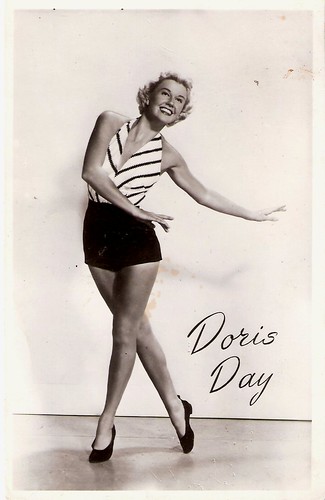
Dutch postcard by Takken, Utrecht, no. 814. Photo: Warner Bros.
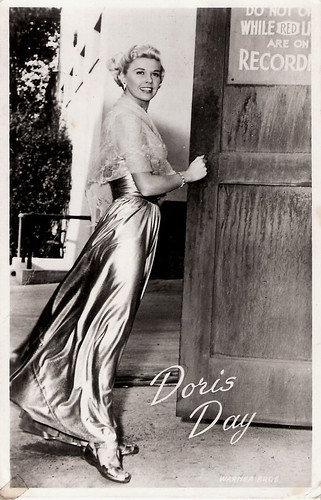
Dutch postcard. Photo: Warner Bros.
Doris Day started out in the 1960s with the hit Please Don't Eat the Daisies (Charles Walters, 1960) in which her co-star was David Niven. In 1962, Day appeared with Cary Grant in the comedy That Touch of Mink (Delbert Mann, 1962), the first film in history ever to gross $1 million in one theatre (Radio City Music Hall). In 1960 and during the 1962 to 1964 period, she ranked number one at the box office.
Despite her successes at the box office, the late 1950s and early 1960s were a difficult period for Day. In 1958, her brother Paul had died. Around this time, her husband, who had also taken charge of her career, made deals for her to star in films she didn't really care about, which led to a bout with exhaustion.
The 1960s weren't to be a repeat of the previous busy decade. She made fewer films, but the ones she did make were successful: Do Not Disturb (Ralph Levy, 1965) with Rod Taylor, and The Glass Bottom Boat (Frank Tashlin, 1966).
By the late 1960s, the sexual revolution of the baby boomer generation had refocused public attitudes about sex. Times had changed, but Day's films had not. Where Were You When the Lights Went Out? (Hy Averback, 1968) and With Six You Get Eggroll (Howard Morris, 1968) with Brian Keith, would be her final features.
In 1968, her husband Martin Melcher suddenly died. Between 1956 and his death, he had produced 18 of her films. A shocked Day discovered she was millions of dollars in debt. Melcher and his business partner Jerome Bernard Rosenthal had squandered virtually all of her considerable earnings, but she was eventually awarded $22 million by the courts in a case against Rosenthal.
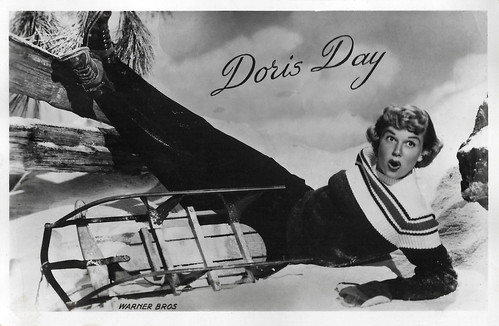
Dutch postcard by Takken, Utrecht, no. 287. Photo: Warner Bros.
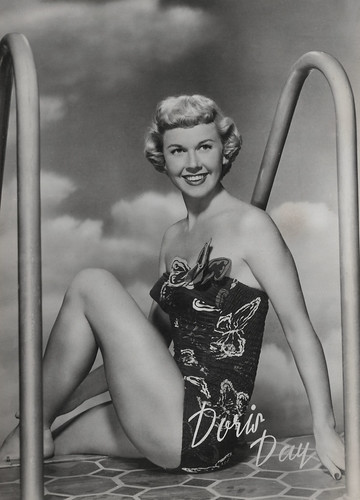
Big Belgian Collectors Card, no. F 44. Photo: Warner Bros.

Belgian postcard, no. 1051. Photo: Warner Bros.

Belgian postcard, no. 1151. Photo: Warner Bros.

Dutch postcard by Takken, Utrecht, no. 4457. Photo: MGM. David Niven and Doris Day in Please Don't Eat the Daisies (Charles Walters, 1960).
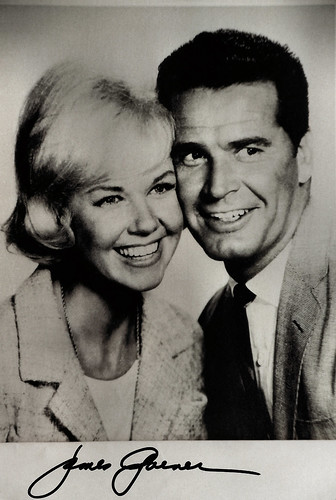
Autograph card. James Garner and Doris Day in Move Over, Darling (Norman Jewison, 1963).
After Martin Melcher's death, Doris Day never made another film. She professed not to have known that he had negotiated a multimillion-dollar deal with CBS to launch her own TV series, The Doris Day Show, the following fall. Day hated the idea of performing on television but felt obligated to do it and needed the work to help pay off her debts. The show became successful and lasted from 1968 until 1973.
The Doris Day Show was a light and fluffy sitcom, which changed formats and producers almost every season. Originally it was about widow Doris Martin and her two young sons (Philip Brown and Todd Stark) who left the big city for the quiet and peace of her family's ranch, which was run by her dad Buck (Denver Pyle) and ranchhand Leroy (James Hampton). Later Doris, Buck and sons Billy and Toby moved to San Francisco, where Doris got a job as a secretary to bumbling magazine publisher Michael Nicholson (McLean Stevenson). In Season Three, the Martin family moved into an apartment above the Paluccis' Italian restaurant, and Doris began writing features for Today's World magazine. Finally, the kids, family, Nicholson, the Paluccis' and all other cast members vanished, and Doris became a single staff writer for Today's World, where her new boss was Cy Bennett (John Dehner).
After her series went off the air, Doris Day only made occasional TV appearances. She did two television specials, The Doris Mary Anne Kappelhoff Special (1971) and Doris Day Today (1975). She also appeared on the John Denver TV show (1974). In 1976, she married for the fourth time, to Barry Comden, 12 years her junior. They had met at the Beverly Hills Old World Restaurant where he was the maitre d'. The couple divorced in 1982. Comden complained that Day preferred the company of her dogs more than him. From then on Doris devoted her life to animals. During the location filming of The Man Who Knew Too Much (Alfred Hitchcock, 1956) she had seen how camels, goats and other 'animal extras' in a marketplace scene were being treated. It began her lifelong commitment to prevent animal abuse. For years, she ran the Doris Day Animal League in Carmel, a resort town a little south of San Francisco.
In the 1985–1986 season, Day returned to the screen with her own television talk show, Doris Day's Best Friends, on CBN. The network cancelled the show after 26 episodes, despite the worldwide publicity it received. Much of that came from her interview with Rock Hudson, in which a visibly ill Hudson was showing the first public symptoms of AIDS. Hudson would die from the syndrome a year later. Her son Terry Melcher had become a music producer and composer who worked with The Beach Boys, Bobby Darin and The Byrds. With Terry and a partner, she co-owned the Cypress Inn in Carmel, a small inn built in a Mediterranean motif. Terry died of melanoma in 2004, aged 62.
In June 2004 she was awarded the Presidential Medal of Freedom by George W. Bush. She did not attend the White House award ceremony because of her intense fear of flying. In 2006, she received a Grammy Lifetime Achievement Award. In a rare interview with The Hollywood Reporter on 4 April 2019, a day after her 97th birthday, Day talked about her work on the Doris Day Animal Foundation, founded in 1978. On the question of what her favourite film was, she answered Calamity Jane: "I was such a tomboy growing up, and she was such a fun character to play. Of course, the music was wonderful, too — 'Secret Love,' especially, is such a beautiful song." Day died at her home in Carmel Valley, California in 2019 at the age of 97 after having contracted pneumonia. As per her last wishes, there will be no funeral or graveside service. Doris Day was cremated and her ashes were scattered in Carmel.

Dutch postcard. Photo: Warner Bros.

Belgian postcard. Photo: Warner Bros.

Big Italian postcard in the Artisti di Sempre series by Rotalfoto, Milano, no. 341.

Italian postcard by Rotalfoto, Milano, no. N 27.

German postcard by Krüger, no. 902/143. Photo: Terb Agency / UFA.

Dutch postcard by DRC, no. F 52. Photo: Warner Bros.

Vintage collectors card, no. F 129. Photo: Warner Bros.
Sources: Wikipedia and IMDb.
This post was last updated on 5 December 2023.
Dutch postcard by Takken / 't Sticht, no. AX 343. Photo: Warner Bros. Doris Day and Szöke Szakall in Tea for Two (David Butler, 1950), the first film for which Doris Day received top-billing.
Dutch card. Photo: Warner Bros. Doris Day and Kirk Douglas in Young Man with a Horn (Michael Curtiz, 1950).
Dutch postcard by Takken, Utrecht, no. 748. Photo: Warner Bros. Doris Day in On Moonlight Bay (Roy Del Ruth, 1951).
Dutch postcard by Takken, Utrecht, no. 810. Photo: Warner Bros. Doris Day with Danny Thomas in I'll See You in My Dreams (Michael Curtiz, 1951).
French postcard in the Picturegoer Series, London, no. D. 418. Photo: Warner Bros. Allyn McLerie and Doris Day in Calamity Jane (David Butler, 1953).
Dutch postcard by Uitg. Takken, Utrecht, no. AX 4240. Photo: Universal International. Publicity still for Pillow Talk (Michael Gordon, 1959). Collection: Geoffrey Donaldson Institute.
Audiences took to her bubbly personality
Doris Mary Ann Kappelhoff was born in 1922, in Cincinnati, Ohio, to Alma Sophia (Welz), a housewife, and William Joseph Kappelhoff, a music teacher and choirmaster. Her mother named her after her favourite silent film star, Doris Kenyon. She had two brothers, Richard, who died before she was born and Paul, a few years older. For many years it was uncertain whether she was born in 1922 or 1924, with Day herself reportedly believing her birth year was the latter and giving her age accordingly. It wasn't until 3 April 2017, her 95th, not 93rd, birthday, that her birth certificate was found by the Associated Press, which confirmed she was born in 1922.
Her parents divorced while she was still a child and she lived with her mother. Like most little girls, Doris liked to dance. At fourteen, she formed a dance act with a boy, Jerry Doherty, and they won $500 in a local talent contest. She and Jerry took a brief trip to Hollywood to test the waters. They felt they could succeed, so she and Jerry returned to Cincinnati to pack and make a permanent move to Hollywood. Tragically, the night before Doris was to move to Hollywood, her car was hit by a train and she badly injured her right leg. The accident ended the possibility of a dancing career. She spent her next years wheelchair-bound, but during this time began singing along with the radio. Observing her daughter sing Alma decided Doris should have singing lessons. She engaged a teacher, Grace Raine. After three lessons, Raine told Alma that young Doris had "tremendous potential". Raine was so impressed that she gave Doris three lessons a week for the price of one. Years later, Day said that Raine had the biggest effect on her singing style and career.
At age 17, Day had her first professional job as a vocalist, on the WLW radio program 'Carlin's Carnival', and in a local restaurant, Charlie Yee's Shanghai Inn. While performing on the radio, she was approached by band leader Barney Rapp. He felt that her name, Kappelhoff, was too harsh and awkward and that she should change her name to something more pleasant. The name 'Day' was suggested by Rapp from one of the songs in Doris' repertoire, 'Day by Day'. She didn't like the name at first, feeling that it sounded too much like a burlesque performer. While she was performing in Barney Rapp's band, she met trombonist Al Jorden, and they married in 1941. The marriage was extremely unhappy and there were reports of Jordan's alcoholism and abuse of the young star. They divorced within two years, not long after the birth of their son Terrence Jorden called Terry. Despondent and feeling his life had little meaning after the much-publicised divorce, Jorden later committed suicide.
After working with Rapp, Day worked with bandleaders Jimmy James, Bob Crosby, and Les Brown. The years touring with Les Brown & His Band of Renown, she later called 'the happiest times in my life'. In 1941, Day appeared as a singer in three Soundies (three-minute film clips containing a song, dance and/or band or orchestral number) with the Les Brown band. Her first hit recording was 'Sentimental Journey' in 1945. It became an anthem of the desire of World War II demobilising troops to return home. In 1946, Doris married saxophone player and former child actor George Weidler, but this union lasted less than a year. After leaving Brown to embark on a solo career, she recorded more than 650 songs from 1947 to 1967.
Day's agent talked her into taking a screen test at Warner Bros. The executives there liked what they saw and signed her to a contract. Her first starring role was in Romance on the High Seas (Michael Curtiz, Busby Berkeley, 1948), with Jack Carson and Janis Paige. The next year, she made two more films, My Dream Is Yours (Michael Curtiz, 1949) and It's a Great Feeling (David Butler, 1949). Audiences took to her beauty, terrific singing voice and bubbly personality, and she turned in fine performances in the films she made - in addition to several hit records.
Belgian postcard. Photo: Warner Bros. Kirk Douglas in Young Man with a Horn (Michael Curtiz, 1950).
Dutch postcard by Takken / 't Sticht, no. AX 631. Photo: Warner Bros. Szöke Szakall and Doris Day in Lullaby of Broadway (David Butler, 1951).
Belgian postcard. Photo: Warner Bros. Doris Day and Gordon MacRae in On Moonlight Bay (Roy Del Ruth, 1951). Collection: Marlene Pilaete.
French postcard in the Entr'acte series by Éditions Asphodèle, Mâcon, no. 001/26. Ronald Reagan and Doris Day on the set of The Winning Team (Lewis Seiler, 1952). Caption: Ronald Reagan and Doris Day relax in their own way.
French postcard in the Picturegoer Series, London, no. D 421. Photo: Warner Bros. Doris Day and Howard Keel in Calamity Jane (David Butler, 1953).
French postcard in the Entr'acte series by Éditions Asphodèle, Mâcon, no. 003/86. Collection: B. Courtel / D.R. Doris Day, Bill Philips, and Frank Flanagan on the set of Lucky Me (Jack Donohue, 1954). Caption: On Doris Day's face, make-up artist Bill Philips (left) makes a final touch-up and cinematographer Frank Flanagan (right) measures the light intensity for a scene in preparation.
Dating Ronald Reagan
Doris Day made three films for Warner Bros. in 1950 and five more in 1951. She co-starred with Gordon MacRae in five nostalgic period musicals: Tea for Two (David Butler, 1950), The West Point Story (Roy Del Ruth, 1950) with James Cagney and Virginia Mayo, On Moonlight Bay (Roy Del Ruth, 1951), Starlift (Roy Del Ruth, 1951), and By the Light of the Silvery Moon (David Butler, 1953).
Her most commercially successful film for Warner was I'll See You in My Dreams (1951), which broke box-office records for 20 years. The film is a musical biography of lyricist Gus Kahn, played by Danny Thomas. It was Day's fourth film directed by Michael Curtiz. One of her few dramatic roles was in Storm Warning (Stuart Heisler, 1951) with Ginger Rogers and Ronald Reagan. She briefly dated Reagan - with whom she also co-starred in The Winning Team (1952) - shortly after his divorce from Jane Wyman when she and Reagan were contract players at Warner Bros.
Doris Day met and married Martin Melcher in 1951. He adopted her young son Terry and became her manager. In 1953, Doris starred in Calamity Jane (David Butler, 1953), which was a major hit. She performed 'Secret Love' in the film, which won the Academy Award for Best Original Song. Several more hits followed including Lucky Me (Jack Donohue, 1954), Love Me or Leave Me (Charles Vidor, 1955) with James Cagney.
Alfred Hitchcock had seen her dramatic role in Storm Warning and chose her to play Jo McKenna opposite James Stewart in his re-make The Man Who Knew Too Much (1956). In the film she sang the song 'Que Será, Será! (Whatever Will Be, Will Be)', which won the Academy Award for Best Original Song and became an evergreen.
In 1959, Day entered her most successful phase as a film actress with a series of romantic comedies. Her best-known film is probably the first one, Pillow Talk (Michael Gordon, 1959) with Rock Hudson and Tony Randall. For her performance, she received an Academy Award nomination for Best Leading Actress. She later co-starred with Hudson and Randall again in Lover Come Back (Delbert Mann, 1961), and Send Me No Flowers (Norman Jewison, 1964). In all three, Day and Hudson played love interests while Randall played Hudson's close friend.
Belgian postcard, no. KF 45. Photo: Warner Bros.
Dutch postcard. Photo: Warner Bros.
Dutch postcard by DRC, no. 147. Photo: Warner Bros. Caption: Doris Day and her mother Alma.
Dutch postcard. Photo: Warner Bros.
Dutch postcard by Takken, Utrecht, no. 814. Photo: Warner Bros.
Dutch postcard. Photo: Warner Bros.
Number one at the box office
Doris Day started out in the 1960s with the hit Please Don't Eat the Daisies (Charles Walters, 1960) in which her co-star was David Niven. In 1962, Day appeared with Cary Grant in the comedy That Touch of Mink (Delbert Mann, 1962), the first film in history ever to gross $1 million in one theatre (Radio City Music Hall). In 1960 and during the 1962 to 1964 period, she ranked number one at the box office.
Despite her successes at the box office, the late 1950s and early 1960s were a difficult period for Day. In 1958, her brother Paul had died. Around this time, her husband, who had also taken charge of her career, made deals for her to star in films she didn't really care about, which led to a bout with exhaustion.
The 1960s weren't to be a repeat of the previous busy decade. She made fewer films, but the ones she did make were successful: Do Not Disturb (Ralph Levy, 1965) with Rod Taylor, and The Glass Bottom Boat (Frank Tashlin, 1966).
By the late 1960s, the sexual revolution of the baby boomer generation had refocused public attitudes about sex. Times had changed, but Day's films had not. Where Were You When the Lights Went Out? (Hy Averback, 1968) and With Six You Get Eggroll (Howard Morris, 1968) with Brian Keith, would be her final features.
In 1968, her husband Martin Melcher suddenly died. Between 1956 and his death, he had produced 18 of her films. A shocked Day discovered she was millions of dollars in debt. Melcher and his business partner Jerome Bernard Rosenthal had squandered virtually all of her considerable earnings, but she was eventually awarded $22 million by the courts in a case against Rosenthal.
Dutch postcard by Takken, Utrecht, no. 287. Photo: Warner Bros.
Big Belgian Collectors Card, no. F 44. Photo: Warner Bros.
Belgian postcard, no. 1051. Photo: Warner Bros.
Belgian postcard, no. 1151. Photo: Warner Bros.
Dutch postcard by Takken, Utrecht, no. 4457. Photo: MGM. David Niven and Doris Day in Please Don't Eat the Daisies (Charles Walters, 1960).
Autograph card. James Garner and Doris Day in Move Over, Darling (Norman Jewison, 1963).
A light and fluffy sitcom
After Martin Melcher's death, Doris Day never made another film. She professed not to have known that he had negotiated a multimillion-dollar deal with CBS to launch her own TV series, The Doris Day Show, the following fall. Day hated the idea of performing on television but felt obligated to do it and needed the work to help pay off her debts. The show became successful and lasted from 1968 until 1973.
The Doris Day Show was a light and fluffy sitcom, which changed formats and producers almost every season. Originally it was about widow Doris Martin and her two young sons (Philip Brown and Todd Stark) who left the big city for the quiet and peace of her family's ranch, which was run by her dad Buck (Denver Pyle) and ranchhand Leroy (James Hampton). Later Doris, Buck and sons Billy and Toby moved to San Francisco, where Doris got a job as a secretary to bumbling magazine publisher Michael Nicholson (McLean Stevenson). In Season Three, the Martin family moved into an apartment above the Paluccis' Italian restaurant, and Doris began writing features for Today's World magazine. Finally, the kids, family, Nicholson, the Paluccis' and all other cast members vanished, and Doris became a single staff writer for Today's World, where her new boss was Cy Bennett (John Dehner).
After her series went off the air, Doris Day only made occasional TV appearances. She did two television specials, The Doris Mary Anne Kappelhoff Special (1971) and Doris Day Today (1975). She also appeared on the John Denver TV show (1974). In 1976, she married for the fourth time, to Barry Comden, 12 years her junior. They had met at the Beverly Hills Old World Restaurant where he was the maitre d'. The couple divorced in 1982. Comden complained that Day preferred the company of her dogs more than him. From then on Doris devoted her life to animals. During the location filming of The Man Who Knew Too Much (Alfred Hitchcock, 1956) she had seen how camels, goats and other 'animal extras' in a marketplace scene were being treated. It began her lifelong commitment to prevent animal abuse. For years, she ran the Doris Day Animal League in Carmel, a resort town a little south of San Francisco.
In the 1985–1986 season, Day returned to the screen with her own television talk show, Doris Day's Best Friends, on CBN. The network cancelled the show after 26 episodes, despite the worldwide publicity it received. Much of that came from her interview with Rock Hudson, in which a visibly ill Hudson was showing the first public symptoms of AIDS. Hudson would die from the syndrome a year later. Her son Terry Melcher had become a music producer and composer who worked with The Beach Boys, Bobby Darin and The Byrds. With Terry and a partner, she co-owned the Cypress Inn in Carmel, a small inn built in a Mediterranean motif. Terry died of melanoma in 2004, aged 62.
In June 2004 she was awarded the Presidential Medal of Freedom by George W. Bush. She did not attend the White House award ceremony because of her intense fear of flying. In 2006, she received a Grammy Lifetime Achievement Award. In a rare interview with The Hollywood Reporter on 4 April 2019, a day after her 97th birthday, Day talked about her work on the Doris Day Animal Foundation, founded in 1978. On the question of what her favourite film was, she answered Calamity Jane: "I was such a tomboy growing up, and she was such a fun character to play. Of course, the music was wonderful, too — 'Secret Love,' especially, is such a beautiful song." Day died at her home in Carmel Valley, California in 2019 at the age of 97 after having contracted pneumonia. As per her last wishes, there will be no funeral or graveside service. Doris Day was cremated and her ashes were scattered in Carmel.
Dutch postcard. Photo: Warner Bros.
Belgian postcard. Photo: Warner Bros.
Big Italian postcard in the Artisti di Sempre series by Rotalfoto, Milano, no. 341.
Italian postcard by Rotalfoto, Milano, no. N 27.
German postcard by Krüger, no. 902/143. Photo: Terb Agency / UFA.
Dutch postcard by DRC, no. F 52. Photo: Warner Bros.
Vintage collectors card, no. F 129. Photo: Warner Bros.
Sources: Wikipedia and IMDb.
This post was last updated on 5 December 2023.