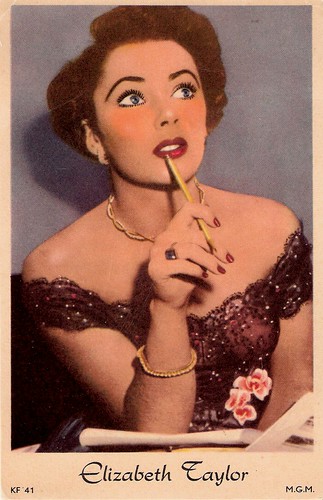
The American historical drama Cleopatra (Joseph L. Mankiewicz, 1963) chronicles the struggles of Cleopatra, the young Queen of Egypt, to resist the imperial ambitions of Rome. It achieved notoriety for its massive cost overruns and production troubles, which included changes in director and cast, a change of filming locale, sets that had to be constructed twice, lack of a firm shooting script, and personal scandal around co-stars Elizabeth Taylor and Richard Burton. Cleopatra almost bankrupted 20th Century Fox, but was also the highest-grossing film of 1963, and it won four Academy Awards, and was nominated for five more, including Best Picture.
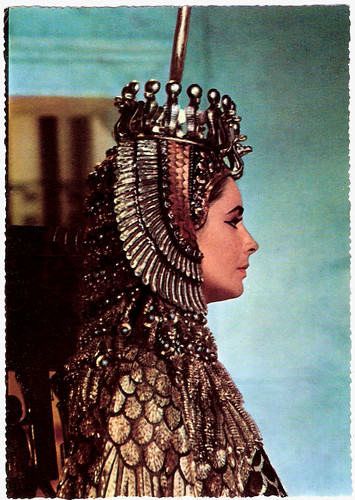
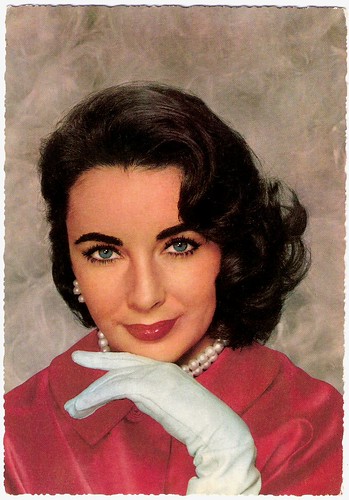
Elizabeth Taylor. Belgian postcard by SB (Uitgeverij Best), Antwerpen (Antwerp). Photo: still for Cleopatra (Joseph L. Mankiewicz, 1963).
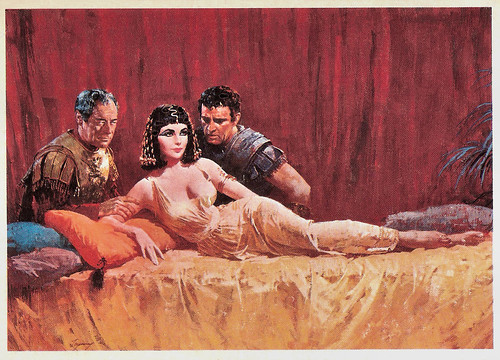
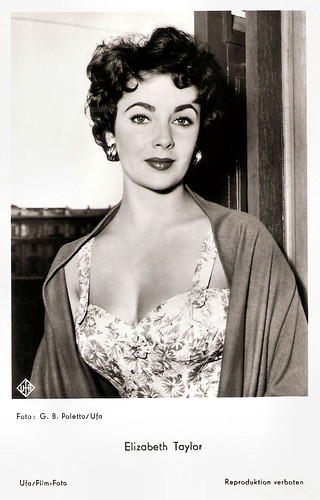
Rex Harrison, Elizabeth Taylor and Richard Burton. Vintage postcard. Image: poster art work for Cleopatra (Joseph l. Mankiewicz, 1963).
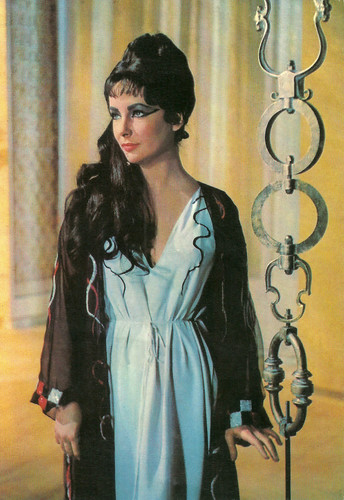
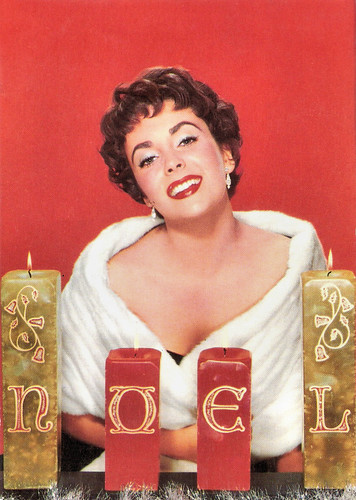
German postcard by ISV, no. A.104. Photo: 20th Century Fox. Elizabeth Taylor in the epic Cleopatra (Joseph Manckiewcz, 1963).
Cleopatra (Joseph Mankiewcz, 1963) was based on a screenplay adapted by Mankiewicz, Ranald MacDougall and Sidney Buchman from a book by Carlo Maria Franzero. It tells the story of the legendary Queen Cleopatra VII of Egypt (Elizabeth Taylor), who experiences both triumph and tragedy as she attempts to resist the imperial ambitions of Rome.
In 48 B.C., Julius Caesar (Rex Harrison) has beaten Pompey the Great in a brutal civil war for control of the Roman Republic and pursues Pompey from Pharsalia to Egypt. Caesar learns that Pompey has fled to neutral Egypt, hoping to enlist the support of the young teenage Pharaoh Ptolemy XIII (Richard O'Sullivan).
Ptolemy, now supreme ruler of Egypt after deposing his older sister, Cleopatra, attempts to gain favour with Caesar by presenting the conqueror with the head of Pompey, borne by his governors, Pothinos (Grégoire Aslan) and Achillas (John Doucette). Caesar is not pleased. For him, it is a sorry end for a worthy foe.
To win Caesar's support from her brother, the young Cleopatra hides herself in a rug, which her servant Apollodorus (Cesare Danova), disguised as a rug peddler, presents to Caesar as a gift from Cleopatra. When a suspicious Caesar unrolls the rug, he finds Cleopatra herself concealed within. The Roman is immediately infatuated; banishing Ptolemy, he declares Cleopatra Egypt's sole ruler and takes her as his mistress.
The ambitious Cleopatra uses her charms to manipulate Caesar and to establish her authority. A year later, she bears him the son he never had, Caesarion, and strives that their son will take his rightful place in Rome. Cleopatra can almost taste Egypt's long-awaited union with Rome, and the formation of a mighty empire. Caesar, however, must return to Italy for his triumph.
Two years pass before the two see each other again. After he is made dictator for life, Caesar sends for Cleopatra. She arrives in Rome in a lavish procession and wins the adulation of the Roman people. On the Ides of March in 44 B.C., the Senate is preparing to vote on whether to award Caesar additional powers for the Republic. Despite warnings from his wife Calpurnia (Gwen Watford) and Cleopatra, he is confident of victory. However, he is stabbed to death by various senators. Octavian (Roddy McDowall), Caesar's nephew, is named as his heir, not Caesarion. Cleopatra returns home to Egypt leaving Rome in turmoil.
Two years later in 42 B.C., Caesar's assassins, among them Cassius (John Hoyt) and Brutus (Kenneth Haigh), are killed at the Battle of Philippi. The powerful Roman general Marc Antony (Richard Burton) establishes a Second Triumvirate government with Octavian and Lepidus. Antony will take control of the eastern provinces including Asia Minor and Syria. In 38 B.C., when Mark Antony, Caesar's protege, beholds the beautiful Cleopatra aboard her elaborate barge at Tarsus, he is smitten and becomes both her lover and military ally.
Octavian uses their affair in his smear campaign against Antony. When Antony returns to Rome to address the situation brewing there, Octavian traps him into a marriage of state to Octavian's sister, Octavia (Jean Marsh). The marriage satisfies no one. Cleopatra is infuriated. Antony, tiring of his Roman wife, soon returns to Egypt and divorces Octavia. IN Egypt, he marries Cleopatra in a public ceremony. It leads the two lovers to a personal and political demise.
Shocked and insulted, the Senators who had previously stood by Antony abandon their hero and vote for war. Octavian murders the Egyptian ambassador, Cleopatra's tutor Sosigenes (Hume Cronyn), on the Senate steps. Sensing Antony's weakness, Octavian attacks and defeats his forces at Actium in 31 B.C. Alarmed, Cleopatra withdraws her fleet and seeks refuge in her tomb. Realising Anthony and her son are death, she arranges to be bitten by a poisonous asp.
In the final shot, Octavian and Agrippa enter Cleopatra's temple afterwords to see her dead, dressed in a gold funeral robe with her two handmaidens, also bitten by the same venomous snake that Cleopatra allowed herself to get bitten, dying by her side. Octavian also finds a last letter from Cleopatra requesting to be buried with Marc Antony.
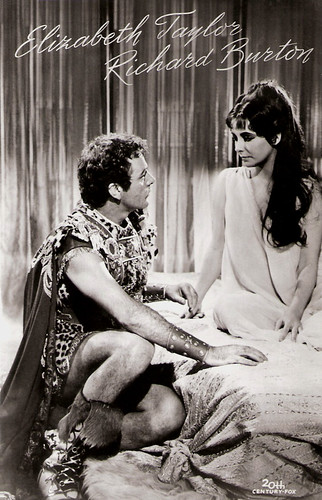
Richard Burton and Elizabeth Taylor. German postcard by Filmbilder-Vertrieb Ernst Freihoff, Essen, no. AX 5536. Photo: publicity still for Cleopatra (Joseph L. Mankiewicz, 1963).
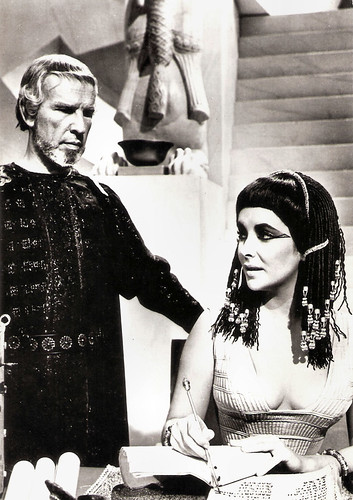
Elizabeth Taylor and Hume Cronyn. Czech postcard by UPF, Praha / Press Photo. Photo: publicity still for Cleopatra (Joseph L. Mankiewicz, 1963).
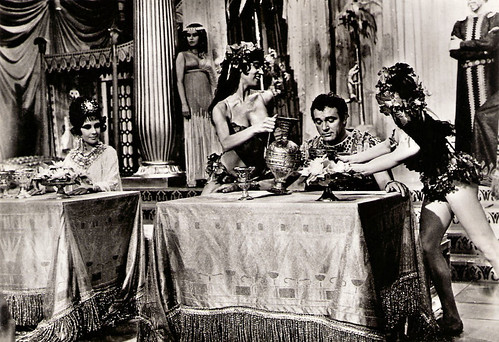
Richard Burton and Elizabeth Taylor. Czech postcard by UPTF Pressfoto, Praha (Prague), no. S 206/7. Photo: publicity still for Cleopatra (Joseph L. Mankiewicz, 1963).
As the story of Cleopatra had proved a hit for silent-screen legend Theda Bara with Cleopatra (J. Gordon Edwards, 1917), and for Claudette Colbert with Cleopatra (Cecil B. De Mille, 1934), 20th Century Fox executives hired veteran Hollywood producer Walter Wanger in 1958 to shepherd a new remake into production. Although the studio originally sought a relatively cheap production of $2 million, Wanger envisioned a much more opulent epic, and in mid-1959 successfully negotiated a higher budget of $5 million.
Rouben Mamoulian was assigned to direct and Elizabeth Taylor was awarded a record-setting contract of $1 million. Filming began in England but in January 1961 Taylor became so ill that production was shut down. Sixteen weeks of production and costs of $7 million had produced just ten minutes of film. Fox was reimbursed by the insurance company and Mamoulian was fired.
Joseph L. Mankiewicz was brought on to the production after Mamoulian's departure and the set moved to Cinecittà, outside of Rome. Peter Finch and Stephen Boyd left the production owing to other commitments and were replaced by Rex Harrison and Richard Burton.
During filming, Taylor met Richard Burton and the two began an adulterous affair. The scandal made headlines worldwide, since both were married to others, and brought bad publicity to the already troubled production. Mankiewicz was later fired during the editing phase, only to be rehired to reshoot the opening battle scenes in Spain.
The cut of the film which Mankiewicz screened for the studio was six hours long. This was cut to four hours for its initial premiere, but the studio demanded (over the objections of Mankiewicz) that the film be cut once more, this time to just barely over three hours to allow theatres to increase the number of showings per day. Mankiewicz unsuccessfully attempted to convince the studio to split the film in two in order to preserve the original cut. These were to be released separately as Caesar and Cleopatra followed by Antony and Cleopatra.
Cleopatra ended up costing $31 million, making it the most expensive film ever made at the time, and almost bankrupted 20th Century Fox. It was also the highest-grossing film of 1963, earning box-office of $57.7 million in the United States (equivalent to $461 million now), yet lost money due to its production and marketing costs of $44 million (equivalent to $352 million now), making it the only film ever to be the highest-grossing film of the year to run at a loss. Cleopatra later won four Academy Awards, and was nominated for five more, including Best Picture which it lost to the British adventure-comedy Tom Jones (Tony Richardson, 1963).
On 21 May 2013, the restored film was shown at a special screening at the 2013 Cannes Film Festival, to commemorate its 50th anniversary. It was later released as a 50th-anniversary version available on DVD and Blu-ray. Unfortunately Fox had long ago destroyed all of the trims and outs from negatives to save costs, preventing the release of traditional outtakes.
Derek Armstrong at All Movie: "Cleopatra is an interesting study in contradictions, as both a dud that won five Oscars and a lavish production that wastes most of its time on scenes of talking heads. Unfortunately, it's also not a 246-minute movie that breezes by; any modern viewer brave enough to sit through its four hours will feel the passage of every minute, with little ultimate reward for the time spent. The leads all acquit themselves admirably, especially Rex Harrison as Caesar, but viewers better acquainted with these characters through Shakespeare's lyrical language will lament the all-too-ordinary and sometimes anachronistic dialogue that comprises Joseph L. Mankiewicz's film. Elizabeth Taylor shines like the star she was, jumping in and out of dozens of ornate costumes, many of which hug her figure tightly, in a way that was provocative at the time. But she's a little too petulant and melodramatic to ultimately be taken seriously."
D.B DuMonteil at IMDb calls the film a 'visual poem, a feast for the eye and for the mind': "it was one of the most underrated Hollywood epics. First of all,it's only partially an epic: most of the scenes are intimate,generally two characters who are constantly tearing each other apart. Joseph L. Mankiewicz, one of the most intelligent director of his time, rewrote the dialogue during the shooting, night after night, and the results are stunning, considering the difficulties he encountered with his budget and his stars. Cleopatra's dream is perfectly recreated, much better than in De Mille's version."
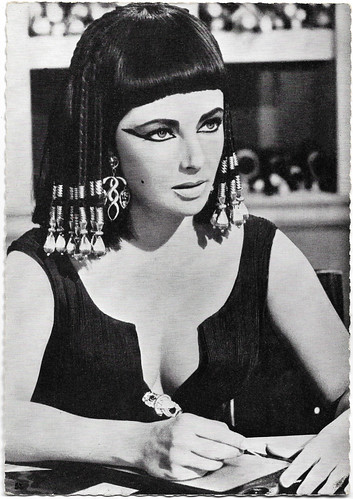
Elizabeth Taylor. German postcard by Filmbilder-Vertrieb Ernst Freihoff, Essen, no. 824. Photo: Cleopatra / Centfox. Publicity still for Cleopatra (Joseph L. Mankiewicz, 1963).
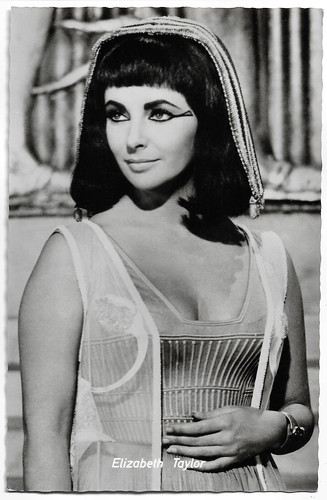
German postcard by Kolibri-Verlag, Minden/Westf., no. 1657. Photo: Centfox. Publicity still for Cleopatra (Joseph L. Mankiewicz, 1963).
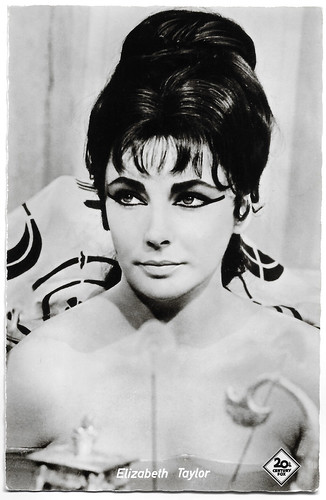
German postcard by Kolibri-Verlag, Minden/Westf., no. 1866. Photo: Centfox. Publicity still for Cleopatra (Joseph L. Mankiewicz, 1963).
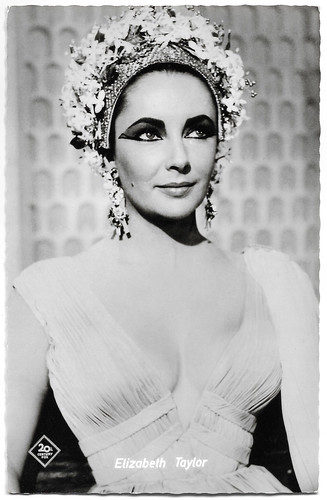
German postcard by Kolibri-Verlag, Minden/Westf., no. 2163. Photo: Centfox. Publicity still for Cleopatra (Joseph L. Mankiewicz, 1963).
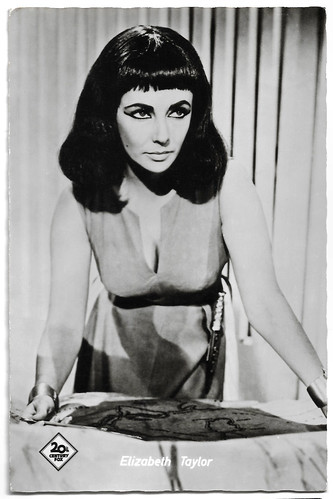
German postcard by Kolibri-Verlag, Minden/Westf., no. 2312. Photo: Centfox. Publicity still for Cleopatra (Joseph L. Mankiewicz, 1963).
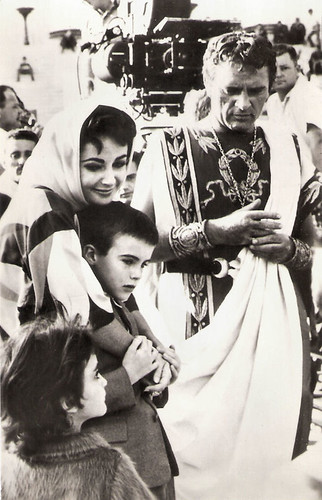
Richard Burton and Elizabeth Taylor. Czech collectors card by Pressfoto, Praha (Prague), no. S 229/2 769. Photo: a 1962 set photo of Cleopatra (Joseph L. Mankiewicz, 1963).
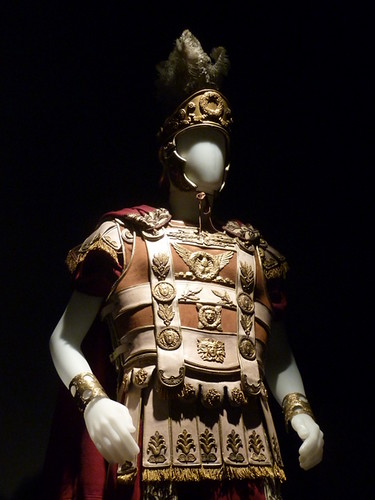
Costume of Richard Burton in Cleopatra (Joseph Mankiewicz, 1963), Cinecittà, Roma. Photo: Ivo Blom.
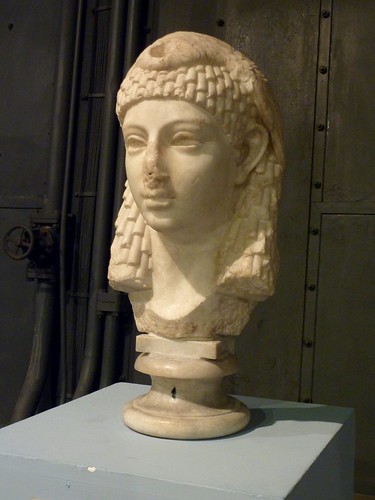
Portrait of Cleopatra. Hellenistic age. Found at the Via Labicana, Rome (1886). Centrale Montemartini Rome, Machine Hall. Photo: Ivo Blom.
Sources: Derek Armstrong (AllMovie), D.B DuMonteil (IMDb), Wikipedia and IMDb.
Elizabeth Taylor. Belgian postcard by SB (Uitgeverij Best), Antwerpen (Antwerp). Photo: still for Cleopatra (Joseph L. Mankiewicz, 1963).
Rex Harrison, Elizabeth Taylor and Richard Burton. Vintage postcard. Image: poster art work for Cleopatra (Joseph l. Mankiewicz, 1963).
German postcard by ISV, no. A.104. Photo: 20th Century Fox. Elizabeth Taylor in the epic Cleopatra (Joseph Manckiewcz, 1963).
The triumph and tragedy of a legendary queen
Cleopatra (Joseph Mankiewcz, 1963) was based on a screenplay adapted by Mankiewicz, Ranald MacDougall and Sidney Buchman from a book by Carlo Maria Franzero. It tells the story of the legendary Queen Cleopatra VII of Egypt (Elizabeth Taylor), who experiences both triumph and tragedy as she attempts to resist the imperial ambitions of Rome.
In 48 B.C., Julius Caesar (Rex Harrison) has beaten Pompey the Great in a brutal civil war for control of the Roman Republic and pursues Pompey from Pharsalia to Egypt. Caesar learns that Pompey has fled to neutral Egypt, hoping to enlist the support of the young teenage Pharaoh Ptolemy XIII (Richard O'Sullivan).
Ptolemy, now supreme ruler of Egypt after deposing his older sister, Cleopatra, attempts to gain favour with Caesar by presenting the conqueror with the head of Pompey, borne by his governors, Pothinos (Grégoire Aslan) and Achillas (John Doucette). Caesar is not pleased. For him, it is a sorry end for a worthy foe.
To win Caesar's support from her brother, the young Cleopatra hides herself in a rug, which her servant Apollodorus (Cesare Danova), disguised as a rug peddler, presents to Caesar as a gift from Cleopatra. When a suspicious Caesar unrolls the rug, he finds Cleopatra herself concealed within. The Roman is immediately infatuated; banishing Ptolemy, he declares Cleopatra Egypt's sole ruler and takes her as his mistress.
The ambitious Cleopatra uses her charms to manipulate Caesar and to establish her authority. A year later, she bears him the son he never had, Caesarion, and strives that their son will take his rightful place in Rome. Cleopatra can almost taste Egypt's long-awaited union with Rome, and the formation of a mighty empire. Caesar, however, must return to Italy for his triumph.
Two years pass before the two see each other again. After he is made dictator for life, Caesar sends for Cleopatra. She arrives in Rome in a lavish procession and wins the adulation of the Roman people. On the Ides of March in 44 B.C., the Senate is preparing to vote on whether to award Caesar additional powers for the Republic. Despite warnings from his wife Calpurnia (Gwen Watford) and Cleopatra, he is confident of victory. However, he is stabbed to death by various senators. Octavian (Roddy McDowall), Caesar's nephew, is named as his heir, not Caesarion. Cleopatra returns home to Egypt leaving Rome in turmoil.
Two years later in 42 B.C., Caesar's assassins, among them Cassius (John Hoyt) and Brutus (Kenneth Haigh), are killed at the Battle of Philippi. The powerful Roman general Marc Antony (Richard Burton) establishes a Second Triumvirate government with Octavian and Lepidus. Antony will take control of the eastern provinces including Asia Minor and Syria. In 38 B.C., when Mark Antony, Caesar's protege, beholds the beautiful Cleopatra aboard her elaborate barge at Tarsus, he is smitten and becomes both her lover and military ally.
Octavian uses their affair in his smear campaign against Antony. When Antony returns to Rome to address the situation brewing there, Octavian traps him into a marriage of state to Octavian's sister, Octavia (Jean Marsh). The marriage satisfies no one. Cleopatra is infuriated. Antony, tiring of his Roman wife, soon returns to Egypt and divorces Octavia. IN Egypt, he marries Cleopatra in a public ceremony. It leads the two lovers to a personal and political demise.
Shocked and insulted, the Senators who had previously stood by Antony abandon their hero and vote for war. Octavian murders the Egyptian ambassador, Cleopatra's tutor Sosigenes (Hume Cronyn), on the Senate steps. Sensing Antony's weakness, Octavian attacks and defeats his forces at Actium in 31 B.C. Alarmed, Cleopatra withdraws her fleet and seeks refuge in her tomb. Realising Anthony and her son are death, she arranges to be bitten by a poisonous asp.
In the final shot, Octavian and Agrippa enter Cleopatra's temple afterwords to see her dead, dressed in a gold funeral robe with her two handmaidens, also bitten by the same venomous snake that Cleopatra allowed herself to get bitten, dying by her side. Octavian also finds a last letter from Cleopatra requesting to be buried with Marc Antony.
Richard Burton and Elizabeth Taylor. German postcard by Filmbilder-Vertrieb Ernst Freihoff, Essen, no. AX 5536. Photo: publicity still for Cleopatra (Joseph L. Mankiewicz, 1963).
Elizabeth Taylor and Hume Cronyn. Czech postcard by UPF, Praha / Press Photo. Photo: publicity still for Cleopatra (Joseph L. Mankiewicz, 1963).
Richard Burton and Elizabeth Taylor. Czech postcard by UPTF Pressfoto, Praha (Prague), no. S 206/7. Photo: publicity still for Cleopatra (Joseph L. Mankiewicz, 1963).
The most expensive film ever made
As the story of Cleopatra had proved a hit for silent-screen legend Theda Bara with Cleopatra (J. Gordon Edwards, 1917), and for Claudette Colbert with Cleopatra (Cecil B. De Mille, 1934), 20th Century Fox executives hired veteran Hollywood producer Walter Wanger in 1958 to shepherd a new remake into production. Although the studio originally sought a relatively cheap production of $2 million, Wanger envisioned a much more opulent epic, and in mid-1959 successfully negotiated a higher budget of $5 million.
Rouben Mamoulian was assigned to direct and Elizabeth Taylor was awarded a record-setting contract of $1 million. Filming began in England but in January 1961 Taylor became so ill that production was shut down. Sixteen weeks of production and costs of $7 million had produced just ten minutes of film. Fox was reimbursed by the insurance company and Mamoulian was fired.
Joseph L. Mankiewicz was brought on to the production after Mamoulian's departure and the set moved to Cinecittà, outside of Rome. Peter Finch and Stephen Boyd left the production owing to other commitments and were replaced by Rex Harrison and Richard Burton.
During filming, Taylor met Richard Burton and the two began an adulterous affair. The scandal made headlines worldwide, since both were married to others, and brought bad publicity to the already troubled production. Mankiewicz was later fired during the editing phase, only to be rehired to reshoot the opening battle scenes in Spain.
The cut of the film which Mankiewicz screened for the studio was six hours long. This was cut to four hours for its initial premiere, but the studio demanded (over the objections of Mankiewicz) that the film be cut once more, this time to just barely over three hours to allow theatres to increase the number of showings per day. Mankiewicz unsuccessfully attempted to convince the studio to split the film in two in order to preserve the original cut. These were to be released separately as Caesar and Cleopatra followed by Antony and Cleopatra.
Cleopatra ended up costing $31 million, making it the most expensive film ever made at the time, and almost bankrupted 20th Century Fox. It was also the highest-grossing film of 1963, earning box-office of $57.7 million in the United States (equivalent to $461 million now), yet lost money due to its production and marketing costs of $44 million (equivalent to $352 million now), making it the only film ever to be the highest-grossing film of the year to run at a loss. Cleopatra later won four Academy Awards, and was nominated for five more, including Best Picture which it lost to the British adventure-comedy Tom Jones (Tony Richardson, 1963).
On 21 May 2013, the restored film was shown at a special screening at the 2013 Cannes Film Festival, to commemorate its 50th anniversary. It was later released as a 50th-anniversary version available on DVD and Blu-ray. Unfortunately Fox had long ago destroyed all of the trims and outs from negatives to save costs, preventing the release of traditional outtakes.
Derek Armstrong at All Movie: "Cleopatra is an interesting study in contradictions, as both a dud that won five Oscars and a lavish production that wastes most of its time on scenes of talking heads. Unfortunately, it's also not a 246-minute movie that breezes by; any modern viewer brave enough to sit through its four hours will feel the passage of every minute, with little ultimate reward for the time spent. The leads all acquit themselves admirably, especially Rex Harrison as Caesar, but viewers better acquainted with these characters through Shakespeare's lyrical language will lament the all-too-ordinary and sometimes anachronistic dialogue that comprises Joseph L. Mankiewicz's film. Elizabeth Taylor shines like the star she was, jumping in and out of dozens of ornate costumes, many of which hug her figure tightly, in a way that was provocative at the time. But she's a little too petulant and melodramatic to ultimately be taken seriously."
D.B DuMonteil at IMDb calls the film a 'visual poem, a feast for the eye and for the mind': "it was one of the most underrated Hollywood epics. First of all,it's only partially an epic: most of the scenes are intimate,generally two characters who are constantly tearing each other apart. Joseph L. Mankiewicz, one of the most intelligent director of his time, rewrote the dialogue during the shooting, night after night, and the results are stunning, considering the difficulties he encountered with his budget and his stars. Cleopatra's dream is perfectly recreated, much better than in De Mille's version."
Elizabeth Taylor. German postcard by Filmbilder-Vertrieb Ernst Freihoff, Essen, no. 824. Photo: Cleopatra / Centfox. Publicity still for Cleopatra (Joseph L. Mankiewicz, 1963).
German postcard by Kolibri-Verlag, Minden/Westf., no. 1657. Photo: Centfox. Publicity still for Cleopatra (Joseph L. Mankiewicz, 1963).
German postcard by Kolibri-Verlag, Minden/Westf., no. 1866. Photo: Centfox. Publicity still for Cleopatra (Joseph L. Mankiewicz, 1963).
German postcard by Kolibri-Verlag, Minden/Westf., no. 2163. Photo: Centfox. Publicity still for Cleopatra (Joseph L. Mankiewicz, 1963).
German postcard by Kolibri-Verlag, Minden/Westf., no. 2312. Photo: Centfox. Publicity still for Cleopatra (Joseph L. Mankiewicz, 1963).
Richard Burton and Elizabeth Taylor. Czech collectors card by Pressfoto, Praha (Prague), no. S 229/2 769. Photo: a 1962 set photo of Cleopatra (Joseph L. Mankiewicz, 1963).
Costume of Richard Burton in Cleopatra (Joseph Mankiewicz, 1963), Cinecittà, Roma. Photo: Ivo Blom.
Portrait of Cleopatra. Hellenistic age. Found at the Via Labicana, Rome (1886). Centrale Montemartini Rome, Machine Hall. Photo: Ivo Blom.
Sources: Derek Armstrong (AllMovie), D.B DuMonteil (IMDb), Wikipedia and IMDb.