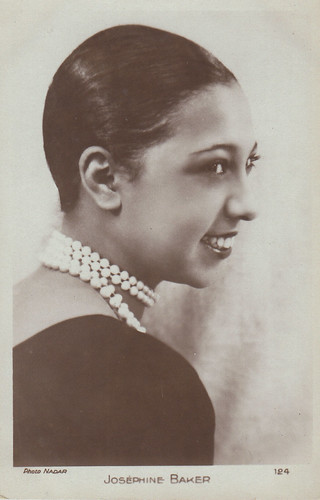
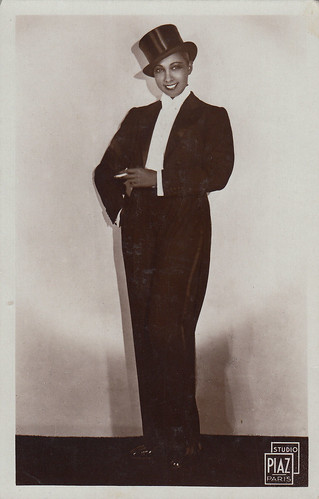
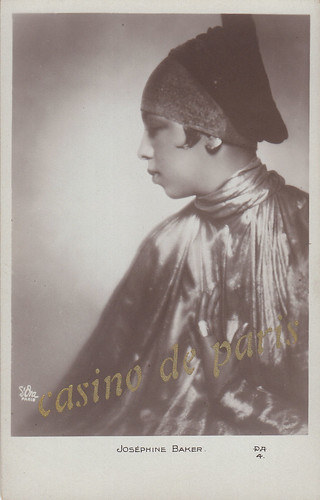
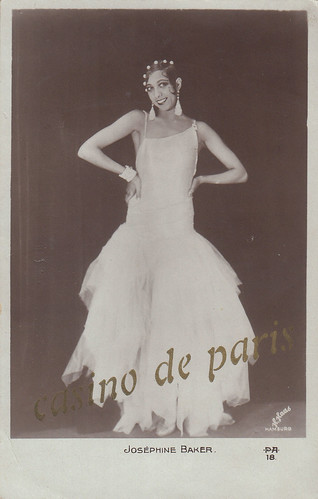
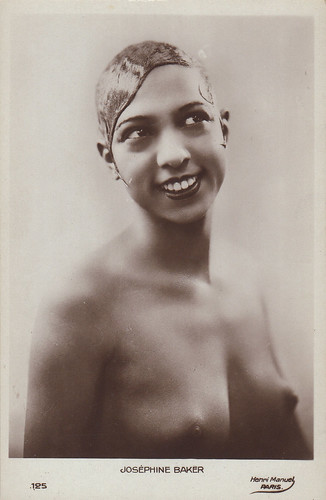
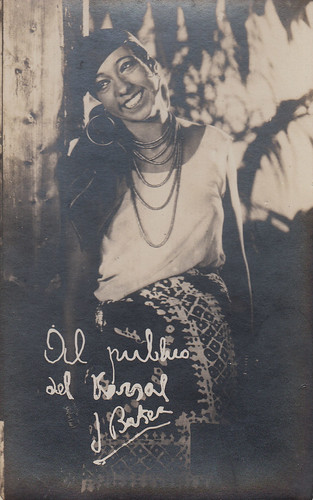
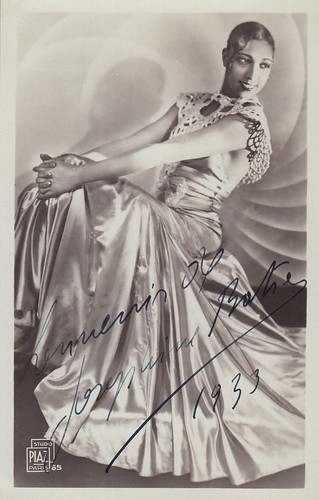
Josephine Baker (1906-1975) was an American singer and dancer who became a legend in Europe. In 1925, 'the Bronze Venus' became an instant success in Paris with her coffee skin, ebony eyes, long legs, and 'smile to end all smiles'. She was the first African American female to become a world-famous entertainer, to integrate an American concert hall, and to star in a major film, the French production La Sirene des Tropiques / Siren of the Tropics (1927). For Il Cinema Ritrovato 2026, Emilie Cauquy curated the program 'Joséphine Baker, Renaissance Woman, ' showing Baker's full filmography, spiced up by a selection of newsreels from Gaumont Pathé archives and rarities.
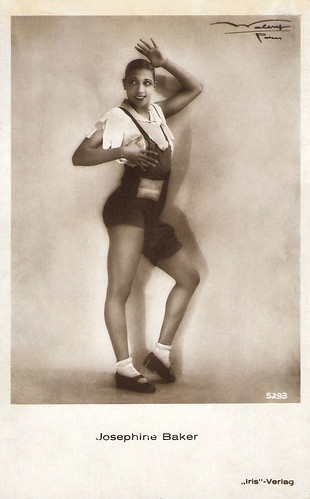
Austrian postcard by Iris Verlag, no. 5293. Photo: Walery, Paris.

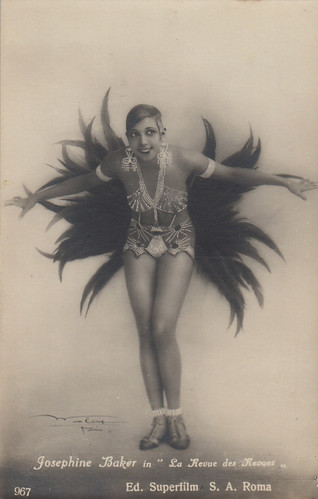
French postcard by Cinémagazine-Edition (CE), no. 531. Photo: Walery, Paris. Josephine Baker in La revue des revues / Parisian Pleasures (Joe Francis, 1927). Collection: Marlene Pilaete.
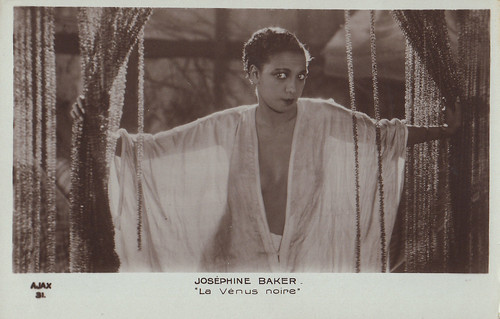
French postcard by Ajax, no. 31. Photo: Josephine Baker. Collection: Marlene Pilaete. Caption: The black Venus.
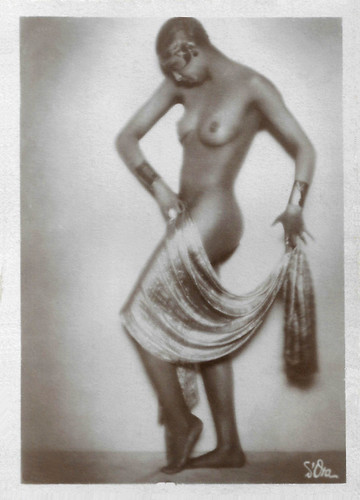
Small French card by Columbia. Photo: d'Ora.

French postcard by A.N., Paris, no. 66. Photo: Henri Manuel.
Josephine Baker was born Frida Josephine McDonald in 1906, in St. Louis, Missouri, US. Her mother, Carrie McDonald, was a laundress, and her father, Eddie Carson, a Vaudeville drummer. Between the ages of 8 and 10, she was out of school, helping to support her family. As a child, Baker developed a taste for the flamboyant that was later to make her famous. At age 11, Josephine witnessed racist attacks on Black people in neighbouring East St. Louis, in which at least 39 people were killed. Josephine dropped out of school at the age of 12, and first danced for the public on the streets of St. Louis for nickels and dimes.
At 13, she married Willie Wells, who was 26. They pretended she was 15. The marriage to Wells lasted less than a year. At 15, she married a Pullman porter named William Howard Baker. Two years later, she left him, but kept his name. Josephine was recruited for the St. Louis Chorus Vaudeville Show. Later, she joined the chorus in a road company (Jones Family Band and the Dixie Steppers) performing the musical comedy 'Shuffle Along' (1923). She headed to New York City, where during the Harlem Renaissance, she performed at the Plantation Club and in the chorus of the popular Broadway revue 'The Chocolate Dandies' (1924).
She performed as the last dancer in a chorus line, a position in which the dancer traditionally performed comically, as if they were unable to remember the dance, until the encore. At the encore, they would not only perform it correctly but also with additional complexity. Baker was then billed as 'the highest-paid chorus girl in Vaudeville.' The first time she left for France was in 1925, after she had been scouted by the white producer Caroline Dudley Reagan, wife of Joseph Delteil and creator of the famous Revue Nègre. Dudley Reagan requested her to come to perform in Paris with a black performing troupe. Paris was a haven for artists and intellectuals in the 1920s. Josephine Baker opened in Paris in 'La revue negre' at the Théatre des Champs-Élysées. The show was a resounding success. The final number of the evening, 'Danse Sauvage' (Wild Dance), was particularly popular. In this number, Baker was carried onto the stage by a muscular male dancer. She was naked (except for a skirt made of flamingo feathers) and seemingly lifeless. But she soon threw herself into a frenzied dance. As she danced more wildly, she rubbed against the man unmistakably.
Curator Emilie Cauquy writes on the Il Cinema Ritrovato website: "Joséphine Baker was never just the woman with the banana skirt. She was a shockwave. Bursting onto the Paris scene of the 1920s, she carved herself into the collective imagination with a body in excessive motion, both fetishised and fiercely independent. Born on the streets of St. Louis, her art came from survival, improvisation, and jazz. Renaissance! Europe wanted 'the jungle', Baker brought the street, turning exoticization into both a weapon and a disguise. Her image, between nudity and animality, fed colonial fantasies, yet she constantly sabotaged them through exaggeration, grimace and refusal of stillness."
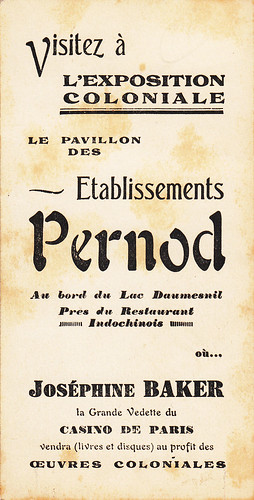
Marlene Pilaete reacts in an email: "I'm always a bit puzzled by those 'modern' re-lectures of past performers, especially when I read this in the Cinema Ritrovato program about Josephine Baker: 'Her image, between nudity and animality, fed colonial fantasies, yet she constantly sabotaged them through exaggeration, grimace and refusal of stillness'. They rewrite history with present-day anti-colonialist lenses. It's funny, about 20-30 years ago, nobody talked about this 'theory' of Baker making faces and dancing energetically to debunk colonial clichés. Baker herself was clear in her 1949 book 'Mes Mémoires'. She referred to her stage career in the U.S. before she came to France and said this about it: 'I've moved from the background to the foreground by dint of crossing my eyes and throwing my arms and legs above the spectators' heads'. It was just her way to stand out from the other chorus girls. She simply used grimaces and exaggerated movements in France because they had brought her success in the U.S., and certainly not to deliberately sabotage colonial fantasies. The fact that Baker attended the 1931 Exposition Coloniale (as proven by the Pernod card I used in my November 2021 EFSP post) proves that, at the time, she didn't really care about colonialism and colonial clichés. I don't know why some people want to transform the young Josephine Baker into an anti-colonialist icon. It seems too difficult for them to simply accept her as a young and ebullient girl eager to please. She was handsomely paid for dancing half-naked or for wearing a banana belt. She gave European audiences what they wanted to see, without a second thought and with no anti-colonialist perspective. She only became a militant activist later in her life."

American postcard by Fotofolio, NY, NY, no. F291. Photo: James Abbe. Josephine Baker in 'La revue negre'.

French postcard by Editions Damilla, Paris, no. 95070. Photo: R.V.

French postcard. Photo: Roger Viollet. Caption: Josephine Baker (1906-1975), American music-hall artist, May 1926.

British postcard by James Gardiner Postcards, Watford, in The Glamour Queens series, no. 8, 1988. Caption: Josephine Baker, 1927.

American postcard by Fotofolio, NY, NY, no. HH13, 1979. Photo: George Hoyningen-Huene. Caption: Josephine Baker, c. 1930.

French postcard by Editions La Malibran, Paris, no. CF 40. Josephine Baker and Jean Gabin in Zouzou (Marc Allégret, 1934).
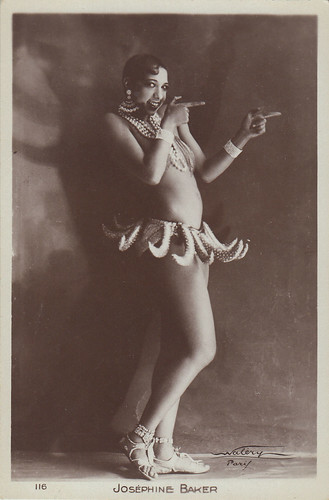
Europe was a sensation for Josephine Baker. When she enjoyed lunch in the dining car of the boat train to Paris, it was the first time she had sat among only white people. In 'La Revue Nègre' (1925) at the Théâtre des Champs-Élysées, she performed her 'Danse Sauvage', dressed only in ostrich feathers. In the show, she also wore a skirt made of imitation bananas, shamelessly portraying a caricature of how most white people viewed someone of African descent at the time. When Baker began performing in Paris, jazz was still a novelty to the European audience. Her fusion of jazz, charleston, and improvised African rhythms was particularly popular in avant-garde artistic circles. Paris was a haven for artists and intellectuals in the 1920s. In 1926, she interrupted the company's European tour and returned to Paris, where she joined the Folies Bergère with the act 'La Folie du Jour'.
In 1928, she undertook another European tour with her company, which caused quite a stir. For instance, her performances were met with fierce protests from conservative quarters in Austria, but she enjoyed great success in Sweden, the Netherlands, and Italy. In Munich, her performance was even banned in 1929 for 'offending public morals'. In 1929, she travelled through Central Europe on the Orient Express with her lover at the time, Giuseppe Pepito Abatino, visiting Yugoslavia and Hungary. In Serbia, she gave a charity performance for the benefit of children living in poverty. Back in Paris, she joined the Folies Bergère for several years. From then on, she was given nicknames such as 'Black Venus', 'The Black Pearl', and 'The Creole Goddess'. She quickly became a favourite of the French, and her fame grew.
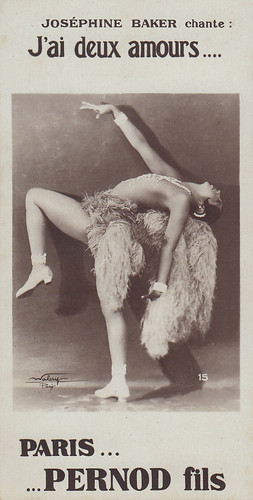
Baker performed in a handful of silent and early sound films, including La Sirene des Tropiques / Siren of the Tropics (Henri Étiévant, Mario Nalpas, 1927) at the side of Pierre Batcheff, Zouzou (Marc Allégret, 1934) opposite Jean Gabin, and La princesse Tam Tam / Princess Tam-Tam (Edmond T. Gréville, 1935) with Albert Préjean. At this time, she also scored her greatest song hit, 'J'ai deux amours' (1931).
In 1936, Baker left for the US and expected a warm welcome. But it turned out to be a cold shower. On Broadway, she performed in 'Ziegfeld Follies' for which Vincente Minnelli had designed the sets and costumes, and Ira Gershwin had written the music. Theatre critics slammed her performances with racist remarks. Time called her a 'negro girl without particular talent'. Disillusioned, she returned to France.
Josephine Baker resolved to settle permanently in the country where she had already been received with open arms and was adored. In Paris, she felt at home and could be who she was. In 1937, she renounced her American citizenship and became a citizen of France. During the German occupation of France, Baker worked with the Red Cross and the Résistance, and as a member of the Free French forces she entertained troops in Africa and the Middle East. She was later awarded the Croix de Guerre and the Legion of Honour with the rosette of the Résistance.

French promotional postcard. Photo: Josephine Baker in La Sirène des tropiques / Siren of the Tropics (Mario Nalpas, Henri Étiévant, 1927). Collection: Marlene Pilaete. The script was written by Maurice Dekobra.
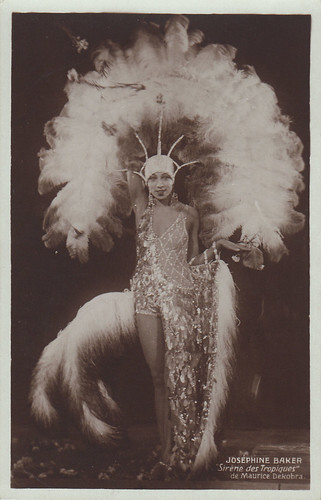
French promotional postcard. Photo: Josephine Baker in La Sirène des tropiques / Siren of the Tropics (Mario Nalpas, Henri Étiévant, 1927). Collection: Marlene Pilaete. The script was written by Maurice Dekobra.

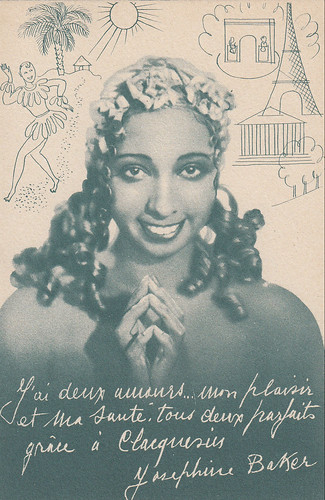
French promotion card by Clacquesin. Caption: I have two loves... my pleasure and my health. Both are perfect thanks to Clacquesin. Josephine Baker.

French postcard by Éditions et Publications cinématographiques, no. 74. Photo: Films Roussillon. Josephine Baker in Zouzou (Marc Allégret, 1934).

French postcard, no. 612. Photo: Piaz, Paris.
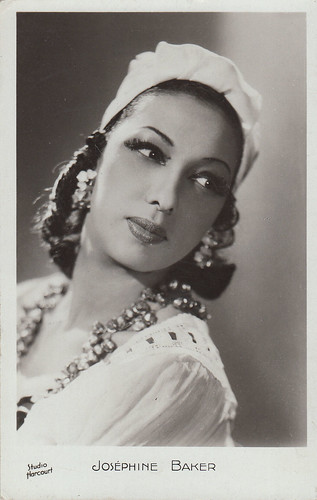
French postcard. Photo: Harcourt. A previous owner of this card wrote in pencil on the back that it was related to the revue 'Paris-London' at the Casino de Paris (1939-1940). Collection: Marlene Pilaete.
After the war, Josephine Baker devoted much of her energy to Les Milandes, her estate in southwestern France, from which she began in 1950 to adopt babies of all nationalities in the cause of what she defined as 'an experiment in brotherhood' and her 'rainbow tribe'. ‘Children of different races who grew up as brothers and sisters do not suffer from racial hatred. That is something people invented,’ she explained. Baker retired from the stage in 1956, but to maintain Les Milandes she was later obliged to return, starring in Paris in 1959.
Although based in France, Baker supported the American Civil Rights Movement during the 1950s. In 1951, the Stork Club in New York City refused to serve her because she was black. Grace Kelly, who was also in the club, witnessed the incident. She resolutely took Baker by the arm and together they left the club – followed by Kelly’s friends. This incident led to a confrontation with right-wing columnist Walter Winchell. In 1951, the civil rights organisation NAACP named her ‘Woman of the Year’. Later, she was falsely accused of being a 'communist sympathiser', and the FBI started a file on her. The FBI often used this term for the civil rights movement. During the McCarthy era, she was told that she was no longer welcome in the United States. In France, she was made a Chevalier of the Légion d'honneur, France's highest honour, in 1961. In 1963, she participated with 250,000 others in Martin Luther King’s march on Washington. ‘I have visited royal palaces and presidential residences and much more. But in the US, I can’t even get a cup of coffee in a hotel. That makes me angry,’ she said in a speech, just before King’s iconic ‘I Have a Dream’ speech.
In the late 1960s, she began having financial difficulties and stopped performing. In 1968, her estate was sold to satisfy accumulated debt. Princess Grace offered her a home in Monaco when she learned of Josephine's financial problems. At the request of the Princess, she performed at Monaco's summer ball in 1974, and it was a great success. That same year, she staged a week of performances in New York and called the show 'An Evening with Josephine Baker'.
In April 19075, Josephine Baker performed a Paris revue to celebrate the 50th anniversary of her Paris debut. The first show in Paris drew a full house. Baker danced on stage with youthful energy and changed outfits 12 times. Among the guests were stars such as Liza Minnelli, Mick Jagger, and Sophia Loren. A congratulatory telegram arrived from French President Valéry Giscard d’Estaing. A few days later, on 10 April 1975, she was stricken and went into a coma. She died later that day at the Pitié-Salpêtrière Hospital from the effects of a cerebral haemorrhage. Baker received a funeral in Paris, which was televised. 20,000 viewers watched as the flag-decorated coffin was driven to the Sainte-Marie-Madeleine church in Paris. She was buried in Monaco. On 30 November 2021, she was symbolically interred in the Panthéon in Paris. Her life was dramatised in the television movie The Josephine Baker Story (1991) and was showcased in the documentary Joséphine Baker. Première icône noire / Josephine Baker: The Story of an Awakening (2018).
Josephine Baker was married four times: to foundry worker Willie Wells (1919), William Howard Baker (1921-1923), French sugar magnate Jean Lion (1937-1938), and finally to orchestra leader Joe Bouillon (1947-1957). Baker was bisexual. Having been married to multiple men, she also maintained relationships with women throughout her adult life. Her famous lovers included the French writer Colette, whom Baker described as ‘the most beautiful panther’, and Cuban artist Frida Kahlo. Baker adopted 12 children, partly because she couldn't have any of her own and partly because she believed in equality for all, no matter what nationality, religion or race. Although Baker's children lacked nothing, some of them later indicated that they felt more like props in a project than living people. 'They were a kind of puppets to her', said her adopted son Jean-Claude Baker, who later wrote a critical biography of Josephine.

French postcard by Ray. Delvert, Villeneuve-sur-Lot. Josephine Baker and her fourth husband, Jo Bouillon, in the park of their Château des Milandes in the commune of Castelnaud-la-Chapelle in the Dordogne. In 1937, Baker rented the château and moved there after the German invasion of Paris in 1941. She used it as a centre for resistance activity. In 1947, she and Jo Bouillon bought the château. There, they carried out their project to adopt children of different nationalities, to prove that the cohabitation of different 'races' could work admirably. Finally, they adopted twelve children. All the children that the couple adopted bear the name Bouillon. Baker and Bouillon separated in 1957 and divorced in 1961. In 1969, Baker had to give up the castle for financial reasons. There is now a museum dedicated to her.

French postcard by Éditions Jean Farcigny, Courbevoie. Photo: Lipnitzki / Viollet. Caption: Josephine Baker at L'Olympia in April 1964.

French postcard by Cie. des Arts Photomécaniques, Paris, no. 1556. Photo: Josephine Baker and Jo Bouillon. Caption: Les Milandes - 'Jorama' 1949. Josephine Sings.

French postcard “Lumicap” by Compagnie des Arts Photomécaniques, Paris. This card shows Josephine and her fourth husband, Jo Bouillon, with the first nine children they adopted: Aiko, Luis, Janot, Jari, Jean-Claude, Moïse, Brahim, Marianne, and Koffi. Later, three more children were added to the 'Rainbow Tribe': Mara and Noël in 1959 and Stellina in 1962 or 1964 (sources differ). Collection: Marlene Pilaete.

Dutch postcard, no. AX 3771.

Czech postcard by Edice z Videni, no 488. Photo: Miroslav Hucek. Caption: Josephine Bakerova (1970).

Romanian postcard by Casa Filmului Acin, no. 5293, 1970.
Josephine Baker performs the 'Danse sauvage' (Banana Dance) at the Folies Bergères. Source: Dwan (YouTube).
Josephine Baker in Pathécolor, shot for the French silent film La Revue Des Revues (1927). Source: Alhambra Museet for humor og satire Frederiksberg (YouTube).
Sources: Il Cinema Ritrovato, Britannica, Historia (Dutch), Wikipedia (English and Dutch) and IMDb. With additional info by Marlene Pilaete.
Austrian postcard by Iris Verlag, no. 5293. Photo: Walery, Paris.
French postcard by Cinémagazine-Edition (CE), no. 531. Photo: Walery, Paris. Josephine Baker in La revue des revues / Parisian Pleasures (Joe Francis, 1927). Collection: Marlene Pilaete.
French postcard by Ajax, no. 31. Photo: Josephine Baker. Collection: Marlene Pilaete. Caption: The black Venus.
Small French card by Columbia. Photo: d'Ora.
French postcard by A.N., Paris, no. 66. Photo: Henri Manuel.
Racial discrimination
Josephine Baker was born Frida Josephine McDonald in 1906, in St. Louis, Missouri, US. Her mother, Carrie McDonald, was a laundress, and her father, Eddie Carson, a Vaudeville drummer. Between the ages of 8 and 10, she was out of school, helping to support her family. As a child, Baker developed a taste for the flamboyant that was later to make her famous. At age 11, Josephine witnessed racist attacks on Black people in neighbouring East St. Louis, in which at least 39 people were killed. Josephine dropped out of school at the age of 12, and first danced for the public on the streets of St. Louis for nickels and dimes.
At 13, she married Willie Wells, who was 26. They pretended she was 15. The marriage to Wells lasted less than a year. At 15, she married a Pullman porter named William Howard Baker. Two years later, she left him, but kept his name. Josephine was recruited for the St. Louis Chorus Vaudeville Show. Later, she joined the chorus in a road company (Jones Family Band and the Dixie Steppers) performing the musical comedy 'Shuffle Along' (1923). She headed to New York City, where during the Harlem Renaissance, she performed at the Plantation Club and in the chorus of the popular Broadway revue 'The Chocolate Dandies' (1924).
She performed as the last dancer in a chorus line, a position in which the dancer traditionally performed comically, as if they were unable to remember the dance, until the encore. At the encore, they would not only perform it correctly but also with additional complexity. Baker was then billed as 'the highest-paid chorus girl in Vaudeville.' The first time she left for France was in 1925, after she had been scouted by the white producer Caroline Dudley Reagan, wife of Joseph Delteil and creator of the famous Revue Nègre. Dudley Reagan requested her to come to perform in Paris with a black performing troupe. Paris was a haven for artists and intellectuals in the 1920s. Josephine Baker opened in Paris in 'La revue negre' at the Théatre des Champs-Élysées. The show was a resounding success. The final number of the evening, 'Danse Sauvage' (Wild Dance), was particularly popular. In this number, Baker was carried onto the stage by a muscular male dancer. She was naked (except for a skirt made of flamingo feathers) and seemingly lifeless. But she soon threw herself into a frenzied dance. As she danced more wildly, she rubbed against the man unmistakably.
Curator Emilie Cauquy writes on the Il Cinema Ritrovato website: "Joséphine Baker was never just the woman with the banana skirt. She was a shockwave. Bursting onto the Paris scene of the 1920s, she carved herself into the collective imagination with a body in excessive motion, both fetishised and fiercely independent. Born on the streets of St. Louis, her art came from survival, improvisation, and jazz. Renaissance! Europe wanted 'the jungle', Baker brought the street, turning exoticization into both a weapon and a disguise. Her image, between nudity and animality, fed colonial fantasies, yet she constantly sabotaged them through exaggeration, grimace and refusal of stillness."
Marlene Pilaete reacts in an email: "I'm always a bit puzzled by those 'modern' re-lectures of past performers, especially when I read this in the Cinema Ritrovato program about Josephine Baker: 'Her image, between nudity and animality, fed colonial fantasies, yet she constantly sabotaged them through exaggeration, grimace and refusal of stillness'. They rewrite history with present-day anti-colonialist lenses. It's funny, about 20-30 years ago, nobody talked about this 'theory' of Baker making faces and dancing energetically to debunk colonial clichés. Baker herself was clear in her 1949 book 'Mes Mémoires'. She referred to her stage career in the U.S. before she came to France and said this about it: 'I've moved from the background to the foreground by dint of crossing my eyes and throwing my arms and legs above the spectators' heads'. It was just her way to stand out from the other chorus girls. She simply used grimaces and exaggerated movements in France because they had brought her success in the U.S., and certainly not to deliberately sabotage colonial fantasies. The fact that Baker attended the 1931 Exposition Coloniale (as proven by the Pernod card I used in my November 2021 EFSP post) proves that, at the time, she didn't really care about colonialism and colonial clichés. I don't know why some people want to transform the young Josephine Baker into an anti-colonialist icon. It seems too difficult for them to simply accept her as a young and ebullient girl eager to please. She was handsomely paid for dancing half-naked or for wearing a banana belt. She gave European audiences what they wanted to see, without a second thought and with no anti-colonialist perspective. She only became a militant activist later in her life."
American postcard by Fotofolio, NY, NY, no. F291. Photo: James Abbe. Josephine Baker in 'La revue negre'.
French postcard by Editions Damilla, Paris, no. 95070. Photo: R.V.
French postcard. Photo: Roger Viollet. Caption: Josephine Baker (1906-1975), American music-hall artist, May 1926.
British postcard by James Gardiner Postcards, Watford, in The Glamour Queens series, no. 8, 1988. Caption: Josephine Baker, 1927.
American postcard by Fotofolio, NY, NY, no. HH13, 1979. Photo: George Hoyningen-Huene. Caption: Josephine Baker, c. 1930.
French postcard by Editions La Malibran, Paris, no. CF 40. Josephine Baker and Jean Gabin in Zouzou (Marc Allégret, 1934).
Banana dance
Europe was a sensation for Josephine Baker. When she enjoyed lunch in the dining car of the boat train to Paris, it was the first time she had sat among only white people. In 'La Revue Nègre' (1925) at the Théâtre des Champs-Élysées, she performed her 'Danse Sauvage', dressed only in ostrich feathers. In the show, she also wore a skirt made of imitation bananas, shamelessly portraying a caricature of how most white people viewed someone of African descent at the time. When Baker began performing in Paris, jazz was still a novelty to the European audience. Her fusion of jazz, charleston, and improvised African rhythms was particularly popular in avant-garde artistic circles. Paris was a haven for artists and intellectuals in the 1920s. In 1926, she interrupted the company's European tour and returned to Paris, where she joined the Folies Bergère with the act 'La Folie du Jour'.
In 1928, she undertook another European tour with her company, which caused quite a stir. For instance, her performances were met with fierce protests from conservative quarters in Austria, but she enjoyed great success in Sweden, the Netherlands, and Italy. In Munich, her performance was even banned in 1929 for 'offending public morals'. In 1929, she travelled through Central Europe on the Orient Express with her lover at the time, Giuseppe Pepito Abatino, visiting Yugoslavia and Hungary. In Serbia, she gave a charity performance for the benefit of children living in poverty. Back in Paris, she joined the Folies Bergère for several years. From then on, she was given nicknames such as 'Black Venus', 'The Black Pearl', and 'The Creole Goddess'. She quickly became a favourite of the French, and her fame grew.
Baker performed in a handful of silent and early sound films, including La Sirene des Tropiques / Siren of the Tropics (Henri Étiévant, Mario Nalpas, 1927) at the side of Pierre Batcheff, Zouzou (Marc Allégret, 1934) opposite Jean Gabin, and La princesse Tam Tam / Princess Tam-Tam (Edmond T. Gréville, 1935) with Albert Préjean. At this time, she also scored her greatest song hit, 'J'ai deux amours' (1931).
In 1936, Baker left for the US and expected a warm welcome. But it turned out to be a cold shower. On Broadway, she performed in 'Ziegfeld Follies' for which Vincente Minnelli had designed the sets and costumes, and Ira Gershwin had written the music. Theatre critics slammed her performances with racist remarks. Time called her a 'negro girl without particular talent'. Disillusioned, she returned to France.
Josephine Baker resolved to settle permanently in the country where she had already been received with open arms and was adored. In Paris, she felt at home and could be who she was. In 1937, she renounced her American citizenship and became a citizen of France. During the German occupation of France, Baker worked with the Red Cross and the Résistance, and as a member of the Free French forces she entertained troops in Africa and the Middle East. She was later awarded the Croix de Guerre and the Legion of Honour with the rosette of the Résistance.
French promotional postcard. Photo: Josephine Baker in La Sirène des tropiques / Siren of the Tropics (Mario Nalpas, Henri Étiévant, 1927). Collection: Marlene Pilaete. The script was written by Maurice Dekobra.
French promotional postcard. Photo: Josephine Baker in La Sirène des tropiques / Siren of the Tropics (Mario Nalpas, Henri Étiévant, 1927). Collection: Marlene Pilaete. The script was written by Maurice Dekobra.
French promotion card by Clacquesin. Caption: I have two loves... my pleasure and my health. Both are perfect thanks to Clacquesin. Josephine Baker.
French postcard by Éditions et Publications cinématographiques, no. 74. Photo: Films Roussillon. Josephine Baker in Zouzou (Marc Allégret, 1934).
French postcard, no. 612. Photo: Piaz, Paris.
French postcard. Photo: Harcourt. A previous owner of this card wrote in pencil on the back that it was related to the revue 'Paris-London' at the Casino de Paris (1939-1940). Collection: Marlene Pilaete.
Communist sympathiser?
After the war, Josephine Baker devoted much of her energy to Les Milandes, her estate in southwestern France, from which she began in 1950 to adopt babies of all nationalities in the cause of what she defined as 'an experiment in brotherhood' and her 'rainbow tribe'. ‘Children of different races who grew up as brothers and sisters do not suffer from racial hatred. That is something people invented,’ she explained. Baker retired from the stage in 1956, but to maintain Les Milandes she was later obliged to return, starring in Paris in 1959.
Although based in France, Baker supported the American Civil Rights Movement during the 1950s. In 1951, the Stork Club in New York City refused to serve her because she was black. Grace Kelly, who was also in the club, witnessed the incident. She resolutely took Baker by the arm and together they left the club – followed by Kelly’s friends. This incident led to a confrontation with right-wing columnist Walter Winchell. In 1951, the civil rights organisation NAACP named her ‘Woman of the Year’. Later, she was falsely accused of being a 'communist sympathiser', and the FBI started a file on her. The FBI often used this term for the civil rights movement. During the McCarthy era, she was told that she was no longer welcome in the United States. In France, she was made a Chevalier of the Légion d'honneur, France's highest honour, in 1961. In 1963, she participated with 250,000 others in Martin Luther King’s march on Washington. ‘I have visited royal palaces and presidential residences and much more. But in the US, I can’t even get a cup of coffee in a hotel. That makes me angry,’ she said in a speech, just before King’s iconic ‘I Have a Dream’ speech.
In the late 1960s, she began having financial difficulties and stopped performing. In 1968, her estate was sold to satisfy accumulated debt. Princess Grace offered her a home in Monaco when she learned of Josephine's financial problems. At the request of the Princess, she performed at Monaco's summer ball in 1974, and it was a great success. That same year, she staged a week of performances in New York and called the show 'An Evening with Josephine Baker'.
In April 19075, Josephine Baker performed a Paris revue to celebrate the 50th anniversary of her Paris debut. The first show in Paris drew a full house. Baker danced on stage with youthful energy and changed outfits 12 times. Among the guests were stars such as Liza Minnelli, Mick Jagger, and Sophia Loren. A congratulatory telegram arrived from French President Valéry Giscard d’Estaing. A few days later, on 10 April 1975, she was stricken and went into a coma. She died later that day at the Pitié-Salpêtrière Hospital from the effects of a cerebral haemorrhage. Baker received a funeral in Paris, which was televised. 20,000 viewers watched as the flag-decorated coffin was driven to the Sainte-Marie-Madeleine church in Paris. She was buried in Monaco. On 30 November 2021, she was symbolically interred in the Panthéon in Paris. Her life was dramatised in the television movie The Josephine Baker Story (1991) and was showcased in the documentary Joséphine Baker. Première icône noire / Josephine Baker: The Story of an Awakening (2018).
Josephine Baker was married four times: to foundry worker Willie Wells (1919), William Howard Baker (1921-1923), French sugar magnate Jean Lion (1937-1938), and finally to orchestra leader Joe Bouillon (1947-1957). Baker was bisexual. Having been married to multiple men, she also maintained relationships with women throughout her adult life. Her famous lovers included the French writer Colette, whom Baker described as ‘the most beautiful panther’, and Cuban artist Frida Kahlo. Baker adopted 12 children, partly because she couldn't have any of her own and partly because she believed in equality for all, no matter what nationality, religion or race. Although Baker's children lacked nothing, some of them later indicated that they felt more like props in a project than living people. 'They were a kind of puppets to her', said her adopted son Jean-Claude Baker, who later wrote a critical biography of Josephine.
French postcard by Ray. Delvert, Villeneuve-sur-Lot. Josephine Baker and her fourth husband, Jo Bouillon, in the park of their Château des Milandes in the commune of Castelnaud-la-Chapelle in the Dordogne. In 1937, Baker rented the château and moved there after the German invasion of Paris in 1941. She used it as a centre for resistance activity. In 1947, she and Jo Bouillon bought the château. There, they carried out their project to adopt children of different nationalities, to prove that the cohabitation of different 'races' could work admirably. Finally, they adopted twelve children. All the children that the couple adopted bear the name Bouillon. Baker and Bouillon separated in 1957 and divorced in 1961. In 1969, Baker had to give up the castle for financial reasons. There is now a museum dedicated to her.
French postcard by Éditions Jean Farcigny, Courbevoie. Photo: Lipnitzki / Viollet. Caption: Josephine Baker at L'Olympia in April 1964.
French postcard by Cie. des Arts Photomécaniques, Paris, no. 1556. Photo: Josephine Baker and Jo Bouillon. Caption: Les Milandes - 'Jorama' 1949. Josephine Sings.
French postcard “Lumicap” by Compagnie des Arts Photomécaniques, Paris. This card shows Josephine and her fourth husband, Jo Bouillon, with the first nine children they adopted: Aiko, Luis, Janot, Jari, Jean-Claude, Moïse, Brahim, Marianne, and Koffi. Later, three more children were added to the 'Rainbow Tribe': Mara and Noël in 1959 and Stellina in 1962 or 1964 (sources differ). Collection: Marlene Pilaete.
Dutch postcard, no. AX 3771.
Czech postcard by Edice z Videni, no 488. Photo: Miroslav Hucek. Caption: Josephine Bakerova (1970).
Romanian postcard by Casa Filmului Acin, no. 5293, 1970.
Josephine Baker performs the 'Danse sauvage' (Banana Dance) at the Folies Bergères. Source: Dwan (YouTube).
Josephine Baker in Pathécolor, shot for the French silent film La Revue Des Revues (1927). Source: Alhambra Museet for humor og satire Frederiksberg (YouTube).
Sources: Il Cinema Ritrovato, Britannica, Historia (Dutch), Wikipedia (English and Dutch) and IMDb. With additional info by Marlene Pilaete.