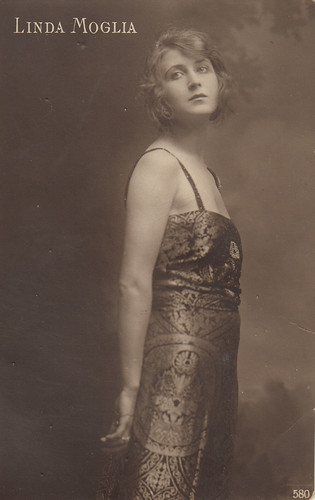
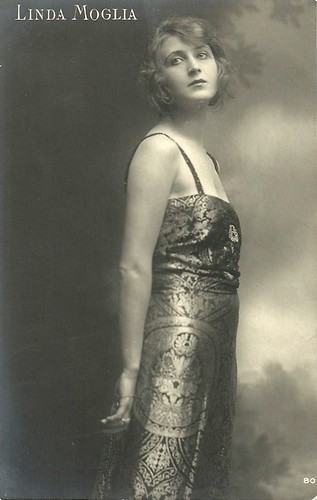
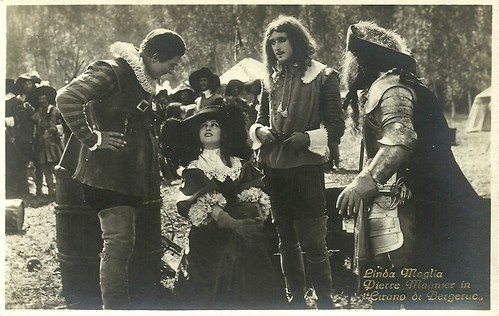
Tonight, the screening of the Franco-Italian historical film Cirano di Bergerac / Cyrano de Bergerac (1923) will be the opening event of Le Giornate del Cinema Muto or the Pordenone Silent Film Festival. We will follow the 44th Giornate during the whole festival. Director Augusto Genina based his film on Edmond Rostand's often-filmed play 'Cyrano de Bergerac'. Pierre Magnier starred as Cyrano de Bergerac, the gentleman with the unusually long nose, Linda Moglia played his beautiful but unreachable niece Roxane, and Angelo Ferrari played his friend and rival in love, Christian de Neuvillette. Will Cyrano ever find love? Enjoy the festival!
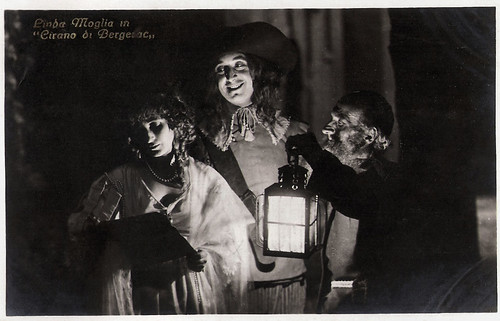
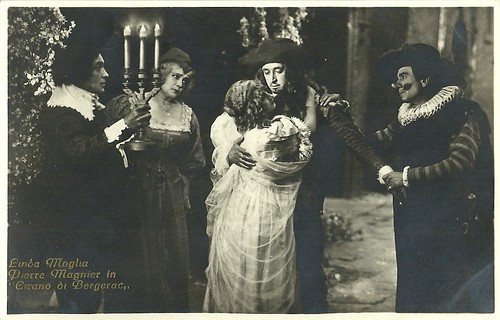
Italian postcard by G.B. Falci, Milano, no. 226. Photo: UCI. Linda Moglia as Roxane and Angelo Ferrari as Christian de Neuvillette in Cirano di Bergerac (Augusto Genina, 1923), based on Edmond Rostand's famous play 'Cyrano de Bergerac'.
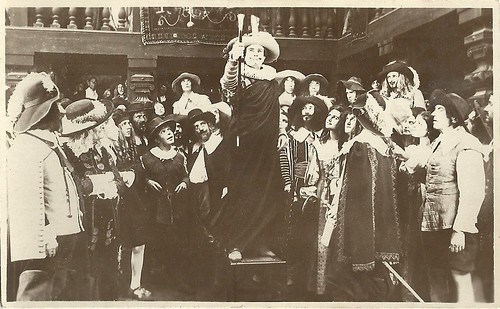
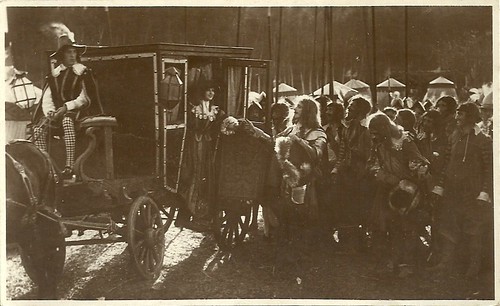
Italian postcard. Photo: UCI. Pierre Magnier as Cyrano de Bergerac in Cirano di Bergerac (Augusto Genina, 1923). Caption: The witty remarks by Cyrano cause for hilarity among the populace present at the theatre.

Italian postcard. Photo: UCI. Pierre Magnier as Cyrano de Bergerac in Cirano di Bergerac (Augusto Genina, 1923). Caption: Before the duel.
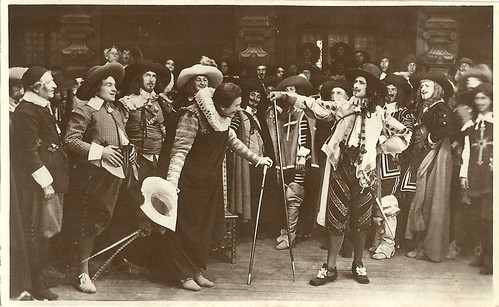
Italian postcard. Photo: UCI. Pierre Magnier as Cyrano de Bergerac in Cirano di Bergerac (Augusto Genina, 1923). Caption: Jokingly, Cyrano ironises the presumptuous Gascogne noble, before duelling with him.
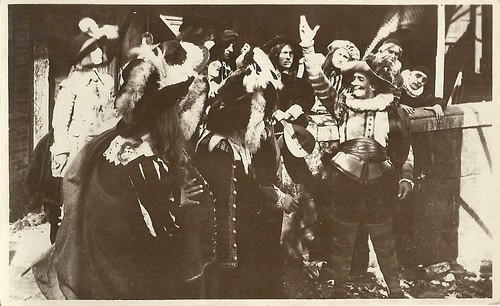
Italian postcard. Photo: UCI. Pierre Magnier as Cyrano de Bergerac in Cirano di Bergerac (Augusto Genina, 1923). Caption: A tale by Cyrano.
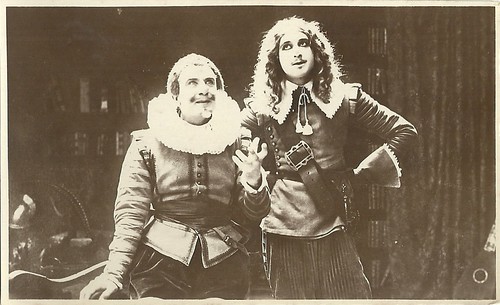
Italian postcard. Photo: UCI. Pierre Magnier as Cyrano de Bergerac and Angelo Ferrari as Christian de Neuvillette in Cirano di Bergerac (Augusto Genina, 1923). Caption: Cyrano addresses to Roxane his most ardent words of love by the lips of Christian, who, incapable of inventing such words, memorises them thanks to Cyrano.
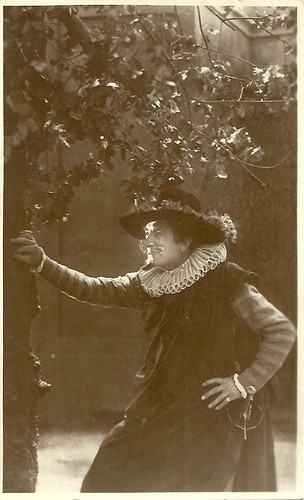
Italian postcard. Photo: UCI. Pierre Magnier as Cyrano de Bergerac in Cirano di Bergerac (Augusto Genina, 1923). Caption: Hidden between the foliage in the garden, Cyrano suggests to Christian the magic, sublime words that the latter isn't capable of inventing and that, aside from Roxane's delicate inhibitions.
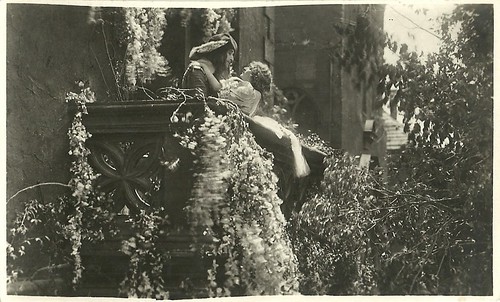
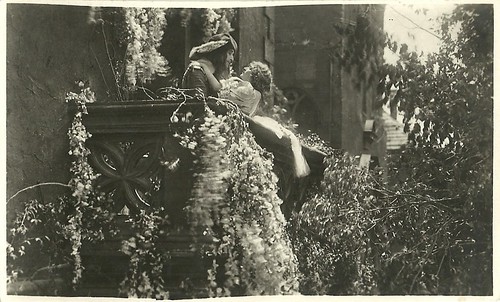
Italian postcard. Photo: UCI. Linda Moglia as Roxane and Angelo Ferrari as Christian de Neuvillette in Cirano di Bergerac (Augusto Genina, 1923). Caption: Christian joins the baluster, finally embracing Roxane. He bends towards her mouth to receive the kiss from her, who has bent because of the sweet words Cyrano lent him.
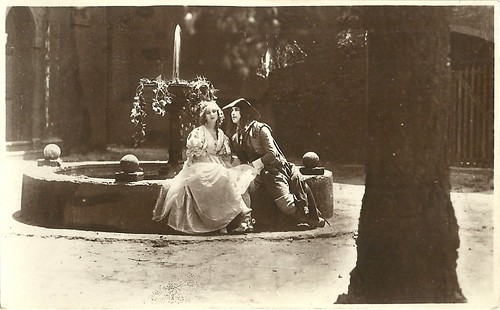
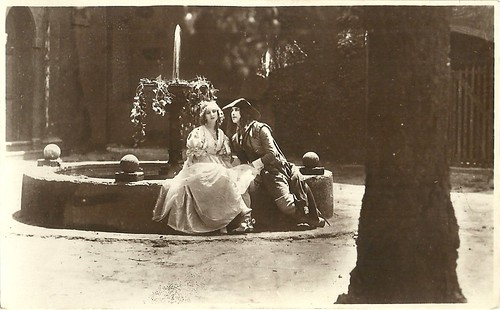
Italian postcard. Photo: UCI. Linda Moglia as Roxane and Angelo Ferrari as Christian de Neuvillette in Cirano di Bergerac (Augusto Genina, 1923). Caption: The nice phrases of Christian he learned from Cyrano, have conquered and seduced Roxane.
Cirano di Bergerac / Cyrano de Bergerac (Augusto Genina, 1923) traces the classical story by Edmond Rostand about the strong, witty and eloquent gentleman, a poet, in 17th-century France. Cirano, a leader filled with plenty of charisma and bravado, has only one flaw: an unusually long nose. The play was inspired by a real person, Cyrano de Bergerac, Savinen (1619-1655), an author known for his swordsmanship and large nose, but the play is a fictionalisation of his life that follows the broad outlines of it.
Future film director Mario Camerini wrote the script for the silent film version. Cirano di Bergerac was shot in 1922. French stage and screen actor Pierre Magnier played Cirano di Bergerac (Cyrano de Bergerac). Magnier would act in over 100 films and was also known for La roue (Abel Gance, 1923) and La règle du jeu (Jean Renoir, 1939).
Whoever challenges Cyrano for his nose will meet his sword. As Cyrano cannot have his beautiful niece Roxana (Roxanne) (Linda Moglia) because of his looks, he secretly helps young Christian de Neuvillette (Angelo Ferrari) to seduce her using Cyrano's poetic words. Christian and Roxane secretly marry before he goes to war, together with Cyrano. From the camp, Cyrano writes Roxane poetic letters in Christian's name, which increase her love for the young man, so much that she visits the camp and declares to Christian she would even love him if he were not beautiful anymore, hurting Christian's feelings.
Just as Cyrano is about to confess to Roxane his fraud, Christian is shot, and he dies in Roxane's arms, content that Roxane really loves him. Five years later, like always, Cyrano visits Roxane in the convent where she has retired. This day, his old enemies have mortally wounded him, but he covers the wound with his hat. When Cyrano is once more reciting Christian's last letter and can do so from the head, Roxane discovers Cyrano was the true author of all of Christian's poetry and understands. It is too late. Cyrano dies reciting his lines.
In 1923, the film won an award at the Turin festival. Afterwards, the whole film was stencil-coloured in Pathé-color. This took three years to complete, delaying the film's release until 1925. The colouring process involved cutting stencils for each frame of the film, one for each of up to four colours. This was done in Paris by Mme. Marie-Berthe Thuillier, the most famous stencil-colour artist. She projected each frame onto a ground glass screen and traced with a Pantograph. These stencils were then used to apply colours to black-and-white prints in a process similar to silk-screening. Each shot was processed separately, so different colour palettes could be used for each shot. In 1999, this colour version was fully restored by Film Preservation Associates for ARTE, in collaboration with Avid Shepard, and with post-production by Lobster. Kurt Kuenne composed new music, executed by the Olympia Chamber Orchestra led by Timothy Brock.
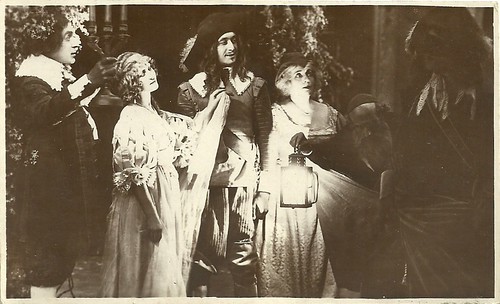
Italian postcard. Photo: UCI. Publicity still for Cirano di Bergerac (Augusto Genina, 1923) with Linda Moglia as Roxane and Angelo Ferrari as Christian de Neuvillette. Caption: Roxane and Christian de Neuvillette marry.
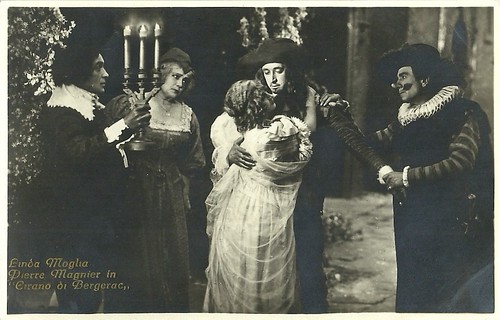
Italian postcard. Photo: UCI. Publicity still for Cirano di Bergerac (Augusto Genina, 1923) with Linda Moglia as Roxane and Pierre Magnier as Cyrano de Bergerac.
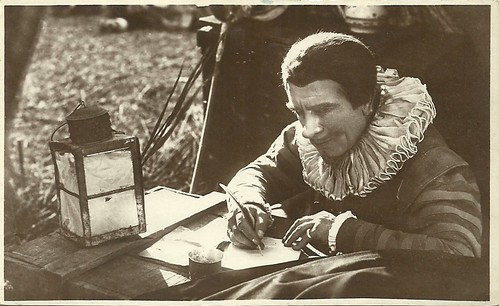
Italian postcard. Photo: UCI. Publicity still for Cirano di Bergerac (Augusto Genina, 1923) with Pierre Magnier as Cyrano de Bergerac. Caption: During the siege of Arras, Cyrano writes to Roxane on behalf of Christian the most ardent words an enamoured heart could have suggested.
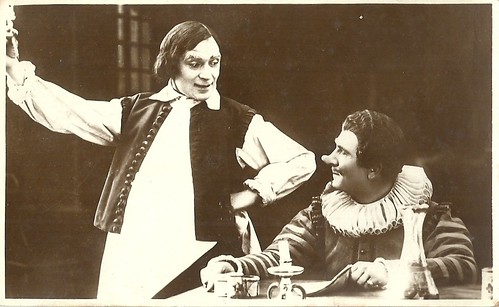
Italian postcard. Photo: UCI. Publicity still for Cirano di Bergerac (Augusto Genina, 1923) with Pierre Magnier as Cyrano de Bergerac. Caption: Cyrano writes...

Italian postcard. Photo: UCI. Pierre Magnier as Cyrano de Bergerac in Cirano di Bergerac (Augusto Genina, 1923), based on Edmond Rostand's play 'Cyrano de Bergerac'. Caption: Songs of a distant homeland.
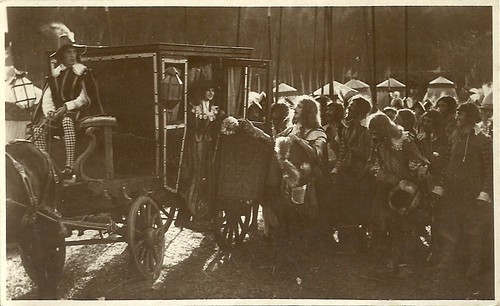
Italian postcard. Photo: UCI. Publicity still for Cirano di Bergerac (Augusto Genina, 1923) with Linda Moglia as Roxane and Angelo Ferrari as Christian de Neuvillette. Caption: Defying danger, Roxane joins Christian at Arras, where he is camping with the soldiers.
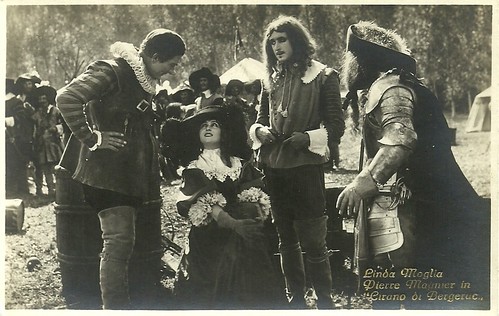
Italian postcard. Photo: UCI. Publicity still for Cirano di Bergerac (Augusto Genina, 1923) with Linda Moglia as Roxane and Pierre Magnier as Cyrano de Bergerac.
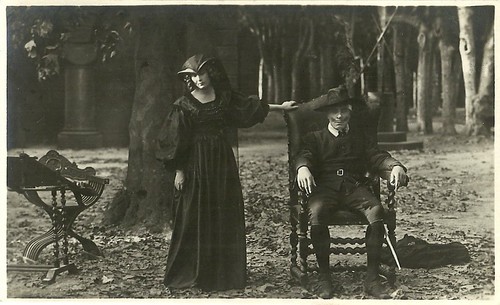
Italian postcard. Photo: UCI. Publicity still for Cirano di Bergerac (Augusto Genina, 1923) with Linda Moglia as Roxane and Pierre Magnier as Cyrano de Bergerac. Caption: A few cronies of the Duke de Guiche have treacherously hit Cyrano. He still has the force to go to his beloved Roxane, and involuntarily, he reveals his heroic sacrifice.

Publicity still for Le Giornate del Cinema Muto 2025. Credit: FPA Classics, Paris. Pierre Magnier in Cirano di Bergerac / Cyrano de Bergerac (Augusto Genina, 1923).
Sources: Wikipedia and IMDb. For those who can't join the festival, a DVD of Cirano di Bergerac has been released by Absolute Medien, together with ARTE.
Italian postcard by G.B. Falci, Milano, no. 226. Photo: UCI. Linda Moglia as Roxane and Angelo Ferrari as Christian de Neuvillette in Cirano di Bergerac (Augusto Genina, 1923), based on Edmond Rostand's famous play 'Cyrano de Bergerac'.
Italian postcard. Photo: UCI. Pierre Magnier as Cyrano de Bergerac in Cirano di Bergerac (Augusto Genina, 1923). Caption: The witty remarks by Cyrano cause for hilarity among the populace present at the theatre.
Italian postcard. Photo: UCI. Pierre Magnier as Cyrano de Bergerac in Cirano di Bergerac (Augusto Genina, 1923). Caption: Before the duel.
Italian postcard. Photo: UCI. Pierre Magnier as Cyrano de Bergerac in Cirano di Bergerac (Augusto Genina, 1923). Caption: Jokingly, Cyrano ironises the presumptuous Gascogne noble, before duelling with him.
Italian postcard. Photo: UCI. Pierre Magnier as Cyrano de Bergerac in Cirano di Bergerac (Augusto Genina, 1923). Caption: A tale by Cyrano.
Italian postcard. Photo: UCI. Pierre Magnier as Cyrano de Bergerac and Angelo Ferrari as Christian de Neuvillette in Cirano di Bergerac (Augusto Genina, 1923). Caption: Cyrano addresses to Roxane his most ardent words of love by the lips of Christian, who, incapable of inventing such words, memorises them thanks to Cyrano.
Italian postcard. Photo: UCI. Pierre Magnier as Cyrano de Bergerac in Cirano di Bergerac (Augusto Genina, 1923). Caption: Hidden between the foliage in the garden, Cyrano suggests to Christian the magic, sublime words that the latter isn't capable of inventing and that, aside from Roxane's delicate inhibitions.
Italian postcard. Photo: UCI. Linda Moglia as Roxane and Angelo Ferrari as Christian de Neuvillette in Cirano di Bergerac (Augusto Genina, 1923). Caption: Christian joins the baluster, finally embracing Roxane. He bends towards her mouth to receive the kiss from her, who has bent because of the sweet words Cyrano lent him.
Italian postcard. Photo: UCI. Linda Moglia as Roxane and Angelo Ferrari as Christian de Neuvillette in Cirano di Bergerac (Augusto Genina, 1923). Caption: The nice phrases of Christian he learned from Cyrano, have conquered and seduced Roxane.
A brave and eloquent gentleman doted on an unusually long nose
Cirano di Bergerac / Cyrano de Bergerac (Augusto Genina, 1923) traces the classical story by Edmond Rostand about the strong, witty and eloquent gentleman, a poet, in 17th-century France. Cirano, a leader filled with plenty of charisma and bravado, has only one flaw: an unusually long nose. The play was inspired by a real person, Cyrano de Bergerac, Savinen (1619-1655), an author known for his swordsmanship and large nose, but the play is a fictionalisation of his life that follows the broad outlines of it.
Future film director Mario Camerini wrote the script for the silent film version. Cirano di Bergerac was shot in 1922. French stage and screen actor Pierre Magnier played Cirano di Bergerac (Cyrano de Bergerac). Magnier would act in over 100 films and was also known for La roue (Abel Gance, 1923) and La règle du jeu (Jean Renoir, 1939).
Whoever challenges Cyrano for his nose will meet his sword. As Cyrano cannot have his beautiful niece Roxana (Roxanne) (Linda Moglia) because of his looks, he secretly helps young Christian de Neuvillette (Angelo Ferrari) to seduce her using Cyrano's poetic words. Christian and Roxane secretly marry before he goes to war, together with Cyrano. From the camp, Cyrano writes Roxane poetic letters in Christian's name, which increase her love for the young man, so much that she visits the camp and declares to Christian she would even love him if he were not beautiful anymore, hurting Christian's feelings.
Just as Cyrano is about to confess to Roxane his fraud, Christian is shot, and he dies in Roxane's arms, content that Roxane really loves him. Five years later, like always, Cyrano visits Roxane in the convent where she has retired. This day, his old enemies have mortally wounded him, but he covers the wound with his hat. When Cyrano is once more reciting Christian's last letter and can do so from the head, Roxane discovers Cyrano was the true author of all of Christian's poetry and understands. It is too late. Cyrano dies reciting his lines.
In 1923, the film won an award at the Turin festival. Afterwards, the whole film was stencil-coloured in Pathé-color. This took three years to complete, delaying the film's release until 1925. The colouring process involved cutting stencils for each frame of the film, one for each of up to four colours. This was done in Paris by Mme. Marie-Berthe Thuillier, the most famous stencil-colour artist. She projected each frame onto a ground glass screen and traced with a Pantograph. These stencils were then used to apply colours to black-and-white prints in a process similar to silk-screening. Each shot was processed separately, so different colour palettes could be used for each shot. In 1999, this colour version was fully restored by Film Preservation Associates for ARTE, in collaboration with Avid Shepard, and with post-production by Lobster. Kurt Kuenne composed new music, executed by the Olympia Chamber Orchestra led by Timothy Brock.
Italian postcard. Photo: UCI. Publicity still for Cirano di Bergerac (Augusto Genina, 1923) with Linda Moglia as Roxane and Angelo Ferrari as Christian de Neuvillette. Caption: Roxane and Christian de Neuvillette marry.
Italian postcard. Photo: UCI. Publicity still for Cirano di Bergerac (Augusto Genina, 1923) with Linda Moglia as Roxane and Pierre Magnier as Cyrano de Bergerac.
Italian postcard. Photo: UCI. Publicity still for Cirano di Bergerac (Augusto Genina, 1923) with Pierre Magnier as Cyrano de Bergerac. Caption: During the siege of Arras, Cyrano writes to Roxane on behalf of Christian the most ardent words an enamoured heart could have suggested.
Italian postcard. Photo: UCI. Publicity still for Cirano di Bergerac (Augusto Genina, 1923) with Pierre Magnier as Cyrano de Bergerac. Caption: Cyrano writes...
Italian postcard. Photo: UCI. Pierre Magnier as Cyrano de Bergerac in Cirano di Bergerac (Augusto Genina, 1923), based on Edmond Rostand's play 'Cyrano de Bergerac'. Caption: Songs of a distant homeland.
Italian postcard. Photo: UCI. Publicity still for Cirano di Bergerac (Augusto Genina, 1923) with Linda Moglia as Roxane and Angelo Ferrari as Christian de Neuvillette. Caption: Defying danger, Roxane joins Christian at Arras, where he is camping with the soldiers.
Italian postcard. Photo: UCI. Publicity still for Cirano di Bergerac (Augusto Genina, 1923) with Linda Moglia as Roxane and Pierre Magnier as Cyrano de Bergerac.
Italian postcard. Photo: UCI. Publicity still for Cirano di Bergerac (Augusto Genina, 1923) with Linda Moglia as Roxane and Pierre Magnier as Cyrano de Bergerac. Caption: A few cronies of the Duke de Guiche have treacherously hit Cyrano. He still has the force to go to his beloved Roxane, and involuntarily, he reveals his heroic sacrifice.
Publicity still for Le Giornate del Cinema Muto 2025. Credit: FPA Classics, Paris. Pierre Magnier in Cirano di Bergerac / Cyrano de Bergerac (Augusto Genina, 1923).
Sources: Wikipedia and IMDb. For those who can't join the festival, a DVD of Cirano di Bergerac has been released by Absolute Medien, together with ARTE.