Showing posts with label Gregory Peck. Show all posts

07 December 2022

Roman Holiday (1953)

Tonight, Ivo Blom, university lecturer Arts & Culture at the Vrije Universiteit and EFSP colloborator, will introduce a screening of Roman Holiday (William Wyler, 1953) at the Rialto VU cinema in Amsterdam. This delightful romantic comedy about a princess who escapes her entourage in Rome and meets a journalist was a huge success, not least because of the chemistry between the two leads, Gregory Peck and Audrey Hepburn. The film won three Oscars, including one for Hepburn, who became a star overnight. The film was shot entirely in Rome. Ivo, a former resident of Rome, will elaborate on the film's (top) locations and the context of the production.

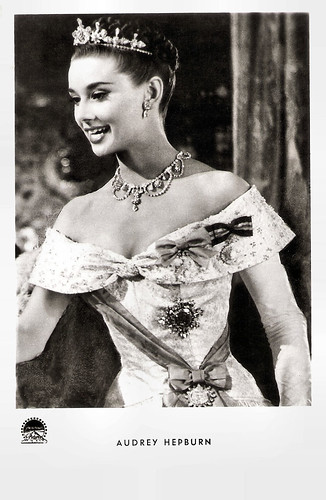
Audrey Hepburn in Roman Holiday (1953)
German postcard by Kunst und Bild, Berlin, no. A 1031. Photo: Paramount. Audrey Hepburn in Roman Holiday (William Wyler, 1953).

Audrey Hepburn and Gregory Peck in Roman Holiday (1953)
German postcard by Kunst und Bild, Berlin, no. A 1079. Photo: Paramount. Audrey Hepburn and Gregory Peck in Roman Holiday (William Wyler, 1953).

Audrey Hepburn in Roman Holiday (1953)
Dutch postcard by Takken / 't Sticht, Utrecht, no. 1469. Photo: Paramount. Audrey Hepburn in Roman Holiday (William Wyler, 1953).

Having a wonderful, romantic time together


Audrey Hepburn plays Princess Ann, a young princess who is on an exhausting tour of European capitals with her entourage. This is how she ends up at the embassy in Rome. She is tired and she is fed up with all the handshaking and all the formalities. In the evening, she rebels against protocol. Her doctor gives her an injection of a sedative after which she is left in her room. She manages to escape through the window.

In the nightly streets of Rome, she is found on a bench by Joe Bradley (Gregory Peck), a single American journalist living in the city for a while. First, he tries to get her in a taxi towards her house and when that fails, he takes her to his own house, to stay the night at his place.

Only the next day at the newsroom does he realises who he has actually brought into his house. With this great scoop in his hands, he persuades her into a fun 'day of doing nothing' with him. They do all the things that 'normal people' think are ordinary, but are special for a princess. Like going out on a terrace, riding a scooter around town and going to a dance night. During their outing, everything is photographed by Irving Radovich (Eddie Albert), a photographer friend. He uses a mini camera hidden in a lighter for this purpose.

Ann and Bradley are having a wonderful, romantic time together, but how long can it last? When Ann realises that her country is in trouble because of her sudden absence, she decides to return and carry out her duties. The next day, she gives a press conference to talk about her visits. She is advised to say she liked all the cities equally, but steps away from that protocol and calls Rome her best experience. She is surprised to see Joe in the room and is shocked to see Irving taking pictures with his lighter.

In the end, Irving and Joe offer her an envelope with a memento of the city, which contains the photos. Ann understands that their secret will remain secret. In her speech, Ann then says how grateful she is for her beautiful stay in town, but Joe clearly hears in this a packaged message of gratitude to him. Both realise that they feel a lot for each other, but that their love is doomed to remain unfulfilled.
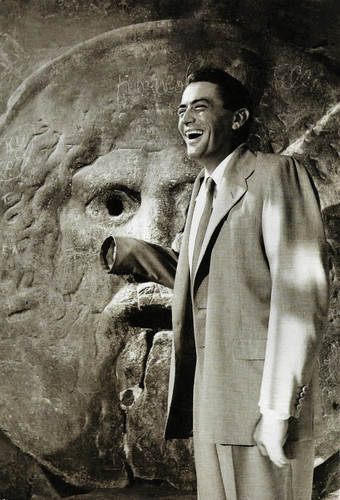
Gregory Peck in Roman Holiday (1953)
Italian postcard by W. Di Giovanni. Photo: Augusto Di Giovanni. Gregory Peck in Roman Holiday (William Wyler, 1953).
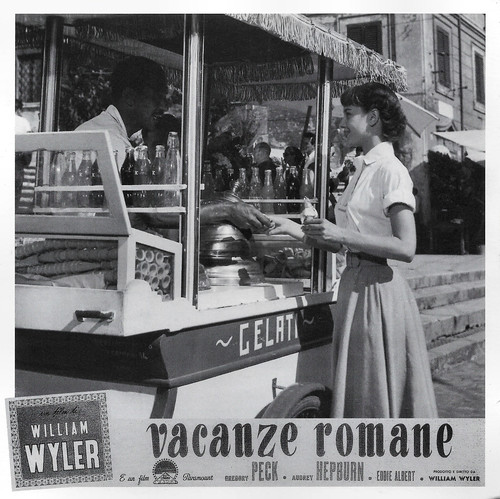
Audrey Hepburn in Roman Holiday (1953)
Italian postcard by W. Di Giovanni. Image: Italian lobby card by Paramount with a photo by Augusto Di Giovanni. Audrey Hepburn in Roman Holiday (William Wyler, 1953).

Bitten by the Mouth of Truth


Director Frank Capra toyed with the idea of Roman Holiday back in 1949. It was to be a variation on his successful film It Happened One Night (1934), but this time starring Cary Grant and Elizabeth Taylor. But Capra's production company Liberty Films was in financial trouble after the flop of It's a Wonderful Life. Capra sold Liberty to Paramount Pictures, where screenwriter Dalton Trumbo went to work on the screenplay. Capra withdrew from the film when it turned out that the budget for the film was too tight.

Paramount then sought George Stevens as director, but he also saw little in the production, after which William Wyler was approached. Wyler who had just directed two heavy dramas, The Heiress (1949) and Detective Story(1951), was happy with this lightweight comedy. Wyler suggested to Paramount to shoot the film in Italy. After all, he had no desire to appear before the House Un-American Activities Committee, which was investigating communist infiltration of the film industry and wanted to be far away from Hollywood. It was therefore a wry coincidence that the screenplay's writer, Dalton Trumbo had been blacklisted by the same House Un-American Activities Committee. Trumbo was one of the Hollywood Ten, a group of screenwriters who were banned from working in Hollywood because of alleged communist sympathies.

For this reason, Trumbo's name does not appear in the credits, nor could he receive the Oscar for Best Screenplay. His friend Ian McLellan Hunter got the credits and the Oscar. It was not until 1993 that the widow of Trumbo, who died in 1976, was finally awarded the Oscar. Paramount was initially not happy with the proposal to shoot the film on location. They wanted to shoot everything at the studio in Hollywood. They eventually relented, partly because Paramount could use frozen assets in Europe. However, Wyler was told that the budget was going down and the film had to be shot in black-and-white. With a budget of one and a half million dollars, Wyler went to work.

Initially, Cary Grant had been tapped for the male lead. However, Grant felt too old for the role and he renounced the film. Gregory Peck was interested though, especially since Roman Holiday was a comedy, and Peck had wanted to be in such a film for years. For the role of Princess Ann, they originally had Elizabeth Taylor in mind. However, director William Wyler wanted Jean Simmons for the role. When Simmons was not available, Wyler wanted to cancel the whole project. However, the studio went ahead and the next person approached was Suzanne Cloutier. However, she was also taken. More actresses were tested, but eventually, the role went to the then virtually unknown Audrey Hepburn, despite the fact that her test shot was actually a failure. She acted far too stiff and unnatural. After the audition, however, the camera kept rolling and recorded a relaxed Hepburn who stood talking enthusiastically to the director. It was this 'performance' that ensured Hepburn got the role.

Shooting in Rome was not always easy. It was extremely hot that summer with temperatures exceeding 35 degrees. The heat also rose to the heads of Rome's residents and strikes broke out regularly and film production suffered considerably. Filming was done without cordoning off streets and with the general public as casual extras. On the other hand, there were also fewer casual extras. Members of the Italian nobility figured at the Ambassador's ball (they donated their wages to charity) and members of the real press attended the press conference.

Among all the veterans like Peck and Wyler, debutante Hepburn struggled to find her way. During a take, for instance, she could not produce the tears she wanted. Take after take, the now boiling Wyler spent on his leading actress. He screamed his anger at all the failed shots, to which Hepburn burst into tears. Wyler immediately ran the camera and the scene was on. Gregory Peck had his own method of pulling Hepburn along. When shooting at the Mouth of Truth, Peck's character, Joe, had to put his hand in the mouth of a statue. According to legend, the mouth would bite the hand off if he was a liar. Wyler was keen to get a natural scare reaction from Hepburn and Peck helped him do that. The moment he withdrew his hand he gave a cry of pain and retracted his hand into the sleeve of his jacket. Hepburn knew nothing and her look of horror and surprise was genuine, as was the scream of terror that escaped her. Wyler could be satisfied, he only needed one take.
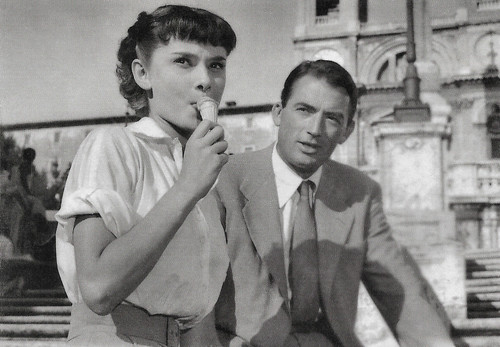
Audrey Hepburn and Gregory Peck in Roman Holiday (1953)
French postcard by Editions Art & Scène, Paris, no. CA 94, 1995, 1995. Photo: Paramount. Audrey Hepburn and Gregory Peck in Roman Holiday (William Wyler, 1953).

Audrey Hepburn and Gregory Peck in Roman Holiday (1953)
Italian postcard. Photo: Paramount. Audrey Hepburn and Gregory Peck in Roman Holiday (William Wyler, 1953).
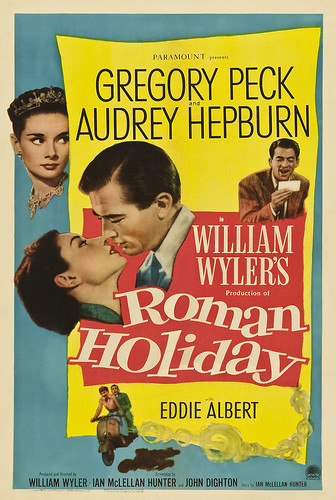
Poster for Roman Holiday (1953)
Postcard. Poster for the Paramount film Roman Holiday (William Wyler, 1953).

Sources: Rialto VU, Wikipedia (Dutch) and IMDb

08 April 2022

Gregory Peck

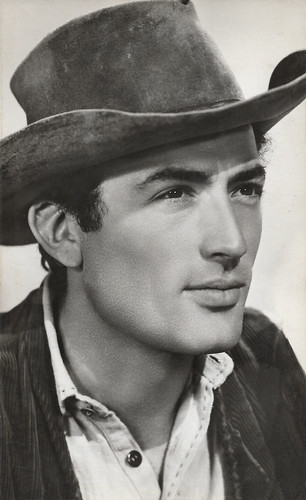
American actor Gregory Peck (1916-2003) was one of the most popular film stars from the 1940s to the 1960s. Peck received five nominations for Academy Award for Best Actor and won once – for his performance as Atticus Finch in To Kill a Mockingbird (1962). He almost always played courageous, nobly heroic good guys who saw injustice and fought it. Among his best-known films are Spellbound (1945), The Yearling (1946), Gentleman's Agreement (1947), Roman Holiday (1953), The Guns of Navarone (1961), and Cape Fear (1962).

Gregory Peck in The Yearling (1946)
Spanish postcard by Archivo Bermejo, Barcelona, no. 4046. Photo: M.G.M. Gregory Peck in The Yearling (Clarence Brown, 1946).

Gregory Peck and Jennifer Jones in Duel in the Sun (1946)
Spanish postcard, 1953. Photo: Procines S.A. Gregory Peck and Jennifer Jones in Duel in the Sun (King Vidor, 1946).

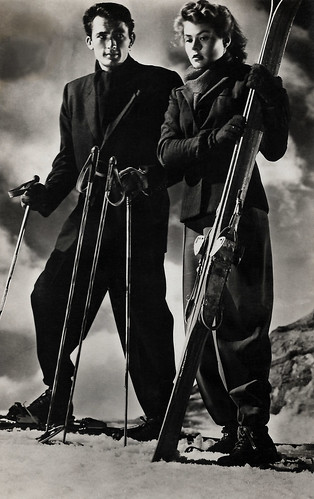
Gregory Peck and Ingrid Bergman in Spellbound (1945)
Italian postcard, no. 1216. Photo: United Artists. Gregory Peck and Ingrid Bergman in Spellbound (Alfred Hitchcock, 1945).

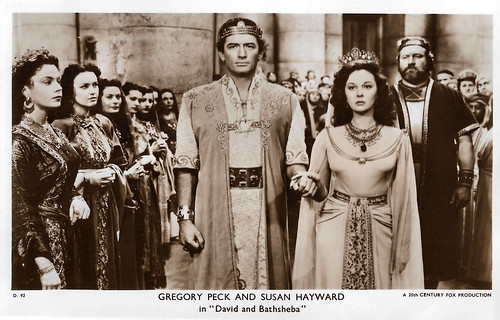
Gregory Peck and Susan Hayward in David and Bathsheba (1951)
British postcard by The Picturegoer Series, London, no. D 92. Photo: 20th Century Fox. Gregory Peck and Susan Hayward in David and Bathsheba (Henry King, 1951).

Audrey Hepburn and Gregory Peck in Roman Holiday (1952)
German postcard by Kunst und Bild, Berlin, no. A 1079. Photo: Paramount. Audrey Hepburn and Gregory Peck in Roman Holiday (William Wyler, 1952).

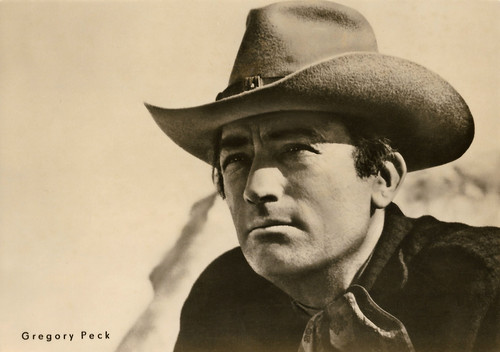
Gregory Peck in Mackenna's Gold (1969)
East-German postcard by VEB Progress Film-Vertrieb, Berlin, no. 229/70. Gregory Peck in Mackenna's Gold (J. Lee Thompson, 1969).

Tall, rugged, and heroic, with a basic decency


Eldred Gregory Peck was born in 1916 in La Jolla, California (now in San Diego). His parents were Bernice Mary (Ayres) and Gregory Pearl Peck, a chemist, and druggist in San Diego. His parents divorced when he was five years old. An only child, he was sent to live with his grandmother.

He never felt he had a stable childhood. His fondest memories are of his grandmother taking him to the cinema every week and of his dog, which followed him everywhere. Peck's father encouraged him to take up medicine. He studied pre-med at UC-Berkeley and, while there, got bitten by the acting bug and decided to change the focus of his studies.

He enrolled in the Neighborhood Playhouse in New York and debuted on Broadway after graduation. His debut was in Emlyn Williams' play 'The Morning Star' (1942). By 1943, he was in Hollywood, where he debuted in the RKO film Days of Glory (Jacques Tourneur, 1944).

Stardom came with his next film, The Keys of the Kingdom (John M. Stahl, 1944), for which he was nominated for an Oscar. Tony Fontana at IMDb: "Peck's screen presence displayed the qualities for which he became well known. He was tall, rugged and heroic, with a basic decency that transcended his roles."

He appeared opposite Ingrid Bergman in Alfred Hitchcock's Spellbound (1945) as an amnesia victim accused of murder. In The Yearling (Clarence Brown, 1946), he was again nominated for an Oscar and won the Golden Globe. He was especially effective in Westerns and appeared in such varied fare as David O. Selznick's critically blasted Duel in the Sun (King Vidor, 1946), the somewhat better received Yellow Sky (William A. Wellman, 1948), and the acclaimed The Gunfighter (Henry King, 1950).

He was nominated again for the Academy Award for his roles in Gentleman's Agreement (Elia Kazan, 1947), which dealt with anti-Semitism, and Twelve O'Clock High (Henry King, 1949), a story of high-level stress in an Air Force bomber unit in World War II. In 1947, Peck, along with Dorothy McGuire, David O'Selznick, and Mel Ferrer, founded the La Jolla Playhouse, located in his hometown, and produced many of the classics there. Due to film commitments, he could not return to Broadway but whet his appetite for live theatre on occasion at the Playhouse, keeping it firmly established with a strong, reputable name over the years.

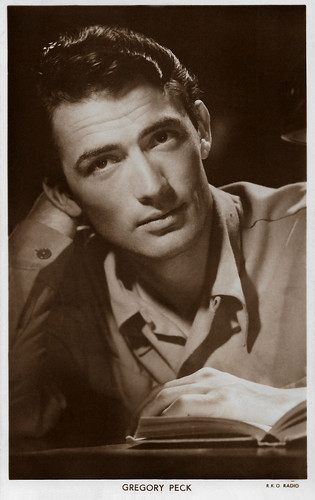
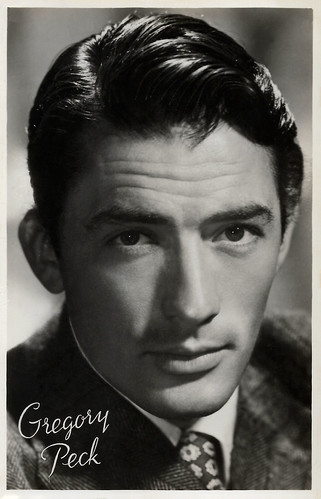
Gregory Peck
British postcard in the Picturegoer Series, London, no. W. 187. Photo: R.K.O. Radio.

Gregory Peck
Dutch postcard. Photo: M.G.M. This card is a gift from Loek Coenraad from his mother's legacy. Many thanks, Loek!

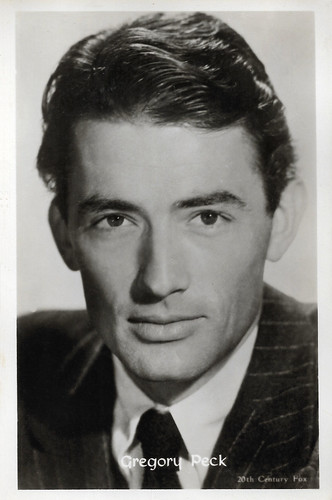
Gregory Peck
Vintage card. Photo: 20th Century Fox.

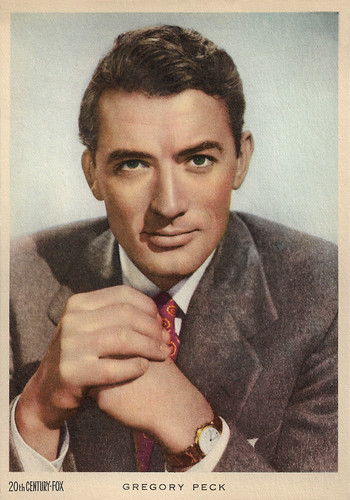
Gregory Peck
Uruguayan postcard by CF. Photo: 20th Century Fox.

Gregory Peck
South-African postcard by East-West Publishers, Cape Town, no. 19.

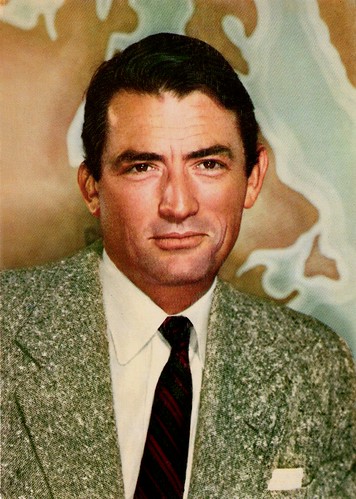
Gregory Peck
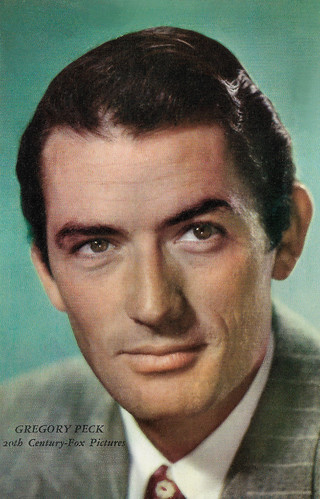
American card by Movie Candid Color Card, Beverly Hills, Calif., no. A32. Photo: Frank Powolny / 20th Century Fox. Caption: Gregory Peck began his professional career in 1939 as a barker. After a few appearances on Broadway, screenwriter Casey Robinson brought him to Hollywood where he rapidly became one of the screen's most sought-after stars.

The greatest film hero of the past 100 years


With a string of hits to his credit, Gregory Peck made the decision to only work in films that interested him. He continued to appear as the heroic, larger-than-life figures in such films as Captain Horatio Hornblower (Raoul Walsh, 1951) with Virginia Mayo, and Moby Dick (John Huston, 1956) with Richard Basehart.

He worked with Audrey Hepburn in her Hollywood debut film, Roman Holiday (William Wyler, 1953). While filming The Bravados (Henry King, 1958), he decided to become a cowboy in real life, so he purchased a vast working ranch near Santa Barbara, California - already stocked with 600 head of prize cattle.

In the early 1960s, he gave a powerful performance as Captain Keith Mallory in The Guns of Navarone (J. Lee Thompson, 1961) opposite David Niven and Anthony Quinn. The film was one of the biggest box-office hits of that year. Peck finally won the Oscar, after four nominations, for his performance as lawyer Atticus Finch in To Kill a Mockingbird (Robert Mulligan, 1962).

He also appeared in two darker films than he usually made, Cape Fear (J. Lee Thompson, 1962) opposite Robert Mitchum, and Captain Newman, M.D. (David Miller, 1963) with Tony Curtis, which dealt with the way people live. The financial failure of Cape Fear (1962) ended his company, Melville Productions.

After making Arabesque (Stanley Donen, 1966) with Sophia Loren, Peck withdrew from acting for three years in order to concentrate on various humanitarian causes, including the American Cancer Society. In the early 1970s, he produced two films, The Trial of the Catonsville Nine (Gordon Davidson, 1972) and The Dove (Charles Jarrott, 1974), when his film career stalled.

He made a comeback playing, somewhat woodenly, Ambassador Robert Thorn in the horror film The Omen (Richard Donner, 1976) with Lee Remick. After that, he returned to the bigger-than-life roles he was best known for, such as MacArthur (Joseph Sargent, 1977) and the infamous Nazi war criminal Dr. Josef Mengele in the huge hit The Boys from Brazil (Franklin J. Schaffner, 1978) with Laurence Olivier and James Mason.

In the 1980s, he moved into television with the miniseries The Blue and the Gray (Andrew V. McLaglen, 1982) in which he played Abraham Lincoln, and The Scarlet and the Black (Jerry London, 1983) with Christopher Plummer and John Gielgud. In 1991, he appeared in the remake of his 1962 film, playing a different role, in Martin Scorsese's Cape Fear (1991). He was also cast as the progressive-thinking owner of a wire and cable business in Other People's Money (Norman Jewison, 1991), starring Danny DeVito.

In 1967, Peck received the Academy's Jean Hersholt Humanitarian Award. He was also been awarded the US Presidential Medal of Freedom. Always politically progressive, he was active in such causes as anti-war protests, workers' rights, and civil rights. In 2003, Peck's portrayal of Atticus Finch was named the greatest film hero of the past 100 years by the American Film Institute, only two weeks before his death. Atticus beat out Indiana Jones, who was placed second, and James Bond who came third.

Gregory Peck died in 2003 in Los Angeles, California. He was 87. Peck was married twice. From 1942 till 1955, he was married to Greta Kukkonen. They had three children: Jonathan Peck (1944-1975), Stephen Peck (1946), and Carey Paul Peck (1949). His second wife was Veronique Passani, whom he met at the set of Roman Holliday. They married in 1955 and had two children: Tony Peck (1956) and Cecilia Peck (1958). The couple remained together till his death.

Gregory Peck and Ingrid Bergman in Spellbound (1945)
Spanish postcard by JDP, Valencia, no. 1092. Gregory Peck and Ingrid Bergman in Spellbound (Alfred Hitchcock, 1945).

Gregory Peck, Jennifer Jones, and Joseph Cotten in Duel in the Sun (1946)
Spanish postcard, no. 5292, 1953. Photo: Procines S.A. Gregory Peck, Jennifer Jones, and Joseph Cotten in Duel in the Sun (King Vidor, 1946).

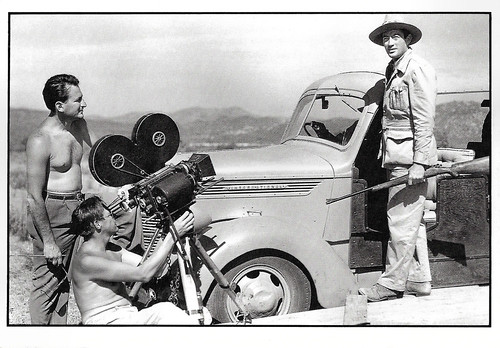
Gregory Peck and Karl Struss on the set of The Macomber Affair (1947)
French postcard in the Entr'acte series by Éditions Asphodèle. Mâcon, no. 001/03. Gregory Peck and Karl Struss on the set of The Macomber Affair/Without Honor (Zoltan Korda, 1947). Caption: Low angle on Gregory Peck, on camera Karl Struss (middle).

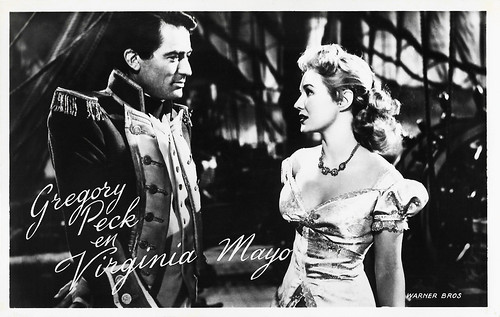
Gregory Peck and Virginia Mayo in Captain Horatio Hornblower R.N. (1951)
Dutch postcard by Takken, Utrecht, no. 610. Photo: Warner Bros. Gregory Peck and Virginia Mayo in Captain Horatio Hornblower (Raoul Walsh, 1951).

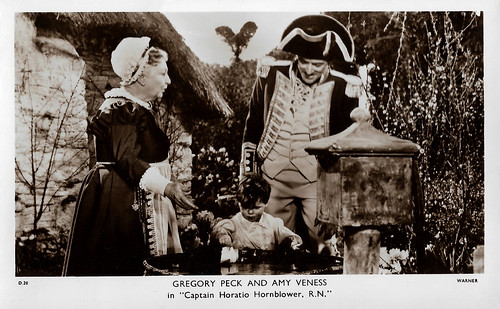
Gregory Peck and Amy Veness in Captain Horatio Hornblower R.N. (1951)
British postcard in the Picturegoer Series, no. D. 20. Photo: Warner Bros. Gregory Peck and Amy Veness in Captain Horatio Hornblower (Raoul Walsh, 1951).

Gregory Peck and Kieron Moore in David and Bathsheba (1951)
British postcard by The Picturegoer Series, London, no. D 90. Photo: 20th Century Fox. Gregory Peck and Kieron Moore in David and Bathsheba (Henry King, 1951).

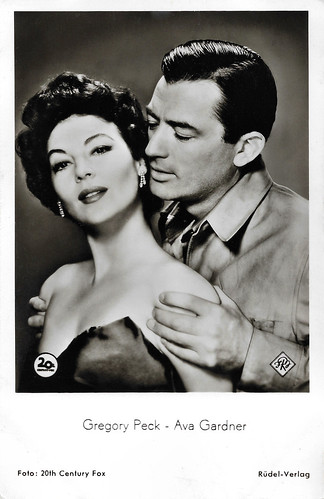
Ava Gardner and Gregory Peck in The Snows of Kilimanjaro (1952)
West-German postcard by Rüdel-Verlag, Hamburg-Bergedorf, no. 507. Photo: 20th Century Fox. Ava Gardner and Gregory Peck in The Snows of Kilimanjaro (Henry King, 1952).

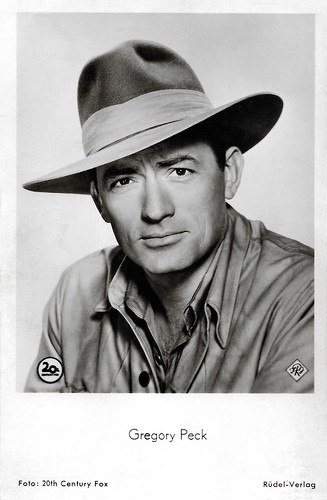
Gregory Peck in The Snows of Kilimanjaro (1952)
West-German postcard by Rüdel-Verlag, Hamburg-Bergedorf, no. 513. Photo: 20th Century Fox. Gregory Peck in The Snows of Kilimanjaro (Henry King, 1952).

Gregory Peck in Roman Holiday (1953)
Italian postcard by W. Di Giovanni. Photo: Augusto Di Giovanni. Gregory Peck in Roman Holiday (William Wyler, 1953).

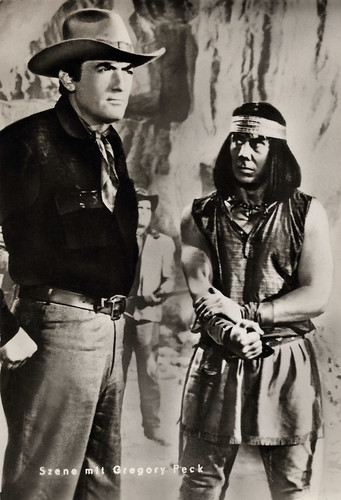
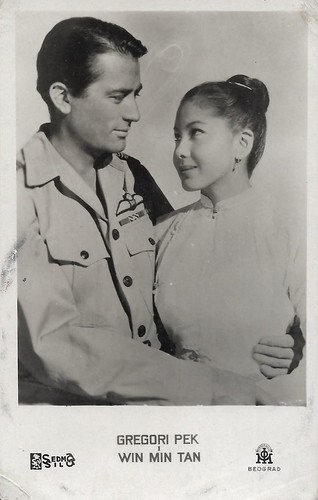
Gregory Peck and Win Min Tanh in The Purple Plain
Yugoslavian postcard by Sedma Sila. Photo: Morava Film, Beograd (Belgrade). Gregory Peck and Win Min Tanh in the British film The Purple Plain (Robert Parrish, 1954).

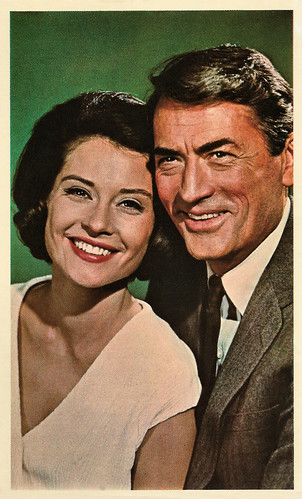
Gregory Peck and Diane Baker in Mirage (1965)

American collectors card by Universal Pictures Company, Inc., 1965. Photo: Universal. Gregory Peck and Diane Baker in Mirage (Edward Dmytryk, 1965).

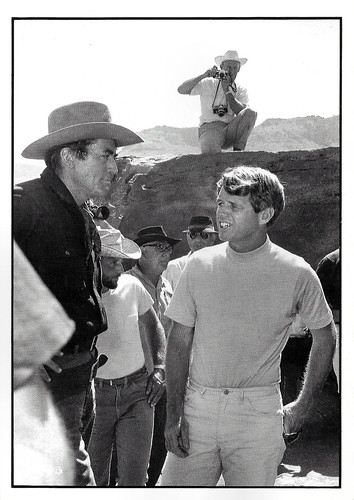
Gregory Peck and Bob Kennedy on the set of Mackenna's Gold (1968)
French postcard in the Entr'acte series by Éditions Asphodèle, Mâcon, no. 003/10. Collection: B. Courtel /D.R. Gregory Peck and Bob Kennedy on the set of Mackenna's Gold (J. Lee Thompson, 1969). Caption: Senator Bob Kennedy visits the film crew shooting in Arizona, starring Gregory Peck.

Gregory Peck in Mackenna's Gold (1969)
East-German postcard by VEB Progress Film-Vertrieb, Berlin, no. 184/70. Gregory Peck in Mackenna's Gold (J. Lee Thompson, 1969).

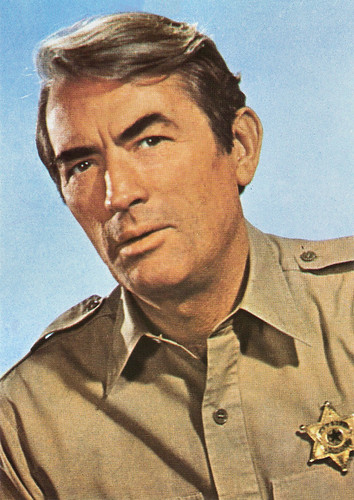
Gregory Peck in I Walk the Line (1970)
Romanian postcard by Casa Filmului Acin. Photo: 20th Century Fox. Gregory Peck in I Walk the Line (John Frankenheimer, 1970).

Sources: Tony Fontana (IMDb), and IMDb.

18 April 2019

David and Bathsheba (1951)

In the Technicolor Biblical epic David and Bathsheba (Henry King, 1951), Gregory Peck plays King David of Israel, who sees the beautiful Bathsheba (Susan Hayward) bathing from the palace roof. She is the wife of Uriah (Kieron Moore), one of his most trusted soldiers who is more devoted to army duty than to his wife. David and Bathsheba succumb to their feelings and their affair results in pregnancy. This has tragic consequences for his family and Israel.

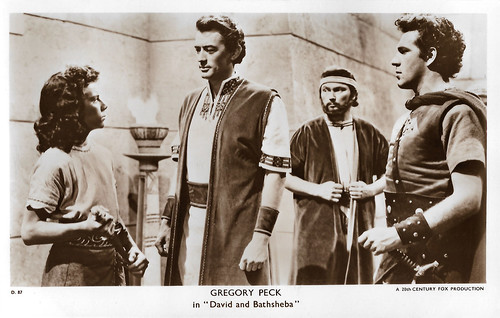
Gregory Peck in David and Bathsheba (1951)
British postcard by The Picturegoer Series, London, no. D 87. Photo: 20th Century Fox. Publicity still for David and Bathsheba (Henry King, 1951) with Gregory Peck and Kieron Moore.

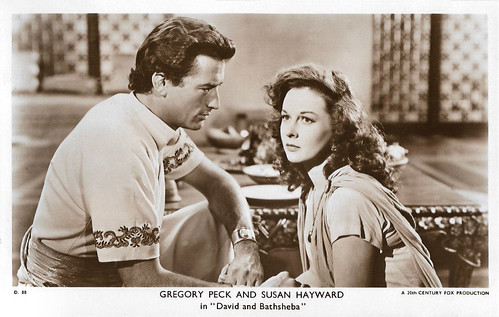
Gregory Peck and Susan Hayward in David and Bathsheba (1951)
British postcard by The Picturegoer Series, London, no. D 88. Photo: 20th Century Fox. Publicity still for David and Bathsheba (Henry King, 1951) with Gregory Peck and Susan Hayward.

The infidelity question


David and Bathsheba (Henry King, 1951) was loosely based on the life of David (Gregory Peck), the second King of Israel, who ruled Israel for approximately forty years (c. 1000 B.C. to 960 B.C.). It tells a very intimate story of David's fall from grace and how he tries to find it again.

The youth of David is told in flashback; how he was chosen by a Prophet of Yahweh to be King of Israel, and earns his way to be second to the king, Saul, by defeating Goliath the Philistine in battle when all else are afraid to beard the giant warrior. Goliath of Gath was portrayed by 203 cm-tall Lithuanian wrestler Walter Talun.

Thereafter, David finally is driven from the court of King Saul of Israel (Francis X. Bushman), becomes a famous warrior, and returns to claim the kingdom and become the instrument of death of Jonathan, the King's son, formerly a friend.

David's wars are successful - the film opens in fact with a successful attack scene. When the Ark of the Covenant is brought to Jerusalem, a soldier reaches out to steady it and is struck dead. While the prophet Nathan (Raymond Massey) declares this the will of God, a sceptical David pronounces it the result of a combination of heat-stroke and too much wine.

David's life is empty since his wife Michal (Jayne Meadows), is Saul's daughter and is cold to him. He craves for the true love of a woman who loves him as a man instead of as King. He turns to Bathsheba (Susan Hayward), whom he sees from the palace roof bathing naked.

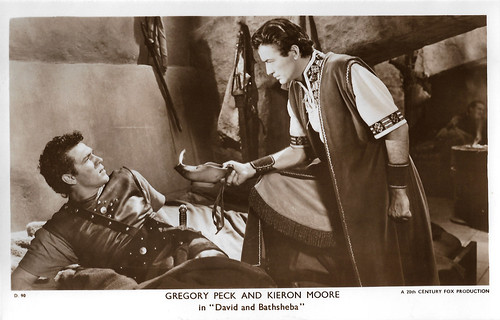
Later Batsheba admits she had hoped he would see her. But she is married to Uriah (Kieron Moore), one of David's most trusted soldiers, and both know an affair would break the law of Moses. When she becomes pregnant, it becomes necessary for Uriah to come in from the battlefield and spend time at home. David's downfall begins when he orders Uriah into a suicidal battle, knowing that this will clear the way for his relationship with Bathsheba. His infatuation leads him to neglect his kingdom and his people, and invokes the wrath of God.

Uriah is killed, a war hero; but this does not solve the infidelity question.  Nathan the prophet advises David the people are dissatisfied with his leadership and desire his sons to rule. Nathan tells David he has forgotten that he is a servant of the Lord. Drought comes to Israel, and David's and Bathsheba's baby dies. Nathan returns to tell David that God is displeased with his sin. He will not die as the law demands, but he will be punished through misfortune in his family. David must rediscover his faith in God in order to save Bathsheba from death by stoning, his kingdom from drought and famine, and himself from his many sins.

At last, David places his hands on the Ark of the Covenant, recently brought to Jerusalem and housed in a temple, which has caused the death of others who accidentally came in contact with it, inviting his god to punish him - and nothing happens... David exits the temple, and finds that rain has come to his parched land.

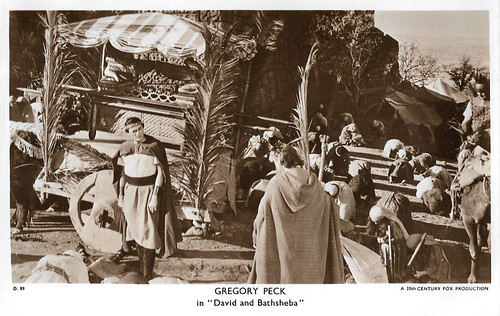
Gregory Peck in David and Bathsheba (1951)
British postcard by The Picturegoer Series, London, no. D 89. Photo: 20th Century Fox. Publicity still for David and Bathsheba (Henry King, 1951) with Gregory Peck.

Gregory Peck and Kieron Moore in David and Bathsheba (1951)
British postcard by The Picturegoer Series, London, no. D 90. Photo: 20th Century Fox. Publicity still for David and Bathsheba (Henry King, 1951) with Gregory Peck and Kieron Moore.

Intense, hypnotising performance


David and Bathsheba (1951) was produced out of 20th Century Fox by Darryl F. Zanuck, and directed by veteran Henry King. The film is based around the second Old Testament book of Samuel from the Bible.

Seeing the success of Cecil B. DeMille's Samson and Delilah (1949), Zanuck had commissioned Philip Dunne to write a script based on King David. Phillip Dunne's Oscar nominated screenplay holds the attention throughout. His script is with much meditation and discussion, interspersed with bursts of word-for-word biblical dramatisations. This makes the film sometimes a bit talkative.

Typically for the genre, David and Bathsheba is a large, grandiose production. From its excellent set designs and art direction by Thomas Little, Lyle Weeler, and George Davis, along Alfred Newman's beautiful music score to the gorgeous Technicolor photography by Leon Shamroy.

The fine cast includes next to the mentioned actors, James Robertson Justice, Raymond Massey and John Sutton plus a dance by a young Gwen Verdon, the future musical theatre star .

David and Bathsheba has all the size and grandeur of many of the great biblical epics of the 1950s and 1960s, but it is the first that humanises the biblical characters themselves. The film earned an estimated $7 million at the US box office in 1951, making it the most popular film of the year.

The power of the film rests in Gregory Peck's intense, hypnotising performance as David. Toward the end, having hit rock bottom, he must answer for his life. These last 15 minutes of the film are great and the handsome Peck is an absolute joy to watch.

Craig Butler at AllMovie: "Fans of Biblical epics will find a lot to like in David and Bathsheba; although there's little here that will appeal to those who don't look favorably upon the genre. The script is predictably overblown, filled with the kind of bombast and stilted melodrama that is to be expected. It's ridiculous, yet in its own strange way, it works."

Gregory Peck and Raymond Massey in David and Bathsheba (1951)
British postcard by The Picturegoer Series, London, no. D 91. Photo: 20th Century Fox. Publicity still for David and Bathsheba (Henry King, 1951) with Gregory Peck and Raymond Massey.

Gregory Peck and Susan Hayward in David and Bathsheba (1951)
British postcard by The Picturegoer Series, London, no. D 92. Photo: 20th Century Fox. Publicity still for David and Bathsheba (Henry King, 1951) with Gregory Peck and Susan Hayward.

Source: Craig Butler (AllMovie), Hal Erickson (AllMovie), American Film InstituteWikipedia and IMDb.