Handsome and distinguished, Douglas Fairbanks Jr. (1909-2000) was much more than the son of his superstar father. He was a bright, multi-talent, who excelled in sports and sculpting, was involved in business and was knighted for his war efforts as a lieutenant. He acted in approximately 100 films or TV shows.
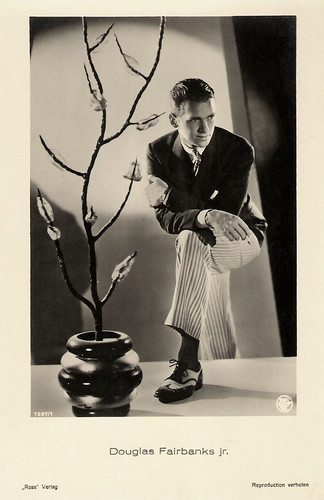
German postcard by Ross Verlag, no. 7297/1, 1932-1933. Photo: First National Pictures.
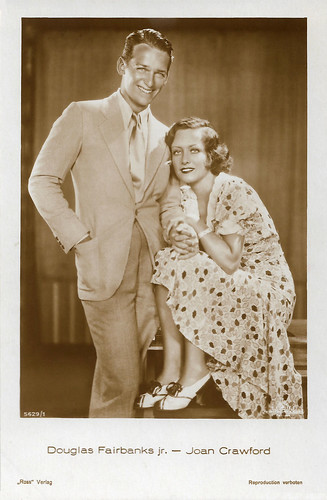
German postcard by Ross Verlag, Berlin, no. 5629/1, 1930-1931. Photo: Metro-Goldwyn-Mayer. Douglas Fairbanks Jr. and Joan Crawford.
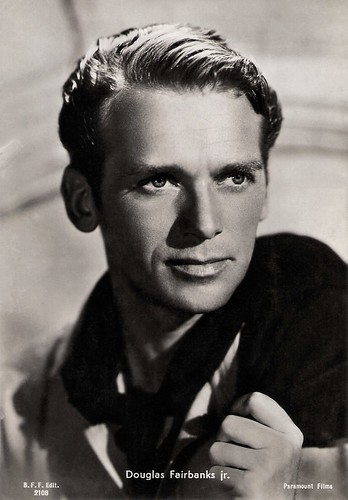
Italian postcard by B.F.F. Edit. (Casa Editr. Ballerini & Fratini, Firenze), no. 2108. Photo: Paramount Films.

American postcard by Universal. Photo: publicity still for The Exile (Max Ophüls, 1947).
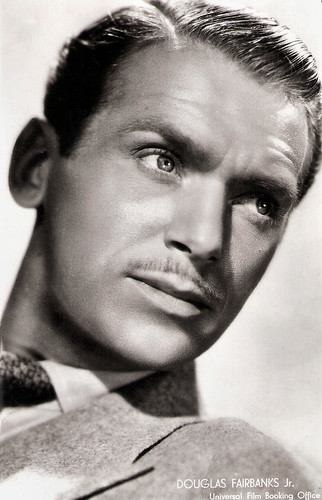
Dutch postcard by J.S.A., no. 192. Photo: Universal Film Booking Office.
Douglas Elton Ulman Fairbanks Junior was born in New York City in 1909 as the only child of the future Swashbuckler of silent films, Douglas Fairbanks, and Beth Sully, the daughter of a wealthy cotton mogul. His parents divorced when he was nine years old, and both remarried.
He lived with his mother in New York, California, Paris and London. He soon proved a gifted boy. Guy Bellinger at IMDb: "Douglas Elton Ulman - better known as Douglas Fairbanks Jr. - never really intended to take up acting as a career. However, the environment he was born into and the circumstances naturally led him to be a thespian. Noblesse oblige."
'Doug' excelled at sports, notably during his stay at the Military Academy in 1919. Later his role in Claude Autant-Lara's L'athlète incomplete/Love Is a Racket (1932) illustrated these abilities. He also excelled academically and attended the Lycée Janson de Sailly in Paris, where he had followed his divorced mother. Very early in his life he developed a taste for the arts as well and became a painter and sculptor. Not content to limit himself to just one field, he became involved in business, in fields as varied as mining, hotel management, owning a chain of bowling alleys and a firm that manufactured popcorn.
During World War II he headed London's Douglas Voluntary Hospital (an establishment taking care of war refugees), was President Franklin D. Roosevelt's special envoy for the Special Mission to South America in 1940 before becoming a lieutenant in the Navy and taking part in the Allies' landing in Sicily and Elba in 1943.
Fairbanks held the Silver Star and the Legion of Merit with V for valour in combat devices from the U.S. government for his combat service. In 1949, he was created an honorary Knight Commander of the Most Excellent Order of the British Empire. A fervent Anglophile, he often entertained Queen Elizabeth II and Prince Philip in his London mansion, 'The Boltons'. In 1954, Fairbanks was promoted to the rank of captain in the Navy.
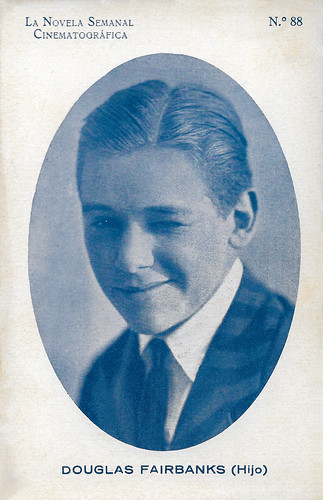
Spanish card by La Novela Semanal Cinematográfica, no. 88.
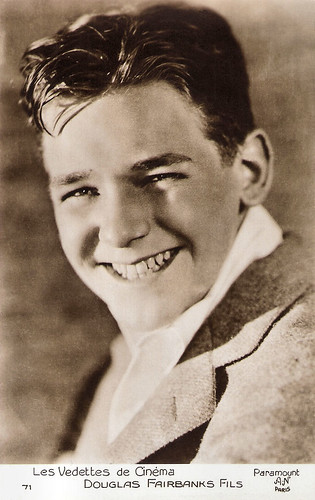
French postcard in the Les Vedettes de Cinéma series by A.N. Paris, no. 71. Photo: Paramount.
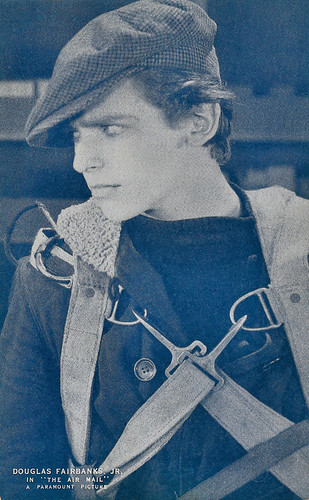
American Arcade postcard by Exhibit Supply Co, Chicago, Ill. Photo: Paramount. Douglas Fairbanks Jr. in The Air Mail (Irvin Willat, 1925).
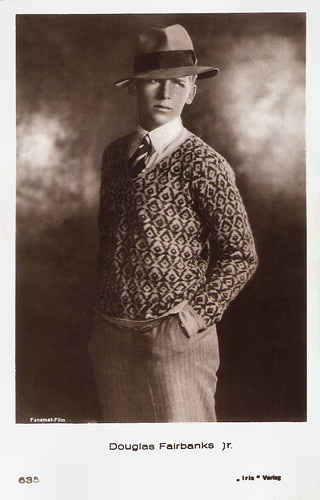
Austrian postcard by Iris Verlag, no. 635. Photo: Fanamet Film.
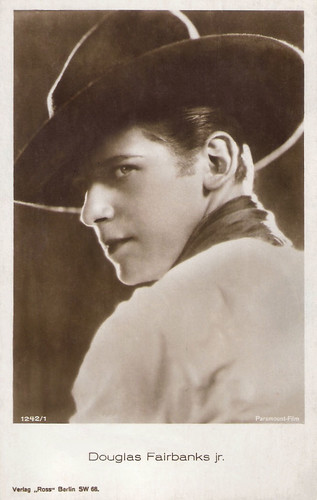
German postcard by Ross Verlag, Berlin, no. 1242/1, 1927-1928. Photo: Paramount Film.
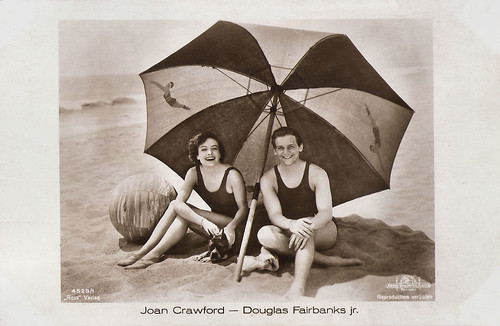
With Joan Crawford. German postcard by Ross Verlag, Berlin, no. 4628/1, 1929-1930. Photo: Metro-Goldwyn-Mayer.
Douglas Fairbanks Jr. began his film career at the age of 13. Largely based on his father's name, Fairbanks, Jr. was given a contract with Paramount Pictures.
He debuted in the silent comedy Stephen Steps Out (Joseph Henabery, 1923) but the film flopped and his career stagnated despite a critically acclaimed role in Stella Dallas (Henry King, 1925), in which he sported a moustache to play a rich husband. In 1929, he took to the stage and appeared in 'Young Woodley' and 'Saturday's Children' in Los Angeles. He impressed his father, his stepmother Mary Pickford, and Charlie Chaplin, who encouraged him to continue acting.
Things really picked up when he appeared in the silent drama Our Modern Maidens (Jack Conway, 1929) opposite Lucille Le Sueur, a young starlet who was soon to become better known as Joan Crawford. They married and the young couple became the toast of the town.
He demonstrated a well-modulated speaking voice and good parts followed in early sound films. He was an ace pilot in the World War I drama The Dawn Patrol (Howard Hawks, 1930), and the hapless partner of Edward G. Robinson in Little Caesar (Mervyn Leroy, 1931). His separation and 1933 divorce from Joan Crawford gained even more publicity than their courtship and marriage.
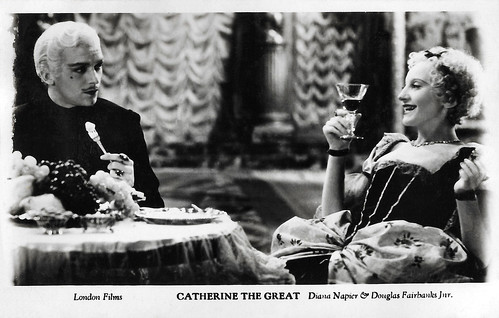
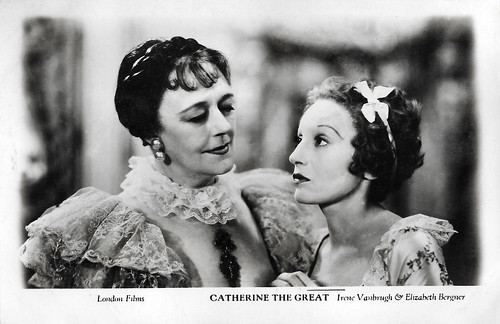
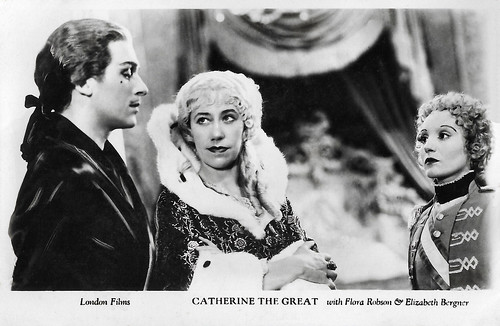
The 1930s were a fruitful period for Fairbanks who easily played various roles. He was good as the mad Tsar in The Rise of Catherine the Great (Paul Czinner, 1934). He was even better as the irresistible villain Rupert of Hentzau in The Prisoner of Zenda (John Cromwell, 1937) starring Ronald Colman. But his most memorable role is that of the British soldier in Gunga Din (George Stevens, 1939) with Cary Grant and Victor McLaglen.
Till then Fairbanks had carefully tried to avoid comparisons with his father, but after Doug Senior's death, he proved himself zestful as a romantic adventurer. In films like The Corsican Brothers (Gregory Ratoff, 1942), The Exile (Max Ophüls, 1947) and Sinbad the Sailor (Richard Wallace,1947) the spirit of his father seemed to glow within him.
In the early 1950s, Fairbanks retired from the cinema and moved to London. He produced and was a co-writer of several films. Between 1954 and 1956 he was the executive producer and host of a popular television anthology show, Douglas Fairbanks, Jr. Presents. Despite a moving part opposite Fred Astaire and Melvyn Douglas in Ghost Story (John Irvin, 1981), he did not appear in a major film.
He published two volumes of autobiography - The Salad Days (1988) and A Hell of a War (1993). Douglas Fairbanks, Jr. also collaborated with Richard Schickel on the illustrated survey of Fairbanks Sr. and Jr. called The Fairbanks Album (1975) and with Jeffrey Vance on a critical study/biography of Fairbanks Sr. ultimately published as Douglas Fairbanks (2008).
He was married three times. After his divorce from Joan Crawford, he was married till her death in 1988 to Mary Lee Eppling, with whom he had three daughters, and from 1991 till his death to Vera Fairbanks. At the age of 90, Douglas Fairbanks Jr. died of a heart attack in 2000. Guy Bellinger: "Now a legend himself, Douglas Fairbanks Jr. left this world with the satisfaction of having lived up to the Fairbanks name at the end of a life nobody could call 'wasted'."
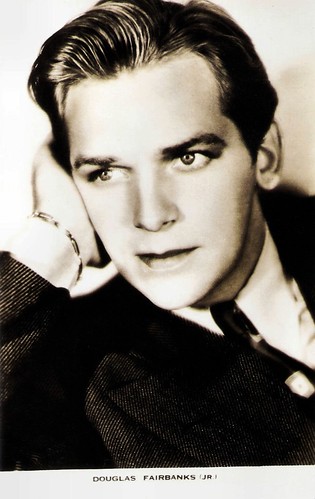
British postcard in the Film Weekly series, London.
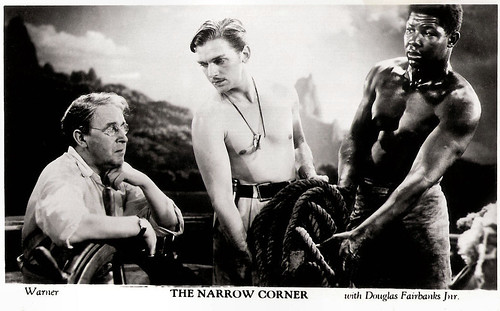
British postcard in the Filmshots series by Film Weekly. Photo: Warner. Publicity still for The Narrow Corner (Alfred E. Green, 1933) with Dudley Digges, Douglas Fairbanks Jr. and Everett Brown.
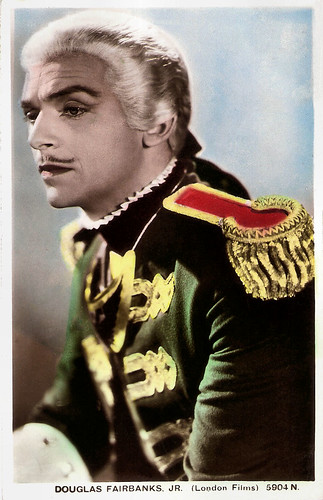
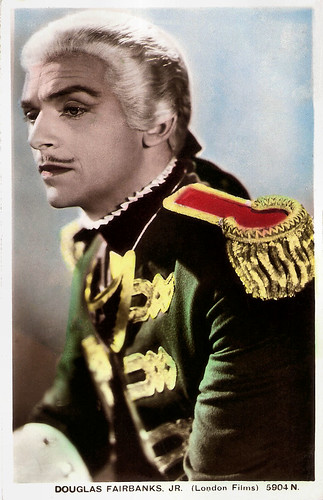
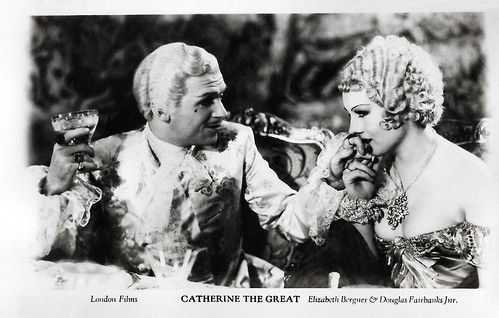
British postcard by Valentine's, no. 5904 N. Photo: London Films. Publicity still for The Rise of Catherine the Great (Paul Czinner, 1934).
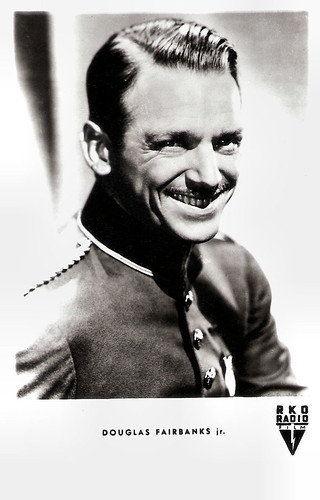
German postcard by Netter's Star Verlag, Berlin. Photo: RKO Radio Film. Publicity still for Gunga Din (George Stevens, 1939).
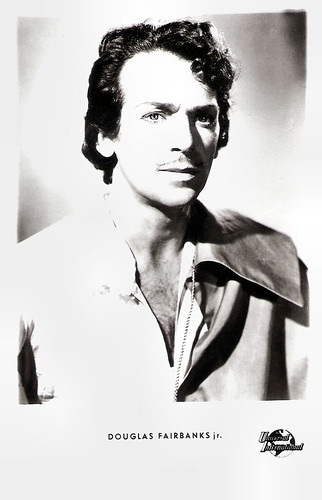
German postcard by Netter's Star Verlag, Berlin. Photo: Universal International. Publicity still for The Exile (Max Ophüls, 1947).
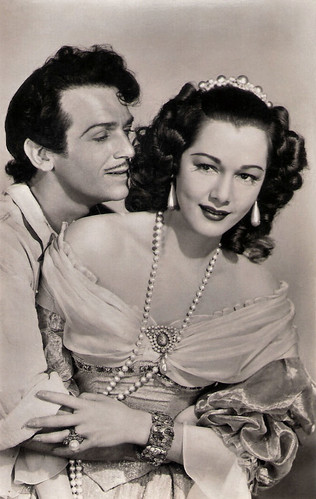
Spanish postcard by Sobe, no. 452. Photo: publicity still for The Exile (Max Ophüls, 1947) with Maria Montez.
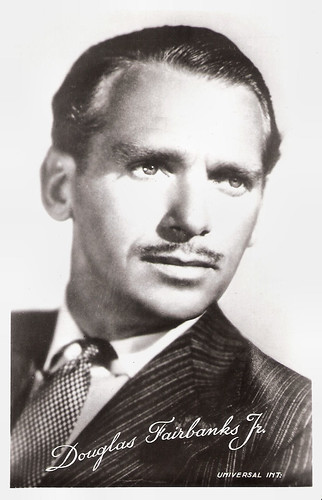
Dutch postcard by 't Sticht, Utrecht, no. 1005. Photo: Universal International.
Sources: Guy Bellinger (IMDb), Hal Erickson (AllMovie), New York Times, The Telegraph (page now defunct), Wikipedia and IMDb.
This post was last updated on 26 February 2024.
German postcard by Ross Verlag, no. 7297/1, 1932-1933. Photo: First National Pictures.
German postcard by Ross Verlag, Berlin, no. 5629/1, 1930-1931. Photo: Metro-Goldwyn-Mayer. Douglas Fairbanks Jr. and Joan Crawford.
Italian postcard by B.F.F. Edit. (Casa Editr. Ballerini & Fratini, Firenze), no. 2108. Photo: Paramount Films.
American postcard by Universal. Photo: publicity still for The Exile (Max Ophüls, 1947).
Dutch postcard by J.S.A., no. 192. Photo: Universal Film Booking Office.
Noblesse oblige
Douglas Elton Ulman Fairbanks Junior was born in New York City in 1909 as the only child of the future Swashbuckler of silent films, Douglas Fairbanks, and Beth Sully, the daughter of a wealthy cotton mogul. His parents divorced when he was nine years old, and both remarried.
He lived with his mother in New York, California, Paris and London. He soon proved a gifted boy. Guy Bellinger at IMDb: "Douglas Elton Ulman - better known as Douglas Fairbanks Jr. - never really intended to take up acting as a career. However, the environment he was born into and the circumstances naturally led him to be a thespian. Noblesse oblige."
'Doug' excelled at sports, notably during his stay at the Military Academy in 1919. Later his role in Claude Autant-Lara's L'athlète incomplete/Love Is a Racket (1932) illustrated these abilities. He also excelled academically and attended the Lycée Janson de Sailly in Paris, where he had followed his divorced mother. Very early in his life he developed a taste for the arts as well and became a painter and sculptor. Not content to limit himself to just one field, he became involved in business, in fields as varied as mining, hotel management, owning a chain of bowling alleys and a firm that manufactured popcorn.
During World War II he headed London's Douglas Voluntary Hospital (an establishment taking care of war refugees), was President Franklin D. Roosevelt's special envoy for the Special Mission to South America in 1940 before becoming a lieutenant in the Navy and taking part in the Allies' landing in Sicily and Elba in 1943.
Fairbanks held the Silver Star and the Legion of Merit with V for valour in combat devices from the U.S. government for his combat service. In 1949, he was created an honorary Knight Commander of the Most Excellent Order of the British Empire. A fervent Anglophile, he often entertained Queen Elizabeth II and Prince Philip in his London mansion, 'The Boltons'. In 1954, Fairbanks was promoted to the rank of captain in the Navy.
Spanish card by La Novela Semanal Cinematográfica, no. 88.
French postcard in the Les Vedettes de Cinéma series by A.N. Paris, no. 71. Photo: Paramount.
American Arcade postcard by Exhibit Supply Co, Chicago, Ill. Photo: Paramount. Douglas Fairbanks Jr. in The Air Mail (Irvin Willat, 1925).
Austrian postcard by Iris Verlag, no. 635. Photo: Fanamet Film.
German postcard by Ross Verlag, Berlin, no. 1242/1, 1927-1928. Photo: Paramount Film.
With Joan Crawford. German postcard by Ross Verlag, Berlin, no. 4628/1, 1929-1930. Photo: Metro-Goldwyn-Mayer.
The toast of the town
Douglas Fairbanks Jr. began his film career at the age of 13. Largely based on his father's name, Fairbanks, Jr. was given a contract with Paramount Pictures.
He debuted in the silent comedy Stephen Steps Out (Joseph Henabery, 1923) but the film flopped and his career stagnated despite a critically acclaimed role in Stella Dallas (Henry King, 1925), in which he sported a moustache to play a rich husband. In 1929, he took to the stage and appeared in 'Young Woodley' and 'Saturday's Children' in Los Angeles. He impressed his father, his stepmother Mary Pickford, and Charlie Chaplin, who encouraged him to continue acting.
Things really picked up when he appeared in the silent drama Our Modern Maidens (Jack Conway, 1929) opposite Lucille Le Sueur, a young starlet who was soon to become better known as Joan Crawford. They married and the young couple became the toast of the town.
He demonstrated a well-modulated speaking voice and good parts followed in early sound films. He was an ace pilot in the World War I drama The Dawn Patrol (Howard Hawks, 1930), and the hapless partner of Edward G. Robinson in Little Caesar (Mervyn Leroy, 1931). His separation and 1933 divorce from Joan Crawford gained even more publicity than their courtship and marriage.
The 1930s were a fruitful period for Fairbanks who easily played various roles. He was good as the mad Tsar in The Rise of Catherine the Great (Paul Czinner, 1934). He was even better as the irresistible villain Rupert of Hentzau in The Prisoner of Zenda (John Cromwell, 1937) starring Ronald Colman. But his most memorable role is that of the British soldier in Gunga Din (George Stevens, 1939) with Cary Grant and Victor McLaglen.
Till then Fairbanks had carefully tried to avoid comparisons with his father, but after Doug Senior's death, he proved himself zestful as a romantic adventurer. In films like The Corsican Brothers (Gregory Ratoff, 1942), The Exile (Max Ophüls, 1947) and Sinbad the Sailor (Richard Wallace,1947) the spirit of his father seemed to glow within him.
In the early 1950s, Fairbanks retired from the cinema and moved to London. He produced and was a co-writer of several films. Between 1954 and 1956 he was the executive producer and host of a popular television anthology show, Douglas Fairbanks, Jr. Presents. Despite a moving part opposite Fred Astaire and Melvyn Douglas in Ghost Story (John Irvin, 1981), he did not appear in a major film.
He published two volumes of autobiography - The Salad Days (1988) and A Hell of a War (1993). Douglas Fairbanks, Jr. also collaborated with Richard Schickel on the illustrated survey of Fairbanks Sr. and Jr. called The Fairbanks Album (1975) and with Jeffrey Vance on a critical study/biography of Fairbanks Sr. ultimately published as Douglas Fairbanks (2008).
He was married three times. After his divorce from Joan Crawford, he was married till her death in 1988 to Mary Lee Eppling, with whom he had three daughters, and from 1991 till his death to Vera Fairbanks. At the age of 90, Douglas Fairbanks Jr. died of a heart attack in 2000. Guy Bellinger: "Now a legend himself, Douglas Fairbanks Jr. left this world with the satisfaction of having lived up to the Fairbanks name at the end of a life nobody could call 'wasted'."
British postcard in the Film Weekly series, London.
British postcard in the Filmshots series by Film Weekly. Photo: Warner. Publicity still for The Narrow Corner (Alfred E. Green, 1933) with Dudley Digges, Douglas Fairbanks Jr. and Everett Brown.
British postcard by Valentine's, no. 5904 N. Photo: London Films. Publicity still for The Rise of Catherine the Great (Paul Czinner, 1934).
German postcard by Netter's Star Verlag, Berlin. Photo: RKO Radio Film. Publicity still for Gunga Din (George Stevens, 1939).
German postcard by Netter's Star Verlag, Berlin. Photo: Universal International. Publicity still for The Exile (Max Ophüls, 1947).
Spanish postcard by Sobe, no. 452. Photo: publicity still for The Exile (Max Ophüls, 1947) with Maria Montez.
Dutch postcard by 't Sticht, Utrecht, no. 1005. Photo: Universal International.
Sources: Guy Bellinger (IMDb), Hal Erickson (AllMovie), New York Times, The Telegraph (page now defunct), Wikipedia and IMDb.
This post was last updated on 26 February 2024.