German actor Hans Adalbert Schlettow (1888–1945) appeared between 1917 and 1945 in about 150 films. He played sinister characters in some of the masterpieces of the German silent cinema, including Fritz Lang's Die Nibelungen (1924) and Joe May's Asphalt (1929). But in real life Schlettow proved to be a sinister character as well.
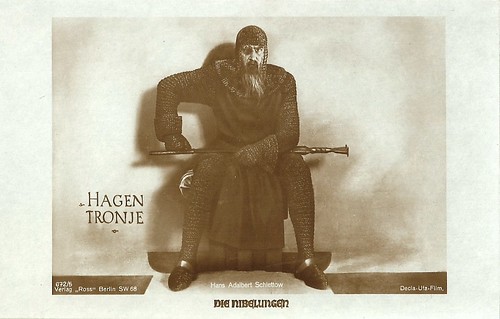
German postcard by Ross Verlag, Berlin, no. 672/5. Photo: Decla-Ufa-Film. Hans Adalbert Schlettow as Hagen (von) Tronje, in Fritz Lang's saga Die Nibelungen (1924).
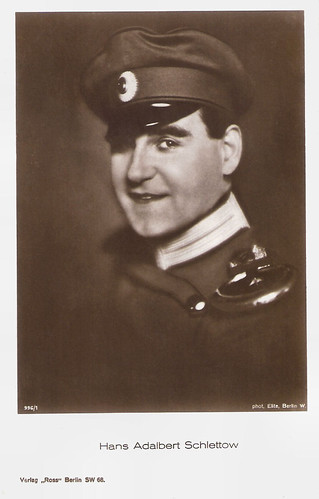
German postcard by Ross Verlag, no. 996/1, 1925-1926. Photo: Elite, Berlin W.
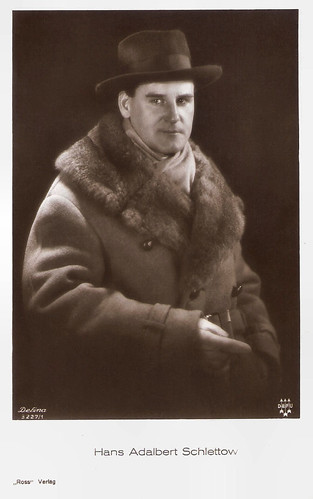
German postcard by Ross Verlag, no. 3227/1, 1928-1929. Photo: Defina / Defu.
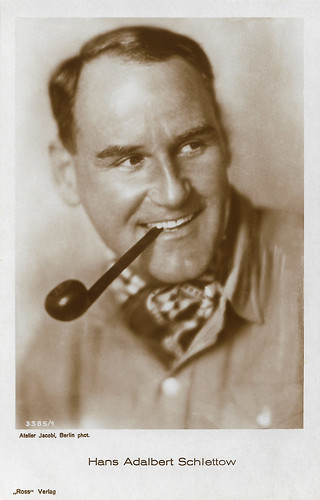
German postcard by Ross Verlag, no. 3385/1, 1928-1929. Photo: Atelier Jacobi, Berlin.
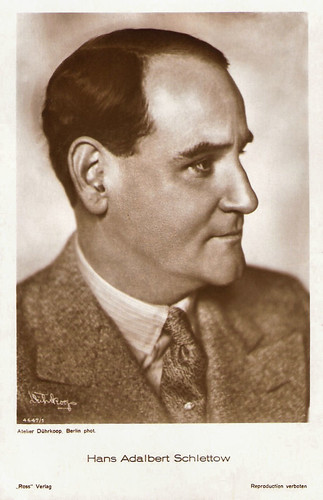
German postcard by Ross Verlag, no. 4647/1, 1929-1930. Photo: Atelier Dührkoop, Berlin.
Hans Adelbert Droescher von Schlettow was born in Frankfurt am Main, Germany in 1887 or 1888 (sources differ; his gravestone says the latter). He was the son of an officer and he himself also strived for a career in the army. He had to stop his military studies because of health problems.
Passionate about the arts, he then turned towards acting. Under his real name, he began his career as a trainee at the Schauspielhaus in Frankfurt in 1908. Then he went to Barmen, and from 1915 to 1919 he was committed to the Hoftheater Mannheim (Mannheim court theatre). In 1920 he joined the Phantastischen Theater in Berlin-Charlottenburg.
Under the stage name Hans Adalbert Schlettow, he made his film debut in three silent productions by director Urban Gad: Die Gespensterstunde/The Ghost Hour (Urban Gad, 1916), Der breite weg/The wide way (Urban Gad, 1916), and Klosterfriede/Monastery Peace (Urban Gad, 1917), all opposite Maria Widal and Olga Engl.
During his career, Schlettow kept changing his names, and was sometimes credited as Hans Adalbert von Schlettow, Adalbert or Adalberg von Schlettow, or Hans Schlettow. After his first film appearances he already worked with such famous stars as Pola Negri in Komtesse Doddy/Countess Doddy (Georg Jacoby, 1918), and Emil Jannings in the Sci-Fi film Algol (Hans Werckmeister, 1919), about an alien from the planet Algol who gives a man a device for superpowers.
Initially, Schlettow often played the lover, such as in the title role of Don Juan (Albert Heine, Robert Land, 1922) opposite Margarete Lanner. Gradually he specialised in sinister characters, such as Satan in Hiob/Job (Kurt Matull, 1918) with Eduard von Winterstein, a murderer in the Emile Zola adaptation Thérèse Raquin/Shadows of Fear (Jacques Feyder, 1928) with Gina Manès, and a criminal in Asphalt (Joe May, 1929).
Schlettow’s most famous films are two Fritz Lang classics, the two-part thriller Dr. Mabuse, der Spieler/Dr. Mabuse, The Gambler (Fritz Lang, 1922) in which he played the chauffeur of bad genius Dr. Mabuse (Rudolf Klein-Rogge), and the lushly produced UFA epic Die Nibelungen (Fritz Lang, 1924), based on the German myth of the Nibelungen, in which he played the villainous Hagen Tronje who discovers the weak spot of the great German hero Siegfried (Paul Richter) and pierces it with a spear.
Schlettow worked also with another legendary director of the silent cinema, David Wark Griffith on Isn't Life Wonderful (D.W. Griffith, 1924). It was Griffith's last independent production, filmed in Berlin, before he was forced to sell his Mamaroneck studio to help pay off mounting debts. At IMDb, Thataw reviews: “Though little known today (...) this little film, in my opinion, is Griffith's last great film. It incorporates the best elements of intimate dramas like Broken Blossoms with a large scale backdrop like Hearts of the World. (...) This story of a poor family's trials and tribulations in inflation ravaged post World War I Germany is remarkably grim and is presented realistically. Griffith came under heavy criticism for presenting a sympathetic portrait of a family in Germany (they had to be changed from German to Polish although one character still tears up a picture of the Kaiser) and for shooting the film in Germany itself.”
Twice Schlettow appeared as Stenka Razin, the leader of the 17th-century uprising of peasants against the Tsarist Russian establishment. In 1928 he starred in Wolga Wolga/Volga Volga, a silent film directed by Russian emigré director Viktor Tourjansky and co-starring Lilian Hall-Davies and Rudolf Klein-Rogge. In 1936 followed a sound version, Stjenka Rasin/Wolga-Wolga (1936), directed by another anti-Soviet émigré Alexandre Volkoff and co-starring Wera Engels and Heinrich George. Razin died in 1671, during the reign of Tsar Aleksei Mikhailovich (father of Peter the Great).
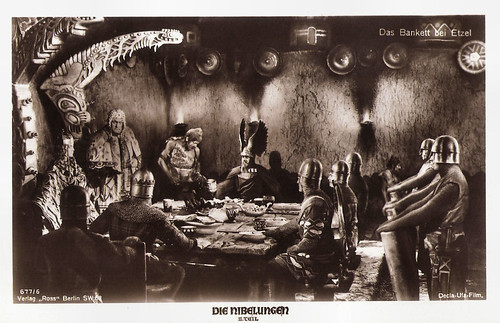
German postcard by Ross Verlag, no. 677/6. Photo: Decla-Ufa-Film. Publicity still for Die Nibelungen, II, Kriemhilds Rache/Kriemhild's Revenge (Fritz Lang, 1924). Das Bankett bei Etzel (The Banquet at Etzel's, King of the Huns). During the banquet the knights discover it is a trap. Hagen von Tronje (Hans Adalbert Schlettow) kills the child of Etzel (Rudolf Klein-Rogge) and Kriemhild (Margarete Schön), after which Etzel swears to kill all Burgunds. Several are killed in fights. Finally, the banqueting hall is set on fire, killing all but Hagen and king Gunther. Most sets of the film were done by Erich Kettelhut, in collaboration with Otto Hunte and Karl Vollbrecht.
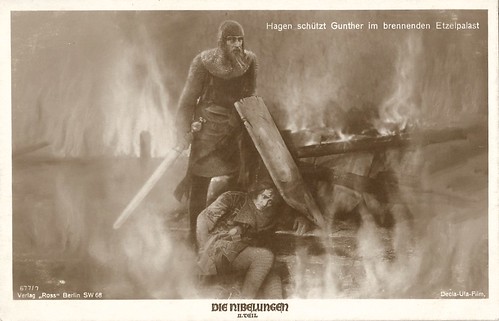
German postcard by Ross Verlag, Berlin, no. 677/7. Photo: Decla-Ufa-Film. Hagen von Tronje (Hans Adalbert Schlettow) protects king Gunther (Theodoor Loos) in the burning palace of Etzel.
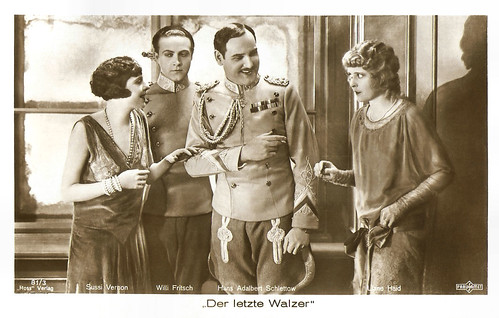
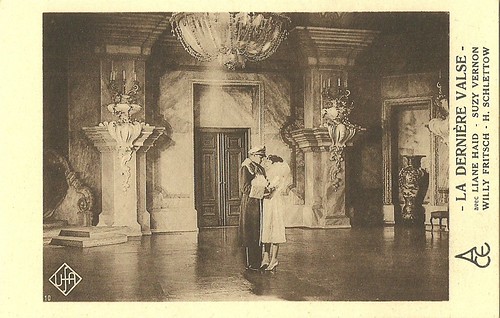
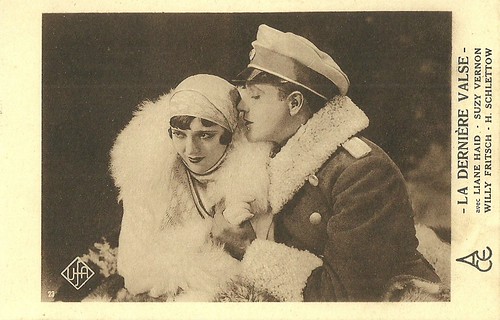
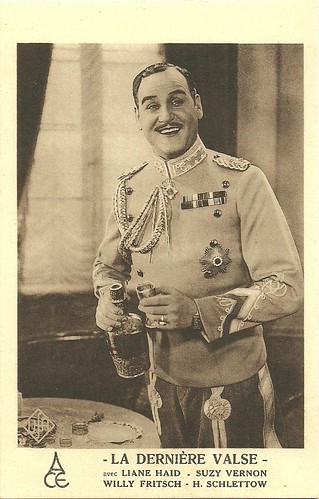
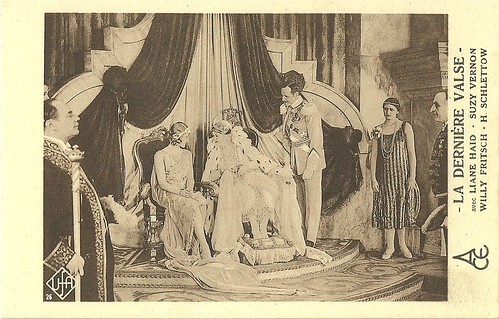
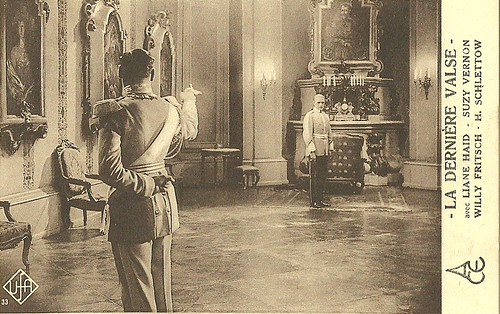
German postcard by Ross Verlag, no. 81/3, 1925-1935. Photo: Parufamet. Publicity still for Der Letzte Walzer/The Last Waltz (Arthur Robison, 1927) with Suzy Vernon, Willy Fritsch, Hans Adalbert Schlettow and Liane Haid.
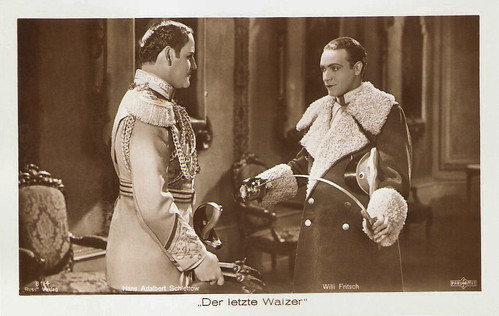
German postcard by Ross Verlag, no. 81/4, 1925-1935. Photo: Parufamet. Publicity still for Der Letzte Walzer/The Last Waltz (Arthur Robison, 1927) with Willy Fritsch and Hans Adalbert Schlettow.
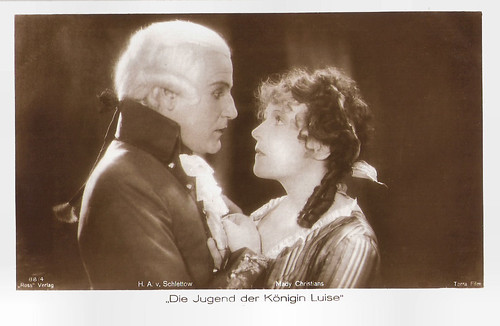
German postcard by Ross Verlag, no. 88/4. Photo: Terra Film. Publicity still for Königin Luise, 1. Teil - Die Jugend der Königin Luise/Queen Louise (Karl Grune, 1927) with Mady Christians.
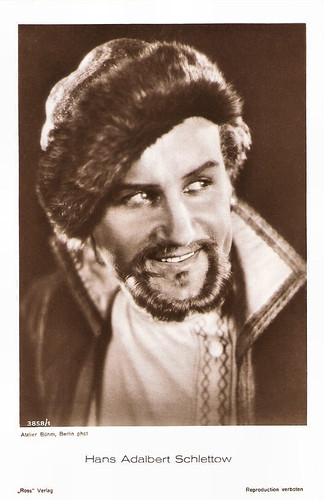
German postcard by Ross Verlag, no. 3859/1, 1928-1929. Photo: Atelier Böhm, Berlin. Publicity still for Wolga Wolga/Volga Volga (Viktor Tourjansky, 1928).
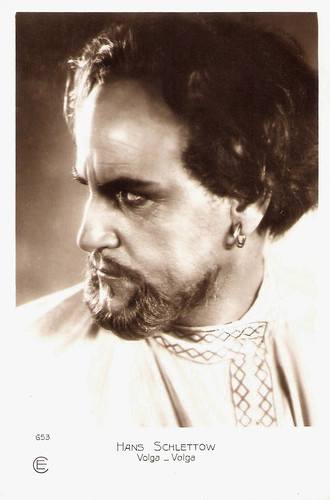
French postcard by Cinémagazine-Edition, Paris, no. 653. Photo: publicity still for Wolga Wolga/Volga Volga (Viktor Tourjansky, 1928).
In 1930, Hans Adalbert Schlettow played Harry the farmer in one of the first English sound films, the thriller A cottage in Dartmoor (Anthony Asquith, 1930) with Swedish actor Uno Henning as an escaped prisoner. The sound of this production, filmed in Sweden, has been lost and the film can now only be shown in a silent version.
After the arrival of sound, Schlettow first appeared in leading parts, such as in the comedy Der tolle Bomberg/The Mad Bomberg (Georg Asagaroff, 1932) with Vivian Gibson, and Der Jäger aus Kurpfalz/The hunter from the Palatinate (Carl Behr, 1932) with Fritz Kampers.
Later he mainly worked as a supporting actor. During the 1930s, he often appeared in Heimat-films, films with a regional background, such as An heiligen Wassern/Sacred Waters (Erich Waschneck, 1932) with Karin Hardt, Die Nacht im Forsthaus/The Roberts Case (Erich Engels, 1933) and Der Jäger von Fall/The Hunter of Fall (Hans Deppe, 1936).
In 1940, he played the role of Santer, the opponent of Winnetou, at the Karl-May-Spielen, a Karl May festival in Werder. Long before the coming to power of Adolph Hitler, Schlettow had been a sympathizer of the Nazis and their anti-Semitic theories. After 1933, Schlettow was regarded by colleagues as an informer.
During the war time he played in such productions as Die Rothschilds/The Rothschilds (Erich Waschneck, 1941), an anti-Semitic and anti-British propaganda film about the rise of the Jewish bankers (the Rothschild family) at the beginning of the 19th century, and Ohm Krüger/Uncle Krüger (Hans Steinhoff, 1941), the second-most expensive prestige and propaganda project of the Nazi period justifying the annihilation politics of the concentration camps, while claiming this to be a creation of the British in South Africa during the Boer war.
He also played in popular entertainment films as the circus spectacle Die grosse Nummer/The Big Number (Karl Anton, 1943), starring Leny Marenbach and Rudolf Prack. In August 1944 in the final phase of the Second World War, Joseph Goebbels placed him on the list of the ‘Gottbegnadeten-Liste der wichtigsten Filmschauspieler’ (the God gifted list of the main film actors), so he did not have to fight at the front.
Hans Adalbert Schlettow died anyway shortly before the end of the war in April 1945. In a burst of patriotism, he had joined the army and during the Battle of Berlin, when the Third Reich started its desperate final offensive, he became a war casualty. About his private life is known that he loved to travel often to sunny, fascist Italy with actor Eduard von Winterstein, with whom he also often worked together.
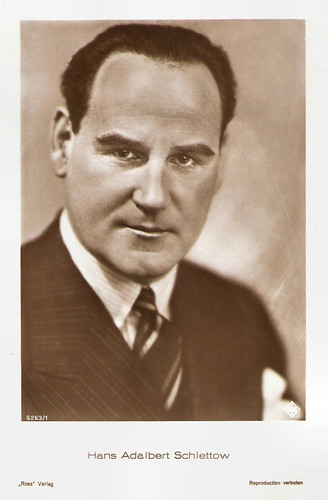
German postcard by Ross Verlag, no. 5263/1, 1930-1931. Photo: Ufa.
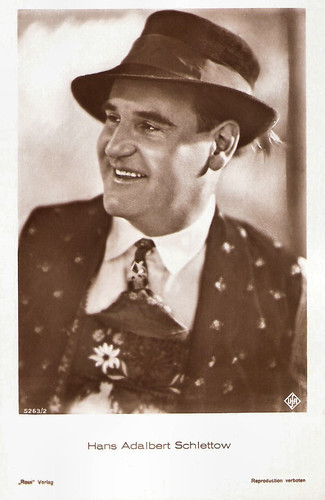
German postcard by Ross Verlag, no. 5263/2, 1930-1931. Photo: Ufa.
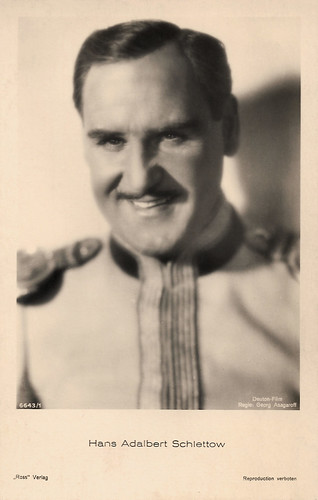
German postcard by Ross Verlag, no. 6643/1, 1931-1932. Photo: Deuton-Film. Publicity still for Der tolle Bomberg/The Mad Bomberg (Georg Asagaroff, 1932).
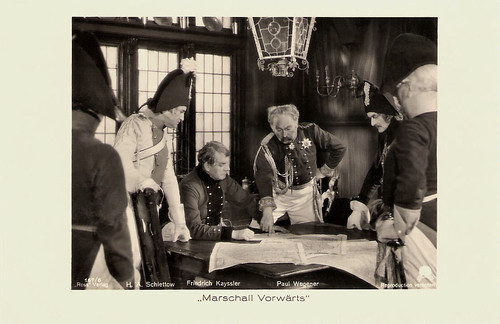
German postcard by Ross Verlag, no. 167/6. Photo: publicity still for Marschall Vorwärts/Marshal Forward (Heinz Paul, 1932) with Paul Wegener and Friedrich Kayssler.
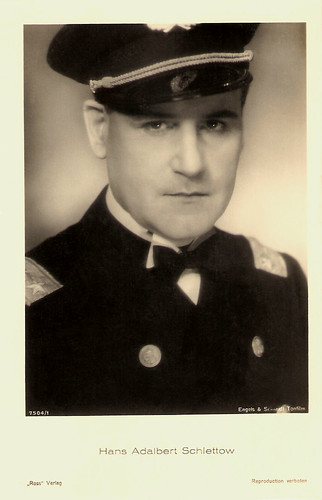
German postcard by Ross Verlag, no. 7504/1, 1932-1933. Photo: Engels & Schmidt Tonfilm.
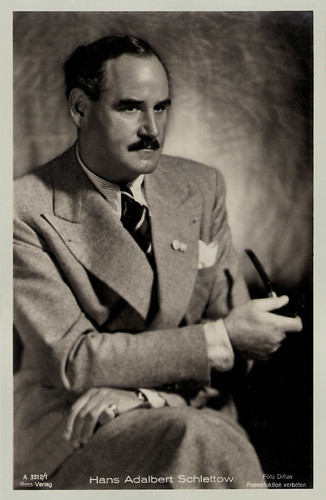
German postcard by Ross Verlag, no. A 3312/1, 1941-1944. Photo: Dillan.
Segment from Die Nibelungen (1924). Source: Dionysus Cinema (YouTube).
Sources: Thomas Staedeli (Cyranos), Philippe Pelletier (CinéArtistes - French), Steven P. Hill (IMDb), AllMovie, Filmportal.de, Wikipedia (German) and IMDb.
German postcard by Ross Verlag, Berlin, no. 672/5. Photo: Decla-Ufa-Film. Hans Adalbert Schlettow as Hagen (von) Tronje, in Fritz Lang's saga Die Nibelungen (1924).
German postcard by Ross Verlag, no. 996/1, 1925-1926. Photo: Elite, Berlin W.
German postcard by Ross Verlag, no. 3227/1, 1928-1929. Photo: Defina / Defu.
German postcard by Ross Verlag, no. 3385/1, 1928-1929. Photo: Atelier Jacobi, Berlin.
German postcard by Ross Verlag, no. 4647/1, 1929-1930. Photo: Atelier Dührkoop, Berlin.
Passionate About the Arts
Hans Adelbert Droescher von Schlettow was born in Frankfurt am Main, Germany in 1887 or 1888 (sources differ; his gravestone says the latter). He was the son of an officer and he himself also strived for a career in the army. He had to stop his military studies because of health problems.
Passionate about the arts, he then turned towards acting. Under his real name, he began his career as a trainee at the Schauspielhaus in Frankfurt in 1908. Then he went to Barmen, and from 1915 to 1919 he was committed to the Hoftheater Mannheim (Mannheim court theatre). In 1920 he joined the Phantastischen Theater in Berlin-Charlottenburg.
Under the stage name Hans Adalbert Schlettow, he made his film debut in three silent productions by director Urban Gad: Die Gespensterstunde/The Ghost Hour (Urban Gad, 1916), Der breite weg/The wide way (Urban Gad, 1916), and Klosterfriede/Monastery Peace (Urban Gad, 1917), all opposite Maria Widal and Olga Engl.
During his career, Schlettow kept changing his names, and was sometimes credited as Hans Adalbert von Schlettow, Adalbert or Adalberg von Schlettow, or Hans Schlettow. After his first film appearances he already worked with such famous stars as Pola Negri in Komtesse Doddy/Countess Doddy (Georg Jacoby, 1918), and Emil Jannings in the Sci-Fi film Algol (Hans Werckmeister, 1919), about an alien from the planet Algol who gives a man a device for superpowers.
Initially, Schlettow often played the lover, such as in the title role of Don Juan (Albert Heine, Robert Land, 1922) opposite Margarete Lanner. Gradually he specialised in sinister characters, such as Satan in Hiob/Job (Kurt Matull, 1918) with Eduard von Winterstein, a murderer in the Emile Zola adaptation Thérèse Raquin/Shadows of Fear (Jacques Feyder, 1928) with Gina Manès, and a criminal in Asphalt (Joe May, 1929).
Schlettow’s most famous films are two Fritz Lang classics, the two-part thriller Dr. Mabuse, der Spieler/Dr. Mabuse, The Gambler (Fritz Lang, 1922) in which he played the chauffeur of bad genius Dr. Mabuse (Rudolf Klein-Rogge), and the lushly produced UFA epic Die Nibelungen (Fritz Lang, 1924), based on the German myth of the Nibelungen, in which he played the villainous Hagen Tronje who discovers the weak spot of the great German hero Siegfried (Paul Richter) and pierces it with a spear.
Schlettow worked also with another legendary director of the silent cinema, David Wark Griffith on Isn't Life Wonderful (D.W. Griffith, 1924). It was Griffith's last independent production, filmed in Berlin, before he was forced to sell his Mamaroneck studio to help pay off mounting debts. At IMDb, Thataw reviews: “Though little known today (...) this little film, in my opinion, is Griffith's last great film. It incorporates the best elements of intimate dramas like Broken Blossoms with a large scale backdrop like Hearts of the World. (...) This story of a poor family's trials and tribulations in inflation ravaged post World War I Germany is remarkably grim and is presented realistically. Griffith came under heavy criticism for presenting a sympathetic portrait of a family in Germany (they had to be changed from German to Polish although one character still tears up a picture of the Kaiser) and for shooting the film in Germany itself.”
Twice Schlettow appeared as Stenka Razin, the leader of the 17th-century uprising of peasants against the Tsarist Russian establishment. In 1928 he starred in Wolga Wolga/Volga Volga, a silent film directed by Russian emigré director Viktor Tourjansky and co-starring Lilian Hall-Davies and Rudolf Klein-Rogge. In 1936 followed a sound version, Stjenka Rasin/Wolga-Wolga (1936), directed by another anti-Soviet émigré Alexandre Volkoff and co-starring Wera Engels and Heinrich George. Razin died in 1671, during the reign of Tsar Aleksei Mikhailovich (father of Peter the Great).
German postcard by Ross Verlag, no. 677/6. Photo: Decla-Ufa-Film. Publicity still for Die Nibelungen, II, Kriemhilds Rache/Kriemhild's Revenge (Fritz Lang, 1924). Das Bankett bei Etzel (The Banquet at Etzel's, King of the Huns). During the banquet the knights discover it is a trap. Hagen von Tronje (Hans Adalbert Schlettow) kills the child of Etzel (Rudolf Klein-Rogge) and Kriemhild (Margarete Schön), after which Etzel swears to kill all Burgunds. Several are killed in fights. Finally, the banqueting hall is set on fire, killing all but Hagen and king Gunther. Most sets of the film were done by Erich Kettelhut, in collaboration with Otto Hunte and Karl Vollbrecht.
German postcard by Ross Verlag, Berlin, no. 677/7. Photo: Decla-Ufa-Film. Hagen von Tronje (Hans Adalbert Schlettow) protects king Gunther (Theodoor Loos) in the burning palace of Etzel.
German postcard by Ross Verlag, no. 81/3, 1925-1935. Photo: Parufamet. Publicity still for Der Letzte Walzer/The Last Waltz (Arthur Robison, 1927) with Suzy Vernon, Willy Fritsch, Hans Adalbert Schlettow and Liane Haid.
German postcard by Ross Verlag, no. 81/4, 1925-1935. Photo: Parufamet. Publicity still for Der Letzte Walzer/The Last Waltz (Arthur Robison, 1927) with Willy Fritsch and Hans Adalbert Schlettow.
German postcard by Ross Verlag, no. 88/4. Photo: Terra Film. Publicity still for Königin Luise, 1. Teil - Die Jugend der Königin Luise/Queen Louise (Karl Grune, 1927) with Mady Christians.
German postcard by Ross Verlag, no. 3859/1, 1928-1929. Photo: Atelier Böhm, Berlin. Publicity still for Wolga Wolga/Volga Volga (Viktor Tourjansky, 1928).
French postcard by Cinémagazine-Edition, Paris, no. 653. Photo: publicity still for Wolga Wolga/Volga Volga (Viktor Tourjansky, 1928).
The Informer
In 1930, Hans Adalbert Schlettow played Harry the farmer in one of the first English sound films, the thriller A cottage in Dartmoor (Anthony Asquith, 1930) with Swedish actor Uno Henning as an escaped prisoner. The sound of this production, filmed in Sweden, has been lost and the film can now only be shown in a silent version.
After the arrival of sound, Schlettow first appeared in leading parts, such as in the comedy Der tolle Bomberg/The Mad Bomberg (Georg Asagaroff, 1932) with Vivian Gibson, and Der Jäger aus Kurpfalz/The hunter from the Palatinate (Carl Behr, 1932) with Fritz Kampers.
Later he mainly worked as a supporting actor. During the 1930s, he often appeared in Heimat-films, films with a regional background, such as An heiligen Wassern/Sacred Waters (Erich Waschneck, 1932) with Karin Hardt, Die Nacht im Forsthaus/The Roberts Case (Erich Engels, 1933) and Der Jäger von Fall/The Hunter of Fall (Hans Deppe, 1936).
In 1940, he played the role of Santer, the opponent of Winnetou, at the Karl-May-Spielen, a Karl May festival in Werder. Long before the coming to power of Adolph Hitler, Schlettow had been a sympathizer of the Nazis and their anti-Semitic theories. After 1933, Schlettow was regarded by colleagues as an informer.
During the war time he played in such productions as Die Rothschilds/The Rothschilds (Erich Waschneck, 1941), an anti-Semitic and anti-British propaganda film about the rise of the Jewish bankers (the Rothschild family) at the beginning of the 19th century, and Ohm Krüger/Uncle Krüger (Hans Steinhoff, 1941), the second-most expensive prestige and propaganda project of the Nazi period justifying the annihilation politics of the concentration camps, while claiming this to be a creation of the British in South Africa during the Boer war.
He also played in popular entertainment films as the circus spectacle Die grosse Nummer/The Big Number (Karl Anton, 1943), starring Leny Marenbach and Rudolf Prack. In August 1944 in the final phase of the Second World War, Joseph Goebbels placed him on the list of the ‘Gottbegnadeten-Liste der wichtigsten Filmschauspieler’ (the God gifted list of the main film actors), so he did not have to fight at the front.
Hans Adalbert Schlettow died anyway shortly before the end of the war in April 1945. In a burst of patriotism, he had joined the army and during the Battle of Berlin, when the Third Reich started its desperate final offensive, he became a war casualty. About his private life is known that he loved to travel often to sunny, fascist Italy with actor Eduard von Winterstein, with whom he also often worked together.
German postcard by Ross Verlag, no. 5263/1, 1930-1931. Photo: Ufa.
German postcard by Ross Verlag, no. 5263/2, 1930-1931. Photo: Ufa.
German postcard by Ross Verlag, no. 6643/1, 1931-1932. Photo: Deuton-Film. Publicity still for Der tolle Bomberg/The Mad Bomberg (Georg Asagaroff, 1932).
German postcard by Ross Verlag, no. 167/6. Photo: publicity still for Marschall Vorwärts/Marshal Forward (Heinz Paul, 1932) with Paul Wegener and Friedrich Kayssler.
German postcard by Ross Verlag, no. 7504/1, 1932-1933. Photo: Engels & Schmidt Tonfilm.
German postcard by Ross Verlag, no. A 3312/1, 1941-1944. Photo: Dillan.
Segment from Die Nibelungen (1924). Source: Dionysus Cinema (YouTube).
Sources: Thomas Staedeli (Cyranos), Philippe Pelletier (CinéArtistes - French), Steven P. Hill (IMDb), AllMovie, Filmportal.de, Wikipedia (German) and IMDb.