Showing posts with label Suzy Vernon. Show all posts

13 December 2014

Der letzte Walzer (1927)

This week's film special is about that typical German phenomenon, a silent film musical. The Ufa production Der letzte Walzer/The Last Waltz (Arthur Robison, 1927) was a successful example. The stars were Willy Fritsch, Suzy Vernon, Liane Haid, Hans Adalbert Schlettow and Ida Wüst. In France, ACE published a series of postcards for the French release, La dernière valse.

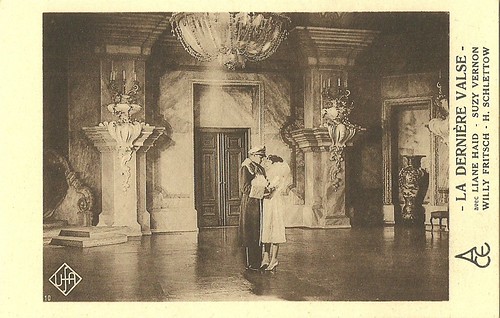
La dernière valse
French postcard by ACE, no. 10. Photo: Ufa. Publicity still of Suzy Vernon and Willy Fritsch in Der letzte Walzer (Arthur Robison, 1927).
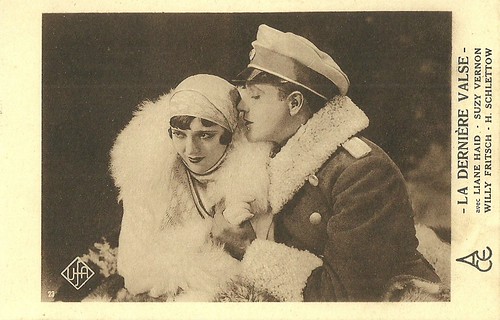
La dernière valse
French postcard by ACE, no. 23. Photo: Ufa. Publicity still of Suzy Vernon and Willy Fritsch in Der letzte Walzer (Arthur Robison, 1927).

A Viennese operetta in Berlin


Der letzte Walzer/The Last Waltz (Arthur Robison, 1927) was based on a Viennese operetta, composed by Oscar Straus and with a libretto by Julius Brammer and Alfred Grünwald.

The original operetta had opened at the Berliner Theater in Berlin on 12 February 1920 and starred Fritzi Massary. It was a huge success, and soon followed international adaptations.

In Vienna it was first presented at the Theater an der Wien on 5 October 1923, with Betty Fischer, Max Hansen, and Richard Tauber in the leading roles.

On 10 May 1921, an English adaptation for Broadway was prepared by Harold R. Atteridge and Edward Delaney, with additional music by Al Goodman. The Last Waltz, directed by J. C. Huffman, opened at the Century Theatre in New York and ran for 185 performances.

Another English adaptation was prepared for the West End by Robert Evett and Reginald Arkell. This version opened at the Gaiety Theatre in London on 7 December 1922 and starred Jose Collins. This adaptation ran for 240 performances.

The next logical step was a film version.
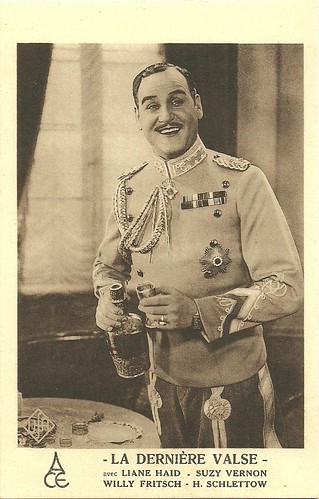
La dernière valse
French postcard by ACE, no. 25. Photo: Ufa. Publicity still of Hans Adalbert Schlettow in Der letzte Walzer (Arthur Robison, 1927).
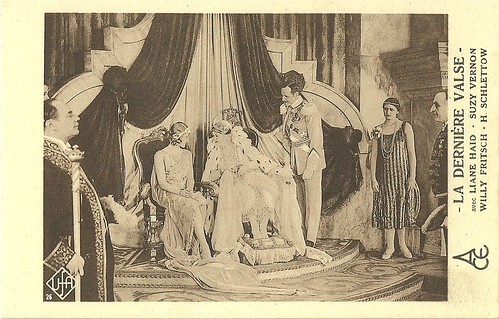
La dernière valse
French postcard by ACE, no. 26. Photo: Ufa. Publicity still of Liane Haid, Sophie Pagay, Hans Adalbert Schlettow and Ida Wüst in Der letzte Walzer (Arthur Robison, 1927).

Foolhardy Swains


In 1927, the Ufa studio produced the German silent film Der letzte Walzer, directed by Arthur Robison and starring Liane Haid, Willy Fritsch and Suzy Vernon.

At AllMovie, Hal Erickson summarizes the plot: "Hans von Schlettow plays the caddish Crown Prince of a mythical European country. Eve willing to sacrifice his honor in favor of a good wine or a pretty girl, the Prince is publicly chastised by his aide, the Count (Willy Fritsch). The two men prepare to fight a duel, whereupon their respective sweethearts, the Princess (Liane Haid) and the Countess (Suzy Vernon), conspire to knock some sense into their foolhardy swains."

The New York Times reviewed the film positively at its US-premiere in 1927: "there is some successful tilting at satire, fun, melodrama and the inevitable romance. This film has a certain charm because it never has to be taken seriously, not even for its type of story, a Teutonic Graustarkian sketch."

The anonymous reviewer adds: "The stage settings and the scenic effects are quite good, especially the sleigh episodes. The players acquit themselves with no little skill, notably Hans von Schlettow as the Crown Prince, Sophie Pepay (sic, Sophie Pagay) as the Queen, Willy Fritsch as Dimitri and Suzy Vernon as the Countess."

Der Letzte Walzer was filmed again as a sound film in 1934 by Georg Jacoby and starring Iván Petrovich, Camilla Horn and Adele Sandrock.

After the war followed two more German screen versions: Der letzte Walzer (Arthur Maria Rabenalt, 1953) with Eva Bartok, Curd Jürgens and O. E. Hasse, and the TV version Der letzte Walzer (?, 1973) starring Jürgen Feindt, Ivan Rebroff and Marika Rökk.

La dernière valse
French postcard by ACE, no. 31. Photo: Ufa. Publicity still of Hans Adalbert Schlettow, Suzy Vernon, Liane Haid, Willy Fritsch and Ida Wüst in Der letzte Walzer (Arthur Robison, 1927).
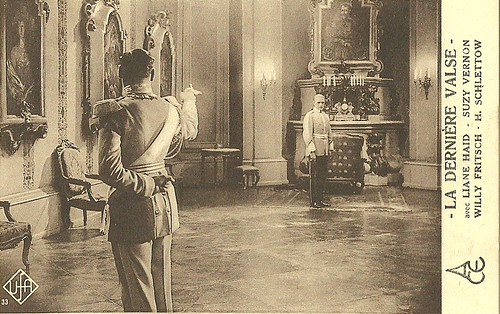
La dernière valse
French postcard by ACE, no. 33. Photo: Ufa. Publicity still of  Hans Adalbert Schlettow and Willy Fritsch in Der letzte Walzer (Arthur Robison, 1927).

Sources: Hal Erickson (AllMovie), The New York Times, The Guide to Musical Theatre, Wikipedia and IMDb.

27 December 2012

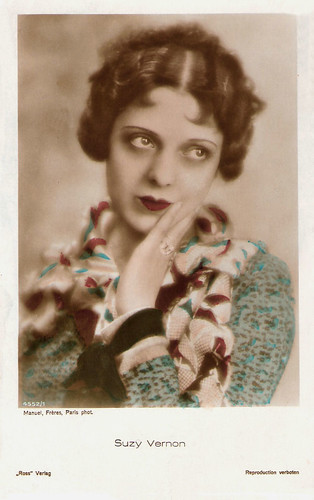
Suzy Vernon

Suzy Vernon (1901-1997) was a popular leading lady in French and German films of the 1920s and 1930s. The French film star worked with some of her era's best directors.

Suzy Vernon
German postcard by Ross Verlag, no. 4442/1, 1929-1930. Photo: Manuel Frères, Paris.

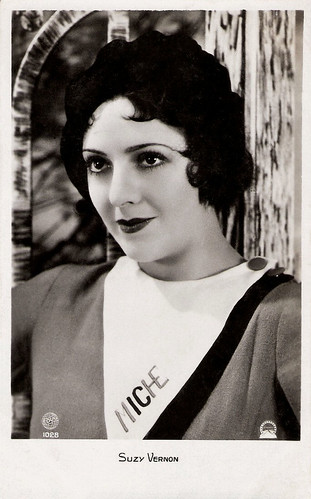
Suzy Vernon
French postcard by E.D.U.G., no. 1028. Photo: Paramount. Publicity still for Miche (1932).

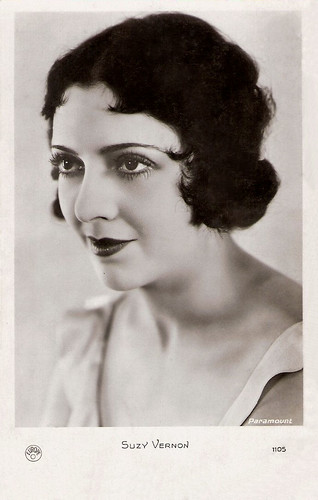
Suzy Vernon
French postcard by Europe, no. 1105. Photo: Paramount.

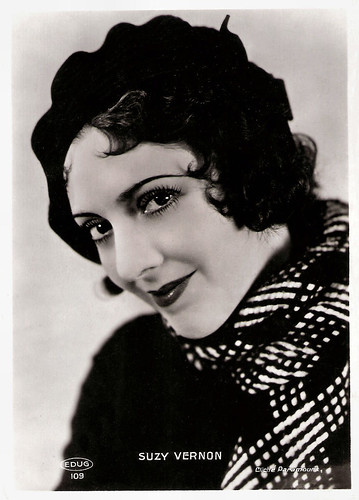
Suzy Vernon
French postcard by E.D.U.G., no. 109. Photo: Paramount.

Napoleon


Suzy Vernon was born as Appollinie Paris in Nice, France, in 1901. She made her film debut in La Conquête des Gaules/The Conquest of the Gauls (Marcel Jonnet, Jan B. Dyl, 1922) based on the book 'Commentaries on the Gallic War' by Gaius Julius Caesar.

Famous Belgian director Jacques Feyder gave her a part in his film Das Bildnis/L’image (Jacques Feyder, 1923). She also appeared as the mother of Jean Forest in Feyder’s realistic mountain drama Visages d'enfants/Children’s Faces (Jacques Feyder, 1925). In 1988, the Belgian Film Archive released a restored print of this classic film. Feyder had a considerable influence on European filmmaking. His films were noteworthy for their introduction of Poetic Realism, a style which eventually became a cinematic movement.

Suzy Vernon next appeared in Napoléon (Abel Gance, 1927), a silent, historical epic of 235 minutes. It was the chef d'oeuvre of legendary French filmmaker Abel Gance, who intended it as the first installment in a multipart film study of the French military hero. Napoléon was largely designed as a showcase for the revolutionary Polyvision process, which utilised multiple images for dramatic effect.

In Germany, Vernon appeared with Nils Asther in Gauner in Frack/Crooks in Tails (Manfred Noa, 1927) and next to Willy Fritsch in Der Letzte Walzer/The Last Waltz (Arthur Robison, 1927), based on the same-named operetta by Oscar Straus - minus the musical score. She costarred with celebrated Russian actor Ivan Mozzhukhin in the melodrama Der Präsident/The President (Gennaro Righelli, 1928), and she costarred with the Italian diva Francesca Bertini in Tu m'appartiens/You Belong to Me (Maurice Gleize, 1929).

Her last silent production was the German detective film Das grüne Monokel/The Green Monocle (Rudolf Meinert, 1929) with Ralph Cancy (sometimes written as Clancy) as detective Stuart Webbs.

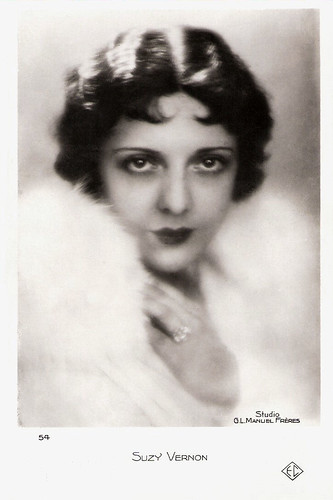
Suzy Vernon
French postcard by Editions Cinémagazine, no. 54. Photo: Studio G.L. Manuel Frères.

Suzy Vernon
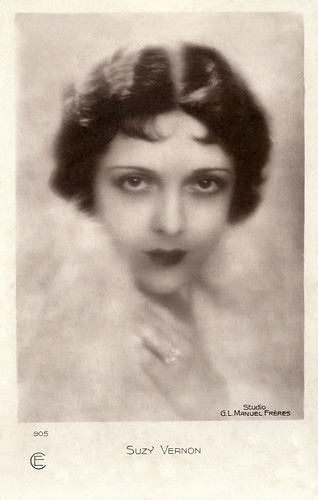
French postcard by Editions Cinémagazine, no. 905. Photo: Studio G.L. Manuel Frères.

Suzy Vernon
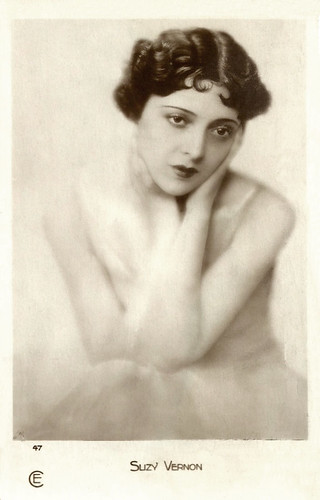
French postcard by Editions Cinémagazine, no. 47.

Alternative language versions in Hollywood


After the sound film arrived, Suzy Vernon went to the USA. There she appeared in some French language versions of Hollywood productions. For First National, she played in Le masque d'Hollywood/Woman Hunter (Clarence G. Badger, John (Jean) Daumery, 1930), an alternative language version of Show Girl in Hollywood (Clarence G. Badger,1930).

She also played the female lead opposite Daniel Mendaille in Contre-enquete/Cross Investigation (Jean (John) Daumery, 1930). This was one of three different versions of the George Kibbe Turner gangster novel 'Those Who Dance', each filmed in a different language. The English version starred Monte Blue and Lila Lee; and the German version, Der Tanz Geht Weiter top-billed Wilhelm (William) Dieterle and Lissi Arna.

Vernon also appeared in the English language white slavery melodrama Girls for Sale! (Bud Pollard, 1930) with Vivian Gibson.

Another early talkie was Le chanteur de Seville (Yvan Noé, Ramon Novarro, 1930), the French-language version of the Technicolor MGM musical drama Call of the Flesh. Silent Superstar Ramon Novarro repeated his role as Juan, a young aspiring singer who is advised that he will never achieve greatness until his heart is broken.

Though the original Call of the Flesh was directed by Charles J. Brabin, the French version was helmed by Novarro, who, according to Hal Erickson at AllMovie “did a commendable job”.

Suzy Vernon
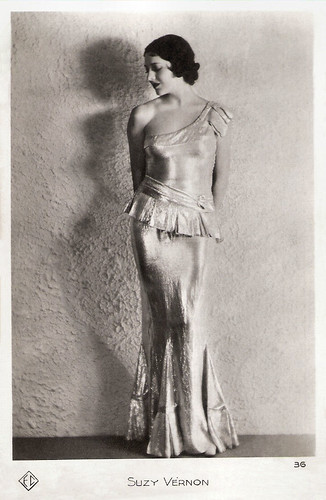
French postcard by Editions Chantal, Paris, no. 36.

Suzy Vernon
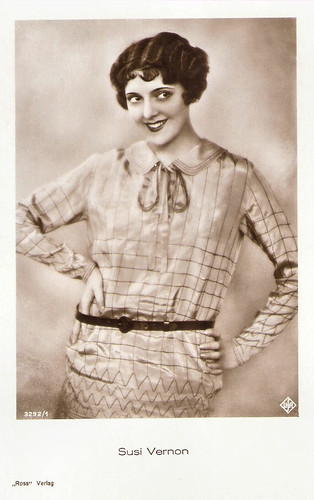
German postcard by Ross Verlag, no. 3291/1, 1928-1929. Photo: Ufa.

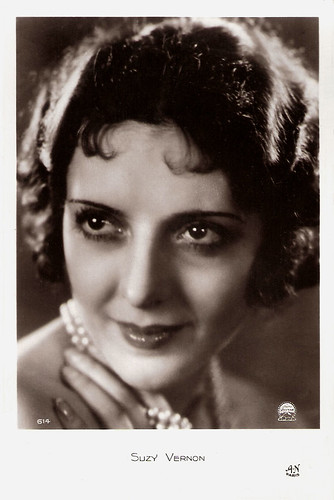
Suzy Vernon
French postcard by A.N., Paris, no. 614. Photo: Paramount.

International shooting locations


For her next films, Suzy Vernon traveled to other international locations. La Femme de Mes Reves/My Dream Woman (Jean Bertin, 1931) with Roland Toutain was filmed in Berlin. It was also simultaneously filmed in a German-language version, Eine Nacht im Grandhotel (Max Neufeld, 1931). Miraculously, both versions came in for a combined cost of only $100,000.

Filmed in North Africa was the Foreign Legion melodrama Le Sergent X (Vladimir Strizhevsky, 1932), in which she again costarred with Ivan Mozzhukhin.

The romantic comedy Miche (Jean de Marguenat, 1932) was purportedly set in Switzerland, but filmed at Paramount's French studios in Joinville.

She starred for director Jacques Tourneur in the romantic comedy Pour être aimé/For Being Loved (1933) with Pierre Richard-Willm. One of her last major films was the anecdotal seriocomedy Un homme en or/A Man and His Wife (Jean Dréville, 1934) with Harry Baur.

In 1940 after some incidental smaller roles in the late 1930s she retired from the film business. She was married to Ralph de Leon. After their divorce, she married a Lebanese doctor. In 1958 she followed her husband to Lebanon, and nobody, not even her family got any news from her. Suzy Vernon seemed to have disappeared, but it is known that she died in 1997 in Moulins, France.

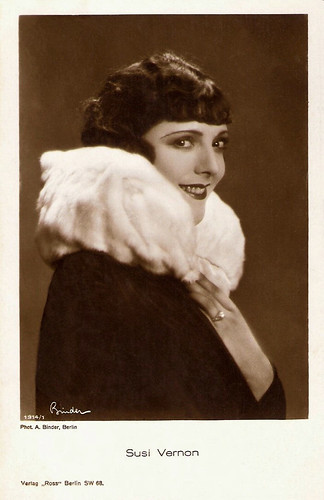
Suzy Vernon
German postcard by Ross Verlag, no. 1914/1, 1927-1928. Photo: Alex Binder, Berlin.

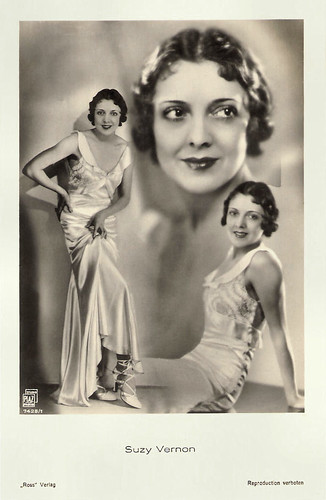
Suzy Vernon
German postcard by Ross Verlag, no. 7428/1, 1932-1933. Photo: Studio Piaz, Paris.

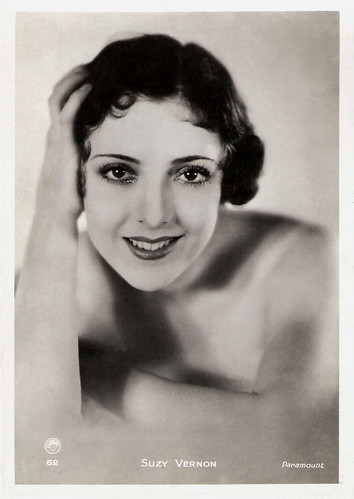
Suzy Vernon
French postcard by Europe, no. 62. Photo: Paramount.

La dernière valse
French postcard by ACE. Photo: Ufa. Suzy Vernon and Willy Fritsch in the German operetta film Der letzte Walzer/The Last Waltz (Arthur Robison, 1927).

Sources: Céline Colassin (CinéArtistes - French), Hal Erickson (AllMovie), Wikipedia, AllMovie and IMDb.

This post was last updated on 24 October 2023.