Theodore Roberts (1861–1928) was an American stage and screen actor who is known for his many roles in films by Cecil B. DeMille and his brother William C. deMille. He was often referred to as the 'Grand Duke of Hollywood'.
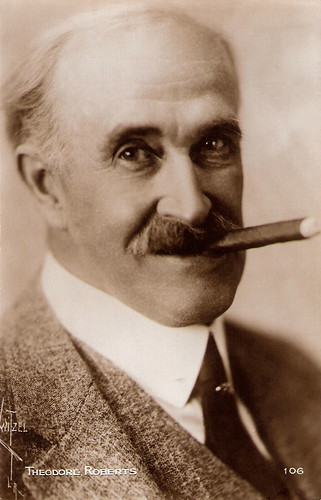
French postcard by Cinémagazine-Edition, no. 106. Photo: Albert Witzel, Los Angeles.

American postcard by M.B.S.C.Co. Photo: Thomas A. Ince Production / First National. Theodore Roberts and Lloyd Hughes in Hail the Woman (John Griffith Wray, 1921).

German postcard by Ross Verlag, no. 681/6. Photo: Paramount-Film / National-Verleih. Theodore Roberts as Moses (right on the rock) in The Ten Commandments (Cecil B. DeMille, 1923). Caption: The Children of Israel at the Red Sea.
Theodore Roberts was born in 1861 in San Francisco, California, USA, as the son of a sea captain, Martin Rickard Roberts, and Mary Elisabeth Nowlin. He was a cousin of the stage actress Florence Roberts. His choice of an acting career disappointed his mother, who wanted him to become a minister, and his father, who wanted him to learn a trade.
Roberts made his first appearance at the Baldwin Theatre in San Francisco in 1880. In the 1890s, he acted with Fanny Davenport in her play 'Gismonda' (1894) and later with Laurette Taylor in 'The Bird of Paradise' (1912).
In 1914 he made his film debut in the silent adventure-drama Call of the North (Oscar Apfel, Cecil B. DeMille, 1914). It was based on a novel, 'The Conjurer's House; a Romance of the Free Forest' by Stewart Edward White and its 1908 play adaptation 'The Call of the North' by George Broadhurst. Robert Edeson starred in the play and reprised his role in this film.
Roberts became a regular on the Cecil B. DeMille team and appeared in 23 of DeMille's films, such as Joan the Woman (1916) with Geraldine Farrar, The Squaw Man (1918) with Elliott Dexter, Don't Change Your Husband (1919) with Gloria Swanson and Dexter, Male and Female (1919) with Swanson and Thomas Meighan, and The Affairs of Anatol (1921) with Swanson and Wallace Reid.
Roberts also acted in films by William C. deMille, such as Miss Lulu Bett (1921) starring Lois Wilson, and Grumpy (1923), in which he played the title character.
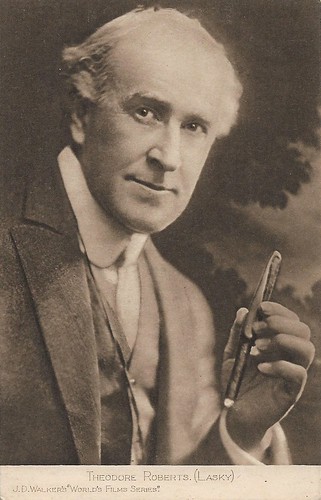
British postcard in J.D. Walker's "World's Film Series". Photo: Lasky.

American Arcade postcard. Photo: Witzel, L.A.
Theodore Roberts is best remembered for his role as Moses in Cecil B. DeMille's silent version of the epic The Ten Commandments (1923). The religious epic, written by Jeanie MacPherson, is divided into two parts: a prologue telling the biblical story of the Exodus and a modern story about two brothers and their respective views of the Ten Commandments.
Lauded for its "immense and stupendous" scenes, use of Technicolour process, and parting of the Red Sea sequence, the expensive film proved to be a box-office hit upon release. It is the first in DeMille's biblical trilogy, followed by The King of Kings (Cecil B. DeMille, 1927) and The Sign of the Cross (Cecil B. DeMille, 1932).
Despite the film's success, Roberts played in fewer films after 1923, until the end of the silent era. His final film was the silent romantic drama Locked Doors (William C. deMille, 1925) starring Betty Compson. The film is considered lost.
In 1928, Theodore Roberts died from uremic poisoning in Hollywood. He was 67. A well-known and well-loved actor, Roberts' funeral in Westlake Park was attended by nearly 2,000 people. However, Roberts felt so much bitterness towards his immediate relatives that he bequeathed his estate to a nephew, a commercial illustrator in New York. The estate was valued at nearly $20,000, including a yacht valued at $10,000.
Several of Roberts' personal items were left to his friends William C. de Mille and his brother Cecil. Roberts claimed that during the worst times of his life, no one in his family offered a word of sympathy or any help at all. His only request was that he be laid to rest next to his beloved wife, actress Florence Smythe, who had passed away in 1925. Roberts is buried in Hollywood Forever Cemetery.
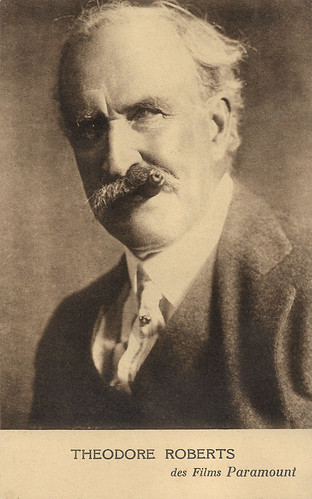
French postcard by Edition Paramount, Paris. Photo: Paramount.
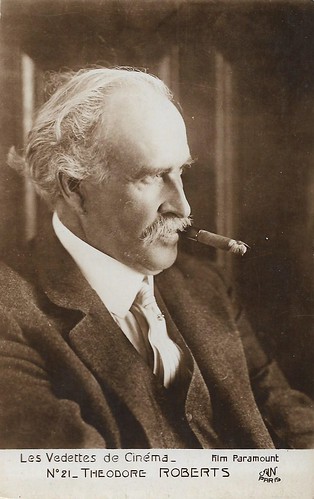
French postcard by A.N. Paris, in the Les Vedettes de Cinéma series, no. 21. Photo: Paramount.

British postcard in the Picturegoer Series, London, no. 123.
Source: Wikipedia and IMDb.
This post was last updated on 20 August 2026.
French postcard by Cinémagazine-Edition, no. 106. Photo: Albert Witzel, Los Angeles.
American postcard by M.B.S.C.Co. Photo: Thomas A. Ince Production / First National. Theodore Roberts and Lloyd Hughes in Hail the Woman (John Griffith Wray, 1921).
German postcard by Ross Verlag, no. 681/6. Photo: Paramount-Film / National-Verleih. Theodore Roberts as Moses (right on the rock) in The Ten Commandments (Cecil B. DeMille, 1923). Caption: The Children of Israel at the Red Sea.
Grumpy
Theodore Roberts was born in 1861 in San Francisco, California, USA, as the son of a sea captain, Martin Rickard Roberts, and Mary Elisabeth Nowlin. He was a cousin of the stage actress Florence Roberts. His choice of an acting career disappointed his mother, who wanted him to become a minister, and his father, who wanted him to learn a trade.
Roberts made his first appearance at the Baldwin Theatre in San Francisco in 1880. In the 1890s, he acted with Fanny Davenport in her play 'Gismonda' (1894) and later with Laurette Taylor in 'The Bird of Paradise' (1912).
In 1914 he made his film debut in the silent adventure-drama Call of the North (Oscar Apfel, Cecil B. DeMille, 1914). It was based on a novel, 'The Conjurer's House; a Romance of the Free Forest' by Stewart Edward White and its 1908 play adaptation 'The Call of the North' by George Broadhurst. Robert Edeson starred in the play and reprised his role in this film.
Roberts became a regular on the Cecil B. DeMille team and appeared in 23 of DeMille's films, such as Joan the Woman (1916) with Geraldine Farrar, The Squaw Man (1918) with Elliott Dexter, Don't Change Your Husband (1919) with Gloria Swanson and Dexter, Male and Female (1919) with Swanson and Thomas Meighan, and The Affairs of Anatol (1921) with Swanson and Wallace Reid.
Roberts also acted in films by William C. deMille, such as Miss Lulu Bett (1921) starring Lois Wilson, and Grumpy (1923), in which he played the title character.
British postcard in J.D. Walker's "World's Film Series". Photo: Lasky.
American Arcade postcard. Photo: Witzel, L.A.
Bitterness in his heart
Theodore Roberts is best remembered for his role as Moses in Cecil B. DeMille's silent version of the epic The Ten Commandments (1923). The religious epic, written by Jeanie MacPherson, is divided into two parts: a prologue telling the biblical story of the Exodus and a modern story about two brothers and their respective views of the Ten Commandments.
Lauded for its "immense and stupendous" scenes, use of Technicolour process, and parting of the Red Sea sequence, the expensive film proved to be a box-office hit upon release. It is the first in DeMille's biblical trilogy, followed by The King of Kings (Cecil B. DeMille, 1927) and The Sign of the Cross (Cecil B. DeMille, 1932).
Despite the film's success, Roberts played in fewer films after 1923, until the end of the silent era. His final film was the silent romantic drama Locked Doors (William C. deMille, 1925) starring Betty Compson. The film is considered lost.
In 1928, Theodore Roberts died from uremic poisoning in Hollywood. He was 67. A well-known and well-loved actor, Roberts' funeral in Westlake Park was attended by nearly 2,000 people. However, Roberts felt so much bitterness towards his immediate relatives that he bequeathed his estate to a nephew, a commercial illustrator in New York. The estate was valued at nearly $20,000, including a yacht valued at $10,000.
Several of Roberts' personal items were left to his friends William C. de Mille and his brother Cecil. Roberts claimed that during the worst times of his life, no one in his family offered a word of sympathy or any help at all. His only request was that he be laid to rest next to his beloved wife, actress Florence Smythe, who had passed away in 1925. Roberts is buried in Hollywood Forever Cemetery.
French postcard by Edition Paramount, Paris. Photo: Paramount.
French postcard by A.N. Paris, in the Les Vedettes de Cinéma series, no. 21. Photo: Paramount.
British postcard in the Picturegoer Series, London, no. 123.
Source: Wikipedia and IMDb.
This post was last updated on 20 August 2026.
