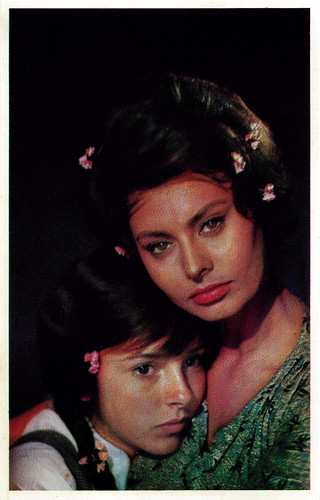
Sophia Loren (1934) rose to fame in post-war Italy as a voluptuous sex goddess, but proved to be an excellent, Oscar winning actress. She became one of the most successful international stars of the 20th Century with such unforgettable films as La Ciociara/Two Women (1960) and Una giornata particolare/A Special Day (1977). Loren made over 100 films in her 60-year career and her pictures in the 2007 Pirelli calendar proved that she is still a major sex symbol.
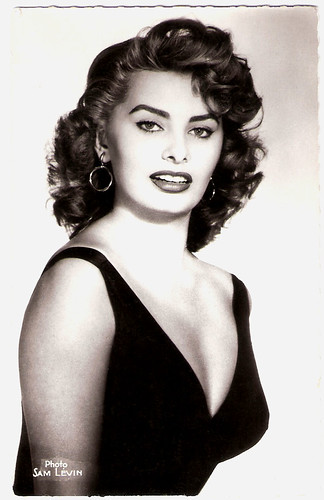
French postcard by Editions du Globe (EDUG), Paris, no. 373. Photo: Sam Lévin.
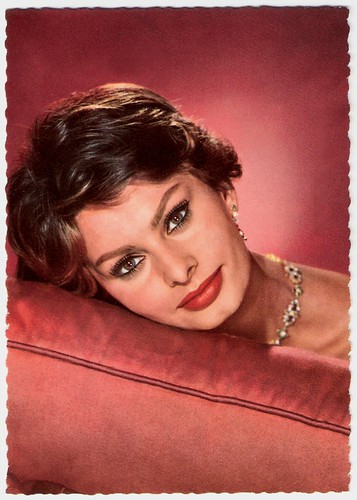
German postcard by Universum-Film Aktiengesellschaft, Berlin-Tempelhof (UFA), no. CK-221. Retail price: 30 Pfg. Photo: Sam Lévin/Ufa.
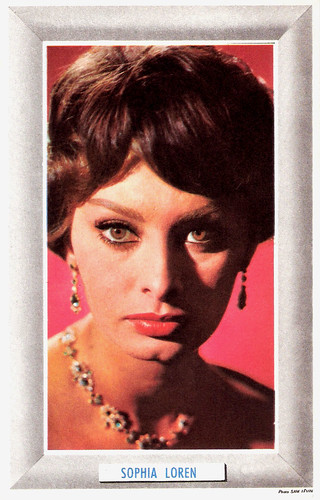
French postcard. Photo: Sam Lévin.
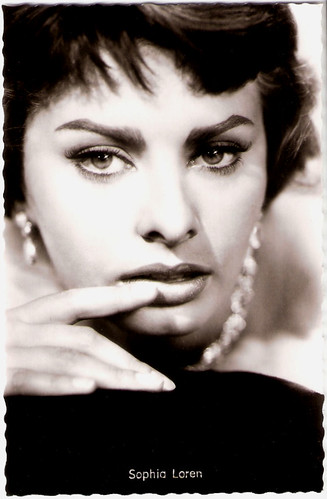
German postcard by Kolibri-Verlag, Minden/Westf., no. 2993.
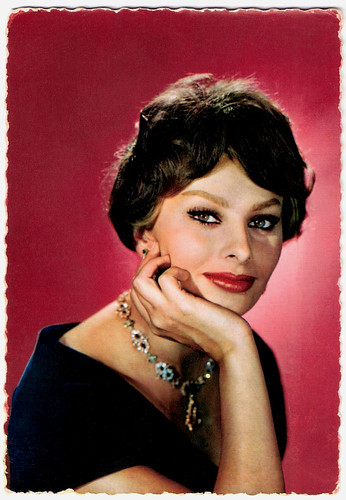
French postcard by Mexichrome, no. 16. Photo: Sam Lévin.
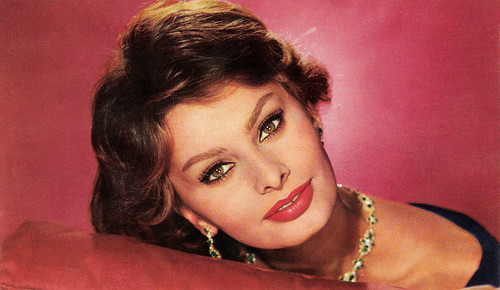
French postcard by E.D.U.G. (Editions du Globe), Paris, no. 39. Offered by Corvisart, Epinal. Photo: Sam Lévin.
Miss Eleganza
Sophia Loren was born
Sofia Villani Scicolone in the charity ward of a Roman hospital in 1934. She was the illegitimate daughter of construction engineer
Riccardo Scicolone and piano teacher and aspiring actress
Romilda Villani. Riccardo was married to another woman and refused to marry Romilda, leaving her without support.
Romilda, Sofia and sister Maria returned to Pozzuoli to live with Sofia's grandmother. Pozzuoli was a small town outside Naples and one of the hardest hit during World War II. The family shared a two-room apartment with the grandmother and several aunts and uncles. The shy, stick thin girl regularly went hungry and had to flee from bombings.
At 14, Sofia had a voluptuous figure and entered a beauty contest. She was selected as one of the finalists, but did not win. In 1950, she was one of the contestants at the Miss Italia competition. She earned the 2nd place and was awarded ‘Miss Eleganza’.
While attending the Miss Rome beauty contest, earlier in 1950, she had met judge
Carlo Ponti, an up-and-coming film producer, 22 years her senior. Ponti had helped launch
Gina Lollobrigida's career, and now began grooming Sofia for stardom. He hired an acting coach to tutor her.
At 16 she was in her first film, the
Totó comedy
Le Sei Mogli di Barbablù/Bluebeard’s Six Wives (Carlo Ludovico Bragaglia, 1950) under the name
Sofia Lazzaro. She also appeared as an extra in
Luci del varietà/Lights of the Variety (Federico Fellini, 1950), the smash hit
Anna (Alberto Lattuada, 1951) and
Quo Vadis (Mervyn Leroy, 1951).
During the early 1950s, she secured work modelling for fumetti magazines. These comic-like magazines used actual photographs. The dialogue bubbles were called 'fumetti' - hence the popular name.
At 17, she was cast by Ponti in her first larger role as the commoner who caught the prince's eye in the filmed opera
La Favorita/The Favorite (Cesare Barlacchi, 1952). The next year she earned third billing after
Silvana Pampanini and
Eleanora Rossi-Drago in
La Tratta Delle Bianche/The White Slave Trade (Luigi Comencini, 1953) and she played, complete with blackface and an Afro, the lead in another filmed opera,
Aida (Clemente Fracassi, 1953) by
Giuseppe Verdi. Her singing was dubbed by
Renata Tebaldi. Ponti eventually changed her name to
Sophia Loren.
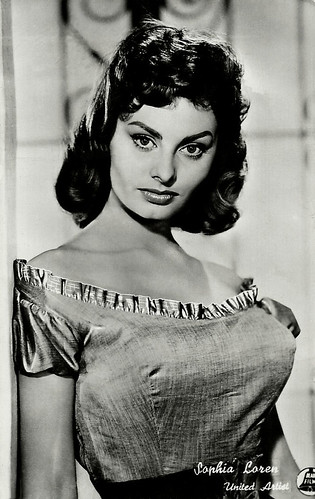
Belgian postcard by Bromophoto, Brussels.
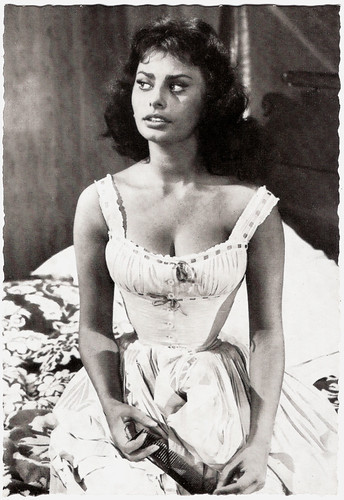
German postcard by WS-Druck, Wanne-Eickel, no. 283. Photo: U.P.
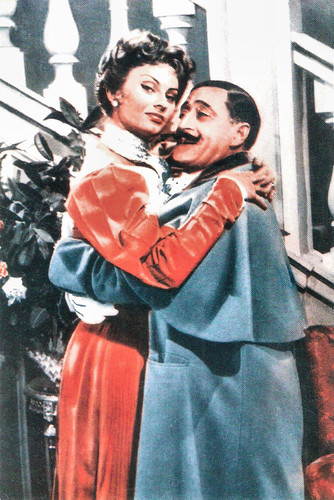
Italian postcard in the series
Gli Artisti di Napoli. Photo: publicity still for
Miseria e nobiltà/Misery and Nobility (Mario Mattoli, 1954) with
Totò.
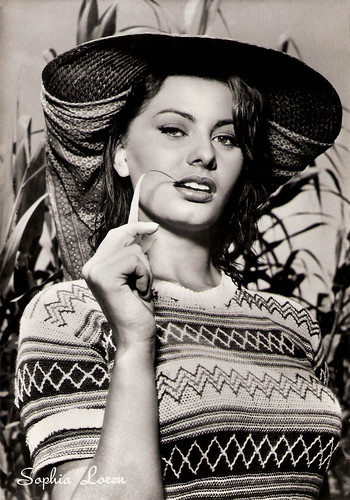
Italian postcard by Rotalfoto, Milano, no. 328. Photo: Ponti-De Laurentiis. Publicity still for
La donna del fiume/Woman of the River (Mario Soldati, 1955).
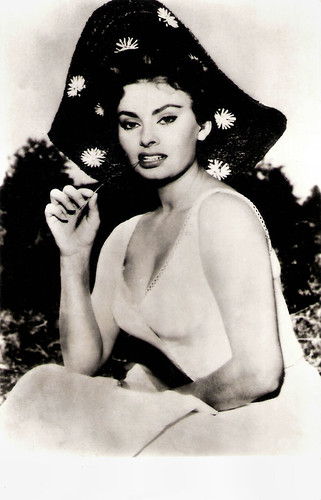
Yugoslavian postcard by Naz Glas, Smederevo, no. 113.
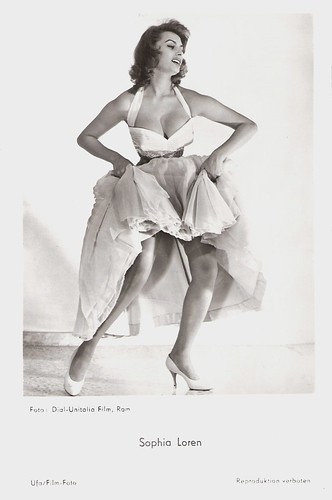
German postcard by Universum-Film Aktiengesellschaft, Berlin-Tempelhof, no. 1631. Photo: Dial / Unitalia Film, Rome.
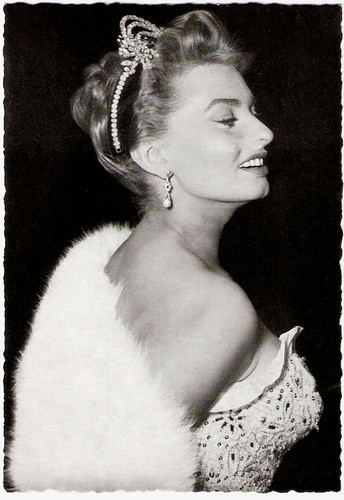
German postcard by WS-Druck, Wanne-Eickel, no. 185. Photo: dpa.
Va-va-va-voom Image
Sophia Loren appeared for the first time with
Marcello Mastroianni in the romantic comedy
Peccato che sia una canaglia/Too Bad She's Bad (Alessandro Blasetti, 1954). They would make 13 films together, including
Tempi nostri/A Slice of Life (Alessandro Blasetti, Paul Paviot, 1954),
La bella mugnaia/The Miller's Wife (Mario Camerini, 1955), and
La fortuna di essere donna/What A Woman (Alessandro Blasetti, 1956).
L'Oro di Napoli/Gold of Naples (Vittorio de Sica, 1954), an anthology of tales depicting various aspects of Neapolitan life, was distributed internationally. At
AllMovie,
Jason Ankeny writes that in reviews "Loren was singled out for the strength of her performance as a Neapolitan shopkeeper, surprising many critics who had dismissed her as merely another bombshell".
The film established her persona as a sensuous working class earth mother. It also began a fruitful, career-long collaboration with De Sica.
Sophia’s first film to find international success was
La Donna del Fiume/The River Girl (Mario Soldati, 1955), in which she danced sensually the Mambo Bacan.
Hal Erickson at
AllMovie: "Through it all, Sophia Loren looks like a million lire - and she even gets to sing and dance!".
She came to the attention of
Stanley Kramer who offered her the female lead in
The Pride And The Passion (Stanley Kramer, 1957) opposite
Cary Grant and
Frank Sinatra. Sophia played a Spanish peasant girl involved in an uprising against the French. This was the turning point in her career, and the film proved to be one of the top US box office successes of the year.
Her next English-language film was
Boy on a Dolphin (Jean Negulesco, 1957) with
Alan Ladd, where she was memorable mostly for emerging from the water in a wet, skin-tight, transparent dress. With her va-va-va-voom image she became an international film star and got a five-picture contract with Paramount Pictures.
Among her Paramount films were
Desire Under the Elms (Delbert Mann, 1958) with
Anthony Perkins and based upon the
Eugene O'Neill play,
Houseboat (Melville Shavelson, 1958), a romantic comedy co-starring
Cary Grant, and the Western
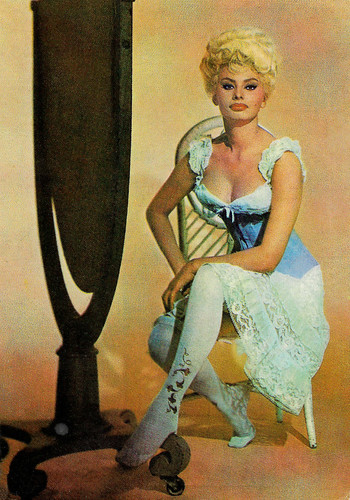
Heller in Pink Tights (George Cukor, 1960) in which she appeared for the first time with blonde hair (a wig). Most of these films were received lukewarmly at best.
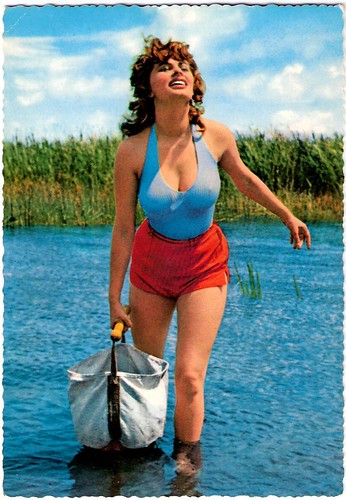
German postcard printed by Krüger, nr. 902/304. Photo: Georg Michalke. Publicity still for
La donna del fiume/The River Girl (Mario Soldati, 1955).
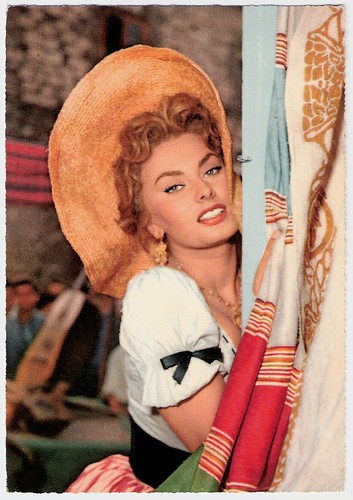
German postcard by Krüger, no. 902/446. Photo: UFA. Publicity still for
La Bella Mugnaia/The Miller's Wife (Mario Camerini, 1955).
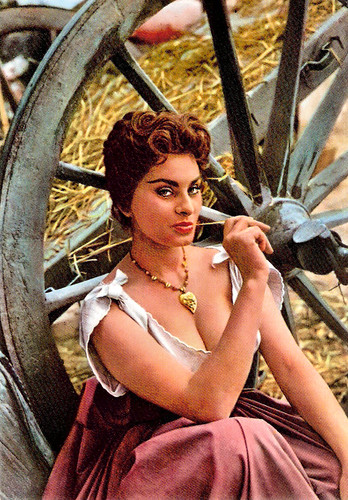
French postcard by P.I. / Korès, no. 38. Photo: Constantin Film. Publicity still for
La bella mugnaia/The Miller's Wife (Mario Camerini, 1955).
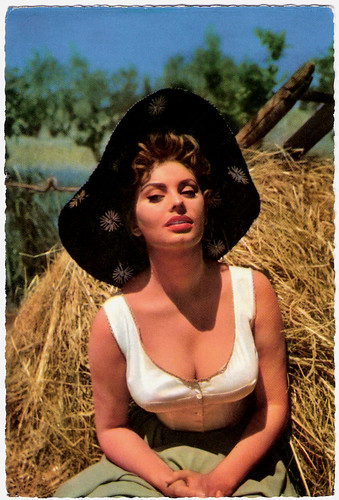
German postcard by UFA, no. 1007. Photo: UFA. Publicity still for
La Bella Mugnaia/The Miller's Wife (Mario Camerini, 1955).
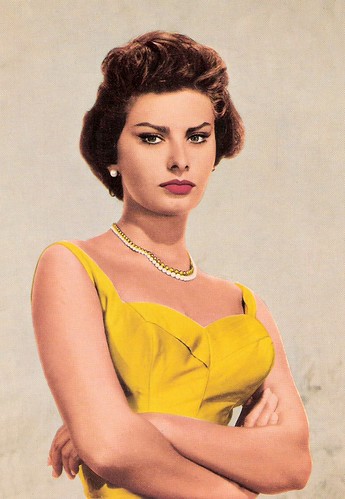
German postcard by Terra-Color, no. F 190. Sent by mail in 1962.
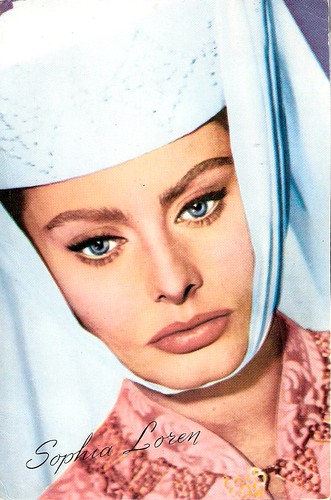
Dutch postcard.
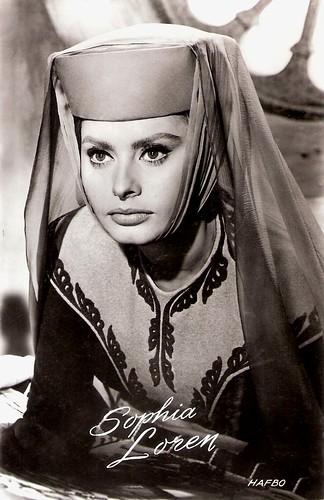
Dutch postcard by Uitg. Takken, Utrecht, no. 4894. Photo: Hafbo. Still from
El Cid (Anthony Mann, 1961).
The most lavish costumes ever created for the cinema
In 1960 Sophia Loren returned to Italy to star in the biggest success of her career,
La Ciociara/Two Women (Vittorio De Sica, 1960). She played a widow desperately trying to protect her daughter from danger during WW II, only to end up in a destructive love triangle with a young radical (
Jean Paul Belmondo).
Hal Erickson at
AllMovie: "A last-minute replacement for
Anna Magnani, Sophia Loren brought hitherto untapped depths of emotion to her performance in
Two Women; she later stated that she was utilizing 'sensory recall,' dredging up memories of her own wartime experiences." Loren won the Best Actress Oscar
for her performance, and also the Cannes, Venice ánd Berlin Film Festivals' best performance prizes.
Next she played in Spain
Samuel Bronston's
epic production of
El Cid (Anthony Mann, 1961) with
Charlton Heston, followed by the De Sica episode of the anthology
Boccaccio '70 (Vittorio De Sica, Federico Fellini, Luchino Visconti, 1962).
On the strength of her Oscar win, she also returned to English-language fare with
Five Miles to Midnight (Anatole Litvak, 1963), followed a year later by
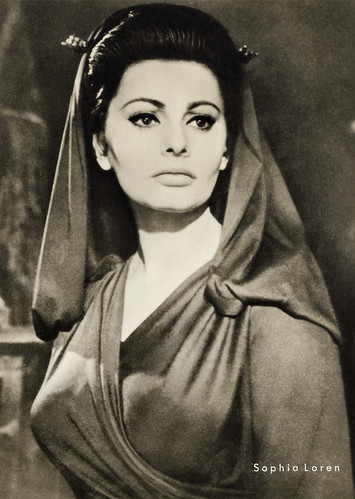
The Fall of the Roman Empire (Anthony Mann, 1964), for which she received $1 million.
Among Loren's other films of this period are
The Millionairess (Anthony Asquith, 1960) with
Peter Sellers,
It Started in Naples (Melville Shavelson, 1960) with
Clark Gable,
Lady L (Peter Ustinov, 1965) with
Paul Newman,
Arabesque (Stanley Donen, 1966) with
Gregory Peck, and
Charlie Chaplin's final film,
A Countess from Hong Kong (1967) with
Marlon Brando.
Despite the failure of many of her films to generate sales at the box office, she invariably turned in a charming performance and she wore some of the most lavish costumes ever created for the cinema.
Her best Italian films include the triptych
Ieri, oggi, domani/Yesterday, Today And Tomorrow (Vittorio De Sica, 1963), a comedy that poked fun at a Catholic priest and gently mocked the Italian law on birth control, and
Matrimonio all'Italiana/Marriage Italian Style (Vittorio De Sica, 1964) with Loren as the hooker who lures Mastroianni into marriage.
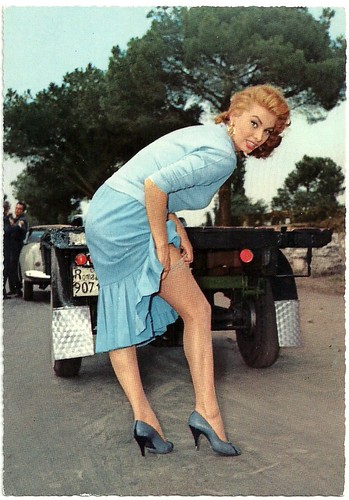
German postcard. Photo: UFA. Taken in Rome, Italy.
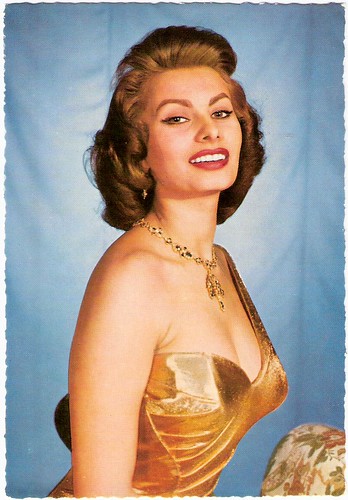
German Postcard by WS-Druck, Wanne-Eickel, no. F 13. Photo: Klaus Collignon.
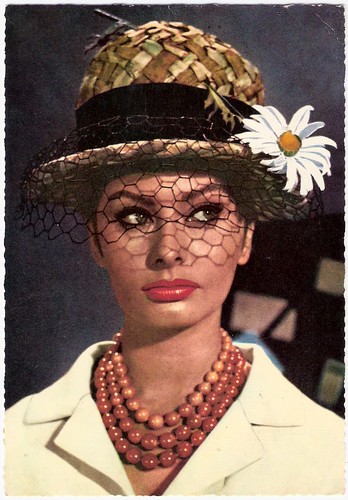
German postcard by ISV, no. A 93. Photo: 20th Century Fox. Publicity still for the British film
The Millionairess (Anthony Asquith, 1960).
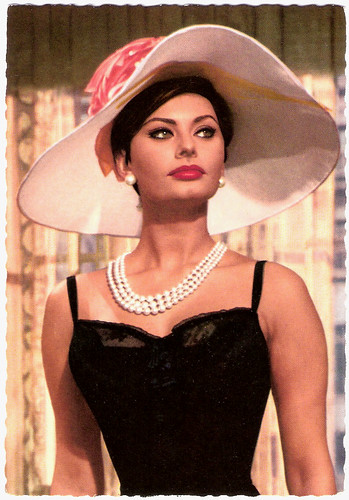
German postcard by Filmbilder-Vertrieb Ernst Freihoff, Essen, no. A 102. Photo: 20th Century Fox. Publicity still for
The Millionairess (Anthony Asquith, 1960).
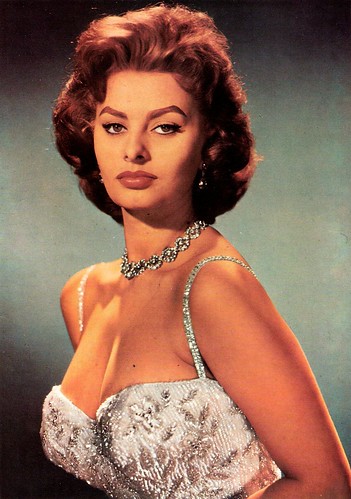
Photo.

German postcard by UFA, no. CK224. Photo: Fried Agency.
A Special Day
After several miscarriages and a highly-publicized struggle to become pregnant, Sophia Loren gave birth to son
Hubert Leoni Carlo Ponti in 1968. She started to work less, and moved into her 40s and 50s with roles in films like De Sica's war drama
I Girasoli/The Sunflowers (Vittorio De Sica, 1972),
Il Viaggio/The Voyage (Vittorio De Sica, 1974) opposite
Richard Burton, and reuniting with Marcello Mastroianni in the mob comedy
La Pupa del Gangster/Get Rita (Giorgio Capitani, 1975).
An artistic highlight was
Una giornata particolare/A Special Day (Ettore Scola, 1977) which earned a Golden Globe for Best Foreign Film. Loren played a bored housewife at the day of the first meeting between Mussolini and Hitler. Left alone in her tenement home when her fascist husband runs off to attend the historic event, Loren strikes up a friendship with her homosexual neighbour (
Marcello Mastroianni). As the day segues into night, Loren and Mastroianni develop a very special relationship that will radically alter both of their outlooks on life.
When a dubbed version of
Una giornata particolare/A Special Day found favour with American audiences, Hollywood again came calling, resulting in a pair of thrillers,
The Brass Target (John Hough, 1978) and
Firepower (Michael Winner, 1979) which offered her a central role as a widow seeking answers in the murder of her chemist husband.
In 1980, Loren portrayed herself, as well as her mother, in
Sophia Loren: Her Own Story (Mel Stuart, 1980), a made-for-television biopic adaptation of her autobiography. Actresses
Ritza Brown and
Chiara Ferrari played Loren at younger ages. She made headlines in 1982 when she served an 18-day prison sentence in Italy on tax evasion charges, a fact that didn't damage her career or popularity.
In her 60s, Loren ventured into various areas of business, including cook books, eyewear, jewellery and perfume. In honour of her lengthy career, Loren was the recipient of a special Oscar in 1991. She also made well-received appearances in her final film with Mastroianni,
Prêt-à-Porter/Ready to Wear (1994),
Robert Altman's take on the French fashion scene, and in the comedy hit
Grumpier Old Men (Howard Deutch, 1995) playing a femme fatale opposite
Walter Matthau and
Jack Lemmon. In 1995 she received the Golden Globe Cecil B. DeMille Award.
At the age of 72, she appeared scantily-clad in the 2007 edition of the famous calendar of Italian racing tire giant Pirelli. It made her the oldest model in the calendar's history. The photos by Dutch photographers
Inez van Lamsweerde and
Vinoodh Matadin proved that she was still a major international sex symbol.
In 2007
Carlo Ponti died. It had been controversial in her native Italy when Sophia Loren had married her mentor Ponti in 1957. Not only was he 45 to her 23, but he had been married previously, and neither the Catholic Church nor Italian government recognized his Mexican divorce. Ponti was charged with bigamy, but the charges were dropped when they had their marriage annulled. They continued living together - scandalous at the time - and remarried after his legal problems had been cleared.
Ponti and Loren made three dozen films together. They had two children, symphony conductor
Carlo Ponti Jr. and film director
Edoardo Ponti.
After four years off the big screen, Sophia Loren co-starred in a film version of the Broadway musical
Nine (Rob Marshall, 2009). She played the mother of famous film director Guido Contini, portrayed by
Daniel Day-Lewis. According to
Jason Ankeny at
AllMovie, "Loren proved she still had movie star charisma with a role in
Chicago director Rob Marshall's
Nine - a lavish tribute to all things Italian."
Loren made a two-part television biopic of her early life titled
La Mia Casa È Piena di Specchi/My House Is Full of Mirrors (Vittorio Sindoni, 2010), based on of the memoir written by her sister
Maria Scicolone.
At 80, Sophia Loren returned to the screen in
Human Voice (2014) directed by her son Edoardo Ponti. At the presentation Tribeca Film Festival in New York, 'the timeless beauty' stunned the press once again when she walked on the red carpet in a chic red pantsuit hand-in-hand with her 41-year-old son to promote the short film.
Human Voice is based on the play by iconic French playwright Jean Cocteau and sees La Loren play a woman in her twilight years facing revelations from her past.
In late 2014, she also presented her first memoir,
Ieri, oggi, domani. La mia vita/Today and Tomorrow: My Life as a Fairy Tale. It includes old pictures, letters and notes detailing encounters with
Cary Grant and other film partners.
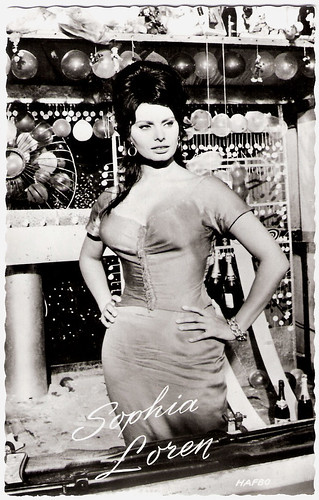
German postcard by Filmbilder-Vertrieb Ernst Freihoff, Essen, no. 5096. Photo: publicity still for
Boccaccio '70 (Vittorio De Sica, 1962).
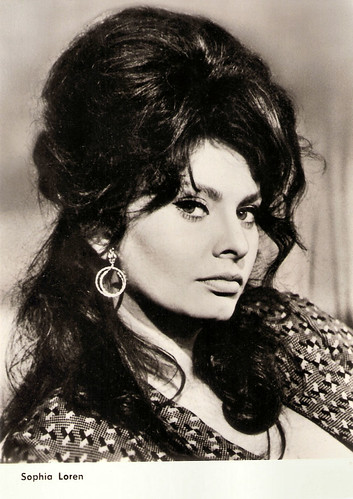
East-German card by VEB Progress Film-Vertrieb, Berlin, no. 2372, 1965. Photo: publicity still for
Boccaccio '70 (Vittorio De Sica a.o., 1962).
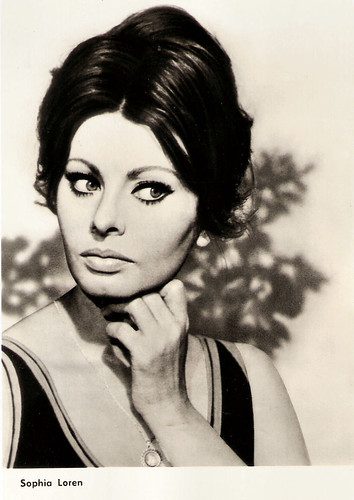
East-German postcard by VEB Progress Filmvertrieb, Berlin, no. 2676, 1966.
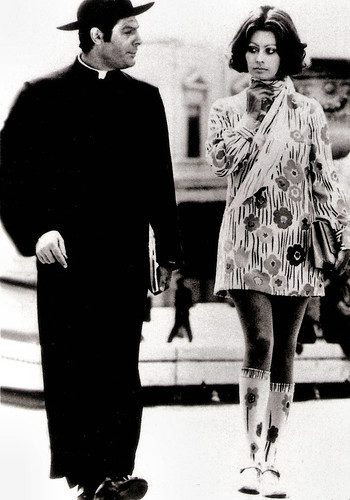
German postcard by pwe Verlag, München (Munich). Photo: publicity still for
La moglie del prete/The Priest's Wife (Dino Risi, 1970) with
Marcello Mastroianni.
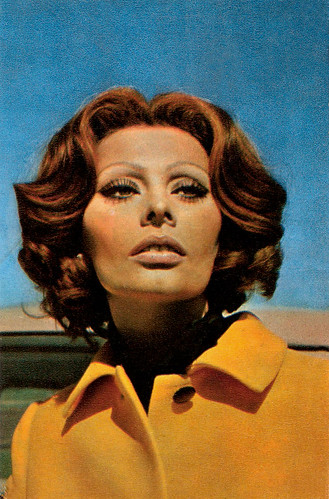
Russian postcard by Izdanije Byuro Propogandy Sovietskogo Kinoiskusstva, no. 4212, 1975. This postcard was printed in an edition of 300.000 cards. The price was 5 kop.
Sophia Loren dances the Mambo Bacan in
La donna del fiume (1955). Source: primocarnero07 (YouTube).
Trailer for
Nine (2009). Source: HQTrailers1 (YouTube).
Sources:
Jason Ankeny (AllMovie),
Hal Erickson (AllMovie),
Shyam Dodge (Daily Mail),
Jenny (IMDb),
Wikipedia,
NNDB,
TCM and
IMDb.
 /
/