Ruggero Ruggeri (1871-1953) was one of the most important Italian stage actors of the first half of the twentieth century. He began his stage career in 1909, performing alongside Lyda Borelli, and often performed in Pirandello's plays. He made his film debut in 1914 in Enrico Guazzoni's L'istruttoria. Nowadays, he is best remembered as the voice of Jesus in the Don Camillo films.

Italian postcard, no. 8067. Photo: Ruggero Ruggeri as Hamlet, either on stage or in the film Amleto (Eleuterio Rodolfi, 1917).
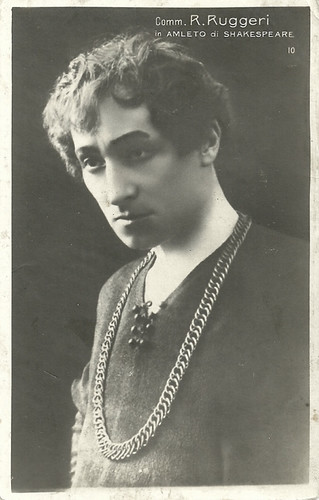
Italian postcard, no. 10. Editor unknown. Ruggero Ruggeri as Hamlet.

Italian postcard by Ed. Vettori, Bologna, no. 245.

Italian postcard by Ed. A. Traldi, Milano. Photo: S.A.I.C. Ruggero Ruggeri in L'uomo più allegro di Vienna / The Most Cheerful Man in Vienna (Amleto Palermi, 1925).

Italian postcard by S.A. Grafitalia, Milano (Milan), no. 10. Photo: Film Lux. Ruggero Ruggeri as Cardinal Federigo Borromeo in I Promessi Sposi / The Spirit and the Flesh (Mario Camerini, 1941).
Multi coloured voice
Ruggero Ruggeri was born in Fano, in the Italian region of Marche, in 1871. He was the son of the lawyer Augusto Ruggeri, who at the time was a philosophy teacher and the headmaster of the local 'Nolfi' high school, and his wife Corina Casazza. The family left the town in 1872 after the father had been publicly attacked by some of his students' parents.
After stints in various cities across central and northern Italy—where the head of the family was transferred by the Ministry of Education to serve as a teacher or school principal—the family settled for several years in Florence, where Ruggero attended primary school. He later attended high school in Bologna, Lodi, and Parma. When Ruggeri's father died in 1886 at the age of only 48, Ruggeri and his mother moved to Guastalla to stay with relatives. Ruggeri interrupted his studies and moved to Bologna to dedicate himself to the theatre.
He was trained as an actor by Ermete Novelli and Claudio Leigheb. Ruggeri broke with the histrionic acting style, so typical of 19th-century theatre. Instead, he opted for a more restrained, sober style, with only some stylisation of his gestures.
His multi-coloured voice was very popular. He was famous for his role as Aligi in 'La figlia di Jorio' (The Daughter of Jorio) by Gabriele D'Annunzio. Ruggeri was the role's original interpreter. He reprised it thirty years later at Rome's Teatro Argentina. The 1934 version was directed by Luigi Pirandello, who was assisted by Guido Salvini. Marta Abba played the title role and the famous painter Giorgio de Chirico designed the sets and costumes.
Ruggero Ruggeri was also the most important performer of Luigi Pirandello's stage plays, such as 'Enrico IV' (Henry IV), which was purposely written for Ruggeri. Pirandello had conceived the role of the Father in 'Six Characters in Search of an Author' (1921) with Ruggeri in mind. However, due to the actor's prior commitments, the role went to Niccodemi's company, featuring Vera Vergani and Luigi Almirante. Nevertheless, in 1936, Ruggeri staged the play at the Teatro Argentina in Rome, performing it for seven nights to tremendous success.
Ruggeri was the leader of various theatre companies, with actresses such as Emma Grammatica, Lyda Borelli, and Wanda Capodaglio, with whom he was also glorified abroad because of their frequent tours.

French postcard. Photo: Nunes-Vais.
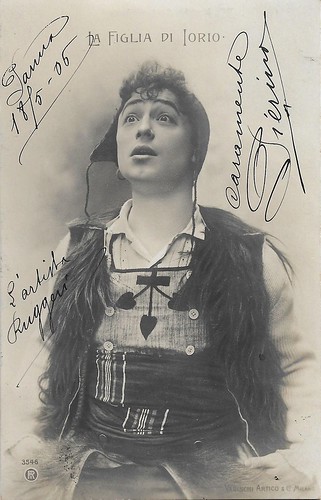
Italian postcard by RPH, no. 3546. Photo: Varischi Artico.& Co., Milano. Mailed 18 May 1906. Ruggero Ruggeri in the stage play 'La figlia di Jorio' (1904).

Italian postcard by Alterocca, Terni, no. 4570. Photo: Comerio, Milano. Card for 'La figlia di Jorio' (The Daughter of Iorio, 1904) written by Gabriele D'Annunzio. Act II, Scene VIII. Caption: Ornella recognises her father. Left: Oreste Calabresi as the dead Lazaro. Right: Ruggero Ruggeri as the culprit, his son Aligi. Ornella, Aligi's sister, was played by Giannina Chiantoni.

Italian postcard by R. Rota Ed., Milano. Photo: cav. G. Artico, Milano.

Italian postcard by Soc. An. Ed. Bettini, Roma, no. 154. Photo: Riccardo Bettini, 1916.
Silent era
From 1914 on, Ruggero Ruggeri played in eleven silent films. He made his film debut in the short silent film L'Instruttoria / The Judge of Instruction (Enrico Guazzoni, 1914), with Mario Almirante.
First, he was seen in a series of dramas and comedies for the Cines company, like Veli di giovinezza / Veils of Youth (Nino Oxilia, 1914) and Papa (Nino Oxilia, 1915).
At Cines, Ruggeri was often paired with diva Pina Menichelli. Their director Nino Oxilia was killed in service during the First World War, shortly after Italy joined the Allied forces.
In 1917, Ruggeri followed this with a memorable film adaptation of William Shakespeare's Hamlet: Amleto (Eleuterio Rodolfi, 1917), with Helena Makowska as Ophelia and Mercedes Brignone as Gertrude. Outside of Italy, the film was released only after the war.
In the mid-1920s, Ruggeri acted in films by Amleto Palermi and Augusto Genina, and in 1930 he appeared opposite Francesca Bertini in La donna di una notte / The Woman of A Night. It was the Italian version of Königin der Nacht, directed by Marcel L'Herbier, who demanded that his name be removed, because the film was edited without his consent.

Italian postcard for the film Amleto (Eleuterio Rodolfi, 1917), adapted from Shakespeare's play 'Hamlet', and starring Ruggero Ruggeri in the title role, here also with Helena Makowska as Ophelia. Caption: Hamlet: 'Oh, I am your jester. What else can one ever do down here that is joyous?'

Italian postcard. Ruggero Ruggeri as Hamlet in Amleto (Eleuterio Rodolfi, 1917). Caption: Horatio and Marcellus tell Hamlet of their vision of the ghost. Hamlet responds (Shakespeare's words): 'Upon the platform, 'twixt eleven and twelve, I'll visit you.'
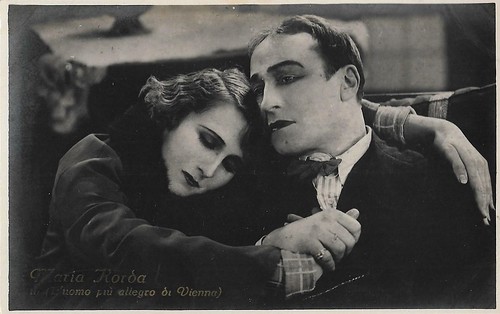
Italian postcard. Photo: Palermi Films. Maria Corda and Ruggero Ruggeri in L'uomo più allegro di Vienna / The Most Cheerful Man in Vienna (Amleto Palermi, 1925).

Italian postcard, no. 624. Photo: Sciutto.
The voice of Jesus
Following his mother's death in 1923, Ruggero Ruggeri embarked on an extensive tour of Europe and North America, during which he met the Frenchwoman Germaine Darcy. They married in 1926. The couple settled in Milan, where they remained for the rest of their lives. In the late 1930s and early 1940s, when Ruggero Ruggeri was already in his sixties and seventies, he performed in ten Italian films, often as the lead, for companies such as Scalera and Lux.
These films included La vedova / The Widow (Goffredo Alessandrini, 1939), Il documento / The Document (Mario Camerini, 1939) with María Denis, and I promesi sposi / The Spirit and the Flesh (Mario Camerini, 1941) with Gino Cervi.
He also appeared in Gelosia / Jealousy (Ferdinando Maria Poggioli, 1942), and played Napoleon in Sant'Elena, piccola isola / Saint Helena - Small Island (Umberto Scarpelli, Renato Simoni, 1942). He also worked as a voice actor, dubbing foreign actors for Italian release.
Ruggeri's best-known performance today is only oral. He was the voice of Jesus in Don Camillo (1952) and in Le retour de Don Camillo / The Return of Don Camillo (1953), both directed by Julien Duvivier.
Ruggero Ruggeri died in 1953, in a Milanese clinic due to complications following thrombophlebitis. He was 81 and had no children. The actor was accorded a state funeral. Those offering condolences included prominent figures such as Luigi Einaudi, Laurence Olivier, Giulio Andreotti, Remigio Paone, and Silvio D'Amico, a theatre critic and the founder and director of the National Academy of Dramatic Arts. Ruggeri was interred at the Cimitero Monumentale di Milano in Milan alongside his mother. His wife survived him by just over a year, passing away in 1954 in a Milanese clinic. Due to his strong ties to his mother's hometown, he was granted honorary citizenship of Guastalla in 1926, and the town's municipal theatre was named after him following his death.

Italian postcard by SA Grafitalia, Roma. Photo: Lux Film. Ruggero Ruggeri as Cardinal Federigo Borromeo offers solace to the repenting Innominato (Carlo Ninchi) in I Promessi Sposi / The Spirit and the Flesh (Mario Camerini, 1941).

Italian postcard by Rotocalco Dagnino, Torino. Photo: Lux. Ruggero Ruggeri as Papà Martin in the drama La gerla di papà Martin (Mario Bonnard, 1940), an adaptation by the Italian Lux company of the popular drama 'Les crochets du père Martin' by Eugène Cormon and Eugène Grangé. Among Ruggeri's co-actors in this film were Germana Paolieri, Roberto Villa, Enrico Glori and Maria Mercader.
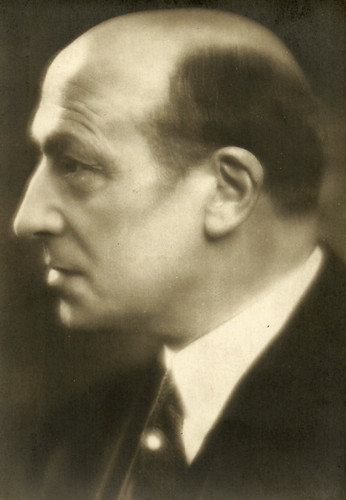
Italian postcard by Alterocca, Terni XIX [1941], no. 7097. Photo: Camuzzi.

Italian postcard by ASER (A. Scaramaglia Edizioni Roma), no. 64. Photo: Pesce.

Teatro Valle, Rome. Ruggero Ruggeri and Lyda Borelli often performed in this prominent Roman theatre. The Teatro Valle was built in 1727 as a wooden structure by Tommaso Morelli, enlarged and turned into stone in 1765 by architect Francesco Fiori and radically transformed, embellished and enlarged in 1821 by architect Giuseppe Valadier. Photo: Ivo Blom.
Sources: Wikipedia (Italian, English, French and German) and IMDb.
This post was last updated on 24 September 2026.


