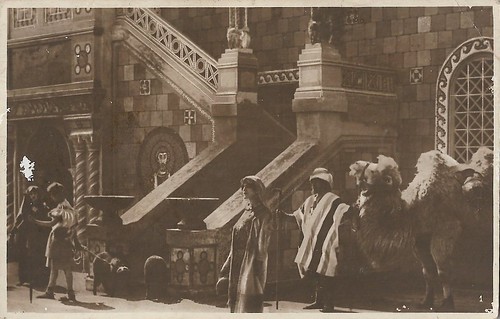
Rita Jolivet (1885-1962) was an English actress of French descent. She was already an acclaimed stage actress when she made her film debut. She appeared in both European and American early silent films. In May 1915, she was one of the few survivors of the Lusitania, after a German submarine destroyed the transatlantic steamer. Rita produced Lest We Forget (1918), a romanticised version of the fatal events. In 1921 she was the star of the Italian epic Teodora.
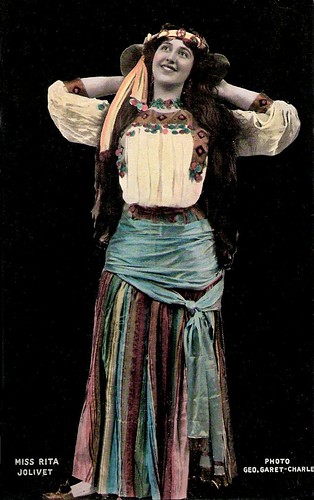
British postcard by Millar & Lang, Ltd., Art Publishers, Glasgow & London. Photo: Geo. Garet-Charle.
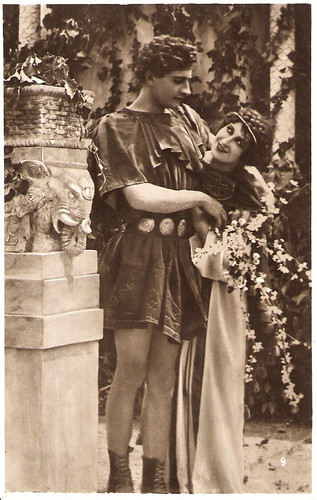
Italian postcard by Unione Cinematografica Italiana, no. 9. Photo: Ambrosio Film. Rita Jolivet and Ferruccio Biancini in Teodora/Theodora (Leopoldo Carlucci, 1921). The back of the card reads: "When Teodora (Rita Jolivet) meets the Greek Andrea (Ferruccio Biancini) she becomes his lover, pretending she is a widow with the name of Mirta."
Marguerite Lucile Jolivet was born in Castleton, New York in 1884 (1885 according to Vittorio Martinelli; Wikipedia states 1890). She was one of three children of Charles Eugene Jolivet from Carmansville, New York, an owner of extensive vineyards in France, and his French wife Pauline Hélène Vaillant, a Parisian concert musician and coming from an old French family.
Eager to become an actress, her mother sent her to London to study acting, pantomime, and dance. From 1903 Rita played her first roles on the British stage. In 1906-1908 she performed in Paris with the comedian Gallipeaux, and she returned to the British stage in 1909.
In 1910, she moved to New York to perform on Broadway. Here Charles Frohman became her mentor and agent, who arranged many parts for her at the Haymarket Theatre.
So she was already an acclaimed stage actress when she made her film debut. Noticing Jolivet's performance at the Garrick Theatre in New York, the American distributor and importer of European films George Kleine proposed her to make films in Italy. Enthusiastic about the Guazzoni epics and Lyda Borelli's Ma l'amor mio non muore/Love Everlasting (Mario Caserini, 1913), Jolivet travelled to Turin where she went to work for the Ambrosio Company.
After three films including the short silent drama Fata Morgana (Edoardo Bencivenga, 1914), and Cuore ed arte/Heart and Art (Edoardo Bencivenga, 1915), with Hamilton Revelle, she returned to the US to play in Cecil B. DeMille's The Unafraid (1915). The film was a huge success and Jolivet acted in another four American films.
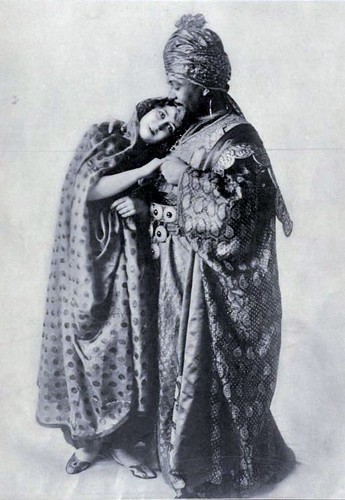
Rita Jolivet and Otis Skinner in Edward Knoblauch's oriental play 'Kismet' in 1912. Collection: CharmaineZoe.
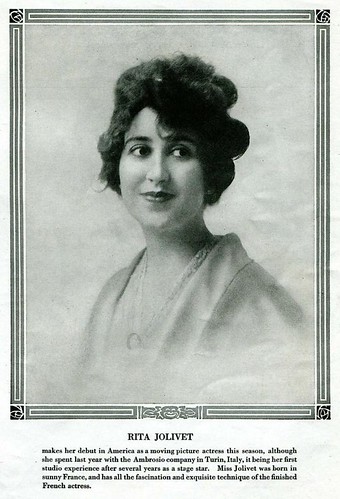
Rita Jolivet in 1915. Collection: CharmaineZoe.
Rita Jolivet embarked on the RMS Lusitania in May 1915 to shoot two more films at Ambrosio and to marry an Italian count. On 7 May 1915, the Lusitania was torpedoed by a German U-boat 12 miles south of the coast of Ireland. The boat rapidly sank in 18 minutes. Jolivet's theatrical producer and mentor Charles Frohmann was on board as well but he perished. Rita was one of the few survivors and was safely escorted to Britain.
Olivet's brother-in-law, George L. Vernon, was drowned in the Lusitania together with almost 1200 people. He was going to join Jolivet's sister, Inez Vernon, who was residing in Europe. Inez became depressed following her husband's death and committed suicide.
Rita Jolivet went to Italy, where she married Count Giuseppe de Cippico di Zara and was known now in private life as the Countess Marguerita de Cippico. She played in films like Zvani (Gino Zaccaria, 1915), Monna Vanna (Mario Caserini, 1915) and La mano di Fatma/The Hand of Fatma (Gino Zaccaria, 1916).
Rita returned to the States, and she decided to produce Lest We Forget (1918), a romanticised version of the fatal events of the Lusitania, directed by French director Léonce Perret. Jolivet personally presented the film in roadshows all around the States.
Rita Jolivet and her husband Count Giuseppe de Cippico di Zara donated the proceeds from Lest We Forget (1918) to the alleviation of suffering caused by World War I. Reportedly, Jolivet also was the best Liberty Bonds seller in the US, selling them more than Fairbanks, Pickford, and Chaplin together.
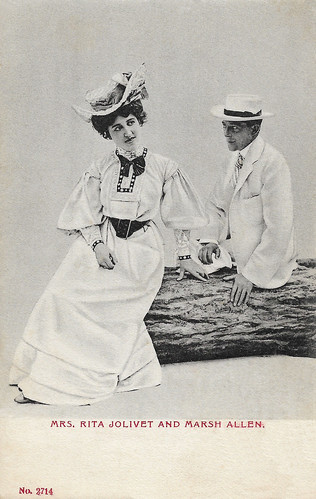
German postcard, no. 2714. Rita Jolivet and Marsh Allen
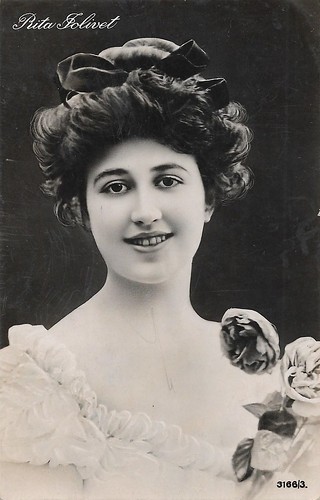
Italian postcard, no. 3166/3.
After the war, Rita Jolivet returned to Italy to star in a long-cherished project on the life of Theodora, Empress of Byzantium: Teodora/Theodora (Leopoldo Carlucci, 1921). It was based on a play by Victorien Sardou about the Roman courtesan and former slave girl, who married the Roman emperor Justinian (René Maupré) and assumed the throne as Empress of Rome.
Sardou's play had been a major hit for Sarah Bernhardt. The film had enormous, imposing sets by Armando Brasini. Because of various economic problems and censorship, the production proceeded slowly in 1919 and 1920 and was finally premiered in the US in 1921. It was a huge success. One year later, the success was even bigger in Italy, with audiences flocking to see the film. The critics were enthusiastic both about the film with its gigantic sets and about Jolivet's performance.
In between theatrical performances, Jolivet continued making films in France and Italy through 1926. Her later screen work included The Bride's Confession (Ivan Abramson, 1921), Roger la Honte/Roger the Shame (Jacques de Baroncelli, 1922), Messalina/The Fall of an Empress (Enrico Guazzoni, 1924) with Bruto Castellani, the lunatic comedy Phi-Phi (George Pallu, 1926) with André Deed, and Marchand de bonheur/Merchant of Happiness (Giuseppe Guarino, 1926).
After divorcing Count de Cippico, she remarried a rich Canadian, James Bryce Allan in 1928. She retreated from the stage and screen world. The couple lived a high life at their Scottish castle and additional dwellings in Paris and Monte Carlo. In the early 1930s, they sold the castle and lived in New York, where Bryce-Allan was the manager of a cotton processing company. After his death, Rita retired from public life.
In 1971 Rita Jolivet fell in the house of a friend while dancing the gigue, a lively baroque dance originating from the English jig. She was seriously injured and died in Nice on 2 March 1971. Always lying about her age, Jolivet even did so in the hospital, telling everyone she was 77 instead of 87.
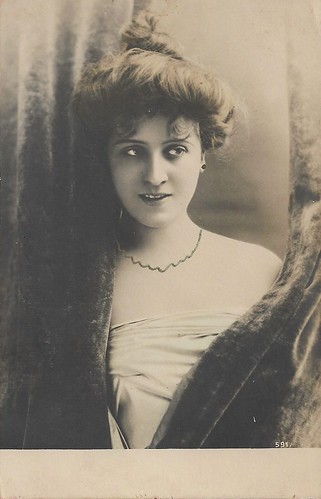
Italian postcard, no. 591.

Italian postcard, no. 3149/3.
Sources: Vittorio Martinelli (Le dive del silenzio), Wikipedia (German, English, French, and Italian) and IMDb.
This post was last updated on 25 November 2024.
British postcard by Millar & Lang, Ltd., Art Publishers, Glasgow & London. Photo: Geo. Garet-Charle.
Italian postcard by Unione Cinematografica Italiana, no. 9. Photo: Ambrosio Film. Rita Jolivet and Ferruccio Biancini in Teodora/Theodora (Leopoldo Carlucci, 1921). The back of the card reads: "When Teodora (Rita Jolivet) meets the Greek Andrea (Ferruccio Biancini) she becomes his lover, pretending she is a widow with the name of Mirta."
To Italy
Marguerite Lucile Jolivet was born in Castleton, New York in 1884 (1885 according to Vittorio Martinelli; Wikipedia states 1890). She was one of three children of Charles Eugene Jolivet from Carmansville, New York, an owner of extensive vineyards in France, and his French wife Pauline Hélène Vaillant, a Parisian concert musician and coming from an old French family.
Eager to become an actress, her mother sent her to London to study acting, pantomime, and dance. From 1903 Rita played her first roles on the British stage. In 1906-1908 she performed in Paris with the comedian Gallipeaux, and she returned to the British stage in 1909.
In 1910, she moved to New York to perform on Broadway. Here Charles Frohman became her mentor and agent, who arranged many parts for her at the Haymarket Theatre.
So she was already an acclaimed stage actress when she made her film debut. Noticing Jolivet's performance at the Garrick Theatre in New York, the American distributor and importer of European films George Kleine proposed her to make films in Italy. Enthusiastic about the Guazzoni epics and Lyda Borelli's Ma l'amor mio non muore/Love Everlasting (Mario Caserini, 1913), Jolivet travelled to Turin where she went to work for the Ambrosio Company.
After three films including the short silent drama Fata Morgana (Edoardo Bencivenga, 1914), and Cuore ed arte/Heart and Art (Edoardo Bencivenga, 1915), with Hamilton Revelle, she returned to the US to play in Cecil B. DeMille's The Unafraid (1915). The film was a huge success and Jolivet acted in another four American films.
Rita Jolivet and Otis Skinner in Edward Knoblauch's oriental play 'Kismet' in 1912. Collection: CharmaineZoe.
Rita Jolivet in 1915. Collection: CharmaineZoe.
Survivor of the Lusitania
Rita Jolivet embarked on the RMS Lusitania in May 1915 to shoot two more films at Ambrosio and to marry an Italian count. On 7 May 1915, the Lusitania was torpedoed by a German U-boat 12 miles south of the coast of Ireland. The boat rapidly sank in 18 minutes. Jolivet's theatrical producer and mentor Charles Frohmann was on board as well but he perished. Rita was one of the few survivors and was safely escorted to Britain.
Olivet's brother-in-law, George L. Vernon, was drowned in the Lusitania together with almost 1200 people. He was going to join Jolivet's sister, Inez Vernon, who was residing in Europe. Inez became depressed following her husband's death and committed suicide.
Rita Jolivet went to Italy, where she married Count Giuseppe de Cippico di Zara and was known now in private life as the Countess Marguerita de Cippico. She played in films like Zvani (Gino Zaccaria, 1915), Monna Vanna (Mario Caserini, 1915) and La mano di Fatma/The Hand of Fatma (Gino Zaccaria, 1916).
Rita returned to the States, and she decided to produce Lest We Forget (1918), a romanticised version of the fatal events of the Lusitania, directed by French director Léonce Perret. Jolivet personally presented the film in roadshows all around the States.
Rita Jolivet and her husband Count Giuseppe de Cippico di Zara donated the proceeds from Lest We Forget (1918) to the alleviation of suffering caused by World War I. Reportedly, Jolivet also was the best Liberty Bonds seller in the US, selling them more than Fairbanks, Pickford, and Chaplin together.
German postcard, no. 2714. Rita Jolivet and Marsh Allen
Italian postcard, no. 3166/3.
Theodora
After the war, Rita Jolivet returned to Italy to star in a long-cherished project on the life of Theodora, Empress of Byzantium: Teodora/Theodora (Leopoldo Carlucci, 1921). It was based on a play by Victorien Sardou about the Roman courtesan and former slave girl, who married the Roman emperor Justinian (René Maupré) and assumed the throne as Empress of Rome.
Sardou's play had been a major hit for Sarah Bernhardt. The film had enormous, imposing sets by Armando Brasini. Because of various economic problems and censorship, the production proceeded slowly in 1919 and 1920 and was finally premiered in the US in 1921. It was a huge success. One year later, the success was even bigger in Italy, with audiences flocking to see the film. The critics were enthusiastic both about the film with its gigantic sets and about Jolivet's performance.
In between theatrical performances, Jolivet continued making films in France and Italy through 1926. Her later screen work included The Bride's Confession (Ivan Abramson, 1921), Roger la Honte/Roger the Shame (Jacques de Baroncelli, 1922), Messalina/The Fall of an Empress (Enrico Guazzoni, 1924) with Bruto Castellani, the lunatic comedy Phi-Phi (George Pallu, 1926) with André Deed, and Marchand de bonheur/Merchant of Happiness (Giuseppe Guarino, 1926).
After divorcing Count de Cippico, she remarried a rich Canadian, James Bryce Allan in 1928. She retreated from the stage and screen world. The couple lived a high life at their Scottish castle and additional dwellings in Paris and Monte Carlo. In the early 1930s, they sold the castle and lived in New York, where Bryce-Allan was the manager of a cotton processing company. After his death, Rita retired from public life.
In 1971 Rita Jolivet fell in the house of a friend while dancing the gigue, a lively baroque dance originating from the English jig. She was seriously injured and died in Nice on 2 March 1971. Always lying about her age, Jolivet even did so in the hospital, telling everyone she was 77 instead of 87.
Italian postcard, no. 591.
Italian postcard, no. 3149/3.
Sources: Vittorio Martinelli (Le dive del silenzio), Wikipedia (German, English, French, and Italian) and IMDb.
This post was last updated on 25 November 2024.