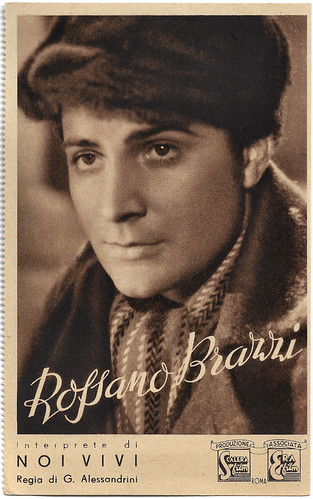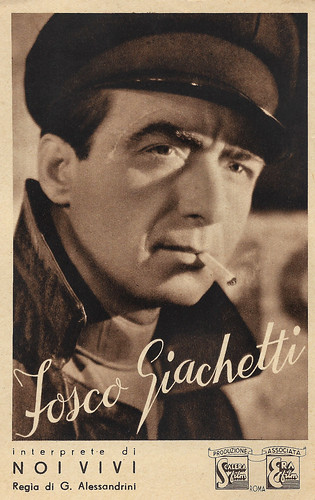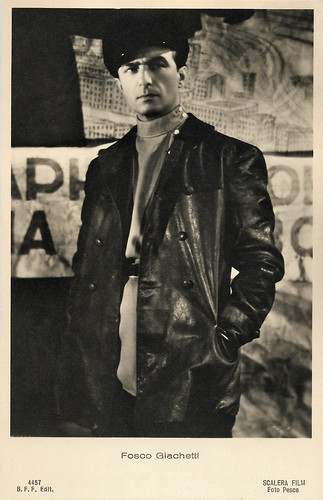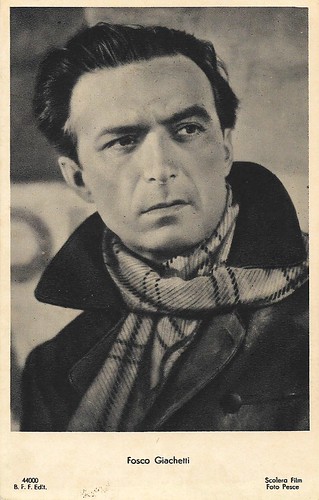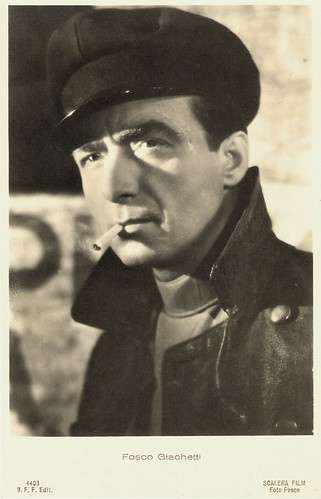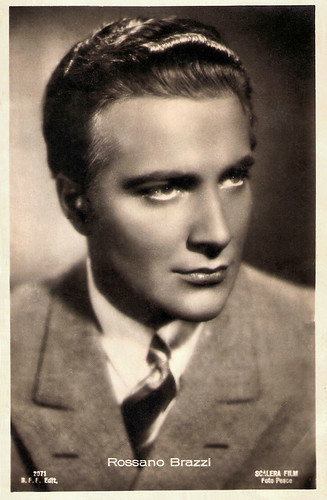
Italian postcard by B.F.F. Edit., no. 2071. Photo: Pesce / Scalera Film.

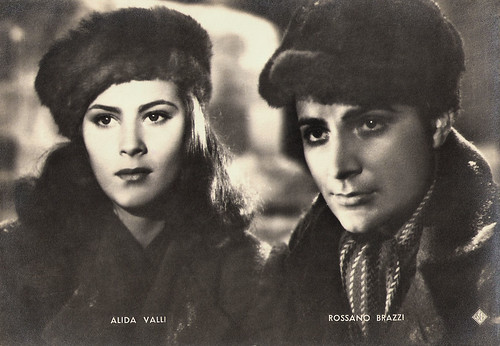
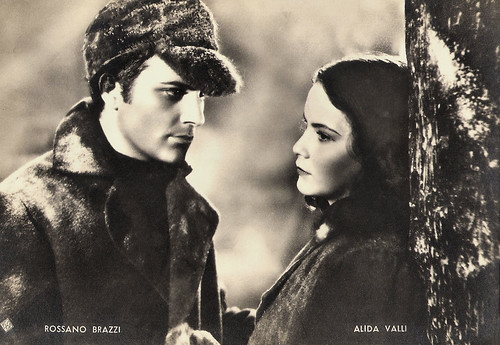
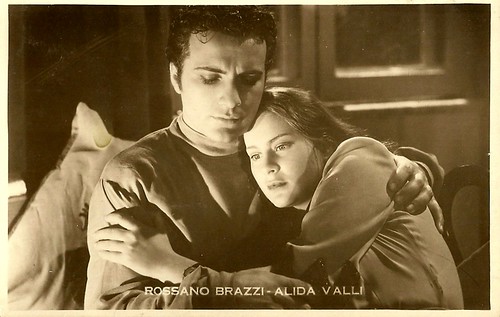
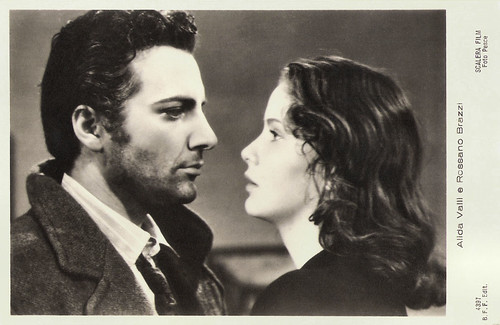
Italian postcard by ASER (A. Scarmiglia, Edizioni, Roma), no. 234. Photo: Pesce. Alida Valli and Rossano Brazzi in Noi Vivi/We the Living (Goffredo Alessandrini, 1942).
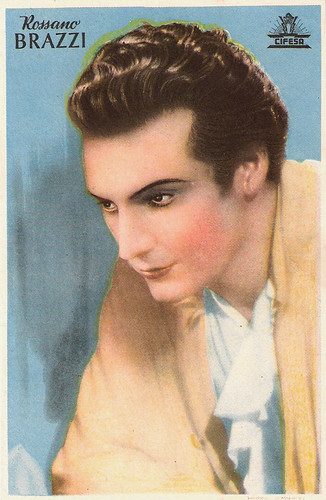
Spanish collector's card by I.G. Viladot, Barcelona. Image: Cifesa.

Italian postcard by Rotalfoto, no. 90.
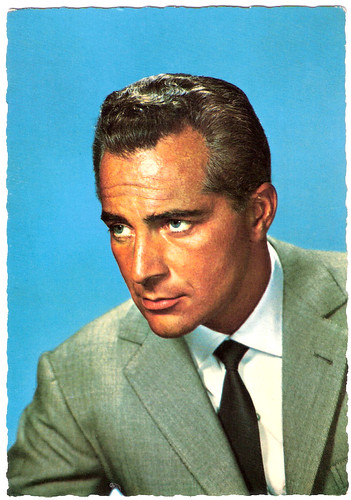
French postcard by E.D.U.G., no. 130.
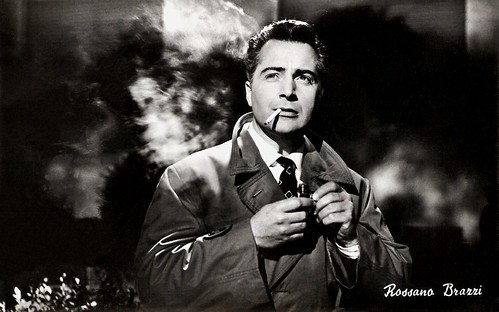
Belgian postcard by Bromophoto, Brussels.
Electric
Rossano Brazzi was born in Bologna, Italy, in 1916. He was the son of Adelmo Brazzi, a shoemaker who later owned a leather factory and Maria Ghedini Brazzi. As a young man, Rossano was quite athletic – playing soccer, tennis, golf, swimming, fencing and boxing. He was particularly good at soccer and assumed the role of goalkeeper for the Florentine college team, where he stayed for two years. During his years at the San Marco University in Florence, he was also an amateur boxer. He quit boxing when he unintentionally but seriously hurt an opponent.
He became friendly with students who were active in the University's amateur theatre. His friends persuaded him to try out for a part. He did and got it. During his second year, he won an important role: the part of the prodigal son in Siro Angeli's 'La Casa'. In 1937, he earned his law degree and was sent by his father to practice law in Rome with an established lawyer. Meanwhile, Rossano actively pursued a stage and screen career. He started to work as an actor for a theatrical company, led by the actresses Irma and Emma Gramatica. When the company played Somerset Maugham's 'The Sacred Flame' in Rome, film producer Michele Scalera offered Brazzi a part in his forthcoming Processo e morte di Socrate/The Trial and Death of Socrates (Corrado D'Errico, 1939).
A year later, the 24-year-old actor astonished critics and the public alike with his electric film portrayal of a middle-aged Edmund Kean in the Alexandre Dumas adaptation Kean (Guido Brignone, 1940). Two years later he delivered a critically acclaimed and award-winning performance in the two-part classic Noi Vivi - Addio Kira/We The Living - Goodbye Kira (Goffredo Alessandrini, 1942) opposite Alida Valli. Other films were Tosca/The Story of Tosca (Carl Koch, 1941), the first Italian Western Una donna dell'ovest/Girl of the Golden West (Carl Koch, 1942) with Michel Simon, and the drama I due Foscari/The Two Foscaris (Enrico Fulchignoni, 1942) based on a screenplay by Michelangelo Antonioni.
His International break came in 1942 when the Ufa cast him opposite Zarah Leander in the film Damals/At That Time (Rolf Hansen, 1943). In 1942, however, Rossano Brazzi was also asked to move to Milan to make propaganda pictures under government sponsorship. He refused, feigning illness, and abandoned his film career for the duration.
Earlier, he had been asked to help the resistance. He capitalised upon his knowledge of the Cinécitta studio, which had been converted into a concentration camp. He helped smuggle inmates, many of them American, British and French prisoners of war. Seven days before the liberation of Rome, Brazzi was arrested by the German SS and was turned over to the Italian authorities. A week later, Brazzi's prison guards vanished and he walked out free.
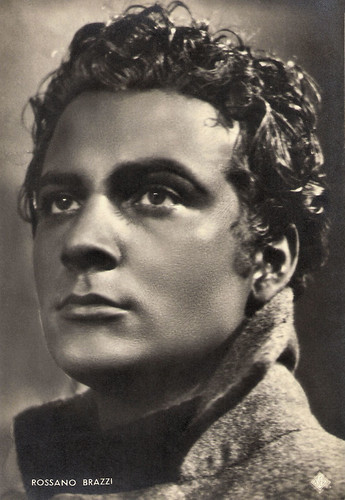
Italian postcard by Aser, Roma, no. 264.
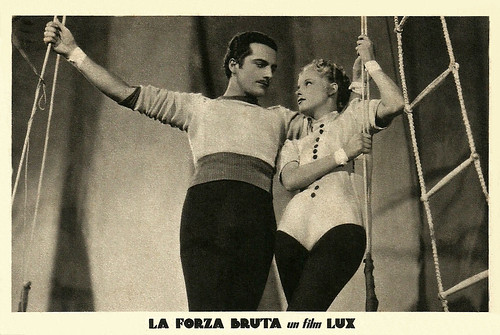
Italian postcard by Rotocalco Dagnino, Torino. Photo: publicity still of Germana Paolieri and Rossano Brazzi in the Lux production La forza bruta/Brute Force (Carlo Ludovico Bragaglia, 1941).

Italian postcard by Zincografica, Firenze. Sent by mail in 1942. Photo: Scalera Film / Era Film, Roma. Publicity still for Noi Vivi/We the Living (Goffredo Alessandrini, 1942).

Italian postcard by B.F.F. Edit., no. 43120. Photo: Pesce / Scolera Film.
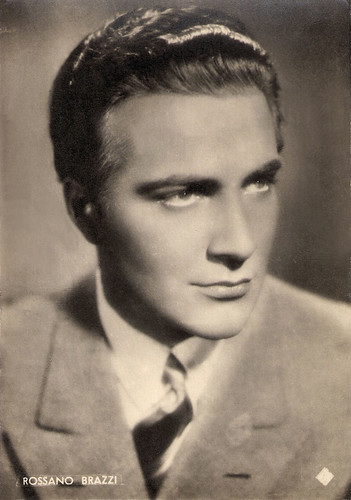
Italian postcard by Aser. Photo: Pesce.

Italian postcard by ASER (A. Scaramaglia, Edizioni, Roma). Photo: Pesce.
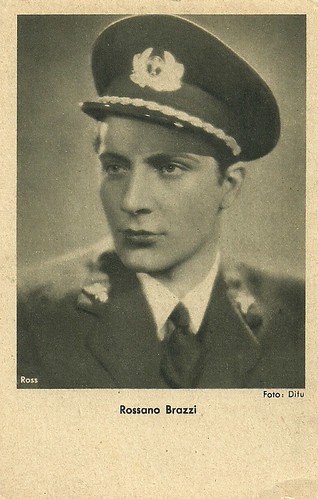
German postcard by Ross Verlag. Photo Difu.
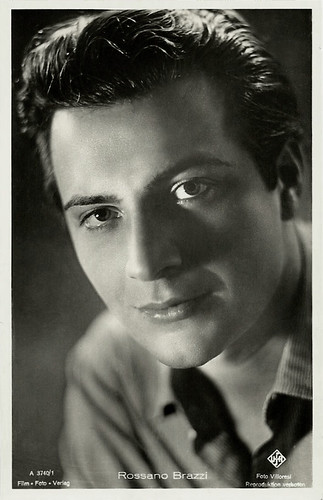
German postcard by Film-Foto-Verlag, no. A 3740/1, 1941-1944. Photo: Ufa / Villoresi.
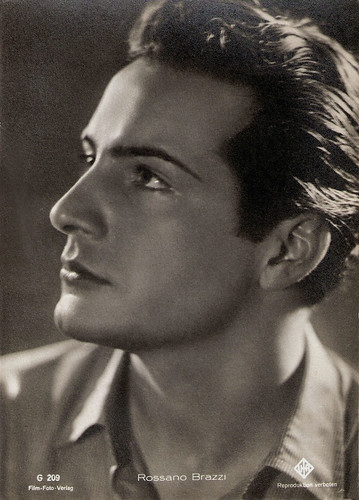
German postcard by Film-Foto-Verlag, no. G 209, 1941-1944. Photo: Ufa.
Blue-eyed hunk
After the war, Rossano Brazzi starred in the enormously popular Aquila nera/Black Eagle (Riccardo Freda, 1946). Then his popularity declined in Italy, as filmmaking began to move in a new direction: the stark, gritty neorealist style. The neorealist directors associated Brazzi with swashbuckling adventures and romances.
Thus, when American producer David O. Selznick offered him the chance to make films in America, he went to Hollywood. At the time, he could read almost no English and his accent was extraordinarily bad. After a year he was finally lent out to producer Mervyn LeRoy who used the actor as the professor in Little Women (Mervyn Leroy, 1949). But Selznick decided not to pick up his option on the actor and Brazzi fled back to Italy. He starred opposite Anna Magnani in Vulcano/Volcano (William Dieterle, 1950), and returned to the stage where he had begun his career.
In 1952, Jean Negulesco, a director Brazzi had met in Hollywood, offered him a part in Three Coins in the Fountain (Jean Negulesco, 1954). As the love-smitten young Italian, he played the third male lead, behind Clifton Webb and Louis Jourdan. The part was small, but the picture did well and it introduced the blue-eyed hunk to international audiences as a new sex symbol.
It was his multi-hued portrayal of the impotent Count Vincenzo Toriato-Faurini opposite Ava Gardner in The Barefoot Contessa (Joseph L. Mankiewicz, 1954) that won him international stardom. This success was followed by the leading male role opposite Katharine Hepburn in David Lean's romance Summertime (1955).
Brazzi became the first Italian actor since Rudolph Valentino to achieve the same global popularity and passion from his admirers. He played Latin Lovers in films like The Story of Esther Costello (David Miller, 1957) with Joan Crawford, Interlude (Douglas Sirk, 1957) with June Allyson and The Light in the Piazza (Guy Green, 1962) with Olivia de Havilland. His probably most famous role was in South Pacific (Joshua Logan, 1958) as Emile De Becque opposite Mitzi Gaynor. But his film roles tended to become routine and repetitive.
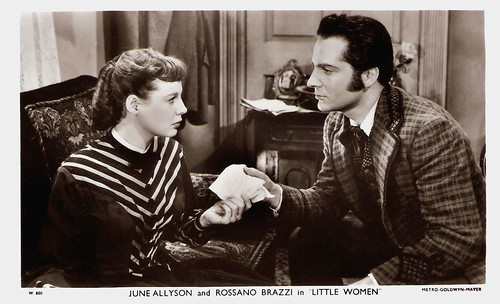
British postcard in the Picturegoer Series, London, no. W. 800. Photo: Metro-Goldwyn-Mayer. Publicity still for Little Women (Mervyn Leroy, 1949) with June Allyson.

German postcard by Kunst und Bild, Berlin, no. A 180. Photo: Döring Film Gmbh.
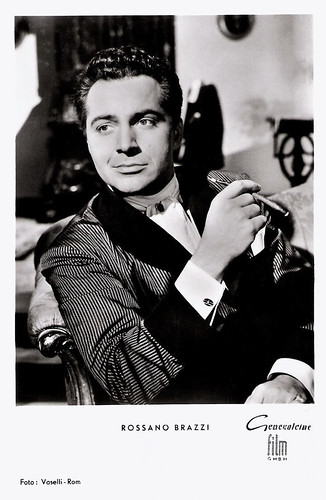
German postcard by Kunst und Bild, Berlin, no. A 571. Photo: Vaselli, Rome / Generalcine Film Gmbh. Publicity still for La donna che inventò l'amore/The Woman Who Invented Love (Ferruccio Cerio, 1952).
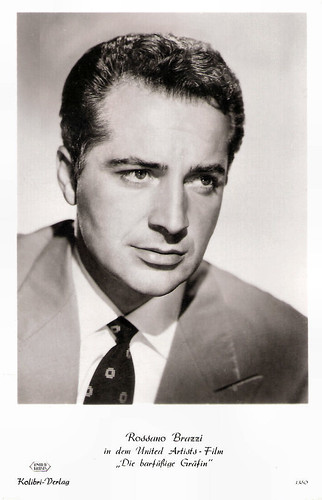
German postcard by Kolibri-Berlag, no. 1360. Photo: United Artists. Publicity still for The Barefoot Contessa (Joseph L. Mankiewicz, 1954).
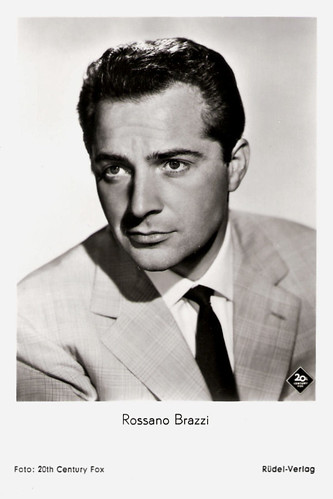
German postcard by Rüdel-Verlag, Hamburg-Bergedorf, no. 1283. Photo: 20th Century Fox. Publicity still for Three Coins in a Fountain (Jean Negulesco, 1954).

Italian postcard by Casa Edite. Ballerini & Fratini, Firenze (B.F.F. Edit.), no. 3587. Photo: Dear Film. Rossano Brazzi in Loser Takes All (Ken Annakin, 1956).
Latin lover label
In the 1960s, Rossano Brazzi wasn't interested in resurrecting (again) the role of the Latin lover. In some of his most willingly comedic performances, he poked fun at his own image: as the smooth, suave and utterly silly Carlos Matabosch in The Bobo (Robert Parrish, 1967), in his brief but very funny role as Giorgio in Woman Times Seven (Vittorio De Sica, 1967) and as himself in Mondo Cane (Paolo Cavara, Gualtiero Jacopetti, Franco Prosperi, 1962). He turned to directing in the mid-1960s and was sometimes credited with the nom de film of Edward Ross. His best-known effort in this capacity was the modest family-oriented film Il Natale che quasi non fu/The Christmas That Almost Wasn't (1966), in which he also starred as the gleefully cartoonish Phineas T. Prune.
The late 1960s and early 1970s found him choosing more uncharacteristic projects, from the nerdy intellectual complete with the tortoiseshell glasses falling down his nose in La ragazza di bersagliere/Soldier's Girl (Alessandro Blasetti, 1966), to the sadistic and brutal Major Bernadelli in Mister Kingstreet's War/Heroes Die Hard (Percival Rubens, 1973), to the gloomy, insane Dr. Frankenstein in Terror! Il castello delle donne maledette/Frankenstein's Castle of Freaks (Dick Randall, 1974).
His refusal to be typecast into characters known for their romantic gallantry and heroism found its way into criminals, sexual deviants, rapists, and Mafia dons. One of his most successful films of this period was the classic crime caper The Italian Job (Peter Collinson, 1969), in which he appeared as the murdered Roger Beckermann. On television, he was a regular on the Harold Robbins-created series The Survivors (1969), playing Onassis clone Antaeus Riakos. He also did guest appearances in popular series like Madigan (1972), Hawaii Five-O (1977), Police Woman (1978), Charlie’s Angels(1979) and The Love Boat (1982).
In Italy, he starred with Stéphane Audran in the TV mini-series Orient-Express (1980) and with Gabriel Byrne in Christopher Columbus (1985). His later films included The Great Waltz (Andrew L. Stone, 1972) with Horst Buchholz, The Final Conflict/The Omen III (Graham Baker, 1981) and Fear City (Abel Ferrara, 1984).
In 1984 Brazzi was indicted along with 36 others for international drug and weapons smuggling; the charges against him, however, were later dropped. Brazzi was working on the Horror film Fatal Frames (Al Festa, 1996) when he was hospitalised with a viral infection that disabled his nervous system. Rossano Brazzi died of complications following the neural virus, in 1994, in Rome, Italy. He was married to Florentine Baroness Lidia Bertolini from 1940 until her death in 1981, and to the German Ilse Fischer, from 1984 until his death. There were no children from these marriages.
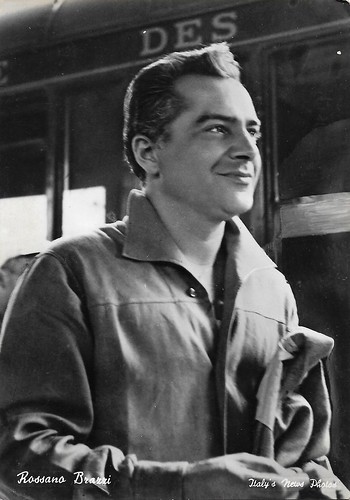
Italian postcard by Bromofoto, no. 1221. Photo: Italy's News Photos.

British postcard. Photo: Associated British.
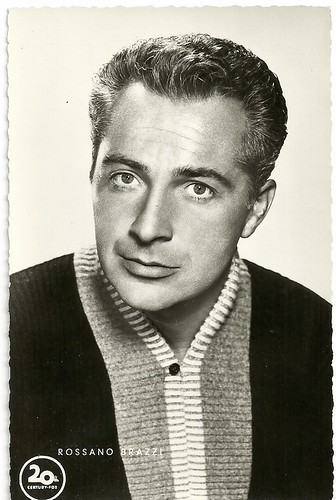
German Postcard by Kunst und Bild, Berlin. Photo: 20th Century Fox.
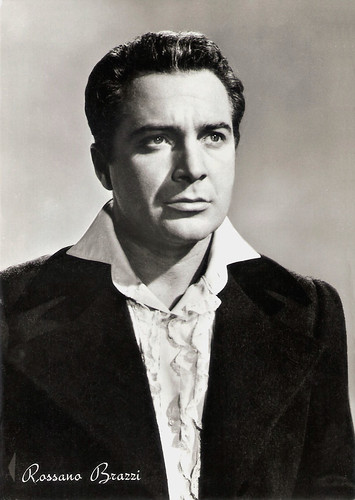
Italian postcard by Rotalfoto, no. 403.
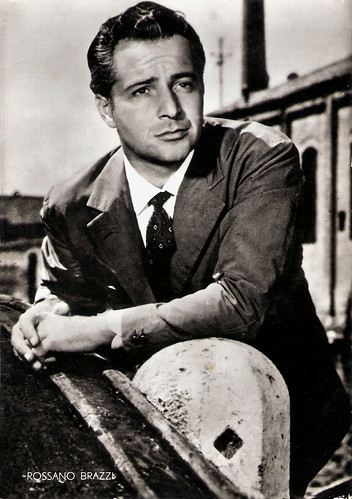
Italian postcard, no. 459.
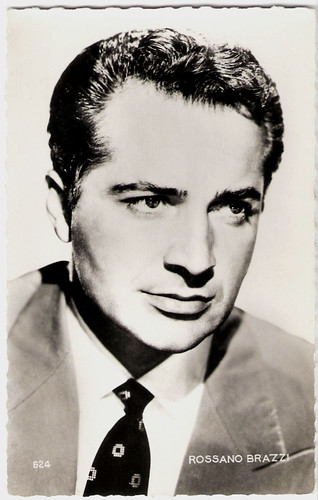
French postcard by Editions P.I., Paris, no. 624, offered by Les carbones Korès 'Carboplane'.
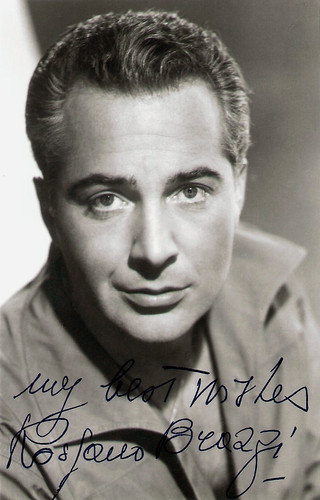
British card by the Reveille Fan Club, London. Photo: British Lion Films.
Sources: Hal Erickson (AllMovie), Rudi Polt (IMDb), BRAZZI! - the official Rossano Brazzi International Network, Encyclopedia Britannica, Wikipedia, and IMDb.
This post was last updated on 7 August 2023.