Showing posts with label Victor Sjöström. Show all posts

17 December 2022

Directed by Victor Sjöström

Director and actor Victor Sjöström (1979-1960) was famous for his poetic and touching epics, such as Ingeborg Holm (1913), Terje Vigen/A Man There Was (1916) - by then the most expensive Swedish film made - and Körkarlen/The Phantom Carriage (1920), considered one of the best Swedish films ever. From 1923 he worked in Hollywood under the name of Victor Seastrom, directing such films as He Who Gets Slapped (1924), starring Lon Chaney, and The Wind (1928), starring Lilian Gish. With the advent of sound cinema, he returned to Sweden. This was for now the final post in our series on silent Swedish cinema.

Körkarlen (1920)
Swedish postcard by Förlag Nordisk Konst, Stockholm, no. 1117/6. Photo: Svensk Filmindustri. Victor Sjöström and Tore Svennberg in Körkarlen/The Phantom Carriage, (Victor Sjöström, 1920).
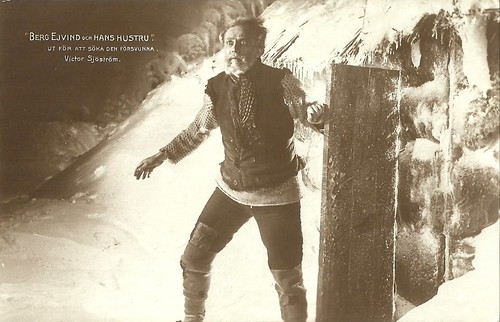
Berg-Ejvind och hans hustru/ The Outlaw and His Wife
Swedish postcard by Nordisk Konst, Stockholm, no. 844/ 11. Photo: Svenska Biografteatern AB. Victor Sjöström in Berg-Ejvind och hans hustru/The Outlaw and His Wife (Victor Sjöström, 1918). Caption: Out to seek the lost.

Victor Sjöström
Swedish postcard by Svenska Biografteatern, no. 12. Photo: Ferd. Flodin, Stockholm. Victor Sjöström.

The first classic of Swedish cinema


Victor David Sjöström was born in Silbodal, Sweden, in 1879. He was only a year old when his father, Olof Adolf Sjöström, moved the family to Brooklyn, New York, where the father soon built up a successful shipping agency. As a boy, Sjöström was close to his mother, actress Sofia Elisabeth Hartman, who died in New York during childbirth in 1886. The seven-year-old Victor returned to Sweden where he lived with relatives in Stockholm. His uncle was a leading actor at the Royal Dramatic Theatre in Stockholm during the latter part of the 19th century, Victor Hartman.

As a teenager, Sjöström loved the theatre. He formed a theatre society at his Uppsala school, which produced the play 'The Two Deaf Men', in which Sjöström is said to have shown a flair for comedy. In 1895, Olof Sjöström returned from the United States, poor. Victor interrupted his studies and moved in with him in Stockholm. He now began working to support himself and his father, including working in a boarding house in Stockholm and selling novelty doughnuts on the city streets. In 1896, his father died, and Sjöström decided to embark on an acting career in earnest. Sjöström could not afford to attend the Drama School, but instead joined Ernst Ahlbom's theatre company, with which he toured Finland from 1896-1898. In the following decade, he worked for several stage companies in Scandinavia, first as an actor and later also as a director. In 1912-1913, he and Einar Fröberg had a theatre company together - the Fröberg-Sjöströmska Society - which performed in Copenhagen and elsewhere.

Then Charles Magnusson of Svenska Bio hired him and fellow stage director, Mauritz Stiller, to helm motion pictures. Here, Sjöström met the photographer brothers Henrik and Julius Jaenzon, who were to work with him. Sjöström made his acting debut in the Stiller film Vampyren/The Vampire to learn the ropes of filmmaking. The film was shot in 1912 but did not premiere until 1913. His debut as a director was the silent film Ett hemligt giftermål/A Ruined Life (Victor Sjöström, 1912) with Hilda Borgström and John Ekman.

Between 1912 and 1915, Victor Sjöström directed 31 silent films of which only three still survive. His drama Trädgårdsmästaren/The Gardener (Victor Sjöström, 1912) was the first film to ever be banned by the Swedish censor system. Sjöström himself played a brutal gardener who rapes a young, innocent woman (Lili Beck, who became Sjöström's second wife) in his employ in a lovely greenhouse. In the final scene, the girl is found dead the next morning on the floor of the greenhouse, with red roses around her. The official comments of the censors were: "A breach of respectability. The association of death and beauty poses a threat to public order." The film was long thought to have been lost, but in 1979 a copy was found in an archive in the United States.

In 1913, he directed Ingeborg Holm (Victor Sjöström, 1913), which is considered his first masterpiece and the first classic of Swedish cinema. Ingeborg Holm is a social realist drama about a woman (played by Hilda Borgström) who, after the death of her husband, loses custody of her children and ends up in a mental hospital. The film attracted widespread attention both for its artistic merits and for the debate on poverty care that arose in its wake, and it was also successful abroad.

Sjöström's big breakthrough came with Terje Vigen/A Man There Was (Victor Sjöström, 1917), a film adaptation of Henrik Ibsen's long poem 'Terje Vigen'. The film is usually called the beginning of the golden age of Swedish film. It was Svenska Bio's most lavish film to date and was among the first films to be shot in natural settings, specifically at Landsort outside Nynäshamn. The film tells the story of a sailor, Terje, who has lost his home and family in the Napoleonic Wars and has become bitter and vengeful, yet finds the strength to act well. Sjöström himself played the lead role as Terje Vigen, and Edith Erastoff, who would become his third wife, also played a leading role. Terje Vigen/A Man There Was (1917) was a success, with Stockholms Dagblad calling it "the best Swedish film ever made".

Tösen fran Stormyrtorpet (1917)
Swedish postcard by Nordisk Konst, Stockholm, no. 843/1. Photo: Svenska Biografteatern AB. Gösta Cederlund as Per Månsson, Greta Almroth as Helga and William Larsson as her father in Tösen från Stormyrtorpet/The Girl from the Marsh Croft (Victor Sjöström, 1917). Caption: At the house of Per Månsson at Västgården. The woman in the back may be Edla Rothgardt, who plays Per Månsson's wife.

Tösen fran Stormyrtorpet (1917)
Swedish postcard by Nordisk Konst, Stockholm, no. 843/10. Photo: Svenska Biografteatern AB. Karin Molander and Greta Almroth in Tösen från Stormyrtorpet/The Girl from the Marsh Croft (Victor Sjöström, 1917). Caption: Alderman's daughter Hildur and the Marsh Girl.

Berg-Ejvind och hans hustru/ The Outlaw and His Wife
Swedish postcard by Nordisk Konst, Stockholm, no. 844/2. Photo: Svenska Biografteatern AB. Victor Sjöström in Berg-Ejvind och hans hustru/The Outlaw and His Wife (Victor Sjöström, 1918). Caption: Berg-Ejvind steals a sheep from the priest.

Berg-Ejvind och hans hustru/The Outlaw and his Wife (1918)
Swedish postcard by Nordisk Konst, Stockholm, no. 844/12 (final card and final scene of the film). Photo: Svenska Biografteatern AB. Victor Sjöström and Edith Erastoff in Berg-Ejvind och hans hustru/The Outlaw and His Wife (Victor Sjöström, 1918). Caption: Death in the snowstorm.
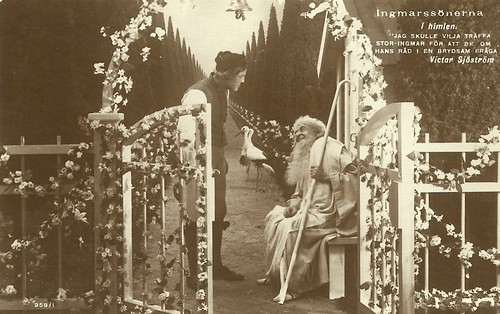
Victor Sjöström in Ingmarssönerna
Swedish postcard by Nordisk Konst, Stockholm, no. 958/1. Photo: Svenska Biografteatern AB. Victor Sjöström in Ingmarssönerna/Sons of Ingmar (Victor Sjöström, 1919). Young Ingmar at Heaven's Gate. Caption: "I would like to meet Old Ingmar to ask for his advice in an awkward matter."
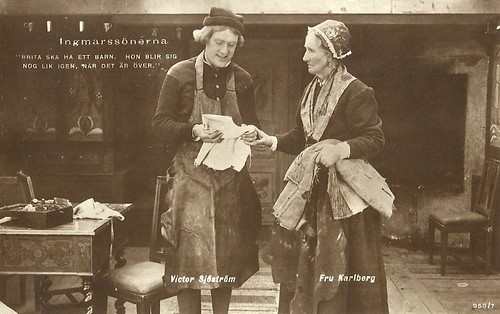
Ingmarssönerna/ Sons of Ingmar
Swedish postcard by Nordisk Konst, Stockholm, no. 958/7. Victor Sjöström and Hildur Karlberg in Ingmarssönerna/Sons of Ingmar (Victor Sjöström, 1919). Caption: Mother: It is because Brita will have her child, but then she will recover and it will be over.
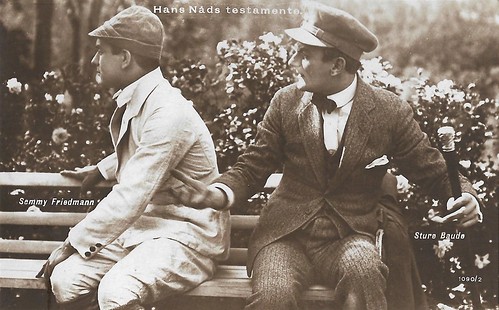
Semmy Friedmann and Sture Baude in Hans Nåds testamente
Swedish postcard by Nordisk Konst, Stockholm, no. 1090/2. Photo: Svenska Biografteatern. Semmy Friedmann and Sture Baude in Hans Nåds testamente/His Grace's Testament/His Lordship's Last Will (Victor Sjöström, 1919).

Tora Teje
Swedish postcard. Nordisk Konst, Stockholm, no. 1092/14. Tora Teje in Klostret i Sendomir/Secret of the Monastery (Victor Sjöström 1920).

Adapting Selma Lagerlöf


The success of Terje Vigen/A Man There Was (Victor Sjöström, 1917) led to a change in Svenska Bio's production policy. Previously the company had been churning out about twenty films a year, but now the producers slowed down the rate of production and they gave each film a higher budget and more thought. That same year saw the release of the Selma Lagerlöf film adaptation Tösen från Stormyrtorpet/The Lass from the Stormy Croft (Victor Sjöström, 1917). Lagerlöf had been impressed by Terje Vigen and gave Sjöström the go-ahead to film this short story. The film was the first of Sjöström's five Lagerlöf films.

Victor Sjöström's next film was also a milestone in his career: Berg-Ejvind och hans hustru/The Outlaw and His Wife (1918), about the Icelandic outlaw Berg-Ejvind who falls in love with the wealthy widow Halla. The film was based on a play by the Danish-Icelandic writer Jóhann Sigurjónsson and, like Terje Vigen, was shot in real settings, this time in Abisko National Park in Lapland. The film was hailed almost unanimously as a great work of art. The depictions of nature were particularly praised. Sjöström starred opposite Edith Erastoff, who was expecting the couple's first child, and the couple's real-life infatuation is thought to add an extra lustre to the love story. In 1918, their daughter Gun ("Guje") was born. They married in 1922, after having to wait five years for her divorce.

Sjöström's other surviving silent Swedish films include Ingmarssönerna/Sons of Ingmar (Victor Sjöström, 1919), the sequel Karin Ingmarsdotter/Karin, Daughter of Ingmar (Victor Sjöström, 1920) and Körkarlen/The Phantom Carriage (Victor Sjöström, 1921), all based on stories by the Nobel-prize winning novelist Selma Lagerlöf. These films are marked by subtle character portrayal, fine storytelling and evocative settings in which the Swedish landscape often plays a key psychological role. The naturalistic quality of his films was enhanced by his, then-revolutionary, preference for on-location filming, especially in rural and village settings.

Ingmarssönerna/Sons of Ingmar (1919) and Karin Ingmarsdotter/Karin, Daughter of Ingmar (1920) are based on the first four chapters of 'Jerusalem', a novel by Lagerlöf, published in two parts in 1901 and 1902. The narrative spans several generations in the 19th century and focuses on several families in Dalarna, Sweden, and a community of Swedish emigrants in Jerusalem. It is loosely based on a real emigration that took place from the parish of Nås in 1896. Sjöström originally intended to film the entire novel but decided to cancel the project after the second film received an unenthusiastic critical response.

In 1919, Svenska Bio and Filmindustri AB Skandia merged to form Svensk Filmindustri (SF). The company's first project was Sjöström's Körkarlen/The Phantom Carriage (1921), which is considered Sjöström's greatest work and the pinnacle of Swedish silent film. Released on New Year's Day 1921, Körkarlen/The Phantom Carriage starred Victor Sjöström himself, alongside Hilda Borgström, Tore Svennberg and Astrid Holm. The characters and acting were of the highest order, and the trick filming and double exposures by Julius Jaenzon were groundbreaking. It is also notable for its advanced (for the time) narrative structure with flashbacks within flashbacks. The film was a huge success both nationally and internationally. When it premiered in New York, the film received a lyrical review in The New York Times and made Sjöström a household name. Later the film would be a major influence on Ingmar Bergman.

Tora Teje
Swedish postcard by Nordisk Konst, Stockholm, no. 1093/7. Tora Teje in Karin Ingmarsdotter/Karin Daughter of Ingmar (Victor Sjöström, 1920).
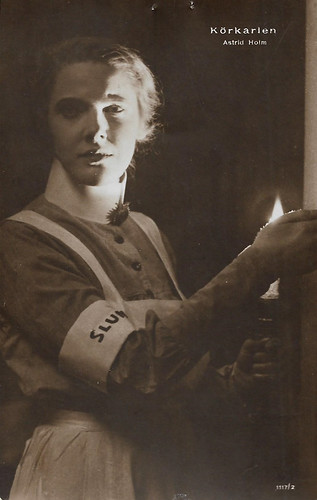
Körkarlen (1920)
Swedish postcard by Förlag Nordisk Konst, Stockholm, no. 1117/2. Photo: Svensk Filmindustri. Astrid Holm in Körkarlen/The Phantom Carriage, (Victor Sjöström, 1920).
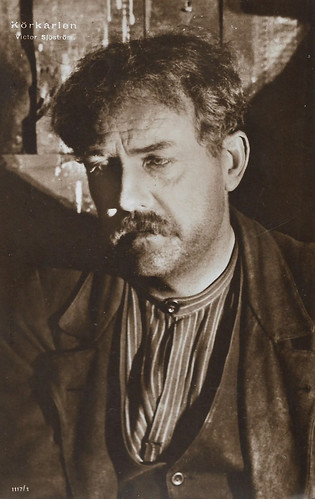
Körkarlen (1920)
Swedish postcard by Förlag Nordisk Konst, Stockholm, no. 1117/3. Photo: Svensk Filmindustri. Victor Sjöström in Körkarlen/The Phantom Carriage, (Victor Sjöström, 1920).

Jenny Hasselqvist and Gösta Ekman in Vem dömer (1922)
Swedish postcard by Axel Eliassons Konstförlag, Stockholm, no. 300. Photo: Skandia Film. Gösta Ekman and Jenny Hasselqvist in Vem dömer/ Love's Crucible (Victor Sjöström, 1922).

Gösta Ekman and Jenny Hasselqvist in Vem dömer (1922)
Swedish postcard by Axel Eliassons Konstförlag, Stockholm, no. 304. Photo: Skandia Film. Gösta Ekman and Jenny Hasselqvist in Vem dömer/ Love's Crucible (Victor Sjöström, 1922).

Meggie Albanesi in Det omringade huset (1922)
Swedish postcard by Axel Eliassons Konstförlag, Stockholm, no. 329. Photo: Skandiafilm / Svensk Filminspelning. Meggie Albanesi in Det omringade huset/The Surrounded House (Victor Sjöström, 1922).
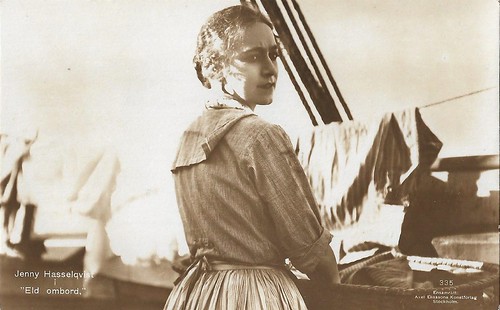
Jenny Hasselqvist in Eld ombord (1923)
Swedish postcard by Axel Eliassons Konstförlag, Stockholm, no. 335. Photo: Svensk Filminspelning. Jenny Hasselqvist in Eld ombord/Fire on board/The Hell Ship (Victor Sjöström, 1923).

Victor Sjöström and Jenny Hasselquist in Eld ombord (1923)
Swedish postcard by Ed. Axel Eliassons Konstförlag, Stockholm, no. 336. Photo: Svensk Filminspelning. Victor Sjöström and Jenny Hasselqvist in Eld ombord/Fire on board (Victor Sjöström, 1923).

The finest production we have yet seen


In 1922, Victor Sjöström received an offer to come and film in Hollywood. The following year, Sjöström and his family left for the United States. His family consisted of his wife Edith and their two daughters, Gun ('Guje") and Karin ("Caje"). They spent seven years in the country. In Sweden, he had acted in his own films as well as in those for others, but in Hollywood, he devoted himself solely to directing. During this time he directed a total of nine films for the newly formed Metro-Goldwyn-Mayer company, of which he became the biggest star director.

Credited as Victor Seastrom, he directed Name the Man! (1924) for Goldwyn Pictures. Goldwyn soon folded into Metro-Goldwyn-Mayer and Sjöstrom directed the psychological thriller He Who Gets Slapped (1924) starring Lon Chaney, Norma Shearer, and John Gilbert. The film was written by Sjöström and Carey Wilson and based on the Russian play 'He Who Gets Slapped' (Тот, кто получает пощёчины; Tot, kto polučájet poščóčiny) by playwright Leonid Andreyev. He Who Gets Slapped was the first film produced entirely by Metro-Goldwyn-Mayer and was highly profitable and critically hailed. In his 1924 review of the film for the New York Times, Mordaunt Hall praised the film's direction, performances, and story, calling it "the finest production we have yet seen". He Who Gets Slapped was important in the careers of Chaney, Shearer, Gilbert, and Sjöström.

He was highly respected by MGM chief Louis B. Mayer and by production head Irving Thalberg, who shared Sjöström's concerns with art that did not exclude profit. Among his other major Hollywood films are The Scarlet Letter (1926) and The Wind (1928), both starring Lillian Gish. In The Scarlet Letter (1926), Gish plays the adulterous Hester Prynne. Sjöström allows Hester a certain voluptuousness. When she leaves the bare rooms of the town for a date with her lover in the verdant woods, she defiantly pulls off her scarlet letter A, takes off her cap as well, and we see her beautiful, rich head of hair. The romantic drama The Wind (1928) featured also Lillian Gish, Lars Hanson and Montagu Love. It was one of the last silent films released by Metro-Goldwyn-Mayer and is considered to be among the greatest silent films.

Unlike the Swedish directors Mauritz Stiller and Hjalmar Bergman, who also tried their luck in the United States, Sjöström enjoyed both artistic and commercial success in that country. Sjöström became one of the most highly-paid directors in Hollywood, reaching his peak at the end of the silent era. Sjöström's first talkie was A Lady to Love (1930) starring Vilma Bánky and Edward G. Robinson. Robinson also appeared in the German-language version also produced and directed by Sjöström. Otherwise, with a different cast, it was released a year later in the United States as Die Sehnsucht Jeder Frau.

Uncomfortable with the modifications needed to direct sound films, Victor Sjöström returned to Sweden where he directed only two more films, the German language Väter und Söhne/Father and Son (1931) and the Swedish language version Markurells i Wadköping/Father and Son (1931). His final directing effort was for 20th Century Fox, the historical drama Under the Red Robe (1937). The adventure film, starring Conrad Veidt and Annabella and filmed in the United Kingdom, was set during the religious wars of early 17th century France.

Over the following fifteen years, Victor Sjöström returned to acting in the theatre, performed a variety of leading roles in more than a dozen films and was a company director of Svensk Film Industri. Aged 78, he gave his final acting performance, probably his best remembered, as the elderly professor Isak Borg who recalls his past in Ingmar Bergman's film Smultronstället/Wild Strawberries (1957) opposite Bergman regulars Bibi Andersson, Ingrid Thulin, and Gunnar Björnstrand. In 1960, Sjöström passed away in Stockholm at the age of 80.

John Gilbert and Norma Shearer in He Who Gets Slapped (1924)
German postcard by Ross Verlag, Berlin, no. 1587/1. Photo: Ufa. John Gilbert and Norma Shearer in He Who Gets Slapped (Victor Sjöström, 1924).

Lillian Gish in The Scarlet Letter (1926)
German postcard by Ross Verlag, no. 1885/1. Photo: Parufamet. Lillian Gish in The Scarlet Letter (Victor Sjöström, 1926).

Lars Hanson in The Scarlet Letter
Italian postcard by Ballerini & Fratini, Firenze, no. 403. Photo: Metro-Goldwyn-Mayer, Roma. Lars Hanson as Reverend Arthur Dimmesdale in the period piece The Scarlet Letter (Victor Sjostrom, 1926), set in the era of the Puritans.

Greta Garbo in The Divine Woman
French postcard by Europe, no. 330. Photo: Metro-Goldwyn-Mayer. Greta Garbo in The Divine Woman (Victor Sjöström, 1928).

Who's this Lady? Part 7
German postcard by Ross Verlag, no. 3327/1, 1928-1929. Photo: MGM. This lady is not Greta Garbo, but Paulette Duval in costume for The Divine Woman (Victor Sjöström, 1928), in which she played with Garbo. Collection: Marlene Pilaete.
Lillian Gish and Lars Hanson in The Wind (1928)
German postcard by Ross Verlag, no. 3822/1, 1928-1929. Photo: United Artists. Lillian Gish and Lars Hanson in The Wind (Victor Sjöström, 1928).

Eva von Berne and John Gilbert in The Masks of the Devil (1928)
German postcard by Ross Verlag, no. 4509/1, 1929-1930. Photo: MGM. Eva von Berne and John Gilbert in The Masks of the Devil (Victor Sjöström, 1928).

Annabella in Under the Red Robe (1937)
French postcard by Viny, no. 46. Photo: 20th Century Fox. Annabella in Under the Red Robe (Victor Seaström, a.k.a. Victor Sjöström, 1937).

Sources: Jon C. Hopwood (IMDb), Wikipedia (Swedish and English) and IMDb.

12 November 2022

Three Swedish silent films: Thomas Graals bästa barn (1918), Mästerkatten i stövlar (1918) and De landsflyktiga (1921),

During the heydays of the silent Swedish cinema, Mauritz Stiller, Victor Sjöström and John W. Brunius were three of the most prominent directors. They produced many outstanding silent films, including some of the best of the adaptations of stories by the Nobel-prizewinning novelist Selma Lagerlöf.

Thomas Graals bästa barn (1918)


Karin Molander in Thomas Graals bäste barn (1918)
Swedish postcard by Förlag Nordisk Konst, Stockholm, no. 958. Photo: Svenska Biografteatern. Karin Molander in Thomas Graals bästa barn/Thomas Graal's First Child (Mauritz Stiller, 1918).

Karin Molander in Thomas Graals bäste barn (1918)
Swedish postcard by Förlag Nordisk Konst, Stockholm, no. 959. Photo: Svenska Biografteatern. Karin Molander in Thomas Graals bästa barn/Thomas Graal's First Child (Mauritz Stiller, 1918).

Kariin Molander and Victor Sjöström in Thomas Graals bästa barn (1918)
Swedish postcard by Förlag Nordisk Konst, Stockholm, no. 960. Photo: Svenska Biografteatern. Victor Sjöström and Karin Molander in Thomas Graals bästa barn/Thomas Graal's First Child (Mauritz Stiller, 1918).

Karin Molander and Victor Sjöström in Thomas Graals bäste barn (1918)
Swedish postcard by Förlag Nordisk Konst, Stockholm, no. 961. Photo: Svenska Biografteatern. Victor Sjöström and Karin Molander in the Swedish silent comedy Thomas Graals bästa barn/Thomas Graal's First Child (Mauritz Stiller, 1918).

On the day of the wedding between the writer Thomas Graal and Bessie an argument develops between them about their respective expectations of the sex of their future first child: she wants a girl, whom she intends to call Lillian, and he a boy. Because of this quarrel, they spend the first days of their life together in mutual segregation, which worries the servants, who ask Bessie's mother to intervene.

But the conflict is soon resolved when Thomas is stung in his pride and drives away a slightly tipsy man who had begun courting his wife. In due course, Lillianus, a boy, is born, but between the couple, in a less explosive and more creeping way, a conflict arises over the different pedagogical conceptions of the two constituents of the couple: she is intransigent and strict, he is more relaxed and easy-going.

But the real reason for Thomas's discomfort is only learnt by Bessie after reading the story her husband has just finished writing: he lacks the seductive and erotic attitudes that were his wife's own before she abandoned them to devote herself completely and exclusively to Lillianus. Bessie understands, and, not without mutual satisfaction, complies with the literary dictate.

Victor Sjöström (1879-1960) was one of the most important Swedish actors and directors, famous for his poetic and touching narratives, such as Ingeborg Holm (1913), Terje Vigen/A Man There Was (1916) - by then the most expensive Swedish film made - and Körkarlen/The Phantom Carriage (1920), considered one of the best Swedish silent films.

From 1923 he worked in Hollywood under the name of Victor Seastrom, directing such films as He Who Gets Slapped (1924), starring Lon Chaney, and The Wind (1928), starring Lilian Gish. Returned to Sweden at the advent of sound cinema, he continued working there. Memorable is his last acting part in Smultronstället/Wild Strawberries (Ingmar Bergman, 1957).

Mästerkatten i stövlar (1918)


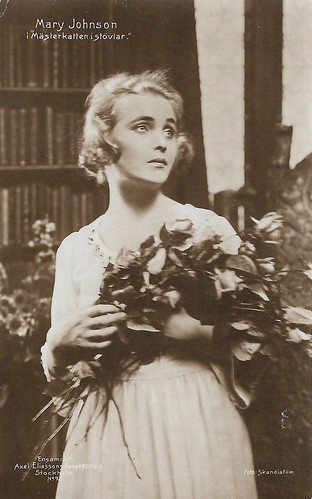
Mary Johnson in Mästerkatten i stövlar (1918)
Swedish postcard by Axel Eliassons Konstförlag, Stockholm, no. 92. Photo: Skandia Film. Gösta Ekman, Mary Johnson and Carl Keil-Möller in Mästerkatten i stövlar/Puss in boots (John W. Brunius, 1918).

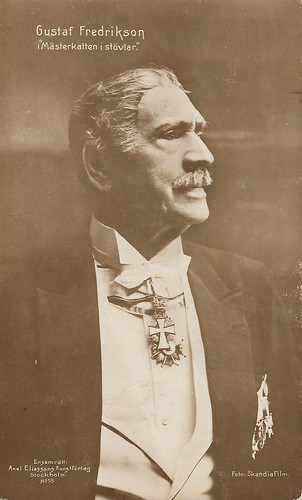
Gustaf Fredrikson in Mästerkatten i stövlar (1918)
Swedish postcard by Axel Eliassons Konstförlag, Stockholm, no. 95. Photo: Skandia Film. Gustaf Fredrikson in Mästerkatten i stövlar/Puss in boots (John W. Brunius, 1918).

Mary Johnson in Mästerkatten i stövlar (1918)
Swedish postcard by Axel Eliassons Konstförlag, Stockholm, no. 96. Photo: Skandiafilm. Gösta Ekman, Mary Johnson and Carl Keil-Möller in Mästerkatten i stövlar/Puss in boots (John W. Brunius, 1918).

Mary Johnson in Mästerkatten i stövlar (1918)
Swedish postcard by Axel Eliassons Konstförlag, Stockholm, no. 97. Photo: Skandiafilm. Gösta Ekman, Mary Johnson and Carl Keil-Möller in Mästerkatten i stövlar/Puss in boots (John W. Brunius, 1918).

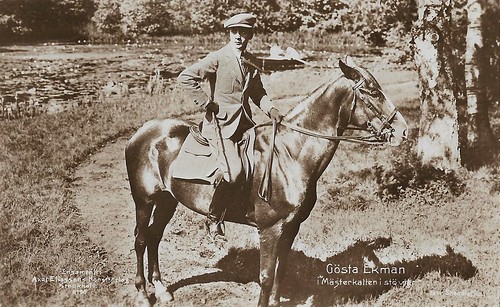
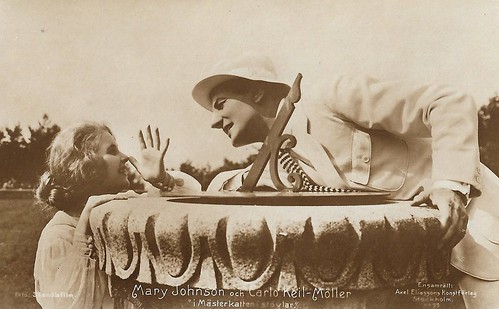
Young Jörgen Steenfeld (Carlo Keil-Möller), the heir of the over-indebted estate Steensgaard, is unable to clear up its finances. He is being looked after by his old friend, "Mästerkatten" (Puss in Boots, Gösta Ekman), ie the enterprising, charming but somewhat irreplaceable Karl Konstantin Kattrup, who has been relegated from the university.

Kattrup becomes manager at Steensgaard. Steenfeld receives visits by count and countess Markdanner and her daughter Rose (Anna Carlsten). The Countess (Märtha Lindlöf) is planning a marriage between Rose and Jörgen, but Jörgen is secretly in love with the orphan Helga Anthon, called Pips (Mary Johnson). Matters are further complicated by the affair between Kattrup and Rose.

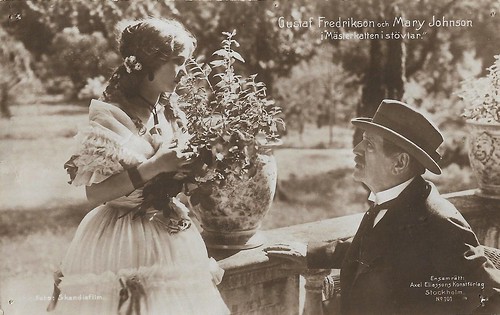
Kattrup is now turning to Steenfeld's largest creditor, Chamberlain von Schinkel (Gustaf "Frippe" Fredrikson), who is a good man and who advises Jörgen to marry Rose to set his finances straight. Kattrup also advises his friend to marry the Countess. With this planned marriage, Kattrup and Steenfeld succeed in holding another creditor from the carpet, the unpleasant schemer Bögedal (Sam Ask).

Steenfeld takes a painful parting of Pips, and the engagement is announced between Jörgen and Rose. None of them is happy: Jörgen just wants Pips, Rose just wants Kattrup. Jörgen realizes that he will make all parties unhappy if he marries Rose, so he breaks up the engagement, to the fiancée's joy. But poor Pips witnesses a love scene between Rose and Kattrup and misunderstands the situation as she confuses Kattrup and Jörgen from their point of view.

Despaired she falls out of a tree, is badly hurt and is taken care of by old von Schinkel who recognizes his youth love, Pips' grandmother. Bögedal takes advantage of the new situation to ensure that Steensgaard will be sold at an auction, where he himself intends to buy the goods. But at the auction, he is overbidden by Kattrup, on von Schinkel's behalf. The old chamberlain has adopted Pips and now grants Steensgaard to her and Jörgen. When these two get together, Kattrup can return to his Rose and everyone is happy except for the plotter Bögedal.

Gösta Ekman in Mästerkatten i stövlar
Swedish postcard by Axel Eliassons Konstförlag, Stockholm, no. 98. Photo: Skandiafilm. Gösta Ekman in Mästerkatten i stövlar/Puss in boots (John W. Brunius, 1918).
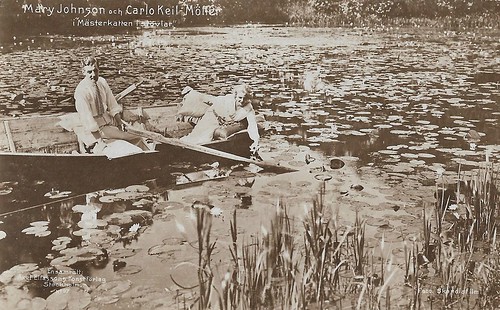
Mary Johnson and Carlo Keil-Möller in Mästerkatten i stövlar
Swedish postcard by Axel Eliassons Konstförlag, Stockholm, no. 99. Photo: Skandia Film. Mary Johnson and Carl(o) Keil-Möller in Mästerkatten i stövlar/Puss in boots (John W. Brunius, 1918).

Mary Johnson and Gustav Fredrikson in Mästerkatten i stövlar
Swedish postcard by Axel Eliassons Konstförlag, Stockholm, no. 101. Photo: Skandia Film. Mary Johnson and Gustaf Fredrikson in Mästerkatten i stövlar/Puss in boots (John W. Brunius, 1918).

De landsflyktiga (1921)


Jenny Hasselqvist in De landsflyktiga (1921)
Swedish postcard by Ed. Axel Eliassons Konstförlag, Stockholm, no. 293. Photo: Skandia Film, Stockholm/Svensk Filmindustri. Jenny Hasselquist in De landsflyktiga/The Emigrants/The Exiles (Mauritz Stiller, 1921).

Jenny Hasselqvist in De landsflyktiga (1921)
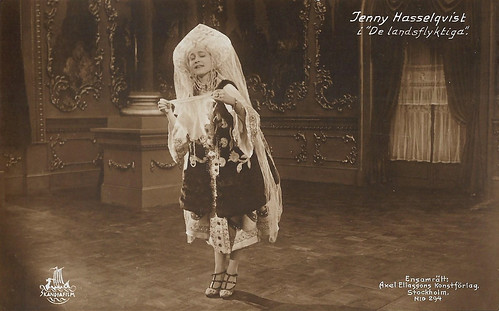
Swedish postcard by Ed. Axel Eliassons Konstförlag, Stockholm, no. 294. Photo: Skandia Film, Stockholm/Svensk Filmindustri. Jenny Hasselquist in De landsflyktiga/The Emigrants/The Exiles (Mauritz Stiller, 1921).

Lars Hanson in De landsflyktiga (1921)
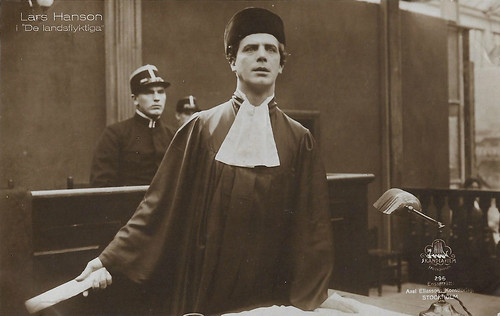
Swedish postcard by Ed. Axel Eliassons Konstförlag, Stockholm, no. 296. Photo: Skandia Film, Stockholm/Svensk Filmindustri. Jenny Hasselquist and Lars Hanson in De landsflyktiga/The Emigrants/The Exiles (Mauritz Stiller, 1921).

De landsflyktiga/The Emigrants/The Exiles (Mauritz Stiller, 1921) was shot in the studios of Filmstaden Råsunda with exteriors at Steninge castle, Stadsgårdskajen and other locations in Stockholm, shot by cinematographer by Henrik Jaenzon. The film was based on Runar Schildt's short story 'Zoja' (1920), which was published in the short story collection Häxskogen. It was during the filming of The Exiles that Stiller, who had been a Russian citizen since his birth in Helsinki, applied to become a Swedish citizen.

The wealthy Barantscheff family lives on the stately Staraja-Selo estate in the heart of Russia. Prince Ivan Ivanovich (Carl Nissen), his wife Ivanovna Stefanovna (Karin Swanstrom), their daughter Sonja (Jenny Hasselqvist) and son Yuri (Nils Ohlin), a lieutenant in the Russian navy who is recovering at home after being wounded in the war. The First World War is in full swing and storm clouds are gathering everywhere. The wealthy banker Andrei Andreyevich Myasoyedoff (Ivan Hedqvist) approaches the prince and proposes to sell the estate because of the troubled times. The prince takes the offer as an insult and refuses. Myasoyedoff has also set his eyes on Sonya, but she has already brusquely rejected him. One day, Sonya, while driving alone, rescues the young revolutionary student Vladimir Alexandrovich Mikhailoff (Lars Hanson), who is being chased by the gendarmes.

When the revolution breaks out, it is Vladimir who helps Sonja and her parents to escape across the border. The family settles in a major international city, perhaps Paris, and continues their former, carefree life of luxury, waiting for the revolution to be crushed so they can return to their former lives at home. But their inherited wealth quickly dwindles, and it is Myasoyedoff, who has also come there as a refugee, who helps them financially. He has managed to bring most of his fortune with him and is already involved in big business. The student Vladimir, a refugee from his former comrades, also arrives. One fine day, the Barantscheff family finds itself on the rocks. But Myasoyedoff is happy to oblige if only Sonya would be a little more accommodating to him.

But Sonja stubbornly refuses. In an upset scene, she rips off all the family jewels she wore to the evening's charity party and gives them as collateral instead of herself for the family's debt. Myasoyedoff takes the jewels and smilingly adds that the pledge is due at the end of the year. On New Year's Eve, Myasoyedoff is found dead in his villa, with Sonya lying unconscious outside. Vladimir, now a lawyer, defends Sonja in court. She admits that she shot Myasoyedoff when he tried to rape her. Afterwards, she threw the revolver from the balcony. But no revolver has been found.

In a break during the last day of the trial comes the explanation. Vladimir confesses to Sonja during a visit to her cell that it was he who shot Myasoyedoff on behalf of his comrades. Myasoyedoff was spying on the emigrants on behalf of the Bolshevik government, and many of their relatives remaining in Russia had already been shot. Myasoyedoff was an informer, Vladimir is the real killer, and Sonya now holds his fate in her hands. But Vladimir's defence speech in court for Sonja leads to her acquittal. She and Vladimir are united, and Sonja utters the film's final line, which it was hoped at the time would have a prophetic meaning: "Out of the darkness that oppresses us, a new Russia will one day arise, a Russia that we can both love." De landsflyktiga/The Emigrants/The Exiles is a lost film, except for a few very short fragments.

Source: Svenskfilmdatabas.

This post was last updated on 31 July 2024.

05 November 2022

Körkarlen (1921)

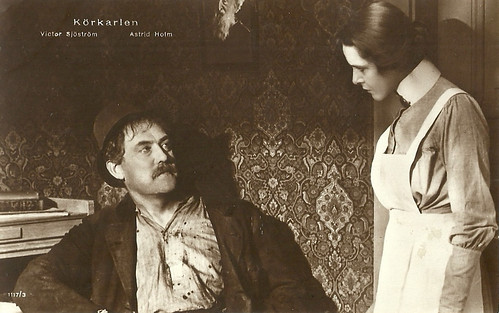
Victor Sjöström's poetic and touching Körkarlen/The Phantom Carriage (Victor Sjöström, 1921) is considered by many film critics the best Swedish film of all time. The silent masterpiece is one of Sjöström's adaptations of the novellas by Selma Lagerlöf. Sjöström himself plays the down-and-out alcoholic, David Holm, who neglects a wish of a dying woman and is forced to take over the phantom carriage for a full year, collecting the souls of the dead. The film was produced by AB Svensk Filmindustri and Förlag Nordisk Konst in Stockholm made a series of wonderful sepia postcards for the film.

Körkarlen (1920)
Swedish postcard by Förlag Nordisk Konst, Stockholm, no. 1117/1. Photo: Svensk Filmindustri. Victor Sjöström in Körkarlen/The Phantom Carriage (Victor Sjöström, 1921).

Körkarlen (1920)
Swedish postcard by Förlag Nordisk Konst, Stockholm, no. 1117/2. Photo: Svensk Filmindustri. Astrid Holm in Körkarlen/The Phantom Carriage (Victor Sjöström, 1921).

Victor Sjöström and Astrid Holm in Körkarlen
Swedish postcard by Förlag Nordisk Konst, Stockholm, no. 1117/3. Photo: Svensk Filmindustri. Victor Sjöström and Astrid Holm in Körkarlen/The Phantom Carriage (Victor Sjöström, 1921).

The legend of the Phantom Carriage


In Körkarlen/The Phantom Carriage (1920), the terminally ill Salvation Army nurse Edit (Astrid Holm) asks on New Year's Eve, her younger companions Maria (Lisa Lundholm) and Gustafsson (Tor Weijden) for one last wish: that they bring David Holm (Victor Sjöström) to her deathbed.

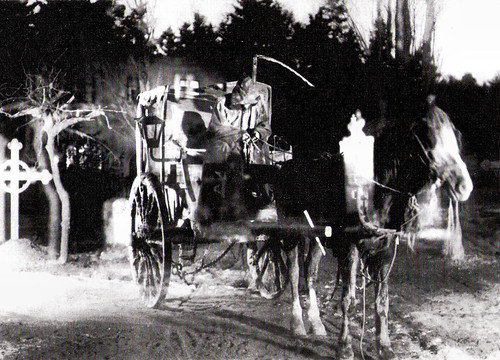
Meanwhile, David, a down-and-out alcoholic, gets drunk with two drinking buddies in a cemetery. He tells them about his former friend Georges (Tore Svennberg), who once told him the legend of the Phantom Carriage. This states that the last person to die in the old year is required by Death to collect the souls of the deceased in his carriage for the duration of the following year until the burden is transferred to a new person at the end of the year.

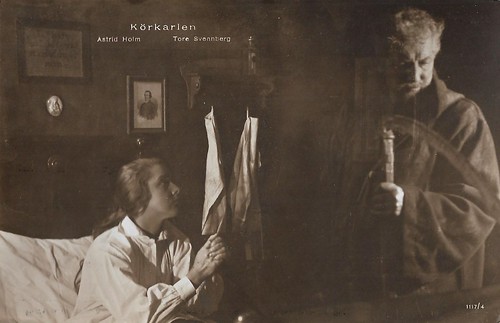
Gustafsson finds David in the cemetery and tries to persuade him to pay Edit his last visit, but he refuses. An argument breaks out with his cronies over his harsh rejection of the request, in the course of which David is mortally wounded. The carriage of death appears, driven by Georges. The latter had died a year ago on New Year's night and declared David his successor.

Georges takes David on a trip down memory lane to his once happy family life with his wife Anna Holm (Hilda Borgström) and their two children. This ended when David got involved with Georges and his drinking companions. He had to serve a prison sentence for drunkenness but professed to be on the mend when he was released. However, when he returned home to find that his wife had left him, he went back on his vow.

On New Year's Eve a year ago, David sought out the Salvation Army dormitory. Despite the warning of her fellow sister, Edit mended his coat without disinfecting it first, contracting tuberculosis in the process. The next morning, as a parting taunt, David promises to call on her next year at the same time so she can see if her prayers for his salvation have been answered. Georges points out to David that this promise must now be fulfilled.

In further flashbacks, we see how Edit, although she had fallen in love with the fallen man, snatched him from his milieu to reunite him with his wife. David, however, soon fell back into his former habits and threatened his family. In a fit of frenzy, after his wife locked him in the kitchen, he smashed the door with an axe. When the carriage enters Edit's room with David, she at first pleads for her life until she recognises David.

She blames herself for the fate of his family since she had reunited him with his wife at the time. The remorseful David kisses her hands, whereupon Edit dies in peace. Georges then brings David to Anna, who is about to kill her children and herself out of despair. In an act of selflessness, David begs God to prevent the desperate act, even if he has to pay for it eternally. As a result, he gets his life back. David and Anna embrace each other in tears.

Körkarlen (1920)
Swedish postcard by Förlag Nordisk Konst, Stockholm, no. 1117/4. Photo: Svensk Filmindustri. Astrid Holm and Tore Svennberg in Körkarlen/The Phantom Carriage (Victor Sjöström, 1921).

Körkarlen
Italian programme card for Il Cinema Ritrovata 2003. Photo: publicity still for Körkarlen/The Phantom Carriage (Victor Sjöström, 1921).

Intensive use of special effects


As early as 1917, A-B Svenska Biografteater, whose merger with Filmindustri AB Scandia created AB Svensk Filmindustri in 1919, had signed a contract with Selma Lagerlöf to bring one of her works to the screen each year. In 1920, Victor Sjöström had already filmed three novels since the contract was signed: Tösen från Stormyrtorpet/The Girl from the Marsh Croft (Victor Sjöström, 1917), Ingmarssönerna/Sons of Ingmar (1919) and Karin Ingmarsdotter/God's Way/Karin Daughter of Ingmar (1920). The latter two were both based on chapters of Lagerlöf's novel 'Jerusalem' (1901-1902), about religious emigrants from Sweden to Palestine. Lagerlöf would win the Nobel Prize for Literature for 'Jerusalem'. Victor Sjöström's film adaptations had been consistently well received by critics, audiences and Lagerlöf herself.

Since the productions had all been set in rural surroundings, Sjöström chose the urban-themed novella 'Körkarlen' (Thy Soul Shall Bear Witness!) as his new project, Körkarlen/The Phantom Carriage (1921). Filming took place at Filmstaden Studios in Solna between May and July 1920. The studio buildings were inspired by the southern Swedish town of Landskrona. Lagerlöf originally wanted to have the film shot on location in Landskrona, but Sjöström decided on a studio production due to the technical possibilities.

The post-production turned out to be an unusually elaborate affair for cinematographer Julius Jaenzon and lab supervisor Eugén Hellman due to the intensive use of special effects. Jaenzon had previously worked with double exposure in Herr Arnes pengar/Sir Arne's Treasure (Mauritz Stiller, 1919), another Lagerlöf adaptation in which Victor Sjöström was not involved, but in this case, several image layers were superimposed. In this way, it was made possible for the ghost figures to move in the picture in three-dimensional space. As soon as they stood in front of a solid object, it shone through the transparent body. This technical achievement must be rated all the more highly because it must be remembered that the cameras in use at the time were still operated with hand cranks.

Körkarlen/The Phantom Carriage (Victor Sjöström, 1920) premiered at 1 January 1921, New Year's Eve. It was a success at the time and is now seen as one of the classics of Swedish silent cinema. In the Lexicon des internationalen Films, Josef Nagel reviewed the film as follows: "An impressive cinematic 'eerie ballad' based on the novel by Selma Lagerlöf. Within the complex narrative and flashback structure, mystical elements meet realistic scenes that denounce social ills resulting from industrialisation. Thanks to great emotional moments, the film unfolds in an atmospherically dense way despite its rather pedagogical, didactic message."

The film had a lasting influence on the work of Ingmar Bergman, who used the character of Death in Det sjunde inseglet/The Seventh Seal (1957) and created a direct reference to the carter of Körkarlen/The Phantom Carriage (1921) by titling him "disciplinarian." In addition, Bergman enlisted Sjöström to star in Smultronstället/Wild Strawberries (1957). It was his final role. Bergman once reported that he had first watched Körkarlen at the age of 15 and every year since. In 2000, Ingmar Bergman made the TV drama Bildmakarna/The Image Makers (2000), which fictionalised the story of the making of Körkarlen/The Phantom Carriage (1920) with Anita Björk as Selma Lagerlöf and Lennart Hjulström as Victor Sjöström.

Remakes were directed by Julien Duvivier, La charrette fantôme/The Phantom Carriage (1939) starring Pierre Fresnay and Marie Bell, and by Arne Mattsson Körkarlen/The Phantom Carriage (1958) with George Fant, Ulla Jacobsson and Anita Björk. In 2012, Körkarlen/The Phantom Carriage (1921) was named the best Swedish film of all time by 50 film critics and connoisseurs in a poll conducted by the Swedish film magazine FLM.

Körkarlen (1920)
Swedish postcard by Förlag Nordisk Konst, Stockholm, no. 1117/6. Photo: Svensk Filmindustri.Victor Sjöström and Tore Svennberg in Körkarlen/The Phantom Carriage, (Victor Sjöström, 1921).

Victor Sjöström in Körkarlen - The Phantom Carriage
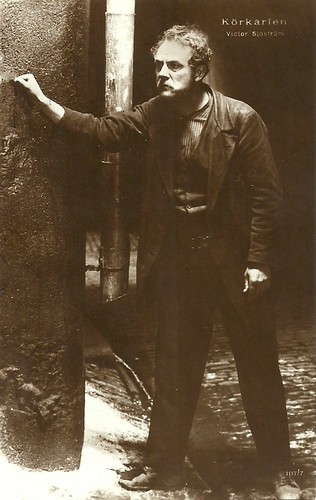
Swedish postcard by Förlag Nordisk Konst, Stockholm, no. 1117/7. Photo: Svensk Filmindustri. Victor Sjöström in Körkarlen/The Phantom Carriage, (Victor Sjöström, 1921).

Victor Sjöström
French postcard by Editions Cinémagazine, no. 146. Victor Sjöström.

Sources: Wikipedia (German and English), and IMDb.

30 April 2019

Thomas Graals bästa film (1917)

The Swedish silent comedy Thomas Graals bästa film/Thomas Graal's Best Film (Mauritz Stiller, 1917), scripted by Gustav Molander (as Harald B. Harald), deals with a screenwriter who falls in love with his secretary Bessie and imagines himself rescuing her from poverty. Reality is quite different as Bessie is a modern woman. The film also mocks the bored aristocracy involved in the modernity of filmmaking. Victor Sjöström and Karin Molander starred in this delicious little gem.

Thomas Graals bästa film
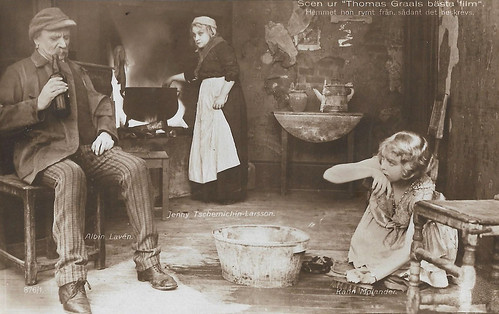
Swedish postcard by Ed. Nordisk Konst, Stockholm, no. 876/1. Photo: Svenska Biografteatern AB. Publicity still for Thomas Graals bästa film/Thomas Graal's Best Film (Mauritz Stiller, 1917). Caption: The home she ran away from, as it was described. Karin Molander as Bessie, with her parents played by Albin Lavén and Jenny Tschernichin-Larsson.

Victor Sjöström and Karin Molander in Thomas Graals bästa film (1917)
Swedish postcard by Ed. Nordisk Konst, Stockholm, no. 876/2. Photo: Svenska Biografteatern AB. Victor Sjöström, Karin Molander and Gucken Cederborg in Thomas Graals bästa film/Thomas Graal's Best Film (Mauritz Stiller, 1917). Caption: Writer Thomas Graal has been shopping.

Victor Sjöström in Thomas Graals bästa film (1917)
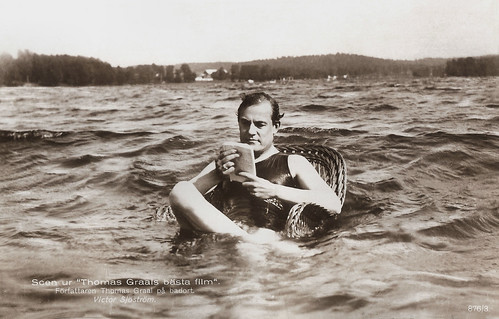
Swedish postcard by Ed. Nordisk Konst, Stockholm, no. 876/3. Photo: Svenska Biografteatern AB. Publicity still for Thomas Graals bästa film/Thomas Graal's Best Film (Mauritz Stiller, 1917) with Victor Sjöström. Caption: The author Thomas Graal at sea.

Thomas Graals bästa film
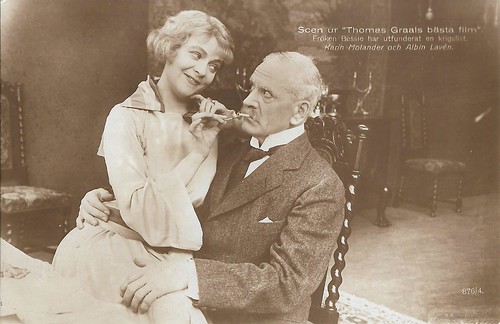
Swedish postcard by Ed. Nordisk Konst, Stockholm, no. 876/4. Photo: Svenska Biografteatern AB. Publicity still for Thomas Graals bästa film/Thomas Graal's Best Film (Mauritz Stiller, 1917), with Karin Molander as Bessie and Albin Lavén, who plays her father. Caption: Miss Bessie has invented a war stratagem.

An adorable romantic comedy, a social tract and one of the first films about filmmaking


In Thomas Graals bästa film/Thomas Graal's Best Film (Mauritz Stiller, 1917), the great Victor Sjöstrom stars as Thomas Graal, a screenwriter. He is very fond of his secretary Bessie, played by the lovely Karin Molander. However, she runs away from his kisses and embraces. In fact, Bessie has already run away earlier from her proper and domineering mother and her bumbling father to go to the big city, where she claimed to Thomas Graal that her parents are poor and mistreated just to get her a job as his secretary.

After she has run away from Thomas' kisses and embraces, Bessie is forced by family servants to go back to her parent's home. In his misfortune, Thomas Graal has run out of ideas. He embroiders Bessie's tall tales to create a screenplay and insists that Bessie must be found to play the lead with him in order to meet her again.

At IMDb, The Red Dutchess writes: "'Thomas Graal's Best Film' is one of the best comedies of the silent era. It works as an adorable romantic comedy about a concupiscent novelist who falls for his secretary; as a startling social tract, with the desiccated aristocracy giving onto the modern world of cinema, entrepreneurs and the New Woman; as one of the first films about filmmaking - there is an exquisite parody of Griffith's monumental 'Intolerance', as the actor playing a hanged criminal complains about the pain of being hoist from a ceiling."

"Stiller's movie shows a thrilling modernity in this sequence as it blurs not only the reality of Graal's writing and the fantasy he imagines, but also intrudes Bessie's own story: she disrupts his narrative just as she disrupts all the forces of (male) power that would try to pin her down. Bessie is one of the great heroines of silent film, permanently amused by the absurd complacency of the inferiors surrounding her, with a gorgeous, generous grin suggesting both a taste for playfulness, and a voracious sexual appetite. The scene where she flees her father and ritualistically forces him to abandon his paternalistic intentions by destroying the bridge between them is hilarious but provocative."

Thomas Graals bästa film/Thomas Graal's Best Film (Mauritz Stiller, 1917) was shot at Svenska Biografteatern's studio at Lidingö with exteriors filmed by Henrik Jaenzon at Restaurant Blå Portens garden at Djurgården and various places in Stockholm.

Thomas Graals bästa film/Thomas Graal's Best Film was premiered on 13 August 1917 at the cinema Röda Kvarn in Stockholm. A year later, the film got a sequel, Thomas Graals bästa barn/Thomas Graal's best child (Mauritz Stiller, 1918) with mostly the same cast and crew.

Karin Molander in Thomas Graals bästa film (1917)
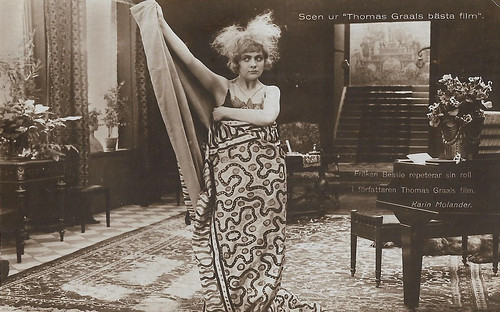
Vintage Swedish postcard by Ed. Nordisk Konst., Stockholm, no. 876/... Photo: Svenska Biografteatern AB. Karin Molander vamping in Thomas Graals bästa film/Thomas Graal's Best Film (Mauritz Stiller, 1917), scripted by Gustav Molander. Caption: Miss Bessie is practising her role in the writer Thomas Graal's film.

Thomas Graals bästa film
Swedish postcard by Ed. Nordisk Konst, Stockholm, no. 876/7. Photo: Svenska Biografteatern AB. Publicity still for Thomas Graals bästa film/Thomas Graal's Best Film (Mauritz Stiller, 1917), with Victor Sjöstrom. Caption: Thomas is found outside of the end-of-life home.

Thomas Graals bästa film
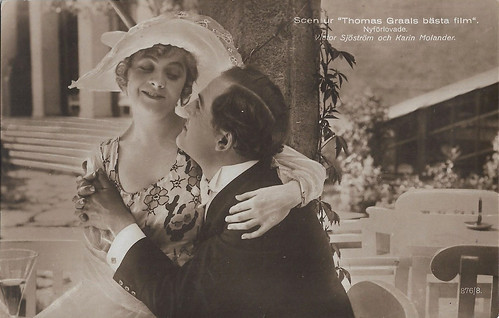
Swedish postcard by Ed. Nordisk Konst, Stockholm, no. 876/8. Photo: Svenska Biografteatern AB. Publicity still for Thomas Graals bästa film/Thomas Graal's Best Film (Mauritz Stiller, 1917), with Victor Sjöström and Karin Molander. Caption: The newly engaged ones.

Thomas Graals bästa film
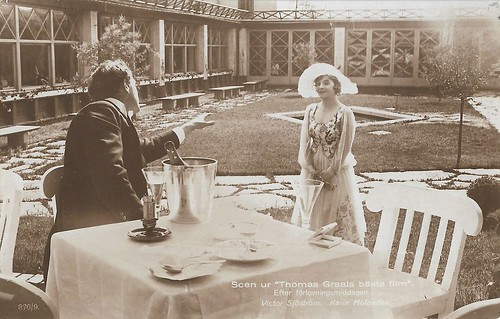
Swedish postcard by Ed. Nordisk Konst, Stockholm, no. 876/9. Photo: Svenska Biografteatern AB. Publicity still for Thomas Graals bästa film/Thomas Graal's Best Film (Mauritz Stiller, 1917), with Victor Sjöström and Karin Molander. Caption: After the engagement dinner.

Thomas Graals bästa film
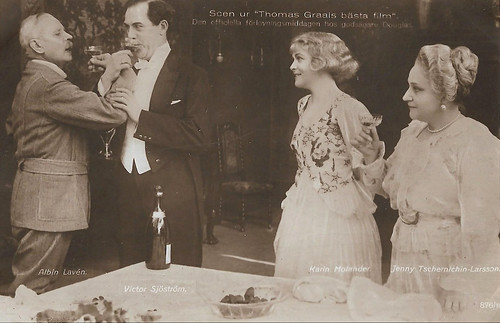
Swedish postcard by Ed. Nordisk Konst, Stockholm, no. 876/10. Photo: Svenska Biografteatern AB. Publicity still for Thomas Graals bästa film/Thomas Graal's Best Film (Mauritz Stiller, 1917). Caption: The official engagement dinner with landlord Douglas and his wife, Bessie's parents (played by Albin Lavén and Jenny Tschernichin-Larsson).

Sources: The Red Dutchess (IMDb), Wikipedia (Swedish) and IMDb.
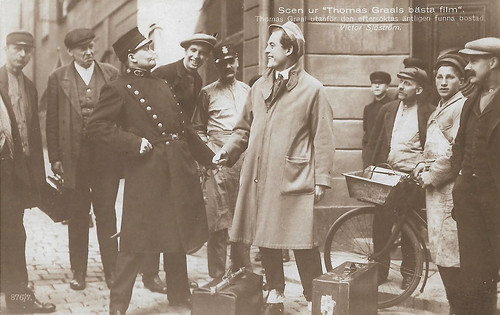
This post was last updated onm 10 July 2022.