Showing posts with label André Brulé. Show all posts

30 June 2021

André Brulé

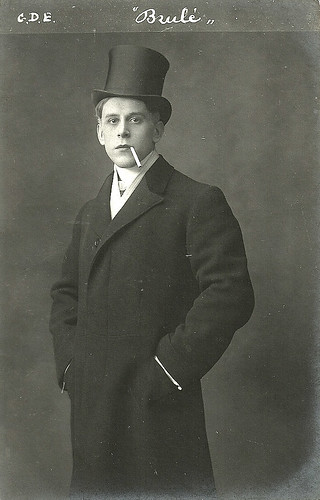
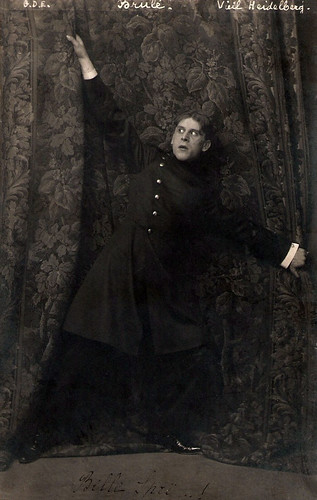
Normally Italian divas clutch to the curtains, but here it's André Brulé (1879-1953). This French actor created Arsène Lupin on stage and also played in several films.

André Brulé in Vieil Heidelberg
Belgian postcard by G.D.E. (G. Dupont-Emera, Rue Royale 142, Bruxelles). Photo: publicity still for the stage play 'Vieil Heidelberg' (Old Heidelberg, 1909).

André Brulé in Vieil Heidelberg
Belgian postcard by G.D.E. (G. Dupont-Emera, Rue Royale 142, Bruxelles). Photo: publicity still for the stage play 'Vieil Heidelberg' (Old Heidelberg, 1909)
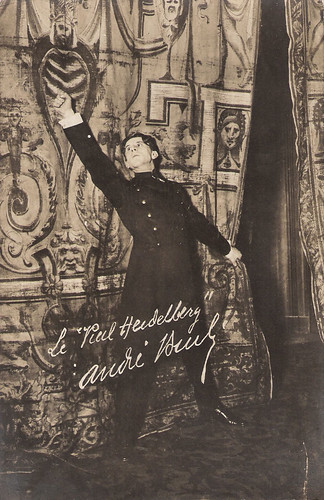
André Brulé in Vieil Heidelberg
French postcard. Photo: publicity still for the stage play Vieil Heidelberg (Old Heidelberg, 1909).
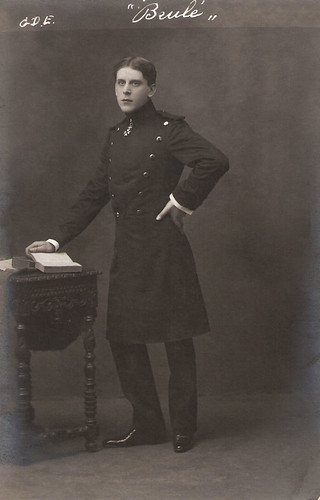
André Brulé
Belgian postcard by G.D.E. Photo: publicity still for the stage play 'Vieil Heidelberg' (Old Heidelberg, 1909).
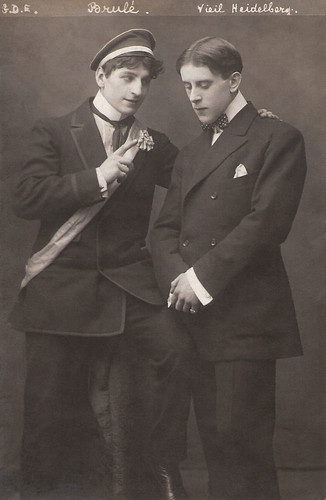
André Brulé in Vieil Heidelberg
Belgian postcard by G.D.E. Photo: publicity still for the play 'Vieil Heidelberg' (Old Heidelberg, 1909). Sent by mail in Belgium in 1909.
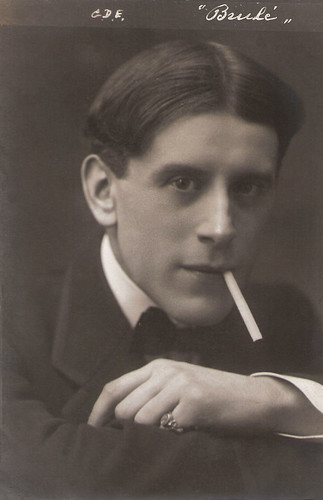
André Brulé
Belgian postcard by G.D.E.

Arsène Lupin


André Brulé was born as André Gresely in Bordeaux, France in 1879.

He was the first actor to impersonate the gentleman thief Arsène Lupin, the hero of the crime fiction novels written by French writer Maurice Leblanc. In Francophone countries, Lupin has enjoyed a popularity as long-lasting and considerable as Sherlock Holmes in the English-speaking world.

Brulé played the double role of Lupin and his alter ego Duc de Charmerace in the stage play 'Arsène Lupin - Nouvelles Aventures' (Arsène Lupin - New Adventures) (1908). The play was written by Francis de Croisset and Maurice Leblanc, and directed by M. Deval. It was staged at the Athenee Theatre in Paris, where Brulé had already performed successfully for several years. Opposite Brulé played Escoffier as Inspector Guerchard.

In 1909 Brulé appeared on stage in another great hit: 'Vieil Heidelberg' (Old Heidelberg). This was the French version of 'Alt Heidelberg', a popular German stage play by Wilhelm Meyer-Förster, staged in France for the first time in 1906, at the Theatre Antoine, in a translation by Maurice Remon & W. Bauer. Later it was staged a.o. at the Odeon Theatre in Paris in the seasons 1906-1907, 1907-1908, 1912-1913 and 1931-1932.

The play knew many adaptations for the cinema. John Emerson directed Old Heidelberg (1915) with Wallace Reid and Lilian Gish. Ernst Lubitsch adapted it as The Student Prince of Old Heidelberg (1927), starring Ramon Novarro and Norma Shearer. In Germany the first of several film adaptations was done by Hans Behrendt in 1923, starring Paul Hartmann and Eva May.

André Brulé in Vieil Heidelberg
Belgian postcard by G.D.E. (G. Dupont-Emera, Rue Royale 142, Bruxelles).
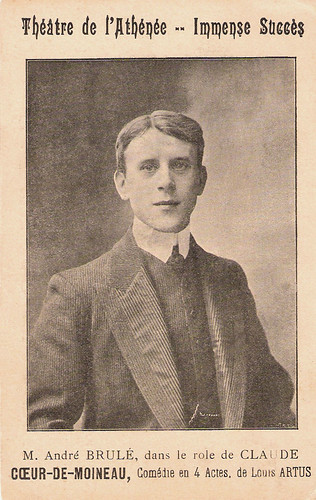
André Brulé
French postcard by Théâtre de l'Athénée, Paris. Photo: publicity still for the boulevard play Coeur de Moineau (Sparrow Heart, 1905) by Louis Artus.
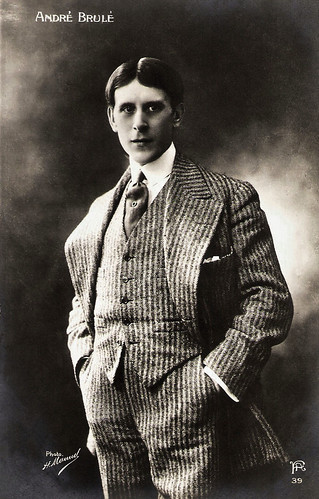
André Brulé
French postcard by FA, no. 39. Photo: Henri Manuel.
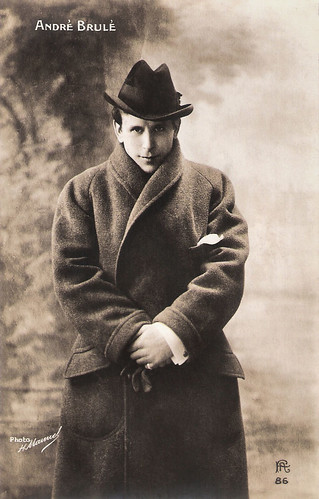
André Brulé
French postcard by FA, no. 86. Photo: Henri Manuel.
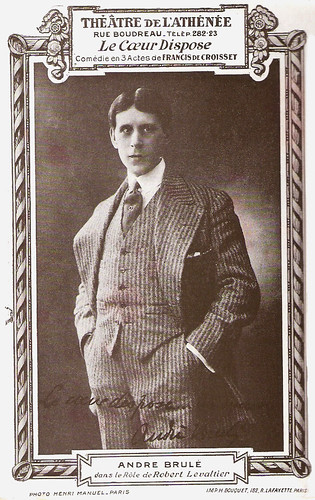
André Brulé
French postcard by Imp. H. Bouquet, Paris for Théâtre de l'Athénée. Photo: Henri Manuel. Publicity still for 'Le Coeur Disposé' (The Arranged Heart, 1912) by Francis de Croisset.

Thief-turned-cop


André Brulé also appeared in several films. He made his first film appearance as young Werther in the early silent short Werther (Henri Pouctal, 1912), a prestigious Pathé production based on the famous literary novel by Johann Wolfgang Goethe which is considered now lost. Other short silent films were Le club des élégants/The Elegant Club (René LePrince, 1912), and Les frères corses/The Corsican brothers (Antoine, 1917) based on the novel by Alexandre Dumas père.

Brulé returned to the screen in the late 1930s. He played such protagonists as the thief-turned-cop François-Eugene Vidocq in Vidocq (Jacques Daroy, 1938), Zoltini in Métropolitain (Maurice Cam, 1939) with Albert Préjean, and Monsieur de Nogrelles in Retour de flamme/The Flame Returns (Henri Fescourt, 1943). Probably his most interesting film of this period was Les gens du voyage/People Who Travel (Jacques Feyder, 1938) in which he appeared as Fernand opposite Françoise Rosay as a middle-aged lion-tamer.

At Films de France, James Travers reviews: "What is perhaps most striking about Les Gens du voyage is how fresh and modern the film still feels. This is partly due to its daring mix of cinematic styles, reflecting the rapid evolution of cinema in the late 1930s. The liberal use of location filming gives the film a neo-realist feel in places; the plot is a mix of melodrama and policier; and elements of early film noir and poetic realism are also noticeable. Some engaging comic touches provide a pleasing contrast to the film's darker moments, without undermining the dramatic content. What is surprising, and what is surely a sign of its director’s genius, is the way in which Feyder manages to combine all these different styles and themes and delivers a work that is cohesive and satisfying."

On stage, Brulé appeared among many, many more in 'L'Épervier' (1914) by Francis de Croisset at the Théâtre de l'Ambigu, 'Le Vertige' (1914) by Charles Méré at the Théâtre de Paris and 'Les Monstres sacrés' (1940) by Jean Cocteau at the Théâtre Michel.

André Brulé died in Paris, in 1953. He was married to French comedy actress Ghislaine Dommanget, but the couple later divorced and she remarried with Louis II, Prince of Monaco.
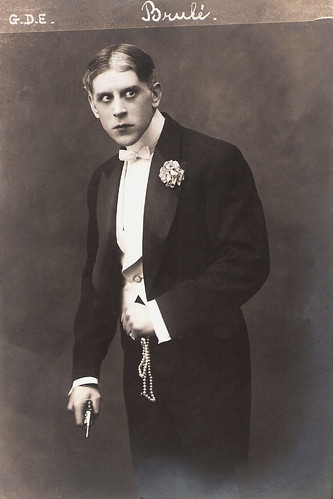
André Brulé
Belgian postcard by G.D.E. Photo: publicity still for the stage play Arsène Lupin - Nouvelles Aventures (Arsène Lupin - New Adventures, 1908).
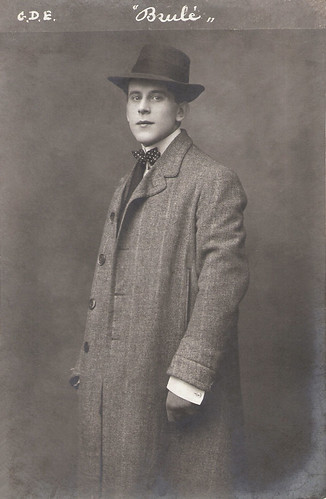
André Brulé
Belgian postcard by G.D.E.

Andre Brulé
Belgian postcard by G.D.E.

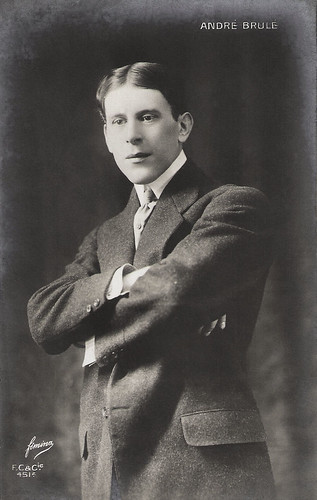
André Brulé
French postcard by F.C. & Cie, no. 451a. Photo: Fémina.
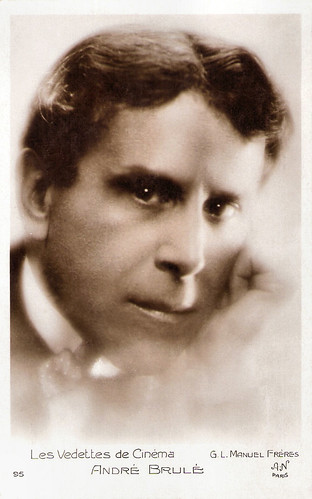
André Brulé
French postcard by A.N., Paris in the Les Vedettes de Cinéma series, no. 95. Photo: G.L. Manuel Frères.

Sources: James Travers (French Films), Hal Erickson (AllMovie), Wikipedia and IMDb.

This post was last updated on 19 August 2023.

19 June 2021

G. Dupont-Emera (G.D.E.)

Amazing is the right word for this series of early 20th-century postcards by G.D.E. French actors are portrayed in unusual, sometimes lively poses which seem like improvisations for the camera. The photos and the postcards were made in Belgium by G. Dupont-Emera in Brussels and the French actors probably visited his studio at the Rue Royale 124 and 142 between 1898 and 1909 when they performed on a stage in the Belgian capital. Dupont started his first studio in Brussels in 1896 at 43 Montagne de la Cour (1896-1900). His final studio was located at 44 Rue de la Ligne. Little else is known about photographer and publisher G. Dupont-Emera (1865-?) or Dupont, but EFSP salutes his work!

André Brulé in Vieil Heidelberg
Belgian postcard by G.D.E. (G. Dupont-Emera), Rue Royale 142, Bruxelles. André Brulé in the play 'Vieil Heidelberg' (Alt Heidelberg) (1906). The card was sent by mail in 1909. 'Alt Heidelberg' was a popular German stage play by Wilhelm Meyer-Förster. It was staged in France for the first time in 1906, at the Theatre Antoine, in a translation by Maurice Remon & W. Bauer. It knew many adaptations for the cinema. Ernst Lubitsch adapted it as The Student Prince of Old Heidelberg (1927), starring Ramon Novarro and Norma Shearer.

French actor André Brulé (1879-1953) created Arsène Lupin on the stage (1908, Athenee, Paris). Brulé also played in such films as Werther (1910), Le club des élégants (1912), and Les frères corses (1917). in the late 1930s, he also played several protagonists such as the lead in Vidocq (1938), Fernand in Les gens du voyage (1938), and Monsieur de Nogrelles in Retour de flamme (1943).

Jules Berry
Belgian postcard by G.D.E. (G. Dupont-Emera), Rue Royale 142, Bruxelles.

French actor and director Jules Berry (1883-1951) is best remembered for his superb character work in the films by Jean Renoir and Marcel Carné.

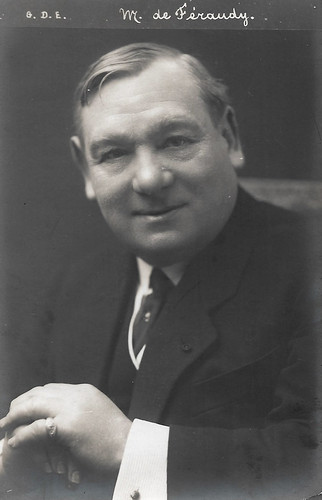
Maurice de Féraudy
Belgian postcard by G.D.E. (G. Dupont-Emera), Rue Royale 142, Bruxelles.

Maurice de Féraudy (1859-1932) was a French director and an actor of the Comédie-Française. He was also a notable actor and director in French silent cinema.

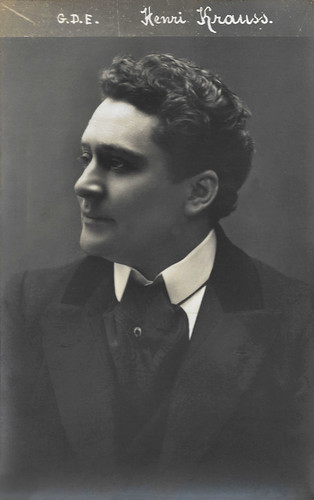
Henry Krauss
Belgian postcard by G.D.E. (G. Dupont-Emera), Rue Royale 142, Bruxelles.

French actor and director Henry Krauss (1866-1935) was a veteran of European cinema. From 1908 on he starred in several powerful character roles in early silent films.

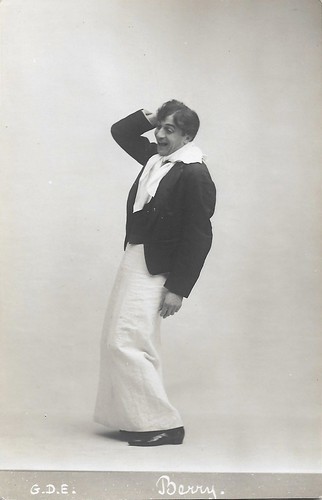
Jules Berry


Jules Berry
French postcard by G.D.E. (G. Dupont-Emera). At the start of his stage career, actor Jules Berry played for twelve years at the Galeries Saint-Hubert theatre in Brussels. The Brussels public gave him a very warm welcome. He played in particular in the comedy Le Mariage de Mademoiselle Beulemans, which had its premiere in 1910 at the Théâtre de l'Olympia in Brussels, and became a big success in Belgium and abroad, and was also turned into an operetta (1912) and film adaptations (1927, 1932, 1950). Berry's outfit in this card may well refer to this popular play. He played Albert, a Parisian employee of the brewer Beulemans, and not only in Brussels but also in the Paris and London performances of the play.

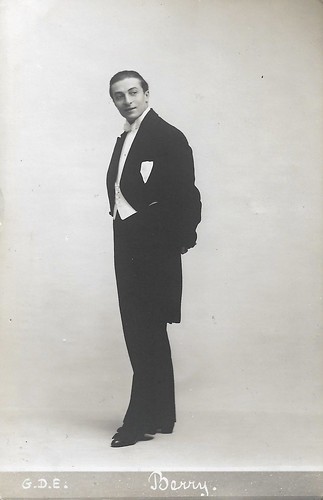
Jules Berry
Belgian postcard by G.D.E. (G. Dupont-Emera).

Jules Berry
Belgian postcard by G.D.E. (G. Dupont-Emera).

André Brulé


André Brulé in Vieil Heidelberg
Belgian postcard by G.D.E. (G. Dupont-Emera).

André Brulé
Belgian postcard by G.D.E. (G. Dupont-Emera, Bruxelles). André Brulé must have done a large photo shoot for Dupont, as many cards by GDE exist of him, either in his princely uniform from the play 'Vieil Heidelberg', or in his "ordinary" clothes.

André Brulé in Vieil Heidelberg
Belgian postcard by G.D.E. (G. Dupont-Emera, Bruxelles). André Brulé an unknown actor in the play 'Vieil Heidelberg' (Old Heidelberg). Sent by mail in Belgium in 1908.

André Brulé
Belgian postcard by G.D.E. (G. Dupont-Emera, Bruxelles).

André Brulé
Belgian postcard by G.D.E. (G. Dupont-Emera, Bruxelles).

Andre Brulé
Belgian postcard by G.D.E. (G. Dupont-Emera, Bruxelles).

André Brulé
Belgian postcard by G.D.E. (G. Dupont-Emera, Bruxelles).

André Brulé in Vieil Heidelberg
Belgian postcard by G.D.E. (G. Dupont-Emera, Bruxelles).

Henry Krauss


Henry Krauss
Belgian postcard by G.D.E. (G. Dupont-Emera, Bruxelles).

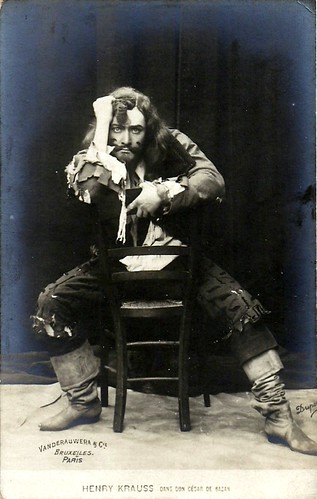
Henry Krauss in Don César de Bazan
Belgian postcard by Ed. Vanderauwera & Cie., Bruxelles. Photo: Dupont. Caption: Henry Krauss in 'Don César de Bazan'. 'Don César de Bazan' is an opéra comique by Jules Massenet, based on the drama 'Ruy Blas' by Victor Hugo.

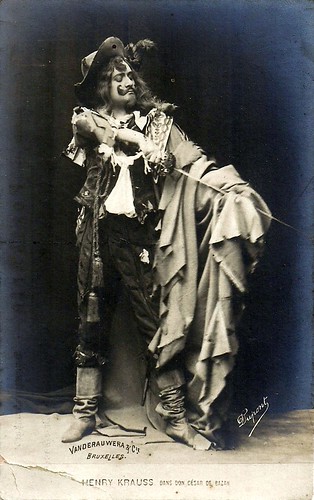
Henry Krauss
Belgian postcard by Ed. Vanderauwera & Cie., Bruxelles. Photo: Dupont. Caption: Henry Krauss in 'Don César de Bazan'. 'Don César de Bazan' is an opéra comique by Jules Massenet, based on the drama 'Ruy Blas' by Victor Hugo.

Henry Krauss
Belgian postcard by Ed. Vanderauwera & Cie., Bruxelles. Photo: Dupont. Caption: Henry Krauss in 'Don César de Bazan'. 'Don César de Bazan' is an opéra comique by Jules Massenet, based on the drama 'Ruy Blas' by Victor Hugo.

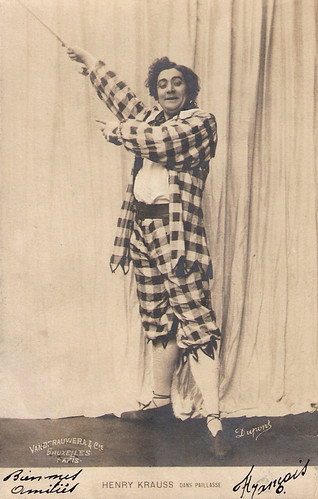
Henry Krauss
Belgian-French postcard by Vanderauwera & Co., Bruxelles / Paris. Photo: Dupont. Henry Krauss in the lead role of the stage play 'Paillasse' by Adolphe d'Ennery.

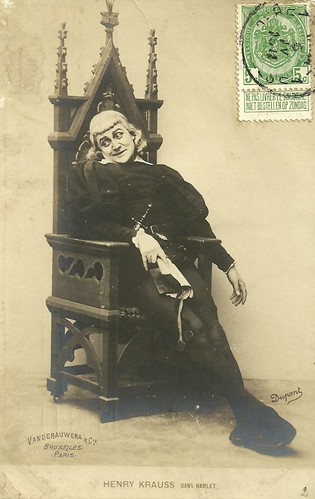
Henry Krauss as Hamlet
Franco-Belgian postcard by Vanderauwera & Co., Brussels / Paris. Photo: Dupont. Henry Krauss in 'Hamlet' by William Shakespeare.

Henry Krauss in Hamlet
Franco-Belgian postcard by Vanderauwera & Co., Brussels / Paris. Photo: Dupont. Caption: Henry Krauss as Hamlet.

Four extra cards


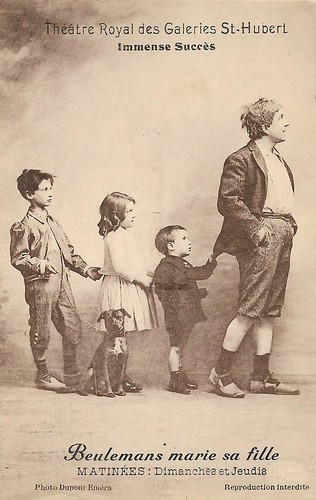
Beulemans marie sa fille
Belgian postcard. Photo: G. Dupont-Emèra (G.D.E.), Bruxelles. Alfred Jacque as Beulemans and Suzanne Gay as his daughter Suzanne in the operetta 'Beulemans marie sa fille' (1912), an adaptation of the stage comedy 'Le marriage de Mlle Beulemans' (1910) by Frantz Fonson et Fernand Wicheler, with music by Arthur Van Oost, and staged at the Brussels Théàtre Royal des Galeries St. Hubert.

Beulemans marie sa fille
Belgian postcard. Photo: Photo G. Dupont-Emera (G.D.E.), Bruxelles. Publicity still for the operetta 'Beulemans marie sa fille' (1912), an adaptation of the stage comedy 'Le marriage de Mlle Beulemans' (1910) by Frantz Fonson et Fernand Wicheler, with music by Arthur Van Oost, and staged at the Brussels Théàtre Royal des Galeries St. Hubert.

Beulemans marie sa fille
Belgian postcard. Photo: Photo G. Dupont-Emera (G.D.E.), Bruxelles. Publicity still for the operetta 'Beulemans marie sa fille' (1912), an adaptation of the stage comedy 'Le marriage de Mlle Beulemans' (1910) by Frantz Fonson et Fernand Wicheler, with music by Arthur Van Oost, and staged at the Brussels Théàtre Royal des Galeries St. Hubert.

Jules Berry and Jane Delmar in La Demoiselle du magasin (1913)
Belgian postcard. Photo: G. Dupont-Emèra (G.D.E.). Jules Berry as André and Jane Delmar as Claire in the play 'La Demoiselle du magasin' (The Shop Girl), a 1913 theatrical play in three acts written by Belgians Frantz Fonson and Fernand Wicheler, who had already had a big success with their play 'Le marriage de Mlle Beulemans' (1910). 'La Demoiselle du magasin' was first performed in Paris at the Théâtre du Gymnase, on 13 February 1913. From 12 October of the same year, it was shown at the Théâtre des Galeries Saint-Hubert in Brussels - to which this card refers. For Delmar, the play meant her claim of fame. After months of performances in Paris, the success was repeated in Brussels. In 1915 the play was staged again in Paris, but this time without Berry. In 1921 there were plans to stage it once more, now again with Berry.

Sources: Cartophilie.be and BnF.

This post was last updated on 24 January 2025.