Showing posts with label Lars Hanson. Show all posts

20 February 2026

Gösta Berling Saga (1924)

Gösta Berlings saga / The Atonement of Gösta Berling (Mauritz Stiller, 1924) was an adaptation of the first novel by Selma Lagerlöf. Gösta was portrayed by Lars Hanson, and Greta Garbo appeared here for the first time under the name 'Garbo'. The cinematography was by Julius Jaenzon, and the art direction was by Vilhelm Bryde, with Edgar Ulmer collaborating on the set design.

Lars Hanson
Swedish postcard by Förlag Nordisk Konst, Stockholm, no. 1286. Photo: Goodwin, 1924. Lars Hanson as Gösta Berling in Gösta Berlings saga / The Atonement of Gösta Berling (Mauritz Stiller, 1924).

Mona Martenson in Gösta Berlings Saga (1924)
Swedish postcard by Axel Eliassons Förlag, Stockholm, no. 379, 1924. Photo: Svenska-Film. Mona Mårtenson as Ebba Dolna in Gösta Berlings saga / The Atonement of Gösta Berling (Mauritz Stiller, 1924).
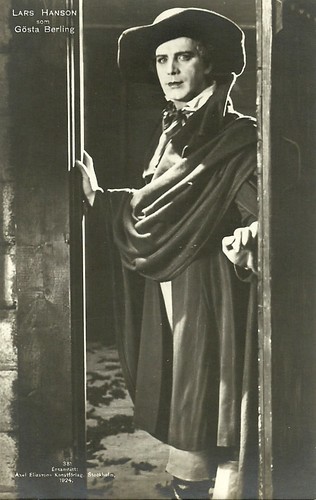
Lars Hanson in Gösta Berlings saga
Swedish postcard by Axel Eliassons Konstförlag, Stockholm, no. 381. Lars Hanson as the title character in Gösta Berlings saga / The Atonement of Gösta Berling (Mauritz Stiller 1924).

Greta Garbo in Gösta Berlings saga (1924)
British postcard by the National Film Theatre, London, no. 5. Greta Garbo in Gösta Berlings saga / The Atonement of Gösta Berling (Mauritz Stiller, 1924).

Jenny Hasselqvist in Gösta Berlings saga (1924)
Swedish postcard by Förlag Nordisk Konst, no. 1291. Photo: Goodwin, 1924. Jenny Hasselqvist as Marianne Sinclair in Gösta Berlings saga / The Atonement of Gösta Berling (Mauritz Stiller, 1924).

A novel out of the stories and people of her homeland


'Gösta Berlings Saga' is the first novel by the Swedish writer Selma Lagerlöf. The book was first published in 1891 by Albert Bonniers Förlag in Stockholm. In Gösta Berling, Selma Lagerlöf is a romantic; the book is a reaction to the realism that prevailed at the time. As a child, she had absorbed the folk tales of her surroundings, and in the autumn of 1881, while walking down the street in Stockholm, she suddenly had the idea of making a novel out of the stories and people of her homeland. Thus, the idea for 'Gösta Berlings Saga' was born.

In the summer of 1890, a Swedish magazine, Idun, organised a novella competition and offered a prize for the best novel of a certain length. Lagerlöf entered the contest with five chapters of 'Gösta Berlings Saga', a story that was then beginning to take shape in her mind. She won the competition.

In 1891, the complete novel was finally published. It is set in Värmland in the 1820s and is about the deposed Lutheran vicar Gösta Berling, who becomes the leader of the cavaliers at Ekeby. The adventurous lives of these cavaliers, former officers and impoverished noblemen who have found a freehold on the Ekeby estate and spend their days in love adventures, making music, playing cards and similar amusements, are presented in numerous quite independent chapters.

The story of Gösta Berling, who is purified into a better person after various experiences, forms the framework for a series of rather loosely connected episodes. The reviews were initially negative, with conservative and liberal critics united in their disapproval. Sales were also poor. It was not until 1893, when the well-known Danish literary critic Georg Brandes published an extraordinarily positive review of the Danish translation, that the assessment of the novel changed.

Over time, the success of Gösta Berling grew more and more, and today it is one of the best-known and most widely read Swedish books. 'Gösta Berlings Saga' has been called the epic prose of Swedish rural life. In 1924, the book was filmed, starring the then-unknown Greta Garbo, and the popular actors Lars Hanson and Gerda Lundquist.

Lars Hanson in Gösta Berlings saga (1924)
Swedish postcard by Förlag Nordisk Konst, no. 1280. Photo: Goodwin, 1923. Lars Hanson as Gösta Berling in Gösta Berlings saga / The Atonement of Gösta Berling (Mauritz Stiller, 1924). Odd is that this photo is dated 1923, while it seems a cutout of a photo dated 1924 (see our other card).

Lars Hanson in Gösta Berlings saga (1924)
Swedish postcard by Förlag Nordisk Konst, no. 1281. Photo: Goodwin, 1924. Lars Hanson as Gösta Berling in Gösta Berlings saga / The Atonement of Gösta Berling (Mauritz Stiller, 1924).

Jenny Hasselqvist in Gösta Berlings saga (1924)
Swedish postcard by Förlag Nordisk Konst, no. 1282. Photo: Goodwin, 1924. Jenny Hasselqvist as Marianne Sinclair in Gösta Berlings saga / The Atonement of Gösta Berling (Mauritz Stiller, 1924).

Jenny Hasselqvist in Gösta Berlings saga (1924)
Swedish postcard by Förlag Nordisk Konst, no. 1283. Photo: Goodwin, 1924. Jenny Hasselqvist as Marianne Sinclair in Gösta Berlings saga / The Atonement of Gösta Berling (Mauritz Stiller, 1924).

Lars Hanson in Gösta Berlings saga (1924)
Swedish postcard by Förlag Nordisk Konst, no. 1287. Photo: Goodwin, 1924. Lars Hanson as Gösta Berling in Gösta Berlings saga / The Atonement of Gösta Berling (Mauritz Stiller, 1924).

Lars Hanson in Gösta Berlings saga (1924)
Swedish postcard by Förlag Nordisk Konst, no. 1288. Photo: Goodwin, 1924. Lars Hanson as Gösta Berling in Gösta Berlings saga / The Atonement of Gösta Berling (Mauritz Stiller, 1924).

Lars Hanson in Gösta Berlings saga (1924)
Swedish postcard by Förlag Nordisk Konst, no. 1289. Photo: Goodwin, 1924. Lars Hanson as Gösta Berling in Gösta Berlings saga / The Atonement of Gösta Berling (Mauritz Stiller, 1924).

The last great masterpiece of Swedish silent cinema


The film adaptation, Gösta Berlings saga / The Atonement of Gösta Berling (Mauritz Stiller, 1924), premiered in two parts in Stockholm on 10 and 17 March 1924. Lars Hanson played the young priest Gösta Berling, who suffers a crisis of meaning in the Swedish countryside around 1820. Emotionally unstable, at the beginning of the plot, Gösta Berling is completely a slave to his lusts and gives in to drunkenness and womanising. After a scandal, he leaves the parish in the dead of night to wander the countryside as a good-for-nothing. With a bunch of other drifters, he comes to Ekeby, the castle of the rich Major Samzelius and his wife (Gerda Lundequist). There, he meets the innocent Countess Elisabeth Dohna (Greta Garbo), who helps Gösta to find inner strength and strength of character. Before the two of them can begin a future together, they have to go through many adventures, such as the burning of Ekeby Castle, set by the mad Major Samzelius (Otto Elg-Lundberg).

Gösta Berlings saga / The Atonement of Gösta Berling ended the Swedish creative period of director Mauritz Stiller. Stiller's forte was elegantly staged relationship comedies like Erotikon (1920), but his greatest commercial successes came with opulent literary adaptations. Among them were two works by Swedish author Selma Lagerlöf, Herr Arnes pengar / Sir Arne's Treasure from 1919 and Gunnar Hedes saga / Snowbound from 1923. The young Greta Gustafson was given the opportunity in the late spring of 1923 to participate in a casting for the upcoming of Stiller's film adaptation of Gösta Berlings saga / The Atonement of Gösta Berling, together with her colleague Mona Mårtenson. Stiller discovered a performing quality in the girl, who was only seventeen at the time, that prompted him to give her the important role of Countess Elisabeth.

Shortly after the extensive filming began, Stiller also arranged for the young woman to adopt the stage name Greta Garbo. There are various versions of how the choice came about, the simplest being that the name Garbo was a development of the original suggestion, Mona Gabor, which was based on the phonetic sound of a former prince of Transylvania. The actress officially adopted the name Greta Garbo on 9 November 1923. The shooting, which lasted almost a whole year, was an ordeal for the completely inexperienced actress. Stiller, who as a director was equally a perfectionist and an autocratic ruler, forced Greta Garbo to unconditional obedience to his instructions. Through endless repetitions of individual scenes and targeted verbal attacks, he steered Greta Garbo in the direction he had intended from the beginning. Garbo gave herself completely into the hands of her mentor and finally accepted without complaint the sometimes violent insults when, in Stiller's opinion, she had not given her best performance.

After the film was shot, Mauritz Stiller went to Hollywood via Berlin together with his protégée Garbo. Gösta Berlings saga / The Atonement of Gösta Berling (Mauritz Stiller, 1924) is today considered the last great masterpiece of Swedish silent cinema. The spectacular fire at Ekeby Castle was the most expensive sequence ever filmed in Sweden at the time. Stiller used the entire technical repertoire, such as rapid editing sequences and lighting effects, to bring the drama of the action to the screen. Another well-known shot showed Elisabeth Dohna fleeing in her horse-drawn sleigh in frantic flight across a frozen lake from a pack of wolves. However, Stiller used specially trained German shepherds for the sequence, hanging weights on their tails so that they would show the typical posture of wolves in the 'longshots'.

The film was originally released in two parts in Sweden, Gösta Berlings saga del I on 10 March 1924, and Gösta Berlings saga del II seven days later. The two-part version was also released in Finland and Norway, but for the rest of the world, a shorter, one-part export version was made. In 1927, the film was recut, almost halving its running time. This was the only version that was archived. In 1933, a sound version was released theatrically in Stockholm, with the intertitles removed, along with additional edits and some reordering of the scenes. Most of the missing material was discovered 20 years later, and a restored version with new intertitles was released in theatres. The Swedish Film Institute added newly found fragments throughout the years, but as of the 1975 restoration, about 450 metres of film from the original cut remained missing. In February 2018, the completion of a new, comprehensive restoration was announced. The 2018 version is 16 minutes longer than the previous restoration and brings the film close to its original running time. It also restores the film's tinting scheme for the first time since its original release.

Lars Hanson in Gösta Berlings saga (1924)
German postcard by Trianon for the German premiere of the film on 20 August 1924, at the Berlin Theater am Nollendorfplatz. Photo: Svenska Film of the Trianon-Film-Konzern, Berlin (also in Leipzig, Frankfurt a.M., Düsseldorf and Hamburg). Lars Hanson in Gösta Berlings saga / The Atonement of Gösta Berling (Mauritz Stiller, 1924).

Gerda Lundequist as Margaretha Samzelius in Gösta Berlings saga (1925)
German postcard by Trianon for the German premiere of the film on 20 August 1924, at the Berlin Theater am Nollendorfplatz. Photo: Svenska Film of the Trianon-Film-Konzern, Berlin (also in Leipzig, Frankfurt a.M., Düsseldorf and Hamburg). Gerda Lundequist as the Major's Wife and Lady of the Estate Ekeby, Margaretha Samzelius, in Gösta Berlings saga / The Atonement of Gösta Berling (Mauritz Stiller, 1924).

Karin Swanström, Sixten Malmerfelt and Jenny Hasselquist in Gósta berlings Saga (1924)
German postcard by Trianon-Film, 1924. Photo: Svenska-Film. Karin Swanström, Sixten Malmerfelt and Jenny Hasselqvist in Gösta Berlings saga / The Atonement of Gosta Berling (Mauritz Stiller, 1924).


Mona Martenson in Gösta Berlings saga (1924)
German postcard by Trianon-Film, 1924. Photo: Svenska-Film. Mona Mårtenson in Gösta Berlings saga / The Atonement of Gosta Berling (Mauritz Stiller, 1924).
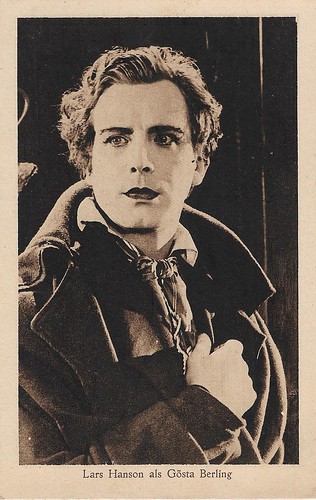
Lars Hanson in Gösta Berlings saga (1924)
German postcard by Trianon for the German premiere of the film on 20 August 1924, at the Berlin Theater am Nollendorfplatz. Photo: Svenska Film of the Trianon-Film-Konzern, Berlin (also in Leipzig, Frankfurt a.M., Düsseldorf and Hamburg). Lars Hanson as Gösta Berling in Gösta Berlings saga / The Atonement of Gösta Berling (Mauritz Stiller, 1924).
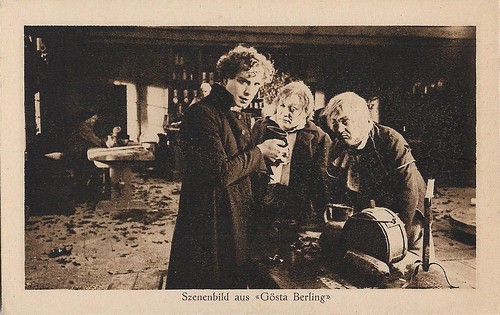
Lars Hanson in Gösta Berlings saga
German postcard by Trianon for the German premiere of the film on 20 August 1924, at the Berlin Theater am Nollendorfplatz. Photo: Svenska Film of the Trianon-Film-Konzern, Berlin (also in Leipzig, Frankfurt a.M., Düsseldorf and Hamburg). Lars Hanson in Gösta Berlings saga / The Atonement of Gösta Berling (Mauritz Stiller, 1924).
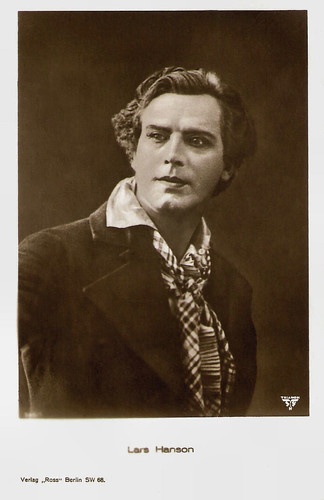
Lars Hanson
German postcard by Ross-Verlag, Berlin. Photo: Trianon. Lars Hanson in Gösta Berlings saga / The Atonement of Gösta Berling (Mauritz Stiller 1924).

Sources: Wikipedia (German and English) and IMDb.

11 November 2024

De landsflyktiga (1921)

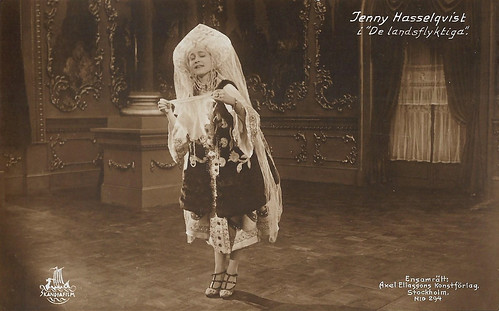
One of the lost films of the Scandinavian silent cinema is the Swedish film De landsflyktiga/The Emigrants (1921), except for a few very short fragments. It was directed by the great Mauritz Stiller and produced by Charles Magnusson for Svensk Filmindustri. Jenny Hasselqvist and Lars Hanson were the stars. Ivo Blom found six vintage Swedish cards of the lost film, published by Axel Eliassons Konstförlag, and reconstructed the film for this post.

Jenny Hasselqvist in De landsflyktiga (1921)
Swedish postcard by Ed. Axel Eliassons Konstförlag, Stockholm, no. 293. Photo: Skandia Film, Stockholm. Jenny Hasselqvist in De landsflyktiga/The Emigrants/The Exiles (Mauritz Stiller, 1921).

Jenny Hasselqvist in De landsflyktiga (1921)
Swedish postcard by Ed. Axel Eliassons Konstförlag, Stockholm, no. 294. Photo: Skandia Film, Stockholm. Jenny Hasselqvist in De landsflyktiga/The Emigrants/The Exiles (Mauritz Stiller, 1921).

Why Mauritz Stiller became a Swedish citizen


De landsflyktiga (Mauritz Stiller, 1921) can be translated as The Emigrants. The film was released in the USA as In Self Defense by George Hamilton, Incorporated in 1922 and was also known under the title Guarded Lips. The British title was The Exiles. De landsflyktiga was shot in the studios of Filmstaden Råsunda with exteriors at Steninge castle, Stadsgårdskajen and other locations in Stockholm. The cinematographer was Henrik Jaenzon.

The film script by Mauritz Stiller and Ragnar Hyltén-Cavallius was based on Runar Schildt's short story 'Zoja' from 1920, which was published in the short story collection 'Häxskogen'. It was during the filming of De landsflyktiga/The Emigrants/The Exiles that Mauritz Stiller, who had been a Russian citizen since his birth in Helsinki, applied to become a Swedish citizen.

The wealthy Barantscheff family lives on the stately Staraja-Selo estate in the heart of Russia. Prince Ivan Ivanovich (Carl Nissen), his wife Ivanovna Stefanovna (Karin Swanstrom), their daughter Sonja (Jenny Hasselqvist) and son Yuri (Nils Ohlin), a lieutenant in the Russian Navy who is recovering at home after being wounded in the war.

The First World War is in full swing and storm clouds are gathering everywhere. The wealthy banker Andrei Andreyevich Myasoyedoff (Ivan Hedqvist) approaches the prince and proposes to sell the estate because of the troubled times. The prince takes the offer as an insult and refuses.

Myasoyedoff has also set his eyes on Sonya, but she has already brusquely rejected him. One day, Sonya, while driving alone, rescues the young revolutionary student Vladimir Alexandrovich Mikhailoff (Lars Hanson), who is being chased by the gendarmes.

Jenny Hasselquist in De landsflyktiga
Swedish postcard by Ed. Axel Eliassons Konstförlag, Stockholm, no. 295. Photo: Skandia Film, Stockholm. Jenny Hasselqvist in De landsflyktiga/The Emigrants/The Exiles (Mauritz Stiller, 1921).

Lars Hanson in De landsflyktiga (1921)
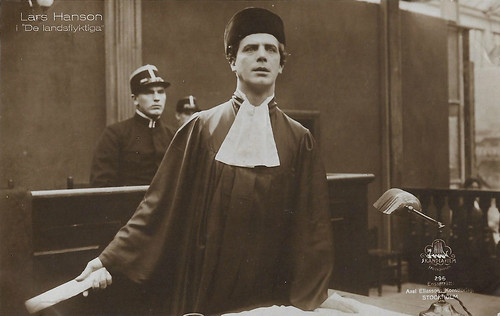
Swedish postcard by Ed. Axel Eliassons Konstförlag, Stockholm, no. 296. Photo: Skandia Film, Stockholm. Lars Hanson in De landsflyktiga/The Emigrants/The Exiles (Mauritz Stiller, 1921).

Out of the darkness that oppresses us, a new Russia will one day arise


When the revolution breaks out, it is Vladimir who helps Sonja and her parents to escape across the border. The family settles in a major international city, perhaps Paris, and continues their former, carefree life of luxury, waiting for the revolution to be crushed so they can return to their former lives at home. But their inherited wealth quickly dwindles, and it is Myasoyedoff, who has also come there as a refugee, who helps them financially.

He has managed to bring most of his fortune with him and is already involved in big business. The student Vladimir, a refugee from his former comrades, also arrives. One fine day, the Barantscheff family finds itself on the rocks. But Myasoyedoff is happy to oblige if only Sonya would be a little more accommodating to him. But Sonja stubbornly refuses. In an upset scene, she rips off all the family jewels she wore to the evening's charity party and gives them as collateral instead of herself for the family's debt.

Myasoyedoff takes the jewels and smilingly adds that the pledge is due at the end of the year. On New Year's Eve, Myasoyedoff is found dead in his villa, with Sonya lying unconscious outside. Vladimir, now a lawyer, defends Sonja in court. She admits that she shot Myasoyedoff when he tried to rape her. Afterwards, she threw the revolver from the balcony. But no revolver has been found.

In a break during the last day of the trial comes the explanation. Vladimir confesses to Sonja during a visit to her cell that it was he who shot Myasoyedoff on behalf of his comrades. Myasoyedoff was spying on the emigrants on behalf of the Bolshevik government, and many of their relatives remaining in Russia had already been shot. Myasoyedoff was an informer, Vladimir was the real killer, and Sonya now holds his fate in her hands.

But Vladimir's defence speech in court for Sonja leads to her acquittal. She and Vladimir are united, and Sonja utters the film's final line, which it was hoped at the time would have a prophetic meaning: "Out of the darkness that oppresses us, a new Russia will one day arise, a Russia that we can both love."

Jenny Hassselquist and Lars Hanson in De landsflyktige (1921)
Swedish postcard by Ed. Axel Eliassons Konstförlag, Stockholm, no. 297. Photo: Skandia Film, Stockholm. Lars Hanson and Jenny Hasselqvist in De landsflyktiga/The Emigrants/The Exiles (Mauritz Stiller, 1921).

Jenny Hasselquist and Lars Hanson in De landsflyktige (1921)
Swedish postcard by Ed. Axel Eliassons Konstförlag, Stockholm, no. 298. Photo: Skandia Film, Stockholm. Lars Hanson and Jenny Hasselqvist in De landsflyktiga/The Emigrants/The Exiles (Mauritz Stiller, 1921).

Sources: Svensk filmdatabas (Swedish), Silent Era, Wikipedia and IMDb.

10 December 2022

Directed by Mauritz Stiller

Director Mauritz Stiller (1883-1928) was next to Victor Sjöström, the greatest director of Swedish cinema's golden age. He wrote and directed 51 silent films since 1912. When Metro-Goldwyn-Mayer invited him to Hollywood as a director, he arrived with his new discovery Greta Gustafsson, now better known as Greta Garbo. After frequent disagreements with MGM and Paramount Pictures studio executives, Stiller returned to Sweden, where he died soon afterwards.

Karin Molander in Thomas Graals bästa film (1917)
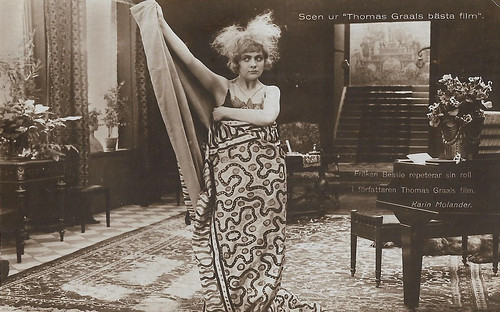
Swedish postcard by Ed. Nordisk Konst, Stockholm, no. 876. Photo: Svenska Biografteatern AB. Karin Molander vamping in Thomas Graals bästa film/Thomas Graal's Best Film (Mauritz Stiller, 1917), scripted by Gustav Molander. The story deals with a screenwriter (Victor Sjöström) who falls in love with his secretary Bessie (Karin Molander) and imagines himself rescuing her from poverty. Reality is quite different as Bessie is a modern woman. The film also mocks the bored aristocracy involved in the modernity of filmmaking. Caption: Miss Bessie is practising her role in the writer Thomas Graal's film.

Herr Arnes pengar (1919)
Swedish postcard by Nordisk Konst, Stockholm, no. 1078/9. Photo: Svenska Biografteatern. Mary Johnson in Herr Arnes pengar/Sir Arne's Treasure (Mauritz Stiller, 1919). Caption: The next day the dream did not leave Elsalill's mind.

Tora Teje and Lars Hanson in Erotikon (1920)
Swedish postcard by Nordisk Konst, Stockholm, no. 1097/9. Tora Teje and Lars Hanson in Erotikon (Mauritz Stiller, 1920).

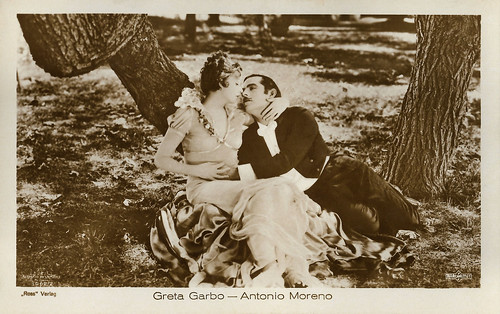
Greta Garbo and Antonio Moreno in The Temptress (1926)
German postcard by Ross Verlag, no. 3062/2, 1928-1929. Photo: Metro-Goldwyn-Mayer / Parufamet. Greta Garbo and Antonio Moreno in The Temptress (Fred Niblo, Mauritz Stiller, 1926).

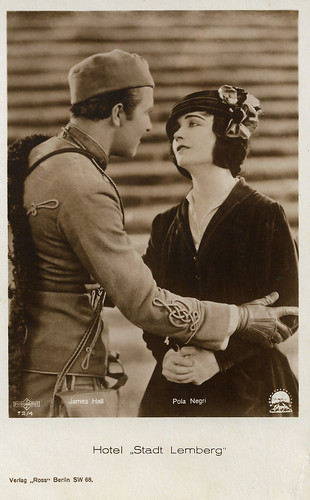
James Hall and Pola Negri in Hotel Imperial (1927)
German postcard by Ross Verlag, Berlin, no. 72/4. Photo: ParUfaMet / Paramount. James Hall and Pola Negri in Hotel Imperial (Mauritz Stiller, 1927). The German film title was Hotel "Stadt Lemberg".

Involved with Sweden's rapidly developing silent film industry


Mauritz Stiller was born Moshe Stiller in Helsingfors (now Helsinki) in 1883. He was one of the six children of Hirsch Stiller and his wife Mindel (née Weissenberg). His family was of Ashkenazi Jewish heritage. Before settling in Finland, they had lived in Russia and Poland, then part of the Russian Empire.

After his father's death when he was four, his mother committed suicide. A family friend, the tailor Peretz Katsman, raised him and Mauritz began working for him at the age of 13. From an early age, Stiller was interested in acting. His talents did not go unnoticed, and soon Stiller got the opportunity to practice and display his acting skills in the Folkteatern of Helsingfors and other theatres in Finland.

Finland was at the time an autonomous Grand Duchy of Finland, part of Russia, and Stiller was drafted into the army of Czar Nicholas II. Rather than report for duty he fled the country for exile and settled in Sweden. He became a Swedish citizen in 1921. By 1912, Stiller had become involved with Sweden's rapidly developing silent film industry.

Together with actor-director Viktor Sjöström, he was recruited as a director and actor in the Swedish film industry by Charles Magnusson at AB Svenska Biografteatern. Stiller began by writing scripts, acting, and directing short films and was immediately successful. Soon he gave up acting to devote his time to writing and directing.

During 1912-1916 he directed no less than 34 films, in different genres. The most remarkable early film was Vingarne/The Wings (1916), an adaptation of Danish writer Herman Bang’s novel ‘Mikael’. Stiller added a framing structure to the story, showing the production of the film itself and how it is received by critics and the audience.

This self-reflexive element is also present in Stiller’s comedies Thomas Graals bästa film/Thomas Graal’s Best Film (1917) and Thomas Graals bästa barn/Thomas Graal’s Best Child (1918), both starring Victor Sjöström in the title role opposite Karin Molander. Both films received much acclaim and were very popular.

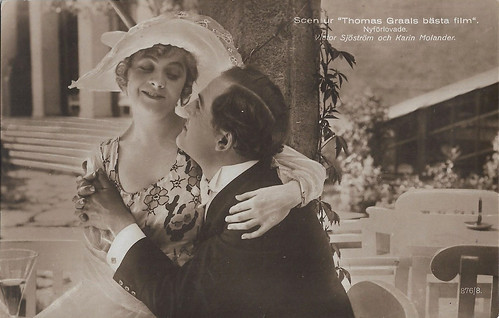
Thomas Graals bästa film
Swedish postcard by Ed. Nordisk Konst, Stockholm, no. 876/8. Photo: Svenska Biografteatern AB. Publicity still for Thomas Graals bästa film/Thomas Graal's Best Film (Mauritz Stiller, 1917), scripted by Gustav Molander. The story deals with a screenwriter (Victor Sjöström) who falls in love with his secretary Bessie (Karin Molander) and imagines himself rescuing her from poverty. Reality is quite different as Bessie is a modern woman. The film also mocks the bored aristocracy involved in the modernity of filmmaking. Caption: The newly engaged ones.

Hauk Aabel and Stina Stockenstam in Alexander den Store
Swedish postcard by Nordisk Konst, Stockholm, no. 877/1. Photo: Svenska Biografteatern AB. Hauk Aabel and Stina Stockenstam in the comedy Alexander den Store/Alexander the Great (Mauritz Stiller, 1917) with . The story of the film deals with a provincial hotel cook, named Alexander the Great, in whose restaurant not only the dishes can be spicy. Caption: Alexander has rediscovered his beloved from his youth.

Karin Molander and Victor Sjöström in Thomas Graals bäste barn (1918)
Swedish postcard by Förlag Nordisk Konst, Stockholm, no. 961. Photo: Svenska Biografteatern. Victor Sjöström and Karin Molander in the comedy Thomas Graals bästa barn/Thomas Graal's First Child (Mauritz Stiller, 1918).

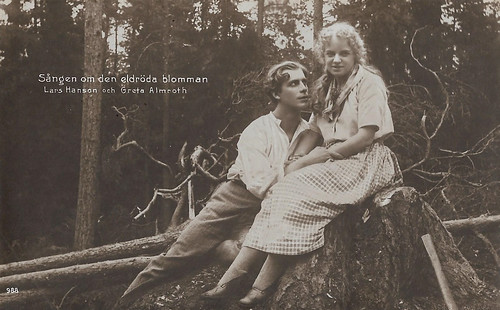
Lars Hanson and Greta Almroth in Sången om den eldröda blomman (1919)
Swedish postcard by Forlag Nordisk Konst, Stockholm, no. 988. Photo: Svenska Biografteatern, Stockholm. Lars Hanson and Greta Amroth in Sången om den eldröda blomman/Song of the Scarlet Flower (Mauritz Stiller, 1919).

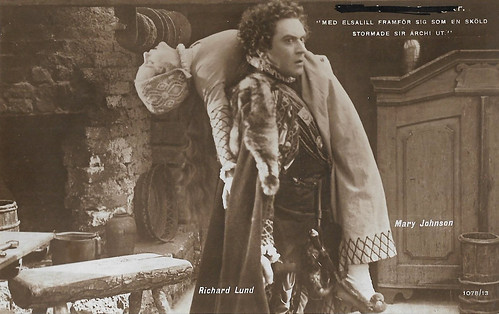
Herr Arnes pengar (1919)
Swedish postcard by Nordisk Konst, Stockholm, no. 1078/3. Photo: Svenska Biografteatern. Richard Lund and Mary Johnson in Herr Arnes pengar/Sir Arne's Treasure (Mauritz Stiller, 1919). Caption: With Elsallil before him like a shield, Sir Archi stormed out.

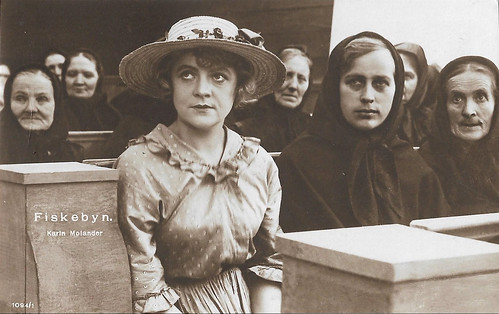
Fiskebyn (1920)
Swedish postcard by Förlag Nordisk Konst, Stockholm, no. 1094/1. Photo: Svenska. Karin Molander in Fiskebyn/Chains/The Fishing Village (Mauritz Stiller, 1920).

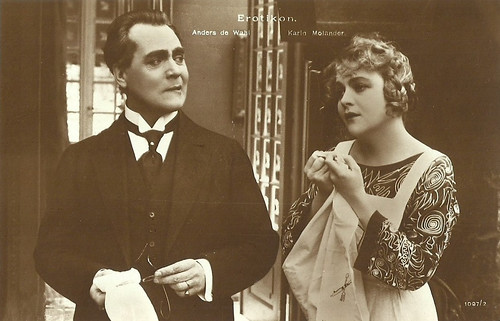
Anders de Wahl and Karin Molander in Erotikon
Swedish postcard by Nordisk Konst, Stockholm, no. 1097/2. Anders de Wahl and Karin Molander in Erotikon (Mauritz Stiller, 1920).

Jenny Hasselqvist in De landsflyktiga (1921)
Swedish postcard by Ed. Axel Eliassons Konstförlag, Stockholm, no. 293. Photo: Skandia Film, Stockholm. Jenny Hasselquist in De landsflyktiga/The Emigrants/The Exiles (Mauritz Stiller, 1921). This is a lost film, except for a few very short fragments.

Continuing disagreements with Hollywood studio executives


By 1920, Mauritz Stiller was a leading figure in Swedish filmmaking. His masterpieces were the Selma Lagerlöf adaptation Herr Arnes pengar/Sir Arne's Treasure (1919) with Richard Lund and Mary Johnson and the stylish comedy Erotikon (1920) with Tora Teje and Lars Hanson.

Jon Wengström writes in The Swedish Film Database: “The characteristic trait in Swedish silent films at the time, the interaction between Man and Nature, was taken to new heights by Stiller in Sången om den eldröda blomman/Song of the Scarlet Flower (1919) and Johan (1921). Both films were shot on location in northern Sweden, and both had spectacular downstream log-riding sequences as dramatic climaxes.”

He also directed Gunnar Hedes saga/Snowbound (1923) starring a young Einar Hanson and based on the Selma Lagerlöf novel ‘En herrgårdssägen’. At the Royal Dramatic Theatre in Stockholm, he met a young actress named Greta Gustafsson whom he cast in an important but secondary role in his film, Gösta Berlings saga/The Atonement of Gosta Berling (1924), featuring Lars Hanson and also a Selma Lagerlöf adaptation.

In 1924, Mauritz Stiller planned to shoot a film in Turkey titled The Odalisque from Smyrna and hired Conrad Veidt and Einar Hanson as stars. Along with Hansen and protégée Greta Gustafsson, Stiller left for Istanbul but the promised financing vanished. They moved to Germany, where Greta appeared in Die Freudlose Gasse (G.W. Pabst, 1925). Then they sailed with Einar Hanson off to the USA.

Stiller had accepted an offer from Louis B. Mayer to direct for Metro-Goldwyn-Mayer. In Hollywood, MGM assigned Stiller to direct Greta Gustafsson as Greta Garbo in her second American film, The Temptress (1926), but he could not deal with the studio structure. After repeated arguments with studio executives, MGM replaced him on the film with Fred Niblo and terminated his contract with the studio.

Paramount Pictures immediately hired Stiller. He made three successful films, The Woman on Trial (1927), Hotel Imperial (1927) and Barbed Wire (1927), all starring Pola Negri. Then Stiller was let go a second time while directing his fourth film, The Street of Sin (1928), starring Emil Jannings and Fay Wray, because of his continuing disagreements with studio bosses.

Mauritz Stiller returned to Sweden in 1927 and died the following year from pleurisy at the age of 45. Garbo was devastated when she heard the news. He was interred in the Norra begravningsplatsen in Stockholm. Mauritz Stiller directed 51 silent films and appeared as an actor in seven productions from 1912 to 1927. In 1960, Hollywood recognised Stiller's contribution to the motion picture industry with a star on the Hollywood Walk of Fame at 1713 Vine Street. Originally his star was listed erroneously as "Maurice Diller" but it was finally corrected in the late 1980s. In Kristianstad, a monument was erected in his honour.

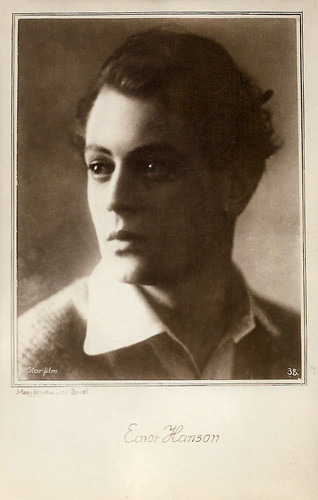
Einar Hanson in Gunnar Hedes saga (1923)
Hungarian postcard by Magy. fot. soksz ipar, Budapest, no. 38. Photo: Starfilm. Einar Hanson in Gunnar Hedes saga/Snowbound (Mauritz Stiller, 1923).

Lars Hanson in Gösta Berlings saga
German postcard. Photo: Svenska Film of the Trianon-Film-Konzern, Berlin (also in Leipzig, Frankfurt a.M., Düsseldorf and Hamburg). Lars Hanson in Gösta Berlings saga/The Saga of Gösta Berling (Mauritz Stiller, 1924). The film was an adaptation of the famous novel by Selma Lagerlöf. The cinematography was by Julius Jaenzon, and the art direction was by Vilhelm Bryde (with Edgar Ulmer collaborating on the set design). This postcard was made by Trianon for the German premiere of the film on 20 August 1924, at the Berlin Theater am Nollendorfplatz.

Pola Negri in Hotel Imperial (1927)
German postcard by Ross Verlag, Berlin, no. 72/1. Photo: Parufamet / Paramount. Pola Negri in Hotel Imperial (Mauritz Stiller, 1927).

Fay Wray in Street of Sin (1928)
German postcard by Ross Verlag, no. 3993/1, 1928-1929. Photo: Paramount. Fay Wray in Street of Sin (Mauritz Stiller, 1928).

Emil Jannings in The Street of Sin (1928)
French postcard by Europe, no. 344. Emil Jannings in The Street of Sin (Mauritz Stiller, 1928).

Sources: Jon Wengström (The Swedish Film Database), Ulf Kjell Gür (IMDb), Sandra Brennan (AllMovie), Wikipedia (English and Swedish), and IMDb.

19 November 2022

Three silent Swedish films starring Lars Hanson: Ett faerligt frieri (1919), Sangen om den elrodan blomman (1919) and Erotikon (1920)

Lars Hanson (1886-1965) was the most successful star of the silent Swedish cinema. He was the virile and handsome leading man in several masterpieces by Victor Sjöström and Mauritz Stiller. When both directors moved to the U.S.A., Hanson did too and he starred in such Hollywood classics as The Wind opposite Lillian Gish. But for this post we focus on three of his Swedish films, Ett farligt frieri/A Dangerous Proposal/A Dangerous Wooing (Rune Carlsten, 1919), Sången om den eldröda blomman/Flame of Life (Mauritz Stiller, 1919) and Erotikon/Bounds That Chafe (Mauritz Stiller, 1920).

Ett faerligt frieri (1919)


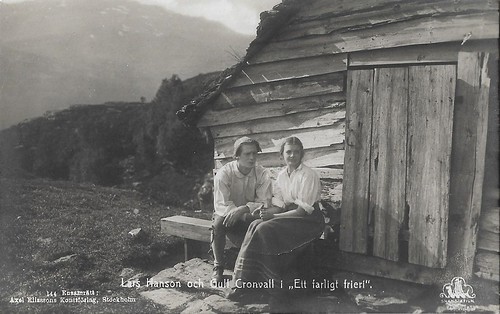
Lars Hanson and Gull Cronvall in Ett farligt frieri (1919)
Swedish postcard by Axel Eliassons Konstförlag, Stockholm, No. 140. Photo: Skandia Film, Stockholm. Lars Hanson and Gull Cronvall in Ett farligt frieri/A Dangerous Proposal (Rune Carlsten, 1919).

Lars Hanson in Ett farligt frieri
Swedish postcard by Axel Eliassons Konstförlag, Stockholm, no. 141. Photo: Skandia Film, Stockholm. Lars Hanson and Gull Cronvall in Ett farligt frieri/A Dangerous Proposal (Rune Carlsten, 1919).

The story of Ett farligt frieri/A Dangerous Proposal/A Dangerous Wooing (Rune Carlsten, 1919) deals with Tore (Lars Hanson), a smallholder's son, secretly in love with Aslaug (Gull Cronvall), the most beautiful girl in the village. Many boys are after her, but Knut (Theodor Blich) and his two sons drive them away if they come too close to the farm.

When Tore asks for Aslaug's hand, her father just laughs at him. Knut has ambitious plans to marry her to the son of the wealthiest farmer around. Even after Knut and Aslaug's brothers have beaten Tore black and blue, he persists in visiting Aslaug, even climbing a giant wall of rock...

The restored version of Ett farligt frieri was shown in 2018 at the Giornate del Cinema Muto in Pordenone, Italy. See Antti Alanen's blogpost on the film.

Lars Hanson and Gull Cronvall in Ett farligt frieri
Swedish postcard by Axel Eliassons Konstförlag, Stockholm, no. 143. Photo: Skandia Film, Stockholm. Lars Hanson and Gull Cronvall in Ett farligt frieri/A Dangerous Proposal/A Dangerous Wooing (Rune Carlsten, 1919).

Lars Hanson and Gull Cronvall in Ett farligt frieri (1919)
Swedish postcard by Axel Eliassons Konstförlag, Stockholm, no. 144. Photo: Skandia Film, Stockholm. Lars Hanson and Gull Cronvall in Ett farligt frieri/A Dangerous Proposal/A Dangerous Wooing (Rune Carlsten, 1919).

Sången om den eldröda blomman (1919)


Lars Hanson and Greta Almroth in Sången om den eldröda blomman (1919)
Swedish postcard by Forlag Nordisk Konst, Stockholm, no. 988. Photo: Svenska Biografteatern, Stockholm. Lars Hanson and Greta Amroth in Sången om den eldröda blomman/Flame of Life (Mauritz Stiller, 1919).

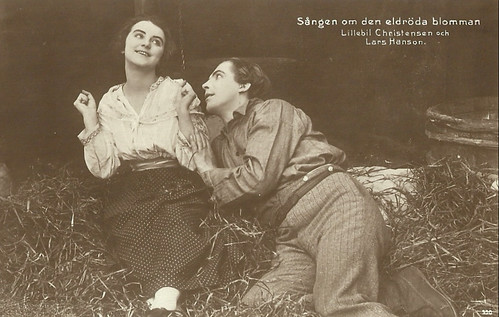
Lars Hanson and Lillebil Christensen in Sången om den eldröda blomman (1919)
Swedish postcard by Forlag Nordisk Konst, Stockholm, no. 989. Photo: Svenska Biografteatern, Stockholm. Lars Hanson and Lillebil Christensen in Sången om den eldröda blomman/Flame of Life (Mauritz Stiller, 1919).

Lars Hanson in Sången om den eldröda blomman (1919)
Swedish postcard by Nordisk Konst, no. 990. Photo: Svenska Biografteatern, Stockholm. Lars Hanson and Lillebil Christensen in Sången om den eldröda blomman / The Song of the Red Flower (Mauritz Stiller, 1919).

Lars Hanson and Louise Fahlman in Sängen um den eldröda blomman (1919)
Swedish postcard by Forlag Nordisk Konst, Stockholm, no. 991. Photo: Svenska Biografteatern, Stockholm. Lars Hanson and Louise Fahlmann in Sången om den eldröda blomman/Flame of Life (Mauritz Stiller, 1919).

According to Swedish Wikipedia, Sången om den eldröda blomman/Flame of Life (Mauritz Stiller, 1919) premiered on 14 April 1919. It was shot at the Svenska Biografteatern film studio at Lidingö, with exterior scenes at the Faxälven river near Långsele, near Sollefteå. Cinematography was by Ragnar Westfelt and Henrik Jaenzon. Armas Järnefelt, a Fin but naturalised Swede and a famous opera composer and conductor, wrote a special film score (his first) for this film, based on Finnish and Swedish folk songs.

Sången om den eldröda blomman/Flame of Life was based on the Finnish novel 'Laulu tulipunaisesta kukasta' (The Song of the Red Flower, 1905) by Johannes Linnankoski. The film became a big popular success and ran for five weeks at the premiere cinema Röda Kvarn in Stockholm, which never had happened before. The net profit of the film was at least $ 80,000, the biggest profit to date for any Swedish film.

The story deals with Olof Koskela (Lars Hanson), the restless son of a wealthy farmer, who at a dance night abandons his girl Anniki (Greta Almroth) for a maid, Elli (Lillebil Christensen), to the consternation of his parents. His mother (Louise Fahlman) almost catches him in the act. A fight breaks out between Olof and his father, after which he has to leave home. Olof joins a group of raftsmen and follows them down the river.

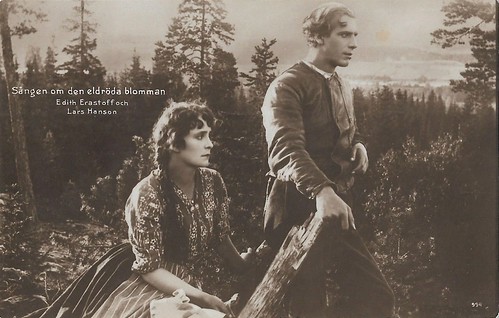
There he meets Kyllikki (Edith Erastoff), but to his surprise, she dismisses him as another landlubber. Then he decides to show that he is not just anyone. The next Sunday, he stakes out the rapids on a log in front of large crowds of spectators along the river and the long rapids. No one has yet dared to run the rapids on a log. But Olof succeeds and at the last minute, he jumps ashore, while the log swirls around down the fall at the foot of the rapids.

That evening, Kyllikki is waiting for him in the forest. When they part the next morning, she says: "When your years of wandering are over, come back. I will wait for you." Olof arrives in the big city and meets Elli again, who has now ended up in a brothel. He is shocked. Eventually, he comes to his senses and returns to his hometown. Both his parents are now dead, and when he seeks out Kyllikki, her father wants nothing to do with him. But then Kyllikki, as stubborn as her father, declares that in that case, she will leave home. Olof and Kyllikki settle down at the Koskela farm. The wanderer has finally found peace.

In June 2019 the restored and sonorised version with an orchestra performing Jarnefelt's music of Sången om den eldröda blomman was shown at the Cinema Ritrovato festival in Bologna, Italy. See Antti Alanen's excellent blogpost. Alanen quotes Swedish Film Archive curator Jon Wengstrom: "As the carefree Olof who finally finds peace within himself, Lars Hanson gives one of the best performances of his career; not least in the scenes where a disillusioned Olof visits bars and brothels in the city. The dialogue with his image in the mirror of a bar is one of the highlights of staging and acting in the film." We were present at this screening and fully agree with Wengstrom.

Lars Hanson and Edith Erastoff in Sången om den eldröda blomman (1919)
Swedish postcard by Forlag Nordisk Konst, Stockholm, no. 992. Photo: Svenska Biografteatern, Stockholm. Lars Hanson and Edith Erastoff in Sången om den eldröda blomman/Flame of Life (Mauritz Stiller, 1919).

Lars Hanson in Sången om den eldröda blomman (1919)
Swedish postcard by Forlag Nordisk Konst, Stockholm, no. 993. Photo: Svenska Biografteatern, Stockholm. Lars Hanson in Sången om den eldröda blomman/Flame of Life (Mauritz Stiller, 1919).

Lars Hanson and Edith Erastoff in Sången om den eldröda blomman (Mauritz Stiller, 1919)
Swedish postcard by Forlag Nordisk Konst, Stockholm, no. 994. Photo: Svenska Biografteatern, Stockholm. Lars Hanson and Edith Erastoff in Sången om den eldröda blomman/Flame of Life (Mauritz Stiller, 1919). Before Olaf and Kylikki part, she says to the restless man: "When your years of wandering are over, come back. I will wait for you."

Lars Hanson and Doris Nelson in Sängen um den eldröda blomman (1919)
Swedish postcard by Forlag Nordisk Konst, Stockholm, no. 995. Photo: Svenska Biografteatern, Stockholm. Lars Hanson and Doris Nelson in Sången om den eldröda blomman/Flame of Life (Mauritz Stiller, 1919). Olof Koskela meets a streetwalker in the city, still unaware that his former beloved Elli now works in a brothel too.

Erotikon (1920)


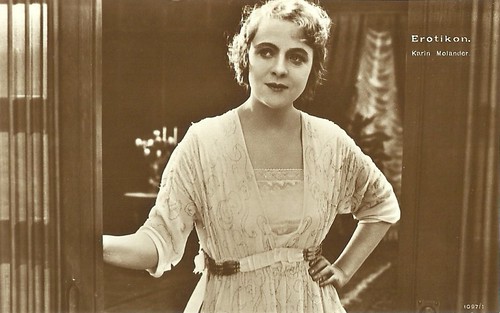
Karin Molander in Erotikon
Swedish postcard by Nordisk Konst, Stockholm, no. 1097/1. Photo: Svensk Filmindustri. Karin Molander in Erotikon/Bounds That Chafe (Mauritz Stiller, 1920).

Anders de Wahl and Karin Molander in Erotikon
Swedish postcard by Nordisk Konst, Stockholm, no. 1097/2. Photo: Svensk Filmindustri. Anders de Wahl and Karin Molander in Erotikon (Mauritz Stiller, 1920).

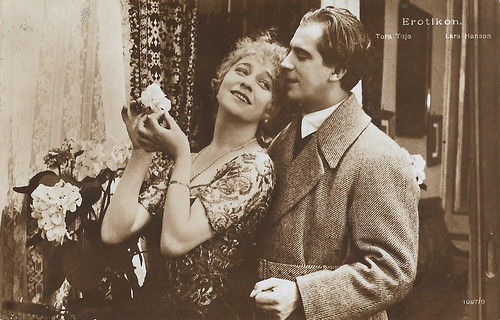
In the romantic comedy Erotikon/Bounds That Chafe (Mauritz Stiller, 1920), the story revolves around an entomology professor obsessed with the sexual life of bugs, and his easygoing wife who is courted by two suitors. Marthe (Karin Molander) is secretly in love with her uncle, prof. Carpentier (Anders de Wahl), while his wife Irene (Tora Teje) loves baron Felix (Vilhelm Bryde). Her husband's friend, the sculptor Preben Wells (Lars Hanson), loves Irene. Carpentier doesn't oppose his wife's flirts as he likes somebody else too.

Erotikon, based on the 1917 play 'A kék róka' by Ferenc Herczeg, pushed the boundaries of what was acceptable on the screen in 1920. Director Mauritz Stiller obviously delighted in teasing his audience with each scandalous plot twist and every salacious leer, and the result is a deliciously subversive comedy that was very much ahead of its time. The film premiered in Sweden on 8 November 1920. It became a commercial success and was sold to 45 markets abroad.

Anders de Wahl and Karin Molander in Erotikon
Swedish postcard by Nordisk Konst, Stockholm, no. 1097/3. Anders de Wahl and Karin Molander in Erotikon/Bounds That Chafe (Mauritz Stiller 1920).

Tora Teje and Lars Hanson in Erotikon
Swedish postcard by Nordisk Konst, Stockholm, no. 1097/6. Photo: Svensk Filmindustri. Tora Teje and Lars Hanson in Erotikon (Mauritz Stiller, 1920).

Tora Teje and Lars Hanson in Erotikon (1920)
Vintage Swedish postcard by Nordisk Konst, Stockholm, no. 1097/9. Photo: Svensk Filmindustri. Tora Teje and Lars Hanson in Erotikon (Mauritz Stiller, 1920).

Sources: Wikipedia (Dutch, Swedish and English) and IMDb.