Showing posts with label Hans Albers. Show all posts

10 September 2023

Hans Albers

Jovial, pleasantly plump Hans Albers (1891-1960) was a superstar of German cinema between 1930 and 1945. He was also one of the most famous German singers of the twentieth century. His song 'Auf der Reeperbahn nachts um halb eins' (On the Reeperbahn at half past midnight) is the unofficial anthem of Hamburg’s neighbourhood of St. Pauli, famous for its brothels, music and nightclubs.

Hans Albers in Der Greifer
German postcard by Ross Verlag, no. 5308/1. Photo: H. Gärtner / SF / Eichberg-Film, Berlin. Hans Albers in Der Greifer/The Snatcher (Richard Eichberg, 1930).

Hans Albers
German Postcard by Ross Verlag, no. 762. Photo: Ufa.
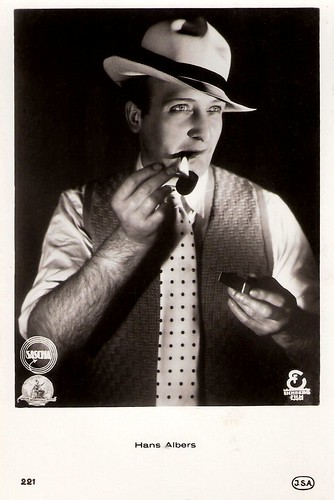
Hans Albers
Dutch postcard by J.S.A., no. 221.

Hans Albers
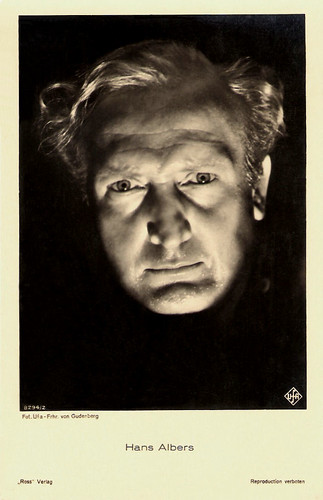
German Postcard by Ross Verlag, no. 8294/12, 1933-1934. Photo: Frhr. von Gudenberg / Ufa.

Hans Albers
German postcard. by Ross Verlag, no. 7039/1, 1932-1933. Photo: Ufa. Publicity still for Der weiße Dämon/The White Demon (Kurt Gerron, 1932).

Hans Albers
German postcard by Verlag und Drückerei Erwin Preuss, Dresden-Freital in the series Die neue farbige Filmstarkarte, Series 1, no. 13. Photo: Charlott Serda.

Blonde Hans


Hans Philipp August Albers was born in the North German port city of Hamburg in 1891. He was the son of a butcher and grew up in the Hamburg district of St. Georg. He was seriously interested in acting by his late teens and took acting classes without the knowledge of his parents.

He debuted as a stage actor in Bad Schwandau, followed by engagements in Frankfurt, Güstrow, Cologne and Hamburg. His first film part was in Jahreszeiten des Lebens/Seasons of Life (Franz Hofer, 1915).

Albers interrupted his career to serve in World War I, where he was badly wounded. After the war ‘der blonde Hans’ started as a comedic actor in various Berlin theatres. He appeared on-stage to great acclaim with Max Reinhardt's Deutsches Theater. Albers' breakthrough performance was that of a waiter in Ferdinand Bruckner's play 'Verbrecher' (Criminals).

His film roles ranged from Demetrius in Ein Sommernachtstraum/A Midsummer Night's Dream (Hans Neumann, 1924) to the title character in Rasputins Liebesabenteuer/Rasputin (Martin Berger, 1928). In Weimar Berlin, he began a relationship with half-Jewish actress Hansi Burg in 1925. She was the daughter of his acting teacher Eugen Burg.

Albers stopped working in theatre to distance himself from the Hitler regime, but the Nazis forced him in 1935 to end his relationship with Hansi Burg, who in 1938 emigrated to England via Switzerland. They secretly remained a couple with him even managing to send her financial support. In 1944 Eugen Burg would be killed in the concentration camp Theresienstadt. Hansi Burg returned to Germany and Albers in 1946. Hans and Hansi would live together until his death in 1960.
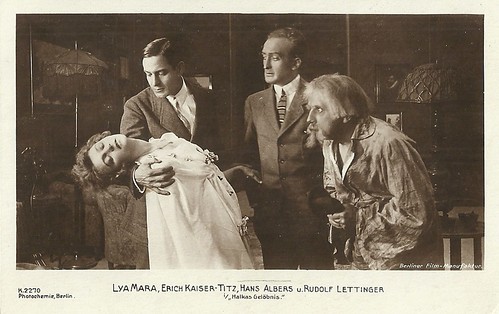
Lya Mara in Halkas Gelöbnis (1918)
German postcard by Photochemie, Berlin, no. K. 2270. Photo: Berliner Film-Manufaktur. Lya Mara, Erich Kaiser-Titz, Hans Albers and Rudolf Lettinger in the German silent film Halkas Gelöbnis (H. Fredall, 1918). This postcard is one of a set of three cards that Photochemie issued on the film.
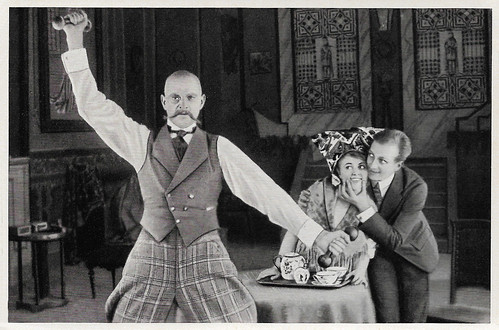
Paul Westermeier, Hanne Brinkmann and Hans Albers in Baroneßchen auf Strafurlaub (1917)
German collectors card by Ross Verlag in the series Vom Werden Deutscher Filmkunst - Der Stumme Film, picture no. 38, group 43. Photo: Paul Westermeier, Hanne Brinkmann and Hans Albers in Baroneßchen auf Strafurlaub/Little Baroness on Punishment Holiday (Otto Rippert, 1917). Caption: "Paul Westermeier 'hantelt', Hans Albers darf in einer kleinen Nebenrolle Hanne Brinkmann in die Wange kneifen". (Paul Westermeier 'works out', Hans Albers - in a small secondary role - is allowed to pinch Hanne Brinkmann in the cheek.)

Hans Albers and Xenia Desni
Austrian postcard by Iris Verlag, no. 670/1. Photo: Naxos-Film / Austrian distr. E. Weil. Hans Albers and Xenia Desni in the German silent film comedy Nixchen (Kurt Blachnitzky, 1926).
Marlene Dietrich, Hans Albers and Emil Jannings in Der blaue Engel (1930), 8,
German postcard by Film und Fotografie, no. A 85. Photo: Sammlung Eickemeyer, Berlin. Emil Jannings, Hans Albers and Marlene Dietrich in Der blaue Engel/The Blue Angel (Josef von Sternberg, 1930).

Hans Albers, Paul Hörbiger, Paul Westermeier and Genia Nikolaiewa in Quick (1931)
German postcard by Ross Verlag, no. 141/5, 1931-1932. Photo: Ufa. Publicity still with Paul Hörbiger, Paul Westermeier and Genia Nikolaieva in Quick (Robert Siodmak, 1931).
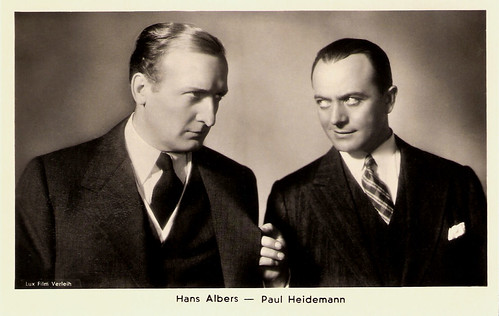
Hans Albers, Paul Heidemann
With Paul Heidemann. Austrian Postcard by Iris Verlag, no. 6699. Photo: Lux Film Verleih.
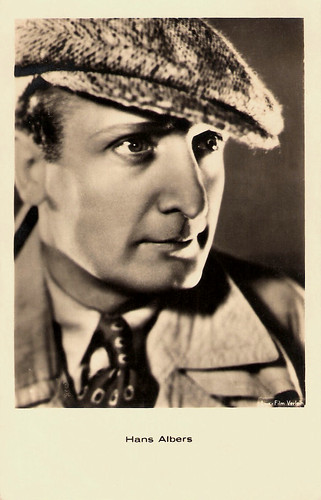
Hans Albers
Austrian Postcard by Iris Verlag, no. 6269. Photo: Lux Film Verleih.
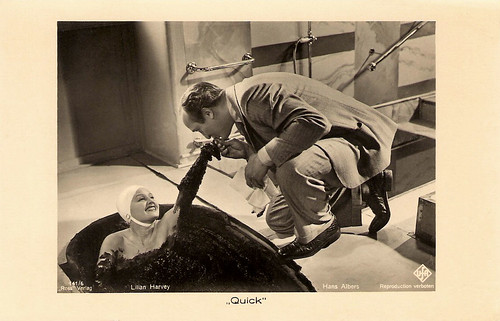
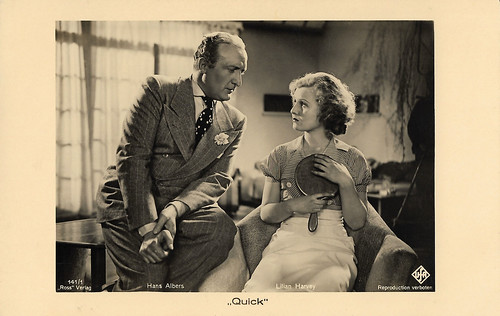
Lilian Harvey, Hans Albers in Quick
German postcard by Ross Verlag, no. 141/6. Photo: Ufa. Lilian Harvey and Hans Albers in Quick (Robert Siodmak, 1931). Collection: Geoffrey Donaldson Institute.

Anna Sten and Hans Albers in Bomben auf Monte Carlo (1931)
German postcard by Ross Verlag, no. 6112/1, 1931-1932. Photo: Ufa. Anna Sten and Hans Albers in Bomben auf Monte Carlo (Hanns Schwarz, 1931).

Hans Albers and Luise Rainer in Heut' kommt's drauf an (1933)
German postcard by Ross Verlag, no. 7766/1, 1932-1933. Photo: Boston-Film. Hans Albers and Luise Rainer in Heut' kommt's drauf an/Today it depends (Kurt Gerron, 1933). This film, now considered lost, was the second film with Luise Rainer.

Hans Albers in Ein gewisser Herr Gran (1933)
German postcard by Ross Verlag, no. 8105/2, 1933-1934. Photo: Ufa. Hans Albers in Ein gewisser Herr Gran (Gerhard Lamprecht, 1933).

Big-mouthed strong man


After roles in over one hundred silent films, Hans Albers starred in the first German talkie, the romance Die Nacht gehört uns/The Night Belongs to Us (Carl Froelich, 1929) with Charlotte Ander.

He then played big-mouthed strong man Mazeppa alongside Emil Jannings and Marlene Dietrich in Der blaue Engel/The Blue Angel (Josef von Sternberg, 1930), the film which made Dietrich an international star.

Albers himself shot to fame with Der Greifer/The Snatcher (Richard Eichberg, 1930) about three crooks who are planning a jewel robbery. Albers enhanced his star status with similar daredevil roles in the 1930s.

He was probably at his best when teamed up with Heinz Rühmann, as in Bomben auf Monte Carlo/Bombs Over Monte Carlo (Hanns Schwarz, 1931) and Der Mann, der Sherlock Holmes war/The Man Who Was Sherlock Holmes (Karl Hartl, 1937).

In the latter film Albers and Rühmann play two confidence tricksters who pretend to be the famous duo Holmes & Dr. Watson and the police, gangsters and girls believe them beyond any doubt. Another success was the comedy Quick (Robert Siodmak, 1932) in which he played a clown opposite Lilian Harvey.

Hans Albers and Sybille Schmitz in F.P.1 antwortet nicht
German postcard by Ross Verlag, no. 7518/1, 1932-1933. Photo: Ufa. Sybille Schmitz and Hans Albers in F.P.1 antwortet nicht/F.P.1 Doesn't Answer (Karl Hartl, 1932).
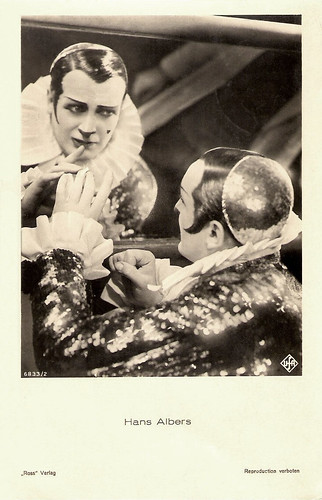
Hans Albers
German Postcard by Ross Verlag, no. 6833/2, 1931-1932. Photo: Ufa.
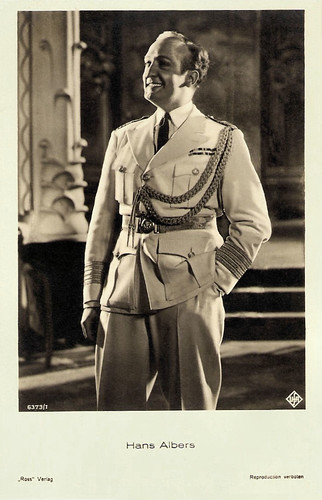
Hans Albers
German postcard by Ross Verlag, no. 6373/1, 1931-1932. Photo: Ufa.
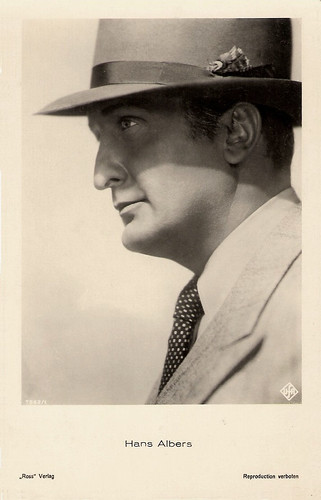
Hans Albers
German Postcard by Ross Verlag, no. 7562/1, 1932-1933. Photo: Ufa.

Massive hits


Many of Hans Albers' songs from his films became massive hits and some even remain popular to this day. While Albers himself never supported the Nazi regime, he became the most popular actor of the Third Reich.

Albers was paid a considerable sum of money to star in Ufa's big-budgeted anniversary picture Münchhausen/The Adventures of Baron Munchausen (Josef von Baky, 1943) but was always careful not to give the impression that he was endorsing the National Socialist regime. Joseph Goebbels, Reich Minister of Propaganda in Nazi Germany had commissioned this lavish production as a commemoration of the 25th anniversary of Ufa, the government-run German film association.

More importantly, it was also to be a rival of the great fantasy films which had come from the Allied nations, such as The Wizard of Oz (Victor Fleming, 1939) and The Thief of Bagdad (Ludwig Berger, Michael Powell, Tim Whelan, 1940). On IMDb, Ron Oliver writes: "In that, it succeeds brilliantly and needs no comparison to any other film."

In 1943 Albers also starred in another classic, Große Freiheit Nr. 7/Great Freedom No. 7 (Helmut Käutner, 1943) with Ilse Werner. The film was banned by the censorship of the Third Reich because the story was considered too 'anti-heroic' and demoralising how German sailors and women were portrayed. The film could only be shown outside Germany.

IMDb reviewer Jan Onderwater comments: "From directing till script, from acting till (Agfa colour) photography this is a brilliant film, with everyone involved giving the best of their talents. What we see is a compelling drama, well balanced, psychologically well conceived and at the same time a film that is great fun to watch over and over again. In this film, there are only people and their lives who are not up to standard Nazi definition."
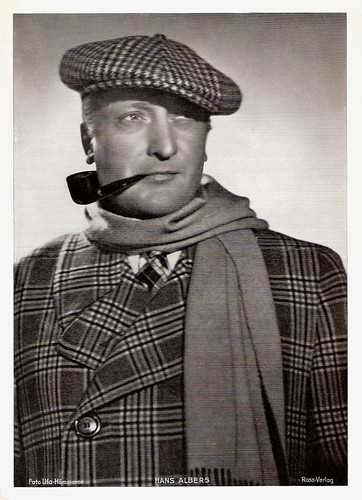
Hans Albers
Big card by Ross Verlag. Photo: Ufa / Hämmerer.
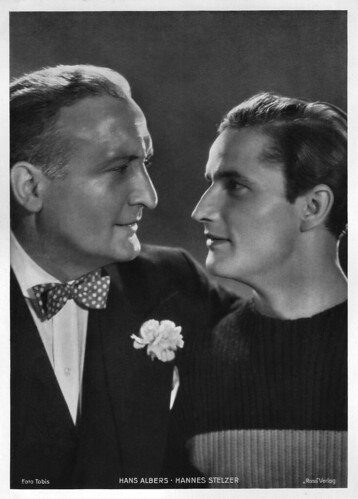
Hans Albers and Hannes Stelzer in Fahrendes Volk (1938)
Big German collectors card by Ross Verlag. Photo: Tobis. Hans Albers and Hannes Stelzer in Fahrendes Volk/Travelling people (Jacques Feyder, 1938).
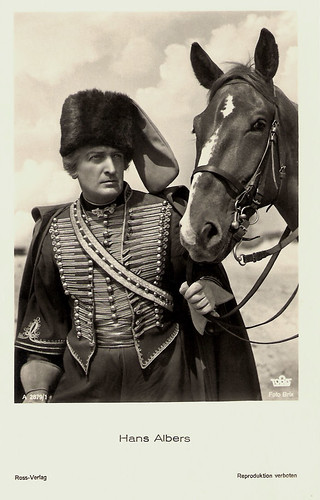
Hans Albers
German Postcard by Ross Verlag, no. A 2879/112, 1939-1940. Photo: Brix / Tobis. Publicity still for Trenck, der Pandur/Trenck the Pandur (Herbert Selpin, 1940).
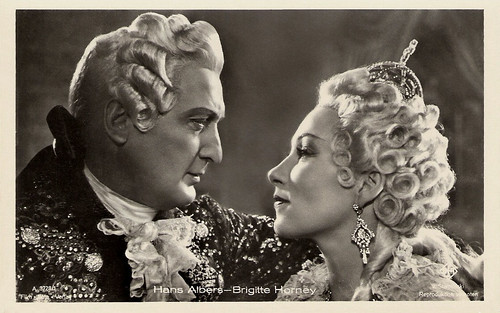
Hans Albers, Brigitte Horney
German postcard by Film-Foto-Verlag, no. A 3728/1, 1941-1944. Photo: V. Swolinski / Ufa. Publicity still for Munchhausen/The Adventures of Baron Munchausen (Josef von Baky, 1943) with Hans Albers and Brigitte Horney.
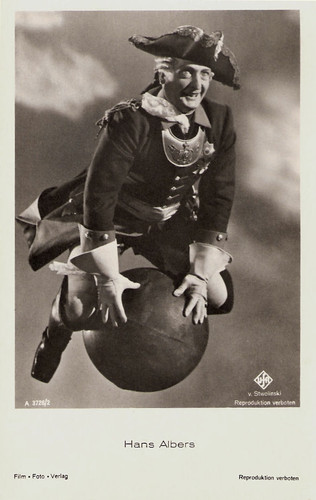
Hans Albers in Münchhausen (1943)
German postcard. Film-Foto-Verlag, no. A 3728/2, 1941-1944. Photo: von Stwolinski / Ufa. Publicity still for Münchhausen/The Adventures of Baron Munchhausen (Josef von Baky, 1943).

St. Pauli


After World War II, Hans Albers matured into character parts to some public and critical acclaim, but he never again enjoyed the huge stardom of the 1930s and early 1940s. One of his better roles of this period was an ageing industry tycoon in Vor Sonnenuntergang/Before Sundown (Gottfried Reinhardt, 1956), which won the Golden Globe as Best Foreign Film of the Year.

On IMDb reviewer Diger Jantzen notes: "Hans Albers' performance is heartbreaking from the start until the end and it is clearly one of his best serious performances ever." Albers' final film was the crime comedy Kein Engel ist so rein/No Angel Is That Pure (Wolfgang Becker, 1960) with Sabine Sinjen.

Today he is probably more known for his music than his films, and his music is still widely-known in modern Germany, even among young people. Many of Albers' songs were humorous tales of drunken, womanising sailors on shore leave, with double entendres such as "It hurts the first time, but with time, you get used to it" in reference to a girl falling in love for the first time. Albers' songs were often peppered with expressions in Low German, which is spoken in Northern Germany.

His most famous song is by far 'Auf der Reeperbahn nachts um halb eins' (On the Reeperbahn at half past midnight) which has become the unofficial anthem of the colourful neighbourhood of St. Pauli. The Hans-Albers-Platz, one block south of the Reeperbahn, has a statue of Albers, by the German artist Jörg Immendorff. Outside of Northern Europe, however, Albers remains virtually unknown, although the image of an older man in a seaman's cap and raincoat playing accordion and singing may be recognised by many outside of Germany, even if they don't know that this image is based on Hans Albers.

As a case in point, McDonald's used such an image in an American television ad campaign in 1986. In reality, Albers had no experience on the water, this being restricted to a one-day trip to Helgoland. Hans Albers died in Kempfenhausen, Bavaria, in 1960. After his death, the Wilhelmplatz, a square in St. Pauli, was named after him. In 1989, Hans Albers was the subject of a biographical docudrama, In Meinem Hertzen Schatz/In My Heart's Treasure.
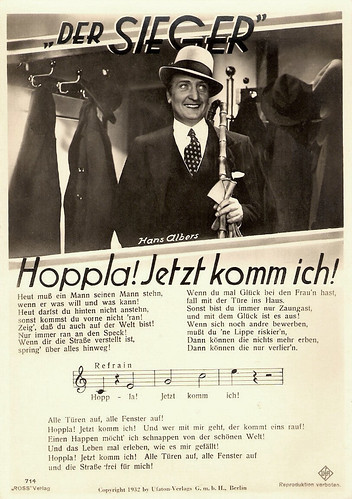
Hans Albers, Der Sieger
German Postcard by Ross Verlag, no. 714, 1932. Photo: Ufa.
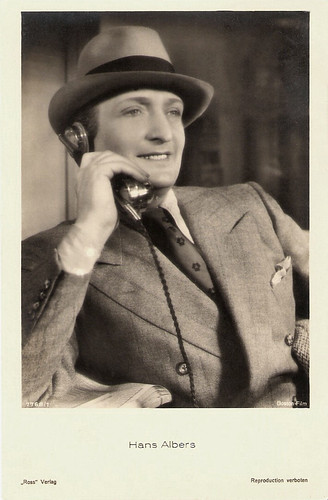
Hans Albers
German postcard by Ross Verlag, no. 7768/1, 1932-1933. Photo: Boston-Film.

Hans Albers
Dutch Postcard by JosPe, no. 545.

Hans Albers in Blaubart (1951)
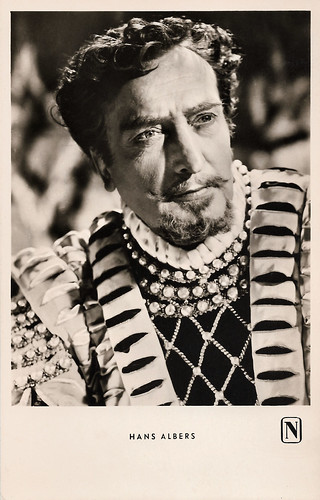
West German postcard by Kunst und Bild, Berlin, no. A 441. Photo: Nationalfilm. Hans Albers in Barbe-Bleue/Blaubart/Bluebeard (Christian-Jacque, 1951).
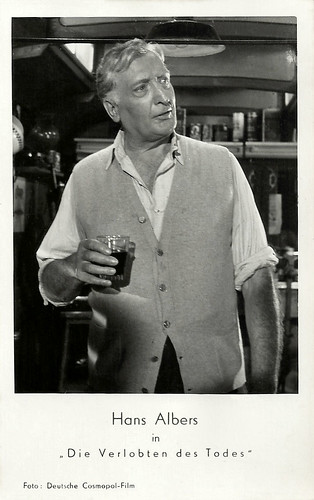
Hans Albers Die Verlobten des Todes
German postcard. Photto: Deutsche Cosmopol-Film. Publicity still for Die Verlobten des Todes/I fidanzati della morte (Romolo Marcellini, 1957).

Hans Albers in Der Greifer (1958)
West German postcard by Ufa/Film-Foto, Berlin-Tempelhof, no. FK 3987. Photo: Wesel / Kurt Ulrich Film / DFH. Hans Albers in Der Greifer/The Ripper (Eugen York, 1958).

Sources: Hal Erickson (AllMovie), Thomas Staedeli (Cyranos), Filmportal.de, Wikipedia and IMDb.

02 August 2023

Der weiße Dämon (1932)

Hans Albers, a superstar of German cinema between 1930 and 1945 played the leading role in the Ufa production Der weiße Dämon/Dope (Kurt Gerron, 1932). The supporting cast is also interesting: Fritz Lang's muse Gerda Maurus as Albers' sister, a rising young female singer who gets addicted to drugs, and Alfred Abel, Hubert von Meyerinck and Peter Lorre as three drugs smugglers. Lorre is the demonic villain, a hunchback.

Hans Albers
German postcard by Ross Verlag, no. 7039/1, 1932-1933. Photo: Ufa. Hans Albers in Der weiße Dämon/Dope (Kurt Gerron, 1932).

Hans Albers and Trude von Molo in Der weiße Dämon
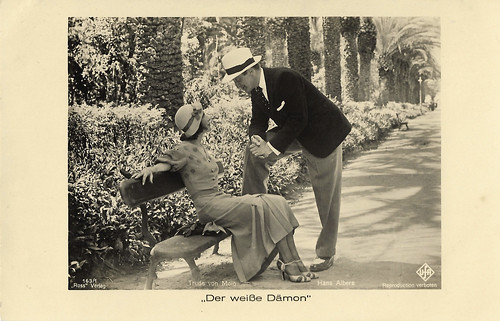
German Postcard by Ross Verlag, no. 163/1, 1932-1933. Photo: Ufa. Hans Albers and Trude von Molo in Der weiße Dämon/Dope (Kurt Gerron, 1932).

A drug called the White Demon


The script of Der weiße Dämon/Dope (Kurt Gerron, 1932) was written by Philipp Lothar Mayring and Fritz Zeckendorf. Alfred Abel plays Consul Gorre, the head of an international gang of drug smugglers that also includes the morphine-addicted theatre director Urussev (Raoul Aslan), the Marquis d'Esquillon (Hubert von Meyerinck), section chief of the gang in Paris, and a man known only as "the Hunchback" (Peter Lorre) who is responsible for importing the narcotics from overseas.

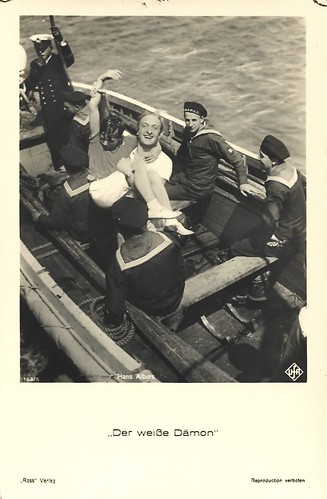
The gang of criminals travels under the guise of an internationally performing touring theatre troupe, joined as a leading lady by the young artist Gerda Gildemeister (Gerda Maurus). Gerda's brother is the "Hamburg boy" Heini Gildemeister (Hans Albers) who, after years of absence spent in South America, finally returns to his hometown by ship. On this journey home, he rescues Gorre's son after he had fallen overboard.

Back home, Heini makes a terrible discovery: Sister Gerda is only a wreck, very weak and ailing in body, mind and soul. Years of morphine abuse have taken their toll on her. She has become completely dependent and can hardly get back on her feet without this drug, also called the "white demon". Heini discovers a corresponding syringe in the pocket of Dora (Trude von Molo), a friend of Gerda's, and receives confirmation from the theatre doctor that his sister has become a dependent morphine addict through years of drug use. Heini immediately takes her to the nearest hospital. But since Gerda is supposed to travel to Paris the next day as part of a tour, the gang members are immediately on the scene and get her out of the hospital. They force Gerda to call her brother and summon him to a meeting in a pub that has a reputation as a drug bar.

When Heini appears there, the gang tries to overpower the "troublemaker", but he manages to free himself and now takes up the pursuit of the gang on his own, as the police who were informed earlier is of no real help. Heini is determined to prevent Gerda from staying in the custody of the unscrupulous dealers even one day longer. But Heini fails in this because Gerda goes to the French capital for a singing performance with the theatre troupe, where she is held in the Marquis' house. The Marquis explains to Heini that Gerda (delirious with fever, as it turns out) has forged a bill of exchange - in the hope that Heini will finally give in so as not to let his sister go to prison.

Consul Gorre, who has been in Heini's debt ever since his son was rescued on the overseas steamer, helps him to free Gerda so that Heini can immediately take her to a sanatorium. But Heini still does not know who the ostensible ally really is. Gildemeister does not let up and follows the gang of criminals. In Lisbon, he manages to get "the hunchback" arrested, while Urusev, who betrayed his buddies, is shot. On the flight home with Dora and Gorre, Heini now also exposes the ominous consul as the head of the gang. With suicidal intent, he then throws himself into the Atlantic. Heini and Gerda's artist colleague Dora, with whom he has become friends in the meantime, return to Hamburg as friends for life.

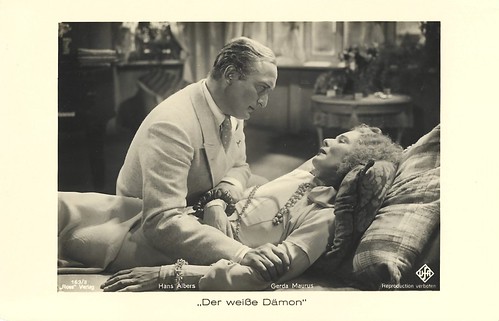
Hans Albers, Trude von Molo and Gerda Maurus in Der weiße Dämon
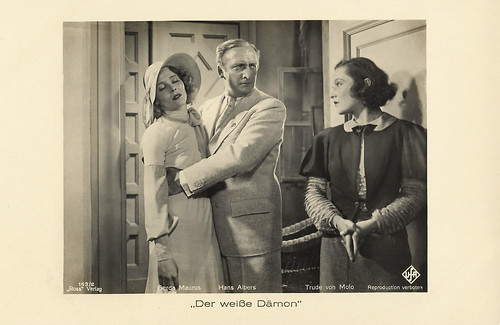
German Postcard by Ross Verlag, no. 163/2, 1932-1933. Photo: Ufa. Hans Albers, Trude von Molo and Gerda Maurus in Der weiße Dämon/Dope (Kurt Gerron, 1932).

Hans Albers and Gerda Maurus in Der weiße Dämon (1932)
German postcard by Ross Verlag, no. 613/3, 1932-1933. Photo: Ufa. Hans Albers and Gerda Maurus in Der weiße Dämon/Dope (Kurt Gerron, 1932).

Dope


Der weiße Dämon/Dope (Kurt Gerron, 1932) was shot from 20 June until August 1932 in Portugal and Spain as well as on the Hapag steamer Emil Kirdorf, in Cuxhaven harbour and on the MS General Osorio (the exterior shots). The premiere took place on 19 November 1932 in Berlin's Ufa-Palast am Zoo.

The film was originally supposed to be called Rauschgift (Dope), but this title caused considerable problems with the German film censors, who feared that the film would advertise drugs. According to a decision of 10 November 1932, corresponding scenes had to be deleted. In Austria, however, the film title Rauschgift was approved.

Julius von Borsody designed the film sets, Günther Anders assisted chief cameraman Carl Hoffmann. Hermann Hoffmann designed the costumes, Erich Holder assisted director Kurt Gerron. Walter Rühland provided the sound. In the cast was the former star of the early silent film, Eva Speyer. She played her last film role here, a very small role. Karl John in turn made his film debut here.

Simultaneously with the original German production, the Ufa made a French version with Jean Murat in the role of Hans Albers under the title Stupéfiants/Narcotics (Kurt Gerron, Roger Le Bon, 1932). In the cast were also Danièle Parola, Jean Worms, Jean Mercanton and Monique Rolland. Raoul Aslan and Peter Lorre repeated their roles from the German version. In contrast to Lorre, director Kurt Gerron, one of the greats of Weimar cinema, theatre and vaudeville, could not escape the Nazis. Gerron was murdered in Auschwitz in 1943.

Trade journal Der Film wrote: "The director Kurt Gerron ... lets the events take their fabulous course and fabulates happily along, out of actor's whim. (...) He uses his only trump cards and knows how to exploit them the fiercely extemporising Albers, who lives it up, ... the excellent Lorre, who plays with gripping demeanour, ... the this time surprisingly good Gerda Maurus...". However, future Minister of Propaganda Joseph Goebbels wrote in his diary entry of 21 November 1932: "Albers a fabulous boy. Otherwise a piece of rubbish."

Hans Albers and Trude von Molo in Der weiße Dämon
German Postcard by Ross Verlag, no. 163/4, 1932-1933. Photo: Ufa. Hans Albers and Trude von Molo in Der weiße Dämon/Dope (Kurt Gerron, 1932).

Hans Albers in Der weiße Dämon (1932)
German postcard by Ross Verlag, no. 163/5, 1932-1933. Photo: Ufa. Hans Albers in Der weiße Dämon/Dope (Kurt Gerron, 1932).

Sources: Zeughauskino (German), Filmportal.de, Wikipedia (German and English) and IMDb.

25 May 2022

Quick (1932)

In the comedy Quick (1932), the Ufa teamed two of their brightest stars, Lilian Harvey and Hans Albers. But their chemistry was less sensational than the sparks that fly between Harvey and Willy Fritsch. Supposedly there were competitive issues that put Harvey on her guard and challenged Albers' ego. Still, the tension between the two works to the advantage of this stage farce filled with mistaken identities and lover's quarrels. The young director Robert Siodmak was in charge. Together with André Daven, Siodmak also co-directed a French-language version, Quick (1932) in which Harvey co-starred with Jules Berry as Quick.

Lilian Harvey and Hans Albers in Quick (1932)
German postcard by Agfa. Photo: Ufa. Hans Albers and Lilian Harvey in Quick (Robert Siodmak, 1932).

Hans Albers and Lilian Harvey in Quick (1932)
German postcard by Ross Verlag, no. 141/1. Photo: Ufa. Hans Albers and Lilian Harvey in Quick (Robert Siodmak, 1932).

Lilian Harvey and Hans Albers in Quick (1932)
German postcard by Ross Verlag, no. 141/2. Photo: Ufa. Hans Albers and Lilian Harvey in Quick (Robert Siodmak, 1932).

Hans Albers and Paul Hörbiger in Quick (1932)
German postcard by Ross Verlag, no. 141/3. Photo: Ufa. Hans Albers and Paul Hörbiger in Quick (Robert Siodmak, 1932).

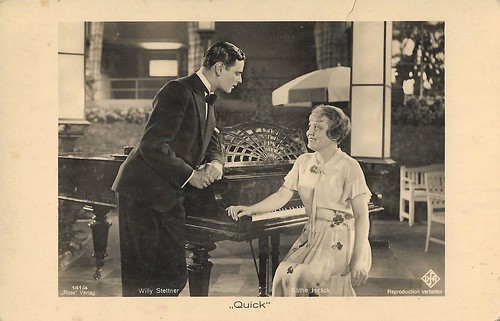
Käthe Haack and Willy Stettner in Quick (1932)
German postcard by Ross Verlag, no. 141/4. Photo: Ufa. Käthe Haack and Willy Stettner in Quick (Robert Siodmak, 1932).

Witty dialogues and charming stars


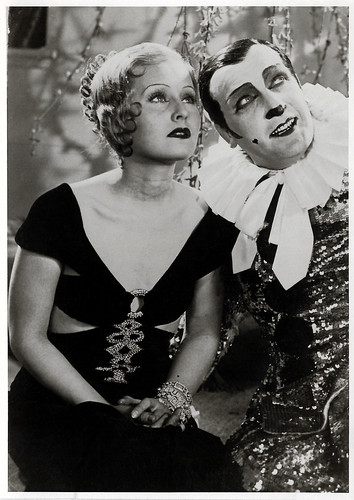
Lilian Harvey plays 21-year-old divorcee Eva Prätorius who is taking some time in a posh spa, the Sonneneck sanatorium, which is under the medical management of the respected Prof. Bertram. Every evening she keeps sneaking out to the Apollo Theatre, the town's vaudeville theatre. She wants to see a performer, the musical clown Quick (Hans Albers in heavy white make-up), do his act.

Eva goes backstage to meet Quick. But she doesn't recognise him when he happens to stand in front of her - without make-up, as she has never seen him before. He also begins to take a shine for the young, capricious woman who adores him every evening from her box. He tries to woo her, masquerading as the theatre's manager.

Quick tries to get her to fall in love with who he is in real life but Eva only likes him as a person who can introduce her to Quick. Unable to resolve her feelings for both the clown and the theatre manager, Eva is angered when she finally learns that they are one and the same. But not for long, of course...

Quick (Robert Siodmak, 1932) was clearly based on a stage play, by Félix Gandéra, and was not a particularly good showcase for any of the main talents except for Hans Albers. However, the mistaken identity and following runaround are never tiresome as and Quick is better than most Ufa films in this genre.

Mayesgwtw39 (IMDb) notes that Quick contains "some witty dialogue [by Hans Müller], but the stars are relying mostly on their screen personas to supply the charm. They do so quite effectively from the leads to the supporting cast. The whole thing makes for a lively and somewhat stylish farce." The sets were designed by art director Erich Kettelhut. Max Pfeiffer was the production manager and film editor Viktor Gertler also served as Robert Siodmak's assistant director.

Hans Albers, Paul Hörbiger, Paul Westermeier and Genia Nikolaiewa in Quick (1931)
German postcard by Ross Verlag, no. 141/5, 1931-1932. Photo: Ufa. Hans Albers, Paul Hörbiger, Paul Westermeier and Genia Nikolaieva in Quick (Robert Siodmak, 1931).

Lilian Harvey and Hans Albers in Quick (1932)
German postcard by Ross Verlag, no. 141/6. Photo: Ufa. Lilian Harvey and Hans Albers in Quick (Robert Siodmak, 1932). Collection: Geoffrey Donaldson Institute.

Hans Albers in Quick (1932)
German postcard by Ross Verlag, no. 6833/2, 1931-1932. Photo: Ufa. Hans Albers in Quick (Robert Siodmak, 1932).

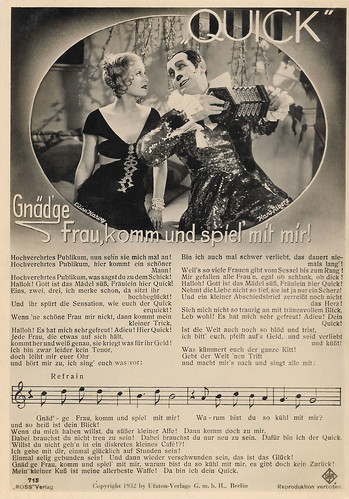
Lilian Harvey and Hans Albers in Quick (1932)
German postcard by Ross Verlag, no. 715/1. Photo: Ufa. Hans Albers and Lilian Harvey in Quick (Robert Siodmak, 1932). Songtext of 'Gnädige Frau, komm und spiel mit mir' (Madam, come and play with me). Copyright: Ufaton-Verlag, 1932.

Sources: Mayesgwtw39 (IMDb), Wikipedia (German and English), and IMDb.

This post was last updated on 19 March 2023.