Showing posts with label Reinhold Schünzel. Show all posts

07 May 2025

Directed by Reinhold Schünzel

German actor, producer, scriptwriter and director Reinhold Schünzel (1888-1953) was for a long period one of the most underrated filmmakers of Weimar Germany. He started his successful film career during the First World War and directed a string of classic comedies including Viktor und Viktoria/Victor and Victoria (1933) and Amphitryon (1935) in the sound era. Only in 1937 he left Nazi Germany and continued his career in Hollywood. In this post, EFSP focuses on the memorable films Schünzel directed.

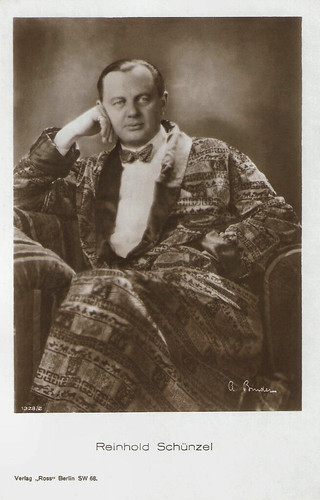
Reinhold Schünzel
German postcard by Ross Verlag, no. 1328/2, 1927-1928. Photo: Alex Binder. Reinhold Schünzel.
Hilde Wörner in Der Graf von Cagliostro (1920)
German postcard by Photochemie, no. K. 3346. Hilde Wörner in the German-Austrian coproduction Der Graf von Cagliostro/The Count of Cagliostro (Reinhold Schünzel, 1920). Photo: Abele, Berlin.

Paul Hartmann
German postcard by Verleih Hermann Leiser, Berlin, no. 3069. Photo: Atelier Oertel, Berlin. Perhaps Paul Hartmann in Katharina die Grösse/Catherine the Great (Reinhold Schünzel, 1920), in which Hartmann played Alexander Manonow opposite Lucie Englisch as the famous czarina Catherine the Great.

Reinhold Schünzel in In der Heimat, da gibt's ein Wiedersehn!
German postcard by Ross Verlag, no. 69/1. Photo: Reinhold Schünzel-Film / Ufa. Reinhold Schünzel and Margot Walter in In der Heimat, da gibt's ein Wiedersehn!/ We'll Meet Again in the Heimat (Reinhold Schünzel, Leo Mittler, 1926). The film was distributed by Ufa. It meant the screen debut of Margot Walter (1903-1994), later known as Margot Landa when married to actor-director Max Landa.

Olly Gebauer and Kurt Vespermann
German postcard by Ross Verlag, no. 6354/1, 1931-1932. Photo: Ufa. Olly Gebauer and Kurt (Curt) Vespermann, probably in the musical comedy Ronny (Reinhold Schünzel, 1931).

Käthe von Nagy in Ronny (1931)
German postcard by Ross Verlag, no. 6367/1. 1931-1932. Photo: Ufa. Käthe von Nagy in Ronny (Reinhold Schünzel, 1931).

The ironic, feather-light and slightly risqué 'Lubitsch touch'


Reinhold Schünzel was greatly influenced by established filmmakers Richard Oswald, who was a mentor and frequent collaborator from 1916 and Ernst Lubitsch, for whom he had worked as an actor in Madame DuBarry (1919). Schünzel's first film as a director was the silent drama Maria Magdalene/Mary Magdalene (Reinhold Schünzel, 1920) an adaptation of Friedrich Hebbel's play starring Eduard von Winterstein, Ilka Grüning and Lucie Höflich. He made his mark with the epic historical drama Katharina die Große/Catherine the Great (1920) with Lucie Höflich as the famous czarina.

His films were popular enough to allow him to set up his production company Schünzel-Film. He merged it several months later with the Vienna-based production company Micheluzzo & Co. (Micco-Film). The new production company then produced Der Graf von Cagliostro/The Count of Cagliostro (Reinhold Schünzel, 1920) starring Conrad Veidt and Anita Berber. In 1926, Schünzel again started his own business with his production company Reinhold Schünzel-Film GmbH. He produced, directed and starred in a series of comedies including Hallo Cesar!/Hello Cesar! (1926), Adam und Eva/Adam and Eve (1928), Don Juan in der Mädchenschule/Don Juan in the Girls School (1928), and Aus dem Tagebuch eines Junggesellen/From a bachelor's diary (1928). These films displayed his full comedic potential and they were rediscovered in the 1980s and presented at the CineGraph Congress and CineFest in Hamburg.

From 1931 on, Reinhold Schünzel worked as a director for Ufa and with the advent of the sound film, his comic talent as a director became even more apparent. Schünzel finished several very successful musical films in the following years including the original drag comedy Viktor und Viktoria/Viktor and Viktoria (1933) - a spoof of British music hall impersonators - and the social satire Die englische Heirat/The English Marriage (1934), often starring Renate Müller in the leading role. Schünzel's satirical, mythologically-themed musical farce Amphitryon (1935) with Willy Fritsch, in particular, had all the hallmarks of the ironic, feather-light and slightly risqué 'Lubitsch touch'. It also boasted above-average production values.

Amphitryon was Ufa's number one box office hit in its year. It has been alleged that Schünzel was Adolf Hitler's favourite director until Hitler discovered that he was one-half Jewish. His work was so popular in Germany that the Nazi regime bestowed upon him the title of 'Ehrenarier' (honorary Aryan) and permitted him to continue to work despite his Jewish background. However, it became more and more difficult for him to work in the Third Reich and as a Half-Jew he depended on a work permit for each further film. Eventually, he left Germany in 1937, increasingly frustrated with governmental interference in his projects.

Like many other exiles, Reinhold Schünzel turned up in Hollywood. Signed by MGM, he directed three films including the glossy operetta Balalaika (1939), a star vehicle for Nelson Eddy. His other films, particularly The Ice Follies of 1939 (1939) and the romanticised and inaccurate biopic of composer Franz Schubert, New Wine (1941) suffered from miscasting. The former was possibly the biggest flop of Joan Crawford's long career. After the war, he returned to Germany in 1949. Surprised and disappointed, he found the same officials in the film licensing authorities who had made it difficult for him to work during the Third Reich. And now he encountered the same difficulties again. Schünzel did not direct another film, but in 1951, at the request of producer Franz Tapper, he co-directed the film version of Die Dubarry/The Dubarry (Georg Wildhagen, Reinhold Schünzel, 1951). Critics and film historians neglected the 'Ehrenarier' while they assumed opportunism behind his work in Nazi Germany. Reinhold Schünzel died in 1953 of a heart attack.

Willy Fritsch in Ronny (1931)
German postcard by Ross Verlag, no. 708. Photo: Ufa. Willy Fritsch in Ronny (Reinhold Schünzel, 1931). Song Text 'Wenn die Garde aufmarschiert'. Copyright: Ufaton, 1932.

Wolf Albach-Retty and Käthe von Nagy in Das schöne Abenteuer (1932)
German postcard by Ross Verlag, no. 142/5. Photo: Ufa. Wolf Albach-Retty and Käthe von Nagy in Das schöne Abenteuer/Beautiful Adventure (Reinhold Schünzel, 1932).

Ida Wüst and Renate Müller in Wie sag' ich's meinem Mann? (1932)
German postcard by Ross Verlag, no. 165/3. Photo: Ufa. Ida Wüst and Renate Müller in Wie sag' ich's meinem Mann?/How Shall I Tell My Husband? (Reinhold Schünzel, 1932).

Willy Fritsch in Saison in Kairo (1933)
German postcard by Ross Verlag, no. 184/1. Photo: Ufa. Willy Fritsch in Saison in Kairo/Cairo Season (Reinhold Schünzel, 1933).

Renate Müller and Hermann Thimig in Viktor und Viktoria
German postcard by Ross Verlag, no. 195/1. Photo: Ufa. Renate Müller and Hermann Thimig in Viktor und Viktoria/Viktor and Viktoria (Reinhold Schünzel, 1933).

Willy Fritsch and Käthe von Nagy in Die Töchter ihrer Exzellenz (1934)
German collectors card in the series 'Vom Werden deutscher Filmkunst - Der Tonfilm', album no. 11, picture no. 94. Photo: Ufa / Ross Verlag. Willy Fritsch and Käthe von Nagy in Die Töchter ihrer Exzellenz/The Daughters of Her Excellence (Reinhold Schünzel, 1934).

Adolf Wohlbrück and Renate Müller in Die englische Heirat (1934)
German collector card in the series 'Vom Werden deutscher Filmkunst - Der Tonfilm', album no. 11, picture no. 97, group 44. Photo: Cine-Allianz/ Ross Verlag. Adolf Wohlbrück (Anton Walbrook) and Renate Müller in Die englische Heirat/The English Marriage (Reinhold Schünzel, 1934).

Adele Sandrock in Die englische Heirat (1934)
German Postcard by Ross Verlag, no. 8881, 1934-1935. Photo: Cine Allianz / Europa. Adele Sandrock in Die englische Heirat/The English Marriage (Reinhold Schünzel, 1934).

Willy Fritsch in Amphitryon (1935)
German postcard by Ross Verlag, no. 9172/3, 1935-1936. Photo: Ufa. Willy Fritsch in Amphitryon/Amphitryon - Happiness from the Clouds (Reinhold Schünzel, 1935).

Ilona Massey and Nelson Eddy in Balalaika (1939)
Hungarian postcard. Photo: Metro-Goldwyn-Mayer. Ilona Massey and Nelson Eddy in Balalaika (Reinhold Schünzel, 1939).

Ilona Massey and Nelson Eddy in Balalaika
Hungarian postcard by Athenaeum Color. Photo: Metro-Goldwyn-Mayer. Ilona Massey and Nelson Eddy in Balalaika (Reinhold Schünzel, 1939).

Sources: I.S. Mowis (IMDb), Filmportal, Wikipedia (German and English) and IMDb.

21 April 2017

Reinhold Schünzel

German actor and director Reinhold Schünzel (1888-1953) started his successful film career during the first World War. He helmed and appeared in more than 100 productions, specialising in light comedies such as the classic ‘drag’ farce Viktor und Viktoria/Victor and Victoria (1933). In 1937 he had to flee Nazi Germany and continued his career in Hollywood.

Reinhold Schünzel
German postcard by Verlag Herm. Leiser, Berlin-Wilm., no. 5070. Photo: Becker & Maass.

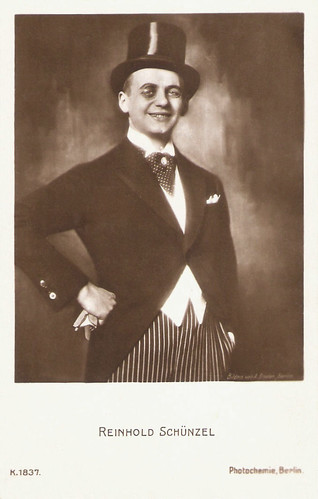
Reinhold Schünzel
German postcard by Photochemie, Berlin, no. K. 1837. Photo: Alex Binder, Berlin.

Eduard von Winterstein, Rosa Porten and Reinhold Schünzel in Die Erzkokette (1917)
German collectors card by Ross Verlag for the album Vom Werden deutscher Filmkunst. Teil I. Der stumme Film (Cigaretten-Bilderdienst Altona-Bahrenfeld 1935), Bild no. 43, Gruppe 41. Photo: Treumann-Larsen-Film. Publicity still for Die Erzkokette/The Superflirt (Franz Eckstein, Rosa Porten, 1917) with left Eduard von Winterstein and Rosa Porten.

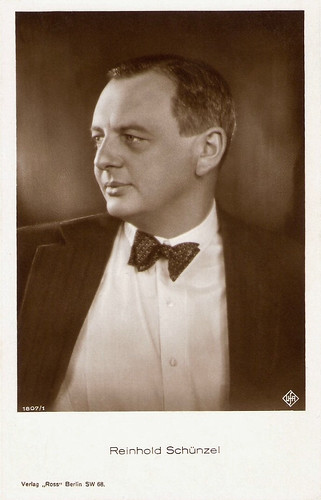
Reinhold Schünzel
German postcard by Ross Verlag, Berlin, no. 1907/1, 1927-1928. Photo: Ufa.

Dolly Haas, Reinhold Schünzel and Lucie Mannheim in Der Ball (1931)
German postcard by Ross Verlag, no. 6079/1, 1931-1932. Photo: Vandal & Delac. Publicity still for Der Ball/The Ball (Wilhelm Thiele, 1931) with Dolly Haas and Lucie Mannheim.

Self-indulgent bonvivant and seducer


Reinhold Schünzel was born in Hamburg, Germany, in 1888 (some sources: 1886). After finishing school, he completed an apprenticeship as a merchant in the Berlin-based publishing company Scherl. He then worked in Berlin, later in Hamburg, as a branch manager for the publishing company.

Besides, he worked as a part-time extra in films. He became a full-time actor in 1912. He then performed at Stadttheater Bern and at Berlin's Komödienhaus at Schiffbauerdamm and at Theater at Königgrätzer Straße. His film debut was in Werner Krafft (Carl Froelich, 1916) with Erika Glässner.

In the same year, he was discovered by Richard Oswald. From then on he often played the part of the self-indulgent bonvivant and seducer, the sly pander and extortionist in Oswald's films. He starred in the Aufklärungsfilms (educational film) Das Tagebuch einer Verlorenen/The Diary of a Lost Woman (Richard Oswald, 1918) with Erna Morena, Werner Krauss, and Conrad Veidt, and Das gelbe Haus/Prostitution (Richard Oswald, 1919) starring Anita Berber.

With Veidt, he starred in Anders als die Andern/Different from the Others (Richard Oswald, 1919), where he embodied the blackmailer of a homosexual violinist, played by Veidt. He also appeared as the villain in the crime films of the Max Landa series, such as Das Geheimnis des Amerika-Docks/The Secret of the America Dock (Ewald André Dupont, 1919).

In 1919 he directed his first film, Maria Magdalena/Mary Magdalena (Reinhold Schünzel, 1919) with Lucie Höflich. He followed this up with the Aufklärungsfilm Das Mädchen aus der Ackerstraße/The Girl From the Ackerstrasse (1920) and the elaborate history film Katharina die Große/Catherine the Great (1920).

Henny Porten and Reinhold Schünzel in Höhenluft
German postcard by Film-Sterne Verlag, no. 508/4. Photo: Messter. Henny Porten and Reinhold Schünzel in the comedy Höhenluft (Rudolf Biebrach, 1917).

Reinhold Schünzel in Das Karussell des Lebens
German postcard by Photochemie, Berlin, no. K.2931. Photo: Union. Reinhold Schünzel in Das Karussell des Lebens (Georg Jacoby, 1918). According to German Wikipedia Schünzel's presence in the film is unsure, but this postcard seems to prove it.

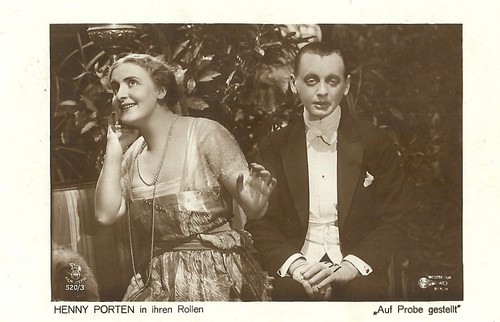
Henny Porten and Reinhold Schünzel in Auf Probe gestellt
German postcard by Rotophot in the Film Sterne series, no. 520/3. Photo: Messter Film. Henny Porten and Reinhold Schünzel in the German silent comedy Auf Probe gestellt (Rudolf Biebrach, 1918).

Erna Morena, Conrad Veidt and Reinhold Schünzel in Das Tagebuch einer Verlorenen (1918)
German postcard by Rotophot in the Film Sterne series, no. 529/6. Photo: Richard Oswald-Film. Erna Morena, Conrad Veidt and Reinhold Schünzel in Das Tagebuch einer Verlorenen/The Diary of a Lost Woman (Richard Oswald, 1918).

Reinhold Schünzel and Ilka Grüning in Die sich verkaufen
German postcard by Ross Verlag, Berlin, no. 616/2. Photo: Richard-Oswald-Film. Reinhold Schünzel and Ilka Grüning in Die sich verkaufen, part 2 of the series Prostitution (Richard Oswald, 1919).

Pola Negri and Reinhold Schünzel in Madame DuBarry (1919)
German postcard by Ross Verlag, no. 627/6. Photo: Union Film. Reinhold Schünzel and Pola Negri in Madame DuBarry (Ernst Lubitsch, 1919). After the death of King Louis XV (Emil Jannings), his minister Choiseul (Schünzel) chases DuBarry (Negri) from the Royal palace.

Classic Drag Farce


Still, in 1920, Reinhold Schünzel set up the production company Schünzel-Film and merged it several months later with the Vienna-based production company Micheluzzo & Co. (Micco-Film). The new production company then produced Der Graf von Cagliostro/The Count of Cagliostro (1920), starring Conrad Veidt and Anita Berber. Schünzel helmed the film as a producer, director, and actor.

Schünzel also starred in ambitious productions like Madame Dubarry/Passion (Ernst Lubitsch, 1919) starring Pola Negri, and the Friedrich Schiller adaption Luise Millerin (Carl Froelich, 1922) featuring Lil Dagover.

From the second half of the 1920s on, he specialised as a director in light comedies. He displayed his full comedic potential in films such as Adam und Eva/Adam and Eve (1923), Halloh Caesar!/Hello Cesar! (1926), and Don Juan in der Mädchenschule/Don Juan in the Girl’s School (1928) with Adolphe Engers.

Even when he was at his busiest as a director, Schünzel found time to act in other men's films, notably Georg Wilhelm Pabst’s adaptation of Die 3-Groschen-Oper/The Beggar's Opera (G.W. Pabst, 1931), in which he played crooked constable Tiger Brown.

With the introduction of the sound film his comic talent as a director came even to a better advantage. From 1931 on, Schünzel worked as a director for Ufa and finished a number of very successful musical films, including Saison in Kairo/Cairo Season (1933), the classic ‘drag’ farce Viktor und Viktoria/Victor and Victoria (1933), and Amphitryon - the clouds comes from the happiness/Amphitryon – Aus den Wolken kommt das Glück (1935). In all these films, Renate Müller played the leading role.

Schünzel also directed the simultaneously film French-language version of Viktor und Viktoria: George et Georgette (Roger Le Bon, Reinhold Schünzel, 1933) starring Meg Lemonnier. Viktor und Viktoria would also lead to such remakes as Victor, Victoria (Blake Edwards, 1981) starring Julie Andrews.

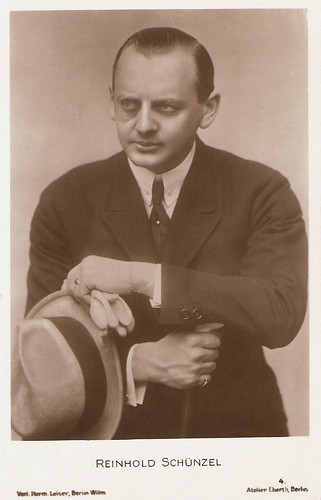
Reinhold Schünzel
German postcard by Herm. Leiser, Berlin-Wilm. Photo: Atelier Eberth, Berlin.

Reinhold Schünzel
German postcard by Ross Verlag, no. 386/1. Photo: Riess.

Reinhold Schünzel
German postcard by Ross Verlag, no. 1328/2, 1927-1928. Photo: Alex Binder.

Reinhold Schünzel
German postcard by Ross Verlag, no. 1328/3, 1927-1928. Photo: Alex Binder.

Reinhold Schünzel
German postcard by Ross Verlag, no. 1585/2, 1927-1928. Photo: Ufa.

Half-Jew


After 1933, Reinhold Schünzel was only by special permission of the Nazis allowed to work because he was described as ‘half-Jew’. Though he tried to make the best of things after Adolph Hitler's ascent to power, the ironic undertone of his films eventually got Schünzel in trouble with the Nazi regime. There were so many interventions in his films that he left the country after finishing Land der Liebe/Land of Love (1937) with Albert Matterstock.

He resettled in Hollywood. His American directorial debut was Rich Man Poor Girl (1938). Although the three musical films he made for MGM were quite successful - the others were Balalaika (1939) and The Ice Follies of 1939 (1939) - and featured stars like Joan Crawford and James Stewart, Schünzel was not able to make his breakthrough in Hollywood. Thus, New Wine (1941) happened to be his last film as a director.

From then on he concentrated solely on playing character roles. He appeared as a Nazi villain in major films as Hangmen Also Die! (Fritz Lang, 1943) and Notorious (Alfred Hitchcock, 1946). Amidst the requisite Nazis and Professorial types, Schünzel enjoyed one of his best-ever screen roles in Paramount's The Man in Half-Moon Street (Ralph Murphy, 1945), playing the conscience-stricken associate of murderous ‘eternal-life’ experimenter Nils Asther.

In 1949 (some sources say 1952) he returned to Germany and worked again at on stage in Munich, as he appeared as a supporting actor in films. For his role in Meines Vaters Pferde/My father's horses (Gerhard Lamprecht, 1954), he received the Bundesfilmpreis (Federal Film Award) as Best Male Supporting Actor.

Shortly after, Reinhold Schünzel died in Munich of heart disease. He was the father of Marianne Stewart. On the occasion of Schünzel’s 100th Birthday in 1988, CineGraph – the Hamburg Institute Center for Film Research dedicated a congress to the work of the director and actor.

Subsequently a biography was published: Reinhold Schunzel: Schaupieler und Regisseur (1989), by Hans-Michael Bock, Wolfgang Jacobson, and Joerg Schoening. The publication inspired Hans-Christoph Blumenberg to make a film about Schünzel, Beim nächsten Kuß knall ich ihn nieder!/The Next Kiss I’ll Shoot Him! (1995). Since 2004 CineFest, the International Festival of German Film Heritage has the Reinhold Schünzel Award, a yearly honorary award for long service to the care, preservation, and dissemination of the German film heritage.

Reinhold Schünzel
German postcard by Ross Verlag, Berlin, no. 361/1. Photo: Alex Binder, Berlin.

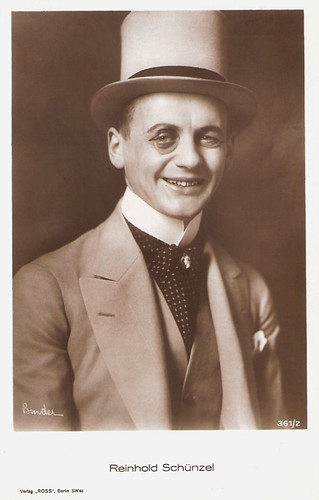
Reinhold Schünzel
German postcard by Ross Verlag, Berlin, no. 361/2. Photo: Alex Binder, Berlin.

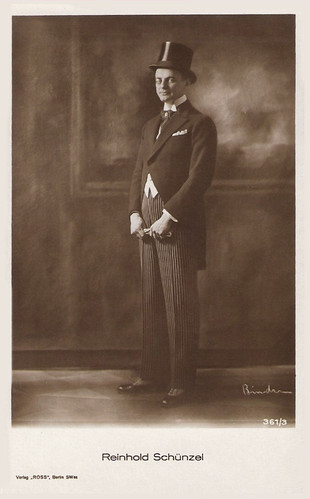
Reinhold Schünzel
German postcard by Ross Verlag, Berlin, no. 361/3, 1919-1924. Photo: Alex Binder.

Reinhold Schünzel
German postcard by Ross Verlag / W.J, Mörling, Berlin, no. 391/2. Photo: Karl Schenker, Berlin.

Reinhold Schünzel
German postcard by Deutsche London Film. Photo: Intercontinental-Film / London-Film / Lilo.

Sources: Hal Erickson (AllMovie), Thomas Staedeli (Cyranos), Filmportal.de, TCM, Wikipedia (German), and IMDb.

This post was last updated on 11 April 2021.

26 January 2016

Auf Probe gestellt (1918)

Another popular film with sturdy and blonde German diva Henny Porten (1890-1960) was the silent comedy Auf Probe gestellt/Put to the test (Rudolf Biebrach, 1918). Behind the camera were several talented artists working who would become very important for the Weimar cinema.

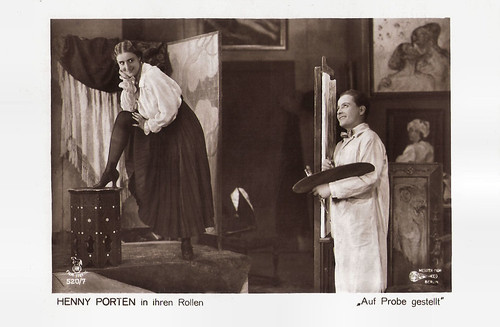
Henny Porten and Hermann Thimig in Auf Probe gestellt (1918)
German postcard in the Film Sterne series by Rotophot, no. 520/7. Photo: Messter Film, Berlin. Publicity still for Auf Probe gestellt/Put to the test (Rudolf Biebrach, 1918) with Henny Porten and Hermann Thimig.

Put to the marriage test


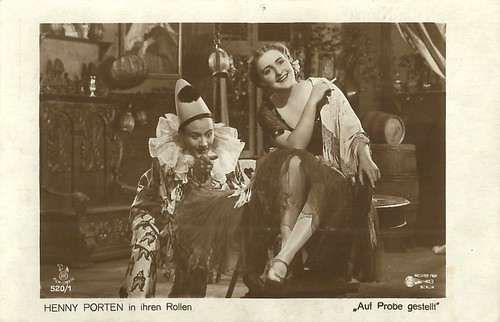
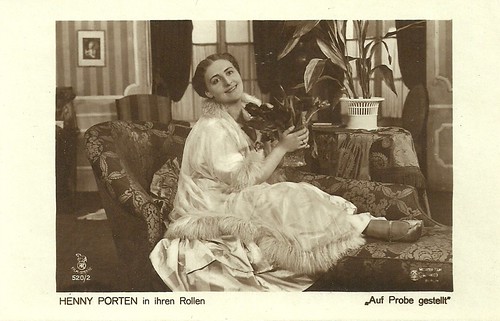
In Auf Probe gestellt/Put to the test (Rudolf Biebrach, 1918), Henny Porten portrays the the young and impoverished widower Countess Marlene von Steinitz.

At the instance of her brother-in-law, Count Steinitz (Heinrich Schroth), she plans to marry the stupid but extremely rich Count Adolar von Warowingen (Reinhold Schünzel), which would liberate her from all her problems at once.

She asks Count Steinitz a delay of eight days and travels to the city to find a solution and enjoy her free life one last time. At an artists party she meets painter Frank Merwin (Hermann Thimig), seduces him and manages to invite the handsome young man to her castle.

When he awakes from his dream, he is treated like a famous personality by all bystanders. Marlene pretends to be his bride, putting him to the test to see if he is any good as husband.

Though Merwin stands the test poorly, and he is sent back to his shabby room, the Countess decides to have him, leaving Count Adolar with a basket as gift, and betrothing Frank in the city.

Henny Porten in Auf Probe gestellt
German postcard in the Film Sterne series by Rotophot, no. 520/1. Photo: Messter Film, Berlin. Publicity still for Auf Probe gestellt/Put to the test (Rudolf Biebrach, 1918) with Henny Porten.

Henny Porten in Auf Probe gestellt 2
German postcard in the Film Sterne series by Rotophot, no. 520/2. Photo: Messter Film, Berlin. Publicity still for Auf Probe gestellt/Put to the test (Rudolf Biebrach, 1918) with Henny Porten.

Henny Porten and Reinhold Schünzel in Auf Probe gestellt
German postcard in the Film Sterne series by Rotophot, no. 520/3. Photo: Messter Film, Berlin. Publicity still for Auf Probe gestellt/Put to the test (Rudolf Biebrach, 1918) with Henny Porten and Reinhold Schünzel.

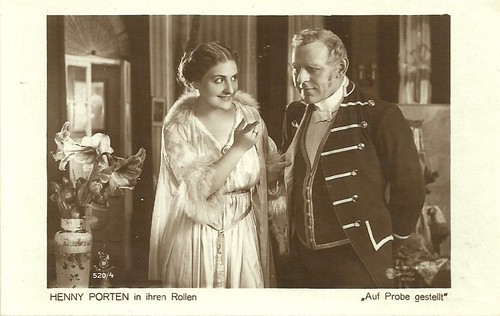
Henny Porten in Auf Probe gestellt 4
German postcard in the Film Sterne series by Rotophot, no. 520/4. Photo: Messter Film, Berlin. Publicity still for Auf Probe gestellt/Put to the test (Rudolf Biebrach, 1918) with Henny Porten.

The talent behind Auf Probe gestellt


The script of Auf Probe gestellt/Put to the test was written by Robert Wiene, the future director of the classic silent horror film Das Cabinet des Dr. Caligari/The Cabinet of Dr. Caligari (1920)

Ludwig Kainer had designed the sets for the film. Kainer designed the sets of all the late 1910s films with Porten and director Rudolf Biebrach.

The camera work was done by famous cinematographer and future director Karl Freund. He had shot many of the late 1910s films with Porten and directed by Biebrach. The following year, in 1919, Freund would become the close collaborator of director Friedrich Wilhelm Murnau.

Auf Probe gestellt premiered on 15 March 1918 at the Mozartsaal cinema in the heart of Berlin.

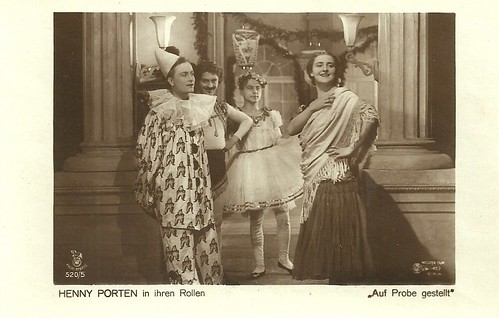
Henny Porten in Auf Probe gestellt 5
German postcard in the Film Sterne series by Rotophot, no. 520/5. Photo: Messter Film, Berlin. Publicity still for Auf Probe gestellt/Put to the test (Rudolf Biebrach, 1918) with Henny Porten.

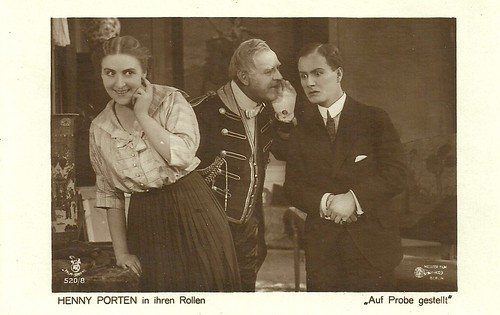
Henny Porten in Auf Probe gestellt 8
German postcard in the Film Sterne series by Rotophot, no. 520/8. Photo: Messter Film, Berlin. Publicity still for Auf Probe gestellt/Put to the test (Rudolf Biebrach, 1918) with Henny Porten and Hermann Thimig.

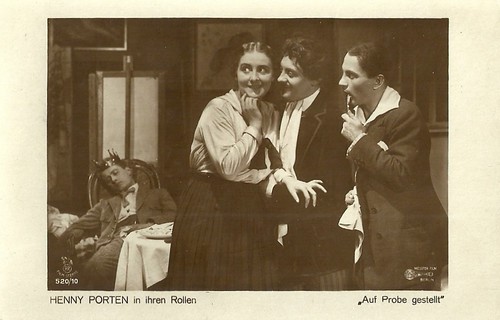
Henny Porten in Auf Probe gestellt
German postcard in the Film Sterne series by Rotophot, no. 520/10. Photo: Messter Film, Berlin. Publicity still for Auf Probe gestellt/Put to the test (Rudolf Biebrach, 1918).

Sources: Wikipedia (German) and IMDb.