British Flora Robson (1902-1984) was one of the half dozen finest dramatic actresses of her generation. Her range extended from queens to murderesses, and she was particularly renowned for her performances in plays demanding dramatic and emotional intensity. Her best-known film role was that of Queen Elizabeth I in both Fire Over England (1937) and The Sea Hawk (1940). However, her career was a constant struggle to achieve the roles worthy of her talents.

Spanish leaflet by Films Selectos, Suplemento Artistico, no. 177, 3.3.1934. Photo: London Films / United Artists. Elisabeth Bergner as Princess Sophie, later Empress Catherine, and Flora Robson as Empress Elisabeth in the British film The Rise of Catherine the Great (Paul Czinner, 1934). The historical film was produced by Alexander Korda and based on the play 'The Czarina' by Lajos Bíró and Melchior Lengyel, about the rise to power of Catherine the Great.
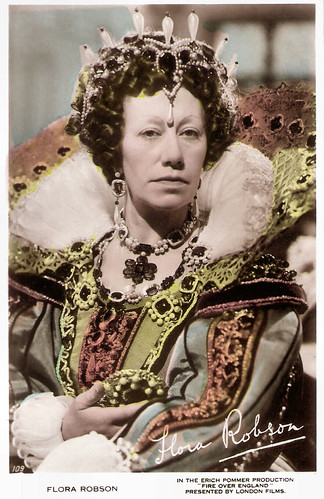
British postcard by Art Photo Postcard, no. 109. Photo: London Films. Publicity still for Fire Over England (William K. Howard, 1937).
Flora McKenzie Robson was born in South Shields, County Durham. She was of Scottish descent, to a family of six siblings. Her father was a ship's engineer. He discovered that Flora had a talent for recitation, and she recited 'Little Orphan Annie' in a school performance. From the age of five, she was taken around by horse and carriage to recite and to compete in recitations. She was educated at the Palmers Green High School and the Royal Academy of Dramatic Art (RADA).
At 19, Robson made her stage debut as Queen Margaret in the play 'Wil Shakespeare' in 1921. She graduated from RADA with a bronze medal, but then she struggled to find a footing in the theatre. She had a long face, with a big nose and a wide mouth and apparently lacked the looks, which were then an absolute requisite for actresses in dramatic roles. After touring in minor parts with Ben Greet's Shakespeare company, she played small parts for two seasons in the new repertory company at Oxford, alongside a youthful John Gielgud. Then her contract was not renewed.
Wikipedia: “She was told, as tactfully as possible, that they required a prettier actress. Unable to secure any acting engagements, she gave up the stage at the age of 23 and in a disconsolate life-change she took up work as a welfare officer in the Shredded Wheat factory in Welwyn Garden City”. In the factory, she formed an amateur theatrical group among the workers there. She later credited this experience with enlarging her view of dramatic structure and acting. In 1929, Tyrone Guthrie, due to direct a season at the new Festival Theatre, Cambridge, asked her to join his company. It was the dramatic making of her.
She played the stepdaughter in Pirandello's 'Six Characters in Search of an Author', and her acting made her the theatrical talk of Cambridge. More excited applause followed with her Isabella in 'Measure for Measure', opposite a youthful Robert Donat, the title role in 'Iphigenia', Varya in 'The Cherry Orchard' and finally the huge challenge of Rebecca West in Ibsen's 'Rosmersholm'.
These performances signalled the arrival of an actress who could either transmit emotional stress or simply hint at it, with rare power. In her second season, though, she had few dramatic opportunities, and once again her lack of chocolate-box appeal meant that the management dispensed with her services.
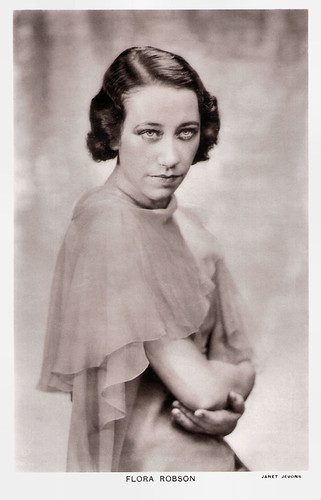
British postcard in the Picturegoer Series, London, no. 901. Photo: Janet Jevons.

British postcard in the "Film Shots" series by Film Weekly. Photo: London Films. Douglas Fairbanks Jr., Flora Robson and Elisabeth Bergner in Catherine the Great (Paul Czinner, 1934).
In the early 1930s, Flora Robson was cast as the adulterous Abbie in Eugene O'Neill's 'Desire under the Elms'. At the time, the censors considered the play too shocking to be given a public performance. In the little club theatre, The Gate, Robson scored a direct hit with audiences and critics alike. Then, her brief, shocking appearance as the doomed prostitute in James Bridie's play 'The Anatomist' was another success. This led to a season as leading lady at the Old Vic, opposite Charles Laughton. By the end of 1933 she was caught in the theatrical firmament as a star.
Cinema beckoned. Her film debut had been a bit part in A Gentleman of Paris (Sinclair Hill, 1931). In 1934, Robson played the Russian Empress Elizabeth in Catherine the Great (Paul Czinner, 1934). The historical film about the rise to power of Catherine the Great was produced by Alexander Korda and based on the play The Czarina by Lajos Bíró and Melchior Lengyel. Elisabeth Bergner starred as Catherine.
Robson played a forceful Livia in another Korda production, I, Claudius (Josef von Sternberg,1937). This was an unfinished film adaptation of the novels 'I, Claudius' (1934) and 'Claudius the God' (1935) by Robert Graves. Charles Laughton played the title role, but the production was dogged by adverse circumstances, culminating in a car accident involving co-star Merle Oberon that ended filming to be ended before completion.
Robson’s best-known film role was that of Queen Elizabeth I in both Fire Over England (William K. Howard, 1937) starring Laurence Olivier and Vivien Leigh, and the Hollywood Swashbuckler The Sea Hawk (Michael Curtiz, 1940) starring Errol Flynn.
She was nominated for the Academy Award for Best Supporting Actress for her role as Ingrid Bergman's Haitian maid, Angelique Buiton, in the romantic drama Saratoga Trunk (Sam Wood, 1945). That same year she gave a hypnotic performance as Ftatateeta, the nursemaid and royal confidante to Vivien Leigh's Queen Cleopatra in the screen adaptation of George Bernard Shaw's Caesar and Cleopatra (Gabriel Pascal, 1945). On stage, she was acclaimed in 1942 in the John Van Druten play 'The Damask Cheek', and in 1949 as the unhappy mother in Leslie Storm's 'Black Chiffon'.
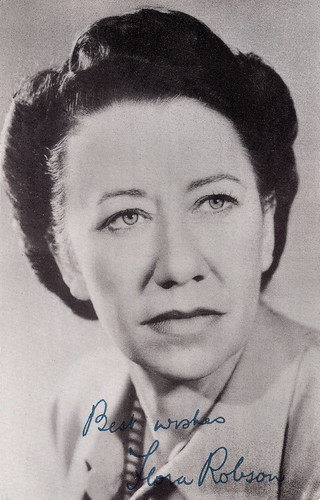
British postcard in the Film Star Autograph Portrait Series, no. 65, by L.D. Ltd., London. Photo: J. Arthur Rank Organisation.
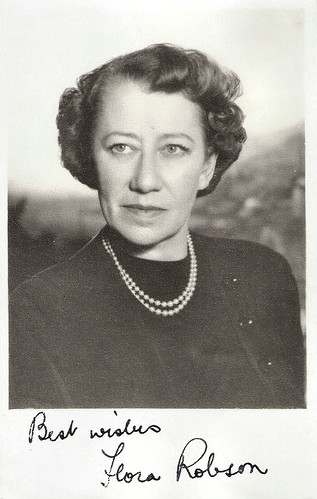
British autograph card by J. Hamilton Mews, London.
After the Second World War, Flora Robson demonstrated her range again in the cinema. She first appeared in the comedy Holiday Camp (Ken Annakin, 1947), the first of a series of films which featured the very ordinary Huggett family. That same year, she appeared as Sister Philippa in Black Narcissus (Michael Powell, Emeric Pressburger, 1947). She was a magistrate in Goodtime Girl (David MacDonald, 1948), and a prospective Labour MP in Frieda (Basil Dearden, 1947) featuring Mai Zetterling.
Robson appeared in the costume melodrama, Saraband for Dead Lovers (Basil Dearden, 1948), starring Stewart Granger. Memorable theatrical performances followed, such as Lady Macbeth on Broadway (1949) and as Paulina in Shakespeare's 'The Winter's Tale' (1951) production by John Gielgud. She was created a Commander of the Order of the British Empire (CBE) in 1952, and raised to Dame Commander (DBE) in 1960. In between, she appeared in such films as Romeo and Juliet (Renato Castellani, 1954) as Juliet’s nurse, and the drama High Tide at Noon (Philip Leacock, 1957).
In the 1960s she continued to act in the West End, in plays such as 'Ring Round the Moon', 'The Importance of Being Earnest' and 'Three Sisters'. Her later film roles include the Empress Dowager Cixi in the historical epic 55 Days at Peking (Nicholas Ray, 1963), Miss Milchrest in the Miss Marple mystery Murder at the Gallop (George Pollock, 1963), and the Queen of Hearts in Alice's Adventures in Wonderland (William Sterling, 1972).
She continued her acting career late into life, though not on the West End stage, from which she retired at 67. She often played in American television films, including a lavish production of A Tale of Two Cities. She also performed in films for British television, including The Shrimp and the Anemone. In the cinema, she was last briefly seen as a Stygian Witch in the fantasy adventure Clash of the Titans (Desmond Davis, 1981) starring Harry Hamlin. Both the BBC and ITV made special programmes to celebrate her 80th birthday in 1982, and the BBC ran a short season of her best films.
Her private life was largely focused on her large family of sisters, nephews and nieces, who used the home in Wykeham Terrace, Brighton, which she shared with sisters Margaret and Shela. In 1984, Flora Robson died in the English seaside resort of Brighton. She was 82. She never married or had any children. "I've known very little personal love, but the public has always shown me great affection", Dame Flora was once quoted. Her two sisters, with whom she shared her life and home, died around the same time.
Trailer Black Narcissus (1947). Source: ryy79 (YouTube).
Trailer Beast In The Cellar (1970). Source: Screenbound Pictures (YouTube).
Sources: William McPeak (IMDb), Marvine Howe (The New York Times), Encyclopaedia Britannica, Wikipedia and IMDb.
This post was last updated on 22 August 2026.
Spanish leaflet by Films Selectos, Suplemento Artistico, no. 177, 3.3.1934. Photo: London Films / United Artists. Elisabeth Bergner as Princess Sophie, later Empress Catherine, and Flora Robson as Empress Elisabeth in the British film The Rise of Catherine the Great (Paul Czinner, 1934). The historical film was produced by Alexander Korda and based on the play 'The Czarina' by Lajos Bíró and Melchior Lengyel, about the rise to power of Catherine the Great.
British postcard by Art Photo Postcard, no. 109. Photo: London Films. Publicity still for Fire Over England (William K. Howard, 1937).
Taken around by horse and carriage to recite
Flora McKenzie Robson was born in South Shields, County Durham. She was of Scottish descent, to a family of six siblings. Her father was a ship's engineer. He discovered that Flora had a talent for recitation, and she recited 'Little Orphan Annie' in a school performance. From the age of five, she was taken around by horse and carriage to recite and to compete in recitations. She was educated at the Palmers Green High School and the Royal Academy of Dramatic Art (RADA).
At 19, Robson made her stage debut as Queen Margaret in the play 'Wil Shakespeare' in 1921. She graduated from RADA with a bronze medal, but then she struggled to find a footing in the theatre. She had a long face, with a big nose and a wide mouth and apparently lacked the looks, which were then an absolute requisite for actresses in dramatic roles. After touring in minor parts with Ben Greet's Shakespeare company, she played small parts for two seasons in the new repertory company at Oxford, alongside a youthful John Gielgud. Then her contract was not renewed.
Wikipedia: “She was told, as tactfully as possible, that they required a prettier actress. Unable to secure any acting engagements, she gave up the stage at the age of 23 and in a disconsolate life-change she took up work as a welfare officer in the Shredded Wheat factory in Welwyn Garden City”. In the factory, she formed an amateur theatrical group among the workers there. She later credited this experience with enlarging her view of dramatic structure and acting. In 1929, Tyrone Guthrie, due to direct a season at the new Festival Theatre, Cambridge, asked her to join his company. It was the dramatic making of her.
She played the stepdaughter in Pirandello's 'Six Characters in Search of an Author', and her acting made her the theatrical talk of Cambridge. More excited applause followed with her Isabella in 'Measure for Measure', opposite a youthful Robert Donat, the title role in 'Iphigenia', Varya in 'The Cherry Orchard' and finally the huge challenge of Rebecca West in Ibsen's 'Rosmersholm'.
These performances signalled the arrival of an actress who could either transmit emotional stress or simply hint at it, with rare power. In her second season, though, she had few dramatic opportunities, and once again her lack of chocolate-box appeal meant that the management dispensed with her services.
British postcard in the Picturegoer Series, London, no. 901. Photo: Janet Jevons.
British postcard in the "Film Shots" series by Film Weekly. Photo: London Films. Douglas Fairbanks Jr., Flora Robson and Elisabeth Bergner in Catherine the Great (Paul Czinner, 1934).
Caught in the theatrical firmament as a star
In the early 1930s, Flora Robson was cast as the adulterous Abbie in Eugene O'Neill's 'Desire under the Elms'. At the time, the censors considered the play too shocking to be given a public performance. In the little club theatre, The Gate, Robson scored a direct hit with audiences and critics alike. Then, her brief, shocking appearance as the doomed prostitute in James Bridie's play 'The Anatomist' was another success. This led to a season as leading lady at the Old Vic, opposite Charles Laughton. By the end of 1933 she was caught in the theatrical firmament as a star.
Cinema beckoned. Her film debut had been a bit part in A Gentleman of Paris (Sinclair Hill, 1931). In 1934, Robson played the Russian Empress Elizabeth in Catherine the Great (Paul Czinner, 1934). The historical film about the rise to power of Catherine the Great was produced by Alexander Korda and based on the play The Czarina by Lajos Bíró and Melchior Lengyel. Elisabeth Bergner starred as Catherine.
Robson played a forceful Livia in another Korda production, I, Claudius (Josef von Sternberg,1937). This was an unfinished film adaptation of the novels 'I, Claudius' (1934) and 'Claudius the God' (1935) by Robert Graves. Charles Laughton played the title role, but the production was dogged by adverse circumstances, culminating in a car accident involving co-star Merle Oberon that ended filming to be ended before completion.
Robson’s best-known film role was that of Queen Elizabeth I in both Fire Over England (William K. Howard, 1937) starring Laurence Olivier and Vivien Leigh, and the Hollywood Swashbuckler The Sea Hawk (Michael Curtiz, 1940) starring Errol Flynn.
She was nominated for the Academy Award for Best Supporting Actress for her role as Ingrid Bergman's Haitian maid, Angelique Buiton, in the romantic drama Saratoga Trunk (Sam Wood, 1945). That same year she gave a hypnotic performance as Ftatateeta, the nursemaid and royal confidante to Vivien Leigh's Queen Cleopatra in the screen adaptation of George Bernard Shaw's Caesar and Cleopatra (Gabriel Pascal, 1945). On stage, she was acclaimed in 1942 in the John Van Druten play 'The Damask Cheek', and in 1949 as the unhappy mother in Leslie Storm's 'Black Chiffon'.
British postcard in the Film Star Autograph Portrait Series, no. 65, by L.D. Ltd., London. Photo: J. Arthur Rank Organisation.
British autograph card by J. Hamilton Mews, London.
Very little personal love
After the Second World War, Flora Robson demonstrated her range again in the cinema. She first appeared in the comedy Holiday Camp (Ken Annakin, 1947), the first of a series of films which featured the very ordinary Huggett family. That same year, she appeared as Sister Philippa in Black Narcissus (Michael Powell, Emeric Pressburger, 1947). She was a magistrate in Goodtime Girl (David MacDonald, 1948), and a prospective Labour MP in Frieda (Basil Dearden, 1947) featuring Mai Zetterling.
Robson appeared in the costume melodrama, Saraband for Dead Lovers (Basil Dearden, 1948), starring Stewart Granger. Memorable theatrical performances followed, such as Lady Macbeth on Broadway (1949) and as Paulina in Shakespeare's 'The Winter's Tale' (1951) production by John Gielgud. She was created a Commander of the Order of the British Empire (CBE) in 1952, and raised to Dame Commander (DBE) in 1960. In between, she appeared in such films as Romeo and Juliet (Renato Castellani, 1954) as Juliet’s nurse, and the drama High Tide at Noon (Philip Leacock, 1957).
In the 1960s she continued to act in the West End, in plays such as 'Ring Round the Moon', 'The Importance of Being Earnest' and 'Three Sisters'. Her later film roles include the Empress Dowager Cixi in the historical epic 55 Days at Peking (Nicholas Ray, 1963), Miss Milchrest in the Miss Marple mystery Murder at the Gallop (George Pollock, 1963), and the Queen of Hearts in Alice's Adventures in Wonderland (William Sterling, 1972).
She continued her acting career late into life, though not on the West End stage, from which she retired at 67. She often played in American television films, including a lavish production of A Tale of Two Cities. She also performed in films for British television, including The Shrimp and the Anemone. In the cinema, she was last briefly seen as a Stygian Witch in the fantasy adventure Clash of the Titans (Desmond Davis, 1981) starring Harry Hamlin. Both the BBC and ITV made special programmes to celebrate her 80th birthday in 1982, and the BBC ran a short season of her best films.
Her private life was largely focused on her large family of sisters, nephews and nieces, who used the home in Wykeham Terrace, Brighton, which she shared with sisters Margaret and Shela. In 1984, Flora Robson died in the English seaside resort of Brighton. She was 82. She never married or had any children. "I've known very little personal love, but the public has always shown me great affection", Dame Flora was once quoted. Her two sisters, with whom she shared her life and home, died around the same time.
Trailer Black Narcissus (1947). Source: ryy79 (YouTube).
Trailer Beast In The Cellar (1970). Source: Screenbound Pictures (YouTube).
Sources: William McPeak (IMDb), Marvine Howe (The New York Times), Encyclopaedia Britannica, Wikipedia and IMDb.
This post was last updated on 22 August 2026.
