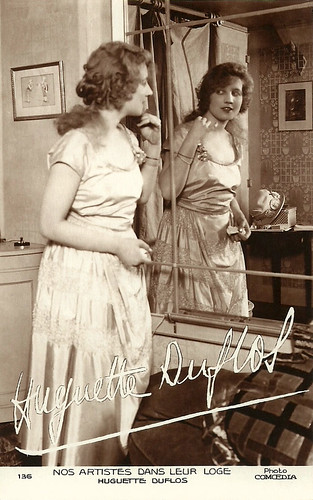
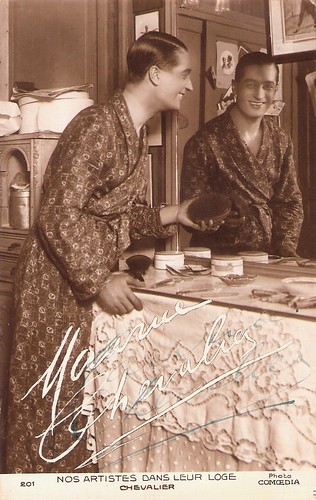
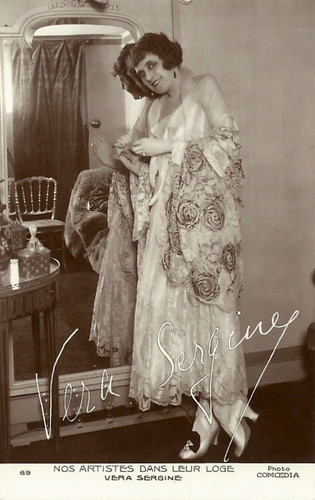
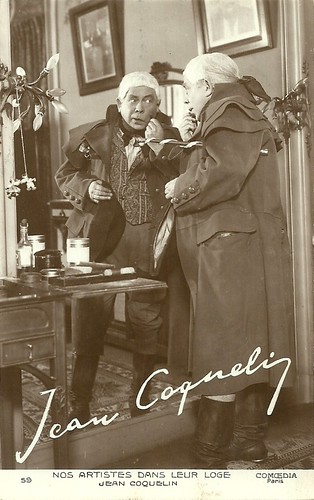
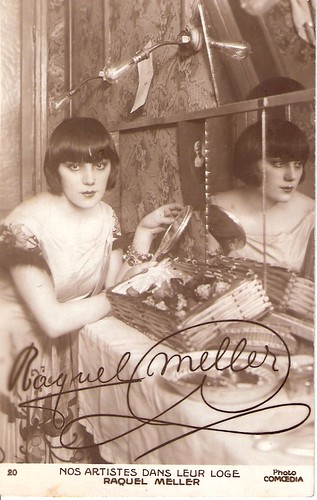
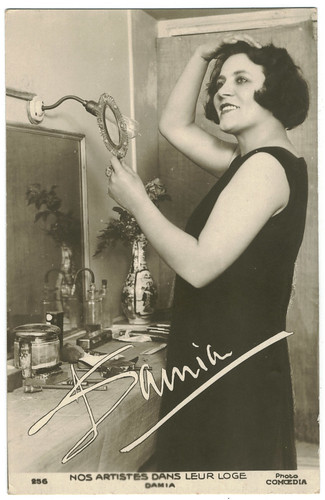
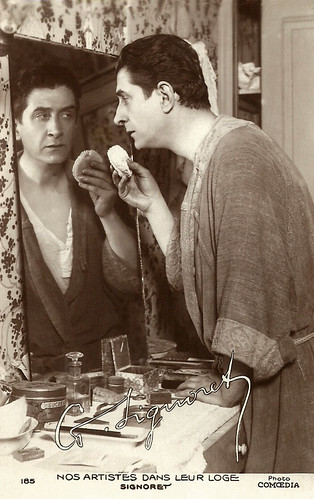
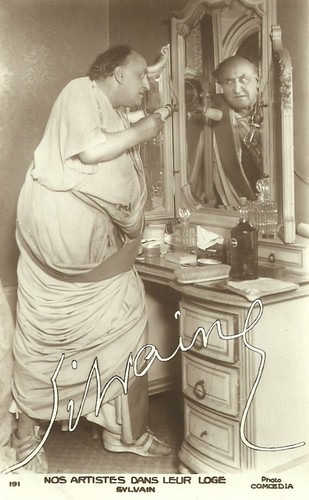
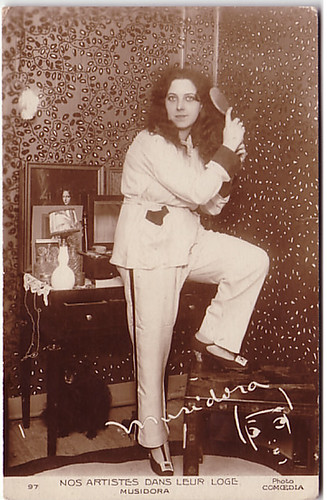
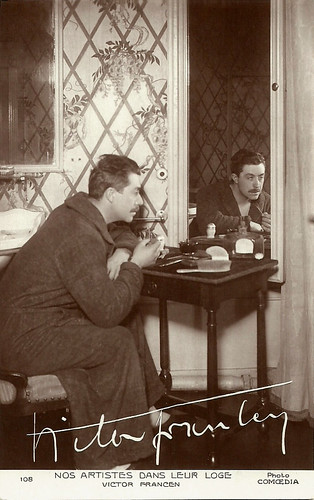
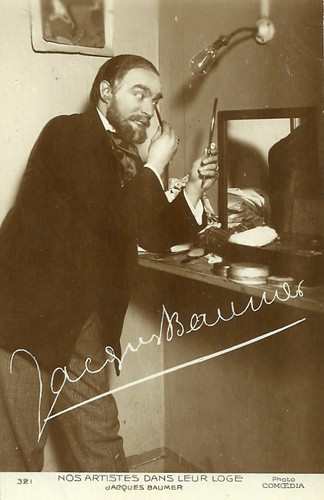
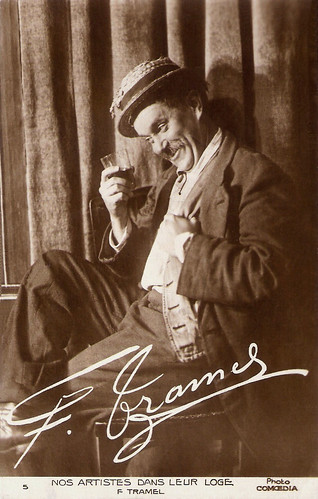
French postcard in the series Nos Artistes dans leur loge, no. 131. Photo: Comoedia.
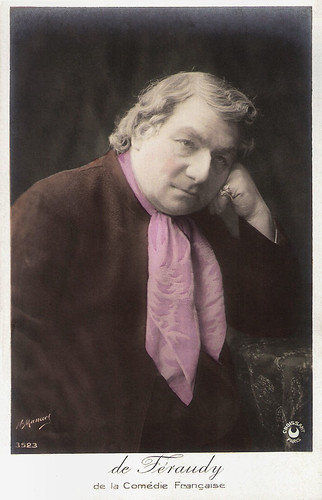
French postcard by Croissant, Paris, no. 3523. Photo Henri Manuel. Written date: 1909. Caption: De Féraudy de la Comédie Française.

French postcard by J.D, et Cie, 3e Serie. Photo: DuGuy. Caption: De Féraudy, Comédie Française.

French postcard by Editions Cinémagazine, no. 418. Photo: Sartony.
A pupil of Got
Dominique Marie Maurice de Féraudy was born in Joinville-le-Pont near Paris in 1859. His father was the commander of the Ecole militaire de gymnastique at Joinville-le-Pont.
After the Conservatoire, where he was a pupil of Got, Maurice entered the Théâtre Français in 1880. In 1887, the role of the apothecary in the Molière comedy 'Monsieur de Pourceaugnac' was his breakthrough. That year, he became ‘sociétaire’ of the Comédie-Française, and in 1929 he became ‘doyen’ (dean), but he left that same year.
Maurice de Féraudy was much acclaimed as a comedian, because of his cheerful performances. The role of his life, which he performed some 1,200 times within 30 years – and had the monopoly on it – was that of Isidore Lechat in 'Les affaires sont les affaires' (Business is business) by Octave Mirbeau (1903). Between 1896 and 1905, Féraudy taught at the Conservatoire, training upcoming actors like Gabriel Signoret.
Other plays he acted in were by a.o. Henri Bataille, Henri Kistemaeckers, Sacha Guitry, Henrik Ibsen, but also classics by Molière, Honoré de Balzac and Alexandre Dumas fils. With two plays by Molière, he toured Quebec, Montreal and New York in 1922, as part of the Comedy Française.
De Féraudy also wrote numerous songs for Paulette Darty, such as the famous 'Fascination' (1901), reprised afterwards by Suzy Delair and Diane Dufresne. Translated into English, this song became an international hit after the Second World War, performed by Nat King Cole among others.
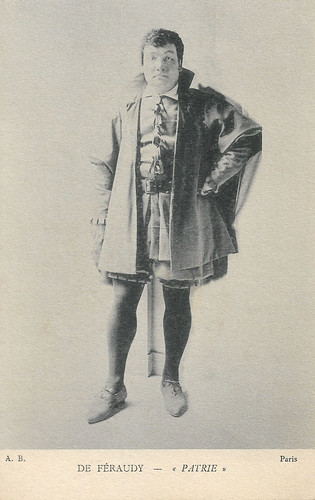
French postcard by A.B., Paris. Maurice de Féraudy in the play 'Patrie!' (1869) by Victorien Sardou.

French minicard (collector's card) in the Collection Félix Potin, series 1 (c. 1900). Photo: G. Camus, Paris.

French postcard in the Collection Artistique du Vin Désiles by S.I.P. Photo: Henri Manuel. Caption: 'Vin Désiles is a delicious wine, full of taste and vigour. While it does well to the weak, it means no harm to the solid ones, on the contrary!'
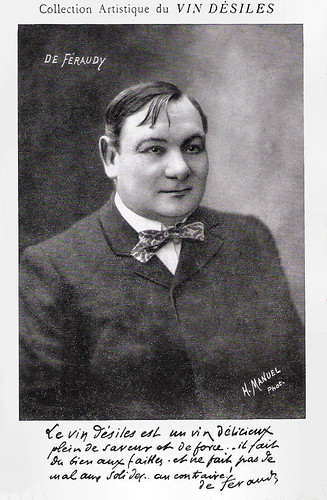
French postcard in the Collection Artistique du Vin Désiles by S.I.P. Photo: Henri Manuel. Caption: 'Vin Désiles is a delicious wine, full of taste and vigour. While it does well to the weak, it means no harm to the solid ones, on the contrary!'
Memorable roles
In 1908-1909, Maurice de Féraudy debuted in the cinema. He directed almost 40 shorts under the aegis of his short-lived company Théâtro-Films. His son Jacques made his first film appearances in two of these films, Simple histoire/Simple story (1908) and Georgette (1908).
Afterwards, Féraudy directed a handful of mostly short films at Pathé and Gaumont, with actors who would later become famous, such as Albert Dieudonné, Roger Karl, Maria Falconetti and Jean Angelo. Féraudy last’s direction was the film Après lui/After him (1918) in which he had the lead himself. While most of the films he directed are forgotten now, better known are the films in which he acted.
In the 1910s Féraudy played in films at Eclair, such as Les gaités de l’escadron/The Gaieties of the Squadron (Joseph Faivre, Maurice Tourneur, 1913), La dame de Monsoreau/The lady Monsoreau (Emile Chautard, 1913), and Monsieur Lecoq (Maurice Tourneur, 1914).
In the 1920s Féraudy enjoyed the pleasure of playing memorable roles despite his high age. After supporting roles in two films with René Hervil: L’ami Fritz/In Old Alsace (1921) and Blanchette (1921), both with Léon Mathot in the lead, Féraudy had the male lead himself together with young Jean Forest in Crainquebille/Coster Bill of Paris (Jacques Feyder, 1922). In this adaptation of a novel by Anatole France, Féraudy played an ageing street vendor who has worked all his life at Les Halles in Paris. Innocently he lands in jail and loses his customers once released, thus becoming an alcoholic. A young street boy (Forest) prevents him from suicide, though, convincing him to start all over again.
Next, Féraudy played the title role in the Honoré de Balzac adaptation Le Cousin Pons/Cousin Pons (Jacques Robert, 1923), about a musician and poor art collector who is befriended by a sympathetic German (André Nox). The human vultures around him, such as his wealthy parvenu lawyer cousins and his landlady, realise that he possesses a valuable art collection, and try to crush poor Pons.

French postcard by PA, no. 70. Photo: Ed. Berr. Maurice de Féraudy as the apothecary in the Molière comedy 'Monsieur de Pourceaugnac'. This part had been his breakthrough in 1887.

French postcard by J.D, et Cie, Serie VII. Photo: DuGuy. Caption: De Féraudy, Comédie Française.
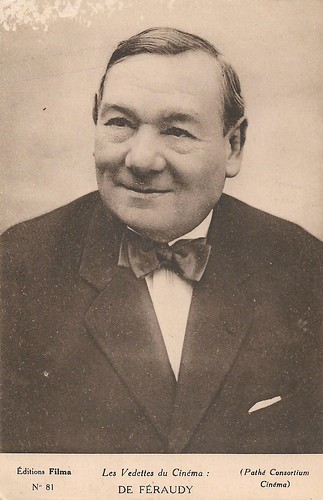
French postcard in the Les Vedettes du Cinéma series by Editions Filma, no. 81. Photo: Pathé Consortium Cinéma.
Cleared from slander
Maurice de Féraudy next played in Le secret de Polichinelle/The Secret of Polichinelle (René Hervil, 1923) about a young man who wants to marry a working-class girl (Andrée Brabant) against the wishes of his parents, and Le Coeur des gueux/Heart beggars (Alfred Machin, Henri Wulschleger, 1925) with Ginette Maddie.
He then appeared in the Danish film Klovnen/The Clown (Anders Sandberg, 1926) with Gösta Ekman and Karina Bell, Lady Harrington (Fred Leroy-Granville, H.C. Grantham-Hayes, 1926) with Claude France and Warwick Ward, Fleur d’amour/Love Flower (Marcel Vandal, 1927) in which Féraudy had the male lead opposite Rose Mai, and the German film Die Hölle von Montmartre/The Hell of Montmartre (Willy Reiber, Franz Seitz, 1928) with Eric Barclay and Suzy Vernon.
A last memorable part was de Féraudy’s role in the tragicomedy Les Deux timides/Two Timid Souls (René Clair, 1928) in which Pierre Batcheff plays Frémissin, a timid young lawyer who loves Cécile (Vera Flory) whose father (Féraudy) suffers from the same timidity. When because of his weak defence a brutal husband is sentenced, the latter (Jim Gérald) uses all means to wreck the young lawyer’s own future marriage with Cécile, as he wants her for himself. Helped by his future father-in-law, Frémissin triumphs and clears his father-in-law and himself from all slander.
After one last part in the early French sound film Ça aussi! … c’est Paris/That too! This is Paris (Antoine Mourre, 1930), de Féraudy retired. He still acted on stage and was even highly successful in 'Cette vieille canaille' (That old scoundrel) in 1931-1932.
Maurice de Féraudy died in Paris in 1932 and was buried at the cemetery of Montparnasse. He was the father of Jacques de Féraudy (1886-1971), who was an actor as well.

French postcard by F.C. & Cie., no. 302. Photo: Henri Manuel. Caption: Maurice de Féraudy de la Comédie Française.
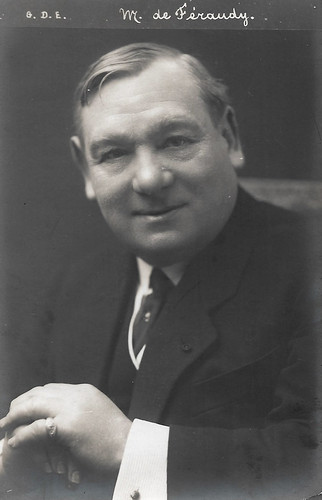
Belgian postcard by G.D.E. (G. Dupont-Emera), Bruxelles.

French postcard by A.N., Paris, no. 19. Photo: G.L. Manuel Frères. Caption: Maurice de Féraudy de la Comédie Française.
Sources: Ciné Ressources, dvdtoile, Le Petit Parisien, Wikipedia (French and English) and IMDb.