Italian postcard by Ed. Ballerini & Fratini, Firenze, no. 526. Photo: Scoffone. Italia Almirante Manzini as Monna Violante in L'arzigogolo (Mario Almirante, 1924).

Italian postcard by Ballerini & Fratini, Firenze, no. 528. Photo: Scoffone. Publicity still for L'arzigogolo (Mario Almirante, 1924), with Italia Almirante.
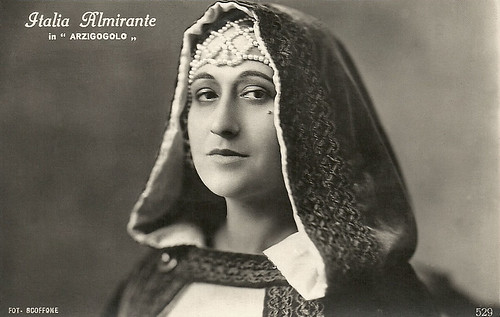
Italian postcard by Ballerini & Fratini, Firenze, no. 529. Photo: Scoffone. Italia Almirante in L'Arzigogolo (Mario Almirante, 1924).

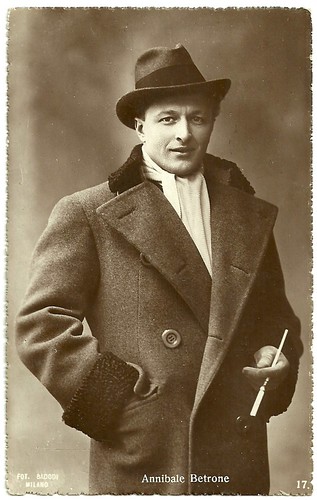
Italian postcard by Ed. G.B. Falci, Milano. Photo: Annibale Betrone in L'arzigogolo (Mario Almirante, 1924).

Italian postcard by Ed. G.B. Falci, Milano, no. 197. Photo: publicity still for L'arzigogolo (Mario Almirante, 1924) with Oreste Bilancia and Italia Almirante
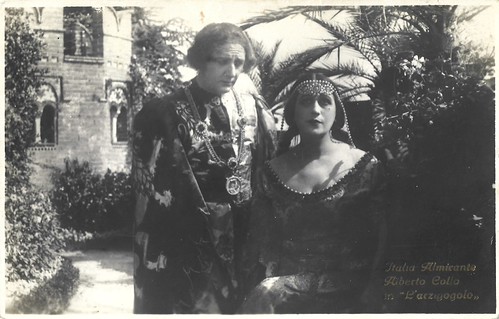
Italian postcard by Ed. G.B. Falci, Milano, no. 198. Italia Almirante Manzini as Monna Violante and Alberto Collo as Count Giano in L'arzigogolo (Mario Almirante, 1924).

Italian postcard by Ed. G.B. Falci, no. 202. Photo: Alba Film. Oreste Bilancia in L'arzigogolo (Mario Almirante, 1924).
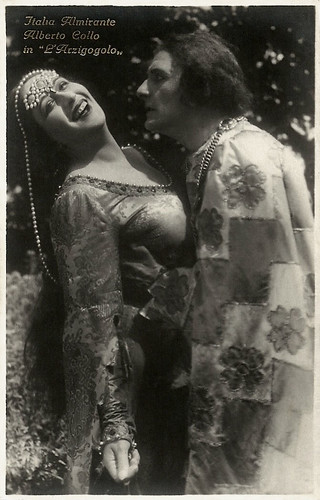
Italian postcard by Ed. G.B. Falci, Milano, no. 203. Photo: publicity still for L'arzigogolo (Mario Almirante, 1924) with Italia Almirante and Alberto Collo.
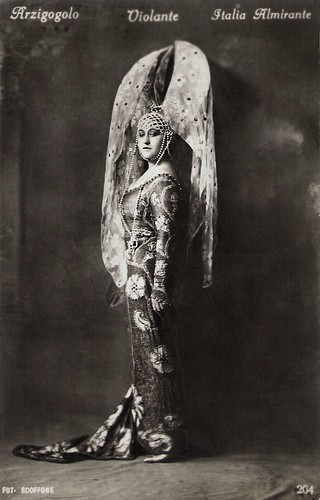
Italian postcard by Ed. G.B. Falci, Milano, no. 204. Photo: publicity still for L'arzigogolo (Mario Almirante, 1924) with Italia Almirante.

Italian postcard by G.B. Falci, Milano, no. 209. Photo: Italia Almirante and Alberto Collo in L'arzigogolo (Mario Almirante, 1924).
An attractive cast
L'arzigogolo/The Court Jester (Mario Almirante, 1924) has an attractive cast. The leading lady is Italia Almirante Manzini (1890-1941), the cousin of director Mario Almirante. After she had starred in the classic epic Cabiria (1914), Almirante had become one of the divas of the Italian silent cinema.
Her co-star was Annibale Betrone (1883-1950), an important figure in the Italian theatre of the first half of the 20th century. Betrone also appeared in several silent and sound films. Oreste Bilancia (1881-1945) was another well-known face of the Italian silent cinema. As in L'arzigogolo, he mostly worked as a supporting actor, but occasionally played the main character.
Almirante plays Monna Violante, daughter of the Prince of Carpi. Her father forces her to find a husband from among her suitors, or he will lock her up in a convent. Violante chooses Floridoro (Oreste Bilancia), a fat and rich merchant, self-confident and convinced that he is protected by good fortune.
Even after the wedding, however, Violante does not abandon her goal of finding the man of her dreams. On a visit to the castles of the Principality, she meets Count Giano (Alberto Collo), one of her former suitors. Cruelly, she pretends to be willing to give him up. So Giano orders Spallatonda (Annibale Betrone), his court jester and servant, to bring her to him, or Giano will chop his head off.
Spallatonda attempts, but with such vehemence that Violante is sensually disturbed. She even allows herself to be seduced by the jester, who then no longer wants to take her to his master. So Giano will carry out his terrible threat. Violante, however, offers herself for the jester's life, and Giano accepts. Spallatonda will be beheaded in mockery. The jester feigns unconsciousness and hides in Violante's room. When Giano arrives, Spallatonda kills him, and then Monna Violante and Spallatonda flee together.

Italian postcard by Ballerini & Fratini, Firenze, no. 205. Photo: Alba Film. An ensemble shot from the opening scene of L'arzigogolo (Mario Almirante, 1924). Caption: The tournament in honour of Violante.

Italian postcard by Ballerini & Fratini, Firenze, no. 206. Photo: Alba Film. Italia Almirante as Monna Violante in L'arzigogolo (Mario Almirante, 1924). Caption: Violante leaves for the hunt.

Italian postcard by Ballerini & Fratini, Firenze, no. 20?. Photo: Alba Film. Italia Almirante as Monna Violante and Alberto Collo as Count Giano in L'arzigogolo (Mario Almirante, 1924). Caption: Giano tries in vain to conquer Violante's coldness.

Italian postcard by Ballerini & Fratini, Firenze, no. 209. Photo: Alba Film. Annibale Betrone as The Jester in L'arzigogolo (Mario Almirante, 1924). Caption: Spallatonda chased from the village.

Italian postcard by Ballerini & Fratini, Firenze, no. 210. Photo: Alba Film. In the back, Italia Amirante as Monna Violante and Alberto Collo as Count Giano in L'arzigogolo (Mario Almirante, 1924). Caption: The dinner in the house of Count Giano.

Italian postcard by Ballerini & Fratini, Firenze, no. 211. Photo: Alba Film. Publicity still for L'arzigogolo (Mario Almirante, 1924). Caption: The arrival of the buffoon at the castle of Giano.

Italian postcard by Ballerini & Fratini, Firenze, no. 214. Photo: Alba Film. Annibale Betrone as The Jester and Alberto Collo as Giano in L'arzigogolo (Mario Almirante, 1924). Caption: Giano to the Jester: ... if you don't manage to convince Violante of my love, I will have your head chopped off!

Italian postcard by Ballerini & Fratini, Firenze, no. 216. Photo: Alba Film. Italia Almirante and Annibale Betrone in L'arzigogolo (Mario Almirante, 1924). Caption: In the calm moonlight, the buffoon sees Violante and declares her his love.
Classic love story
L'arzigogolo is a classic love story in the vein of William Shakespeare's 'Romeo and Juliet'. Director Mario Almirante wrote the script originally in French. Almirante directed such films as Il fornaretto di Venezia / The Baker Boy of Venice (1923) and L'ombra / The Shadow (1923). He wrote a liberal adaptation of a popular 1922 Sem Benelli's 'comic poem in four acts'. The Italian playwright, essayist and librettist Benelli provided the texts for several noted Italian operas, including Italo Montemezzi's 'L'amore dei tre re' and 'L'incantesimo', and Umberto Giordano's 'La cena delle beffe', based on Benelli's own play of the same title.
The sets for L'arzigogolo were designed by Luigi Sapelli, better known as Caramba, who specialised in costume dramas. The Director of photography was Ubaldo Arata, who was one of Italy's most famous cinematographers.
After the premiere, the critic of Il Roma della Domenica wrote: "L'arzigogolo did not delude the high expectations, because it is the result on the screen of an original and interesting work. Therefore the poet (Sem Benelli) can be satisfied."
The critic of La Vita Cinematografica adds: "We never saw Italia Almirante so perfect in place. She exquisitely figures as an intelligent woman. Her plastic beauty, preserved by exuberant costumes, makes the complex and enigmatic character of Violante more fascinating and suggestive."
Società Anonima Stefano Pittaluga distributed the film. L'arzigogolo became one of the most successful films in Italy in 1924. The most popular film that year was Die Nibelungen, a two-part German fantasy film by Fritz Lang. L'arzigogolo is now in the public domain.
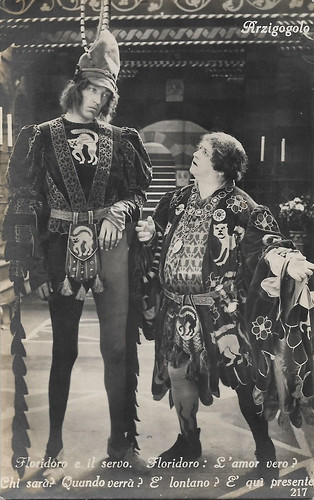
Italian postcard by Ballerini & Fratini, Firenze, no. 217. Photo: Alba Film. Oreste Bilancia as Floridoro in L'arzigogolo (Mario Almirante, 1924). Caption: Floridoro and the servant. Floridoro: Her true love? Who is it? When will he come? Is he far away? Is he here?
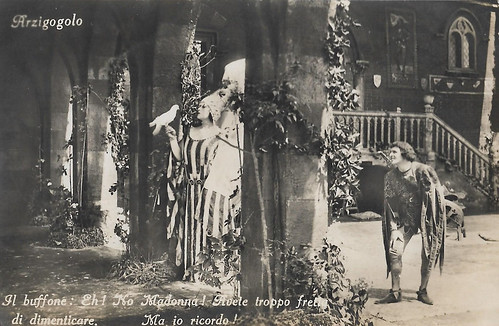
Italian postcard by Ballerini & Fratini, Firenze, no. 218 or 219. Photo: Alba Film. Annibale Betrone as The Jester and Italia Almirante Manzini as Monna Violante in L'arzigogolo (Mario Almirante, 1924). Caption: The Jester: What! No Milady! You have too great haste to forget. But I remember!
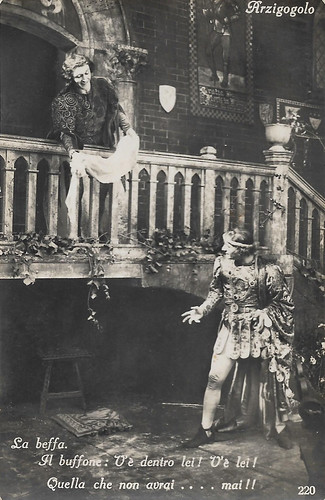
Italian postcard by Ballerini & Fratini, Firenze, no. 220. Photo: Alba Film. Annibale Betrone as The Jester and Alberto Collo as Giano in L'arzigogolo (Mario Almirante, 1924). Caption: The mockery. The Jester: She is in this, it is hers. She whom you'll never have... never!

Italian postcard by Ballerini & Fratini, Firenze, no. 221. Photo: Alba Film. Italia Almirante as Monna Violante, Annibale Betrone as The Jester, Oreste Bilancia as Floridoro, and Alberto Collo as Giano in L'arzigogolo (Mario Almirante, 1924). Caption: The Jester rebels against Giano and defies death out of love for Violante.

Italian postcard by Ballerini & Fratini, Firenze, no. 222. Photo: Alba Film. Annibale Betrone as The Jester in L'arzigogolo (Mario Almirante, 1924). Caption: The Jester in prison.
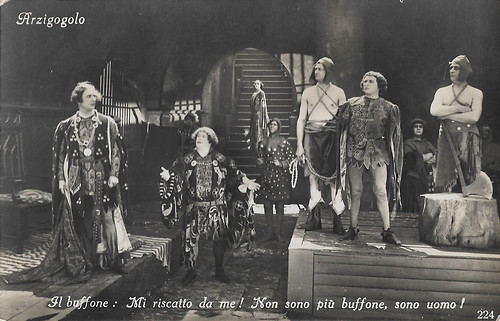
Italian postcard by Ballerini & Fratini, Firenze, no. 224. Photo: Alba Film. Annibale Betrone as The Jester, Oreste Bilancia as Floridoro, and Alberto Collo as Giano in L'arzigogolo (Mario Almirante, 1924). Caption: The Jester: I redeem myself! I am no longer a jester, but a man!

Italian postcard by Ballerini & Fratini, Firenze, no. 226. Photo: Alba Film. Annibale Betrone as The Jester, Oreste Bilancia as Floridoro, and Alberto Collo as Giano in L'arzigogolo (Mario Almirante, 1924). Caption: Dead!

Italian postcard by Ballerini & Fratini, Firenze, no. 227. Photo: Alba Film. Annibale Betrone and Italia Almirante in L'arzigogolo (Mario Almirante, 1924). Caption: True love...attained in vain... He is dead!

Italian postcard by Ballerini & Fratini, Firenze, no. 228. Photo: Alba Film. Annibale Betrone and Oreste Bilancia in L'arzigogolo (Mario Almirante, 1924). Caption: The buffoon resurrected to the great terror of Floridoro.

Italian postcard by Ballerini & Fratini, Firenze, no. 229. Photo: Alba Film. Oreste Bilancia as Floridoro, and Alberto Collo as Giano in L'arzigogolo (Mario Almirante, 1924). Caption: The Death of Giano.
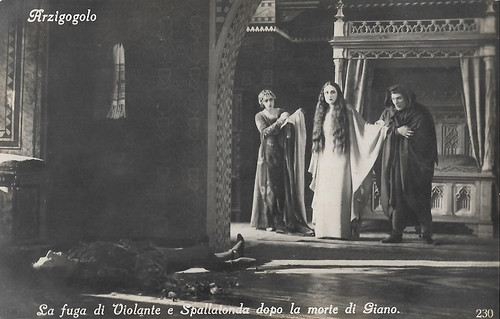
Italian postcard by Ballerini & Fratini, Firenze, no. 230. Photo: Alba Film. Italia Almirante Manzini as Monna Violante, Annibale Betrone as The Jester, and Alberto Collo as Giano in L'arzigogolo (Mario Almirante, 1924). Caption: The flight of Violante and Spallatonda after Giano's death.
Sources: Vittorio Martinelli (Il Cinema Muto Italiano 1923-1931 - Italian), Wikipedia (Italian and Cymraeg) and IMDb.