Showing posts with label June Allyson. Show all posts

30 August 2026

La Collectionneuse: June Allyson

With her twinkling smile and her wholesome and unassuming screen image, June Allyson gained wide popularity as the perfect girl-next-door in the 1940s. Later, she would become the perfect screen wife, eager, loyal and understanding, notably in three films with James Stewart. Audiences found their pairing especially endearing and believable. In 1986, she said: "I have big teeth. I lisp. My eyes disappear when I smile. My voice is funny. I don’t sing like Judy Garland. I don’t dance like Cyd Charisse. But women identify with me. And while men desire Cyd Charisse, they’d take me home to meet Mom".

June Allyson
French postcard by Editions E.P.I., Paris, no. 2 10 D. Photo: Metro Goldwyn Mayer.

June Allyson
Dutch postcard by Takken, Utrecht, no. a.x. 254. Photo: Metro-Goldwyn-Mayer.

A serious accident


June Allyson was born on the 7th of October 1917 in New York City, U.S.A.

Her parents were Robert Geisman and Clara Provost.

Later, she would claim that her name was 'Van Geisman' and that she was of Dutch origin. However, records show that her paternal grandparents, Harry Geisman (without a 'Van') and Anna Hafner, were immigrants from Germany.

When she was a child, June Allyson was a victim of a serious accident. Doctors feared that she would be crippled for life.

She had to wear a brace to support her spine for some time.  She started doing exercises to be able to walk again and to build her muscles. A determined child, she finally recovered.

June Allyson
British postcard in the Picturegoer series, no. W251. Photo: Metro Goldwyn Mayer.

June Allyson
French or Belgian postcard, no. 951. June Allyson and Peter Lawford in Good News (Charles Walters, 1947).

Becoming a dancer


An avid fan of the films of Fred Astaire and Ginger Rogers, June Allyson dreamed of becoming a professional dancer.

June soon started entering dance contests.

She embarked on a career in show business in the second half of the 1930s.

From 1937 to 1940, she appeared in 10 musical shorts at Educational and Vitaphone, including Up and Downs (1937), Dime a Dance (1938), Sing for Sweetie (1938), The Prisoner of Swing (1938), Rollin’in Rhythm (1939) and All Girl Revue (1940).

She also had her first professional stage engagement in 1937 at the Lido Club in Montreal.

June Allyson
Dutch postcard by Van Leer’s Fotodruk Industrie N.V., Amsterdam, no. 351.

June Allyson
American postcard by Movie Candid Color Card, Beverly Hills, California. Photo: MGM.

Broadway


June Allyson worked for the first time on Broadway as a chorus girl in the musical 'Sing Out the News' (1938-1939).

She then was in the cast of 'Very Warm for May' (1939-1940), which, despite a score by Jerome Kern and Oscar Hammerstein II and staging by Vincente Minnelli, lasted only 59 performances.

Next came another chorus girl’s job in Rodgers and Hart’s 'Higher and Higher' (1940), which marked the Broadway debut of famous Hungarian-born soprano Marta Eggerth. However, it turned out that the biggest hit of the show was a trained sea lion named 'Sharkey'.

She was a dancing girl and an understudy to Betty Hutton in 'Panama Hattie', which premiered on the 30th of October 1940. When Hutton came down with measles, June had the opportunity to replace her for a few days.

Producer George Abbott noticed her and took a liking to her. He gave her a good supporting part in his Broadway show 'Best Foot Forward' (1941-1942). M.G.M. bought the film rights, and June Allyson was hired to appear in the screen adaptation.

June Allyson
Dutch postcard by Uitgave P.F. Cladder, Amsterdam, no. 49-36.

June Allyson
Dutch postcard by Uitgave J. Sleding N.V., Amsterdam, no. 1250.

A team with Van Johnson


In 1943, she had three musical numbers in Best Foot Forward and sang George and Ira Gershwin’s 'Treat Me Rough' in Girl Crazy.

That same year, she also sang 'In a Little Spanish Town' with Gloria DeHaven and Virginia O’Brien in the star-studded musical Thousand Cheers (1943).

She then had a supporting part in Meet the People (1944).

Producer Joe Pasternak thought that June was ready for bigger things, and M.G.M. teamed her with Van Johnson in Two Girls and a Sailor (1944), which made her a star.

Having noticed the great screen chemistry between June and Van Johnson, M.G.M. would later reunite them in High Barbaree (1947), The Bride Goes Wild (1948), Too Young to Kiss (1951), which won her a Golden Globe for Best Performance by an Actress in a Comedy or Musical, and Remains to Be Seen (1953).

June Allyson, Van Johnson and Arlene Dahl
French or Belgian postcard, no. 551. June Allyson, Arlene Dahl and Van Johnson in The Bride Goes Wild (Norman Taurog, 1948).

June Allyson and Gene Kelly
Spanish postcard, no. 4384. June Allyson and Gene Kelly in The Three Musketeers (George Sidney, 1948).

M.G.M. star


June Alyson was Margaret O’Briens sister in Music for Millions (1944) and co-starred with Robert Walker in Her Highness and the Bellboy (1945) and The Sailor Takes a Wife (1945). After Two Sisters from Boston (1946) with Kathryn Grayson, she had her first straight dramatic part, as Claudette Colbert’s depressed and neurotic stepdaughter, in The Secret Heart (1946).

June guest-starred in two lavish biopics based on the life and music of famous composers. Till the Clouds Roll by (1946) was about Jerome Kern, and Words and Music (1948) depicted the rise to fame of the duo Richard Rodgers and Lorenz Hart.

At 29, she still looked youthful enough to play a college girl in the lively and cheerful musical Good News (1947).

She played Constance in The Three Musketeers (1948) and Jo March in Little Women (1949), which were both top-grossers.

In 1949, she co-starred with James Stewart, with whom she got along very well, in The Stratton Story, as his devoted wife. It was one of the most popular films of the year.

June Allyson and Walter Pidgeon
Spanish postcard, no. 1123. June Allyson and Walter Pidgeon.

June Allyson, Peter Lawford and Marie McDonald
French or Belgian postcard, no. 1151. June Allyson, Marie McDonald and Peter Lawford.

Growing dissatisfied with her roles


Two films with her husband, Dick Powell, followed: The Reformer and the Redhead (1950) and Right Cross (1950).

June Allyson had two straight parts in a row as a turn-of-the-century doctor in The Girl in White (1952) and as an army nurse in Battle Circus (1953), opposite Humphrey Bogart.

After ten years working exclusively for M.G.M., June began growing dissatisfied with the roles she was being offered. She reckoned that working for other studios would give her career a welcome boost.

In May 1953, it was announced that her M.G.M. contract had been dissolved through mutual agreement.

She owed them one more film, which would be Executive Suite (1954), as William Holden’s wife. It received the Special Jury Prize for Ensemble Acting at the Venice Film Festival.

June Allyson and Dick Powell
Dutch postcard by Fotoarchief Film en Toneel, no. A.X. 303. Photo: Metro Goldwyn Mayer. June Allyson and Dick Powell. The stationery paper Dick Powell is writing on is Waldorf Astoria’s.

June Allyson and James Stewart
Dutch postcard by Foto Archief Film en Toneel, no. a.x. 352. Photo: Metro Goldwyn Mayer. June Allyson and James Stewart in The Stratton Story (Sam Wood, 1949).

Enduring popularity


June Allyson was again James Stewart’s understanding and supporting wife in Universal’s The Glenn Miller Story (1954) and Paramount’s Strategic Air Command (1955), which were massive hits.

In 20th Century Fox’s Woman’s World (1954), she was Cornel Wilde’s unsophisticated and gauche wife, involved in a three-men competition for a general manager job. The film cleverly contrasted her guileless character with that of her two glamorous co-stars, Lauren Bacall and Arlene Dahl. It was a box office success.

In a complete departure from her screen image, she agreed to play Jose Ferrer’s domineering, jealous and manipulative wife in The Shrike (1955). During the course of the story, the character played by June is compared to a shrike, an innocent-looking bird which impales its prey. Although the original 1952 Broadway play concluded with a dour note, the end of the movie was altered by Universal to offer a more positive conclusion, enabling the wife to express her regrets. It was assumed that audiences were not ready to accept June Allyson as a wholly negative character. Nevertheless, the public stayed away from The Shrike.

She was back to more familiar fare as another perfect wife, this time Alan Ladd’s, in Warner’s The McConnell Story (1955). During filming, there were rumours of an off-screen affair between the two stars. The McConnell Story proved much more popular with audiences than The Shrike.

In February 1955, she received the 'Year’s Most Popular Actress ' Photoplay award, which recognised her audience appeal in 1954. In 1955, she placed 9th on the list of the ten most popular stars at the U.S. box office.

June Allyson
French or Belgian postcard, no. 850. June Allyson in The Reformer and the Redhead (Norman Panama, Melvin Frank, 1950).

June Allyson
French or Belgian postcard, no. 552.

Four remakes in a row


June Allyson then starred in four remakes in a row, which, as a whole, suffered by comparison with the originals.

M.G.M’s The Opposite Sex (1956) was a musical version of The Women (1939), but director David Miller was no George Cukor. Despite its cast, which, besides June, included Joan Collins, Ann Sheridan, Ann Miller, Joan Blondell, Dolores Gray, Agnes Moorehead and Charlotte Greenwood, it didn’t meet the expected success.

Columbia’s You Can’t Run Away from It (1956) was directed by Dick Powell. It was a remake of It Happened One Night (1934), which had won five Oscars at the time, including one for Claudette Colbert, one for Clark Gable and one for director Frank Capra. Unsurprisingly, there wasn’t any Oscar nomination for You Can’t Run Away from It.

Universal’s Interlude (1957) benefited from Douglas Sirk’s direction and from beautiful Bavarian and Austrian locations, but it was quite a hard task for June and Rossano Brazzi to compete with the screen chemistry Irene Dunne and Charles Boyer had displayed in When Tomorrow Comes (1939). Later, Interlude would get some critical reevaluation.

Finally came My Man Godfrey (1957), again at Universal. The 1936 version, starring Carole Lombard and William Powell, was a Screwball Comedy classic. The same couldn’t be said of the remake.

June Allyson and her daughter Pamela
French or Belgian postcard, no. 950. June Allyson and her daughter Pamela.

June Allyson
Italian postcard by Rotalfoto, Milano, no. 75.

Last appearances on the big screen


After A Stranger in My Arms (1959), opposite Jeff Chandler, which was a box-office disappointment, she only made very few appearances on the big screen.

June Allyson played a lesbian murderess in They Only Kill Their Masters (1972).

She later was featured in Blackout (1978), about four criminals terrorising the occupants of an apartment complex during the 1977 New York blackout.

She briefly appeared in A Girl, Three Guys and a Gun, which premiered in 2000 at the Cinequest Film Festival and later was released on the video circuit.

Allyson also co-hosted the M.G.M. compilation film That’s Entertainment III (1994).

June Allyson
Dutch postcard, no. A. x. 464. Photo: Metro-Goldwyn-Mayer.

June Allyson and Ricardo Montalban in Right Cross (1950)
French or Belgian postcard, no. 651. June Allyson and Ricardo Montalban in Right Cross (John Sturges, 1950).

Television and stage


June Allyson was much more active on television.

From September 1959 to April 1961, she hosted The DuPont Show with June Allyson, an anthology drama series in a format similar to The Loretta Young Show. She acted in 17 of the 57 episodes.

She appeared in popular series such as Burke’s Law, The Incredible Hulk, The Love Boat, Hart to Hart and Murder, She Wrote. She was also featured in the TV movies See the Man Run in 1971, Letters from Three Lovers in 1973, Curse of the Black Widow in 1977, Three on a Date in 1978 and The Kid with the Broken Halo in 1982.

She guest-starred in various panel game shows, musical variety series and talk shows such as I’ve Got a Secret, What’s My Line?, The Perry Como Show, The Judy Garland Show, The Match Game, The Mike Douglas Show, The Dean Martin Show, The Tonight Show Starring Johnny Carson, The Merv Griffin Show, Larry King Live, …

She occasionally appeared on stage. She notably replaced Julie Harris in the Broadway play 'Forty Carats' on the 5th of January 1970 and played it for several months. She also toured with 'No, No Nanette' in 1971 and 1972.

June Allyson in Too Young to Kiss (1951)
French or Belgian postcard, no. 952. June Allyson in Too Young to Kiss (Robert Z. Leonard, 1951). In the film, she plays a pianist masquerading as a 14-year-old child prodigy.

June Allyson and Van Johnson in Too Young to Kiss (1951)
French or Belgian postcard, no. 952. June Allyson and Van Johnson in Too Young to Kiss (Robert Z. Leonard, 1951).

Depend spokeswoman


In the first part of the 1980s, June Allyson became the spokeswoman for Depend undergarments, a Kimberly-Clark Corporation line especially designed for adults suffering from bladder leakage, and this association would last for many years. June said she accepted because her mother faced a similar problem.

The marketing campaigns, with the catchphrase 'Get Back into Life', helped reduce the social stigma of incontinence.

In 1988, President Ronald Reagan appointed her to the Federal Council on Ageing.

At the end of the 1990s, the June Allyson Foundation, whose main goal was to help research the causes and management of pelvic floor disorders and incontinence, was established.

In 2008, it would merge with the AUGS (American Urogynecologic Society).

June Allyson
Italian postcard by B.F.F. Edit., no. 1792. Photo: Metro Goldwyn Mayer.
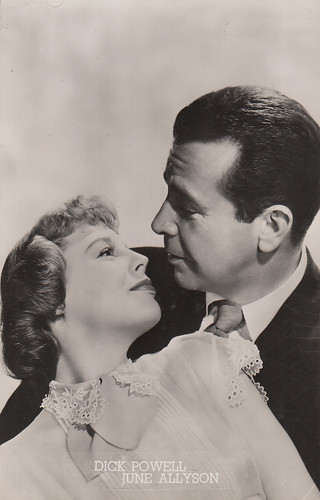
June Allyson and Dick Powell
Belgian postcard, no. 951. June Alyson and Dick Powell.

Her private life


June Allyson fell in love with Dick Powell during the filming of Meet the People (1944), and they married in 1945. They adopted a daughter, Pamela, in 1948, and had a son, Robert Jr., in 1950.

In 1961, June filed for divorce, but the couple soon reconciled and stayed married until Powell’s death in January 1963.

Unable to cope with a deep sense of loss, she married Glenn Maxwell, a men’s hair stylist, in October 1963. They divorced in 1965 but remarried in 1966. They finally divorced for good in 1970. About this difficult period, she later said: "When Dick Powell went away, my life went mad. For eight years, I lived in a tunnel. I was like a blind person. I handled his death very badly."

In 1976, she married Dr. David Ashrow, with whom she found emotional stability.

June Allyson died on the 8th of July 2006 from pulmonary respiratory failure and acute bronchitis.

June Allyson and James Stewart Stewart in The Glenn Miller Story (1954)
Dutch postcard by Takken, Utrecht, no. A.X. 1744. Photo: Universal. June Allyson and James Stewart in The Glenn Miller Story (Anthony Mann, 1954).

June Allyson and Harry James in The Opposite Sex (1956)
German postcard by Kunst und Bild, Berlin. June Allyson and Harry James in The Opposite Sex (David Miller, 1956).

Text and postcards: Marlene Pilaete.

16 February 2022

The Three Musketeers (1948)

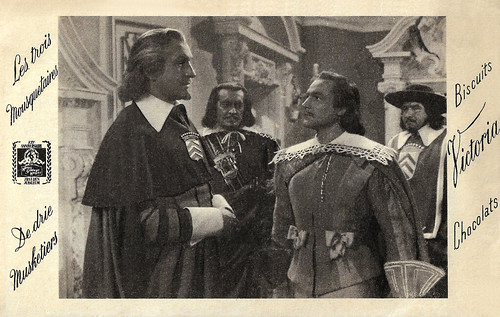
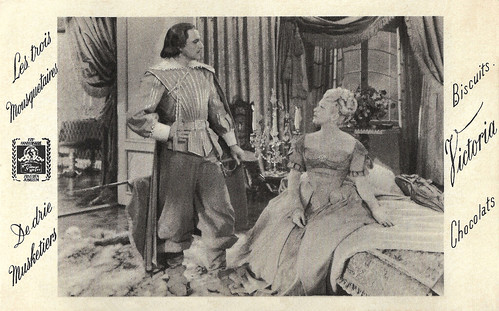
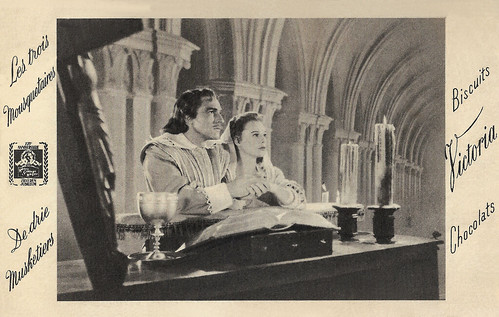
The Three Musketeers (George Sidney, 1948) is a classic Swashbuckler, starring Gene Kelly as D’Artagnan and Lana Turner as Milady De Winter. Other stars in the cast include Van Heflin, June Allyson, Gig Young, Angela Lansbury, and Vincent Price. It is one of the many, adaptations of the famous French book ‘Les trois mousquetaires’ by Alexandre Dumas père, and possibly the liveliest one, full of acrobatics, galloping horses, flapping cloaks, and sword fights with almost operatic intensity. Dumas’s story is followed quite faithfully, but the creative fantasy is in the theatrical way of depicting it.

June Allyson and Gene Kelly in The Three Musketeers (1948)
Dutch postcard by van Leer's Fotodrukindustrie N.V., Amsterdam, no. 351, no. 6. Photo: Metro Goldwyn Mayer (M.G.M.) June Allyson and Gene Kelly in The Three Musketeers (George Sidney, 1948), based on the novel by Alexandre Dumas.

Van Heflin, Gene Kelly, Gig Young, and Robert Coote in The Three Musketeers (1948)
Dutch postcard by Foto Archief Film en Toneel, no. 3454. Photo: M.G.M. Van Heflin, Gene Kelly, Gig Young, and Robert Coote in in The Three Musketeers (George Sidney, 1948), based on the novel by Alexandre Dumas.

Van Heflin, Robert Coote, Gig Young, and Gene Kelly in The Three Musketeers (1948)
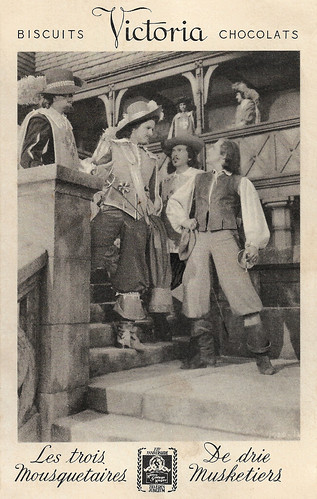
Belgian postcard by Victoria Biscuits Chocolats, no. 3. Photo: M.G.M. Van Heflin, Robert Coote, Gig Young, and Gene Kelly in The Three Musketeers (George Sidney, 1948), based on the novel by Alexandre Dumas.

The Three Musketeers (1948)
Belgian postcard by Victoria Biscuits Chocolats, no. 4. Photo: M.G.M. Frank Morgan, Reginald Owen, Gene Kelly, Van Heflin, Gig Young, and Robert Coote in The Three Musketeers (George Sidney, 1948), based on the novel by Alexandre Dumas.

June Allyson and Gene Kelly in The Three Musketeers (1948)
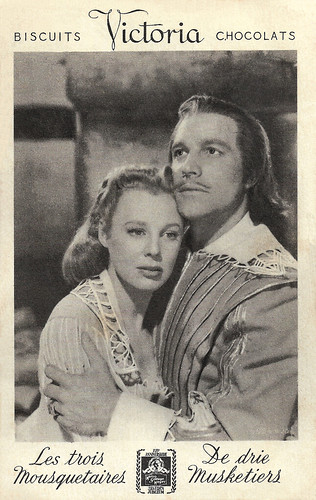
Belgian postcard by Victoria Biscuits Chocolats, no. 5. Photo: M.G.M. June Allyson and Gene Kelly in The Three Musketeers (George Sidney, 1948), based on the novel by Alexandre Dumas.

June Allyson and Gene Kelly in The Three Musketeers (1948)
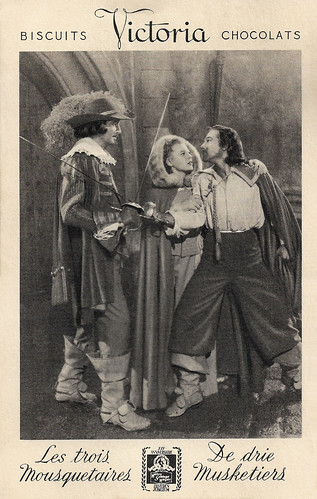
Belgian postcard by Victoria Biscuits Chocolats, no. 6. Photo: M.G.M. June Allyson and Gene Kelly in The Three Musketeers (George Sidney, 1948), based on the novel by Alexandre Dumas.

June Allyson and Gene Kelly in The Three Musketeers (1948)
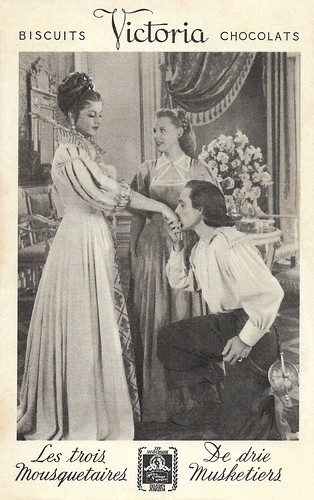
Belgian postcard by Victoria Biscuits Chocolats, no. 8. Photo: M.G.M. June Allyson and Gene Kelly in The Three Musketeers (George Sidney, 1948), based on the novel by Alexandre Dumas.

The good advice never to let himself be compromised with impunity


As in the book, the story of The Three Musketeers (George Sidney, 1948) is set in 1625 in France. The young and inexperienced D'Artagnan (Gene Kelly) leaves his home village in Gascony to become a musketeer in Paris in the service of His Majesty King Louis XIII (Frank Morgan). In his pocket, he has the letter of recommendation from his father (silent film star Robert Warwick), a former musketeer and friend of the current captain of the musketeers, Treville (Reginald Owen).

His father has taught him the art of fencing masterfully and gives him the good advice never to let himself be compromised with impunity. He is only too happy to follow this advice. Very soon, before he has even reached Paris, D'Artagnan gets into a confrontation with Rochefort (Ian Keith), Cardinal Richelieu's (Vincent Price) confidant, and his companion, the mysterious Lady de Winter (Lana Turner). At this first opportunity to preserve his honour in battle, he is unceremoniously struck down and robbed by Rochefort's henchmen, and his credentials are also taken from him.

Once in Paris, he not only meets his new friends and comrades-in-arms Athos (Van Heflin), Porthos (Gig Young), and Aramis (Robert Coote), but also his landlord's niece, Constance Bonacieux (June Allyson), and falls in love. Many adventures and entanglements lie ahead and in the path of the brave hero D'Artagnan. Driven by his desire to become the king's musketeer and to prove himself in battle, he falls into the clutches of both Queen Anne (Angela Lansbury) and cardinal Richelieu, experiences numerous dangerous situations, and sometimes needs his new friends to get away at all.

Nevertheless, he sets out to travel to England for the Queen's honour, to retrieve a jewellery box given away by the Queen's secret lover, Lord Buckingham (John Sutton), and to prevent Richelieu from plotting. To assist him, he is accompanied by Athos, Porthos, and Aramis, as well as his dull but loyal servant Planchet (Keenan Wynn). Shortly after D'Artagnan's return from England, Constance is kidnapped at the behest of Cardinal Richelieu. D'Artagnan makes a pass at Milady de Winter, discovers a delicate secret, and only just manages to save himself.

Constance is freed and taken to safety in England, shortly after which war breaks out, and our four friends are drawn into it. They overhear a conspiratorial meeting between the Cardinal and Lady de Winter in an inn. The latter is to travel to England and kill Buckingham. Planchet also travels to England at D'Artagnan's behest to warn Buckingham. Lady de Winter is convicted and is to be executed. Constance is appointed her guardian. Milady de Winter, after a lengthy psychological duel, manages to take out Constance as well as a guard and Buckingham and then escapes. Athos and D'Artagnan, who wanted to help Constance, arrive too late; after Constance dies in D'Artagnan's arms, they themselves also have only escaped.

Back in Paris, the four friends track down Lady de Winter, pronounce the death sentence on her, and have the prisoner executed. During their subsequent escape towards Spain, they are overpowered and arrested. Their fate seems to be sealed, but young D'Artagnan still has one trump card: the Countess's passport, personally sealed and signed by Cardinal Richelieu, with the note that everything the bearer of this letter undertakes will serve the good of the state. The king is not allowed to know the background of this letter - so Richelieu has to give in. Aramis receives permission to take up a clerical office. Porthos is allowed to marry richly, Athos gets his property back and D'Artagnan is to negotiate a peace offer with the enemy England on behalf of France.

The Three Musketeers (1948)
Belgian postcard by Victoria Biscuits Chocolats, no. 9. Photo: M.G.M. John Sutton as The Duke of Buckingham and Angela Lansbury as Queen Anne in The Three Musketeers (George Sidney, 1948), based on the novel by Alexandre Dumas.

The Three Musketeers (1948)
Belgian postcard by Victoria Biscuits Chocolats, no. 10. Photo: M.G.M. June Allyson as Constance Bonacieux and Gene Kelly as D'Artagnan in The Three Musketeers (George Sidney, 1948), based on the novel by Alexandre Dumas.

Angela Lansbury, June Allyson, and Gene Kelly in The Three Musketeers (1948)
Belgian postcard by Victoria Biscuits Chocolats, no. 12. Photo: M.G.M. Angela Lansbury, June Allyson, and Gene Kelly in The Three Musketeers (George Sidney, 1948), based on the novel by Alexandre Dumas.

Vincent Price and Gene Kelly in The Three Musketeers (1948)
Belgian postcard by Victoria Biscuits Chocolats, no. 14. Photo: M.G.M. Vincent Price and Gene Kelly in The Three Musketeers (George Sidney, 1948), based on the novel by Alexandre Dumas.

Vincent Price and Gene Kelly in The Three Musketeers
Belgian postcard by Victoria Biscuits Chocolats, no. 15. Photo: M.G.M. Gene Kelly as D'Artagnan and Vincent Price as Richelieu in The Three Musketeers (George Sidney, 1948), based on the novel by Alexandre Dumas.

Gene Kelly and Lana Turner in The Three Musketeers (1948)
Belgian postcard by Victoria Biscuits Chocolats, no. 16. Photo: M.G.M. Gene Kelly and Lana Turner in The Three Musketeers (George Sidney, 1948), based on the novel by Alexandre Dumas.

Lana Turner and Gene Kelly in The Three Musketeers (1948)
Belgian postcard by Victoria Biscuits Chocolats, no. 17. Photo: M.G.M. Lana Turner and Gene Kelly in The Three Musketeers (George Sidney, 1948), based on the novel by Alexandre Dumas.

An outrageously entertaining yarn


Among the many American film versions of Alexandre Dumas' 'Les trois mousquetaires' (The Three Musketeer) are the 1914 Film Attractions Co. production, directed by Charles V. Henkel, the 1921 Douglas Fairbanks production, directed by Fred Niblo, the 1935 RKO Radio Pictures, Inc. production, directed by Rowland V. Lee and starring Walter Abel, Paul Lukas, and Margot Grahame, Richard Lester's 1974 Twentieth Century-Fox production starring Michael York, Oliver Reed, Richard Chamberlain, and Raquel Welch; and the 1993 Buena Vista release, directed by Stephen Herek and starring Charlie Sheen, Kiefer Sutherland, Chris O'Donnell, and Rebecca de Mornay.

This splashy 1948 MGM adaptation of The Three Musketeers was the third sound version and was also the first version in Technicolor. In 1947, a representative of the National Catholic Legion of Decency, an organisation that monitored the interests of the Church in motion pictures, objected to the characterisation of Cardinal Richelieu in the planned MGM adaptation of Dumas' story. In a letter to MGM producer Pandro S. Berman, the organisation stated its objection to the cardinal being portrayed as a "worldly and unscrupulous man" and urged the studio to remove the character from the film. Berman refused to remove the character from the film but promised he would use great caution in all sensitive matters pertaining to the story and in the film, Richelieu is never referred to as Cardinal Richelieu.

Berman also indicated that Constance, the married mistress of D'Artagnan in the novel, would be unmarried in the film version. While early sound versions of The Three Musketeers eliminated the deaths of Constance and Milady, this adaptation telescopes the novel's events to allow for these tragedies. According to AFI, screenwriter Robert Ardry was displeased with director George Sidney's irreverent approach to the Dumas story and objected to the spoof elements that were added to the film.

A biography of Gene Kelly noted that Belgian fencing champion Jean Heremans, who appears in the film as the cardinal's guard, taught Kelly how to fence. Kelly's biography also noted that during the filming of a bedroom scene, Kelly flung Lana Turner onto a bed with such force that she fell to the ground and suffered a broken elbow. Hal Erickson at AllMovie: “True to form, MGM saw to it that Lana Turner, as Milady, was dressed to the nines and heavily bejeweled for her beheading sequence. Portions of the 1948 The Three Musketeers, in black and white, showed up in the silent film-within-a-film in 1952's Singin' in the Rain, which of course also starred Gene Kelly.”

The Three Musketeers opened to mostly favourable reviews, with several reviewers commenting on the film's unusual tongue-in-cheek approach. New York Times reviewer Bosley Crowther noted that "more glittering swordplay, more dazzling costumes, more colors or more of Miss Turner's chest have never been seen in a picture than are shown in this one." And added: “Completely fantastic, however, is Miss Turner as the villainess, the ambitious Lady de Winter who does the boudoir business for the boss. Loaded with blond hair and jewels, with twelve-gallon hats and ostrich plumes, and poured into her satin dresses with a good bit of Turner to spare, she walks through the palaces and salons with the air of a company-mannered Mae West.”

In 1948, there was an Oscar nomination for Robert Planck in the category Best Cinematography/Colour. And a more recent review, Hans J. Wollstein at AllMovie: “The Three Musketeers remains an outrageously entertaining yarn, the Southern California locales perfectly standing in for 17th Century France and England.” And finally, Yvette Banek at her blog In so many words: “Lana Turner is really quite superb in her evilness. So evil that she is even photographed without make-up. Well, as 'without make-up' as MGM got, at any rate. Even then, she is exquisitely beautiful - especially when praying.”

Van Heflin and Lana Turner in The Three Musketeers (1948)
Belgian postcard by Victoria Biscuits Chocolats, no. 18. Photo: M.G.M. Gene Kelly and Lana Turner in The Three Musketeers (George Sidney, 1948), based on the novel by Alexandre Dumas.

Gene Kelly and June Allyson in The Three Musketeers (1948)
Belgian postcard by Victoria Biscuits Chocolats, no. 19. Photo: M.G.M. Gene Kelly and June Allyson in The Three Musketeers (George Sidney, 1948), based on the novel by Alexandre Dumas.

Lana Turner in The Three Musketeers (1948)
Belgian postcard by Victoria Biscuits Chocolats, no. 23. Photo: M.G.M. Lana Turner as Milady in The Three Musketeers (George Sidney, 1948), based on the novel by Alexandre Dumas.

The Three Musketeers (1948)
Belgian postcard by Victoria Biscuits Chocolats, no. 25. Photo: M.G.M. June Allyson as Constance Bonacieux in The Three Musketeers (George Sidney, 1948), based on the novel by Alexandre Dumas.

Lana Turner and June Allyson in The Three Musketeers (1948)
Belgian postcard by Victoria Biscuits Chocolats, no. 26. Photo: M.G.M. Lana Turner and June Allyson in The Three Musketeers (George Sidney, 1948), based on the novel by Alexandre Dumas.

Lana Turner and Vincent Price in The Three Musketeers (1948)
Belgian postcard by Victoria Biscuits Chocolats, no. 28. Photo: M.G.M. Lana Turner and Vincent Price in The Three Musketeers (George Sidney, 1948), based on the novel by Alexandre Dumas.

Sources: Bosley Crowther (New York Times), Hal Erickson (AllMovie), Yvette Banek (In so many words), AFI, Wikipedia (Dutch, German), and IMDb.