Showing posts with label Alberto Pasquali. Show all posts

19 August 2026

Alberto Pasquali

Alberto Pasquali (1882–1929) was an Italian stage and screen actor, famous for his religious characters.

Santo Francesco
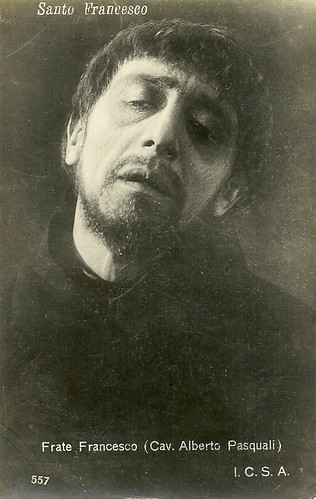
Italian postcard, no. 557. Photo: ICSA. Alberto Pasquali in Frate Francesco / Santo Francesco (Giulio Antamoro, 1927), a biopic on the life of St. Francis.

Christus (1916) Getsemane
French postcard by J. Mayer, graveur, Paris and Films Primior, Paris. Photo: Cines company of Rome. Alberto Pasquali as Christ, agonising in the gardens of Getsemane in Christus (Giulio Antamoro, Enrico Guazzoni, 1916). Caption: My soul is mortally saddened, so stay here and stay awake with me.

Christus (1916)
French postcard by Les Films Primior, Paris. Graveur (engraving): J. Meyer, Paris. Photo: Cines. Alberto Pasquali as Jesus and Augusti Mastripietri as Judas in Christus / Christ (Giulio Antamoro, Enrico Guazzoni, Cines 1916). Caption: My friend, you betray the Son of Man by a kiss?

Santo Francesco
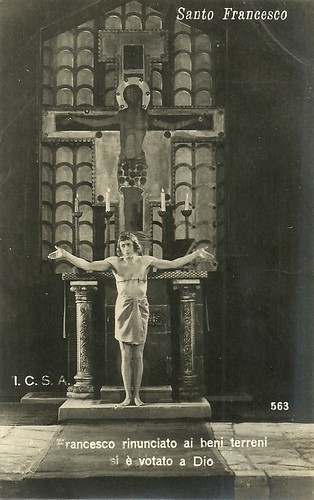
Italian postcard, no. 563. Photo: ICSA. Alberto Pasquali in Frate Francesco / Santo Francesco (Giulio Antamoro, 1927). Caption: Francis renounces all his earthly goods and dedicates himself to God.

Alberto Pasquali
Italian postcard by FotoEbany, no. 213. Sent by mail in 1928.

Filming in Egypt amidst the ruins


Alberto Pasquali was born in Turin in 1882. His mother acted in Venetian dialect plays, and Alberto approached the stage at an early age.

Pasquali managed to obtain major parts at the most important stage companies, including those of Ferruccio Garavaglia, Emma Gramatica and Di Lorenzo-Falconi.

He made his film debut in Christus / Christ (1916), directed by Giulio Antamoro but finished by Enrico Guazzoni. Pasquali played the title role. Antamoro went to Egypt to shoot several scenes amidst the ruins, adding even scenes not mentioned in the Bible, in which Christ wanders among the ruins of Luxor, deploring the decay of the world.

Christus / Christ (1916) presents the life of Christ, from the Annunciation to the Transfiguration through a succession of cinematographic tableaux vivants based on famous works, such as the 'Annunciation' by Fra Angelico, 'La Natività' by Correggio, 'The Last Supper' by Leonardo da Vinci, 'The Pieta' by Michelangelo and 'The Transfiguration' by Raphael.

After the success of this film, Pasquali often played Christ and acted in various religious films and plays, like the film Redenzione / Redemption (Carmine Gallone, 1919) starring Diana Karenne as Mary Magdalene. In the USA, he appeared in The Twice Born Woman (Malcolm Strauss, 1921), with Deyha Loti as Mary Magdalene. Moreover, Pasquali played St Frances of Assisi in the biopic Frate Francesco / The Passion of St. Francis (1927), again directed by Giulio Antamoro.

Christus (1916)
French postcard by Films Primior, Paris / J. Meyer, Paris. Photo: Cines. Alberto Pasquali in Christus/Christ (Giulio Antamoro and, uncredited, Enrico Guazzoni, 1916). Caption: The Flagellation. Bowing to the demands of the people, Pilate flogged Jesus.

Christus (Cines 1916)
French postcard by Les Films Primior, Paris. Graveur (engraving): J. Meyer, Paris. Photo: Cines. Alberto Pasquali in Christus / Christ (Giulio Antamoro, Enrico Guazzoni, 1916). Caption: Let the little children come to me. If you don't resemble these children, you will not enter the Kingdom of Heaven.

Diana Karenne in La peccatrice casta (1919)
Spanish cromo by Chocolat Imperiale, Barcelona, no. 3 of 6 cards. Photo: Dist. Verdaguer / Tiber Film. Diana Karenne and Alberto Pasquali in La peccatrice casta (Diana Karenne, Gennaro Righelli, 1919).

Diana Karenne in La peccatrice casta (1919)
Spanish cromo by Chocolat Imperiale, Barcelona, no. 4 of 6 cards. Photo: Dist. Verdaguer / Tiber Film. Diana Karenne and Alberto Pasquali in La peccatrice casta (Diana Karenne, Gennaro Righelli, 1919).

Diana Karenne in La peccatrice casta (1919)
Spanish cromo by Chocolat Imperiale, Barcelona, no. 5 of 6 cards. Photo: Dist. Verdaguer / Tiber Film. Diana Karenne and Alberto Pasquali in La peccatrice casta (Diana Karenne, Gennaro Righelli, 1919).

Diva films and period pieces


Among Alberto Pasquali's films were many diva films with such stars as Maria Jacobini, Diana Karenne, Helena Makowska, Italia Almirante Manzini, Linda Pini, Elena Sangro and Marcella Albani.

He also appeared in period piece dramas like Leonardo Da Vinci (Giulia Cassini-Rizzotto, Mario Corsi), Il fornaretto di Venezia / The Baker Boy of Venice (Mario Almirante, 1923), an adaptation of the novel 'Il Fornaretto' (1846) by Francesco Dall'Ongaro, and I due Foscari / The Two Foscari (Mario Almirante, 1923).

Pasquali also starred in adventure films like Kiff Tebbi (Mario Camerini, 1928). The film portrayed the Italo-Turkish War and promoted the Italian Fascist regime's imperial policies in Libya and in wider Africa. While privately funded (although the government supported its production), the film foreshadowed future collaborations between the film industry and the Italian state.

Until 1929, Pasquali acted in some 30 films. His last was the German film Anschluß um Mitternacht / Call at Midnight (1929), directed by Mario Bonnard and starring Marcella Albani.

After this role, Alberto Pasquali returned to Italy, where he suddenly died in Milan at the age of 46, on 14 February 1929.

Il Fornaretto di Venezia
Italian postcard by G.B. Salci, Milano, no. 257. Probably Nini Dinelli as Clemenza Barbo (or Lia Miari as her servant Annella) and Alberto Pasquali as Alvise Guoro, secret lover of the married Clemenza Barbo, in Il fornaretto di Venezia / The Baker Boy of Venice (Mario Almirante, 1923). Caption: Nightly gatherings.

Santo Francesco
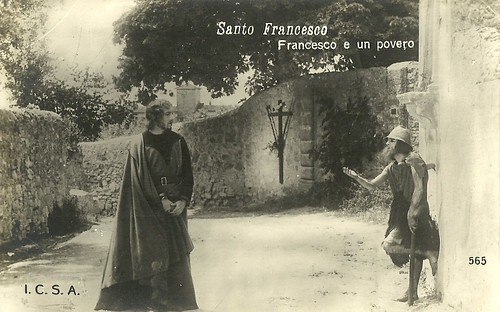
Italian postcard, no. 565. Photo: ICSA. Alberto Pasquali in Frate Francesco / Santo Francesco (Giulio Antamoro, 1927), a biopic on the life of St. Francis. Caption: Frances and a poor man.

Santo Francesco
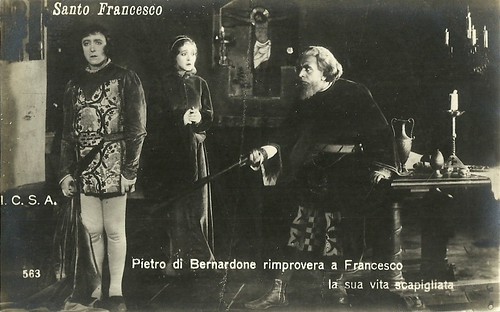
Italian postcard, no. 563. Photo: ICSA. Alberto Pasquali and Alfredo Robert in Frate Francesco / Santo Francesco (Giulio Antamoro, 1927), a biopic on the life of St. Francis. Caption: Pietro di Bernardone (Robert) reproaches Frances (Pasquali) for his dissolute life.

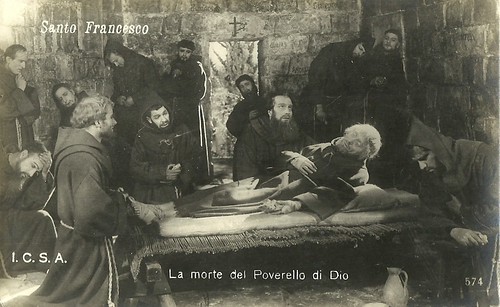
Santo Francesco
Italian postcard, no. 574. Photo: ICSA. Alberto Pasquali in Frate Francesco / Santo Francesco (Giulio Antamoro, 1927). Caption: The Death of God's Little Poor Man.

Sources: Wikipedia (Italian and English) and IMDb.

26 December 2024

Christus (1916)

On the 2nd Day of Christmas, a post on the Italian silent film Christus/Christ (1916). This Cines production directed by count Giulio Antamoro and filmed in Palestine and Egypt was a worldwide success. Alberto Pasquali played Jesus and Leda Gys played Mary.

Christus (1916)  Flight to Egypt
French postcard by Les Films Primior, Paris. Photo: Cines. Publicity still for Christus (Giulio Antamoro, 1916). Translation of the caption: 'The Flight to Egypt: Get up, take your child and his mother, fly to Egypt and stay there until I warn you.'

Christus (1916) Holy Family in Egypt
French postcard by Les Films Primior, Paris. Photo: Cines. Publicity still for Christus (Giulio Antamoro, 1916). Caption: 'The Sky over Egypt. At the entrance of Memphis, in Old Cairo, the Well of Matarea saves the menaced life of Jesus.'

Shot on location


In 1915-1916, so right in the middle of the First World War, Italian director Count Giulio Cesare Antamoro went to Palestine and Egypt, on behalf of the film company Cines. He went there with a crew and an impressive cast to film Christ (1916).

Earlier, the Kalem production From the Manger to the Cross (Sidney Olcott, 1912) had faithfully reproduced the sketches by James Tissot, drawn on location in Egypt and Palestine.

Antamoro wanted to film the life of Christ on location. His Christus (1916) became a worldwide success, because of the quotations from famous artworks such as Fra Angelico's 'Annunciation', Leonardo da Vinci's 'Last Supper' and Michelangelo's 'Pietà', but also because of the location shots.

The press drew a direct relationship between the authenticity of Giulio Antamoro's film and that of the earlier sketches by James Tissot.

Even more than in the Kalem production, the Cines crew exploited the monuments and scenery in Egypt for the film, bending the Biblical tales to make it more spectacular.

Christus (1916) Youth in Nazareth
French postcard by Les Films Primior, Paris. Photo: Cines. Publicity still for Christus (Giulio Antamoro, 1916). Caption: 'In Nazareth, surrounded by the Holy Virgin and Joseph, Jesus grows up in wisdom, in grace and in age, before God and before mankind.' On the right, Leda Gys plays the Holy Virgin.

Christus (1916) Jesus among the ruins of the world (Luxor, Egypt)
French postcard by Les Films Primior, Paris. Photo: Cines. Alberto Pasquali as Jesus in Christus (Giulio Antamoro, 1916). Caption: 'The world is dying, oppressed, degraded and in despair, Jesus, says, but God is there who guards.'

The holy family


Arriving in Egypt after their Flight from Jerusalem, the Holy Family passes the pyramids of Gizeh and the famous Sphinx in Christ (1916).

We notice Mary in Memphis under Cairo, where she receives food and drinks after the Flight to Egypt. Afterwards, we see the Holy Family near a row of sphinxes at Karnak.

Later in the film, when Jesus has grown up, he reflects on the decay of the world. Director Giulio Antamoro then shows Jesus (Alberto Pasquali) walking through the majestic ruins of Luxor.

There is no Biblical reason for this scene, but Giulio Antamoro thus combines literal decay with spiritual decay. Besides, in 1915-1916 there were more ancient buildings in Egypt than in Palestine to exploit, and thus Antamoro used Egypt's monumentality.

For the average cinema visitor in Europe during the First World War, the vision of ancient ruins must have created associations with the modern ruins in Northern France and Belgium, daily visible in cinema newsreels.

Christus (1916) Entry of Christ into Jerusalem
French postcard by Films Primior, Paris. Photo: Cines. Publicity still for Christus (Giulio Antamoro, 1916). Entry of Christ into Jerusalem. On Palm Sunday, the Sunday before Easter, Christians celebrate Christ's triumphant entry into Jerusalem.

Christus (1916) Getsemane
French postcard by Films Primior, Paris. Photo: Cines. Publicity still for Christus (Giulio Antamoro, 1916). Christ (Alberto Pasquali) agonising in the gardens of Gethsemane.

Additional shooting


The leading roles in Christus (1916) were acted by Alberto Pasquali (Christ), Leda Gys (Mary), Amleto Novelli (Pilate), and Augusto Mastripietri (Judas), while Renato Visca played the young Jesus.

When additional shooting was necessary in 1916, Enrico Guazzoni, the director of Quo Vadis? (1912), Marcantonio e Cleopatra (1913) and Cajus Julius Caesar (1914), was in charge, while Antamoro wasn't available anymore.

Janiss Garza at AllMovie reviewed the result as: "static, pretentious and dated (yes, even for 1917 (sic)). In addition, the titles - at least in the English version - were long and wordy, which was anathema to moviegoers of the 'teens."

However, Christus (1916) was an international success. A tagline read: "Greatest screen success Europe has known is acclaimed with new honours in America." Two other films with the same title were released in 1914 and 1919 but both are missing now.

Cines' Christus was eventually restored by producer Goffredo Lombardo, the founder of Titanus and the son of Leda Gys. The restored film was shown at the 2000 Venice Film Festival.

Christus (1916) towards Mount Calvary and the Crucifixion
French postcard by Les Films Primior, Paris. Christ towards Mount Calvary and the Crucifixion. While Simon of Cyrene is carrying the cross, Jesus (Alberto Pasquali) meets his mother Mary (Leda Gys) and Mary Magdalene (Aurelia Cattaneo), on the way to Mount Calvary. Translation of the caption: 'The Calvary: Jesus meets his mother Mary and Mary Magdalene. Turning towards the other women, he speaks: Don't weep for me, daughters of Jerusalem, but for you and your children.'

Christus (1916) Calvary
French postcard by Films Primior, Paris. Christ's Crucifixion on Mount Calvary. Translation of the caption: 'Father, forgive them, for they know not what they do.'

Christus (1916) Pietà
French postcard by Films Primior, Paris. The Pietà with Jesus (Alberto Pasquali) and Mary (Leda Gys). Translation of the caption: 'The descent of the cross. See if there is any sorrow like mine.'

Sources: Janiss Garza (AllMovie - page now defunct), Mario Gauci (IMDb - page now defunct) and IMDb.

08 August 2015

Frate Francesco (1927)

Frate Francesco/The Passion of St. Francis (1927) aka Santo Francesco was the third Italian film on the life of Saint Francis of Assisi. St. Francis, or Santo Francesco in Italian, was played by Alberto Pasquali, and the film was directed by Giulio Antamoro.

Santo Francesco
Italian postcard by ICSA, no. 557. Photo: publicity still for Frate Francesco (Giulio Antamoro, 1927) with Alberto Pasquali as St. Francis.

Santo Francesco
Italian postcard by ICSA, no. 563. Photo: publicity still for Frate Francesco (Giulio Antamoro, 1927) with Alberto Pasquali as St. Francis. Caption: 'Francis renounces all his earthly goods and dedicates himself to God.'

Santo Francesco
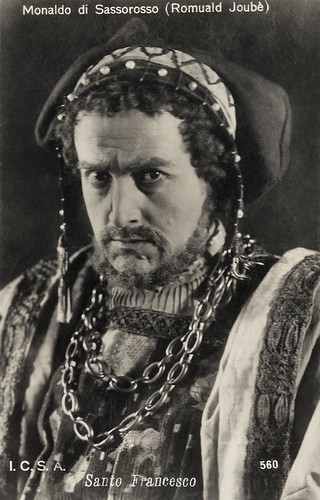
Italian postcard by ICSA, no. 560. Photo: publicity still for Frate Francesco (Giulio Antamoro, 1927) with Romuald Joubé as Monaldo di Sassorosso.

Elena Baranowitch as Monna Pica in Santo Francesco
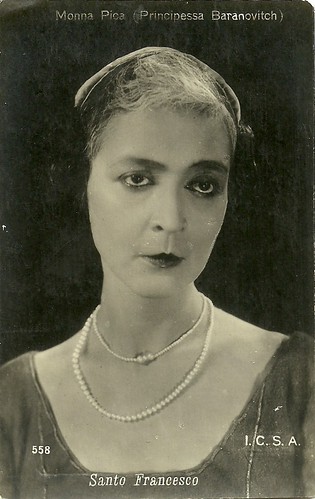
Italian postcard by ICSA, no. 558. Photo: publicity still for Frate Francesco aka Santo Francesco (Giuliano Antamoro, 1927) with Elena Baranowitch as Monna Pica.

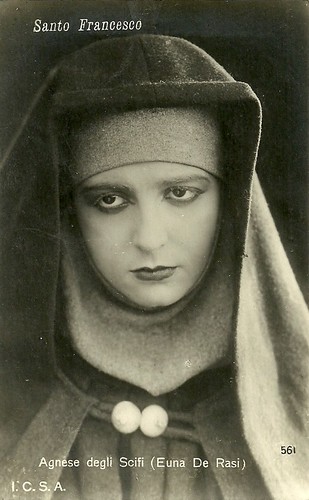
Euna De Rasi as Agnese in Santo Francesco
Italian postcard by ICSA, no. 561. Photo: publicity still for Frate Francesco aka Santo Francesco (Giuliano Antamoro, 1927) with Euna De Rasi as Agnese.

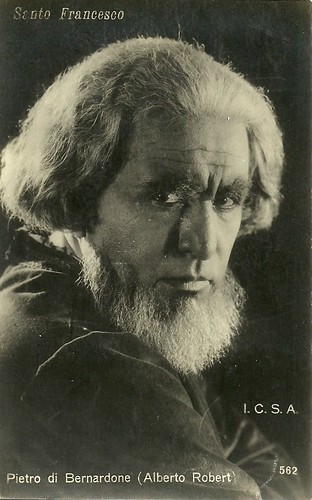
Alfredo Robert (Pietro di Bernardone) in Santo Francesco
Italian postcard by ICSA, no. 562. Photo: publicity still for Frate Francesco aka Santo Francesco (Giuliano Antamoro, 1927) with Alfredo Robert as Pietro di Bernardone.

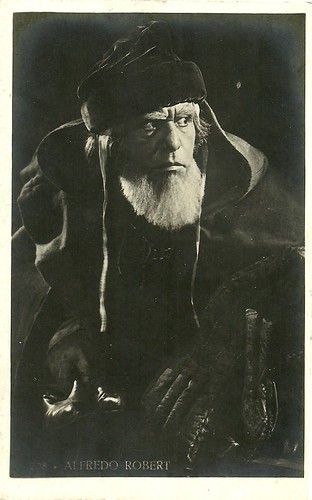
Alfredo Robert in Santo Francesco
Italian postcard for Frate Francesco aka Santo Francesco (Giuliano Antamoro, 1927) with Alfredo Robert as Pietro di Bernardone.

Ambitious project


Frate Francesco (Giulio Antamoro, 1927) was the third Italian silent film on the life of St. Francis of Assisi, after Il poverello di Assisi (Enrico Guazzoni, 1911) and Frate Sole (Mario Corsi, Ugo Falena, 1918). In addition, the poet Guido Gozzano had written a film script in 1916 and Adolfo Padovan had tried in vain his luck at Milano Films in the early 1910s.

Antamoro's Francis had been an ambitious project: in budget, in length, and in scope. Several scriptwriters were attracted while the famous Francescan, Professor Dane Jörgensen wrote the first script version. Instead of the idyllic countryside in Falena's version, Antamoro focused on characters, extending the storyline with all kinds of antagonists like Monaldo di Sassorosso and Myria di Leros who get ample time and space.

The film is also full of symbolism: Francis is presented as the new Christ, standing before the Crucifix. His mother holds a wounded man as in Mary's Pietà. The narrative's parable is that of a weak man who overcomes and mediates in conflicts, only thanks to his belief.

Still, not all critics liked the film at its release and some accused it of being too static and therefore uncinematic. Moreover, the film came out in a year that most Italian film people had lost hope to revive its national cinema and many had fled to Berlin to pursue their careers in Germany.

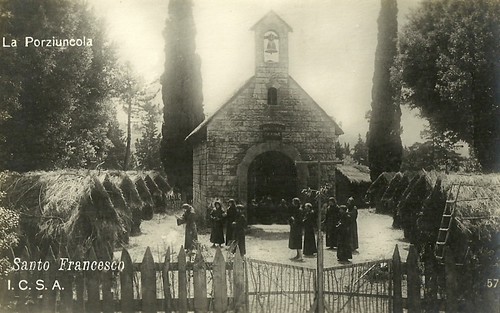
Santo Francesco
Italian postcard by ICSA, no. 557. Photo: publicity still for Frate Francesco (Giulio Antamoro, 1927). Caption: 'La Porziuncola'. Near this chapel dating from the 4th century, Frances and his followers built huts. Later it would be the basis of the first Francescan convent and would be incorporated in the Basilica Santa Maria degli Angeli in Assisi.

Santo Francesco
Italian postcard by ICSA, no. 563. Photo: publicity still for Frate Francesco (Giulio Antamoro, 1927) with Alberto Pasquali as St. Francis. Caption: 'Pietro di Bernardone (Alfredo Robert) reproaches Frances (Pasquali) his dissolute life.'

Santo Francesco
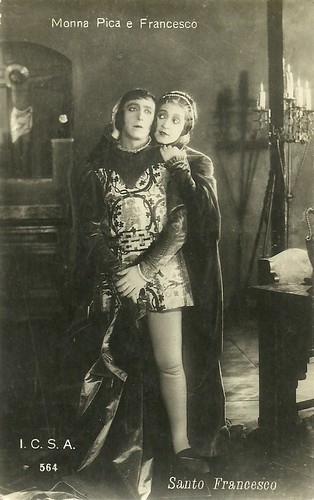
Italian postcard by ICSA, no. 564. Photo: publicity still for Frate Francesco (Giulio Antamoro, 1927) with Alberto Pasquali as Francesco and Enta Droubetzkoy aka Elena Baranowitch as Francesco's mother Monna Pica.

Santo Francesco
Italian postcard by ICSA, no. 565. Photo: publicity still for Frate Francesco (Giulio Antamoro, 1927). Caption: 'Francis and a poor man.'

Santo Francesco
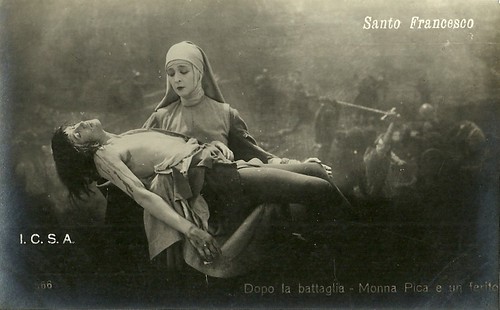
Italian postcard by ICSA, no. 566. Photo: publicity still for Frate Francesco (Giulio Antamoro, 1927). Caption: 'After the battle. Monna Pica (Enta Droubetzkoy) and a wounded man.'

Santo Francesco
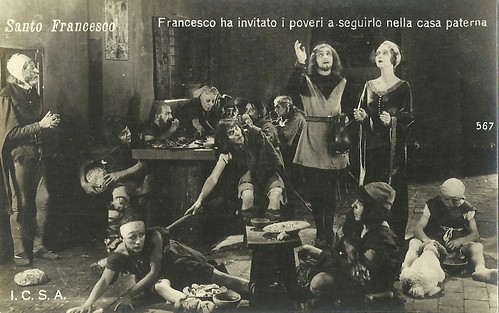
Italian postcard by ICSA, no. 567. Photo: publicity still for Frate Francesco (Giulio Antamoro, 1927). Caption: 'Frances has invited the poor to follow him to his father's house.' In the middle Alberto Pasquali as Frances and Enta Droubetzkoy as his mother.

Santo Francesco
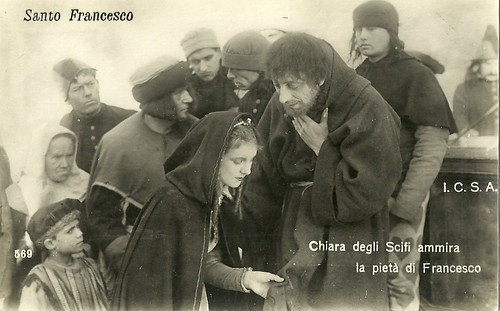
Italian postcard by ICSA, no. 569. Photo: publicity still for Frate Francesco (Giulio Antamoro, 1927). Caption: 'Chiara degli Scifi (Bice Jany) admires the piety of Francesco (Alberto Pasquali).'

Santo Francesco
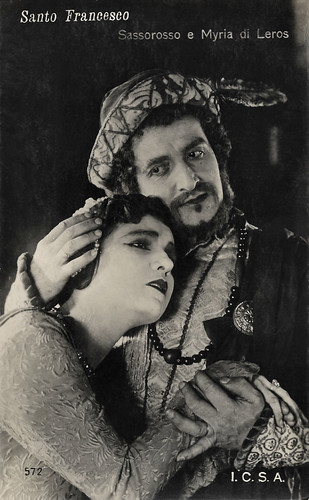
Italian postcard by ICSA, no. 572. Photo: publicity still for Frate Francesco (Giulio Antamoro, 1927) with Monaldo di Sassorosso (Romuald Joubé) and Myria di Leros (Donatella Gemmò).

Santo Francesco
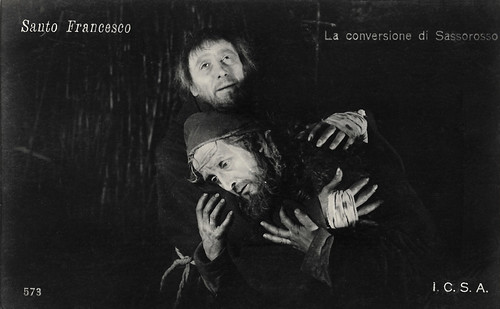
Italian postcard by ICSA, no. 573. Photo: publicity still for Frate Francesco (Giulio Antamoro, 1927). Caption: 'The conversion of Sassorosso.' Visible are Alberto Pasquali as St. Francis and Romuald Joubé as Sassorosso.

Santo Francesco
Italian postcard by ICSA, no. 574. Photo: publicity still for Frate Francesco (Giulio Antamoro, 1927). Caption: 'The Death of God's Little Poor Man'.

Sources: Elena Mosconi (L'impressione del film, 2006), Wikipedia (Italian) and IMDb.