Sir Laurence Olivier (1907-1989) was one of the most famous and revered actors of the 20th century. He played a wide variety of roles on stage and screen from Greek tragedy, Shakespeare and Restoration comedy to modern American and British drama. The Brit got fourteen Oscar nominations, with two wins for Best Actor and Best Picture for Hamlet (1948), and two honorary awards.
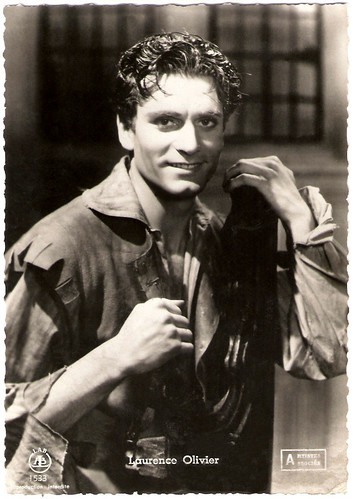
Belgian Postcard by Les Editions d’Art L.A.B., Brussels, no. 1533. Photo: United Artists. Publicity still for Fire Over England (William K. Howard, 1937).

British postcard by Publicity Photographs LTD., London, no. 373.

British postcard by Art Photo, no. 104. Photo: London Film / Erich Pommer Production. Vivien Leigh and Laurence Olivier in Fire Over England (William K. Howard, 1937).

British postcard by the National Portrait Gallery (NPG), no. P236. Photo: Laszlo Willinger, 1940. Caption: Laurence Olivier, Baron Olivier of Brighton.

Swiss postcard by News Productions, Baulmes, no. 55833. Photo: W. Eugene Smith. Vivien Leigh and Laurence Olivier in a stage production of 'Romeo and Juliet' in 1940.

French postcard by A.N., Paris, no. 1266. Photo: J. Rank Org. Ltd. Laurence Olivier in Hamlet (Laurence Olivier, 1948).
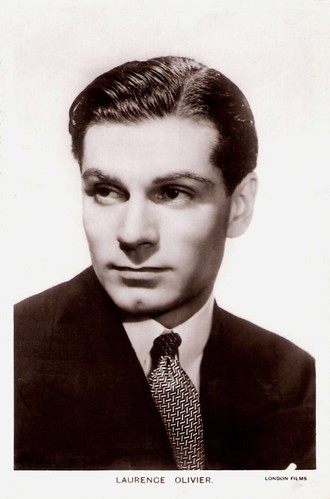
British postcard in the Picturegoer Series, London, no. 695b. Photo: London Films.
Laurence Kerr Olivier was born in Dorking, England, in 1907. He was raised in a severe, strict, and religious household, ruled over by his father, Gerard Kerr Olivier, an Anglican minister. Larry took solace in the care of his mother, Agnes Louis née Crookenden, and was grief-stricken when she died when he was only 12. A year later, he went to St. Edward's School in Oxford and appeared in school drama productions. At 15, he played Katherine in 'The Taming of the Shrew' to rave reviews. Another success was his Puck in 'A Midsummer Night's Dream'.
His father, who was an unabashed theatre lover, decided that Larry would become an actor. He entered the Central School of Speech Training and Dramatic Arts in London at the age of 17. One of his instructors was Claude Rains. Upon graduation in 1926, he joined The Birmingham Repertory Company, where he would play 'Hamlet' and 'Macbeth'. He married actress Jill Esmond in 1930, but the marriage was not happy.
At first, Olivier's athleticism and elegant features typecast him as a young innocent hero. Although he appeared in a spate of London successes, such as 'Journey's End', 'The Last Enemy' and 'Private Lives', he still struggled for serious recognition. The good-looking Olivier made his film debut opposite Lilian Harvey in The Temporary Widow (Gustav Ucicky, 1930). He went to Hollywood as the ‘next Ronald Colman’, but initially, he held the cinema in little regard.
He played a lead in The Yellow Ticket (Raoul Walsh, 1931) and was chosen to play Antonio in Queen Christina (Rouben Mamoulian, 1933), but was rejected by the star, Greta Garbo.
He returned to London and played opposite Gloria Swanson in Perfect Understanding (Cyril Gardner, 1933). In 1935, he had his stage breakthrough in 'Romeo and Juliet', alternating the roles of Romeo and Mercutio with John Gielgud. This resulted in an invitation to be the star at the Old Vic in 1937/1938. His tenure had mixed artistic results, but by the season's end, he was one of the major Shakespearean actors in England. He made his first Shakespeare film adaptation, As You Like It (Paul Czinner, 1936), but he decided that Shakespeare did not work well on film.

Spanish card, no. 1074. Merle Oberon and Laurence Olivier in The Divorce of Lady X (Tim Whelan, 1938).

British postcard in the Film Partners Series, London, no. P 291. Photo: Columbia. Laurence Olivier and Valerie Hobson in Q Planes / Clouds Over Europe (Tim Whelan, Arthur B. Woods, 1939).

Belgian postcard by Les Editions d'Art L.A.B., Bruxelles, no. 1518. Photo: MGM. Laurence Olivier in Pride and Prejudice (Robert Z. Leonard, 1940). The Wallonian title is Orgueil et Préjugés.

Vintage postcard. Photo: Vivien Leigh and Laurence Olivier in That Hamilton Woman / Lady Hamilton (Alexander Korda, 1941).

Romanian collector card. Photo: Universal Film. Laurence Olivier and Renée Asherson in Henry V (Laurence Olivier, 1944).
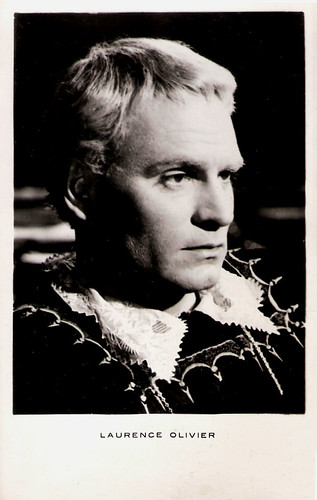
Yugoslav postcard. Photo: Victory Rank. Publicity still for Hamlet (Laurence Olivier, 1948).
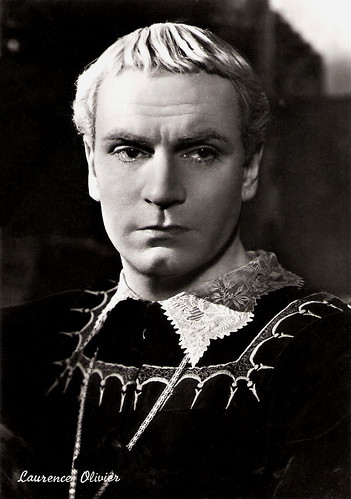
Italian postcard by Bromofoto, Milano, no. 214. Photo: Victory Rank. Publicity still for Hamlet (Laurence Olivier, 1948).
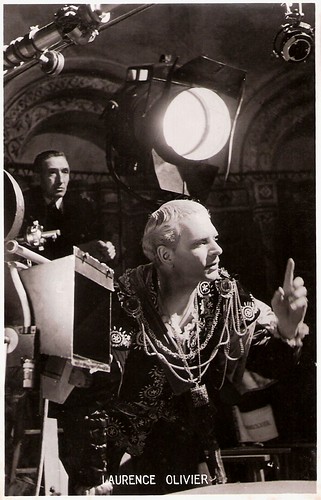
British postcard by Rotary Photo, London, no. F.S.5. Photo: Laurence Olivier directs a scene in Hamlet (1948).
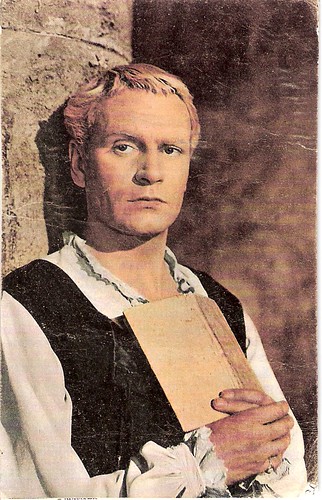
Spanish card by F. Molina, Madrid. D.L.M. 7.803/59. Photo: still from Hamlet (1948).
Laurence Olivier saw Vivien Leigh in 'The Mask of Virtue' in 1936, and a friendship developed after he congratulated her on her performance. They played lovers in the film Fire Over England (William K. Howard, 1937). In private, the (both married) actors also began an affair.
After the shooting of the film, Olivier travelled to Hollywood to play Heathcliff in Wuthering Heights (William Wyler, 1939). Leigh followed soon to be with him ánd to pursue her dream of playing Scarlett O'Hara in Gone with the Wind (Victor Fleming, 1939).
The filming of Wuthering Heights proved to be a turning point for Olivier, both in his success in the USA, which had eluded him until then, but also in his attitude to film, which he had regarded as an inferior medium. He began to moderate his performance and began to appreciate the possibilities film offered.
Wuthering Heights was a hit, and Olivier was nominated for an Oscar. Leigh won the Oscar for Gone with the Wind, and the couple suddenly found themselves to be major celebrities. They were married in 1940.
Olivier's film career flourished with highly regarded performances in Rebecca (Alfred Hitchcock, 1940) and Pride and Prejudice (Robert Z. Leonard, 1940). In That Hamilton Woman (Alexander Korda, 1941), he played Horatio Nelson, and Leigh played Emma Hamilton.

French postcard in the Collection 'Portraits de Cinema' by Editions Admira, Aix-en-Provence & Chapman Collection / SNAP Photos / Cosmos, no. PHN 661. Vivien Leigh and Laurence Olivier in William Shakespeare's 'Antony and Cleopatra' (1951). In 1951, the play ran in repertory with G.B. Shaw's 'Caesar and Cleopatra' at the Ziegfeld Theatre in New York.
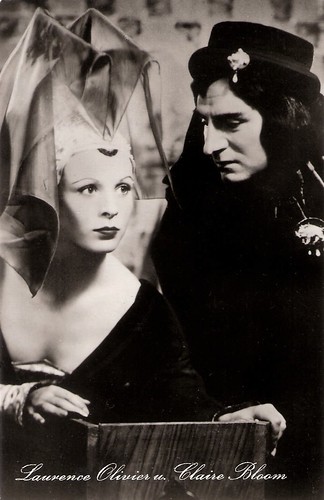
East German postcard by VEB Progress Film-Vertrieb, Berlin, no. 1099. Photo: publicity still for Richard III (Laurence Olivier, 1955) with Claire Bloom.
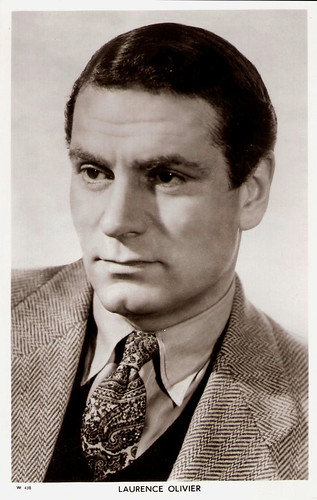
British postcard in the Picturegoer Series, London, no. W 438.
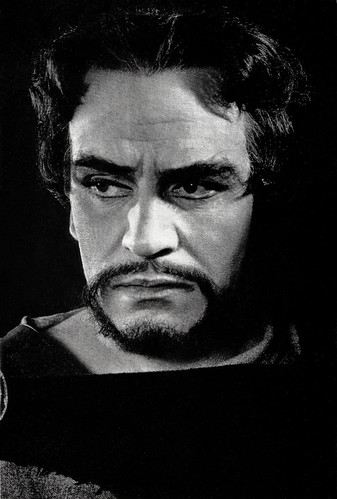
British postcard in the Royal Shakespeare Company series, no. 27. Photo: Angus McBean. Publicity still for the stage production of 'Macbeth' at Stratford-upon-Avon in 1955.
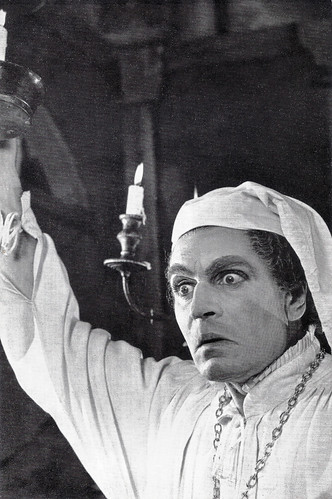
British postcard in the Royal Shakespeare Company series, no. 28. Photo: Angus McBean. Publicity still for the stage production of 'Twelfth Night' at Stratford-upon-Avon in 1955.
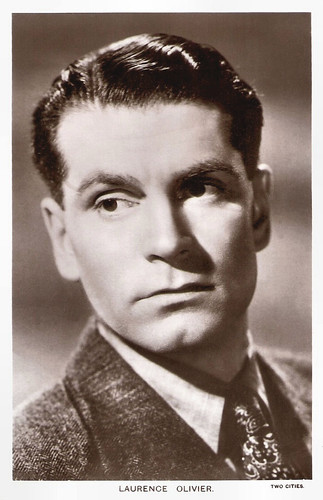
British postcard in the Picturegoer Series, London, no. W 228. Photo: Two Cities.
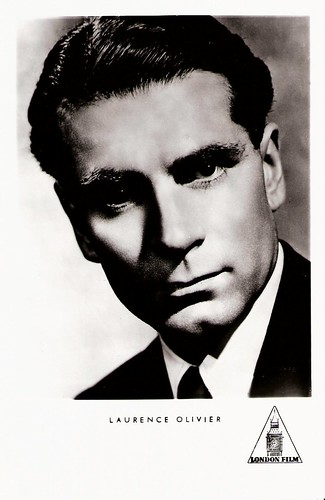
German postcard by Netter's Star Verlag, Berlin. Photo: London Film.
When Britain engaged in World War II, the Oliviers returned to England. In 1944, Laurence Olivier made his film directing debut with an adaptation of Shakespeare's Henry V. James C. Robertson writes in Reference Guide to British and Irish Film Directors: "With a lavish budget for the time, Henry V is beautifully filmed in Technicolour, draws on an excellent cast, and benefits from William Walton's stirring but unobtrusive music. Olivier's central performance is impeccable, while the battle sequences provide a spectacular climax."
After being knighted in 1947, Olivier adapted Hamlet (Laurence Olivier, 1948), again for his own film company, Two Cities. James C. Robertson: "He drastically shortened Shakespeare's text, but with much less visual action, the film appealed less to audiences than the flamboyant Henry V. Even so, Desmond Dickinson's imaginative monochrome cinematography, which helps create a brooding atmosphere of suppressed tension, is impressive, and Olivier assembles a fine cast and gives a memorable performance himself as Hamlet." Hamlet is still the only Shakespeare adaptation to win the Best Picture Oscar. However, the failure of Olivier's Richard III (Laurence Olivier, 1955) to make back its money meant that he would never direct another Shakespearean film.
He was Oscar-nominated again for his lead as the seedy, pathetic vaudevillian Archie Rice in The Entertainer (Tony Richardson, 1960). The role of Rice's daughter - both in the play and in the film - was played by Joan Plowright. Soon after the release of The Entertainer, he divorced Vivien Leigh and married Plowright. Years later, after Olivier's death, biographer Donald Spoto claimed that Olivier was bisexual. Plowright confirmed this and said he was once attached to Danny Kaye. Biographer Terry Coleman suggested that he also had a relationship with Edwardian actor Henry Ainley.
During the 1960s, Olivier began appearing more frequently in films, usually in character parts, as in Spartacus (Stanley Kubrick, 1960), Bunny Lake Is Missing (Otto Preminger, 1965) and Oh! What a Lovely War (Richard Attenborough, 1969). He received Oscar nominations for his reclusive mystery writer in Sleuth (Joseph L. Mankiewicz, 1972), the sadistic Nazi dentist in Marathon Man (John Schlesinger, 1976) and the kindly but determined Nazi-hunter in The Boys from Brazil (Franklin J. Schaffner, 1978).
When he was forced out as director of the Royal National Theatre in 1973, he chose to do short film appearances on a ‘pay cheque’ basis. He later admitted that he particularly despised Inchon (Terence Young, 1982), in which he played General MacArthur. His final performance was a wheelchair-bound old soldier in War Requiem (Derek Jarman, 1989). Later that year, Laurence Olivier died of cancer in Steyning, England, aged 82. Fifteen years after his death, he returned to the cinema. Through the use of computer graphics, footage of him was integrated into Sky Captain and the World of Tomorrow (Kerry Conran, 2004), in which Olivier 'played' the villain.
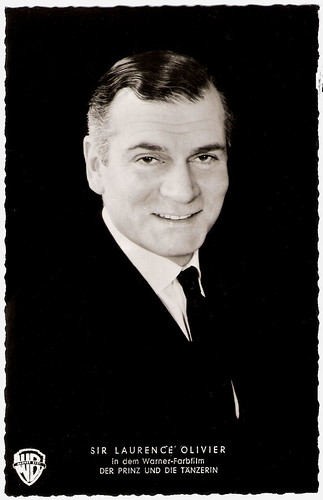
German postcard by Kunst und Bild, Berlin-Charlottenburg, no. V 176. Photo: Warner Bros. Publicity still for The Prince and the Showgirl (Laurence Olivier, 1957).

West German collector card by Ufa/Film-Foto, no. 57. Photo: Universal Film. Laurence Olivier in Spartacus (Stanley Kubrick, 1960).

French postcard in the Entr'acte series by Éditions Asphodèle, Mâcon, no. 004/8. Photo: Collection B. Courtel / D.R. Laurence Olivier and Peter Ustinov on the set of Spartacus (Stanley Kubrick, 1960). Caption: Contrast of eras between the clothing of Laurence Olivier and that of the director and actor Peter Ustinov.
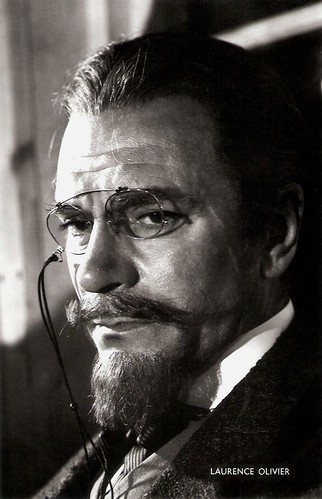
British card. Photo: publicity still for the stage play 'Uncle Vanya' in 1963.

British postcard. Laurence Olivier in Othello (Stuart Burge, 1965).
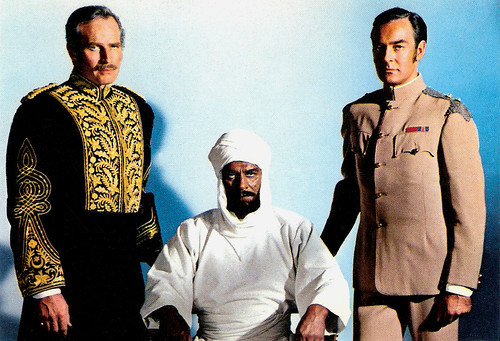
Italian postcard. Photo: Dear Film. Publicity still for Khartoum (Basil Dearden, Eliot Elisofon, 1965) with Charlton Heston and Richard Johnson.
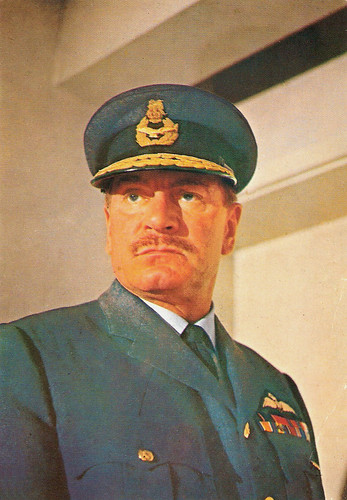
British postcard by Dixon-Lotus / Spitfire Productions Ltd, no. L6/8699, 1969. Photo: Robert Penn. Still for Battle of Britain (Guy Hamilton, 1969).
Sources: James C. Robertson (Reference Guide to British and Irish Film Directors), Hal Erickson (AllMovie - Page now defunct), Dale O'Connor (IMDb), Wikipedia and IMDb.
Belgian Postcard by Les Editions d’Art L.A.B., Brussels, no. 1533. Photo: United Artists. Publicity still for Fire Over England (William K. Howard, 1937).
British postcard by Publicity Photographs LTD., London, no. 373.
British postcard by Art Photo, no. 104. Photo: London Film / Erich Pommer Production. Vivien Leigh and Laurence Olivier in Fire Over England (William K. Howard, 1937).
British postcard by the National Portrait Gallery (NPG), no. P236. Photo: Laszlo Willinger, 1940. Caption: Laurence Olivier, Baron Olivier of Brighton.
Swiss postcard by News Productions, Baulmes, no. 55833. Photo: W. Eugene Smith. Vivien Leigh and Laurence Olivier in a stage production of 'Romeo and Juliet' in 1940.
French postcard by A.N., Paris, no. 1266. Photo: J. Rank Org. Ltd. Laurence Olivier in Hamlet (Laurence Olivier, 1948).
British postcard in the Picturegoer Series, London, no. 695b. Photo: London Films.
The next Ronald Colman
Laurence Kerr Olivier was born in Dorking, England, in 1907. He was raised in a severe, strict, and religious household, ruled over by his father, Gerard Kerr Olivier, an Anglican minister. Larry took solace in the care of his mother, Agnes Louis née Crookenden, and was grief-stricken when she died when he was only 12. A year later, he went to St. Edward's School in Oxford and appeared in school drama productions. At 15, he played Katherine in 'The Taming of the Shrew' to rave reviews. Another success was his Puck in 'A Midsummer Night's Dream'.
His father, who was an unabashed theatre lover, decided that Larry would become an actor. He entered the Central School of Speech Training and Dramatic Arts in London at the age of 17. One of his instructors was Claude Rains. Upon graduation in 1926, he joined The Birmingham Repertory Company, where he would play 'Hamlet' and 'Macbeth'. He married actress Jill Esmond in 1930, but the marriage was not happy.
At first, Olivier's athleticism and elegant features typecast him as a young innocent hero. Although he appeared in a spate of London successes, such as 'Journey's End', 'The Last Enemy' and 'Private Lives', he still struggled for serious recognition. The good-looking Olivier made his film debut opposite Lilian Harvey in The Temporary Widow (Gustav Ucicky, 1930). He went to Hollywood as the ‘next Ronald Colman’, but initially, he held the cinema in little regard.
He played a lead in The Yellow Ticket (Raoul Walsh, 1931) and was chosen to play Antonio in Queen Christina (Rouben Mamoulian, 1933), but was rejected by the star, Greta Garbo.
He returned to London and played opposite Gloria Swanson in Perfect Understanding (Cyril Gardner, 1933). In 1935, he had his stage breakthrough in 'Romeo and Juliet', alternating the roles of Romeo and Mercutio with John Gielgud. This resulted in an invitation to be the star at the Old Vic in 1937/1938. His tenure had mixed artistic results, but by the season's end, he was one of the major Shakespearean actors in England. He made his first Shakespeare film adaptation, As You Like It (Paul Czinner, 1936), but he decided that Shakespeare did not work well on film.
Spanish card, no. 1074. Merle Oberon and Laurence Olivier in The Divorce of Lady X (Tim Whelan, 1938).
British postcard in the Film Partners Series, London, no. P 291. Photo: Columbia. Laurence Olivier and Valerie Hobson in Q Planes / Clouds Over Europe (Tim Whelan, Arthur B. Woods, 1939).
Belgian postcard by Les Editions d'Art L.A.B., Bruxelles, no. 1518. Photo: MGM. Laurence Olivier in Pride and Prejudice (Robert Z. Leonard, 1940). The Wallonian title is Orgueil et Préjugés.
Vintage postcard. Photo: Vivien Leigh and Laurence Olivier in That Hamilton Woman / Lady Hamilton (Alexander Korda, 1941).
Romanian collector card. Photo: Universal Film. Laurence Olivier and Renée Asherson in Henry V (Laurence Olivier, 1944).
Yugoslav postcard. Photo: Victory Rank. Publicity still for Hamlet (Laurence Olivier, 1948).
Italian postcard by Bromofoto, Milano, no. 214. Photo: Victory Rank. Publicity still for Hamlet (Laurence Olivier, 1948).
British postcard by Rotary Photo, London, no. F.S.5. Photo: Laurence Olivier directs a scene in Hamlet (1948).
Spanish card by F. Molina, Madrid. D.L.M. 7.803/59. Photo: still from Hamlet (1948).
Turning point
Laurence Olivier saw Vivien Leigh in 'The Mask of Virtue' in 1936, and a friendship developed after he congratulated her on her performance. They played lovers in the film Fire Over England (William K. Howard, 1937). In private, the (both married) actors also began an affair.
After the shooting of the film, Olivier travelled to Hollywood to play Heathcliff in Wuthering Heights (William Wyler, 1939). Leigh followed soon to be with him ánd to pursue her dream of playing Scarlett O'Hara in Gone with the Wind (Victor Fleming, 1939).
The filming of Wuthering Heights proved to be a turning point for Olivier, both in his success in the USA, which had eluded him until then, but also in his attitude to film, which he had regarded as an inferior medium. He began to moderate his performance and began to appreciate the possibilities film offered.
Wuthering Heights was a hit, and Olivier was nominated for an Oscar. Leigh won the Oscar for Gone with the Wind, and the couple suddenly found themselves to be major celebrities. They were married in 1940.
Olivier's film career flourished with highly regarded performances in Rebecca (Alfred Hitchcock, 1940) and Pride and Prejudice (Robert Z. Leonard, 1940). In That Hamilton Woman (Alexander Korda, 1941), he played Horatio Nelson, and Leigh played Emma Hamilton.
French postcard in the Collection 'Portraits de Cinema' by Editions Admira, Aix-en-Provence & Chapman Collection / SNAP Photos / Cosmos, no. PHN 661. Vivien Leigh and Laurence Olivier in William Shakespeare's 'Antony and Cleopatra' (1951). In 1951, the play ran in repertory with G.B. Shaw's 'Caesar and Cleopatra' at the Ziegfeld Theatre in New York.
East German postcard by VEB Progress Film-Vertrieb, Berlin, no. 1099. Photo: publicity still for Richard III (Laurence Olivier, 1955) with Claire Bloom.
British postcard in the Picturegoer Series, London, no. W 438.
British postcard in the Royal Shakespeare Company series, no. 27. Photo: Angus McBean. Publicity still for the stage production of 'Macbeth' at Stratford-upon-Avon in 1955.
British postcard in the Royal Shakespeare Company series, no. 28. Photo: Angus McBean. Publicity still for the stage production of 'Twelfth Night' at Stratford-upon-Avon in 1955.
British postcard in the Picturegoer Series, London, no. W 228. Photo: Two Cities.
German postcard by Netter's Star Verlag, Berlin. Photo: London Film.
In character
When Britain engaged in World War II, the Oliviers returned to England. In 1944, Laurence Olivier made his film directing debut with an adaptation of Shakespeare's Henry V. James C. Robertson writes in Reference Guide to British and Irish Film Directors: "With a lavish budget for the time, Henry V is beautifully filmed in Technicolour, draws on an excellent cast, and benefits from William Walton's stirring but unobtrusive music. Olivier's central performance is impeccable, while the battle sequences provide a spectacular climax."
After being knighted in 1947, Olivier adapted Hamlet (Laurence Olivier, 1948), again for his own film company, Two Cities. James C. Robertson: "He drastically shortened Shakespeare's text, but with much less visual action, the film appealed less to audiences than the flamboyant Henry V. Even so, Desmond Dickinson's imaginative monochrome cinematography, which helps create a brooding atmosphere of suppressed tension, is impressive, and Olivier assembles a fine cast and gives a memorable performance himself as Hamlet." Hamlet is still the only Shakespeare adaptation to win the Best Picture Oscar. However, the failure of Olivier's Richard III (Laurence Olivier, 1955) to make back its money meant that he would never direct another Shakespearean film.
He was Oscar-nominated again for his lead as the seedy, pathetic vaudevillian Archie Rice in The Entertainer (Tony Richardson, 1960). The role of Rice's daughter - both in the play and in the film - was played by Joan Plowright. Soon after the release of The Entertainer, he divorced Vivien Leigh and married Plowright. Years later, after Olivier's death, biographer Donald Spoto claimed that Olivier was bisexual. Plowright confirmed this and said he was once attached to Danny Kaye. Biographer Terry Coleman suggested that he also had a relationship with Edwardian actor Henry Ainley.
During the 1960s, Olivier began appearing more frequently in films, usually in character parts, as in Spartacus (Stanley Kubrick, 1960), Bunny Lake Is Missing (Otto Preminger, 1965) and Oh! What a Lovely War (Richard Attenborough, 1969). He received Oscar nominations for his reclusive mystery writer in Sleuth (Joseph L. Mankiewicz, 1972), the sadistic Nazi dentist in Marathon Man (John Schlesinger, 1976) and the kindly but determined Nazi-hunter in The Boys from Brazil (Franklin J. Schaffner, 1978).
When he was forced out as director of the Royal National Theatre in 1973, he chose to do short film appearances on a ‘pay cheque’ basis. He later admitted that he particularly despised Inchon (Terence Young, 1982), in which he played General MacArthur. His final performance was a wheelchair-bound old soldier in War Requiem (Derek Jarman, 1989). Later that year, Laurence Olivier died of cancer in Steyning, England, aged 82. Fifteen years after his death, he returned to the cinema. Through the use of computer graphics, footage of him was integrated into Sky Captain and the World of Tomorrow (Kerry Conran, 2004), in which Olivier 'played' the villain.
German postcard by Kunst und Bild, Berlin-Charlottenburg, no. V 176. Photo: Warner Bros. Publicity still for The Prince and the Showgirl (Laurence Olivier, 1957).
West German collector card by Ufa/Film-Foto, no. 57. Photo: Universal Film. Laurence Olivier in Spartacus (Stanley Kubrick, 1960).
French postcard in the Entr'acte series by Éditions Asphodèle, Mâcon, no. 004/8. Photo: Collection B. Courtel / D.R. Laurence Olivier and Peter Ustinov on the set of Spartacus (Stanley Kubrick, 1960). Caption: Contrast of eras between the clothing of Laurence Olivier and that of the director and actor Peter Ustinov.
British card. Photo: publicity still for the stage play 'Uncle Vanya' in 1963.
British postcard. Laurence Olivier in Othello (Stuart Burge, 1965).
Italian postcard. Photo: Dear Film. Publicity still for Khartoum (Basil Dearden, Eliot Elisofon, 1965) with Charlton Heston and Richard Johnson.
British postcard by Dixon-Lotus / Spitfire Productions Ltd, no. L6/8699, 1969. Photo: Robert Penn. Still for Battle of Britain (Guy Hamilton, 1969).
Sources: James C. Robertson (Reference Guide to British and Irish Film Directors), Hal Erickson (AllMovie - Page now defunct), Dale O'Connor (IMDb), Wikipedia and IMDb.

1 comment:
I absolutely loved him in Khartoum.
Post a Comment