French singer and actress Polaire (1874-1939) had a career in the entertainment industry which stretched from the early 1890s to the mid-1930s. She encompassed the range from music-hall singer to stage and film actress. Her most successful period professionally was from the mid-1890s to the beginning of the First World War.

French postcard. Photo: Paul Boyer.
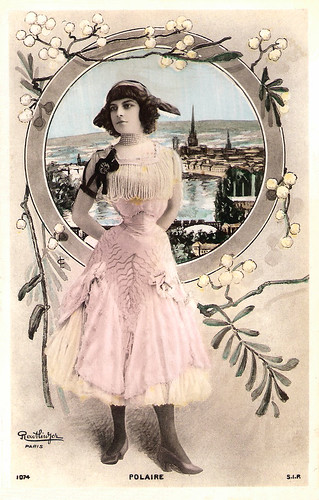
French postcard by S.I.P., Paris, no. 1074. Photo: Reutlinger, Paris.
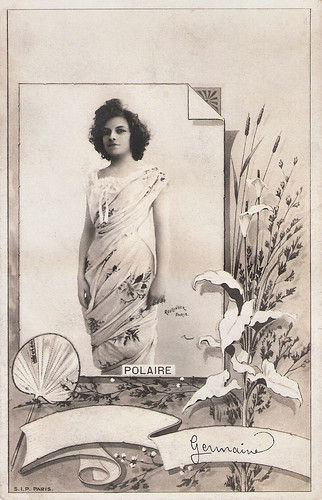
French postcard by S.I.P., Paris. Sent by mail in 1904. Photo: Reutlinger, Paris.
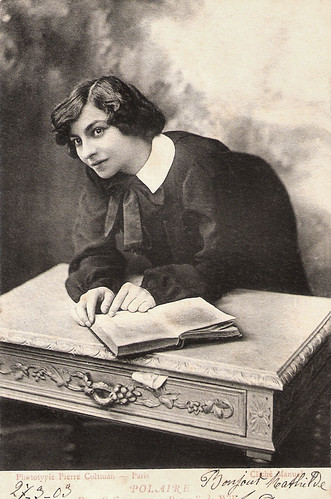
French postcard by Phototypie Pierre Coltman, Paris. Photo: Manuel. Publicity still for the play 'Claudine à Paris' by Willy (actually by Colette). Sent by mail in 1903.
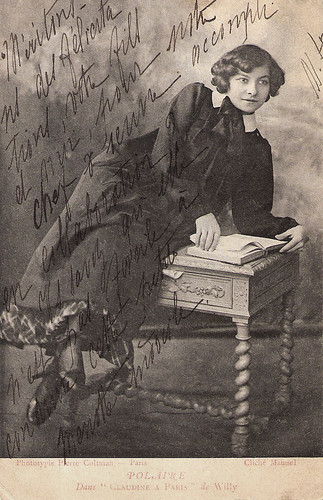
French postcard by Phototypie Pierre Coltman, Paris. Photo: Manuel. Publicity still for the stage production 'Claudine à Paris'.

French postcard. Sent by mail in 1903.
Polaire was born Émilie Marie Bouchaud in Agha, Algeria, in 1874. According to her memoirs, she was one of eleven children of whom only four survived – and eventually only two, Émilie and her brother Edmond. When her father died of typhoid, her mother temporarily placed the children under the care of Polaire’s grandmother in Algiers.
In 1891, at the age of 17, she came to Paris to join her brother Edmond, who performed there in the café-concerts under the name of Dufleuve. She had already sung in cafes in Algiers and continued on this path, eventually becoming a popular music-hall singer and dancer.
She performed the French version of 'Ta-ra-ra Boom-de-ay': 'Tha ma ra boum di hé'. It would be her greatest success, already from the start. She became a big name and was portrayed by Henri de Toulouse-Lautrec in the magazine Le Rire in 1895. Not only were her singing and dancing qualities remarkable, but Polaire also distinguished herself by her particular physique. She had an exceptional wasp waist, at a time when women tortured themselves with tight corsets to refine their waist.
After a first failed attempt to conquer New York as a singer, Polaire returned to Paris, where she expanded her range with prose theatre as well. She managed to get the role of Claudine in Colette’s play 'Claudine à Paris', which she performed at the Bouffes-Parisiens in 1902. She again performed the play in the US in 1910. This time, she was a big hit in the US and came back loaded with money.
Obtaining the part of Claudine was not so easy, Polaire writes in her memoirs. Colette's husband, Willy, at the time reclaimed the rights of Colette’s novels, and didn’t consider this music-hall singer fit for this serious part. But a dashing and headstrong Polaire managed to convince Willy in person that she was Claudine, so she got the part. 'Claudine à Paris' was performed some 120 times in France, with great success. Colette herself was very satisfied with the result. Willy even managed to exploit the success by a whole line of merchandising. Afterwards, Polaire would consider him her substitute father.
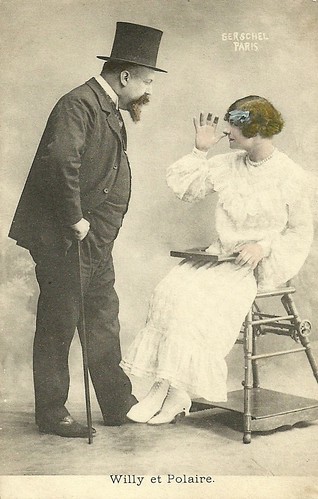
French postcard. Photo Gerschel, Paris. Polaire and Willy.
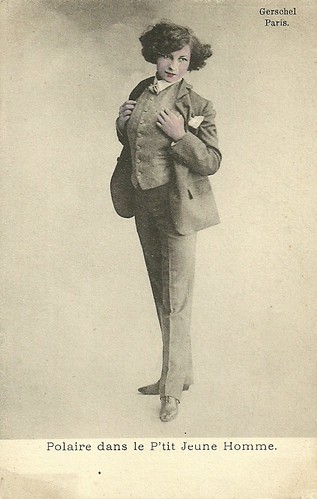
French postcard. Photo: Gerschel, Paris. Polaire in 'Le P'tit Jeune Homme'. Polaire played this travesty role in 1903 at the Bouffes-Parisiens.
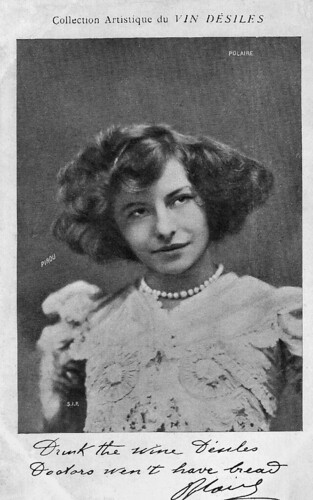
French promotion card by S.I.P. for Vin Désiles. Photo: Pirou. Caption: 'Drink the wine Désiles. Doctors won't have bread. Polaire'.
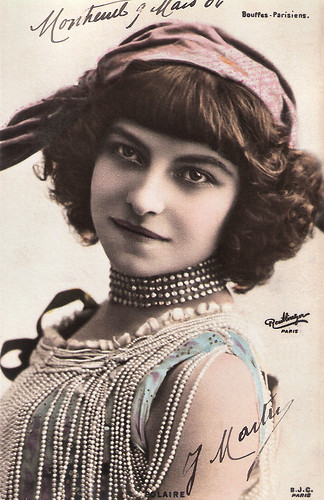
French postcard by B.J.C., Paris. Photo: Reutlinger, Paris. Bouffes-Parisiens.
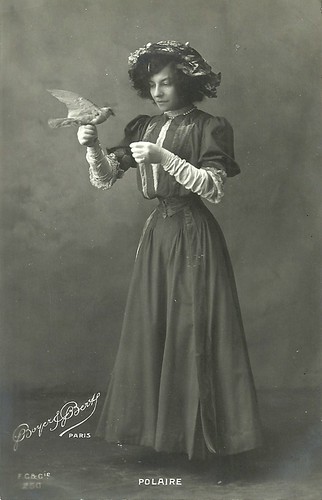
French postcard by F.C. & Cie., no. 250. Photo: Boyer & Bert, Paris.

French postcard. Photo: Stebbing.
From 1909, Polaire appeared in several film roles. She made two films at Pathé frères, Moines et guerriers / Nuns and Warriors (Julien Clément, 1909) and La tournée des grand-ducs / The Grandduke’s Tour (Léonce Perret, 1910), in which she aptly played a dancer.
She went to Germany to play a Cuban lady in Zouza (Reinhard Bruck, 1911), in which future film director Richard Oswald was one of her co-stars.
Back in France, she acted again at Pathé in Le visiteur / The Visitor (Albert Capellani, René Leprince, 1911), but she was mostly active at the Éclair film company between 1911 and 1914, starting with Le poison de l’humanité / The Poison of Humanity (Émile Chautard, Victorin Jasset, 1911).
From 1912 to 1914, she did a series of six films with then then young and upcoming film director Maurice Tourneur, working for Éclair: Les gaîtés de l'escadron / The Funny Regiment (1913), based on the novel by Georges Courteline; Le dernier pardon (1913), a comedy written by Gyp; La dame de Monsoreau (1913), after Alexandre Dumas père; Le Friquet (1914), with Polaire in the title role; Soeurette / The Sparrow (1914); and the mystery film Monsieur Lecoq (1914), after Émile Gaboriau. Her co-stars in these films were often Maurice de Féraudy, Charles Krauss, Henry Roussel and Renée Sylvaire.
Le Friquet was restored by the Cinémathèque française in the mid-1990s and was shown at international festivals. It deals with a poor trapeze worker who loses her lover to a rich, immoral lady and then commits suicide during her trapeze act. It was based on a play Polaire had performed herself in 1904.
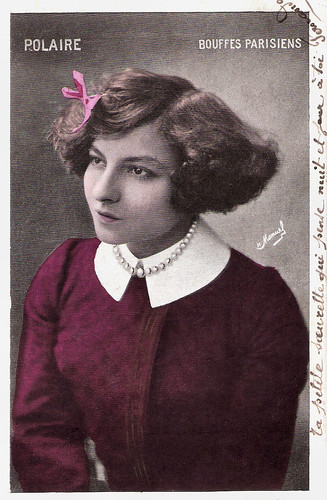
French postcard. Photo: H. Manuel. Publicity still for the stage play 'Claudine à Paris' (1902) at the Théâtre des Bouffes Parisiens. Sent by mail in 1906.
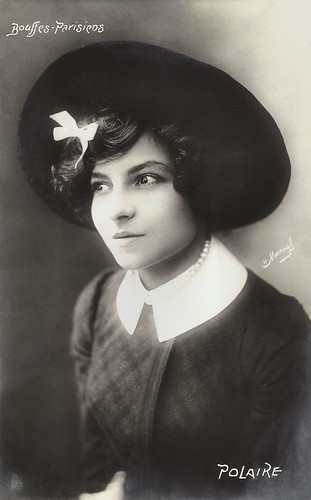
French postcard by EM. Photo: H. Manuel. Publicity still for 'Claudine à Paris' (1902).
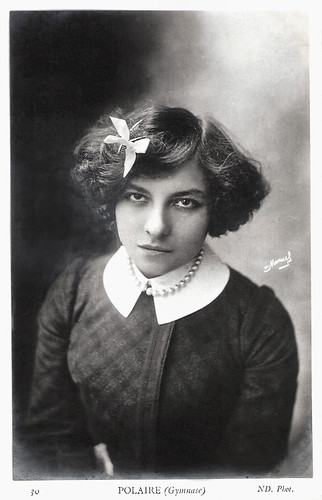
French postcard by ND Phot., no. 30 Photo: H. Manuel. Caption: Polaire (Gymnase).
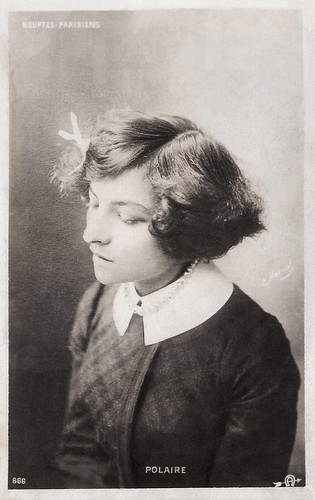
French postcard, no. 666. Photo: H. Manuel. Publicity still for 'Claudine à Paris' (1902). Sent by mail in 1908.

French postcard by Phototypie Pierre Coltman, Paris. Photo: Manuel. Polaire in 'Claudine à Paris'. Sent by mail in 1902.

French postcard by Phototypie Pierre Coltman, Paris. Photo: Manuel. Polaire in 'Claudine à Paris'.
After World War I, Polaire dedicated herself primarily to the stage. During her career, she recorded many of her songs, such as 'Tha ma ra boum di hé', 'La Glu' - based on a poem by Jean Richepin, 'Tchique tchique' by Vincent Scotto, and the telephone song 'Allo! Chéri!', sang with her partner Marjal, and she recited 'Charlotte prays to Our Lady' by Jehan Rictus.
'Mademoiselle Polaire' is cited by the 'Guinness Book of Records' as co-holder, with the British Ethel Granger, of the thinnest waist of 33 cm. She says in her memoirs that she had repeatedly circled her waist with a fake collar of the 'normal size' of 41 or 42 cm. Polaire was further noted for her heavy Arabic-style makeup, her lavish clothing with fur, lots of jewellery and often short skirts, and her short bob haircut, well before it became fashionable around 1920.
She posed for various painters such as Antonio de La Gandara, Henri de Toulouse-Lautrec, Leonetto Cappiello, Rupert Carabin and John / Juan Sala and the photographers Nadar and Léopold Reutlinger. John Sala became, in 1893, the portraitist of Parisian society. His life-sized portrait of Polaire (1910) was auctioned at Drouot's in Paris on 28 June 2016. Polaire had become a wealthy lady with a house on the Champs-Elysées and a country house in the Var, Villa Claudine.
French postcard. Photo: Paul Boyer.
French postcard by S.I.P., Paris, no. 1074. Photo: Reutlinger, Paris.
French postcard by S.I.P., Paris. Sent by mail in 1904. Photo: Reutlinger, Paris.
French postcard by Phototypie Pierre Coltman, Paris. Photo: Manuel. Publicity still for the play 'Claudine à Paris' by Willy (actually by Colette). Sent by mail in 1903.
French postcard by Phototypie Pierre Coltman, Paris. Photo: Manuel. Publicity still for the stage production 'Claudine à Paris'.
French postcard. Sent by mail in 1903.
Tha ma ra boum di hé
Polaire was born Émilie Marie Bouchaud in Agha, Algeria, in 1874. According to her memoirs, she was one of eleven children of whom only four survived – and eventually only two, Émilie and her brother Edmond. When her father died of typhoid, her mother temporarily placed the children under the care of Polaire’s grandmother in Algiers.
In 1891, at the age of 17, she came to Paris to join her brother Edmond, who performed there in the café-concerts under the name of Dufleuve. She had already sung in cafes in Algiers and continued on this path, eventually becoming a popular music-hall singer and dancer.
She performed the French version of 'Ta-ra-ra Boom-de-ay': 'Tha ma ra boum di hé'. It would be her greatest success, already from the start. She became a big name and was portrayed by Henri de Toulouse-Lautrec in the magazine Le Rire in 1895. Not only were her singing and dancing qualities remarkable, but Polaire also distinguished herself by her particular physique. She had an exceptional wasp waist, at a time when women tortured themselves with tight corsets to refine their waist.
After a first failed attempt to conquer New York as a singer, Polaire returned to Paris, where she expanded her range with prose theatre as well. She managed to get the role of Claudine in Colette’s play 'Claudine à Paris', which she performed at the Bouffes-Parisiens in 1902. She again performed the play in the US in 1910. This time, she was a big hit in the US and came back loaded with money.
Obtaining the part of Claudine was not so easy, Polaire writes in her memoirs. Colette's husband, Willy, at the time reclaimed the rights of Colette’s novels, and didn’t consider this music-hall singer fit for this serious part. But a dashing and headstrong Polaire managed to convince Willy in person that she was Claudine, so she got the part. 'Claudine à Paris' was performed some 120 times in France, with great success. Colette herself was very satisfied with the result. Willy even managed to exploit the success by a whole line of merchandising. Afterwards, Polaire would consider him her substitute father.
French postcard. Photo Gerschel, Paris. Polaire and Willy.
French postcard. Photo: Gerschel, Paris. Polaire in 'Le P'tit Jeune Homme'. Polaire played this travesty role in 1903 at the Bouffes-Parisiens.
French promotion card by S.I.P. for Vin Désiles. Photo: Pirou. Caption: 'Drink the wine Désiles. Doctors won't have bread. Polaire'.
French postcard by B.J.C., Paris. Photo: Reutlinger, Paris. Bouffes-Parisiens.
French postcard by F.C. & Cie., no. 250. Photo: Boyer & Bert, Paris.
French postcard. Photo: Stebbing.
A poor trapeze worker
From 1909, Polaire appeared in several film roles. She made two films at Pathé frères, Moines et guerriers / Nuns and Warriors (Julien Clément, 1909) and La tournée des grand-ducs / The Grandduke’s Tour (Léonce Perret, 1910), in which she aptly played a dancer.
She went to Germany to play a Cuban lady in Zouza (Reinhard Bruck, 1911), in which future film director Richard Oswald was one of her co-stars.
Back in France, she acted again at Pathé in Le visiteur / The Visitor (Albert Capellani, René Leprince, 1911), but she was mostly active at the Éclair film company between 1911 and 1914, starting with Le poison de l’humanité / The Poison of Humanity (Émile Chautard, Victorin Jasset, 1911).
From 1912 to 1914, she did a series of six films with then then young and upcoming film director Maurice Tourneur, working for Éclair: Les gaîtés de l'escadron / The Funny Regiment (1913), based on the novel by Georges Courteline; Le dernier pardon (1913), a comedy written by Gyp; La dame de Monsoreau (1913), after Alexandre Dumas père; Le Friquet (1914), with Polaire in the title role; Soeurette / The Sparrow (1914); and the mystery film Monsieur Lecoq (1914), after Émile Gaboriau. Her co-stars in these films were often Maurice de Féraudy, Charles Krauss, Henry Roussel and Renée Sylvaire.
Le Friquet was restored by the Cinémathèque française in the mid-1990s and was shown at international festivals. It deals with a poor trapeze worker who loses her lover to a rich, immoral lady and then commits suicide during her trapeze act. It was based on a play Polaire had performed herself in 1904.
French postcard. Photo: H. Manuel. Publicity still for the stage play 'Claudine à Paris' (1902) at the Théâtre des Bouffes Parisiens. Sent by mail in 1906.
French postcard by EM. Photo: H. Manuel. Publicity still for 'Claudine à Paris' (1902).
French postcard by ND Phot., no. 30 Photo: H. Manuel. Caption: Polaire (Gymnase).
French postcard, no. 666. Photo: H. Manuel. Publicity still for 'Claudine à Paris' (1902). Sent by mail in 1908.
French postcard by Phototypie Pierre Coltman, Paris. Photo: Manuel. Polaire in 'Claudine à Paris'. Sent by mail in 1902.
French postcard by Phototypie Pierre Coltman, Paris. Photo: Manuel. Polaire in 'Claudine à Paris'.
The thinnest waist of 33 cm
After World War I, Polaire dedicated herself primarily to the stage. During her career, she recorded many of her songs, such as 'Tha ma ra boum di hé', 'La Glu' - based on a poem by Jean Richepin, 'Tchique tchique' by Vincent Scotto, and the telephone song 'Allo! Chéri!', sang with her partner Marjal, and she recited 'Charlotte prays to Our Lady' by Jehan Rictus.
'Mademoiselle Polaire' is cited by the 'Guinness Book of Records' as co-holder, with the British Ethel Granger, of the thinnest waist of 33 cm. She says in her memoirs that she had repeatedly circled her waist with a fake collar of the 'normal size' of 41 or 42 cm. Polaire was further noted for her heavy Arabic-style makeup, her lavish clothing with fur, lots of jewellery and often short skirts, and her short bob haircut, well before it became fashionable around 1920.
She posed for various painters such as Antonio de La Gandara, Henri de Toulouse-Lautrec, Leonetto Cappiello, Rupert Carabin and John / Juan Sala and the photographers Nadar and Léopold Reutlinger. John Sala became, in 1893, the portraitist of Parisian society. His life-sized portrait of Polaire (1910) was auctioned at Drouot's in Paris on 28 June 2016. Polaire had become a wealthy lady with a house on the Champs-Elysées and a country house in the Var, Villa Claudine.
Well into the 1920s, she continued to gamble away huge fortunes. Polaire's finances also suffered from a series of actions by the French tax authorities, and she struggled to find stage or screen roles as she aged. Polaire died in 1939 at the age of 65 in Champigny-sur-Marne in the Val-de-Marne. Her body was buried at the Cimetière du Centre, in the eastern Paris suburb of Champigny-sur-Marne.
In the past, Polaire was often mixed up with Italian actress Pauline Polaire. Pauline Polaire (1904-1986) was a younger actress who was active in the 1920s in several Italian Forzuti films around strongman characters like Maciste and Saetta. Her real name was Giulietta Gozzi, and she was a niece of the Italian diva Hesperia (Olga Mambelli).

French postcard by Neurdein Frères Phot.-Edit., no. 1. Photo: Collection P. Nadar. Caption: Theâtre des Bouffes-Parisiens. 'Claudine à Paris'. On m'á demandé en mariage. (I've been proposed to.)

French postcard by Neurdein Frères Phot.-Edit., no. 2. Photo: Collection P. Nadar. Caption: Theâtre des Bouffes-Parisiens. 'Claudine à Paris'. Je voudrais bien savoir si j'ai une dot. (I would like to know if I have a dowry.)

French postcard by Neurdein Frères Phot.-Edit., no. 5. Photo: Collection P. Nadar. Caption: Theâtre des Bouffes-Parisiens. 'Claudine à Paris'. Pouah! Ils me dégoûtent tous! (Ugh! They all disgust me!)
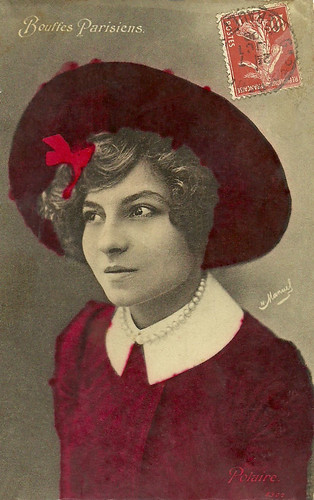
French postcard, no. 8307. Photo: H. Manuel. Publicity still for 'Claudine à Paris' (1902). Collection: Didier Hanson.

French postcard by Phototypie Pierre Coltman, Paris. Photo: Manuel. Polaire in 'Claudine à Paris'.

French postcard by Phototypie Pierre Coltman, Paris. Photo: Manuel. Polaire in 'Claudine à Paris'.
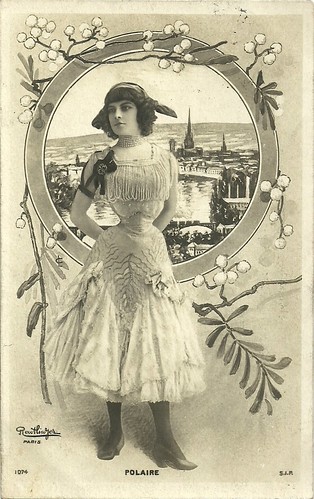
French postcard by S.I.R., no. 1074. Photo: Reutlinger, Paris.
Sources: Polaire - Un Etoile de la Belle Epoque (French - Now defunct), Du temps des cerises aux feuilles mortes (French), Wikipedia (English, French and Dutch), and IMDb.

No comments:
Post a Comment