Henry Stuart (1885-1948) was a Swiss actor, director and writer, who was very successful in the German silent cinema.

German postcard by Ross Verlag G.m.b.H., Berlin. Photo: Sofar-Film-Produktion. Henry Stuart, Agnes Eszterhazy, Ilka Grüning, Karl Etlinger and Robert Garrison in Die freudlose Gasse / The Joyless Street (Georg Wilhelm Pabst, 1925). Caption: Hotel Carlton.
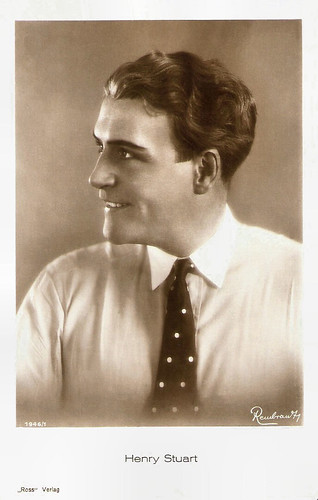
German postcard by Ross Verlag, no. 1946/1, 1927-1928. Photo: Rembrandt.
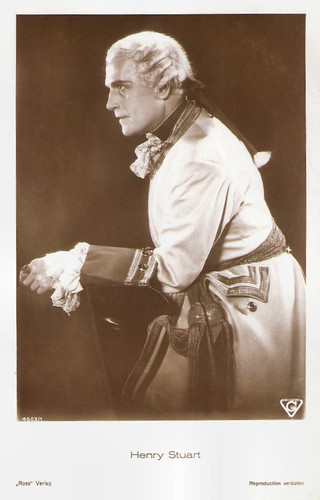
German postcard by Ross Verlag, no. 4503/1, 1929-1930. Photo: Photo: G [Greenbaum-Film]. Publicity still for Der Günstling von Schönbrunn / Favorite of Schönbrunn (Erich Waschneck, Max Reichmann, 1929).

Austrian postcard by Iris Verlag, no. 5111. Photo: Atelier Hanni Schwarz.
Henry Stuart was born as Court Henry Eduard Hess in Cairo, Egypt, in 1885. He was the son of the Swiss doctor Eduard Hess (1848–1923) and his wife Maria, née Ernst. His father had been working in Egypt since 1872 and was a board member of the International Hospital in Cairo. Shortly before the turn of the century, Henry Stuart came to Europe and began his studies in Paris and England.
He visited the Akademie der Bildenden Künste München (Academy of Fine Arts in Munich), planning to become a painter. Shortly before World War I broke out, he was in Vienna, where he established his first contacts in the film world. His budding film career was brought to a temporary halt due to the war. During the war, Stuart stayed in Britain, but afterwards he returned to Germany.
In 1922, he started his highly successful career as an actor in the German silent cinema. He often performed the role of a perfect gentleman and noble lover. Probably his first appearance was a small part in the elaborate costume drama Ein Glas Wasser / A Glass of Water (Ludwig Berger, 1922) set in England during the reign of Queen Anne (Mady Christians). According to Wikipedia, the film was very well received both commercially and critically on its release. The film, based on a play of the same title by Eugène Scribe, is considered one of the milestones of Weimar cinema.
It was followed by the fantasy Die Perrücke / The Wig (Berthold Viertel, 1924) in which he played the major part of Julian, the lover of a princess (Jenny Hasselqvist), whose husband (Otto Gebühr) tries to separate them.
In another classic Die freudlose Gasse / Joyless Street (G.W. Pabst, 1925), a morality tale set during the Viennese Depression, Stuart plays Egon Stirner, the secretary of an international speculator. He is arrested for the murder of a lawyer’s wife, but the culprit is the penniless Maria Lechner (Asta Nielsen). Maria is desperately in love with Stirner and has murdered the woman because she suspected her of being a rival. The film, which also features Greta Garbo in one of her first roles, was one of the first films of the 'Neue Sachlichkeit' (New Objectivity) movement.
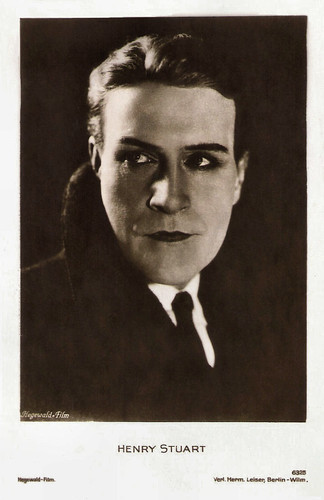
German postcard by Verlag Herm. Leiser, Berlin-Wilm., no. 6325. Photo: Hegewald-Film.
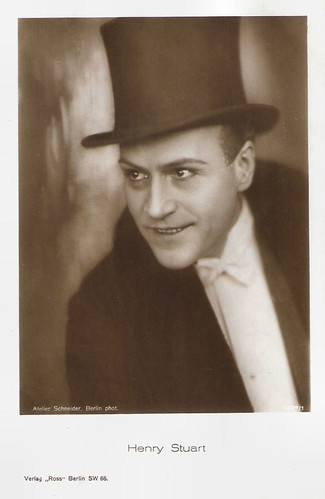
German postcard by Ross Verlag, Berlin, no. 1327/1, 1927-1928. Photo: Atelier Schneider, Berlin.
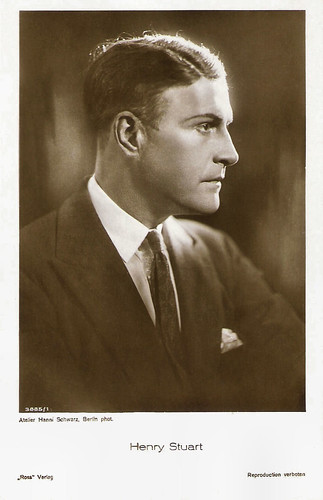
German postcard by Ross Verlag, no. 3885/1, 1928-1929. Photo: Atelier Hanni Schwarz, Berlin.
In the following years, Henry Suart starred in an impressive series of films. In 1925, he appeared in Die Strasse des Vergessens / The Street of Forgetting (Heinz Paul, 1925) with Hella Moja, and Das Abenteuer der Sybille Brant / The Adventures of Sybil Brent (Carl Froehlich, 1925) with Henny Porten.
The following year, he acted in such films as Unter Ausschluss der Öffentlichkeit / Under Exclusion of the Public (Conrad Wiene, 1926) with Maly Delschaft, Schenk mir das Leben / Give me the life (Klaus Fery, 1926), the war film Die versunkene Flotte / Wrath of the Seas (Graham Hewett, Manfred Noa, 1926) with Nils Asther, Die zwei und die Dame / The Two and the Lady (Alwin Neuss, 1926) with Agnes Esterhazy and Bernhard Goetzke, and Das Mädchen ohne Heimat / The Girl Without a Homeland (Constantin J. David, 1926).
In 1927 he appeared in Liebelei / Flirtation (Jakob & Luise Fleck, 1927) with Fred Louis Lerch and Evelyn Holt, Wenn Menschen reif zur Liebe werden / When People Become Ripe for Love (Jakob & Luise Fleck, 1927), Die geheime Macht / Sajenko the Soviet (Erich Waschneck, 1927) with Walter Rilla, Die Frau mit dem Weltrekord / The Woman with the World Record (Erich Waschneck, 1927) with Lee Parry, and Der Bettler vom Kölner Dom / The Beggar of the Cologne Cathedral (Rolf Randolf, 1927) with Hanni Weisse.
He starred opposite Brigitte Helm in Der Skandal in Baden-Baden / The Scandal in Baden-Baden (Erich Waschneck, 1928). That same year, Stuart went to India to stage the feature film Der Ring der Bajadere, as well as direct the documentaries Der Maharadscha von Mysore hat Geburtstag / The Birthday of the Maharadja of Mysore (Henry Stuart, 1929) and Nuri, der Elefant / Nuri, the Elephant (Henry Stuart, 1930).
Back in Germany, Stuart played his last roles in silent films: the industrialist Erwin Voss in Das Recht auf Liebe / The Right on Love (Jakob & Luise Fleck, 1929). The film addresses the issue of the rights of ex-soldiers made impotent by war wounds to get married. It was made in the Weimar tradition of the 'Aufklärungsfilme' (Enlightenment films). He also played Kaiser Franz in the part-talkie Der Günstling von Schönbrunn / The Favourite of Schonbrunn (1929), starring Iván Petrovich and Lil Dagover. The historical film was directed by Erich Waschneck, but Max Reichmann directed the sound sequences.
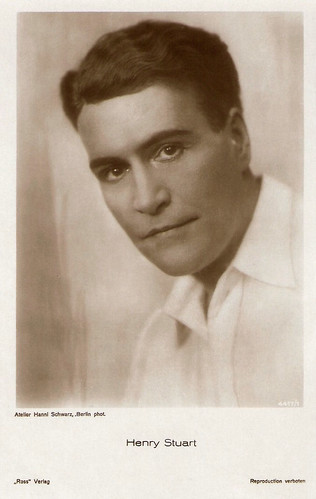
German postcard by Ross Verlag, no. 4417/1, 1929-1930. Photo: Atelier Hanni Schwarz, Berlin.
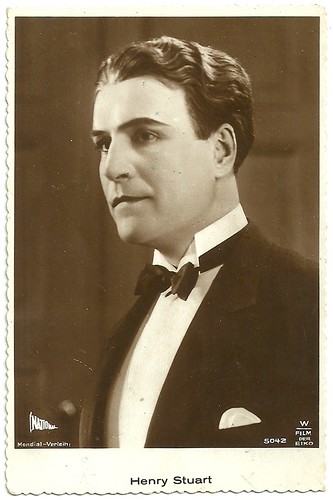
Austrian postcard, no. 5042. Photo: National / Mondial-Filmverleih / Eiko.
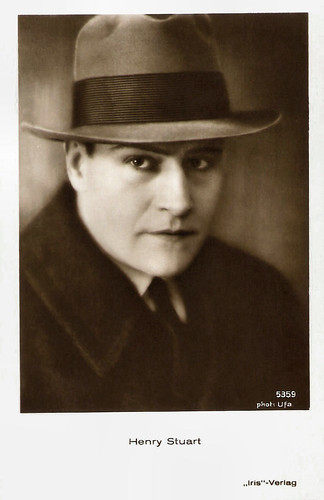
Austrian postcard by Iris Verlag, no. 5359. Photo: Ufa.
In the sound era, Henry Stuart didn’t find much work. In Berlin, he performed at the Englischen Theater Deutscher Schauspieler and worked for the radio as well as a manuscript and title translator. In 1933, he directed a short, Zwischen 12 und 2 / Between 12 and 2, based on the play 'Hotelratten' (Hotel Rats).
In 1938, he co-wrote the script for the Yiddish-American production 'The Power of Life'. He became a Swiss citizen, and in 1941, he released the only feature sound film directed by him: Krishna. Abenteuer im indischen Dschungel / Krishna, adventures in the Indian Jungle (1941), codirected and conscripted with Lola Kreuzberg, whose company had already produced Stuart’s films in India in 1928-1929. It probably was a sound version of Der Ring der Bajadere.
In 1942, Stuart played a British enemy in the Propaganda film Germanin (Max W. Kimmich, 1942), starring famous Austrian mountain climber Luis Trenker as a German doctor in Africa who discovers and proves the efficacy of a cure for sleeping sickness - a serum called `Germanin'. The film has strong anti-British undertones, and the history of the film is horrendous. In the summer of 1940, 4,000 black POWs were transferred to Stalag IIIA, a prisoner-of-war camp in Luckenwalde, Germany. Three hundred of these men, including African-Americans and French-speaking Africans, were forced to participate as extras in this Nazi film. Many of them were later exterminated by the Nazis.
His final film appearance was a small uncredited part, again as a British lord, in the all-star super-production Münchhausen / Baron Munchhausen (Josef von Baky, 1943) featuring Hans Albers. The Agfa colour epic was released after Stuart's death.
How, when and where exactly Henry Stuart died was unclear for a long time. His death year was indicated by several sources as 1942, but according to German Wikipedia, it was in 1948. Henry Stuart left Berlin in the 1940s and returned to his homeland, Switzerland. Last residing in Zurich, he died shortly before his 63rd birthday at Zollikerberg Hospital in Zollikon. His ashes were interred in the family grave in Bülach.
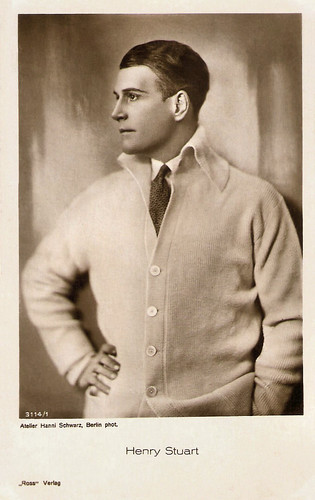
German postcard by Ross Verlag, no. 3114/1, 1928-1929. Photo: Atelier Hanni Schwarz, Berlin.
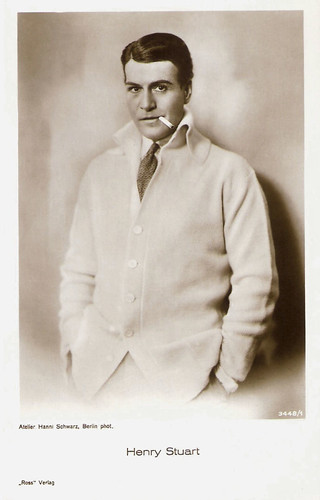
German postcard by Ross Verlag, no. 3448/1, 1928-1929. Photo: Atelier Hanni Schwarz, Berlin.
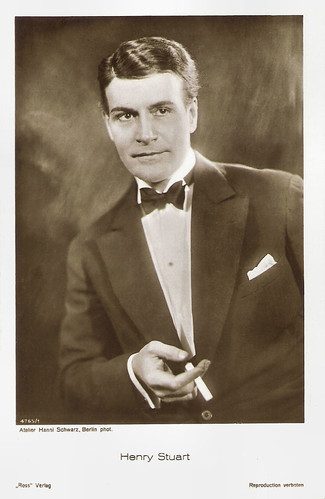
German postcard by Ross Verlag, no. 4765/1, 1929-1930. Photo: Atelier Hanni Schwarz, Berlin.
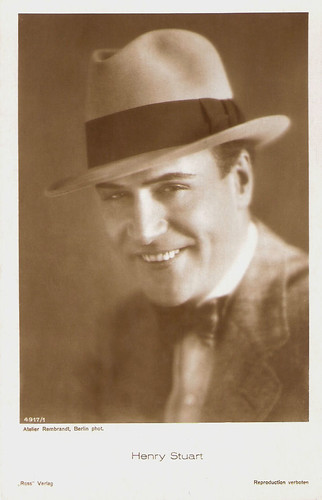
German postcard by Ross Verlag, no. 4917/1, 1929-1930. Photo: Atelier Rembrandt, Berlin.
Sources: Filmportal, Thomas Staedeli (Cyranos), Wikipedia (English and German) and IMDb.
German postcard by Ross Verlag G.m.b.H., Berlin. Photo: Sofar-Film-Produktion. Henry Stuart, Agnes Eszterhazy, Ilka Grüning, Karl Etlinger and Robert Garrison in Die freudlose Gasse / The Joyless Street (Georg Wilhelm Pabst, 1925). Caption: Hotel Carlton.
German postcard by Ross Verlag, no. 1946/1, 1927-1928. Photo: Rembrandt.
German postcard by Ross Verlag, no. 4503/1, 1929-1930. Photo: Photo: G [Greenbaum-Film]. Publicity still for Der Günstling von Schönbrunn / Favorite of Schönbrunn (Erich Waschneck, Max Reichmann, 1929).
Austrian postcard by Iris Verlag, no. 5111. Photo: Atelier Hanni Schwarz.
Perfect gentleman and noble lover
Henry Stuart was born as Court Henry Eduard Hess in Cairo, Egypt, in 1885. He was the son of the Swiss doctor Eduard Hess (1848–1923) and his wife Maria, née Ernst. His father had been working in Egypt since 1872 and was a board member of the International Hospital in Cairo. Shortly before the turn of the century, Henry Stuart came to Europe and began his studies in Paris and England.
He visited the Akademie der Bildenden Künste München (Academy of Fine Arts in Munich), planning to become a painter. Shortly before World War I broke out, he was in Vienna, where he established his first contacts in the film world. His budding film career was brought to a temporary halt due to the war. During the war, Stuart stayed in Britain, but afterwards he returned to Germany.
In 1922, he started his highly successful career as an actor in the German silent cinema. He often performed the role of a perfect gentleman and noble lover. Probably his first appearance was a small part in the elaborate costume drama Ein Glas Wasser / A Glass of Water (Ludwig Berger, 1922) set in England during the reign of Queen Anne (Mady Christians). According to Wikipedia, the film was very well received both commercially and critically on its release. The film, based on a play of the same title by Eugène Scribe, is considered one of the milestones of Weimar cinema.
It was followed by the fantasy Die Perrücke / The Wig (Berthold Viertel, 1924) in which he played the major part of Julian, the lover of a princess (Jenny Hasselqvist), whose husband (Otto Gebühr) tries to separate them.
In another classic Die freudlose Gasse / Joyless Street (G.W. Pabst, 1925), a morality tale set during the Viennese Depression, Stuart plays Egon Stirner, the secretary of an international speculator. He is arrested for the murder of a lawyer’s wife, but the culprit is the penniless Maria Lechner (Asta Nielsen). Maria is desperately in love with Stirner and has murdered the woman because she suspected her of being a rival. The film, which also features Greta Garbo in one of her first roles, was one of the first films of the 'Neue Sachlichkeit' (New Objectivity) movement.
German postcard by Verlag Herm. Leiser, Berlin-Wilm., no. 6325. Photo: Hegewald-Film.
German postcard by Ross Verlag, Berlin, no. 1327/1, 1927-1928. Photo: Atelier Schneider, Berlin.
German postcard by Ross Verlag, no. 3885/1, 1928-1929. Photo: Atelier Hanni Schwarz, Berlin.
India
In the following years, Henry Suart starred in an impressive series of films. In 1925, he appeared in Die Strasse des Vergessens / The Street of Forgetting (Heinz Paul, 1925) with Hella Moja, and Das Abenteuer der Sybille Brant / The Adventures of Sybil Brent (Carl Froehlich, 1925) with Henny Porten.
The following year, he acted in such films as Unter Ausschluss der Öffentlichkeit / Under Exclusion of the Public (Conrad Wiene, 1926) with Maly Delschaft, Schenk mir das Leben / Give me the life (Klaus Fery, 1926), the war film Die versunkene Flotte / Wrath of the Seas (Graham Hewett, Manfred Noa, 1926) with Nils Asther, Die zwei und die Dame / The Two and the Lady (Alwin Neuss, 1926) with Agnes Esterhazy and Bernhard Goetzke, and Das Mädchen ohne Heimat / The Girl Without a Homeland (Constantin J. David, 1926).
In 1927 he appeared in Liebelei / Flirtation (Jakob & Luise Fleck, 1927) with Fred Louis Lerch and Evelyn Holt, Wenn Menschen reif zur Liebe werden / When People Become Ripe for Love (Jakob & Luise Fleck, 1927), Die geheime Macht / Sajenko the Soviet (Erich Waschneck, 1927) with Walter Rilla, Die Frau mit dem Weltrekord / The Woman with the World Record (Erich Waschneck, 1927) with Lee Parry, and Der Bettler vom Kölner Dom / The Beggar of the Cologne Cathedral (Rolf Randolf, 1927) with Hanni Weisse.
He starred opposite Brigitte Helm in Der Skandal in Baden-Baden / The Scandal in Baden-Baden (Erich Waschneck, 1928). That same year, Stuart went to India to stage the feature film Der Ring der Bajadere, as well as direct the documentaries Der Maharadscha von Mysore hat Geburtstag / The Birthday of the Maharadja of Mysore (Henry Stuart, 1929) and Nuri, der Elefant / Nuri, the Elephant (Henry Stuart, 1930).
Back in Germany, Stuart played his last roles in silent films: the industrialist Erwin Voss in Das Recht auf Liebe / The Right on Love (Jakob & Luise Fleck, 1929). The film addresses the issue of the rights of ex-soldiers made impotent by war wounds to get married. It was made in the Weimar tradition of the 'Aufklärungsfilme' (Enlightenment films). He also played Kaiser Franz in the part-talkie Der Günstling von Schönbrunn / The Favourite of Schonbrunn (1929), starring Iván Petrovich and Lil Dagover. The historical film was directed by Erich Waschneck, but Max Reichmann directed the sound sequences.
German postcard by Ross Verlag, no. 4417/1, 1929-1930. Photo: Atelier Hanni Schwarz, Berlin.
Austrian postcard, no. 5042. Photo: National / Mondial-Filmverleih / Eiko.
Austrian postcard by Iris Verlag, no. 5359. Photo: Ufa.
All-star-super-production
In the sound era, Henry Stuart didn’t find much work. In Berlin, he performed at the Englischen Theater Deutscher Schauspieler and worked for the radio as well as a manuscript and title translator. In 1933, he directed a short, Zwischen 12 und 2 / Between 12 and 2, based on the play 'Hotelratten' (Hotel Rats).
In 1938, he co-wrote the script for the Yiddish-American production 'The Power of Life'. He became a Swiss citizen, and in 1941, he released the only feature sound film directed by him: Krishna. Abenteuer im indischen Dschungel / Krishna, adventures in the Indian Jungle (1941), codirected and conscripted with Lola Kreuzberg, whose company had already produced Stuart’s films in India in 1928-1929. It probably was a sound version of Der Ring der Bajadere.
In 1942, Stuart played a British enemy in the Propaganda film Germanin (Max W. Kimmich, 1942), starring famous Austrian mountain climber Luis Trenker as a German doctor in Africa who discovers and proves the efficacy of a cure for sleeping sickness - a serum called `Germanin'. The film has strong anti-British undertones, and the history of the film is horrendous. In the summer of 1940, 4,000 black POWs were transferred to Stalag IIIA, a prisoner-of-war camp in Luckenwalde, Germany. Three hundred of these men, including African-Americans and French-speaking Africans, were forced to participate as extras in this Nazi film. Many of them were later exterminated by the Nazis.
His final film appearance was a small uncredited part, again as a British lord, in the all-star super-production Münchhausen / Baron Munchhausen (Josef von Baky, 1943) featuring Hans Albers. The Agfa colour epic was released after Stuart's death.
How, when and where exactly Henry Stuart died was unclear for a long time. His death year was indicated by several sources as 1942, but according to German Wikipedia, it was in 1948. Henry Stuart left Berlin in the 1940s and returned to his homeland, Switzerland. Last residing in Zurich, he died shortly before his 63rd birthday at Zollikerberg Hospital in Zollikon. His ashes were interred in the family grave in Bülach.
German postcard by Ross Verlag, no. 3114/1, 1928-1929. Photo: Atelier Hanni Schwarz, Berlin.
German postcard by Ross Verlag, no. 3448/1, 1928-1929. Photo: Atelier Hanni Schwarz, Berlin.
German postcard by Ross Verlag, no. 4765/1, 1929-1930. Photo: Atelier Hanni Schwarz, Berlin.
German postcard by Ross Verlag, no. 4917/1, 1929-1930. Photo: Atelier Rembrandt, Berlin.
Sources: Filmportal, Thomas Staedeli (Cyranos), Wikipedia (English and German) and IMDb.

No comments:
Post a Comment