We are in Bologna for Il Cinema Ritrovato 2026. Molly Haskell curated this section on American actress, model and dancer Barbara Stanwyck (1907-1990), a versatile professional with a strong, realistic screen presence. By 1944, Stanwyck had become the highest-paid woman in the United States. After a short but notable career as a stage actress in the late 1920s, she made 85 films in 38 years in Hollywood before turning to television. She was a favourite of her directors, including Cecil B. DeMille, Fritz Lang, and Frank Capra. Scheduled in Bologna are several classics including Capra's Ladies of Leisure (1930), King Vidor's Stella Dallas (1937), Preston Sturges' The Lady Eve (1941) and Billy Wilder's Double Indemnity (1944).

French postcard by Editions P.I., offered by Victoria S.A. (Biscuits, Chocolates and Patisserie), Brussels. Photo: Paramount Pictures, 1950. Barbara Stanwyck in Double Indemnity (Billy Wilder, 1944).

British Real Photograph postcard, London, no. FS 120. Photo: 20th Century Fox. Robert Taylor and Barbara Stanwyck in His Affair (William A. Seiter, 1937).

Italian postcard by B.F.F. Edit., no. 2011. Photo: Paramount Films.

Italian postcard by B.F.F. Edit., no. 2113. Photo: Warner Bros.
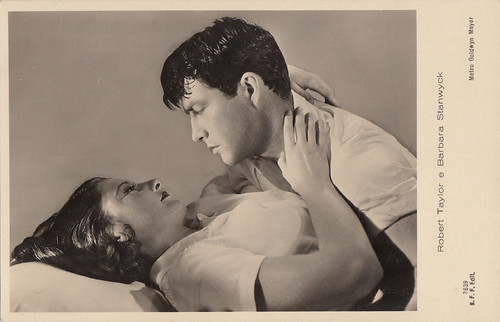
Italian postcard by B.F.F. Edit., no. 2639. Photo: Metro-Goldwyn-Mayer. Collection: Marlene Pilaete.

Italian postcard by B.F.F. Edit., no. 3840. Photo: Metro-Goldwyn-Mayer. Barbara Stanwyck and Robert Taylor in His Brother's Wife (W.S. Van Dyke, 1936). Collection: Marlene Pilaete.

Italian postcard by B.F.F. Edit., no. 8610. Photo: Paramount Films.
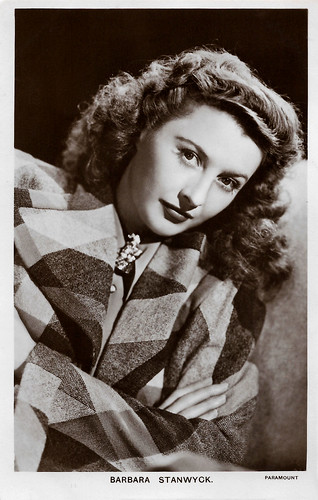
British postcard in the Picturegoer Series, no. W 68. Photo: Paramount.
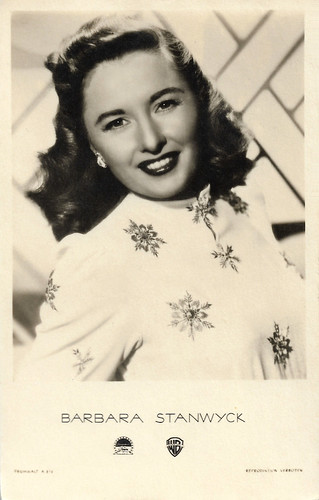
German postcard, no. 87. Photo: Paramount / Warner Bros.

French postcard by Editions P.I., no. 323. Photo: Metro-Goldwyn-Mayer (MGM), 1953.
Barbara Stanwyck was born Ruby Catherine Stevens in 1907 in Brooklyn, New York. She was the daughter of Catherine Ann (McPhee) and Byron E. Stevens, a bricklayer. Her mother died of complications from a miscarriage after she was accidentally knocked off a trolley by a drunk. Two weeks after the funeral, her father, Byron Stevens, joined a work crew digging the Panama Canal and was never seen again. Barbara was brought up by her elder sister, Mildred and was partially raised in foster homes. Ruby toured with Mildred during the summers of 1916 and 1917, and practised her sister's routines backstage.
At the age of 14, she dropped out of school to take a job wrapping packages at a department store in Brooklyn. Later, she went to work at the local telephone company, but she had the urge to enter show business. In 1923, a few months before her 16th birthday, Ruby auditioned for a place in the chorus at the Strand Roof, a nightclub over the Strand Theatre in Times Square. A few months later, she obtained a job as a dancer in the 1922 and 1923 seasons of the Ziegfeld Follies, dancing at the New Amsterdam Theatre.
In 1926, she played a chorus girl in the play 'The Noose'. It became one of the most successful plays of the season, running on Broadway for nine months and 197 performances. Ruby changed her name to Barbara Stanwyck by combining the first name of her character, Barbara Frietchie, with the last name of another actress in the play, Jane Stanwyck. Stanwyck became a Broadway star soon afterwards, when she was cast in her first leading role in 'Burlesque' (1927). She received rave reviews, and it was a huge hit. The producer had great plans for her, but the Hollywood offers kept coming.
In 1928, Barbara moved to Hollywood. Stanwyck's first sound film was The Locked Door (George Fitzmaurice, 1929) opposite Rod La Rocque, followed by Mexicali Rose (Erle C. Kenton, 1929). Neither film was successful. Nonetheless, Frank Capra chose Stanwyck for his romantic drama Ladies of Leisure (Frank Capra, 1930) with Ralph Graves, and it established an enduring friendship with the director. He would often choose her to be the star of his films.
Barbara Stanwyck soon proved to be an extremely versatile actress who could adapt to any role. She was equally at home in all genres, from melodramas, such as Forbidden (Frank Capra, 1932) and Stella Dallas (King Vidor, 1937), to thrillers, such as Double Indemnity (Billy Wilder, 1944), also starring Fred MacMurray. She was the ambitious woman sleeping her way to the top from 'the wrong side of the tracks' in Baby Face (Alfred E. Green, 1933), a pre-code classic. She also excelled in comedies such as Remember the Night (Mitchell Leisen, 1940) and The Lady Eve (Preston Sturges, 1941) opposite Henry Fonda, and in Westerns, such as Union Pacific (Cecil B. DeMille, 1939) with Joel McCrea.

Italian postcard by S.A. Arte della Stampa, Roma. Photo: Columbia. Barbara Stanwyck and Nils Asther in The Bitter Tea of General Yen (Frank Capra, 1932). Caption: In war, just like in love, you need to be feared... hated...

Vintage promotion card for Lux Toilet Soap. Collection: Marlene Pilaete.
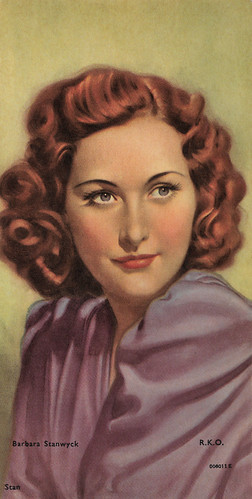
American postcard by Lux Soap, no. 008011E. Photo: R.K.O. Caption: Barbara Stanwyck, R.K.O. Star says: "Lux Toilet Soap's active lather leaves skin deliciously fragrant. It's the best way I know to protect daintiness!"

Italian postcard by Rizzoli & C., Milano, 1936. Photo: 20th Century Fox.
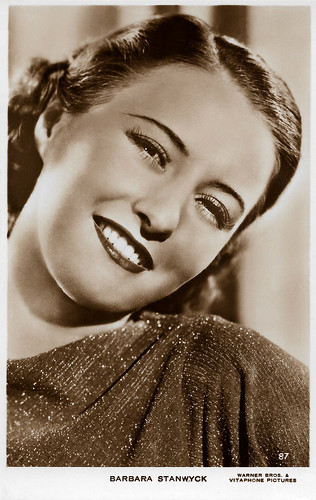
British postcard by Milton, no. 87. Photo: Warner Bros & Vitaphone Pictures.
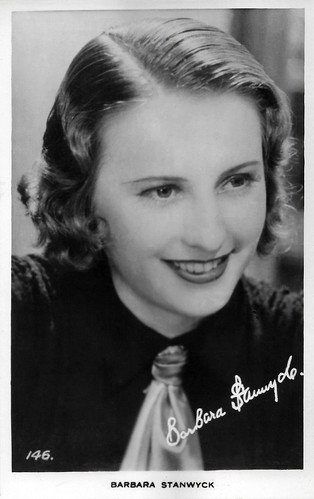
British postcard by Valentine & Sons LTD., Dundee and London, no. 146.
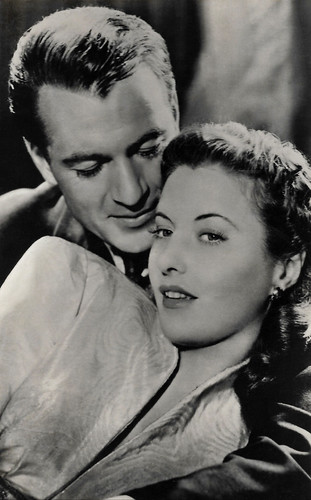
Spanish postcard by SOBE, no. 499. Sent by mail in 1949. Photo: Barbara Stanwyck and Gary Cooper in Meet John Doe (Frank Capra, 1941).

French postcard by E.C., Rueil Malmaison, no. 543. Photo: Metro-Goldwyn-Mayer.

Belgian collector card by Kwatta, Bois d'Haine, no. C. 107. Photo: Metro-Goldwyn-Mayer (M.G.M.). Barbara Stanwyck in B.F.'s Daughter (Robert Z. Leonard, 1948).

Belgian collector card by Kwatta, Bois D 'Haine, no. C. 155. Photo: M.G.M. Richard Hart and Barbara Stanwyck in B.F.'s Daughter (Robert Z. Leonard, 1948).
Barbara Stanwyck was also well known for her TV roles as Victoria, the matriarch of the Barkley family in the Western series The Big Valley (1965). In 1983, she also played in the hit mini-series The Thorn Birds (1983), which did much to keep her in the public eye. She turned in an outstanding performance as Mary Carson. One of her last roles was in the hit drama series The Colbys (1985).
Barbara Stanwyck died in 1990 in Santa Monica, California. On the Cinema Ritrovato site, Molly Haskell writes: "Her ability to connect directly with an audience begins with the voice – lush, weary, tender, worldly, skeptical, ranging nimbly between hard and soft. It could be metallic, mannish and brittle or gentle as a down pillow, sometimes within the same film, as befits an actress who was at ease in every genre, from woman’s melodrama to the western, with noir and screwball comedy in between. More iconoclast than icon, more a character star on the order of Bogie or Cagney, she was neither a great beauty nor a glamour puss. The importance of this – her refusal or inability to be simplified into a single image – has to be seen as a major factor in her longevity. If she was underappreciated in her time, her minimalist gifts – the fluid movement, the stillness in repose, the sense of interiority – have come to seem ultramodern. A cross-genre retrospective will showcase the many facets of this iconoclast."
She was 82 and left 93 films and a host of TV appearances as her legacy. She was nominated for the Academy Award for Best Actress four times, for Stella Dallas (King Vidor, 1937), Ball of Fire (Howard Hawks, 1941), Double Indemnity (Billy Wilder, 1944) and Sorry, Wrong Number (Anatole Litvak, 1948).For her television work, she won three Emmy Awards, for The Barbara Stanwyck Show (1961), The Big Valley (1966) and The Thorn Birds (1983). Her performance in The Thorn Birds also won her a Golden Globe. She received an Honorary Oscar at the 1982 Academy Award ceremony and the Golden Globe Cecil B. DeMille Award in 1986. She was also the recipient of honorary lifetime awards from the American Film Institute (1987), the Film Society of Lincoln Centre (1986), the Los Angeles Film Critics Association (1981) and the Screen Actors Guild (1967).
Barbara Stanwyck was married twice, to film actors Frank Fay (1928-1935) and Robert Taylor (1939-1952). Her son, Dion Anthony 'Tony' Fay (1932), was adopted. Frank Fay and Stanwyck's marriage and their experience in Hollywood are said to be the basis of the Hollywood film A Star is Born (William A. Wellman, 1937). The womanising, alcoholic Fay's career floundered, while Stanwyck's flourished for decades. Their stormy marriage finally ended after a drunken brawl, during which he tossed their adopted son, Dion, into the swimming pool.
There were rumours of affairs with Marlene Dietrich and Joan Crawford, but Stanwyck wed Robert Taylor, who had gay rumours of his own to dispel. Their marriage started off on a sour note when his possessive mother demanded he spend his wedding night with her rather than with Barbara. In 1957, Tony, her adopted son, was arrested for trying to sell lewd pictures while waiting to cash his unemployment check. When questioned by the press about his famous mother, he replied, "We don't speak." They became permanently estranged in February 1951, when he was 19 years old. The rift never healed. She saw him only a few times after his childhood. He was reportedly bequeathed some money from Stanwyck's estate on condition he never speak publicly about her.
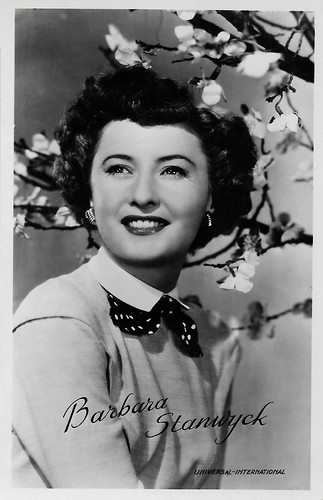
Dutch postcard, no. X 3216. Photo: Universal International.

Dutch postcard by S & v. H., A. Photo: M.P.E.A.

Dutch postcard, no. 3362. Photo: MGM.

Dutch postcard by PEB. Sent by mail in 1950.

American postcard by Godfrey Herbert, The World Explorer, 1941. Photo: Paramount.
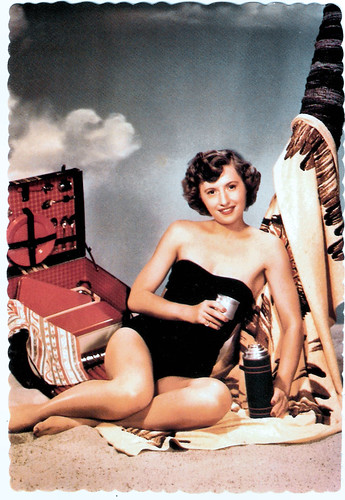
Canadian postcard by Fan Club Post Card, no. PC9.

Belgian collector card by Kwatta, Bois d'Haine, no. C. 312. Photo: M.G.M. Barbara Stanwyck and Van Heflin in East Side, West Side (Mervyn LeRoy, 1949).

Vintage collector card. Photo: Paramount.

American postcard by Coral-Lee, Rancho Cordova, CA, no. SC17489. Photo: Tony Koroda / 1981 Sygma. Ronald Reagan and Barbara Stanwyck in Cattle Queen of Montana (Allan Dwan, 1954).

German postcard by Anco, no. 1/77. Photo: Four Star Margate. Barbara Stanwyck as Victoria Barkley in the TV series The Big Valley (1965).

German postcard by Anco, no. 1/77. Photo: Four Star Margate. Barbara Stanwyck as Victoria Barkley, Linda Evans, Lee Majors, Richard Long and Peter Breck in the TV series The Big Valley (1965). Caption: Familie Barkley (Barkley Family).
Sources: Denny Jackson (IMDb), Wikipedia and IMDb.
French postcard by Editions P.I., offered by Victoria S.A. (Biscuits, Chocolates and Patisserie), Brussels. Photo: Paramount Pictures, 1950. Barbara Stanwyck in Double Indemnity (Billy Wilder, 1944).
British Real Photograph postcard, London, no. FS 120. Photo: 20th Century Fox. Robert Taylor and Barbara Stanwyck in His Affair (William A. Seiter, 1937).
Italian postcard by B.F.F. Edit., no. 2011. Photo: Paramount Films.
Italian postcard by B.F.F. Edit., no. 2113. Photo: Warner Bros.
Italian postcard by B.F.F. Edit., no. 2639. Photo: Metro-Goldwyn-Mayer. Collection: Marlene Pilaete.
Italian postcard by B.F.F. Edit., no. 3840. Photo: Metro-Goldwyn-Mayer. Barbara Stanwyck and Robert Taylor in His Brother's Wife (W.S. Van Dyke, 1936). Collection: Marlene Pilaete.
Italian postcard by B.F.F. Edit., no. 8610. Photo: Paramount Films.
British postcard in the Picturegoer Series, no. W 68. Photo: Paramount.
German postcard, no. 87. Photo: Paramount / Warner Bros.
French postcard by Editions P.I., no. 323. Photo: Metro-Goldwyn-Mayer (MGM), 1953.
An extremely versatile actress who could adapt to any role
Barbara Stanwyck was born Ruby Catherine Stevens in 1907 in Brooklyn, New York. She was the daughter of Catherine Ann (McPhee) and Byron E. Stevens, a bricklayer. Her mother died of complications from a miscarriage after she was accidentally knocked off a trolley by a drunk. Two weeks after the funeral, her father, Byron Stevens, joined a work crew digging the Panama Canal and was never seen again. Barbara was brought up by her elder sister, Mildred and was partially raised in foster homes. Ruby toured with Mildred during the summers of 1916 and 1917, and practised her sister's routines backstage.
At the age of 14, she dropped out of school to take a job wrapping packages at a department store in Brooklyn. Later, she went to work at the local telephone company, but she had the urge to enter show business. In 1923, a few months before her 16th birthday, Ruby auditioned for a place in the chorus at the Strand Roof, a nightclub over the Strand Theatre in Times Square. A few months later, she obtained a job as a dancer in the 1922 and 1923 seasons of the Ziegfeld Follies, dancing at the New Amsterdam Theatre.
In 1926, she played a chorus girl in the play 'The Noose'. It became one of the most successful plays of the season, running on Broadway for nine months and 197 performances. Ruby changed her name to Barbara Stanwyck by combining the first name of her character, Barbara Frietchie, with the last name of another actress in the play, Jane Stanwyck. Stanwyck became a Broadway star soon afterwards, when she was cast in her first leading role in 'Burlesque' (1927). She received rave reviews, and it was a huge hit. The producer had great plans for her, but the Hollywood offers kept coming.
In 1928, Barbara moved to Hollywood. Stanwyck's first sound film was The Locked Door (George Fitzmaurice, 1929) opposite Rod La Rocque, followed by Mexicali Rose (Erle C. Kenton, 1929). Neither film was successful. Nonetheless, Frank Capra chose Stanwyck for his romantic drama Ladies of Leisure (Frank Capra, 1930) with Ralph Graves, and it established an enduring friendship with the director. He would often choose her to be the star of his films.
Barbara Stanwyck soon proved to be an extremely versatile actress who could adapt to any role. She was equally at home in all genres, from melodramas, such as Forbidden (Frank Capra, 1932) and Stella Dallas (King Vidor, 1937), to thrillers, such as Double Indemnity (Billy Wilder, 1944), also starring Fred MacMurray. She was the ambitious woman sleeping her way to the top from 'the wrong side of the tracks' in Baby Face (Alfred E. Green, 1933), a pre-code classic. She also excelled in comedies such as Remember the Night (Mitchell Leisen, 1940) and The Lady Eve (Preston Sturges, 1941) opposite Henry Fonda, and in Westerns, such as Union Pacific (Cecil B. DeMille, 1939) with Joel McCrea.
Italian postcard by S.A. Arte della Stampa, Roma. Photo: Columbia. Barbara Stanwyck and Nils Asther in The Bitter Tea of General Yen (Frank Capra, 1932). Caption: In war, just like in love, you need to be feared... hated...
Vintage promotion card for Lux Toilet Soap. Collection: Marlene Pilaete.
American postcard by Lux Soap, no. 008011E. Photo: R.K.O. Caption: Barbara Stanwyck, R.K.O. Star says: "Lux Toilet Soap's active lather leaves skin deliciously fragrant. It's the best way I know to protect daintiness!"
Italian postcard by Rizzoli & C., Milano, 1936. Photo: 20th Century Fox.
British postcard by Milton, no. 87. Photo: Warner Bros & Vitaphone Pictures.
British postcard by Valentine & Sons LTD., Dundee and London, no. 146.
Spanish postcard by SOBE, no. 499. Sent by mail in 1949. Photo: Barbara Stanwyck and Gary Cooper in Meet John Doe (Frank Capra, 1941).
French postcard by E.C., Rueil Malmaison, no. 543. Photo: Metro-Goldwyn-Mayer.
Belgian collector card by Kwatta, Bois d'Haine, no. C. 107. Photo: Metro-Goldwyn-Mayer (M.G.M.). Barbara Stanwyck in B.F.'s Daughter (Robert Z. Leonard, 1948).
Belgian collector card by Kwatta, Bois D 'Haine, no. C. 155. Photo: M.G.M. Richard Hart and Barbara Stanwyck in B.F.'s Daughter (Robert Z. Leonard, 1948).
A stormy marriage and gay rumours
Barbara Stanwyck was also well known for her TV roles as Victoria, the matriarch of the Barkley family in the Western series The Big Valley (1965). In 1983, she also played in the hit mini-series The Thorn Birds (1983), which did much to keep her in the public eye. She turned in an outstanding performance as Mary Carson. One of her last roles was in the hit drama series The Colbys (1985).
Barbara Stanwyck died in 1990 in Santa Monica, California. On the Cinema Ritrovato site, Molly Haskell writes: "Her ability to connect directly with an audience begins with the voice – lush, weary, tender, worldly, skeptical, ranging nimbly between hard and soft. It could be metallic, mannish and brittle or gentle as a down pillow, sometimes within the same film, as befits an actress who was at ease in every genre, from woman’s melodrama to the western, with noir and screwball comedy in between. More iconoclast than icon, more a character star on the order of Bogie or Cagney, she was neither a great beauty nor a glamour puss. The importance of this – her refusal or inability to be simplified into a single image – has to be seen as a major factor in her longevity. If she was underappreciated in her time, her minimalist gifts – the fluid movement, the stillness in repose, the sense of interiority – have come to seem ultramodern. A cross-genre retrospective will showcase the many facets of this iconoclast."
She was 82 and left 93 films and a host of TV appearances as her legacy. She was nominated for the Academy Award for Best Actress four times, for Stella Dallas (King Vidor, 1937), Ball of Fire (Howard Hawks, 1941), Double Indemnity (Billy Wilder, 1944) and Sorry, Wrong Number (Anatole Litvak, 1948).For her television work, she won three Emmy Awards, for The Barbara Stanwyck Show (1961), The Big Valley (1966) and The Thorn Birds (1983). Her performance in The Thorn Birds also won her a Golden Globe. She received an Honorary Oscar at the 1982 Academy Award ceremony and the Golden Globe Cecil B. DeMille Award in 1986. She was also the recipient of honorary lifetime awards from the American Film Institute (1987), the Film Society of Lincoln Centre (1986), the Los Angeles Film Critics Association (1981) and the Screen Actors Guild (1967).
Barbara Stanwyck was married twice, to film actors Frank Fay (1928-1935) and Robert Taylor (1939-1952). Her son, Dion Anthony 'Tony' Fay (1932), was adopted. Frank Fay and Stanwyck's marriage and their experience in Hollywood are said to be the basis of the Hollywood film A Star is Born (William A. Wellman, 1937). The womanising, alcoholic Fay's career floundered, while Stanwyck's flourished for decades. Their stormy marriage finally ended after a drunken brawl, during which he tossed their adopted son, Dion, into the swimming pool.
There were rumours of affairs with Marlene Dietrich and Joan Crawford, but Stanwyck wed Robert Taylor, who had gay rumours of his own to dispel. Their marriage started off on a sour note when his possessive mother demanded he spend his wedding night with her rather than with Barbara. In 1957, Tony, her adopted son, was arrested for trying to sell lewd pictures while waiting to cash his unemployment check. When questioned by the press about his famous mother, he replied, "We don't speak." They became permanently estranged in February 1951, when he was 19 years old. The rift never healed. She saw him only a few times after his childhood. He was reportedly bequeathed some money from Stanwyck's estate on condition he never speak publicly about her.
Dutch postcard, no. X 3216. Photo: Universal International.
Dutch postcard by S & v. H., A. Photo: M.P.E.A.
Dutch postcard, no. 3362. Photo: MGM.
Dutch postcard by PEB. Sent by mail in 1950.
American postcard by Godfrey Herbert, The World Explorer, 1941. Photo: Paramount.
Canadian postcard by Fan Club Post Card, no. PC9.
Belgian collector card by Kwatta, Bois d'Haine, no. C. 312. Photo: M.G.M. Barbara Stanwyck and Van Heflin in East Side, West Side (Mervyn LeRoy, 1949).
Vintage collector card. Photo: Paramount.
American postcard by Coral-Lee, Rancho Cordova, CA, no. SC17489. Photo: Tony Koroda / 1981 Sygma. Ronald Reagan and Barbara Stanwyck in Cattle Queen of Montana (Allan Dwan, 1954).
German postcard by Anco, no. 1/77. Photo: Four Star Margate. Barbara Stanwyck as Victoria Barkley in the TV series The Big Valley (1965).
German postcard by Anco, no. 1/77. Photo: Four Star Margate. Barbara Stanwyck as Victoria Barkley, Linda Evans, Lee Majors, Richard Long and Peter Breck in the TV series The Big Valley (1965). Caption: Familie Barkley (Barkley Family).
Sources: Denny Jackson (IMDb), Wikipedia and IMDb.

No comments:
Post a Comment