
German postcard by EAS (E. A. Schwerdtfeger, Berlin), no. 871.

German postcard by EAS (E. A. Schwerdtfeger, Berlin), no. 935.

German postcard by EAS (E. A. Schwerdtfeger, Berlin), no. 1001.
Drawing international attention
Emmy Wehlen was born Emily Wehlen in Mannheim, Germany, in 1887. She received her musical training at the Mannheim Conservatory as a teenager, preparing her for a future in performance.
Her early stage career flourished in German musical theatre, with roles in Stuttgart, Munich, and Berlin with the Thalia-Theater company. Here, she performed alongside the humorist Arnold Rieck. She also recorded the song 'Ohne Männer' (Without Men), a duet from the operetta 'Doktor Klapperstorch', with Rieck.
Her talent soon drew international attention, leading to an invitation to London as a potential successor to the celebrated actress Lily Elsie. In 1909, Wehlen made a significant impact at Daly's Theatre, starring as Sonia in 'The Merry Widow', an English version of Franz Lehár's operetta 'Die lustige Witwe'.
That same year, she played Olga in the hit musical 'The Dollar Princess', an English version of Leo Fall's operetta 'Die Dollarprinzessin', which enjoyed an impressive run of 428 performances. It solidified her status as a notable West End performer.
Her success crossed the Atlantic, and by 1911, she was on Broadway, appearing in shows like 'Marriage a la Carte' and the Ziegfeld production 'A Winsome Widow', alongside Mae West. Critics praised her as "very pretty, very graceful" with a "distinctly pleasant voice" and an "indescribable charm of personality" that endeared her to audiences. Her final Broadway performance came during the 1914/1915 season in 'To-Night's the Night'.

British postcard by Beagles' Postcards, no. 280F. Emmy Wehlen in the operetta 'The Dollar Princess' (Die Dollarprinzessin) by Leo Fall.

British postcard by Rotary Photo, no. 6915 H. Photo: Foulsham & Banfield LTD. Emmy Wehlen as Winifred and George Grossmith as Max Daly in 'The Girl on the Film'. 'The Girl on the Film' is a Musical Farce in Three Acts with a book by James T. Tanner based on the original German musical comedy 'Filmzauber' by Rudolf Bernauer and Rudolf Schanzer. It has music by Walter Kollo, Willy Bredschneider and Albert Sirmay and lyrics by Adrian Ross. It opened at the Gaiety Theatre, London, on 5 April 1913, where it ran for 232 performances.
Leading roles in 18 films
Shortly after her last Broadway show, Emmy Wehlen shifted her focus from the stage to the burgeoning world of American silent films, appearing in over twenty films between 1915 and 1920.
She quickly established herself as a leading lady, primarily working for the Metro Pictures Corporation. Her film debut was in When a Woman Loves (Robert G. Vignola, 1915). This was followed by a string of roles in films such as Her Reckoning (Robert G. Vignola, 1915), The Pretenders (George D. Baker, 1916), and Vanity (John B. O'Brien, 1916).
Wehlen remained prolific throughout the late 1910s, with notable appearances in Sowers and Reapers (George D. Baker, 1917) opposite Harry Davenport, The Trail of the Shadow (Donald Crisp, 1917), Miss Robinson Crusoe (Christy Cabanne, 1917), and The Duchess of Doubt (George D. Baker, 1917).
Other significant films included His Bonded Wife (Henri Diamant-Berger, 1918), Sylvia on a Spree (Harry L. Franklin, 1918), alongside Joseph Sweeney and The Amateur Adventuress (Henry S. North, 1919) with Eugene Pallette. Her final film role was as Vania in Lifting Shadows (Léonce Perret, 1920). She had appeared in 18 films, mostly in leading roles.
After her last film, she returned to the operetta stage, but ended her career after a few years. She disappeared from the public eye while still in her early thirties. Emmy Wehlen lived a long life and passed away in 1977. Only three Wehlen films are known to have survived, and none of these have been re-released in any format to the public.
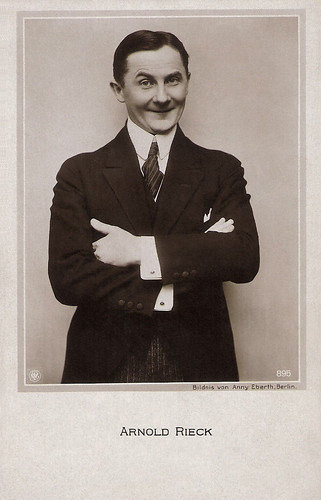
German postcard by NPG, no. 895. Photo: Anny Eberth, Berlin. German humorist, couplet singer, and actor Arnold Rieck (1876-1924) was a forerunner of the stand-up comedians of today. He was also one of the first stage actors who started to perform in films.

German postcard by NPG, no 896. Photo: Anny Eberth, Berlin.
Sources: Wikipedia (German and English) and IMDb.

No comments:
Post a Comment