
French postcard by A.N., Paris, no. 360. Photo: Paramount.

British postcard in the "Pictures" Portrait Gallery by Pictures Ltd, London, no. 136.

Swedish postcard by Förlag Nordisk Konst, Stockholm, no. 1153.

British postcard by Beagles in the 'Famous Cinema Star' series, no. 114.A.

Italian postcard by G. Vettori, Bologna, no. 154. Photo: Paramount Pictures. Thomas Meighan and Leatrice Joy in The Man Who Saw Tomorrow (Alfred E. Green, 1922).
Nearly eighty silent films
Thomas Meighan was born in 1879 to John and Mary Meighan in Pittsburgh, Pennsylvania. His father was the president of Pittsburgh Facing Mills, a major manufacturing company, and his family was well-off. Meighan's parents encouraged him to go to college, but he refused. At the age of 15, his father sent him to work shovelling coal in an effort to instil a sense of discipline and a strong work ethic. After his experience with manual labour, he attended Mount St. Mary's College to study pharmacology. After three years of study, Meighan decided he wished to pursue acting. This decision ultimately resulted in a career in both theatre and the emerging film industry.
Meighan became a juvenile player in the Pittsburgh Stock Company, headed by Henrietta Crosman. In 1900, he began his acting career on Broadway in New York. Between 1900 and 1912, he acted in six plays, among which two were with John Barrymore and Lucile Watson. His breakthrough role came in 1908 when he appeared with William Collier Sr. in 'The Dictator'. This play was followed by a leading role in 'The College Widow', which had a successful run on Broadway in the 1907–1908 season. During this run, he met his wife, Frances Ring. Though he became a well-known film star from the late 1910s on, he remained devoted to the stage.
Thomas Meighan made his film debut in a short British film with Gladys Cooper. His first film was titled Dandy Donovan, the Gentleman Cracksman. The film was shot in London during his performances at a theatre in England in 1914. Gary Brumburgh at IMDb: "Having developed a highly respected name for himself on Broadway right after the turn of the century, he decided, at the age of 36, to give up the stage to pursue the still-floundering medium of movie-making. It was a wise and prosperous move."
In 1915, the Famous Players-Lasky Corporation gave Meighan a contract, and the American studio produced most of his films. Till 1928, Meighan contributed to nearly eighty silent films. His first American film was The Fighting Hope (George Melford, 1915) with Laura Hope Crews. During the next two years, Meighan's career took off. In 1918, he made a propaganda film for World War I, titled Norma Talmadge and Thomas Meighan in a Liberty Loan Appeal. He then played opposite Mary Pickford in M'Liss (Marshall Neilan, 1918).
Thomas Meighan achieved stardom in 1919. He had his breakthrough with The Miracle Man (George Loane Tucker, 1915). He played Tom Burke, a notorious con-man, who tries one last scheme, a faith-healing scam, before going clean. The film co-starred Betty Compson and Lon Chaney. Initially produced for $126,000, the film grossed $1,000,000 in theatrical rentals and became the second-highest-grossing film of 1919. The Miracle Man is now believed to be lost except for brief clips. From then on, Meighan commanded a salary of $5,000 per week for much of his career. At one point, it reached $10,000 per week.

Spanish postcard by La Novela Semanal Cinematografica, no. 72.

Spanish collector card in the Collecciones Amatller Series, Series M, artist 17, no. 48, by Chocolate Amatller. Thomas Meighan and the Spanish writer Vicente Blasco Ibáñez. The latter was the author of 'The Four Horsemen of the Apocalypse', 'Mare Nostrum', 'The Torrent', 'The Temptress', and 'Blood and Sand', all filmed in Hollywood in the 1920s, even if not with Meighan.
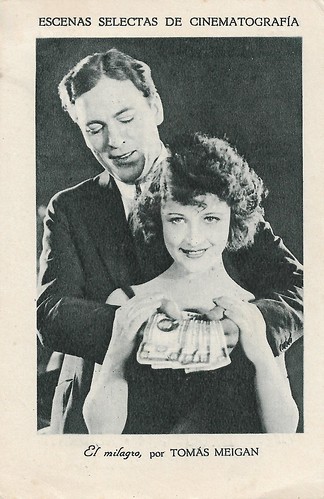
Spanish minicard in the Escenas selectas de cinematografía series, series B, no. 2, for Juan Garcia, Chocolates Gavilan, Alicante. Thomas Meighan in The Miracle Man (George Loan Tucker, 1919). The woman could be Betty Compson.
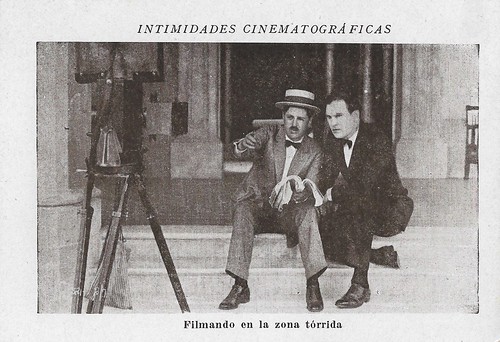
Spanish minicard in the Series Intimidades cinematograficas, series I, card 9 of 20. Caption: Filming in a stormy area. Here, Thomas Meighan and director Alfred Green, during the making of The Ne'er Do Well (1923), shot in Panama. The director, holding the film's script, points out to the actor where he needs to go, the door of the local Teatro Tivoli. Next to them, the camera, which cannot wait to get set in motion by the cinematographer, who is just finishing lunch.

Spanish collector card in the series 'Los artistas cinematográficos en la intimidad' by Amatller, Barcelona, Series A. Left to right: Thomas Meighan, Jeanie MacPherson, Lois Wilson, Cecil B. DeMille, Conrad Nagel, and Gloria Swanson. The photo was made during a visit to Nagel's villa, part of one of the biggest acacia plantations in California.

American arcade card. Ex. Sup. Co., Chicago. Paramount Pictures. Thomas Meighan in The Alaskan (Herbert Brenon, 1924).

French postcard by Editions Cinémagazine, no. 39. Photo: Apeda.

French postcard by A.N. Paris, in the Les Vedettes de Cinéma series, no. 21. Photo: Paramount.

French postcard in the Les Vedettes de Cinéma series by A.N., Paris, no. 110. Photo: Paramount.
Involved in two Hollywood scandals
Thomas Meighan next appeared in Cecil B. DeMille's Male and Female (Cecil B. DeMille, 1919), which starred him with Gloria Swanson and Lila Lee. Most of that film's cast returned for the comedy Why Change Your Wife? (Cecil B. DeMille, 1920), which co-starred Bebe Daniels. He appeared in three other films by DeMille and seven films by his brother, William C. deMille. Among his best-known films is also Manslaughter (Cecil B. DeMille, 1922) with Leatrice Joy and Lois Wilson.
His popularity continued through the Roaring Twenties, during which he starred in several pictures. His female film partners included Renée Adorée (two films), Billie Burke (five films), Pauline Frederick (five films), Leatrice Joy (three films in 1922, including Manslaughter), Lila Lee (eleven films), Blanche Sweet (five films), Norma Talmadge (three films), Virginia Valli (two films), and Lois Wilson (five films). In the mid-1920s, Paramount decided to close its New York Astoria studio and bring its big three stars, Richard Dix, Bebe Daniels and Thomas Meighan to Hollywood. Meighan refused and was too big a star at the time to be fired, so the studio ostensibly kept the facility open for him.
In 1924, he played in The Alaskan (Herbert Brenon, 1924) with Estelle Taylor and Anna May Wong. He also co-starred with Louise Brooks in the crime film The City Gone Wild (James Cruze, 1927). His final silent films were The Mating Call (1928), which was critical of the Ku Klux Klan, and The Racket (Lewis Milestone, 1928), which was nominated for an Academy Award for Best Picture. Both were produced by Howard Hughes and were thought lost until rediscovered in private collections in 2006.
Thomas Meighan's first sound feature film was The Argyle Case (Howard Bretherton, 1929, with H.B. Warner, Lila Lee, and Zasu Pitts. At this time, he was nearing 50. Fearing his popularity might wane, he decided to go into real estate. It wasn't until 1931 that he returned to the screen with Young Sinners (John G. Blystone, 1931). Meighan only made four other sound films, the last one being Peck's Bad Boy (Edward F. Cline, 1934) with Jackie Cooper. Two years later, in 1936, Thomas Meighan died prematurely of lung cancer. He was originally buried at Calvary Cemetery in Queens. After almost a year, his remains were moved to a family plot at Saint Mary Cemetery in Meighan's hometown of Pittsburgh.
Meighan was involved in two Hollywood scandals: he was the only witness at the secret marriage of Jack Pickford and Olive Thomas, and he paid a large share of the bail to get Rudolph Valentino out of prison after the latter was accused of bigamy. Thomas Meighan and Frances Ring remained married until his death. Their marriage was considered happy and strong. One writer remarked, "Thomas Meighan and Rin Tin Tin were the only Hollywood stars who had never seen a divorce court". The couple had no children. For his contribution to the cinema, a star is dedicated to Thomas Meighan on the Walk of Fame on Hollywood Boulevard. The Thomas Meighan Theatre in New Port Richey, Florida, was named in his honour. Designed by Thomas Reed Martin, the 500-seat theatre opened with Meighan's The New Klondike (Lewis Milestone, 1926). The building still stands but is now called the Richey Suncoast Theatre.

Italian postcard by G. Vettori, Bologna. Photo: Paramount. Thomas Meighan and Leatrice Joy.

British postcard in the second Series of 42 Cinema Stars issued with Sarony Cigarettes, no. 57. Photo: Warner Bros.

Belgian postcard Weekblad Cinéma, Antwerpen.

Swedish postcard by Förlag Nordisk Konst, Stockholm, no. 1118.

Russian postcard by Gozniak, Moscow, 1927, Series 2,no. A. 1725.

Spanish postcard by EFB (Editorial Fotografica, Barcelona), no. A.86.

British hand-coloured postcard, in the Foreign Series by Ross Verlag no. 1438/1. Photo: Paramount.
Sources: Gary Brumburgh (IMDb), Wikipedia (French and English), and IMDb.
This post was last updated on 15 August 2026.

No comments:
Post a Comment