Charles de Rochefort (1887-1952) was a star of the French silent cinema. He appeared in 34 films between 1911 and 1932, sometimes as a French cowboy. In 1923, he went to the US and made several films in Hollywood. After his return to France, he became a director of sound films.

French postcard by A.N., Paris, in the series Les Vedettes de Cinéma, no. 77. Photo: Paramount Film.

French postcard by Editions Filma in the Les Vedettes de l'Écran series, no. 117. Charles de Rochefort in Le roi de Camargue / King of Camargue (André Hugon, 1922).

German postcard by Ross Verlag, no. 681/5. Photo: Paramount-Film / National-Verleih. Charles de Rochefort as Pharao Ramses in The Ten Commandments (Cecil B. DeMille, 1923). Caption: The Egyptians pursue the exiting Jews.

Danish postcard by Alex Vincents Kunstforlag, no. 128. Photo: Famous Players-Lasky / Paramount. Gloria Swanson and Charles de Roche (Charles de Rochefort) in Madame Sans-Gêne (Léonce Perret, 1925).
Charles d’Authier de Rochefort was born in Port-Vendres, France, in 1887. He was the son of Paul Charles Dominique d'Authier de Rochefort and Camille Caroline Rose Félicité Guelfucci. In 1905, he started to work in the theatre and the music halls. In 1910 he made his film debut. One of his first films was the short Pathé comedy Max se marie / Max's Divorce (Max Linder, Lucien Nonguet, 1911) with Max Linder. He would play in eight Linder films between 1910 and 1914.
He also appeared in Pathé dramas by Georges Denola, Albert Capellani and Abel Gance. In 1918 he performed in the serial Impéria (12 episodes) by Jacques Durand, with Jacqueline Forzane. Then followed the films Marthe (Gaston Roudès, 1919), Fille du peuple / Girl of the People (Camille de Morlhon, 1920), L’empire du diamant / The Empire of the Diamond (Léonce Perret, 1920) and Roi de Camargue / King of Camargue (André Hugon, 1921).
De Rochefort again appeared in two serial films: Gigolette (Henri Pouctal, 1921, 4 episodes) and L’empereur des pauvres (René Leprince, 1921, 6 episodes) with Gina Manés and a young Lily Damita.
In 1922, De Rochefort played in several films: in André Antoine’s L’Arlésienne / The Girl from Arles, two films by André Hugon: Notre dame d’amour / Our Lady of Love and Le diamant noir / The Black Diamond, L’homme qui pleure / The Crying Man by Louis d’Hée and Louis de Verande, and the British-French co-production The Spanish Jade / Sous le soleil d’Espagne by John S. Robertson and starring Evelyn Brent.
After two more French films, La dame au ruban de velours (Giuseppe Guarino, 1923) with Arlette Marchal, and La faute des autres / Other's Fault (Jacques Olivier, 1923), Charles de Rochefort left France and went again to the United States.

Spanish card by La Novela Semanal Cinematográfica, no. 104.

French postcard by Cinémagazine-Edition, no. 158.

French postcard by Editions Cinémagazine, no. 34. Photo: Studio Pathé.

French postcard. Photo: Croissy.

French postcard. Photo: Croissy.
In Hollywood, Charles de Rochefort played in The Marriage Maker (William C. deMille, 1923) with Mary Astor.
He briefly appeared in Hollywood / Joligud (James Cruze, 1923) and with Dorothy Dalton in The Law of the Lawless (Victor Fleming, 1923). Credited as Charles De Roche, he also played opposite Pola Negri in The Cheat (George Fitzmaurice, 1923), a remake of Cecil B. DeMille's 1915 hit feature using the same script by Hector Turnbull and Jeanie MacPherson.
His best-known Hollywood part was Pharaoh Rameses, the Magnificent, in the prologue of the epic The Ten Commandments (Cecil B. DeMille, 1923) with Rod La Rocque.
In the following year, De Rochefort appeared in four more American films: Love and Glory (Rupert Julian, 1924), Shadows of Paris (Herbert Brenon, 1924), The White Moth (Maurice Tourneur, 1924) starring Barbara LaMarr; and Madame Sans-Gêne (Léonce Perret, 1924), a super-production around Gloria Swanson.
In 1925 Rochefort left Hollywood and returned to France, where he played in La princesse aux clowns / The Princess and the Clowns (André Hugon, 1925) with Huguette Duflos.

Italian postcard by Ed. Fratelli Palombi, Roma. Photo: Paramount-Film. Charles de Rochefort as Pharao Ramses in The Ten Commandments (Cecil B. DeMille, 1923).

Spanish collector card by Chocolate Amatller, Series N, Artist no. 19, no. 50. Charles de Roche[fort] in Law of the Lawless (Victor Fleming, 1923).

American Arcade postcard. Photo: Paramount. Charles de Rochefort or Charles Roche in Law of the Lawless (Victor Fleming, 1923).

Cover of the French film journal Mon Ciné, no. 97, 27 December 1923. Charles de Rochefort during the shooting of Law of the Lawless (Victor Fleming, 1923).
Charles de Rochefort then stayed away from the cinema for four years. When he returned in 1929, it was not as an actor but as director. Meanwhile, sound film had arrived. At the Paramount Pictures studio at Joinville-le-Pont in Paris, he directed the sound film Une femme a menti / A Woman Has Lied (1929) with Louise Lagrange and scripted by immigrant Hermann Kosterlitz, aka Henry Koster.
In 1930 he made the French, Italian, Czech and Romanian versions of Paramount on Parade, starring resp. Maurice Chevalier, Carmen Boni, Jiří Voskovec and Pola Illéry.
Rochefort also directed the multilingual Le secret du docteur / The Secret of the Doctor (1930), with Marcelle Chantal in the French and Eugenia Zoffoli in the Spanish version.
In 1931 Rochefort acted once more i La croix du sud / Southern Cross (André Hugon, 1931), for which he also did the photography, and he directed Televisione (1931), the Italian version of the Paramount multilingual Magie moderne / Television. He also directed the short Dorville chauffeur (1930) and Un bouquet de flirts (1931) with Josette Day.
He went on to work on stage and had his own theatre in Paris, the Théâtre Charles de Rochefort, which still exists today as the Théâtre Tristan-Bernard at 64 rue Rocher. In 1943 he wrote the book 'Le Film de Mes Souvenirs' (Secrets de Vedettes). Charles de Rochefort died in Paris in 1952. He was 64.

Italian postcard by Ballerini & Fratini, no. 141. Photo: Films Paramount, Roma. Gloria Swanson and Charles de Roche(fort) in Madame Sans-Gêne (Léonce Perret, 1925).
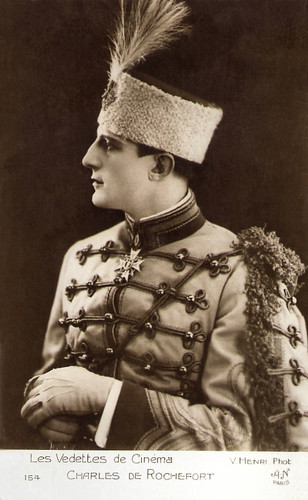
French postcard by A.N., Paris, no. 154. Photo: V. Henri.
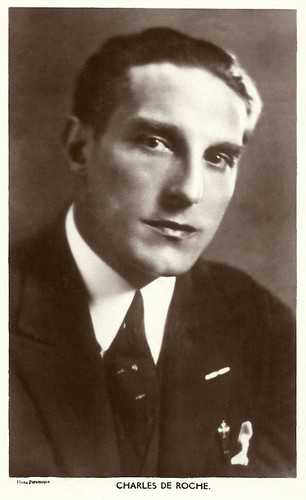
British postcard in the Picturegoer Series, London, no. 141. Photo: Paramount.

Italian postcard by G.B. Falci Editore Milano, no. 592.
First Part of The Ten Commandments (1923). Source: joe25Xcel (YouTube).
Sources: Pascal Donald (CineArtistes - Now Defunct), Wikipedia and IMDb.
This post was last updated on 26 August 2026.
French postcard by A.N., Paris, in the series Les Vedettes de Cinéma, no. 77. Photo: Paramount Film.
French postcard by Editions Filma in the Les Vedettes de l'Écran series, no. 117. Charles de Rochefort in Le roi de Camargue / King of Camargue (André Hugon, 1922).
German postcard by Ross Verlag, no. 681/5. Photo: Paramount-Film / National-Verleih. Charles de Rochefort as Pharao Ramses in The Ten Commandments (Cecil B. DeMille, 1923). Caption: The Egyptians pursue the exiting Jews.
Danish postcard by Alex Vincents Kunstforlag, no. 128. Photo: Famous Players-Lasky / Paramount. Gloria Swanson and Charles de Roche (Charles de Rochefort) in Madame Sans-Gêne (Léonce Perret, 1925).
Serials
Charles d’Authier de Rochefort was born in Port-Vendres, France, in 1887. He was the son of Paul Charles Dominique d'Authier de Rochefort and Camille Caroline Rose Félicité Guelfucci. In 1905, he started to work in the theatre and the music halls. In 1910 he made his film debut. One of his first films was the short Pathé comedy Max se marie / Max's Divorce (Max Linder, Lucien Nonguet, 1911) with Max Linder. He would play in eight Linder films between 1910 and 1914.
He also appeared in Pathé dramas by Georges Denola, Albert Capellani and Abel Gance. In 1918 he performed in the serial Impéria (12 episodes) by Jacques Durand, with Jacqueline Forzane. Then followed the films Marthe (Gaston Roudès, 1919), Fille du peuple / Girl of the People (Camille de Morlhon, 1920), L’empire du diamant / The Empire of the Diamond (Léonce Perret, 1920) and Roi de Camargue / King of Camargue (André Hugon, 1921).
De Rochefort again appeared in two serial films: Gigolette (Henri Pouctal, 1921, 4 episodes) and L’empereur des pauvres (René Leprince, 1921, 6 episodes) with Gina Manés and a young Lily Damita.
In 1922, De Rochefort played in several films: in André Antoine’s L’Arlésienne / The Girl from Arles, two films by André Hugon: Notre dame d’amour / Our Lady of Love and Le diamant noir / The Black Diamond, L’homme qui pleure / The Crying Man by Louis d’Hée and Louis de Verande, and the British-French co-production The Spanish Jade / Sous le soleil d’Espagne by John S. Robertson and starring Evelyn Brent.
After two more French films, La dame au ruban de velours (Giuseppe Guarino, 1923) with Arlette Marchal, and La faute des autres / Other's Fault (Jacques Olivier, 1923), Charles de Rochefort left France and went again to the United States.
Spanish card by La Novela Semanal Cinematográfica, no. 104.
French postcard by Cinémagazine-Edition, no. 158.
French postcard by Editions Cinémagazine, no. 34. Photo: Studio Pathé.
French postcard. Photo: Croissy.
French postcard. Photo: Croissy.
Super-production
In Hollywood, Charles de Rochefort played in The Marriage Maker (William C. deMille, 1923) with Mary Astor.
He briefly appeared in Hollywood / Joligud (James Cruze, 1923) and with Dorothy Dalton in The Law of the Lawless (Victor Fleming, 1923). Credited as Charles De Roche, he also played opposite Pola Negri in The Cheat (George Fitzmaurice, 1923), a remake of Cecil B. DeMille's 1915 hit feature using the same script by Hector Turnbull and Jeanie MacPherson.
His best-known Hollywood part was Pharaoh Rameses, the Magnificent, in the prologue of the epic The Ten Commandments (Cecil B. DeMille, 1923) with Rod La Rocque.
In the following year, De Rochefort appeared in four more American films: Love and Glory (Rupert Julian, 1924), Shadows of Paris (Herbert Brenon, 1924), The White Moth (Maurice Tourneur, 1924) starring Barbara LaMarr; and Madame Sans-Gêne (Léonce Perret, 1924), a super-production around Gloria Swanson.
In 1925 Rochefort left Hollywood and returned to France, where he played in La princesse aux clowns / The Princess and the Clowns (André Hugon, 1925) with Huguette Duflos.
Italian postcard by Ed. Fratelli Palombi, Roma. Photo: Paramount-Film. Charles de Rochefort as Pharao Ramses in The Ten Commandments (Cecil B. DeMille, 1923).
Spanish collector card by Chocolate Amatller, Series N, Artist no. 19, no. 50. Charles de Roche[fort] in Law of the Lawless (Victor Fleming, 1923).
American Arcade postcard. Photo: Paramount. Charles de Rochefort or Charles Roche in Law of the Lawless (Victor Fleming, 1923).
Cover of the French film journal Mon Ciné, no. 97, 27 December 1923. Charles de Rochefort during the shooting of Law of the Lawless (Victor Fleming, 1923).
Multilingual productions
Charles de Rochefort then stayed away from the cinema for four years. When he returned in 1929, it was not as an actor but as director. Meanwhile, sound film had arrived. At the Paramount Pictures studio at Joinville-le-Pont in Paris, he directed the sound film Une femme a menti / A Woman Has Lied (1929) with Louise Lagrange and scripted by immigrant Hermann Kosterlitz, aka Henry Koster.
In 1930 he made the French, Italian, Czech and Romanian versions of Paramount on Parade, starring resp. Maurice Chevalier, Carmen Boni, Jiří Voskovec and Pola Illéry.
Rochefort also directed the multilingual Le secret du docteur / The Secret of the Doctor (1930), with Marcelle Chantal in the French and Eugenia Zoffoli in the Spanish version.
In 1931 Rochefort acted once more i La croix du sud / Southern Cross (André Hugon, 1931), for which he also did the photography, and he directed Televisione (1931), the Italian version of the Paramount multilingual Magie moderne / Television. He also directed the short Dorville chauffeur (1930) and Un bouquet de flirts (1931) with Josette Day.
He went on to work on stage and had his own theatre in Paris, the Théâtre Charles de Rochefort, which still exists today as the Théâtre Tristan-Bernard at 64 rue Rocher. In 1943 he wrote the book 'Le Film de Mes Souvenirs' (Secrets de Vedettes). Charles de Rochefort died in Paris in 1952. He was 64.
Italian postcard by Ballerini & Fratini, no. 141. Photo: Films Paramount, Roma. Gloria Swanson and Charles de Roche(fort) in Madame Sans-Gêne (Léonce Perret, 1925).
French postcard by A.N., Paris, no. 154. Photo: V. Henri.
British postcard in the Picturegoer Series, London, no. 141. Photo: Paramount.
Italian postcard by G.B. Falci Editore Milano, no. 592.
First Part of The Ten Commandments (1923). Source: joe25Xcel (YouTube).
Sources: Pascal Donald (CineArtistes - Now Defunct), Wikipedia and IMDb.
This post was last updated on 26 August 2026.

No comments:
Post a Comment