The success of the pioneering Swedish film studio Svenska Biografteatern AB during and after the First World War inspired others. Skandia Film in Stockholm was the most successful competitor. Like Svenska Bio, Skandia relied on the Nordic landscape and literature for its silent films. Skandia's main director was John Wilhelm Brunius, who was also an actor and scriptwriter. Other staff directors were Einar Rudd (or Ruud) and Rune Carlsten. Nils Bouveng, the manager of Skandia, had previously been the manager of Hasselblad studios, where Rune Carlsten had also been under the producer's supervision. Among the stars of Skandia Film were Gösta Ekman, Anders De Wahl and actress-director Pauline Brunius, the wife of John W. Brunius. Brunius also gave the salesgirl Greta Gustafsson her first acting chance: the future Greta Garbo appeared as an extra in his film En Lyckoriddare / Soldiers of Fortune (1921). This film and many Skandia productions are presumed lost now. But some postcards of the Skandia films have survived, although they are rare. Ivo Blom shared his collection for this post.
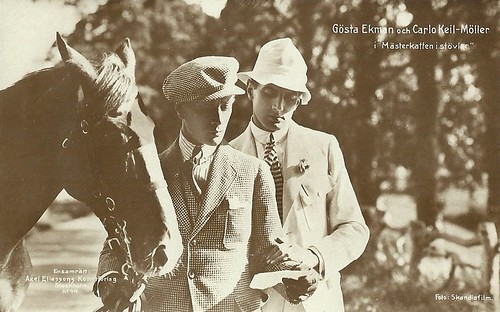
Swedish postcard by Axel Eliassons Konstförlag, Stockholm, no. 1194. Photo: Skandia Film. Gösta Ekman and Carlo Keil-Möller in the romantic film Mästerkatten i stövlar / Puss in boots (John W. Brunius, 1918). It was John W. Brunius's directorial debut and an international success.
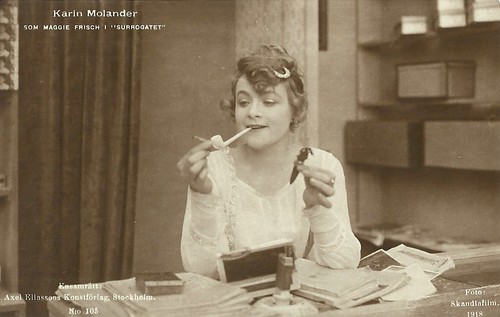
Swedish postcard by Axel Eliassons Konstförlag, Stockholm, no. 105. Photo Skandiafilm, 1918. Karin Molander in Surrogatet (Einar Brunn, 1918-1919).
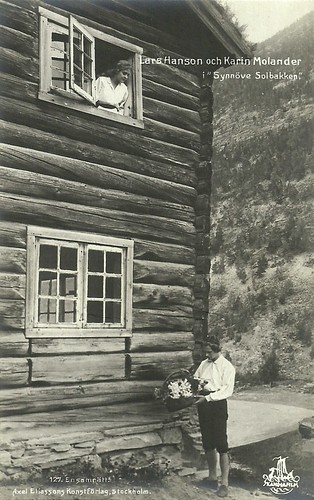
Swedish postcard by Axel Eliassons Konstförlag, Stockholm, no. 127. Photo: Skandiafilm. Still for Synnöve Solbakken / The Girl from Solbakken (John W. Brunius, 1919) with Lars Hanson and Karin Molander. Sent by mail in Norway in 1920. Synnöve Solbakken was based on the novel written by Bjørnstjerne Bjørnson in 1857. The assistant director of the film was Einar Brunn, and it was filmed in Sweden and Norway by photographers Hugo Edlund and Arthur Thorell.
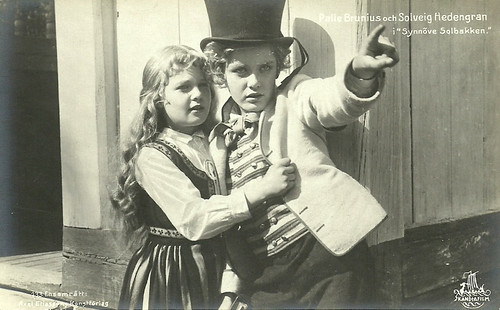
Swedish postcard by Axel Eliassons Konstförlag, no. 133. Photo: Skandia Film. Palle Brunius and Solveig Hedengran in Synnöve Solbakken / The Girl from Solbakken (John W. Brunius, 1919).
In Synnöve Solbakken (John W. Brunius, 1919), Palle Brunius and Solveig Hedengran play the same characters as the stars, Karin Molander and Lars Hanson, but then in their childhood. Palle Brunius (1909-1976) was the son of the director, John W. Brunius. He would only pay a handful of child roles in films by his father, and another handful in those of his mother. Solveig Hedengran (1910-1956) instead acted in some 28 films, mostly Swedish sound films and often in supporting parts. Synnöve Solbakken was her first film.

Swedish postcard by Axel Eliassons Konstforlag, Stockholm, no 141. Photo: Skandia Film, Stockholm. Lars Hanson and Gull Cronvall in Ett farligt frieri / A Dangerous Proposal (Rune Carlsten, 1919).
The story of Ett farligt frieri / A Dangerous Proposal (Rune Carlsten 1919) deals with Tore, a smallholder's son (Lars Hanson), in love with Aslaug, a farmer's daughter (Gull Cronvall) whose father Knut (Theodor Blich) has ambitious plans to marry her to the son of the wealthiest farmer around. Even after Knut and Aslaug's brothers have beaten Tore black and blue, he persists in visiting Aslaug, even climbing a giant wall of rock...

Swedish postcard by Axel Eliassons Konstförlag, Stockholm, no. 154. Photo: Skandia Film. Ernst Rolf, Mary Gräber, and Erik Lindholm in Åh i morron kväll / Oh Tomorrow Night (John W. Brunius, 1919).
In the silent comedy Åh i morron kväll / Oh Tomorrow Night (John W. Brunius, 1919), Ernst Rolf is married to Josefina, a once sweet woman who has become a shrew and nag. He fantasizes about other women and if given the opportunity, will he act upon the temptation to cheat on his wife? The film premiered on 8 December 1919, in Gothenburg and Stockholm. Cinema musicians were given suggestions to play famous songs from Rolf's repertory.

Swedish postcard by Axel Eliassons Konstförlag, Stockholm, no. 159. Photo: Skandia Film. Gösta Ekman as an agricultural student in the Swedish silent comedy Bomben / The Bomb (Rune Carlsten, 1920).

Swedish postcard by Axel Eliassons Konstförlag, Stockholm, no. 166. Photo: Skandia Film. Still for Bomben / The Bomb (Rune Carlsten, 1920), starring Karin Molander. Caption: Elsa Vendel's first morning amidst her own possessions.

Swedish postcard by Axel Eliassons Konstförlag, Stockholm, no. 185. Photo: Skandia Film. Gösta Ekman and Mary Johnson in the comedy Familjens traditioner (Rune Carlsten, 1920).
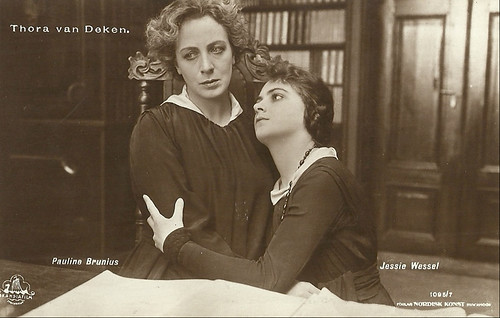
Swedish postcard by Verlag Nordisk Konst, Stockholm, no. 1095/7. Photo: Skandia Film. Pauline Brunius and Jessie Wessel in Thora van Deken (John W. Brunius, 1920). The film was an adaptation of a novel written by Henrik K. Pontoppidan.
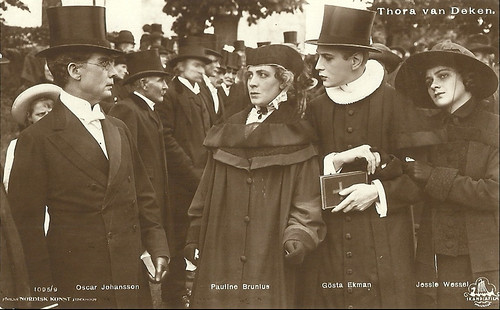
Swedish postcard by Verlag Nordisk Konst, Stockholm, no. 1095/9. Photo: Skandia Film. Pauline Brunius, Gösta Ekman, Jessie Wessel and Oscar Johansson in Thora van Deken (John W. Brunius, 1920).
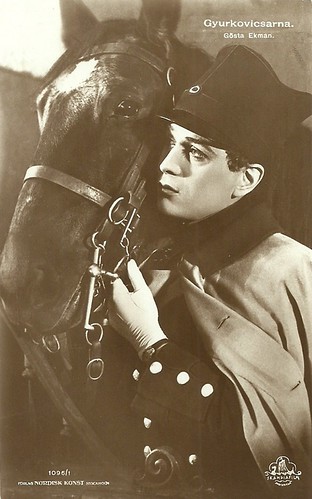
Swedish postcard by Forlag Nordisk Konst, Stockholm, no. 1096/1. Photo: Skandia Film. Gösta Ekman in Gyurkovicsarna / Lieutenant Tophat (John W. Brunius, 1920).
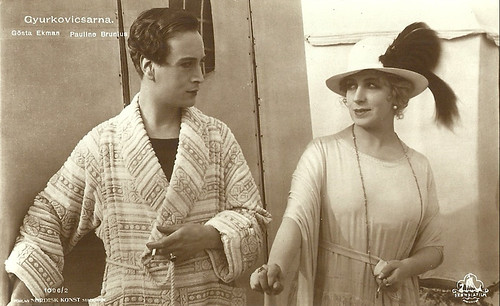
Swedish postcard by Forlag Nordisk Konst, Stockholm, no. 1096/2. Photo: Skandia Film. Gösta Ekman and Pauline Brunius in Gyurkovicsarna / Lieutenant Tophat (John W. Brunius, 1920).

Swedish postcard by Förlag Nordisk Konst, Stockholm, no. 1115/1. Photo: Skandia Film. Gösta Ekman in En lyckoriddare / A Fortune Hunter (John W. Brunius, 1921).
In En lyckoriddare / A Fortune Hunter (John W. Brunius, 1921), Gösta Ekman plays a lackey who pretends to be an elegant Swedish count, thus fooling the pompous, boorish father (Axel Ringvall) of the beautiful Gertrud (Mary Johnson). He marries Gertrud, signing the documents as the count, but then the real count (Carlo Keil-Möller) shows up...

Swedish postcard by Axel Eliassons Konstförlag, Stockholm, no. 193. Photo: Skandia Film. Anders de Wahl in Kvarnen / The Windmill (John W. Brunius, 1921).
Kvarnen / The Windmill (John W. Brunius, 1921) was shot at the Skandia studio at Lidingö and with exteriors shot at Sjöbo and Skåne by Hugo Edlund. The basis for the film was the novel 'Møllen' (The Mill, 1896) by Karl Gjellerup. During filming in Sjöbo, a real old mill burned down right in front of the camera. The Swedish Film Institute's film archive holds a restored print of the film. Tommy Gustafsson, in his article 'Travellers as a Threat in Swedish Cinema of the 1920s', in the volume Swedish Film: An Introduction and Reader (2010), indicates that Kvarnen was the first Swedish film on miscegenation. Though he has promised his wife on her deathbed not to remarry against the will of his son Hans, miller Jacob (Anders de Wahl) is attracted by the lustful, devious and gypsy-like farm's maid Lise (Klara Kjellblad). Instead, Hans hates Lise and prefers the pure sister of the forester, Anna. Indeed, the flimsy and dirty Lise is only after Jacob's money and his mill, while keeping an affair with the farmhand on the side. Jacob and the farmhand are in the palm of Lise's hand, but when Jacob finally catches the couple, he avenges himself by having the mill's millstone crush the lovers.
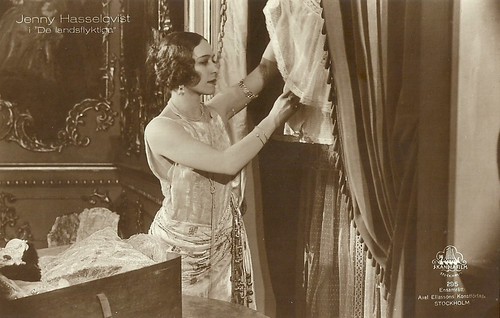
Swedish postcard by Ed. Axel Eliassons Konstförlag, Stockholm, no. 295. Photo: Skandia Film, Stockholm / Svensk Filmindustri. Still for De landsflyktiga / The Emigrants / The Exiles (Mauritz Stiller, 1921), starring Jenny Hasselqvist.
De landsflyktiga / The Emigrants / The Exiles (Mauritz Stiller, 1921) is a lost film, except for a few very short fragments. Already in 1919, Skandia had merged with Svenska Biograph, although Skandia Film continued as a distributor of Swedish films like De landsflyktiga, which was produced by Svensk Filmindustri.
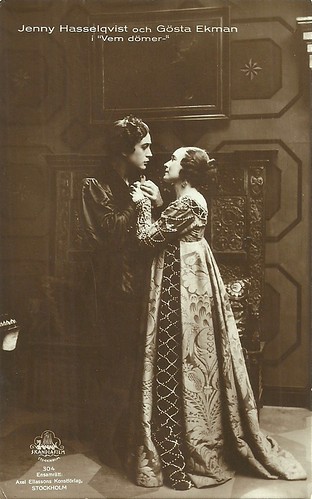
Swedish postcard by Axel Eliassons Konstförlag, Stockholm, no. 304. Photo: Skandia Film. Gösta Ekman and Jenny Hasselqvist in the Swedish silent drama Vem dömer / Love's Crucible (Victor Sjöström, 1922).
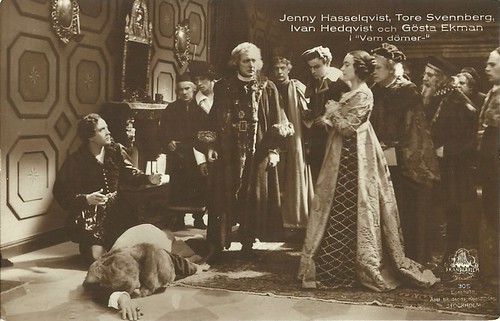
Swedish postcard by Axel Eliassons Konstförlag, Stockholm, no. 305. Photo: Skandia Film. Jenny Hasselqvist, Ivan Hedqvist, Tore Svennberg and Gösta Ekman in Vem dömer / Love's Crucible (Victor Sjöström, 1922). Nils Asther had a small part in this film. He is the man just left of Jenny Hasselqvist.
Vem dömer / Love's Crucible (Victor Sjöström, 1922) is a Renaissance drama about a young woman named Ursula (Jenny Hasselqvist), who is in love with Bertram (Gösta Ekman), the son of the mayor (Tore Svennberg). She is accused of having poisoned her older husband, the sculptor Master Anton (Ivan Hedqvist). She has to prove her virginity through a fire test. The film's title reads: Who judges?

Swedish postcard by Axel Eliassons Konstförlag, Stockholm, no. 323. Photo: Skandia-Film. Pauline Brunius and Gösta Ekman in the silent romantic drama Kärlekens ögon / Med kärlekens ögon / Scarlet Angel (John W. Brunius, 1922).
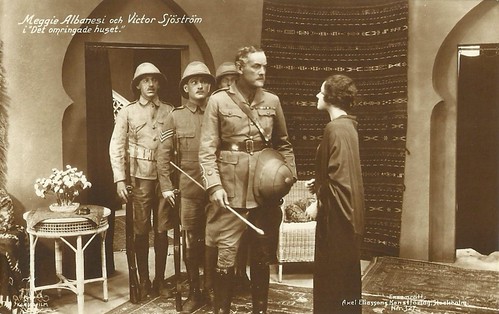
Swedish postcard by Ed. Axel Eliassons Konstförlag, Stockholm, no. 327. Photo: Skandia Film / Svensk Filminspelning. Postcard for Det omringade huset / The Surrounded House (Victor Sjöström, 1922), starring Meggie Albanesi and Victor Sjöström.

Swedish postcard by Axel Eliassons Konstförlag, Stockholm, no. 329. Photo: Skandiafilm / Svensk Filminspelning. Meggie Albanesi in Det omringade huset / The Surrounded House (Victor Sjöström, 1922).
Sources: Scott Lord (Silent Film: Greta Garbo - Victor Seastöm), Mette Hjort and Ursula Lindqvist (A Companion to Nordic Cinema), David Bret (Greta Garbo: A Divine Star), Mariah Larsson and Anders Marklund (Swedish Film: An Introduction and Reader), Wikipedia and IMDb.
Swedish postcard by Axel Eliassons Konstförlag, Stockholm, no. 1194. Photo: Skandia Film. Gösta Ekman and Carlo Keil-Möller in the romantic film Mästerkatten i stövlar / Puss in boots (John W. Brunius, 1918). It was John W. Brunius's directorial debut and an international success.
Swedish postcard by Axel Eliassons Konstförlag, Stockholm, no. 105. Photo Skandiafilm, 1918. Karin Molander in Surrogatet (Einar Brunn, 1918-1919).
Swedish postcard by Axel Eliassons Konstförlag, Stockholm, no. 127. Photo: Skandiafilm. Still for Synnöve Solbakken / The Girl from Solbakken (John W. Brunius, 1919) with Lars Hanson and Karin Molander. Sent by mail in Norway in 1920. Synnöve Solbakken was based on the novel written by Bjørnstjerne Bjørnson in 1857. The assistant director of the film was Einar Brunn, and it was filmed in Sweden and Norway by photographers Hugo Edlund and Arthur Thorell.
Swedish postcard by Axel Eliassons Konstförlag, no. 133. Photo: Skandia Film. Palle Brunius and Solveig Hedengran in Synnöve Solbakken / The Girl from Solbakken (John W. Brunius, 1919).
In Synnöve Solbakken (John W. Brunius, 1919), Palle Brunius and Solveig Hedengran play the same characters as the stars, Karin Molander and Lars Hanson, but then in their childhood. Palle Brunius (1909-1976) was the son of the director, John W. Brunius. He would only pay a handful of child roles in films by his father, and another handful in those of his mother. Solveig Hedengran (1910-1956) instead acted in some 28 films, mostly Swedish sound films and often in supporting parts. Synnöve Solbakken was her first film.
Swedish postcard by Axel Eliassons Konstforlag, Stockholm, no 141. Photo: Skandia Film, Stockholm. Lars Hanson and Gull Cronvall in Ett farligt frieri / A Dangerous Proposal (Rune Carlsten, 1919).
The story of Ett farligt frieri / A Dangerous Proposal (Rune Carlsten 1919) deals with Tore, a smallholder's son (Lars Hanson), in love with Aslaug, a farmer's daughter (Gull Cronvall) whose father Knut (Theodor Blich) has ambitious plans to marry her to the son of the wealthiest farmer around. Even after Knut and Aslaug's brothers have beaten Tore black and blue, he persists in visiting Aslaug, even climbing a giant wall of rock...
Swedish postcard by Axel Eliassons Konstförlag, Stockholm, no. 154. Photo: Skandia Film. Ernst Rolf, Mary Gräber, and Erik Lindholm in Åh i morron kväll / Oh Tomorrow Night (John W. Brunius, 1919).
In the silent comedy Åh i morron kväll / Oh Tomorrow Night (John W. Brunius, 1919), Ernst Rolf is married to Josefina, a once sweet woman who has become a shrew and nag. He fantasizes about other women and if given the opportunity, will he act upon the temptation to cheat on his wife? The film premiered on 8 December 1919, in Gothenburg and Stockholm. Cinema musicians were given suggestions to play famous songs from Rolf's repertory.
Swedish postcard by Axel Eliassons Konstförlag, Stockholm, no. 159. Photo: Skandia Film. Gösta Ekman as an agricultural student in the Swedish silent comedy Bomben / The Bomb (Rune Carlsten, 1920).
Swedish postcard by Axel Eliassons Konstförlag, Stockholm, no. 166. Photo: Skandia Film. Still for Bomben / The Bomb (Rune Carlsten, 1920), starring Karin Molander. Caption: Elsa Vendel's first morning amidst her own possessions.
Swedish postcard by Axel Eliassons Konstförlag, Stockholm, no. 185. Photo: Skandia Film. Gösta Ekman and Mary Johnson in the comedy Familjens traditioner (Rune Carlsten, 1920).
Swedish postcard by Verlag Nordisk Konst, Stockholm, no. 1095/7. Photo: Skandia Film. Pauline Brunius and Jessie Wessel in Thora van Deken (John W. Brunius, 1920). The film was an adaptation of a novel written by Henrik K. Pontoppidan.
Swedish postcard by Verlag Nordisk Konst, Stockholm, no. 1095/9. Photo: Skandia Film. Pauline Brunius, Gösta Ekman, Jessie Wessel and Oscar Johansson in Thora van Deken (John W. Brunius, 1920).
Swedish postcard by Forlag Nordisk Konst, Stockholm, no. 1096/1. Photo: Skandia Film. Gösta Ekman in Gyurkovicsarna / Lieutenant Tophat (John W. Brunius, 1920).
Swedish postcard by Forlag Nordisk Konst, Stockholm, no. 1096/2. Photo: Skandia Film. Gösta Ekman and Pauline Brunius in Gyurkovicsarna / Lieutenant Tophat (John W. Brunius, 1920).
Swedish postcard by Förlag Nordisk Konst, Stockholm, no. 1115/1. Photo: Skandia Film. Gösta Ekman in En lyckoriddare / A Fortune Hunter (John W. Brunius, 1921).
In En lyckoriddare / A Fortune Hunter (John W. Brunius, 1921), Gösta Ekman plays a lackey who pretends to be an elegant Swedish count, thus fooling the pompous, boorish father (Axel Ringvall) of the beautiful Gertrud (Mary Johnson). He marries Gertrud, signing the documents as the count, but then the real count (Carlo Keil-Möller) shows up...
Swedish postcard by Axel Eliassons Konstförlag, Stockholm, no. 193. Photo: Skandia Film. Anders de Wahl in Kvarnen / The Windmill (John W. Brunius, 1921).
Kvarnen / The Windmill (John W. Brunius, 1921) was shot at the Skandia studio at Lidingö and with exteriors shot at Sjöbo and Skåne by Hugo Edlund. The basis for the film was the novel 'Møllen' (The Mill, 1896) by Karl Gjellerup. During filming in Sjöbo, a real old mill burned down right in front of the camera. The Swedish Film Institute's film archive holds a restored print of the film. Tommy Gustafsson, in his article 'Travellers as a Threat in Swedish Cinema of the 1920s', in the volume Swedish Film: An Introduction and Reader (2010), indicates that Kvarnen was the first Swedish film on miscegenation. Though he has promised his wife on her deathbed not to remarry against the will of his son Hans, miller Jacob (Anders de Wahl) is attracted by the lustful, devious and gypsy-like farm's maid Lise (Klara Kjellblad). Instead, Hans hates Lise and prefers the pure sister of the forester, Anna. Indeed, the flimsy and dirty Lise is only after Jacob's money and his mill, while keeping an affair with the farmhand on the side. Jacob and the farmhand are in the palm of Lise's hand, but when Jacob finally catches the couple, he avenges himself by having the mill's millstone crush the lovers.
Swedish postcard by Ed. Axel Eliassons Konstförlag, Stockholm, no. 295. Photo: Skandia Film, Stockholm / Svensk Filmindustri. Still for De landsflyktiga / The Emigrants / The Exiles (Mauritz Stiller, 1921), starring Jenny Hasselqvist.
De landsflyktiga / The Emigrants / The Exiles (Mauritz Stiller, 1921) is a lost film, except for a few very short fragments. Already in 1919, Skandia had merged with Svenska Biograph, although Skandia Film continued as a distributor of Swedish films like De landsflyktiga, which was produced by Svensk Filmindustri.
Swedish postcard by Axel Eliassons Konstförlag, Stockholm, no. 304. Photo: Skandia Film. Gösta Ekman and Jenny Hasselqvist in the Swedish silent drama Vem dömer / Love's Crucible (Victor Sjöström, 1922).
Swedish postcard by Axel Eliassons Konstförlag, Stockholm, no. 305. Photo: Skandia Film. Jenny Hasselqvist, Ivan Hedqvist, Tore Svennberg and Gösta Ekman in Vem dömer / Love's Crucible (Victor Sjöström, 1922). Nils Asther had a small part in this film. He is the man just left of Jenny Hasselqvist.
Vem dömer / Love's Crucible (Victor Sjöström, 1922) is a Renaissance drama about a young woman named Ursula (Jenny Hasselqvist), who is in love with Bertram (Gösta Ekman), the son of the mayor (Tore Svennberg). She is accused of having poisoned her older husband, the sculptor Master Anton (Ivan Hedqvist). She has to prove her virginity through a fire test. The film's title reads: Who judges?
Swedish postcard by Axel Eliassons Konstförlag, Stockholm, no. 323. Photo: Skandia-Film. Pauline Brunius and Gösta Ekman in the silent romantic drama Kärlekens ögon / Med kärlekens ögon / Scarlet Angel (John W. Brunius, 1922).
Swedish postcard by Ed. Axel Eliassons Konstförlag, Stockholm, no. 327. Photo: Skandia Film / Svensk Filminspelning. Postcard for Det omringade huset / The Surrounded House (Victor Sjöström, 1922), starring Meggie Albanesi and Victor Sjöström.
Swedish postcard by Axel Eliassons Konstförlag, Stockholm, no. 329. Photo: Skandiafilm / Svensk Filminspelning. Meggie Albanesi in Det omringade huset / The Surrounded House (Victor Sjöström, 1922).
Sources: Scott Lord (Silent Film: Greta Garbo - Victor Seastöm), Mette Hjort and Ursula Lindqvist (A Companion to Nordic Cinema), David Bret (Greta Garbo: A Divine Star), Mariah Larsson and Anders Marklund (Swedish Film: An Introduction and Reader), Wikipedia and IMDb.

2 comments:
I was surprised to see myself listed as one of your “sources”. Thank you. Your postcards are always beautiful and I enjoy reading your text. Scott
Thanks, Scott. We love your blog.
Post a Comment