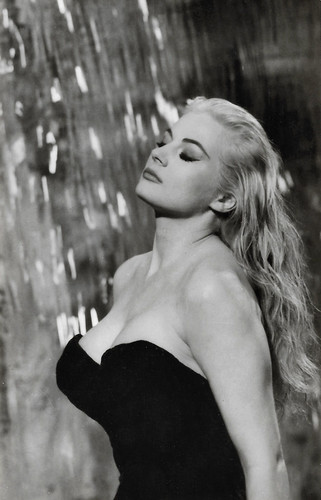
Romanian postcard by Casa Filmului Acin. Anita Ekberg in La dolce vita (Federico Fellini, 1960).

Romanian postcard by Casa Filmului Acin, no. 159. Anouk Aimée and Marcello Mastroianni in La dolce vita (Federico Fellini, 1960).

Italian postcard by Bromofoto, Milano, no. 1703. Photo: Cineriz. Magali Noël in La dolce vita (Federico Fellini, 1960). Collection: Marlene Pilaete.
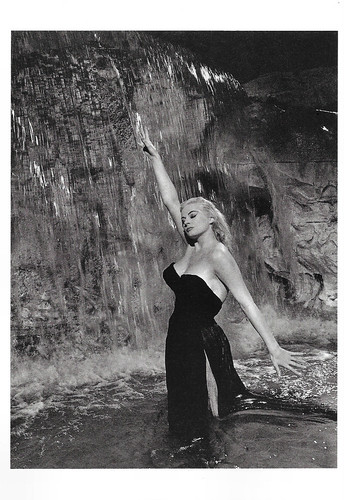
French postcard in the Collection Magie Noire by Editions Hazan, Paris, no. 6323. Anita Ekberg in La dolce vita (Federico Fellini, 1960).

Swiss postcard by News Productions. Photo: Cinémathèque Suisse. Yvonne Furneaux as Emma and Marcello Mastroianni as Marcello at the Via Colombo outside Rome, after Emma's suicide attempt, in La dolce vita (Federico Fellini, 1960).
Swept away by the sweet life of high society.
La dolce vita marks the first of several acclaimed collaborations between director Federico Fellini and actor Marcello Mastroianni, who came to represent Fellini’s alter ego. Mastroianni plays Marcello Rubini, a reporter in Rome during the late 1950s who is always on the lookout for a scoop. He covers the gossip news of foreign movie stars, religious visions and the decadent aristocracy. That's why he spends his evenings among Rome's upper class. He tends to get quite close to his subjects, especially when they're beautiful women like the local heiress Maddalena (Anouk Aimée), and Swedish film star Sylvia (Anita Ekberg). He has affairs with both, although he is engaged to Emma (Yvonne Furneaux), a clingy, insecure woman. Rubini dreams of becoming a literary author, but he abandons those ideals for a career in the lucrative tabloid press. Although he recognises its superficiality and immorality, he allows himself to be swept away by the sweet life of high society. Fellini follows the handsome, weary, desperate Marcello during a week and reveals the emptiness, boredom and destructiveness of 'la dolce vita' while at the same time making it highly glamorous and seductive.
Dino De Laurentiis was the film's original producer. He wanted a famous American or French actor, such as Paul Newman or Gérard Philipe, to play Rubini to guarantee international marketability. According to rumours, Newman was keen to take part, but Fellini wanted an Italian actor. The rift between Fellini and De Laurentiis occurred precisely over the name of Marcello Mastroianni: unlike Fellini, De Laurentiis did not consider him suitable for the part. Another reason for the rift between De Laurentiis and Fellini was the screenplay, which the producer considered too chaotic. The screenplay was written by Fellini, Tullio Pinelli, Ennio Flaiano, and Brunello Rondi.
The script was provisional, as was often the case with Fellini's productions. He stated that the film would only find its true form on the screen. During filming, the script underwent considerable changes. Two scenes, absent from the original screenplay, were completely 'improvised': the party of the nobles at the castle, filmed in the Giustiniani-Odescalchi palace in Bassano Romano in the province of Viterbo, and the 'miracle' that the two children claim to have witnessed, with the participation of a crowd of faithful, law enforcement officers and military personnel. The episode was inspired by a report by the Roman reporter Tazio Secchiaroli in June 1958: the subject of the report was the apparition of the Virgin Mary to two children in a farm at Maratta Alta, near Terni. Secchiaroli participated in the filming of the fake miracle scene and said that the atmosphere of the episode in the film was similar to what the photographer saw when he arrived in the small Umbrian town. The character of Paparazzo in the film was inspired by Tazio Secchiaroli.
Another choice made by Fellini was to hire Anita Ekberg for the part of Sylvia. The various changes in dates led to the withdrawal of many actors. Among them was Maurice Chevalier, who was to play the father of Marcello, a travelling salesman who joins Marcello on a tour of the night. After considering many names, Fellini eventually gave the part to Annibale Ninchi. The impressed Mastroianni found him very credible in the role of his father. The character of Steiner was given to Alain Cuny after about fifty actors were considered for the part. Steiner was to be played by Henry Fonda, but the actor dropped out, much to the disappointment of Fellini. Many names were mentioned, and auditions were held for Emma's part. Gina Lollobrigida stated that she was offered the part and that she would have gladly accepted, but that her husband, out of jealousy, hid the script that the production sent her, and so the offer fell through due to Lollobrigida's failure to respond, who in turn thought that the production had changed its mind. The director then opted for Yvonne Furneaux. The film also features young artists like Laura Betti in a vaguely autobiographical role, model and singer Nico (Christa Päffgen) and a very young Adriano Celentano performing Little Richard's 'Ready Teddy.
La dolce vita was shot between spring and summer 1959. Most of the film was shot at the Cinecittà Studios in Rome. Set designer Piero Gherardi created over eighty locations, including the Via Veneto, the dome of Saint Peter's with the staircase leading up to it, and various nightclubs. The structure of the film consists of a prologue, followed by seven chapters interrupted once by an intermezzo, and an epilogue. Throughout, seven dawn sequences, seven day sequences, and eight night sequences are interwoven. The relationship between Fellini and the new producers, Angelo Rizzoli and Giuseppe Amato, was relaxed and cordial, despite the budget being exceeded. One of the most substantial costs incurred in the production was that of reconstructing Via Veneto, the Roman street of nightclubs, sidewalk cafes and the parade of the night, in the studio. According to official sources, the film cost no more than 540 million lire, which was not an excessive amount for an ambitious production such as La dolce vita.

French postcard by Editions La Malibran, Paris / Saint-Dié, no. CI 4. Marcello Mastroianni and Anita Ekberg in La dolce vita (Federico Fellini, 1960).

Vintage photo. Marcello Mastroianni in La dolce vita (Federico Fellini, 1960).

Small Czechoslovakian card by Pressfoto, Praha (Prague), no. S 83/7, 1965. Retail price: 0,50 Kcs. Anita Ekberg and Marcello Mastroianni in La dolce vita (Federico Fellini, 1960).

Small Romanian collector card. Photo: Marcello Mastroianni and Anouk Aimée in La Dolce Vita (Federico Fellini, 1960).

Italian postcard by Modric, Editoria d'arte, Ancona, no. MX 099. Photo: Pierluigi Praturlon. Anita Ekberg and Marcello Mastroianni during the filming of La dolce vita / The Sweet Life (Federico Fellini, 1960).
Boos, insults and applause
Dino De Laurentiis described La dolce vita as ’incoherent, false and pessimistic' and predicted that it would prove to be a disaster. Four hours were edited and then reduced to three with cuts. On 5 February 1960, the national premiere took place at the Capitol cinema in Milan. The film was booed. Fellini was stopped by a woman who accused him of handing the country over to the Bolsheviks and was spat on for being a detractor of the bourgeoisie and the aristocracy. Mastroianni was also insulted. It was reported that the film had been seized for reasons of public order. Fellini received 400 telegrams in a single day in Milan, accusing him of being a communist, a traitor and an atheist. The aristocracy had allowed Fellini to film in their homes and castles and then felt exposed.
Jean Toschi Marazzani Visconti, cousin of Luchino Visconti, was present at the Milan premiere and states that 'The boos and insults that evening made more news than the applause. In the event of the seizure, the next morning at the Capitol, there was already a queue at the box office. The appeal of the forbidden.‘ The Vatican saw the scene in which a statue of Christ is transported through the air by helicopter as a parody of the return of Christ. In Spain, La dolce vita was banned until the death of General Franco in 1975. However, after fifteen days of screening, the film had already covered the producer's expenses. Despite the claims of De Laurentiis, La dolce vita managed to recoup the budget in just the first fifteen days of screening. The film's commercial success was aided by an intense advertising campaign and the heated climate of criticism.
After three or four weeks, La dolce vita was on track to reach one billion lire, and after two months of screening, the box office takings exceeded one and a half billion. IMDb reports box office takings in the United States of $19,571,000 at the time, plus another $8,000,000 from rentals. At the end of the 1959-1960 film season, La dolce vita was the highest-grossing film of the year in Italy, with takings of 2,271,000,000 lire at the time. Currently, it ranks thirteenth in the list of the most watched Italian films of all time, with 13,617,148 paying viewers. Worldwide, the film has grossed over $82.5 million.
La dolce vita influenced customs and language. The scene at the Trevi Fountain with Anita Ekberg and Marcello Mastroianni has become a symbolic scene of 20th-century cinema. The title of the film itself has become a common expression used to describe a rich and luxurious lifestyle, often with excesses such as those shown in the film. The film also gave its name to an item of clothing, namely the high-necked jumper, known as the 'dolce vita' jumper, as worn by Mastroianni in the film. Thanks to this film, the term 'paparazzi' entered general usage. The word refers to the surname of the intrusive press photographer Paparazzo. The character of Paparazzo, the news photographer, is portrayed by Walter Santesso. Philip French writes in The Guardian that today the film has lost its ability to shock, but not its ability to fascinate, stimulate and provoke, and remains a work of great moral and visual impact. Bosley Crowther, in his review for The New York Times, writes that the modern lifestyle represented by Fellini, hallucinatory and almost circus-like in style, is the first to have earned the adjective 'Fellinian'.
Roger Ebert stated that if asked, 'What is your favourite film?', he would answer 'La dolce vita', adding that it is a film that never ages. In his 1961 review, he stated that the technical excellence with which the film was made surpassed any production he had seen before, except for a few classics by Ingmar Bergman, and that the cinematography and soundtrack are as important as the dialogue in bringing the attack on 'La dolce vita' to life. This attack is also created by the frequent symbolism, although it becomes too obvious to fit into the fluidity of the plot. Ebert surmised that it was precisely the film's very understandable symbolism that contributed to its success. "The movie is made with boundless energy. Fellini stood here at the dividing point between the neorealism of his earlier films (like La Strada) and the carnival visuals of his extravagant later ones (Juliet of the Spirits, Amarcord). His autobiographical 8 1/2, made three years after La dolce vita, is a companion-piece, but more knowing: There the hero is already a filmmaker, but here he is a young newspaperman on the make." In 2010, a new restoration of La dolce vita was carried out with the collaboration of Ennio Guarneri, assistant to Otello Martelli, director of photography at the L'Immagine Ritrovata laboratory in Bologna.

Italian postcard by Modric, Editoria d'arte, Ancona, no. MX 103. Photo: Pierluigi Praturlon. Marcello Mastroianni and Anita Ekberg during the filming of La dolce vita / The Sweet Life (Federico Fellini, 1960).

Italian postcard by Modric, Editoria d'arte, Ancona, no. MX 104. Photo: Pierluigi Praturlon. Marcello Mastroianni during the filming of La dolce vita / The Sweet Life (Federico Fellini, 1960).

Vintage poster postcard, no. XX 900 / 34. Italian poster by Cineriz for La dolce vita / The Sweet Life (Federico Fellini, 1960), starring Anita Ekberg and Marcello Mastroianni. Design: Giorgio Olivetti.

Italian poster postcard in the Federico Fellini series by Gruppo Prospettive. Italian poster by Cineriz for La dolce vita / The Sweet Life (Federico Fellini, 1960), starring Anita Ekberg and Marcello Mastroianni. Design: Sandro Simeoni.

French postcard. Caption: Cannes 2014. 67e Festival de Cannes 14-25 Mai. Photo: Marcello Mastroianni in La dolce vita (Federico Fellini, 1960).
Sources: Roger Ebert (Rogerebert.com), Philip French (The Guardian), Bosley Crowther (The New York Times), Wikipedia (Italian, Dutch and English), Britannica and IMDb.

No comments:
Post a Comment