
Dutch postcard. Piet Bambergen and René van Vooren in De Mounties Show (1968-1984).
De Mounties was an Amsterdam comedy duo, founded in 1946 by Chris Houthuizen and Ab Smit. The duo became known in the theatre and on television in the 1970s and 1980s in the line-up of Piet Bambergen and René van Vooren. The duo performed popular humour in the genre of farces and revues. In 1948, Smit wanted to continue as a professional artist together with Houthuizen, but Houthuizen did not want to give up his job at a file factory. Smit subsequently left De Mounties, and his place was filled by Piet Bambergen. When, in 1950, Bambergen also wanted to pursue a professional career, Houthuizen left De Mounties. His role was taken over by Fred Plevier, and they expanded De Mounties' fame nationwide. In the mid-fifties, they performed on various radio programs. Tragedy struck De Mounties in early 1956. During a recording session, Plevier suffered a heart attack at the age of 26, which he barely survived. The doctors strongly advised Plevier to quit the hectic life of an artist, after which Plevier left The Mounties. Bambergen then turned to his predecessor, Ad Smit. They completed a highly successful tour and continued to build on the success of De Mounties. From 1958, Smit and Bambergen recorded three records on the labels of Decca Records, the Belgian Olympia label, and Telefunken. In early 1960, a disagreement arose between Smit and Bambergen regarding the division of the fee. This became an insurmountable conflict, and at the end of June 1960, Smit left De Mounties. Bambergen then turned to his old partner, Plevier. Plevier's health had improved by then, but was not optimal. Their big breakthrough came in 1961, when they got their first television appearance as two plumbers on the Rudi Carrell Show. This performance made them nationally famous overnight. De Mounties continued to return on the Rudi Carrell Show. Bambergen also achieved success in four German television shows.
In 1965, Rudi Carrell offered Bambergen the opportunity to come and work in Germany, but without Plevier. Bambergen refused. In 1965, the Mounties were to get their own television show on VARA, but suddenly, Plevier suffered a heart attack during a camera rehearsal. He died on the spot. Once again, Bambergen stood alone as a Mountie, but in 1966, he found a new partner in René van Vooren, the son of René Sleeswijk. Van Vooren had previously filled in for Plevier when he was ill. Although Bambergen never built as close a friendship with Van Vooren as he did with Plevier, the new duo became very successful. In 1967, the Mounties produced the comedy television series De man zonder hoofd (The Man Without a Head) for the AVRO: an originally British series that was translated by Van Vooren. A year later, they created De Mounties show, a television program featuring sketches and songs that the AVRO would continue to broadcast until 1974. Around the same time, they also started a successful revue. In 1976, De Mounties show was taken over by the TROS, which continued to broadcast the program until the mid-1980s. From the 1990s onwards, Piet Bambergen worked mainly without René Van Vooren. In 1996, Bambergen died of a heart attack at the age of 65. This marked the definitive end of De Mounties.

Dutch postcard by Phonogram/Gebr. Spanjersberg N.V., Rotterdam (SPARO), no. 1210. Still from an episode of the Rudi Carrell Show that won the prestigious Silver Rose of the Montreux television festival in 1964. This episode was shot on an artificial, uninhabited island, where Robinson Crusoe (Rudi Carrell) and his monkey Friday get a visit from a mermaid, played by singer Esther Ofarim.
Dutch television showmaster, actor and singer Rudi Carrell (1934-2006) was hailed after his death as the greatest TV entertainer in Europe. After his breakthrough in the Netherlands, he went to Germany and gained enormous popularity there on TV. He also acted in several German films.

Dutch promotion card by Philips. Photo: Piet Römer, Adèle Bloemendaal and Leen Jongewaard in the Dutch TV series 't Schaep met de 5 Pooten / The Sheep with Five Legs (Joes Odufré, 1969-1970).
't Schaep met de 5 pooten is a Dutch comedy television series broadcast by the KRO, starring Adèle Bloemendaal, Piet Römer, and Leen Jongewaard. The first series was broadcast in the 1969-1970 season and was watched by an average of 6 million people. The series was written by Eli Asser, and the music was by Harry Bannink. The series produced a number of popular songs and won the Golden Televizier-Ring in 1970. In 2006, a remake of 't Schaep followed, starring Loes Luca, Pierre Bokma, Marc-Marie Huijbregts, Carry Tefsen, and Georgina Verbaan. The remake was followed by four more series.

Dutch postcard, no. 1. Photo: Jaap Maarleveld in De avonturen van Okkie Trooij / The Adventures of Okkie Trooy (Nan Wamelink, Bram van Erkel, 1962).
De avonturen van Okkie Trooij / The Adventures of Okkie Trooy was a Dutch children's TV program that was broadcast by the AVRO from 1962 to 1964. The 27 episodes of 30 minutes were directed by Nan Wamelink and Bram van Erkel. Jaap Maarleveld played inventor Okkie Trooy (wordplay on 'Octrooi', Dutch for patent). Actually, his only invention is a case that, when he opens it himself, is full of currants, but if someone else opens the case, it is empty.

Dutch postcard by JosPe, Arnhem, no. 7. Photo: NCRV. Jan Krol in Bartje (Willy van Hemert, 1972–1973).
From December 1972 on, Dutch NCRV television broadcast the seven-part TV series Bartje. Pioneer TV director Willy van Hemert translated the popular regional novel of Anne de Vries, written at the beginning of the 20th century, into a memorable drama. The actors were non-professionals, including Jan Krol as the young, rebellious son Bartje (pronounced: BAR-che).

Dutch postcard by Gebr. Spanjersberg N.V., Rotterdam. Tom Manders as the vagabond Dorus in the TV show Bij Dorus op schoot / On Dorus' Lap (1967-1969).
Dutch artist, comedian and cabaret performer Tom Manders (1921-1972) was best known as Dorus. Starting in 1953, Manders was involved with the design of Carel Kamlag's cafe Saint-Germain-des-Prés at the Rembrandtplein in Amsterdam. Manders performed there himself as a vagabond, a role that would later become famous as Dorus. When VARA offered him an opportunity to perform on television, he had the cafe copied in the studio and started a successful show that would be broadcast for several years. Between 1956 and 1962, Manders worked together with organist Cor Steyn for the radio program De Showboat. Together they created tracks like 'Twee motten' (Two Moths), and 'Bij de marine' (In the Navy). Manders got into financial trouble when he tried to produce Dorus movies. In 1967, he won the Zilveren Roos prize and started a new program, Bij Dorus op schoot / on Dorus' Lap. In a classic scene, a young girl tries to sing the famous Dutch children's song 'Poessie Mauw', of which she endlessly repeated only the title.

Dutch postcard by VPRO / Uitgeverij De Harmonie, Amsterdam. Photo: Roel Bazen. Kees van Kooten and Wim de Bie in Keek op de week (1988-1993).
The Simplisties Verbond is a more or less fictitious Dutch organisation, founded by the comical TV duo Kees van Kooten and Wim de Bie. They formed the comedic duo Van Kooten en De Bie, often abbreviated as 'Koot en Bie', in a variety of often very popular programs for the VPRO broadcasting organisation from 1972 to 1998. Their collaboration had started in the Dalton Lyceum high school in The Hague, where they had formed a theatre group named Cebrah. Every year between 1972 and 1985 they published a tear-off calendar named 'Bescheurkalender', combining the Dutch words for tear-off and splitting one's sides in laughter. For their television shows, they won three Silver Nipkow Awards, in 1974, 1977 and a special award in 1985.

Dutch postcard by Gebr. Spanjersberg, Rotterdam / Facet, Lunteren. Rien van Nunen and Piet Römer in Stiefbeen en zoon (1963-1971).
Stiefbeen en zoon (1963-1971) was a Dutch comedy series based on the English sitcom Steptoe and Son (1962-1965), written by Ray Galton and Alan Simpson and starring Harry H. Corbett and Wilfrid Brambell. Stiefbeen en zoon, directed by and scripted by Jaap van der Merwe, is about the conflicts between a father and a son. Stiefbeen senior (Rien van Nunen) is a dealer in rags and old metals, who has rather grubby ways. By contrast, his 40-year-old son Dirk Stiefbeen (Piet Römer) has more social aspirations and pretensions. The lazy and manipulative Pa Stiefbeen has the necessary tricks to make sure that his son Dirk does not touch a woman. The mind of Dirk is an easy prey for his dissatisfied father.

Dutch promotion card by VARA. Promotion for the variety TV program Sterrenshow, presented by Willem Ruis, which toured through the Netherlands.
Willem Ruis (1945-1986) was an innovative presenter of various quiz shows and a very popular variety program in the Netherlands. He presented the Willem Ruis Show, the Willem Ruis Lottoshow, 5 tegen 5 and the Sterrenshow for Dutch television. Only 41, he died of a cardiac arrest during a vacation in Spain in 1986.

Dutch collectors card by Monty, no. 1, 1970. Photo: Gerard Soeteman. Rutger Hauer in the TV series Floris (Paul Verhoeven, 1969).
The Dutch TV series Floris (1969) was the start of the successful careers of director Paul Verhoeven, scriptwriter Gerard Soeteman and actor Rutger Hauer. Hauer played the exiled knight Floris. With his Indian friend Sindala (Jos Bergman), he tries to get his birthright papers back from Maarten van Rossem (Hans Culeman), an evil lord. During their quest, they get help from Wolter van Oldenstein (Ton Vos), a nobleman who offers them a place in his castle. They also meet the pirate Lange Pier (Hans Boskamp).
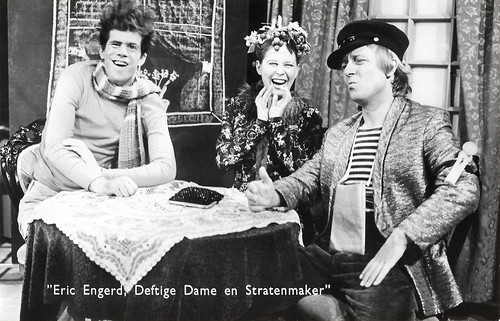
Dutch postcard by Vara. Photo: Fotoatelier Nederlandse Omroep Stichting. Joost Prinssen as Erik Engerd (Eerie Eric), Wieteke van Dort as Deftige Dame (Posh Lady) and Aart Staartjes as Stratemaker op zee (Bricklayer at sea), in De Stratemaker op zee show / The Bricklayer at Sea Show (Frans Boelen, Aart Staartjes, 1972).
De stratenmaker op zee show / The Bricklayer At Sea Show (1972-1974) was a groundbreaking children's show with Aart Staartjes, Joost Prinsen and Wieteke van Dort. The show was directed by Staartjes and Frans Boelen, with music by Harry Bannink. Important lyrical contributions were by Willem Wilmink; other lyricists were Karel Eykman (writing as Hendrik Blaak) and Hans Dorrestijn. Each instalment of De Stratemaker featured a collection of memorable songs ranging from hilarious to touching to naughty.

Dutch postcard by N.V. Vita Nova, Hank (N.B.). Photo: M.M. Chanowski, 1969. Meneer de Uil (Mr. Owl) in De Fabeltjeskrant / The Fables Newspaper (1968-1992).
In the long-running Dutch animation series, De Fabeltjeskrant (Cock Andreoli, 1968-1992), Meneer de Uil (Mr. Owl) reads from De Fabeltjeskrant (The Fables Newspaper). It is named after the links between the scenes, which show various animals (each has a first name and the species name) who live in a wood in partially stereotypical, partially human-like interaction. Major characters include Mrs. Stork, the self-proclaimed posh de facto mayor, her sycophantic messenger Zoef the Hare, the brothers Beaver, who construct about everything and the ever-scheming Lowieke the Fox; there are many minor ones. In 2005, De Fabeltjeskrant was chosen as the best Dutch TV series for kids in the 20th century.

Dutch postcard in the GTST-verzamelkaarten series by RTL4, no. 10. Photo: Govert de Roos. Katja Schuurman in Goede Tijden Slechte Tijden / GTST (1990-now).
Sexy and exotic Katja Schuurman (1975) was one of the first soap stars of the Netherlands. She showed durability as a TV host and as an actress in many TV series and films. Goede tijden, slechte tijden / Good Times, Bad Times, also known as GTST, began on 1 October 1990 on RTL 4 and is now the longest-running Dutch soap opera. The program was the first daily (every workday) soap in the Netherlands and Europe. The soap is produced by Joop van den Ende, and to date, over 7,000 episodes have been broadcast. It was initially based on the Australian soap The Restless Years; however, it switched to original scripts during the third season and onwards. In 2014, in a Christmas Day episode, there was a gay marriage in the soap opera when the on-screen couple played by Ferry Doedens and Dave Mantel decided to get married; this was the first time this happened in a Dutch TV show.

Dutch postcard by Vita Nova, Schiedam. Sent by mail in 1968. Hetty Blok and Leen Jongewaard in Ja zuster, nee zuster / Yes Nurse, No Nurse (1966-1968).
Hetty Blok was the sweetly anarchistic Sister Klivia in the TV series Ja zuster, nee zuster / Yes Nurse, No Nurse (1966-1968) written by Annie M.G. Schmidt. Her co-star was Leen Jongewaard as the burglar Gerrit and his granddad, Opa. Their songs, like the Twips and M'n opa, became evergreens in the Netherlands. The series deals with the fortunes of the residents of the Klivia Retirement Home on Primulastraat, who regularly clash with the grumpy neighbour Boordevol. In the retirement home itself, where Sister Klivia rules the roost, live the engineer, the wigmaker Jet, the boys Bobby and Bertus, and later also Gerrit the burglar. The series was broadcast by VARA from 3 September 1966 to 7 September 1968, in two seasons of ten episodes. The series was originally created for young people but was also very popular among adults.

Dutch postcard by Boomerang, Amsterdam, 2002. Photo: NAA. Golden Earring in Toppop (Rien van Wijk, 1970-1988).
AVRO's Toppop - in short: Toppop - was the first weekly pop program on Dutch television. The AVRO broadcast the program from 22 September 1970 to 27 June 1988. The initiator and director of Toppop was Rien van Wijk. The idea for the program was copied from the British Top of the Pops. Ad Visser kept, until 1985, the presentation of AVRO's Toppop. Toppop was mainly filled with images of pop artists performing their latest hit in the Toppop studio. If artists were not available for a gig in the studio, a camera crew went to film them at their place. If that failed, there was also the jazz ballet led by Penney de Jager to replace the act's images. For many Belgians and Dutch, AVRO's Toppop was the primary source of information in the field of pop music. Ad and Penney thus were for many the epitome of rock 'n' roll. With the advent of the video clip and the forerunners of MTV, the popularity of Toppop declined. However, in 2000, Toppop was chosen as the TV program of the century in a Dutch poll.

Dutch postcard by Gebr. Spanjersberg, Rotterdam / Voka, Arnhem. Cor Witschge in Pipo de Clown (1958-1980).
Pipo de Clown is a character created by writer and artist Wim Meuldijk. Pipo became famous as the lead character of a popular early Dutch television series also written by Meuldijk, and which was subsequently popularised in films and on records. The best-known of the Pipo actors was Amsterdam actor Cor Witschge, who played the part in the television series from 1958 to 1968 and from 1974 to 1980. The regular Pipo cast often performed in theatres and for company occasions. Pipo returned to the mainstream in the film Pipo en de p-p-Parelridder (Martin Lagestee, 2003).

Dutch postcard by NCRV. Photo: NCRV / Instituut voor Beeld en Geluid. Willeke Alberti in the Dutch TV series De kleine waarheid / The Small Truth (Willy van Hemert, 1970–1972).
For more than 60 years now, Willeke Alberti (1945) has been a very popular singer in the Netherlands. During the 1960s, she was a teen idol with several #1 hits. Later, she starred as an actress on stage, in popular films and on TV in the popular series De kleine waarheid / The Small Truth (Willy van Hemert, 1970–1972). Through the years, Alberti has become embraced in the Netherlands as a gay icon, due to a combination of her song repertoire, her durability, and her performances in support of manifold (gay) causes.

French postcard by D. Caplan Editeur, St. Nicolas d'Aliermont, no. 3. Image: Joop Geesink / Dollywood. Loeki the Lion and his friend Piep the Mouse
Loeki de Leeuw (Loeki the Lion) was an animated puppet who appeared on Dutch public television from 1972 to 2004. He appeared in ultra-short sketches, often even without any text, and he was noted for his clumsiness and his catchphrase, "Asjemenou". KGF Vissers at IMDb compares the sketches with 'a one-line newspaper cartoon'. Loeki was named after the famous International football player Louis Biesbrouck (Loek), but it is also said that his name is a derivation of the verb to look. Dutch film producer and animator Joop Geesink (1913–1984) developed the character. Loeki came to national prominence when advertising was first allowed on Dutch television in 1972. Regulatory requirements had been drawn up in order that the public could make a clear distinction between the programmes and the adverts, and the solution chosen was a short break bumper which would signal the beginning and end of the advertisement breaks. These bumpers comprised humorous animations of Loeki and his friends, including Piep de Muis (Piep the Mouse), and were such a success with the public that Loeki soon started appearing in between individual commercials. Studio Geesink (aka Dollywood), who made the animations, estimate that over 8000 individual films were made, several of which survive on home-made VHS recordings which have been uploaded to YouTube. Loeki appeared in France (as Loeki le Lion), England (in the Westward TV region), Austria, Italy, Japan, and in the United States. Loeki is the mascot of the theme park Huis ten Bosch in Nagasaki. A Dutch advertising prize, the Golden Loeki, was named after him and continues to this day.

Dutch postcard by The Reader's Digest, Amsterdam. Sent by mail in 1970. Promotion for The Reader's Digest Reuzenrad van fortuin.
Willem Duys (1928-2011) was a Dutch radio and television presenter, commentator, and music producer. From 1963 until 1979, he presented Voor de Vuist Weg, the first talk show on Dutch television. In 1974, he received the Gouden Televizierring, one of the main Dutch TV awards, for this program. He regularly presented the Grand Gala du Disque and was a commentator for large tennis matches. For eight years (1962, 1963, 1974–1976, 1978, 1979 and 1983), he was the regular Eurovision Song Contest Commentator for Dutch television viewers.

Dutch postcard by Editions Altona, Amsterdam / Gebr. Spanjersberg, Rotterdam. Photo: Telefunken.
John Kraaykamp, Sr., was one of the most popular comedians in the Netherlands, praised for his perfect timing. For years, he formed a comedy team with Rijk de Gooyer as Johnny & Rijk. In the 1950s, they recorded the song 'Twee jongens op een gitaar' (Two Guys on a Guitar). It was the start of a long and successful partnership. Johnny and Rijk began to perform together on the radio and television. In the Spring of 1956, they joined the Weekendshow, a popular entertainment show on Dutch radio. In 1962, they got together again for Open het dorp (Open the village), an extremely well-watched TV benefit marathon presented by Mies Bouwman, in which they performed in their pyjamas. In the 1960s and 1970s, they performed regularly together on Dutch TV. In 1964, they began with the Johnny & Rijk shows. In their shows, Rijk was the ‘feeder’ and John the comedian. The duo also recorded a couple of hit singles, including 'De Bostella' (The Bostella), for which they received a gold record in 1968. They even had a show on German TV, Spass durch Zwei / Fun By Two (Bob Rooijens, 1970-1971). They both also played in more serious plays and films. From 1993 until 2003, Johnny starred in the successful sitcom Het Zonnetje in Huis opposite his son John Kraaijkamp, Jr.

Dutch postcard by Gebr. Spanjersberg N.V., Rotterdam. Sent by mail in 1967. Photo: Joop Doderer in Swiebertje (1955-1975).
In the Netherlands, Dutch actor Joop Doderer (1921-2005) was widely known as the tramp Swiebertje. He played the lead in the popular TV series Swiebertje that was broadcast for twenty years, from 1955 until 1975. He also appeared in many Dutch and some international films. The character Swiebertje is a lovable vagabond, and the TV show presents a comforting image of a simple rural past. His wanderings, during which he typically got in trouble but always found a happy ending, evoked romanticism and adventure. The show was the second-most popular show among Dutch children in 1966; the most popular was the more adult program Bonanza.

Dutch postcard by Uitgeverij Takken, Utrecht, no. AX 5985, 1964.
Funny-looking, reddish André van Duin (1947) is a famous comedian and actor in Dutch-speaking countries. He is also a singer, writer, and creator of television programs, and he starred in three Dutch film comedies. In 1964, he was discovered when he won the TV talent contest show Nieuwe Oogst (New Harvest) and started appearing as a guest on TV shows. In the 1970s, André van Duin set up his own Revue with Frans van Dusschoten as the straight man and Corrie van Gorp as the leading lady. These shows were televised for the TROS, and in 1975 Van Duin won an award for Dag dag heerlijke lach / Hello hello delicious laugh (1974-1975). André van Duin debuted as an actor playing an army recruit in the TV series Het meisje met de blauwe hoed / The Girl With The Blue Hat (Dick van 't Sant, 1972), featuring Jenny Arean. Very popular was the WWF-promoting TV series Animal Crackers (1988). Between 1993 and 1999, Van Duin made television shows for RTL. In 2016, he took over the presentation of the programme Heel Holland Bakt from Martine Bijl. In 2017 and 2019, Van Duin played in the TV drama series Het geheime dagboek van Hendrik Groen / The Secret Diary of Herman Groen, in which he starred alongside Kees Hulst and Olga Zuiderhoek.

Dutch postcard by Euro Color Cards, Rotterdam, no. ECC 1120. This is not a pin-up card, but a vintage postcard of a Dutch icon of the 1960s. Phil Bloom (1945) was not just another model; she is an artist, a one-time film actress and a Dutch legend.
Phil Bloom was the first person to appear completely nude on Dutch television, on 28 July 1967, as a presenter in the TV show Hoepla. Hoepla! was a controversial youth program by the VPRO in which music legend Jimi Hendrix, for example, also performed. The image of the naked Bloom caused a major uproar at the time, which made it into not only the Dutch but also the foreign press, and parliamentary questions were asked about the segment.

Dutch promotion card by JosPe, Arnhem / Fotodrukindustrie for the second national Walking tour to 'Het Dorp' (The Village) in Arnhem on Saturday 13 June 1964. Photo: Mies Bouwman during the fund-raising programme Open het dorp / Open the Village (1962).
Dutch TV Icon Mies Bouwman started her career on the very first broadcasting evening of the Dutch broadcasting association KRO (Catholic Radio Broadcaster) on 16 October 1951. Bouwman made her name as the host of the first large fund-raising programme on Dutch TV, Open Het Dorp / Open the Village. In this show, viewers were asked to donate money for charity in order to open a special village for people with disabilities. This show was broadcast live on 26 and 27 November 1962 and lasted 23 hours. Bouwman presented the entire show. Later, Bouwman developed and hosted Eén van de acht / One of the Eight, known in the UK as The Generation Game. She hosted numerous talk shows, as well as the Dutch version of This Is Your Life. Bouwman also appeared in one film, the family film Martijn en de Magiër / Martin and the Magician (Karst van der Meulen, 1973). Mies Bouwman was appointed a Knight in the Order of Orange-Nassau.

Dutch postcard by Art Unlimited, Amsterdam, no. C 2884. Photo: Erwin Olaf, 1986. Caption: Theo & Thea 'Happy Birthday'. Arjan Ederveen and Tosca Niterink in Theo & Thea (Robert Wiering, Pieter Kramer, 1985-1989).
Arjan Ederveen and Tosca Niterink were the stars of the classical satirical Dutch TV series Theo en Thea / Theo and Thea (1985-1989) and Kreatief met Kurk / Creative with Cork (1993-1994). Theo and Thea became hugely famous in the Netherlands, and a whole generation remembers the duo with the big front teeth. Although Theo & Thea was a children's programme, it also became popular among students. Incidentally, the series was not always popular with parents. The programme was criticised for its adult themes, such as drugs, sexual harassment and prostitution. Theo and Thea returned in the film Theo en Thea en de Ontmaskering van het Tenenkaasimperium / Theo and Thea and the Unmasking of the Toe Cheese Empire (Pieter Kramer, 1989). Arjan Ederveen later also made 30 minuten / 30 Minutes (1995-1997) and acted in the stage musicals 'Hairspray' and 'Lang en Gelukkig' (Happily Ever After) and in several films.

Dutch postcard by VARA-gids. Photo: VARA. Jan Ligthart as Merijntje Gijzen and Piet Römer as Flierfluiter in the TV series Merijntje Gijzens Jeugd / Merijntje Gijzen's Youth (Kees Van Iersel, 1974).
One of the best Dutch TV series ever was Merijntje Gijzens Jeugd / Merijntje Gijzen's Youth (Kees van Iersel, 1974), based on the regional novels by A.M. de Jong. De Jong incorporated many of his own childhood memories into the story surrounding Merijntje Gijzen. The series provides an authentic picture of the Brabant farm labourer environment of the early twentieth century, the poverty, the hard work, and the unassailable authority of the farmers.

Dutch postcard by NAA (Nederlands Audiovisueel Archief), Hilversum. Photo: KRO. Martin Perels as Wilbur Quant and Erik van 't Wout as Aristides Quarles van Ispen in Q & Q (Bram van Erkel, 1974).
Q & Q (Bram van Erkel, 1974) is a Dutch youth series that was broadcast by the KRO. The first series of 13 episodes (known as Een Mislukte Foto) appeared on screen in the autumn of 1974. In 1976, a second 13-part series followed (Kunst- en vliegwerk). Two years later, a shortened version of that series was released as a feature film. Both series were directed by Bram van Erkel. Harrie Geelen and Joop Stokkermans provided the script and music, respectively. The theme tune was sung by Robert Long. Q & Q is about two friends, Aristides Quarles van Ispen and Wilbur Quant. They live in the fictional village of Runkum. In both the first and second series, they stumble upon several criminals by chance. Because they are only half-believed by the adults, particularly the police, they decide to investigate themselves, aided by Aristides' great-uncle 'Grandpa' Reinier Quarles van Ispen (Bob de Lange), as well as Juultje (Maélys Morel), Wilbur's sister.

Dutch postcard by Boomerang, no. P20-09. Photo: Comedy Central. Tim Haars, Huub Smit, Wesley van Gaalen, Peter Vernhout, Steffen Haars and Flip van der Kuil in New Kidz (Steffen Haars, Stef van der Kuil, 2007-2011). Caption: Greetings from Brabant.
New Kids is a Dutch television series. First broadcast on Flabber.nl in December 2007, it became a hit on the internet, where the first seven episodes combined were viewed more than three million times. As a result, the second season was broadcast on 101 TV, BNN's digital youth channel. In 2009, Comedy Central aired new episodes of season 3 on its channel. This led to a breakthrough with audiences in the Netherlands and Belgium. The series, written by Steffen Haars and Flip van der Kuil, centres on a group of 'bad' street youths from the North Brabant village of Maaskantje. The television series was followed by two feature films, New Kids Turbo (Steffen Haars, Flip van der Kuil, 2010) and New Kids Nitro (Steffen Haars, Flip van der Kuil, 2011).

Dutch autograph card by NCRV-TV. Photo: NCRV. Fred Benavente, Ted de Braak, Henk van der Horst, Alexander Pola and Jan Fillekers in the Dutch satirical show Farce Majeure (1966-1986).
Farce Majeure was a Dutch satirical and musical television program from the NCRV featuring Alexander Pola, Fred Benavente, Ted de Braak, Jan Fillekers, and Henk van der Horst. The music for many of the songs is by Harry Bannink. The first series of broadcasts ran from 1966 to 1976. A second series ran from 1983 to 1986. The title Farce Majeure is a pun on the French term 'force majeure', which means major force. However, 'farce' in French means 'joke', so 'farce majeure' can be translated as 'super joke'.

Dutch postcard by Sales Promotion Spits, Blaricum. Photo: ASA, Amsterdam / Max Appelboom Producties B.V. Maroesja Lacunes and Ton Lensink in Ti-Ta Tovenaar / Tita the Wizard (Ton Lensink, 1972).
Ti-Ta Tovenaar / Tita the wizard (1972-1974) is a Dutch children's television series originally broadcast by the NOS from 1972 to 1974. It is set in a castle in the clouds, where Tita (Ton Lensink), the absent-minded wizard, lives with his daughter Tika (Maroesja Lacunes). She learns how to conduct magic, but her spells often have a different outcome since her father is so absent-minded. Ti-Ta-Tovenaar was broadcast in the Netherlands starting 1 October 1972. It was a daily series. Each episode lasted about five minutes and was broadcast at 18:45 or 18:55, just before children's bedtime, and was broadcast simultaneously by the NOS on the channels Nederland 1 and Nederland 2. Most episodes were concluded by Tika and sometimes by her father, with the line "We'll see about that tomorrow." Ton Lensink was also the director. The series was popular; comic books and records were released, dolls were sold, and later, magical lanterns as well. The series ran for only two seasons (1972-1974) but has been repeated many times since.

Dutch postcard. Berend Boudewijn.
Berend Boudewijn (1936) is a Dutch actor, theatre and television director, and television presenter. In the Netherlands, he directed both theatre and television from 1960 onwards. Additionally, he presented TV and radio programs from 1961. For television, he directed hundreds of programs, with a preference for drama and cabaret. In 1973, he won the Televizierring for presenting the innovative and popular quiz De Berend Boudewijn Kwis (De BB-Kwis), which was broadcast simultaneously in the Netherlands and Belgium during the final season (1974-1975).

Dutch Christmas card by VARA, 1991. Caption: On behalf of VARA, happy holidays and... a healthy and prosperous 1992. Dutch TV presenters Sonja Barend and Astrid Joosten.
Sonja Barend (1940–2026) was a Dutch television personality who worked for television from 1966. She hosted one of the nation’s first talk shows, Sonja (1974–1975). From 1977, she developed her style and became the Dutch 'talk show queen', with her weekly talk show attracting millions of viewers. She was noted for her combination of emotional warmth and sharp questioning – until then unheard of on Dutch TV. Her shows broke taboos and allowed ordinary people a voice in public dialogue. She was outspoken on political and ideological topics, and television viewers either loved or hated her. She retired from television in 2006, after four decades of television making. Barend died on 11 April 2026, at the age of 86.
Astrid Joosten (1958) is a Dutch television personality and presenter. She is known for the magazine programme Jongbloed en Joosten (1988-1990), and has been presenting the very popular quiz show Twee voor Twaalf since 1991! Twee voor Twaalf / 2 for 12 is a general knowledge quiz in which the participants, teams of two players, must answer twelve questions. Hence the name: 2 for 12. They must then guess a word from the twelve initial letters of the answers. Joosten also starred in Off Screen (Pieter Kuijpers, 2005) and other films and TV series. In 2017, Astrid Joosten was honoured as a Knight of the Order of Orange-Nassau for her extensive work on Dutch television over the past 25 years and her commitment to various charities.

Dutch postcard by VPRO- televisie, Hilversum, no. 574. Dolf Brouwers as Sjef van Oekel in Van Oekel's Discohoek (1974-1975).
Sjef van Oekel is a fictional character played by Dolf Brouwers who appears in television series by Wim T. Schippers. The character later also became the protagonist in a celebrity comic strip, drawn by Theo van den Boogaard and written by Wim T. Schippers. Schippers conceived the character of Van Oekel in 1972 when he saw the name on a car accessories company in Reet, Belgium. Harry Touw, who played the character Fred Haché in the Wim T. Schippers universe, suggested his friend Dolf Brouwers for this role. Brouwers christened him Sjef. Van Oekel is always dressed in a black suit with a bow tie, wears large black glasses, and has a small moustache. He often expresses himself in archaisms and employs rhetoric. The character first played minor roles in Barend Servet's television series in 1972. Van Oekel soon became very popular, as did his catchphrases, including "reeds" (already), "pardon reeds" (pardon alreadys), "dat ben ik dus" (that is me), and "ik word niet goed" (I'm not feeling well). Van Oekel also regularly sang and became nationally known with the hit 'Zuurkool met vette Jus' (Sauerkraut with Fatty Gravy, 1973). He sang the song from behind a heavily laden table, after which he finally collapsed to the ground amidst the plates and dishes. Eventually, he got his own television program, Van Oekel's Discohoek (1974-1975), conceived, written, compiled, and directed by Wim van der Linden, Wim T. Schippers, and Ellen Jens. In the disco show, Van Oekel hosted pop artists who performed, clearly lip-syncing. Regularly, an office cabinet would fall over, or Van Oekel would trip over a cable, causing the sound to cut out. The performance by the American Donna Summer with her song 'The Hostage', in which she answers a ringing telephone halfway through, is legendary.

Dutch press photo by NOS. Koos Postema in Klasgenoten / Classmates (1985).
Koos Postema (1932-2026) was a Dutch reporter, television and radio presenter. In 1960, he started as a reporter for the VARA radio program Dingen van de dag / Things of the day. The switch to television was made in 1963 when he became a reporter for the news program Achter het Nieuws / Behind the News. In a program featuring all broadcasters during the 1963 Elfstedentocht, he covered this legendary iceskating race from the studio in Bussum, smoking heavily. In 1969, Postema got his own TV talk show, Een klein uur U / A little less than an hour U, for which he won the Silver Nipkow Disc that same year. In 1971, the program changed to Een groot uur U / A great hour U, with controversial and taboo-breaking broadcasts about abortion, the contraceptive pill, assisted suicide, transsexuality, and a sensational broadcast about pedophilia with former PvdA Senator and child pornography collector Edward Brongersma. In addition to his TV work, Postema remained active as a radio presenter. From 1977 to 1979, he was the main presenter of VARA-Visie alongside W.L. Brugsma. From 1980 onwards, he also started working for the NOS. Postema was a commentator for the live television broadcast of the succession to the throne in 1980 with Jaap van Meekeren. One of the most successful television programs Postema produced was Klasgenoten / Classmates (1985-1989). Ultimately, 175 episodes of Klasgenoten were produced. Later, he was sought after, particularly in the conference circuit, as a moderator, discussion leader, or presenter. In 2012, he made his acting debut in the feature film Het bombardement (Ate de Jong, 2012) with a small role as a minister. On his eightieth birthday, he was given his own Koos Postemalaan in the Media Park in Hilversum. He passed away on 21 February 2026 in Hilversum, at the age of 93.

Dutch postcard by Art Unlimited Amsterdam, no. C 8891. Image: VPRO / Jiskefet. Annet Malherbe, Herman Koch, Michiel Romeyn and Kees Prins in Jiskefet (2000).
Jiskefet was a Dutch absurdist-satirical series broadcast by the VPRO from 1990 to 2005. The word 'jiskefet' is Frisian for 'garbage can' and was suggested as the title by the mother of the first director, Pieter Verhoeff, on his birthday. The series was created by Kees Prins, Michiel Romeyn, and Herman Koch. The program was more or less a continuation of the radio program Borát, also from the VPRO, featuring many sketches and improvisations, with Annet Malherbe and Marjan Luif, among others. Most seasons of the series consisted of standalone sketches. Series featuring self-contained subjects were also regularly produced. In 2025, Jiskefet received an Honorary Silver Nipkow Award.

Dutch press photo.
Dutch television comedian, singer and actor Paul de Leeuw (1962) gained national fame in the late eighties and early nineties with television shows for broadcasting company VARA. He often came into the public eye with satire about Dutch show business personalities and taboo subject matter. His shows would often feature musical acts, many of which managed to gain national fame after they had been in De Leeuw's show. De Leeuw also had many hit singles himself in the Netherlands. In an episode in his variety show De Schreeuw van de Leeuw / The Cry of the Lion, the young singer René Klijn spoke about his diagnosis, AIDS. Due to the candid conversation about his life, the virus, and ultimately his death — with his friends and his father among those in the audience — this episode won several awards. De Leeuw is best-known internationally for presenting the results of the Dutch televote in the Eurovision Song Contest 2006. A spokesperson is supposed to present the televote by simply thanking the presenters, performers and fans, before giving the result, but instead De Leeuw gave his mobile phone number to the presenter Sakis Rouvas live on-air, and made ad-lib comments, which somewhat lengthened the Dutch results as compared to other countries. De Leeuw also remarked that Rouvas and his female co-presenter, Maria Menounos, reminded him of Will & Grace. As the results were live and required for the contest to continue, De Leeuw could not be cut off until he finished giving the voting results. De Leeuw's actions resulted in negative comments from the commentators, with the BBC's Terry Wogan calling the act "pathetic" and asking "Who selected this eejit?" during the United Kingdom coverage of the contest. De Leeuw presented the votes again for the Netherlands at the 2007 contest, but this time did not cause as much of a stir as he had the year before. Until mid-2009, he hosted the weekly chat and comedy show Mooi! Weer De Leeuw / Beautiful! The Lion Again. Paul de Leeuw continues to present TV shows, sometimes with considerable success.

Dutch postcard by Gebr. Spanjersberg, N.V., Rotterdam, no. 1. Photo: NCRV. Still from the TV series Gompie en zijn vriendjes / Gompie and his Friends (1966-1972), written by Jaap Molenaar.
Gompie en zijn vriendjes / Gompie and his Friends is a television series for preschoolers. Jaap Molenaar was the writer of the series and also one of the main actors. Gompie is a walrus who experiences many adventures together with his friends and Daddy Wirrewarre, the Viewing Cabinet Man (Jaap Molenaar). Gompie's most typical catchphrases are: "Gómpie..., how sad..." and "Gompie wants a hug". They were spoken by Jan Borkus. Gompie's friends are other puppets: Peentje is a mischievous little boy with red hair, Majolica plays a refined lady, and Ritsaert is a fox. They all live in Daddy Wirrewarre's house. The puppet series was broadcast by the NCRV from 5 October 1966 to 25 November 1972. Initially, the program was part of the children's program Het Koerhuis van Papa Wirrewarre / Daddy Wirrewarre's Courier House. In 1967, it became part of the program Kijkkast / The Viewing Cabinet.

Dutch promotion card by Jan Maassen, Zwolle. Caption: Ome Willem (Uncle Will) and his nephew. Edwin Rutten in De film van Ome Willem / Uncle Will's Movie (1974-1989).
De film van Ome Willem / Uncle Will's Movie is a children's program broadcast by the VARA between 1974 and 1989, featuring songs and short performances. Each episode began with Ome Willem (Edwin Rutten) walking in through a paper door and then exuberantly greeting the children in the studio and the children watching. The paper door featured a different motif in every episode. Next, Ome Willem received drawings from the children, greeted the Goat Herders, and kissed the big grey Goat Herder on the head. After this, Ome Willem climbed onto his drum kit and sang 'Luister even wat ik vraag?' (Listen to what I'm asking?) accompanied by the Goat Herders, with the peculiar line "Do you also want a poop sandwich?" Subsequently, a sketch was performed by Ome Willem, Teun, Toon, and August, in which the theme was introduced, and a conflict often arose between the characters. Famous was the happy ending, accompanied by the song 'Deze vuist op deze vuist' (This Fist on this Fist) at the end of the program. The music for the program was provided by Harry Bannink's combo, who sat at the piano for years as the orchestra's chief Goat Herder, with Uncle Will on the drums. The actors Jennifer Willems (Teun), Aart Staartjes (Toon), and Pieke Dassen (August) played the roles of headstrong children in the performances.

Dutch promotion card by Larcom Grafische Produkten. Photo: Theo Hogenboom. Wieteke van Dort in her creation Aunt Lien. Signed in 1999.
Wieteke van Dort (1943-2024) was born in Surabaya, the then Japanese-occupied Dutch East Indies, now Indonesia. In 1957, Wieteke and her family were on leave in the Netherlands. Interested in acting, Wieteke left for the Toneelschool (Academy of Dramatic Arts) in Amsterdam. A glowing career followed in which Van Dort played a variety of roles and sang songs to music by such prominent Dutch composers as Joop Stokkermans and Harry Bannink. In the late 1960s, she concentrated on radio and television with great success. She was a key figure in the development of Dutch youth television. With Willem Nijholt, she starred in the youth series Oebele (1968-1971) as the duo Aagje and Koen, two adults in the county of Oebele, where children call the shots in the village square. This was followed by roles in the De Stratemakeropzeeshow / The Bricklayer At Sea Show (Frans Boelen, 1972-1974), in a famous trio with Aart Staartjes and Joost Prinsen. In this groundbreaking youth programme, Wieteke van Dort played, among others, the distinguished lady who accidentally farts. De Stratemakeropzeeshow was followed by J.J. de Bom voorheen: 'De kindervriend' / J.J. de Bom formerly: ‘The children's friend’ (Frans Boelen, 1979-1981), in which children's problems were treated with sketches and songs. Wieteke played the always positive social worker Titia Konijn. Again later, Van Dort was involved in the creation of the classic educational youth programme Het Klokhuis / The Applecore, where she played the roles of the market trader and Queen Beatrix. During De Stratemakeropzeeshow, she invented the character Tante Lien (Aunt Lien). The character is strikingly similar to the many Dutch East Indies ladies who came to live in the Netherlands in the 1950s. They merged into Dutch society, but they also held on to their old customs and habits. She got her own TV show: The Late Late Lien Show (Frans Boelen, 1979-1981). The show was set in a living room setting and was full of jokes, skits, songs, and stories full of nostalgia. In her biography 'Kind van twee culturen' (Child of Two Cultures), written by journalist Hans Visser in 2018, she said Lien has been good for the self-awareness of many Dutch Indonesians. In 1999, Queen Beatrix appointed her a Knight of the Order of Orange-Nassau.

German autograph card by RTL Television.
Linda de Mol (1964) is a Dutch television presenter and actress. She is the daughter of singer John de Mol Sr. and sister of TV-producer and Endemol co-founder John de Mol, and has frequently appeared in his productions. Linda made her television debut at age 12 in Wat je zegt ben je zelf (1976), an AVRO programme largely made by children. In 1984, she resurfaced on Sky Channel, hosting English-language music programmes, some of Endemol's first productions. From 1986 to 1989, De Mol announced cartoons on The DJ Kat Show. She became best known for presenting programs for the TROS and later RTL and Talpa, such as Love Letters (1990-2005), and Miljoenenjacht / Deal or No Deal (2000-now). Linda de Mol also presented programs for German television for many years, including the very popular Traumhochzeit (1992-2000), the German version of Love Letters. Additionally, she acted in the television series Gooische Vrouwen (Will Koopman, 2005-2025) and Spangen (1999) and played the lead role in some feature films, including Ellis in Glamourland (Pieter Kramer, 2004) and the thriller Terug naar de kust / The Dark House (Will Koopman, 2009). In 2003, she launched her own monthly glossy, LINDA. From 2015 through 2019, De Mol played a leading role in her self-created series Familie Kruys (Will Koopman, a.o., 2015-2019). In 2017 and 2018, she presented the program Oh, wat een jaar!, which she also created. During these years, she was the most important presenter for RTL 4 with her successful programs.
Sources: Wikipedia and IMDb. Check out De Schatkamer at Beeld en Geluid (Dutch).

No comments:
Post a Comment