Cinema in 1906

French postcard by Croissant, Paris, no. 3672. Photo: Film Pathé. Publicity still for Un drame à Venise / Venetian Tragedy (Lucien Nonguet, 1906). Caption: In the Name of Honour.
In the early Pathé Frères production Un drame à Venise / Venetian Tragedy, one of the rich palaces of Venice is the setting for a drama of smouldering love and hate. In the Middle Ages, an important lord was not loved by his wife. Despite the sumptuous wealth her husband surrounds her with, the noble dame can only think about a young and handsome Romeo. The lover is surprised by the husband, who kills him, and Romeo ends up in a canal. The noble lady escapes her death when her husband is stopped by her miraculous beauty... The film is partly in colour.

Reprint of original French postcard by Croissant, Paris, no. 3672. Photo: Film Pathé. Publicity still for Un drame à Venise / Venetian Tragedy (Lucien Nonguet, 1906). Caption: Public entertainment.
In the 16th century, an important lord was not loved by his wife. Despite the sumptuous wealth her husband surrounds her with, the noble dame can only think about a young and handsome Romeo. A beggar who earlier on had been rewarded by the lord betrays the adulterous couple.

French postcard by Croissant, Paris, no. 3871. Photo: Gaumont phot. Publicity still for Mignon (Alice Guy, 1906). Caption: [Lothario to Mignon:] Have you suffered, have you wept? Have you languished without hope?
Alice Guy directed nine (or seven - the sources differ) scenes from the opera 'Mignon' for a synchronised sound film, in the Gaumont Chronophone Studio, Paris, in 1906. 'Mignon' (1866) is an opéra comique in three acts by Ambroise Thomas. The original French libretto was by Jules Barbier and Michel Carré, based on Goethe's novel 'Wilhelm Meisters Lehrjahre'.

French postcard by Croissant, Paris, no. 3871. Photo: Gaumont. Publicity still for Mignon (Alice Guy, 1906). Caption: Goodbye, Mignon, be brave! Don't cry!
Alice Guy (1873-1968) is generally considered to be the world's first female director. She was born in 1873 in Paris. In 1896, she entered the film business as a secretary for Léon Gaumont at Gaumont-Paris. The next year, Gaumont changed from manufacturing cameras to producing films, and Guy became one of its first directors. She averaged two two-reelers a week and impressed the company so much with the output and the quality of her productions that by 1905, she was made the company's production director, supervising the company's other directors. After her first film in 1896, she directed and produced or supervised almost six hundred silent films ranging in length from one minute to thirty minutes, the majority of which were of the single-reel length. In addition, she also directed and produced or supervised one hundred and fifty synchronised sound films for the Gaumont Chronophone. Alison McMahan at Women Film Pioneers Project: "Her Gaumont silent films are notable for their energy and risk-taking; her preference for real locations gives the extant examples of these Gaumont films a contemporary feel." In 1907, Alice Guy married Herbert Blaché, an Englishman who ran the company's British and German offices. The pair went to the U.S. in 1909 to set up the company's operations there. In 1910, she and her husband set up their own production company in New York, the Solax Film Co. (1910-1914), and built a studio in Fort Lee, New Jersey. After a period of critical and financial success, her company's fortunes declined, and she eventually shut down the studio. Although she secured work directing films for several major Hollywood studios, she returned to France in 1922 after her divorce from Blaché. She was never able to secure any directorial jobs there and never made a film again.

French postcard by Croissant, Paris, no. 3890. Photo: Gaumont phot. Publicity still for Carmen (Alice Guy, 1906). Caption: "Toreador, be on guard, and dream as you fight. May a dark eye watch you, and may love await you."
On this card for the 1906 film Carmen, directed by Alice Guy for Gaumont, Carmen flirts with the toreador before his fight with the bull: "Toréador, en garde, et songe en combattant. Qu'un œil noir te regarde et que l'amour t'attends." The film consisted of 12 so-called phonoscènes, an early sound-on-disc system. The film is presumed lost. It is unknown who the singers are. Allison MacMahan told us that this version of Carmen was among the earliest phonoscenes made. No performers were listed, only 'Opera Français'.
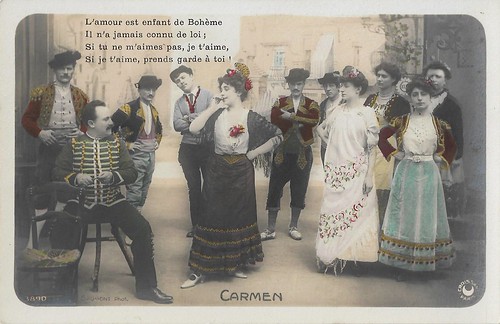
French postcard by Croissant, Paris, no. 3890. Photo: Gaumont Phot. Scene from Carmen (Alice Guy, 1906). Caption: [The gypsy girl Carmen challenges Don José:] "Love is a Bohemian child, it has never known any law; if you do not love me, I love you, if I love you, beware."
Mark the half-visible logo Elge behind the woman on the right. It stands for L.G., the initials of Gaumont owner and founder Léon Gaumont. Croissant also released the coloured series of postcards for pre-1910 Pathé Frères movies.
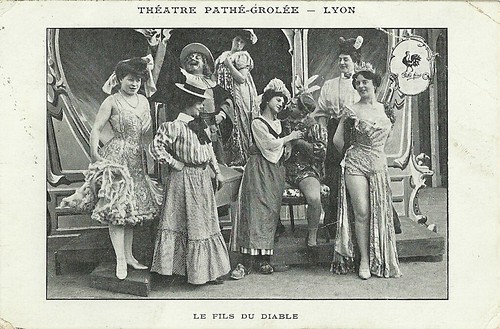
French postcard by Théâtre Pathé Grolée, Lyon. Photo: Pathé Frères. André Deed in Le fils du diable / The Devil's Son (Charles Lucien Lépine, 1906). The cinematography was by Segundo de Chomón.

French postcard by Théâtre Pathé Grolée, Lyon. Photo: Pathé Frères. Georges Vinter in Le tour du monde d'un policier / A Policeman's Trip Around The World (Charles Lépine, 1906). Special effects by Segundo de Chomón.
In Le tour du monde d'un policier (1906), a police detective has many adventures as he travels to Suez, Bombay, Yokohama, and the U.S.

French postcard by Théâtre Pathé Grolée, Lyon. Photo: Pathé Frères. Publicity still for L'espionne / The Spy (N.N., 1906), with Louis Pagliéri.
In L'espionne (1906), the daughter of a Cossack, Vera, loves a young tartar who is the enemy of her father. She betrays her father to save the life of her lover, but loses her own life instead.

French postcard by Cinema Pathé Frères. Photo: Pathé Frères. Fernand Rivers as the professor in La Peine du talion / Tit-for-Tat (Gaston Velle, 1906).
In La peine du talion (1906), a professor and two students are walking in a grove, looking for rare butterflies. They capture some, which turn suddenly into pretty girls. In revenge, the girls turn him into a butterfly. After a brief examination, the teacher is sentenced to retaliation, a gigantic plug pricked with a pin. But the students ask pardon for their teacher. The scene ends in a splendid apotheosis.

French postcard by Cinema Pathé Frères. Photo: Pathé Frères. Publicity still for Chiens contrebandiers / Dogs Used As Smugglers (Georges Hatot, 1906).
The screenplay for Les chiens contrebandiers (1906) was written by André Heuzé. In a Spanish village, not far from the border, lives Manuela. She and her companions make lace, which is smuggled by the men. Manuela has a lover who has a rival, Antonio. After his advances are rejected, Antonio swears revenge. In the following scene, the smugglers are gathered in a cave known only to them. This is where they place the lace on the dogs who have to bring it safely to the other side of the border. Meanwhile, Antonio has warned customs, and under his guidance, they pursue the dogs. However, the intelligent beasts flee, crossing hills, woods, thickets, throwing themselves to swim, barely taking time to breathe, thinking only of their precious bales. Sometimes a bale falls, but it is immediately picked up by the following dog. The smugglers were warned of the treachery by one of them. Hidden in the timber, they wait for the customs passage. Shots are exchanged, and on both sides, there are wounded. This diversion allows the dogs to get ahead. The border is near, and in a final effort, they cross the post and safely recover the goods that are entrusted to them.
Theatre in 1906

British postcard by Rotary Photo E.C., no. 4222F. Photo: Foulsham & Banfield. Lewis Waller in the play 'Robin Hood' (1906) by Henry Hamilton and William Devereux.
Lewis Waller (1860-1915) was best known as a matinee idol in the popular romantic plays of his day. He also worked as a playwright and a stage manager, and appeared in several films.

British postcard by Rotary Photo E.C., no. 4359 G. Photo: Foulsham & Banfield. Evelyn Millard as Lady Marian in the British play 'Robin Hood', first performed in November 1906.
Evelyn Mary Millard (1869-1941) was an English Shakespearean actress, manager of actors and ‘stage beauty’ in the late nineteenth and early twentieth centuries. She is mainly known for creating the role of Cecily Cardew for the premiere of Oscar Wilde's play 'The Importance of Being Earnest' in 1895.

British postcard by J. Beagles & Co., no. 354 R. Photo: F.W. Burford. Herbert Beerbohm Tree as Nero in the stage production 'Nero' (1906).
Stephen Phillips’ play 'Nero' opened at His Majesty’s Theatre, London, in 1906. In addition to Herbert Beerbohm Tree as Nero, Constance Collier played Poppaea, while Tree's wife, Helen Maud Holt, played Agrippina, mother of Nero.

British postcard by Beagles & Co., London, no. G 407. Photo: F.W. Burford. Constance Collier as Poppaea and Herbert Beerbohm Tree as Nero in the stage production 'Nero' (1906). Constance Collier created the part of Poppaea for the stage. Stephen Phillips’ 'Nero' opened at His Majesty’s Theatre, London, in 1906.
Constance Collier (1878–1955) was an English stage and film actress and later one of Hollywood's premier drama and voice coaches. In a career that covered six decades, she evolved into one of London’s and Broadway’s finest tragediennes. Although she appeared in several silent British and American films, her career in the cinema really took off in her senior years when Collier appeared in well-regarded supporting roles in more than twenty Hollywood productions.

British postcard by Rotary Photo E.C., no. 3287B. Photo: Burford. Herbert Beerbohm Tree as Mark Antony and Constance Collier as Cleopatra in the Shakespeare play 'Antony and Cleopatra', first performed in 1906. Also with Hugh C. Buckler as Eros and Alice Crawford as Charmian.

British postcard by The Philco Publishing Co., London, no. 3316 E. Photo: Bassano. Constance Collier as Cleopatra in the stage production 'Antony and Cleopatra' (1906).
Just after the turn of the century (1901), Constance Collier was invited to join the theatre company of the esteemed Herbert Beerbohm Tree, who had been searching for a comparably tall leading lady to play opposite him. In 1905, Collier married handsome English actor Julian Boyle (stage name Julian L'Estrange). They performed together for many years until he died in 1918 in New York from the deadly Spanish influenza. In 1906, Beerbohm Tree's extravagant revival of 'Antony and Cleopatra' opened at His Majesty's Theatre, with Tree as Mark Antony and Constance Collier as Cleopatra, a performance for which she received much critical praise. Collier was now established as a popular and distinguished actress.

British postcard by Holland Rowbottom, Theatrical Printer, Bournemouth & London. Photo: publicity still for the stage play 'The Girl Who Lost Her Character'. Caption: Take her away.
The play 'The Girl Who Lost Her Character' by Walter Melville was produced in 1906. The Melville family were successful in their acting, writing and management of several theatres in London and the provinces. Perhaps the most spectacular success of the family was the partnership between Frederick and Walter Melville, who jointly ran the Lyceum, the Prince’s Theatre and other major theatres, mainly in London. Their melodramas, most notably the ‘Bad Women Dramas’, filled the Melville theatres after the pantomime season, continuing a long theatrical tradition well into the twentieth century.

French postcard by Croissant, Paris, no. 3312. Photo: Henri Manuel. Sarah Bernhardt in the play 'La Vierge d'Avila' (1906) by Catulle Mendès. The postcard was mailed in 1907. Caption: VIth Tableau. That lily is a Pater [nostrum], that jasmine an Ave [Maria]...

French postcard. Photo: Henri Manuel. Sarah Bernhardt as Soeur Therese in 'La Vierge d'Avila' in a 1906 performance at Theatre Sarah-Bernhardt. 'La Vierge d'Avila' was composed by Reynaldo Hahn and written by Catulle Mendès.

French postcard in the Collection Photo-Programme, Paris. Publicity still for 'Jules César' (Julius Caesar) by William Shakespeare, performed at the Théâtre de l'Odéon in Paris. First night at 4-12-1906. Caption: Translated and reworked by Louis de Gramont. 10th Tableau. The Battlefield. The voluntary death of Cassius, struck on his command by Pindarus.
In this production of 'Jules César' (Julius Caesar), Edmond Duquesne played Caesar, Maxime Desjardins Brutus, Philippe Garnier Cassius, Édouard de Max Mark Antony, Ballot Pindarus, and Madeleine Barjac Calpurnia. Scenes: Lucien Jusseaume, music: Gustave Doret.

French postcard. Mounet-Sully, Albert Lambert, Louis Delaunay, Louis Ravet and Mlle Lucie Brille in the stage play 'Polyeucte' by Pierre Corneille, staged at the Théâtre de la Nature in Cauterets on 11 or 12 August 1906.
In the stage play 'Polyeucte'(1906), Mounet-Sully played Polyeucte, Lambert Severus, and Lucie Brille Pauline. The play is based on the life of the martyr Saint Polyeuctus.

French postcard. Staging of the opera 'La Vestale' by Gaspare Spontini and libretto by Étienne de Jouy, performed at the Théâtre des Arènes in Béziers on 26 and 28 August 1906.
In the opera 'La Vestale' (1906), the lead singers were Valentin Duc (Théâtre de l'Opéra) as Licinius and Harriet Strasy (Théâtre de la Monnaie) as Julia. The set was designed by Jambon & Bailly, de l'Opéra. General director: M. D'Herbilly, conductor: Jean Nussy-Verdié, ballet director: Céline Rozier.

Danish postcard by Ed. Paul Heckscher, no. 2162. Egill Rostrup as the Norwegian King Haakon Herdebred (Haakon II) in the play 'Axel og Valborg' (1808-1810) by Adam Oehlenschläger. This postcard was mailed in 1907.
Danish actor, director and theatre historian Egill Barfod Rostrup (1876-1940) was the son of barrister and master carpenter Søren Kaspar William Rostrup and Vitta Kristiane Barfod. He was admitted to the Royal Theatre's drama school in 1896 and made his debut at the Royal Theatre in 1899. He then joined the Folketeatret (1899-1900), Casino (1900-1905) and Dagmarteatret (1905-1918). Rostrup made his film debut in 1911 and did two films with August Blom at Nordisk in 1913 and 1919. Yet, it was not until the early 1920s that he frequently appeared in a series of films with A.W. Sandberg. He made a significant contribution to theatre history research before obtaining his doctorate in 1921. He also began to work as a director, staging a long series of performances at the leading theatres and occasionally playing a role himself. His performances at the Royal Theatre around 1928-1930 were particularly noteworthy. Egill Rostrup was very interested in the ideas of the Russian Konstantin Stanislavski and in 1940 translated his work ‘An Actor's Work on Himself’ into Danish.

Danish postcard by Ed. Paul Heckscher. Martinius Nielsen in 'Axel og Valborg' by Adam Oehlenschläger, a tragedy in five acts written in Paris in 1806 and first printed in Copenhagen in 1810. In 1906, Martinius Nielsen produced and directed the play at the Dagmar Theatre in Copenhagen, with Adam Poulsen as Axel and Anna Larssen as Valborg. Nielsen himself played a Black Friar.
Danish actor and theatre director Martinius Nielsen (1859-1928) made his stage debut at Casino in 1880, where he remained until 1884. Then he followed his future wife, Oda Nielsen, to the Dagmar Theatre. He subsequently joined the Royal Theatre (1886–1889), returned to the Dagmar Theatre (1889–1894) and then joined the Folketeatret (1894–1897). From 1897 to 1909, he was the theatre director at the Dagmar Theatre, where he made it Copenhagen's leading theatre. From 1902 to 1905, he was also director of the Casino Theatre. Martinius made his film debut in 1910 with Nordisk Films Kompagni in Kean (Holger Rasmussen, 1910) and subsequently appeared as an actor in only one other film, Den hemmelige Traktat / The Secret Treaty (Alfred Lind, 1913). In 1914, he made his debut as a film director with the production company Dania Bio Film. Between 1914 and 1923, and with a peak in 1916-1918, he directed 17 films, mostly for Nordisk, and often with Valdemar Psilander in the lead.
Sources: Fondation Jérôme Seydoux-Pathé (French), Roberta and Simone Blaché (The Memoirs of Alice Guy Blaché), Alison McMahan (Alice Guy Blaché: Lost Visionary of the Cinema), Alison McMahan (Women Film Pioneers Project), Kinomata: la donna nel cinema, Les Archives du spectacle (French), Danskefilm, Wikipedia (Danish) and IMDb.
For the complete film La Peine du talion in full colour, see Vimeo. And check out last year's post, Back to 1905.

No comments:
Post a Comment