
German postcard by Ross Verlag, no. 1966/1, 1927-1928. Photo: Max Munn Autrey / Fox.

Austrian postcard by Iris Verlag, no. 913. Photo: Fox Film.
An interesting lineage
Sally Phipps was born as Nellie Bernice Bogdon on the 25th of May 1911 in Oakland, U.S.A.
Her parents were Albert Bogdon, a professional magician, and Edithe Lane.
Sally’s maternal grandmother, Nellie Cleary Phelps, was the daughter of one of the plural wives of William Wines Phelps, an early leader of the Latter Day Saint Movement and author of numerous Mormon hymns.
But Nellie distanced herself from Mormonism and became known for her civic activities in Oakland for many years, especially in connection with the well-being of working girls, the education and welfare of children, the chamber of commerce and the local elections. Her husband, Jacob Lane, edited several directories, including two of Hawaii, in 1888 and 1890, both dedicated to King Kalakaua, the penultimate Hawaiian monarch, whom he had met several times. The Lanes, incidentally, were famous writer Jack London’s friends.
In 1892, Nellie and Jacob adopted Sally’s mother, Edithe, who was not yet one year old.

Italian postcard by G.B. Falci Editore, Milano, no. 523. Photo: Max Munn Autrey / Fox Film Corp.
Winner of a beautiful baby contest
In 1913, Sally was placed in the house of neighbours Warren and Eva Sawyer, while her mother worked in an art photographic studio in San Francisco, as a colourist. That same year, she won a beautiful baby contest in Oakland.
The Sawyers worked at the Essanay film studios in Niles and suggested using Sally to play 'the baby' in a Broncho Billy short.
So, she made her film debut as Bernice Sawyer in Broncho Billy and the Baby (1915). Two other Western shorts opposite Broncho Billy followed: The Western Way (1915) and The Outlaw’s Awakening (1915).
Sally’s early film career ended following a serious stagecoach accident which happened during the filming of a picture, in which several people, including Eva Sawyer, were injured. Grandmother Nellie reckoned that the Essanay studios were not a safe place for a little girl and decided that Sally should live with her.
In 1916, Sally was chosen to take part with her grandmother in the 4th of July Celebration elaborate parade in Oakland, as an attendant to the Goddess of Liberty. The city was proud of its little movie star.

Italian postcard by G.B. Falci Editore, Milano, no. 529. Photo: Max Munn Autrey / Fox Film Corp.
A film contract at Fox
In January 1917, Albert Bogdon and Edithe Lane divorced, after several years of separation.
Albert enlisted in the U.S. Navy in April. He also gave up magic to build a new career as a lawyer. In 1924, he was elected State Senator of Colorado.
In 1922, Edithe remarried Albert Beutler, whom she later divorced in the 1930s. Sally and her brother Lane joined them, although they would never like their stepfather.
In 1924, the family lived in Los Angeles. A friend ot them was married to musician Danny Borzage. His brother was none other than famous director Frank Borzage, who arranged for Fox to give Sally a screen test.
It led to a movie contract, and the young girl was quickly renamed Sally Phipps.

Spanish postcard in the Kursaal series. Photo: Fox.

Italian postcard by G.B. Falci Editore, Milano, no. 352. Photo: Fox Film Corp.
Wampas Baby Star
Her film career at Fox started in 1925 with uncredited bit parts. She then appeared in two comedy shorts, Light Wines and Bearded Ladies (1926) and Big Business (1926).
Her career received a big boost when she was selected as one of the Wampas Baby Stars of 1927.
She got leading roles in Love Makes’Em Wild (1927), High School Hero (1927), Why Sailors Go Wrong (1928), The News Parade (1928) and None But the Brave (1928). She was also featured in the comedy shorts Girls (1927), The Kangaroo Detective (1927), A Midsummer Night’s Steam (1927), Cupid and the Clock (1927), Gentlemen Prefer Scotch (1927), Mum’s the Word (1927) and Hold Your Hat (1928). Her frequent co-star was then Nick Stuart.
In June 1927, Sally’s father, Senator Albert Bogdon, was shot dead by a jealous husband, who was finally convicted of involuntary manslaughter. Bogdon’s widow, Adele, was convinced it was a frame-up, arranged by his political enemies.
In 1929, Sally officially asked to have a legal guardian appointed, explaining that her stepfather badly handled her financial affairs. The Court ruled in her favour, and she moved out of her parents’ house.

German postcard by Ross Verlag, no. 3841/1, 1928-1929. Photo: Fox.
Fox loses interest in Sally
At the end of the 1920s, Fox had somehow begun to lose interest in Sally, and she had to face strong competition from Sue Carol, another Fox contractee and a Wampas Baby star of 1928. Carol had a certain likeness to Sally and even sported the same kind of hairdo at one time. They were similar in type and were assigned the same kind of roles.
In 1928, Sally was slated to star in a sort of sequel to The News Parade but, when the film was finally released in 1929 as Chasing Through Europe, she was nowhere to be seen, and it was Sue Carol who headed the cast with Nick Stuart.
At the end of 1928, Sally started work on Scarehead, a film about the newspaper world, for which Fox had high hopes. But the movie, directed by Fred Newmeyer, was shelved. Benjamin Stoloff was assigned to rework it, and it finally came out as Protection (1929), with Dorothy Burgess replacing Sally as the female lead.
Sally performed a song for Fox Movietone Follies of 1929 (1929), directed so far by Marcel Sano. When Fox’s executives realised that there were too many unrelated musical numbers and no plot, they called David Butler to the rescue. He was asked to replace Marcel Sano and to bring some coherence to the project. Butler quickly devised a story and shot some new scenes. As a result, Sally’s specialty act was edited out from the final cut. However, various Fox cuties, such as Sue Carol, Sharon Lynn, Lola Lane and Dixie Lee, appeared in Fox Movietone Follies of 1929. It was rather obvious that other female players were given more chances than Sally.
All she could get from Fox at the time were supporting roles in Joy Street (1929) and The One Woman Idea (1929). After the short Detectives Wanted (1929), the option on her Fox contract was dropped.

Italian postcard by G.B. Falci Editore, Milano, no. 654.

German postcard by Ross Verlag, no. 4492/1, 1929-1930. Photo: Fox.
Later acting career
Sally made a brilliant comeback on stage, as a movie-struck ingenue, in the Broadway hit 'Once in a Lifetime', which opened to rave reviews on the 24th of September 1930.
While playing in 'Once in a Lifetime', she appeared in her last film, a Vitaphone comedy short called Where Men Are Men (1931).
She left the play in May 1931 to marry Benedict Gimbel Jr., one of the wealthy brothers of a famous department store chain. In 1933, she decided to leave her philandering husband, and the divorce became final in June 1935.
After a Broadway flop, 'Knock on Wood', which lasted only 11 performances in 1935, Sally worked for a Shakespearean repertoire touring company in 1936.
At the end of the year, she was hired by the Federal Theatre Project in New York. She notably worked in clerical positions for their Research Department and performed in several of their radio broadcasts. She left in June 1939 and soon departed for India, where she stayed for a year. There she taught acting at a girls’ school, worked as a secretary and took part in radio shows.

Italian postcard by G.B. Falci Editore, Milano, no. 715. Photo: Fox Film.
Her unconventional later life
Back in New York, Sally met musician Alfred Harned and married him in 1941. They had a daughter, Maryanna, in 1942, and a son, Robert, in 1944.
In the mid-1940s, the family went to live in Hawaii, where Sally’s mother, who had become an expert in colouring black and white photographs, ran three photographic shops.
In 1946, Sally suffered a nervous breakdown and was hospitalised for several months. After she was discharged, she decided to live alone, leaving Maryanna and Robert to stay with their father. In 1950, she abruptly departed from Hawaii, deserting her husband and children.
She chose to live in Denver, where she worked for several years as a secretary for the McQuay-Norris Mfg. Co., a large motor parts company. After a brief stint as an amateur talent show director at the Redpath-Horner Company, she definitely settled in New York at the end of 1955. In 1956, the divorce between Sally and Alfred was finalised.
Sally got more secretarial jobs over the years and finally found a permanent position in 1963 at the Emerson Television and Radio Company. She worked as a private secretary to their National Service Manager in Jersey City, in the New York metropolitan area. She would stay there until she resigned in 1973.

Austrian postcard by Iris Verlag, no. 5534. Photo: Max Munn Autrey / Fox.
Reconnecting with her children
In 1959, Sally decided to meet her daughter in Cleveland, where the young girl, then a promising athlete, was slated to take part in a track competition.
Unfortunately, they were unable to re-establish a deep bond and only maintained a cordial correspondence thereafter, without rejoining again.
In 1967, there was a reunion with her son, Robert, whom she had not seen for seventeen years. They got along very well and stayed close for the rest of Sally’s life.
In 1976, she received an Award from the Rosemary Association, an organisation that paid homage to former silent stars.
Sally Phipps died from cancer on the 17th of March 1978.

German postcard by Ross Verlag, no. 4855/1, 1929-1930. Photo: Fox.
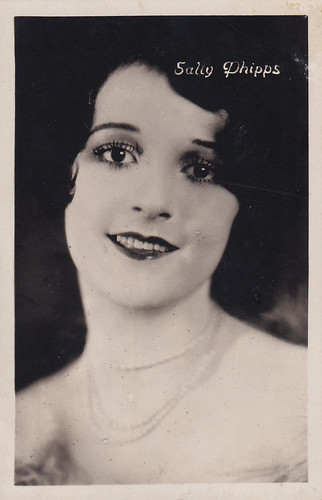
Italian postcard by Foto Ebano.
Text and postcards: Marlene Pilaete.

No comments:
Post a Comment