
Spanish edition by ELD of the postcard series Passion et mort de Notre Seigneur Jésus-Christ. Photo: Films Pathé Frères. This was the fourth part of the French silent film La Vie de Notre Seigneur Jésus-Christ (Maurice André Maître, Pathé Frères, 1913), with Jacques Norman playing Christ.

French postcard by M. Le Deley, Paris. Photo: Pathé. Publicity still from Les Trois Mousquetaires / The Three Musketeers (Henri Diamant Berger, 1921), based on the famous novel by Alexandre Dumas père, and produced by Pathé Consortium Cinéma.

French postcard by M. Le Deley, Paris. Photo: Pathé Consortium Cinéma. Gina Relly in L'empereur des pauvres / The Emperor of the Poor (René Leprince, 1922), an adaptation of the novel by Felicien Champsaur.
A man with a keen business sense
Ernest Louis Désiré Le Deley was born in 1859 in Mont Saint-Aignan in the Seine-Maritime department of Normandy. He was given the same first name as his father, a shoemaker. His mother was Sophie Victoire Flambart. In 1886, the 27-year-old Ernest Junior lived in Paris with Josephine Petit. The unmarried couple had two sons, Maurice Ernest and Joseph Louis. Ernest was a ‘phototypeur’ (a phototype printer). In the early 1890s, he worked for Edmond Laussedat’s factory and workshops in Châteaudun, some 130 km south of Paris, and later in Cloyes, some 12 km south of Châteaudun. In 1890, Ernest and Josephine were living in Cloyes and had a third son, Edmond Alfred, named after Edmond Laussedat.
In 1898, Ernest Le Deley took over Henri Racle’s phototype business at 73 Rue Claude Bernard in Paris. In 1886, André Quinsac had been the first to set up shop there as a ‘phototypeur’. Quinsac had a reputation as the ‘best’ phototype printer in France. He won gold medals at various international exhibitions. Following his death, Louis Rouillé and then Henri Racle took over the business and the collection. Both soon found themselves in debt and were eventually forced to sell everything.
Le Deley realised there has been a new medium in which phototype can be used: the picture postcard. In 1889, to mark the World’s Fair, 300,000 cards were printed featuring an engraving of the new Eiffel Tower. In the summer of 1891, Dominique Piazza from Marseille released the first postcard(s) featuring a photograph printed using phototype. Postcards thus became increasingly popular during the 1890s, though they were certainly not yet a craze. It was not until 1898 that the Almanach du Commerce de Paris included the ‘Cartes Postales’ section for the first time, listing only Adolph Philipp. A year later, there were already five. And that number would grow rapidly in the early 1900s. Le Deley recognised that the postcard might well become a best-selling item, and that phototype is the method of choice for printing cards with a sharp image. However, he was not primarily thinking of ‘postcards’ when he took over Racle’s business. He wanted to open a phototype printing works in Paris, like his friend Edmond Laussedat from Châteaudun, for whom he had worked for almost 10 years.
The 1899 edition of the Almanach du Commerce in Paris still lists Henri Racle at 73 Rue Claude-Bernard, but Ernest only took over the business at the end of 1898, which was already too late for the Almanach’s deadline. 1900 is therefore the first year in which he could have had an advertisement for his business placed in the Almanach. Under ‘Cartes Postales’, some 20 names can already be found, and Ernest is among them, but only with his name and address and a reference to the phototype section. There, his advertisement is considerably larger and, by a strange twist of fate and, above all, of the alphabet, he is placed directly beneath his former employer, Edmond Laussedat, who also has a studio in Paris. Ernest stated that he was the successor to Quinsac, the leading name in phototypie. Racle and Rouillé were omitted. He registered for the upcoming World Exhibition in Paris, running from 15 April to 12 November.
It soon became clear that Ernest Le Deley had a keen business sense and was determined to make a success of his enterprise. A year after taking part in the World’s Fair, he published a large-format album featuring 50 large-scale images from the exhibition. He also released the first volume in the series ‘France Pittoresque et Monumentale’. In 1902, Ernest was granted a 15-year patent for his ‘Stéromobile le merveilleux’, a device for viewing stereoscopic cards. Ernest then releases sets of 12 cards, packaged in an envelope, including a couple of lovely sets of Paris. Business is going well, and Ernest is running out of space on Rue Claude Bernard. In the course of 1902, he opened a new factory at 11–13 Rue des Arquebusiers. He now needed a shop for his postcards. The postcard craze really took off with the 1900 World’s Fair in Paris. The cards could be bought in bookshops, newsagents or kiosks, and in shops selling tourist souvenirs, but soon proper ‘postcard shops’ began to open as well. Some of these shopkeepers produced their own cards, but most sold picture postcards, fantasy cards, etc., which they purchased from various publishers, including Le Deley. In 1905, Ernest took over the entire stock and the postcard shop of Charles L'Hôpital on Boulevard Sébastopol, a prime location. He named it the 'Grand Comptoir de Carte Postale Illustrée. He also had his two 'factories' in Rue Claude Bernard and Rue des Arquebusiers.

French postcard by Ed. Le Deley, Paris. Gabrielle Réjane in the stage play 'Madame Sans-Gêne' by Victorien Sardou and Émile Moreau, performed at the Théâtre Moncey in Paris. Réjane starred as the outspoken laundress Catherine Hübscher, who later becomes the Duchess of Danzig. The play was written by Sardou and Moreau for Réjane and was first performed on 27th October 1893 at the Théâtre du Vaudeville in Paris, owned by her husband, Paul Porel. This card is for a later version, again with Réjane - even if Gallica does not indicate any staging of the play at this theatre with Réjane in the lead. After the first performances in 1893, Réjane would repeat the play several times at her own Théâtre Réjane, opened in 1906.

French postcard by Ed. Le Deley, Paris. Georges Dorival in 'L'Affaire des poisons', performed in 1907, by Victorien Sardou. French stage and screen actor Dorival or Georges Dorival (1871-1939) made triumphant tours as Le Coq (the coquerel) in Edmond Rostand's 'Chantecler'. He appeared in 26 films at Pathé Frères between 1909 and 1914 and was also a painter and an important art collector.

French postcard by ELD (Ernest Le Deley). Retirement home of the Association des Artistes Dramatiques in Pont-aux-Dames-Couilly (S.- and M.) M. Coquelin Ainé, Président. Benoît-Constant Coquelin (1841-1909), known as Coquelin aîné (Coquelin the Elder), was a French actor who was known as one of the greatest theatrical figures of the age.

French postcard by ELD (Ed. Le Deley). Scene from 'Chantecler' (1910) by Edmond Rostand. Act II. Les Nocturnes. Caption: Ode to the Night.

French postcard by Ed. Le Deley (ELD), no. 87. Félix Galipaux in the French stage play 'Chantecler' (1910), written by Edmond Rostand.
The peak of the postcard craze
Around 1905, ‘postcards’ were all the rage, particularly among the bourgeoisie, many of whose women and children began collecting them. Ernest Le Deley doesn’t just sell his cards in his shop. He has sales representatives who sell his cards all over France. He sends a card to the businesses he plans to visit. The heliotype printing business he took over from Henri Racle in Rue Claude-Bernard in late 1898 had grown into a large enterprise. In Rue des Arquebusiers alone, some 60 men were employed. On Sunday, 28 June 1908, a fire broke out in the workshop on Rue des Arquebusiers. There was particularly significant damage to the precision machinery and photographic equipment. Ernest stated that the 60 employees would not be left unemployed, but could work temporarily at the other factory on Rue Claude-Bernard.
A few years after opening his shop in Paris, Ernest also wanted to open branches, which he had run by a manager. An invoice from 1915 lists nine branches. The postcard craze reached its peak around 1907–1910. Between 1905 and 1910, the Bergeret company in Nancy produced between 90 and 100 million cards a year. Between 1900 and 1930, they are estimated to have printed a billion cards. No figures are available for Ernest Le Deley’s production, but he must undoubtedly have printed millions of cards as well. This was also necessary to be able to pay all his staff.
Ernest not only sells his maps to shopkeepers in France, but he also offers them the opportunity to publish postcards under their own name, which he prints. He can take all the hassle off their hands, enabling even shopkeepers in small villages to publish a series of picture postcards. Ernest does not limit himself to France in this regard; he also sends his sales representatives to Belgium. He usually publishes the postcards of the major cities himself.
On Friday 20 December 1913, another fire broke out at Ernest’s factory on Rue des Arquebusiers. This time, the damage amounted to 350,000 francs. The war did not dampen postcard sales. Publishers were able to print thousands of cards featuring photographs of soldiers, the front line, ruins, events, as well as propaganda and satirical cards. Many soldiers sent a card home from time to time. Ernest, too, produced a great many ‘war cards’. Ernest Le Deley would not live to see the end of the war. He died on 6 August 1917 at the age of 58 in his flat at 41 Rue Censier, some 700 metres from 73 Rue Claude-Bernard, where he had opened his printing business in late 1898.
With her sons serving in the army, Josephine Petit had to leave the day-to-day running of the shop and printing workshops in the hands of her staff until her sons returned. The eldest, Maurice Ernest, took over the management from April 1919. The golden age of the postcard was drawing to a close. Maurice, who had already been involved in the photographic side of the business before the war, now focused more on photography. In 1920, he had a stand at the 1st International Exhibition in Lille. He took photographs of all the stands and the surroundings, and inside his stand, he had a photo studio where visitors could have their photograph taken. A series of postcards was quickly printed in Paris from these photographs and sold at the exhibition.

French postcard by Ed. Le Deley (ELD) / GPL. Photo: Bert. Mme Simone as La Faisane (The Pheasant) in 'Chantecler' (1910), written by Edmond Rostand. French actress and writer Pauline Benda (1877- 1985) was known as Madame Simone or simply Simone. She made her debut in the theatre in 1902 and acted in plays by Luigi Pirandello and Henry Bataille. In 1898, she married stage actor Charles Le Bargy. She was 21 at the time, he 40. After divorcing Le Bargy, she took the name Madame Simone. In 1909, she married Claude Casimir-Perier, son of former president Jean Casimir-Perier. Alain-Fournier was her secretary and also her lover during this marriage, but he died as a conscript as early as 1914. In 1915, she married for the third time, this time to writer François Porché. In her younger life, she had often acted in Porché's plays. From 1930, she devoted herself to writing. Her last book was published in 1970.

French postcard by Ed. Le Deley (ELD) / GPL. Photo Bert. Lucien Guitry as Le coq (The Rooster), i.e. Chantecler in the stage play 'Chantecler' by Edmond Rostand. Lucien Guitry (1860-1925) was considered the preeminent French actor of his day. For many years, he played opposite Sarah Bernhardt. He also appeared in silent films like Tosca (1908) and Ceux de chez nous (1915). He was married to Jeanne Desclois and Renée de Pont-Jest, and his son was the well-known actor-writer-director Sacha Guitry.

Spanish edition by ELD of the postcard series Passion et mort de Notre Seigneur Jésus-Christ. This was the fourth part of the French silent film La Vie de Notre Seigneur Jésus-Christ (Maurice André Maître, Pathé Frères, 1913), with Jacques Norman playing Christ. Caption: The Death of Jesus.

Spanish edition by ELD of the postcard series Passion et mort de Notre Seigneur Jésus-Christ. Photo: Pathé Frères. This was the fourth part of the French silent film La Vie de Notre Seigneur Jésus-Christ (Maurice André Maître, 1913), with Jacques Norman playing Christ. ELD also issued three postcard series on the other three parts of the films: 1. Naissance de Jésus; 2. L'Enfance de Jésus; 3. Vie publique et miracles de Notre-Seigneur Jésus-Christ. A print of this film has been preserved by the Cinémathèque française. Caption: The Grave.
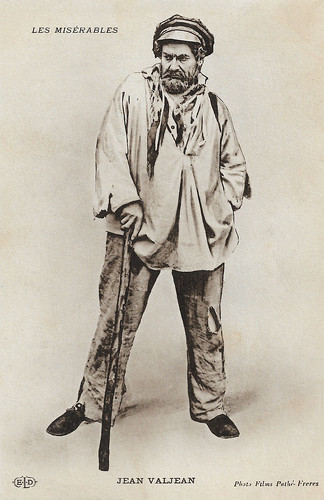
French postcard by Ed. Le Deley (ELD). Photo: Films Pathé-Frères. Henry Krauss as Jean Valjean, relentlessly pursued by the Justice, in Les Misérables (Albert Capellani, 1913). Sent by mail in 1916.

French postcard by Ed. Le Deley, Paris. Photo: Pathé Frères. Gaudin as Gavroche in Les Misérables (Albert Capellani, 1913), adapted from the famous novel by Victor Hugo. Caption: The Death of Gavroche. During the June Revolution of 1832, young Gavroche (Gaudin), son of the Thenardier couple, is killed while collecting bullets from deceased soldiers. On this card, he is shown as a revolutionary hero. This card is part of a booklet made by Le Deley with multiple portraits of the main actors and various scenes of the film.

French postcard by M. Le Deley, Paris. Photo: Pathé. Publicity still from Les Trois Mousquetaires / The Three Musketeers (Henri Diamant Berger, 1921), based on the famous novel by Alexandre Dumas père, and produced by Pathé Consortium Cinéma. On this card, the Three Musketeers and D'Artagnan, played by Henri Rollan as Athos, Charles Martinelli as Porthos, Pierre de Guingand as Aramis, and Aimé Simon-Girard as D'Artagnan. In the back, Armand Bernard as Planchet and Louis Pré fils as Grimaud.

French postcard by M. Le Deley, Paris. Photo: Pathé Consortium Cinéma. Still from Les Trois Mousquetaires / The Three Musketeers (Henri Diamant Berger, 1921). On the right side, Richelieu (Édouard de Max) is playing chess against, possibly, King Louis XIII. Left, Queen Anne of Austria (Jeanne Desclos). The silent super-serial Les Trois Mousquetaires / The Three Musketeers (1921) was the first film adaptation of the famous adventure novel by Alexandre Dumas père, published in 1844. It was a French twelve-hour film divided into one-hour chapters, designed to be released in consecutive weeks over a three-month period.

French postcard by Ed. Le Deley, Paris. Photo: U.C.I. / Gaumont / Tiber Film. Hesperia in Il figlio di Madame Sans-Gêne (Baldassarre Negroni, 1921), adapted from the novel by Émile Moreau. Here, Hesperia as Madame Sans-Gêne is portrayed similarly to François Gérard's portrait of Juliette Récamier.

French postcard by M. Le Deley, Paris. Photo: U.C.I. / Gaumont / Tiber Film. Hesperia and perhaps Luigi Rinaldi or Camillo de Rossi in Il figlio di Madame Sans-Gêne / The Son of Madame Sans-Gêne (Baldassarre Negroni, 1921), based on the novel by Émile Moreau.

French postcard by M. Le Deley, Paris. Photo: Pathé Consortium Cinema. Scene from the French silent film L'Empereur des pauvres (René Leprince, 1922), an adaptation of the novel by Felicien Champsaur, starring Léon Mathot, Gina Relly and Henry Krauss. The man down right on this card could be Mathot.

French postcard by M. Le Deley, Paris. Photo: Pathé Consortium Cinema. Gina Relly in L'Empereur des pauvres (René Leprince, 1922). The rich, young and spoiled Marc Anavan (Léon Mathot) decides to change his life, becomes a vagabond and starts doing good around him. He becomes the peaceful spokesperson for the disinherited, helped by the love of pure, young Sylvette (Gina Relly). Marc has to face revolution, anarchism and the Great War before retaking his humanitarian mission. In the end, he overcomes all the hardships on his way.

French postcard by Ets. Le Deley, Paris, for Gaumont-Metro-Goldwyn. Photo: Metro Goldwyn. Caption: a new screen star, Norma Shearer.
Source: Franki Olieu (Kortrijk in oude postkaarten - Dutch).

No comments:
Post a Comment