
Spanish postcard by CyA, no. 81. Photo: Metro Goldwyn Mayer. John Ericson in Bad Day at Black Rock (John Sturges, 1955). The Spanish film title was Conspiración de silencio.

Vintage postcard, no. 358. Photo: M.G.M.

Dutch postcard by Takken / 't Sticht, no. AX 708. Photo: Metro-Goldwyn-Mayer. John Ericson and Pier Angeli in Teresa (Fred Zinnemann, 1951).
Career kick-start
John Ericson was born Joachim Alexander Ottokar Meibes in Düsseldorf, Germany, in 1926. He was the son of Carl F. Meibes, a German chemist and Ellen Wilson, a Swedish actress and opera singer. Escaping from the Nazi regime, his family emigrated to the U.S. when he was three. At first, living in Detroit, they eventually settled in New York, where his dad (according to a 1955 newspaper article) found lucrative employment as president of a food extract company.
After graduating from Newton High School, John enrolled at the Academy of Dramatic Arts in New York, financially supporting his studies by working at a Walgreens drug store. Most sources, including Wikipedia, incorrectly cite his acting debut as being in 'Stalag 17' on Broadway, but Ericson himself stated (in a 1989 interview with Skip E. Lowe) that his career kick-started with the romantic wartime drama Teresa (Fred Zinnemann, 1951), filmed in Italy by Metro Goldwyn Mayer.
Afterwards, he made the decision not to sign a studio contract for fear of being typecast as 'boy-next-door' types. On the strength of his performance in Teresa, producer/director José Ferrer offered Ericson not only what amounted to being the nominal lead in 'Stalag 17' (1951), but the opportunity to play an initially unsympathetic part as the slick, cynical gambler J. J. Sefton.
The coveted film role in Stalag 17 (Billy Wilder, 1953) was eventually assigned to William Holden, who won an Academy Award for his role.
Between 1954 and 1955, Ericson was under contract at MGM and made four films for the studio: Rhapsody (Charles Vidor, 1954) opposite Elizabeth Taylor and Vittorio Gassman, Green Fire (Andrew Marton, 1954), co-starring Stewart Granger and Grace Kelly, who had been in his class at the Academy. and the seminal Spencer Tracy Western Bad Day at Black Rock (John Sturges, 1955) as a nervy hotel clerk.

Dutch postcard by Takken / 't Sticht, no. 1809. Photo: M.G.M.

British postcard in the Picturegoer Series, London, no. D 601. Photo: Metro-Goldwyn-Mayer. John Ericson and Edmund Purdom in The Student Prince (Richard Thorpe, 1954).
Nude centrefold in Playgirl
During the next three decades, John Ericson worked as a free-lance actor. His wavy-haired good looks and athletic build were not lost on the industry. He co-starred with Barbara Stanwyck in Forty Guns (Samuel Fuller, 1957) and with Fred MacMurray in another Western, Day of the Badman (Harry Keller, 1958).
His career continued mostly on television. Ericson's frequent TV guest appearances included Rawhide (1959), Bonanza (1959), Burke's Law (1963), The FBI (1965) and The Invaders (1967). He co-starred with Anne Francis in Honey West (1965), a short-lived series apparently modelled on the British series The Avengers (1961). It featured a crime-solving, judo-savvy lady detective (even wearing Diana Rigg-style jumpsuits) and her right-hand man. The show only lasted for 30 episodes, but has since gained a minor cult following.
For the big screen, he went to Italy and Spain. There he starred in the Peplum Io Semiramide / Slave Queen of Babylon (Primo Zeglio, 1963) about Semiramis, a queen of the Neo-Assyrian Empire (Yvonne Furneaux). He also starred in the James Bond pastiche Agente S 03: Operazione Atlantide / Operation Atlantis (Domenico Paolella, 1965) and Spaghetti Westerns. In the U.S., he had leads in thrillers such as The Money Jungle (Francis D. Lyon, 1967) with Lola Albright, and Science Fiction B-graders like The Destructors (Francis D. Lyon, 1968) starring Richard Egan, and The Bamboo Saucer (Frank Telford, 1968), which was Dan Duryea's last film.
Ericson also starred as the titular 1930s Depression-era gangster in Pretty Boy Floyd (Herbert J. Leder, 1960). He appeared in the Disney film Bedknobs and Broomsticks (Robert Stevenson, 1971) and posed for the nude centrefold in Playgirl magazine's January 1974 issue. On the stage, he played King Arthur to Kathryn Grayson's Guinevere in a 1967 production of the musical 'Camelot'. A reviewer commented that what Ericson lacked in the vocal department he more than made up for by a 'masterful performance'. His dramatic theatrical credits included 'Richard III', 'Mr. Roberts' and 'A Streetcar Named Desire'.
In his spare time, John Ericson took up painting landscapes and still lifes. He was also a sculptor and a keen amateur photographer. Until he died of pneumonia in 2020, he resided in New Mexico with his second wife, Karen Huston, whom he married in 1974. With his first wife, Milly Ericson Courye, he had two children, Brett and Nicole. John Ericson was 93.
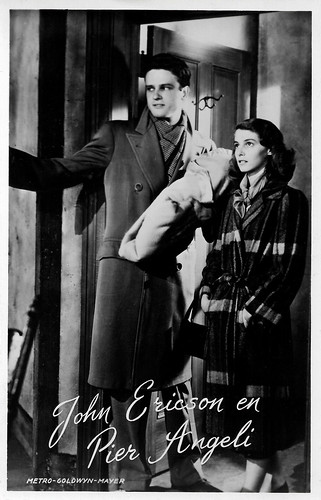
Dutch postcard by Takken, Utrecht, no. 709. Photo: Metro-Goldwyn-Mayer (MGM). John Ericson and Pier Angeli in Teresa (Fred Zinnemann, 1951).

Belgian postcard offered by RI-RI Demaret Chocolate, no. 1051. Photo: MGM. John Ericson and Pier Angeli in Teresa (Fred Zinnemann, 1951).
Sources: I.S. Mowis (IMDb), Wikipedia and IMDb.

No comments:
Post a Comment