7 October: The Art of the Benshi

Japanese postcard. Minoru Takada (1899-1977).
Ivo Blom will be in Prordennone to attend Le Giornate del Cinema Muto 2026. One festival section is dedicated to the mesmerising artistry of Japan’s celebrated benshi. Since the first film screenings by the Lumière brothers, these movie orators breathed life into silent film. During the benshi's heyday, more than 7,000 of these artists narrated films and made silent actors speak. Their voices rang out in cinemas across Japan, in Korea and other Japanese colonies, and in Japanese American communities in the United States. The greatest benshi were famous enough to rival the screen stars. Ivo recently acquired a set of rare vintage postcards of Japanese film stars from before WW II. For this occasion, we share this set with you. We kindly thank Japanese film scholar Hiroshi Komatsu, who helped us identify most of the actors. Minoru Takada above was a Japanese actor and film producer in the Taisho and Showa periods. He appeared in over 230 films between 1924 and 1971. His wife was the former actress Mikiko Mitsuki. Takada starred, e.g. in Wakasa yo saraba (Shigenori Sakata, 1924), one of his first films, and Yasujirō Ozu's film I Graduated, But... / Daigaku wa detakeredo (1929).
10 October: Directed by Robert Wiene

German postcard by Ross Verlag, no. 643/10. Photo: Decla. Fern Andra and Hans Heinrich von Twardowski in Genuine (Robert Wiene, 1920).
The 45th edition of 'Le Giornate del Cinema Muto' also has the section 'Weimar Uncensored'. It includes Genuine (1920), an expressionist silent film starring Fern Andra. The maker is the Hungarian-Czechoslovak film director and screenwriter Robert Wiene (1873-1938), who became particularly famous for another expressionist film, Das Kabinett des Dr. Caligari / The Cabinet of Dr Caligari (1919), a milestone in film history.
11 October: Gay Portraits

American postcard by Pomegranate, Petaluma, CA. Postcard from the book 'Gay Portraits'. Photo: Rice. Collection: Motion Picture and Television Archive. Caption: Alla Nazimova (Russian, 1878-1945) studied with Stanislavsky in Russia (1898) and became a star of the American stage (1906) before heading for success in Hollywood (1916).
'Gay Portraits, A Book of Postcards' (1990) contained 30 black- and white postcards of outstanding men and women who have made important contributions to literature, music, dance, theatre and politics. I bought this book some 35 years ago. From the introduction: "Worldwide persecution of gays, once commonplace and even proper, is today recognised for what it is: bigotry as base as any other. With enlightenment comes reevaluation and fresh discovery of gay contributions to culture and history." Much has changed since then. The word ‘gay’ has been replaced by ‘LGBTQ+’, which also includes transgender, intersex and asexual people. Yet acceptance is on the decline, whilst violence against ‘queers’ is on the rise. The women and men on the postcards are from the 19th and 20th centuries. They left a mark on their times, and were also 'gay'. Most of them lived in a time when sexual openness was unthinkable, but they tried to and contributed to change. 11 October is Coming Out Day, a great opportunity to showcase 15 portraits from this postcard book at EFSP. In the coming months, we will post on more postcard books, from various decades.
14 October: Films Selectos (Part 3)

Spanish collector card (leaflet) in the Films Selectos series. Photo: Mary Pickford in The Taming of the Shrew (Sam Taylor, 1929).
The era in Spain before General Franco is an interesting goldmine for film memorabilia. We can't get enough of the beautiful leaflets from the early 1930s, published as an appendix by the weekly Films Selectos. We love the detailed photographs and the subtle colouring of this series. Here's a new selection of the Suplemento Artistico leaflets by Films Selectos. Mary Pickford (1892-1979) was a legendary silent film actress, known as 'America’s sweetheart.' She co-founded United Artists and helped establish the Academy.
18 October: Kathleen Turner

Dutch collector card.
We continue the series on American stars of the 1980s and 1990s. Their postcards are sometimes quite hard to find, so we also use vintage collector cards for these posts. Kathleen Turner (1954) made her film debut as a femme fatale in the thriller Body Heat (1981), which gave her a reputation as a sex symbol. She became one of Hollywood's most successful actresses in the 1980s, thanks to her portrayals of strong female characters. By her own admission, Turner turned down every role offered of a victimised, weak woman. She starred in more than thirty films.
21 October: Published by S.I.P.

French postcard by S.I.P. (Société Industrielle de Photographie). Photo: Waléry, Paris. Collection: Marlène Pilaete.
S.I.P. was an abbreviation for Société Industrielle de Photographie. This French industrial society published countless postcards in the early 20th Century. Before early 1906, the logo changed from the straight letters S.I.P. to the roundel with the big S between cards 1347 and 1372. S.I.P. published many portraits of the grand stage stars of the Belle Époque, and the design of the cards reflected the current styles. Dutch-born exotic dancer and executed spy Mata Hari (1876-1917) was an international society figure between 1905 and the First World War. She never appeared in a film, but her life was filmed several times.
28 October: Film programmes by Illustrierte Film-Bühne

West German film programme by Illustrierte Film-Bühne (merged with Illustrierte Film-Kurier), no. 4417, page 1 (cover). Photos: Pallas Film. Maurice Ronet and Jean Wall in Ascenseur pour l'échafaud / Elevator to the Gallows (Louis Malle, 1958). The German title was Fahrstuhl zum Schafott.
The blog's name is European Film Star Postcards, but we like to go beyond our theme. Illustrierte Film-Bühne (IFB) was a West German 'Filmprogrammheft' (film programme) that existed between 1946 and 1969. The numbered film programmes included plot details, cast lists, and lots of photos. Publisher Paul Franke founded Illustrierte Film-Bühne in Munich in 1946. An issue had four and sometimes eight pages, often printed in sepia, but also in blue, green or red. From 1951 on, full-colour editions also became available. The final issue of Illustrierte Film-Bühne, no. 8069, was published in 1969. The programmes provide an insight into the history of cinema in West Germany.
29 October: Before Hollywood: Kalem
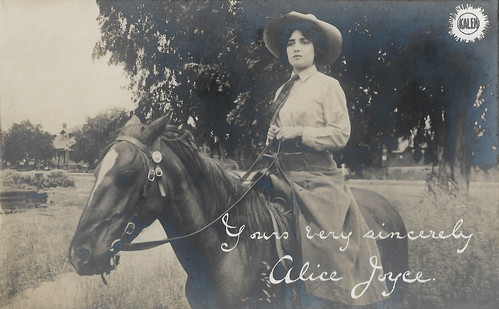
British postcard. Photo: Kalem.
In 2021, EFSP did a Before Hollywood series. This Summer, Ivo Blom found cards from early studios like Kalem and Lubin in the Brighton postcard shop Step Back in Time. So we will update the posts on these pioneer studios. Alice Joyce (1890-1955) was an American screen actress who, at the peak of her career, was nicknamed the "Madonna of the Screen". In 1910, she became one of Kalem's biggest stars. Joyce played well-behaved ladies of the better society in melodramas, comedies, and occasionally crime stories.
31 October: Telly Savalas

Spanish collector card by Accion. Telly Savalas in Kojak (1973-1978).
Telly Savalas (1922–1994) was missing from EFSP, but we’re going to rectify that huge mistake. The American actor and singer of Greek descent was famous in our youth for his bald head and deep, resonant voice. He acted in many films, in Hollywood and Europe, but we remember him as the bald, lollipop-sucking Inspector Theo Kojak of the TV series Kojak (1973-1978).
11 November: Photo by Paul Nadar

French postcard, no. 232. Photo: Nadar. The photo was taken in the 1880s, but the card may be a few decades newer. Albert Lambert in the title role of Victor Hugo's play 'Ruy Blas'.
EFSP continues its 'Photo by' series with a post on French photographer Paul Nadar (or P. Nadar) (1856-1939). He was the son and long-time collaborator of the famous photographer (Félix) Nadar. Paul continued the studio after his father's death and became known as a society photographer in Paris during the Belle Époque. Our focus is on Nadar's many portraits of famous French actors and actresses.
12 November: Van Williams

Spanish postcard by Ediciones Este, no. 18-T, 1964. Photo: Warner Bros. Van Williams in the TV series Surfside 6 (Charles R. Rondeau, a.o., 1960-1962). The Spanish title was Rompeolas.
Hunky American film and TV actor Van Williams (1934-2016) was best known for his leading role as Kenny Madison in both Warner Bros. television detective series Bourbon Street Beat (1959–1960) and its sequel, Surfside 6 (1960–1962). For one season, he starred as the title character in The Green Hornet (1966–1967), with Bruce Lee as his partner Kato. In 2027, as EFSP celebrates its 20th anniversary, we will bring you a series on classic American TV series that have inspired European and Hollywood cinema.

A screenshot of the stats of European Film Star Postcards from 2011 till 30 September 2026.

No comments:
Post a Comment