German actress Mady Rahl (1915-2009) was one of the last of the female Ufa Stars. She was discovered by director Detlev Sierck, later better known as Douglas Sirk. She had a legion of male admirers during the Second World War. The platinum blonde actress had perfect comic timing, vampish good looks and a sultry, smoky voice. On TV, she was the German voice of Lucille Ball. Mady Rahl appeared in more than 120 films and television shows in a career spanning some 70 years.
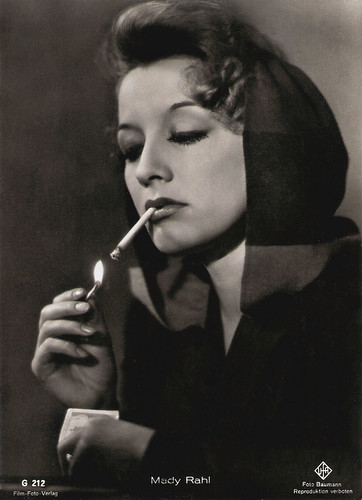
German postcard by Film-Foto-Verlag, no. G 212, 1941-1944. Photo: Foto Baumann / Ufa.
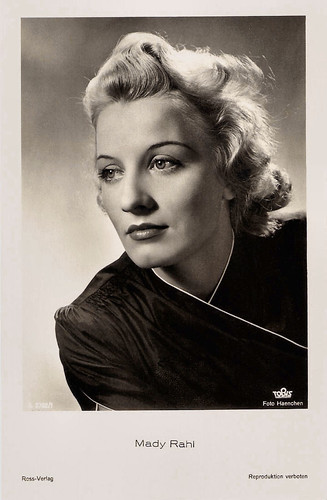
German postcard by Ross-Verlag, no. A 2702/1, 1939-1940. Photo: Haenchen / Tobis.
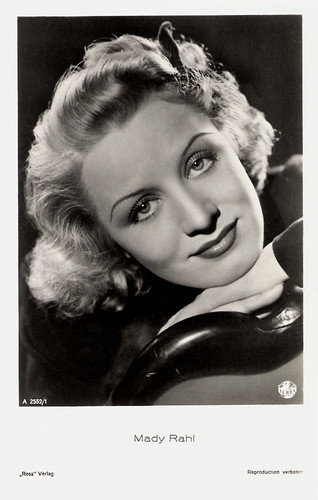
German postcard by Film-Foto-Verlag, no. A 2552/1, 1941-1944. Photo: Terra.
Mady Rahl was born Edith Gertrud Meta Raschke in Berlin-Charlottenburg in 1915. During her schooltime, she came in contact with the theatre and took acting lessons from the famous actor Rudolf Klein-Rogge. She also had lessons in singing and dancing. In 1934, she made her film debut in a short comedy Zwei Genies / Two Geniuses (1934) by Detlev Sierck, a young, struggling director who would later become the famous Hollywood director Douglas Sirk.
In 1935, Rahl made her stage debut in Sierck's 'Wandlung' (The Change) at the Old Lyceum Theatre in Leipzig, with Rudolf Klein-Rogge. As his own career began to take off, Detlev Sierck introduced Mady Rahl to the bosses of the Ufa studios in Babelsberg, Berlin. A four-year contract quickly followed. First, she played a small role in Der geheimnisvolle Mister X / The Mysterious Mister X (J.A. Hübler-Kahla, 1936), starring Ralph Arthur Roberts and Hermann Thimig.
Then she got bigger parts in the Pat & Patachon comedy Blinde Passagiere / Stowaways (Fred Sauer, 1936), and in Das Gäßchen zum Paradies / Paradise Road (Martin Fric, 1936) with Hans Moser and little Peter Bosse. Mady Rahl became known to the general public with her role at the side of the legendary La Jana in the circus drama Truxa (Hans H. Zerlett, 1937).
Till the end of the war followed 30 more roles in films like the melodrama Zu neuen Ufern / To New Shores (Detlev Sierck, 1937) starring Zarah Leander, and the musical Hallo Janine! / Hello Janine! (Carl Boese, 1939), with Marika Rökk and Johannes Heesters. Under the Third Reich, Mady Rahl's career continued to flourish. Propaganda minister Josef Goebbels was a fan of lightweight musical comedies, and one of his favourites was Die lustigen Vagabunden / The Jolly Vagabonds (Jürgen von Alten, 1940), in which Mady Rahl played Gisela Merz. It was rumoured that they had an affair, but the actress always denied it.
Other popular films from this period were Meine Frau Teresa / My Wife Teresa (Arthur Maria Rabenalt, 1942), Tonelli (Victor Tourjansky, 1943) with Ferdinand Marian and Winnie Markus, and Die tolle Susanne / The Great Susanne (Géza von Bolváry, 1945). These films made her a darling of the German public.
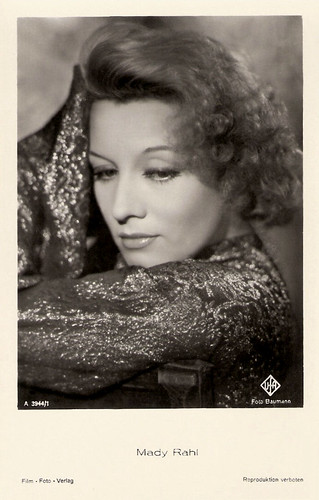
German postcard by Film-Foto-Verlag, no. A 3944/1, 1941-1944. Photo: Foto Baumann / Ufa.
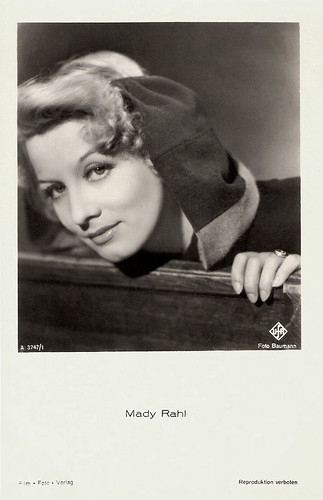
German postcard by Film-Foto-Verlag, no. 3747/1, 1941-1944. Photo: Foto Baumann / Ufa.
After the war, Mady Rahl continued her career in Schuss um Mitternacht / A Shot at Midnight (Hans H. Zerlett, 1949), Die Dame in Schwarz / The Lady in Black (Erich Engels, 1951) with Paul Hartmann, Ober zahlen / Waiter, the Bill (E.W. Emo, 1957) with Hans Moser and Paul Hörbiger, and the authentic war drama Haie und kleine Fische / Sharks and Little Fish (Frank Wisbar, 1957).
To her other well-known films belong Der Page vom Palast-Hotel (Thomas Engel, 1958), the Heinz Erhardt comedy Immer die Radfahrer / Always the Bikers (Hans Deppe, 1958), and the crime film Der Greifer / The Ripper (Eugen York, 1958) starring Hans Albers.
Nacht fiel über Gotenhafen / Darkness Fell on Gotenhafen (Frank Wisbar, 1959) was a harrowing drama about the first month of 1945 when the Russian Red Army broke into the eastern part of Germany and forced millions of civilians to flee. In later years, she also appeared frequently on stage and TV. She was the German voice for Lucille Ball in her shows.
During the sixties, Mady Rahl appeared in a lot of crime and Horror films like the Edgar Wallace crime film Der Fälscher von London / The Forger of London (Harald Reinl, 1961), Die weisse Spinne / The White Spider (Harald Reinl, 1963), the thriller Das Wirtshaus von Dartmoor / The Inn on Dartmoor (Rudolf Zehetgruber, 1964) and Der Hund von Blackwood Castle / The Horror of Blackwood Castle (Alfred Vohrer, 1968). She also appeared in the curious SM film Le Malizie di Venere / Venus in Furs (Massimo Dallamano, 1969) starring Laura Antonelli.
To her later films belong Karl May (Hans Jürgen Syberberg, 1974) with Helmut Käutner and Kristina Söderbaum, and Der Angriff / The Agression (Theodor Kotulla, 1986) with Pascale Petit. Mady Rahl was married three times, first to financier Theodor Reimers, then to film producer Wilhelm Sperber, and finally to architect Werner Bürkle. Mady Rahl died in 2009 in a retirement home in Munich, Germany. She was 84. Her grave is in the Nordfriedhof Cemetery in Munich,
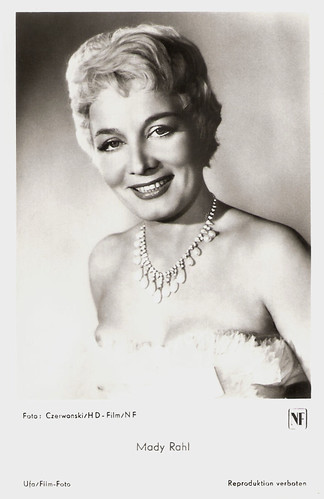
German postcard by Ufa, no. FK 3542. Retail price: 25 Pfg. Photo: Czerwonski / HD-Film / NF.
Trailer Immer die Radfahrer / Always the Bikers (1958). Source: Trailer Tracker Classic (YouTube).
Sources: Telegraph, Thomas Staedeli (Cyranos), Stephanie D'Heil (Steffi-line), Wikipedia and IMDb.
This post was last updated on 28 May 2026.
German postcard by Film-Foto-Verlag, no. G 212, 1941-1944. Photo: Foto Baumann / Ufa.
German postcard by Ross-Verlag, no. A 2702/1, 1939-1940. Photo: Haenchen / Tobis.
German postcard by Film-Foto-Verlag, no. A 2552/1, 1941-1944. Photo: Terra.
Darling of the German public
Mady Rahl was born Edith Gertrud Meta Raschke in Berlin-Charlottenburg in 1915. During her schooltime, she came in contact with the theatre and took acting lessons from the famous actor Rudolf Klein-Rogge. She also had lessons in singing and dancing. In 1934, she made her film debut in a short comedy Zwei Genies / Two Geniuses (1934) by Detlev Sierck, a young, struggling director who would later become the famous Hollywood director Douglas Sirk.
In 1935, Rahl made her stage debut in Sierck's 'Wandlung' (The Change) at the Old Lyceum Theatre in Leipzig, with Rudolf Klein-Rogge. As his own career began to take off, Detlev Sierck introduced Mady Rahl to the bosses of the Ufa studios in Babelsberg, Berlin. A four-year contract quickly followed. First, she played a small role in Der geheimnisvolle Mister X / The Mysterious Mister X (J.A. Hübler-Kahla, 1936), starring Ralph Arthur Roberts and Hermann Thimig.
Then she got bigger parts in the Pat & Patachon comedy Blinde Passagiere / Stowaways (Fred Sauer, 1936), and in Das Gäßchen zum Paradies / Paradise Road (Martin Fric, 1936) with Hans Moser and little Peter Bosse. Mady Rahl became known to the general public with her role at the side of the legendary La Jana in the circus drama Truxa (Hans H. Zerlett, 1937).
Till the end of the war followed 30 more roles in films like the melodrama Zu neuen Ufern / To New Shores (Detlev Sierck, 1937) starring Zarah Leander, and the musical Hallo Janine! / Hello Janine! (Carl Boese, 1939), with Marika Rökk and Johannes Heesters. Under the Third Reich, Mady Rahl's career continued to flourish. Propaganda minister Josef Goebbels was a fan of lightweight musical comedies, and one of his favourites was Die lustigen Vagabunden / The Jolly Vagabonds (Jürgen von Alten, 1940), in which Mady Rahl played Gisela Merz. It was rumoured that they had an affair, but the actress always denied it.
Other popular films from this period were Meine Frau Teresa / My Wife Teresa (Arthur Maria Rabenalt, 1942), Tonelli (Victor Tourjansky, 1943) with Ferdinand Marian and Winnie Markus, and Die tolle Susanne / The Great Susanne (Géza von Bolváry, 1945). These films made her a darling of the German public.
German postcard by Film-Foto-Verlag, no. A 3944/1, 1941-1944. Photo: Foto Baumann / Ufa.
German postcard by Film-Foto-Verlag, no. 3747/1, 1941-1944. Photo: Foto Baumann / Ufa.
Harrowing Drama, Horror and SM
After the war, Mady Rahl continued her career in Schuss um Mitternacht / A Shot at Midnight (Hans H. Zerlett, 1949), Die Dame in Schwarz / The Lady in Black (Erich Engels, 1951) with Paul Hartmann, Ober zahlen / Waiter, the Bill (E.W. Emo, 1957) with Hans Moser and Paul Hörbiger, and the authentic war drama Haie und kleine Fische / Sharks and Little Fish (Frank Wisbar, 1957).
To her other well-known films belong Der Page vom Palast-Hotel (Thomas Engel, 1958), the Heinz Erhardt comedy Immer die Radfahrer / Always the Bikers (Hans Deppe, 1958), and the crime film Der Greifer / The Ripper (Eugen York, 1958) starring Hans Albers.
Nacht fiel über Gotenhafen / Darkness Fell on Gotenhafen (Frank Wisbar, 1959) was a harrowing drama about the first month of 1945 when the Russian Red Army broke into the eastern part of Germany and forced millions of civilians to flee. In later years, she also appeared frequently on stage and TV. She was the German voice for Lucille Ball in her shows.
During the sixties, Mady Rahl appeared in a lot of crime and Horror films like the Edgar Wallace crime film Der Fälscher von London / The Forger of London (Harald Reinl, 1961), Die weisse Spinne / The White Spider (Harald Reinl, 1963), the thriller Das Wirtshaus von Dartmoor / The Inn on Dartmoor (Rudolf Zehetgruber, 1964) and Der Hund von Blackwood Castle / The Horror of Blackwood Castle (Alfred Vohrer, 1968). She also appeared in the curious SM film Le Malizie di Venere / Venus in Furs (Massimo Dallamano, 1969) starring Laura Antonelli.
To her later films belong Karl May (Hans Jürgen Syberberg, 1974) with Helmut Käutner and Kristina Söderbaum, and Der Angriff / The Agression (Theodor Kotulla, 1986) with Pascale Petit. Mady Rahl was married three times, first to financier Theodor Reimers, then to film producer Wilhelm Sperber, and finally to architect Werner Bürkle. Mady Rahl died in 2009 in a retirement home in Munich, Germany. She was 84. Her grave is in the Nordfriedhof Cemetery in Munich,
German postcard by Ufa, no. FK 3542. Retail price: 25 Pfg. Photo: Czerwonski / HD-Film / NF.
Trailer Immer die Radfahrer / Always the Bikers (1958). Source: Trailer Tracker Classic (YouTube).
Sources: Telegraph, Thomas Staedeli (Cyranos), Stephanie D'Heil (Steffi-line), Wikipedia and IMDb.
This post was last updated on 28 May 2026.

No comments:
Post a Comment