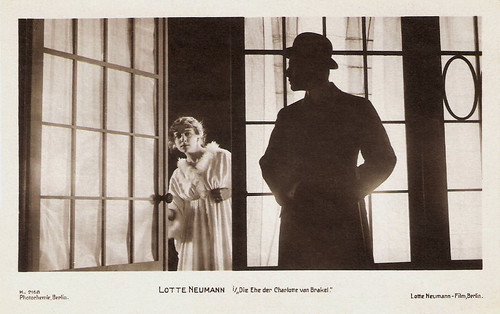
German postcard by Photochemie, Berlin, no. K. 2168. Photo: Lotte Neumann-Film. Lotte Neumann in Die Ehe der Charlotte von Brakel / The Marriage of Charlotte von Brakel (Paul von Woringen, 1918).

German postcard by Photochemie, Berlin, no. K. 2095. Photo: Lotte Neumann-Film. Lotte Neumann in Die Richterin / The Judge (Paul von Woringen, 1917).

German postcard by Photochemie, Berlin, no. K. 2103. Photo: Lotte Neumann-Film, Berlin. Lotte Neumann in Der Geigenspieler / The Violin Player (Paul von Woringen, 1917).

German postcard by Photochemie, Berlin, no. K. 2968. Photo: Deutsche Mutoskop & Biograph GmbH, Berlin. Magda Madeleine in Die einsame Frau / The Lonely Woman (Paul von Woringen, Willy Zeyn, 1918).

German postcard by Ross Verlag, Berlin, no. 359/2, 1919-1924. Photo: Becker & Maass, Berlin / Deutsche Mutoskop & Biograph.
Artistic director of Deutsche Mutoskop- und Biograph
Ernest Guillaume Paul von Woringen was born in 1859 in Rotterdam, the Netherlands. He was the son of German parents. Thanks in part to his wife, the variety artist Nora Gilis, he started his film career as artistic director of the Berlin film company Deutsche Mutoskop- und Biograph GmbH, as the German subsidiary of the American Mutoscope and Biograph Company. The trademark of the company, usually referred to simply as Deutsche Mutoskop or DMB, was ‘DB’ within a circle. DMB distributed and produced several hundred films between 1898 and 1924. From the early 1910s, Deutsche Mutoskop- und Biograph shifted its focus increasingly towards film production, though it remained active in the distribution business until 1919. The company’s first large film studio was built at 10 Zietenstraße in Berlin-Lankwitz: a glass hall measuring approximately 700 m² on a multi-storey base.
In January 1911, Von Woringen became the company's general manager. He directed the production of feature films, mainly comedies and film dramas, and maintained the company in a time of rapidly evolving public taste for fictional action films. Von Woringen also quickly made the transition to long feature films. He was responsible for the prestigious and ambitious historical production Theodor Körner (1912), typical of the wave of nationalist, anti-French films from just before the First World War, in this case about the fight against Napoleon's marauders in Germany. The film was directed by Franz Porten and Gerhard Dammann, with Friedrich Feher in the title role and 300 soldiers in historical costumes.
From 1913, Paul von Woringen was active behind the camera as director of his own films. His directorial debut was Die Landstrasse / The Country Road (1913), in which an escaped convict commits a murder in a small village. The murder is blamed on a passing beggar, played by Carl Goetz. The original screenplay was written by renowned author Paul Lindau and used a short story by Duke Ernst of Saxe-Coburg and Gotha as the basis for the film. The story was thematically based on the Rannersdorf murder trial, which attracted considerable attention at the time.
In 1915, Von Woringen started to make films with Lotte Neumann (1896-1977). Neumann was one of the most successful actresses in the early days of the German silent cinema and the female star of the Deutsche Mutoskop- und Biograph GmbH, such as the Detective film Der rote Faden / The Common Thread (1915) with Rudolf Klein-Rhoden as Detective Barker Swift. Lotte Neumann also worked as a screenwriter and a producer. In 1917-1918, Von Woringen directed Neumann in films for her own company, Lotte Neumann-Film, founded within DMB.
The first film Neumann produced herself with Lotte Neumann-Film was Der Mut zum Glück / The Courage to Happiness (Paul von Woringen, 1917). The film was shot at the Mutoskop studio in Berlin-Lankwitz and co-starred Erich Kaiser-Titz and Heinrich Schroth. It passed censorship in July 1917 and then soon premiered at the Berliner Sportpalast. The Neue Kino-Rundschau (September 1917): "A very excellent film that met with undivided applause from those appearing in it. It is particularly characterised by the excellent interaction between Lotte Neumann and Erich Kaiser-Tietz [sic!]. A truly rare pleasure to immerse yourself in the performance by these two, where one is forced to wonder how much an artist can do from a role that he grasps and thinks through with all his soul! The direction also has its share in the completed whole and must be lauded."

German poster by DMB (Deutsche Mutoskop- und Biograph) for Die Landstrasse / The Country Road (Paul von Woringen, 1913). Design: A. Hubert. Collection: Eye Filmmuseum.

Gertman postcard by Photochemie, Berlin, no. K. 2089. Photo: Lotte Neumann-Film, Berlin. Lotte Neumann as Eveline, Heinrich Schroth as her father and Franz Ramharter as Baron von Sanden in Der Mut zum Glück / The Courage to Happiness (Paul von Woringen, 1917).

German postcard by Photochemie, Berlin, no. K. 2091. Photo: Lotte Neumann-Film, Berlin. Lotte Neumann in Der Mut zum Glück / The Courage to Happiness (Paul von Woringen 1917). This was the first film Neumann produced herself with her company, Lotte Neumann-Film.

German postcard by Photochemie, Berlin. no. K. 2094. Photo: Lotte Neumann-Film, Berlin. Lotte Neumann in Die Richterin / The Judge (Paul von Woringen, 1917).

German postcard by Photochemie, Berlin, K. 2096. Photo: Lotte Neumann-Film, Berlin. Lotte Neumann and Ernst Rückert in Hinter verschlossenen Türen / Behind Closed Doors (Paul von Woringen, 1917).
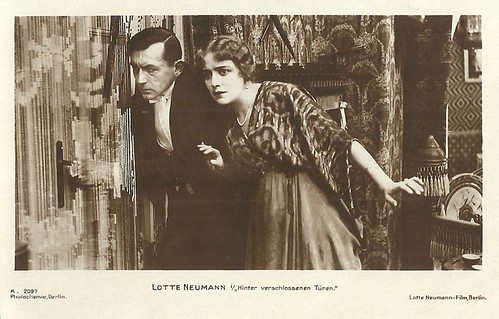
German postcard by Photochemie, Berlin, K. 2097. Photo: Lotte Neumann-Film, Berlin. Lotte Neumann and Ernst Rückert in Hinter verschlossenen Türen / Behind Closed Doors (Paul von Woringen, 1917).
Left by Lotte Neumann
Paul von Woringen directed for Lotte Neumann-Film such melodramas as Die Richterin / The Judge (1917), Hinter verschlossenen Türen / Behind Closed Doors (1917), Die Ehe der Charlotte von Brakel / The Marriage of Charlotte von Brakel (1917), and the two-parter Das Schweige im Walde / The Silence in the Woods (1918, 2 parts).
In Die Richterin / The Judge (Paul von Woringen, 1917), Carl Clewing plays Fritz, a businessman who falls in love with his neighbour's daughter (Lotte Neumann), who was brought up in strict order by her father. The girl agrees to marry him. Since Fritz does not want to go into marriage with a lie, he admits to a misstep from a long time ago: in his youth, he falsified a check and went to jail. The strict paternal principles have turned the girl into a moral judge, and she lets the upcoming marriage burst at the last moment. The script was by Hans Land, a pseudonym of Hugo Landsberger. Die Richterin was shot at the Mutoskop studio in Berlin-Lankwitz. In October 1917, it was presented to the German Board of Censorship, and quite soon after, it was released.
Lotte Neumann also starred in Der Geigenspieler / The Violin Player (1917), a psychological crime movie which Von Woringen wrote and directed. Other actors were Johannes Müller, Paul Otto, Elisabeth Hruby, Marga Köhler, and Wilhelm Huch. It is not known when exactly the film premiered, but in August 1917 it was shown at the Berlin Passagetheater. In 1918, Lotte Neumann decided to continue her film career at Maxim Film, and she left DMB and Paul von Woringen.
In 1919-1920, Von Woringen made several films at DMB starring two new discoveries, Hilde Wolter and Magda Magdeleine. Magdeleine had debuted at Deutsche Mutoskop & Biograph in Das Licht in der Nacht / The Light in the Night (Emil Albes, 1917). After that, she had played leads in her own film series, often directed by Willy Zeyn. In 1918, Paul von Woringen directed her in Die einsame Frau / The Lonely Woman (Willy Zeyn, Paul von Woringen, 1918), Wenn Freunde zu Rivalen werden / When Friends Become Rivals (Paul von Woringen, 1919), Die Lüge der Pia Mahren / Pia Mahren’s Lie (Paul von Woringen, 1919), and Das Rätsel der Unbekannten / The Mystery of the Unknown (Paul von Woringen, 1919). Often, she was paired with actor Karl Beckersachs. Between late 1917 and early 1920, Madeleine made 16 films at Deutsche Mutoskop und Biograph. Hilde Wolter had the female leads or supporting parts in 9 films directed by Von Woringen between 1919 and 1920, such as Eine tolle Kiste / A Brilliant Box (1919), Wie das Schicksal spielt / How Fate Works (1920) and Sybill Morgan (1920). In 1921, she switched to Orplid-Film.
The emergence of the UFA in 1917 created formidable competition for DMB. Due to the declining success of his films, Paul von Woringen gave up his post at Deutsche Mutoskop und Biograph in 1921. After the DMB studio had remained largely unused for a time, it was bought by Muto-Großatelier für Filmherstellung GmbH in 1922. This was a joint venture between Flora-Film GmbH, Deutsche Mutoskop- und Biograph GmbH (DMB), Fern Andra Film-Atelier, Georg Bluen & Co. and Lixie Film-Atelier Weißensee GmbH. Von Woringen made only one more film with DMB, Im Schatten der Anderen / In the Shadow of Others (Paul von Woringen, 1924), again with Magda Magdeleine, before retiring completely. For Madeleine, it also meant her last leading role and her second-to-last film. Paul von Woringen died in Poortugaal near Rotterdam in 1928. Only a few of his films have survived, including the crime drama Der rote Faden. His first film, Die Landstrasse, is now part of Eye Filmmuseum's Desmet collection.

German postcard by Photochemie, Berlin, no. K. 2099. Photo: Lotte Neumann-Film, Berlin. Lotte Neumann in Hinter verschlossenen Türen / Behind Closed Doors (Paul von Woringen, 1917).

German postcard by Photochemie, Berlin, no. K. 2100. Photo: Lotte Neumann-Film, Berlin. Lotte Neumann and probably Paul Otto in Der Geigenspieler / The Violin Player (Paul von Woringen, 1917). The first of a series of four cards.

German postcard. Photochemie, Berlin, no. K. 2101. Photo: Lotte Neumann-Film, Berlin. Lotte Neumann in Der Geigenspieler / The Violin Player (Paul von Woringen, 1917).

German postcard by Photochemie, Berlin, no. K. 2167. Photo: Lotte Neumann-Film, Berlin. Lotte Neumann in Die Ehe der Charlotte von Brakel / The Marriage of Charlotte von Brakel (Paul von Woringen, 1918). Her co-stars were Bruno Kastner and Frieda Richard. The man collapsing is Rudolf Lettinger.
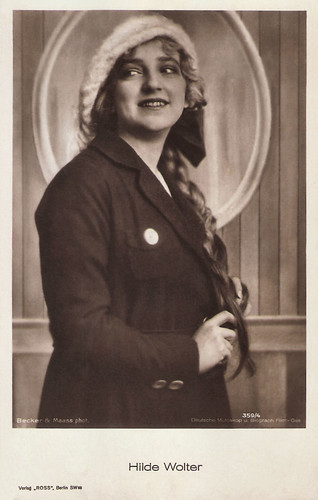
German postcard by Ross Verlag, Berlin, no. 359/4. Photo: Becker & Maass, Berlin / Deutsche Mutoskop & Biograph Film-Ges.
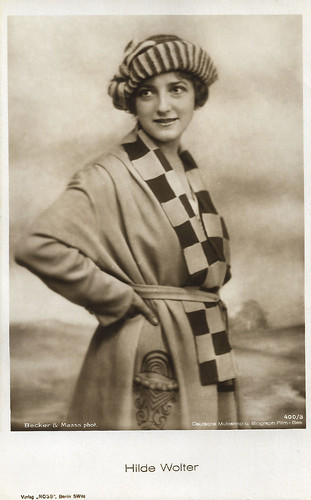
German postcard by Ross Verlag, Berlin, no. 400/3, 1919-1924. Photo: Becker & Maass, Berlin / Deutsche Mutoskop & Biograph Film-Ges. Hilde Wolter.
Sources: Michael Wedel (The Encyclopedia of Early Cinema), Early German Film Database, Filmportal, Wikipedia (German) and IMDb.

No comments:
Post a Comment