
German postcard by Ross Verlag, Berlin, no. 844/2. Photo: British-American Film A.-G. (Bafag), Berlin. Lillian Gish in The White Sister (Henry King, 1923), shot in Italy.

German postcard by Ross Verlag, no. 2079/2, 1927-1928. Photo: United Artists. Ronald Colman in The Magic Flame (Henry King, 1927).

Spanish collector card (leaflet) in the series Films Selectos. Photo: United Artists. Una Merkel in The Eyes of the World (Henry King, 1930).

Italian postcard by Cinema-Illustrazione, Milano, series 2, no. 33. Photo: United Artists (Artisti Associati). Lupe Velez and John Holland in Hell Harbor (Henry King, 1930), produced by Inspiration Pictures and distributed by United Artists.

German postcard by Ross Verlag, no. 191/3. Lilian Harvey and El Brendel in My Lips Betray (John G. Blystone, Henry King, 1933).

Spanish postcard by SOBE, no. 563. Photo: 20th Century Fox. Tyrone Power and Wanda Hendrix in Prince of Foxes (Henry King, 1949).
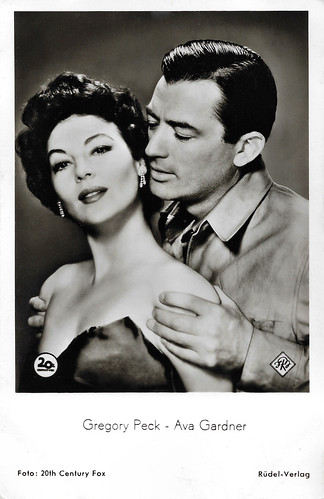
West German postcard by Rüdel-Verlag, Hamburg-Bergedorf, no. 507. Photo: 20th Century Fox. Ava Gardner and Gregory Peck in The Snows of Kilimanjaro (Henry King, 1952).
One of the first major and commercially successful Hollywood directors
Henry Edmondson King was born on his family's farm near Christiansburg, Virginia, in 1886. The son of a lawyer, he grew up in a Methodist family. His family had ties to the Confederate States of America. His grandfather served under Robert E. Lee during the American Civil War. His brother Louis later also became a film director in Hollywood. King first appeared as an actor in school plays. After high school, he went to study engineering. Against his parents wishes, eh stopped his studies Henry decided to stop his studies and became an apprentice actor with the touring Empire Stock Company. He often performed song-and-dance routines in blackface. During his travels, he befriended actress Pearl White. While accompanying her on a visit to the Lubin film studio in Philadelphia in 1913, he was somehow talked into trying out as a film actor. King was cast as Western villains in one-reelers.
The next year, he moved to California to work for the Lubin Company at their Los Angeles studio, much like his contemporary and future colleague Frank Borzage. He graduated to romantic leads in full-length feature films with the Balboa Amusement Company. Henry King began directing in 1915 and made his debut with Who Pays, a 12-part serial. King directed the first episode but did not direct the rest but appeared in it as an actor. King discovered Baby Marie Osborne at the Balboa studio lunchroom and helped construct a vehicle for her, Little Mary Sunshine (1916), with King in the male lead. This film made the 5-year-old a star. Between 1913 and 1925, King acted in approximately sixty films.
Henry King was contracted by Pathé in 1916 and, subsequently, by silent film pioneer and producer Thomas H. Ince. In 1919, he achieved his first success for Ince with the army comedy 23½ Hours' Leave (1919) starring Douglas MacLean. He achieved a second success with both critics and the general public with the rustic southern drama Tol'able David (1921), set in his native region. That film marked the debut of Inspiration Films, the production company he had co-founded with lead actor Richard Barthelmess and Charles H. Duell. From that point on, King gradually became one of the first major and commercially successful Hollywood directors.
For his production company, King created ambitious, high-budget films such as the Italy-set dramas The White Sister (1923) and Romola (1924), both starring Lillian Gish. In The White Sister (1923), he introduced Ronald Colman to American audiences, drawing a moustache on the actor's clean-shaven face with a retouching pencil. A moustache later became a Colman trademark. Working for Sam Goldwyn, King directed the archetypal tearjerker Stella Dallas (1925) with Belle Bennett, Alice Joyce and Colman. It was a huge success. Kevin Brownlow in 'The Parade's Gone By': "Filmically, his production of Stella Dallas (1926) is prosaic. It consists of medium long shots and close shots; there are few travelling shots, few dramatic angles. Yet warmth and humanity pervade every scene."
The Western The Winning of Barbara Worth (1926) saw leads Ronald Colman and Vilma Banky emerge as one of the most romantic screen couples of the 1920s, but it also gave Gary Cooper his first significant role following some earlier work as an extra and stunt performer. Producer Samuel Goldwyn initially objected. He thought Cooper was just another 'damn cowboy'. Goldwyn quickly changed his mind after seeing the rushes.
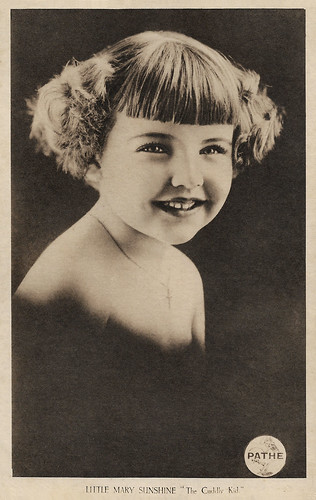
British postcard in the Pathé Frères Cinema LTD Series. Photo: Pathé. Marie Osborne in Little Mary Sunshine (Henry King, 1916). Caption: The cuddly kid.

French postcard by Editions Filma, no. 6. Lillian Gish in The White Sister (Henry King, 1923).
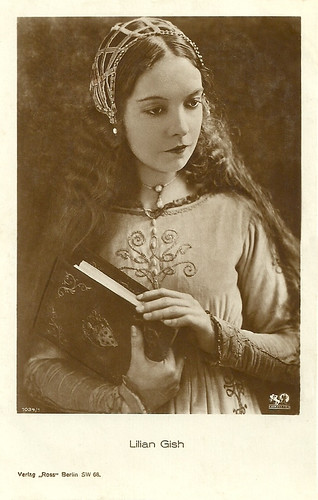
German postcard by Ross Verlag, Berlin, no. 1034/1. Photo: Phoebus Film / MGM. Lillian Gish in the American period piece Romola (Henry King, 1924), shot on location in Italy, and set in Renaissance Florence. The film deals with Tito, a fraud (William Powell), who arrives in Florence and marries Romola, the daughter (Gish) of the blind scholar Bardo (Bonaventura Ibanez), whom he has helped with scholarly work. Meanwhile, he has a fake marriage with a farmer girl, Tessa (Dorothy Gish), who believes the marriage is real, so she drowns herself. Because of the abuse of his powers, the mob revolts against Tito, and he is killed. Romola is now free to marry the man she always loved, Carlo (Ronald Colman). Colman and Gish had just acted in another film by Henry King, also shot in Italy: The White Sister (1923).
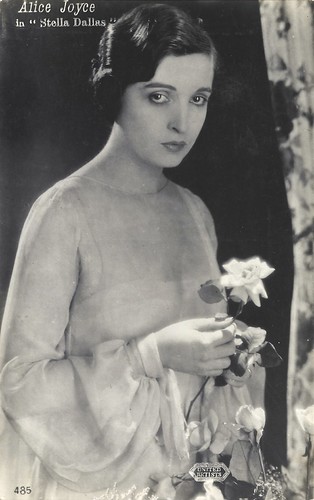
Italian postcard by Ballerini & Fratini, Firenze Ed., no. 485. Photo: United Artists. Alice Joyce as Helen Morrison in Stella Dallas (Henry King, 1925), starring Belle Bennett.

German postcard by Ross Verlag, Berlin, no. 1796/1, 1927-1928. Photo: United Artists.Vilma Banky in The Winning of Barbara Worth (Henry King, 1926).

German postcard by Ross Verlag, Berlin, no. 1794/2, 1927-1928. Photo: United Artists. Ronald Colman in The Winning of Barbara Worth (Henry King, 1926).

French postcard by Cinémagazine-Edition, Paris, no. 495. Photo: United Artists. Ronald Colman and Vilma Banky in The Magic Flame (Henry King, 1927).

German postcard by Ross Verlag Foreign, no. 3671/1, 1928-1929. Photo: United Artists. Gilbert Roland and Norma Talmadge in The Woman Disputed (Henry King, Sam Taylor, 1928).

Spanish collector card (leaflet) in the series Films Selectos, no. 60, 5.12.1931. Photo: Inspirational Pictures / United Artists. Set design for Hell's Harbor (Henry King, 1930), starring Lupe Velez and Jean Hersholt.

Spanish collector card (Leaflet) in the series Films Selectos, no. 70, 13.2.1932. Photo: United Artists. John Holland and Una Merkel in The Eyes of the World (Henry King, 1930).

Spanish collector card (Leaflet) in the series Films Selectos, Suplemento Artistico, no. 80, 23.4.1932. Charles Farrell and Janet Gaynor in Merely Mary Ann (Henry King, 1931).
A consummate craftsman who worked across all genres
With the advent of sound film, Henry King established himself as a consummate craftsman who worked across all genres. Throughout his career, he remained one of the favourite directors of Darryl F. Zanuck’s production company, 20th Century Fox.
In the early 1930s, he enjoyed success with romantic films such as Merely Mary Ann (1931) and State Fair (1933), both starring the then-hugely popular Janet Gaynor. Way Down East (1935) marked Henry Fonda's second film appearance.
This success enabled him to work on big-budget films such as the drama Lloyd's of London (1936). The film gave Tyrone Power, who had just arrived in Hollywood, his big break. Power starred in eleven films directed by King. I.S. Mowis at IMDb: "Much of his work was characterised by an uncomplicated approach and a vivid visual style rather than cinematic tricks or technical individuality. For the most part, it was his meticulous attention to detail, and his reliance on superior plots and good acting, that got the job done."
Tyrone Power also headlined the lavish super-production In Old Chicago (1937), a disaster movie set against the backdrop of the Great Chicago Fire. The dramatic Jazz film Alexander's Ragtime Band (1938) took its title from an Irving Berlin song and traced the history of jazz from the ragtime of the early 20th century to the swing era of the 1930s. Alexander's Ragtime Band became the biggest box-office hit in the United States in 1938.
King also showcased Power, his favourite leading man, in Jesse James (1939), a highly successful Western shot in stunning Technicolour. Power also appeared in the pirate film The Black Swan (1942), and the historical adventure films Captain from Castile (1947) and Untamed (1955), all of which were filmed using the same process.

Dutch postcard, no. 263. Photo: Hal Phyfe / Fox Film. James Dunn and Sally Eilers in Over the Hill (Henry King, 1931).

German postcard by Ross Verlag, no. 8692/1, 1933-1934. Photo: Fox. Lilian Harvey in My Lips Betray (John G. Blystone, Henry King, 1933).

British postcard in the Film Partners Series, London, no. PC3. Warner Baxter and Janet Gaynor in One More Spring (Henry King, Fox 1935).

Italian postcard by Ballerini & Fratini, Firenze (B.F.F. Edit.), no. 3605. Photo: 20th Century Fox. Loretta Young in Ramona (Henry King, 1936). Collection: Marlene Pilaete.

British Real Photograph postcard, London, no. FS 94. Photo: 20th Century Fox. Madeleine Carroll and Tyrone Power in Lloyd's of London (Henry King, 1936).
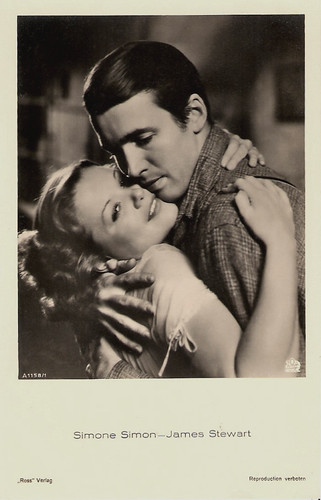
German postcard by Ross Verlag, no. A 1158/1, 1937-1938. Photo: 20th Century Fox. Simone Simon and James Stewart in Seventh Heaven (Henry King, 1937).

British Real Photograph postcard, London, no. FS 176. Photo: 20th Century Fox. Tyrone Power and Alice Faye in Alexander's Ragtime Band (Henry King, 1938).

Latvian postcard by EMBR, no. 3328. Photo: 20th Century Fox. Alice Faye and Tyrone Power in In Old Chicago (Henry King, 1938). Collection: Marlène Pilaete.

Dutch postcard by J.S.A., no. 24. Photo: 20th Century Fox. Spencer Tracy in Stanley and Livingstone (Henry King, Otto Brower, 1939).

British postcard in the Film Partners Series, London, no. PC 320. Photo: 20th Century Fox. John Payne and Brenda Joyce in Maryland (Henry King, 1940).
Lush, melancholic adaptations of literary works
During World War II, Henry King served as a pilot and deputy commander at the Civil Air Patrol coastal patrol base in Brownsville. He directed three war films, all set during the Second World War. A Yank in the R.A.F. (1941) told the story of an American pilot who joined the Royal Air Force before the United States entered the war. Although not intended as propaganda, the film was highly successful in the United States. A Bell for Adano (1945) was set against the backdrop of the Allied landing in Sicily. In the compelling Twelve O'Clock High (1949), King cast Gregory Peck for the first time. Twelve O'Clock High depicted the aircrews who carried out daily American air raids on Nazi Germany and occupied France.
King also directed several religiously inspired films, such as the biographical drama The Song of Bernadette (1943), based on the novel of the same name by Franz Werfel, and the epic biblical film David and Bathsheba (1951). The Song of Bernadette was another big hit. It made Jennifer Jones a star and earned King a Best Director Oscar nomination and the very first Golden Globe Award for Best Director. In addition to his cinematic focus on figures such as Bernadette Soubirous, Irving Berlin, and F. Scott Fitzgerald, he also directed a biopic about Woodrow Wilson: Wilson (1944). Despite winning Oscars and receiving critical acclaim, the film was a box-office failure.
He made five more films with Gregory Peck, including the Westerns The Gunfighter (1950) and The Bravados (1958). During the final decade of his career, King directed several lush, melancholic adaptations of literary works by Ernest Hemingway, such as The Snows of Kilimanjaro (1952) and The Sun Also Rises (1957), and F. Scott Fitzgerald, like Tender Is the Night (1962), his final film.
The list of his superb (melo)dramas also includes Love Is a Many-Splendored Thing (1955), an adaptation of the autobiography of Han Suyin, a Chinese physician and author who wrote in English, and the biographical film Beloved Infidel (1959), in which Gregory Peck portrayed F. Scott Fitzgerald for the last time in a King film.
Henry King passed away at the age of 96 in Toluca Lake, a neighbourhood in the Los Angeles area. He was married twice. From 1914 till her death in 1952, he was married to |Gypsy Abbott, who was an actor at Balboa Company. The couple had three children, Frank, John and Martha. In 1959, he married Ida King Davis, and the couple remained together till his death in 1982. Though nominated for two Academy Awards for Best Director, King failed to win the coveted trophy. He did win a Lifetime Achievement Award from the Directors Guild of America in 1956. In 1998, Twelve O'Clock High (1949) was added to the National Film Registry. Tol'able David (1921) joined that list of premier American films in 2007. In 2014, it was followed by the musical comedy State Fair (1933). Henry King was interred with his second wife, Ida Davis, in the Davis King family plot at Myrtle Hill Cemetery in Tampa, Florida.

British postcard by Picturegoer, no. W127. Jennifer Jones in The Song of Bernadette (Henry King, 1943). Photo: Twentieth Century Fox. Collection: Marlene Pilaete.

Italian postcard by Bromofoto, Milano, no. 250. Photo: RKO Radio Films. Dana Andrews in Deep Waters (Henry King, 1948).

Dutch postcard, no. a.x. 276-134. Photo: 20th Century Fox. Wanda Hendrix in Prince of Foxes (Henry King, 1949).

British postcard by The Picturegoer Series, London, no. D 90. Photo: 20th Century Fox. Gregory Peck and Kieron Moore in David and Bathsheba (Henry King, 1951).

Italian postcard by Edizioni S.I.P.Ci., Milano. Photo: 20th Century Fox. Hildegard Knef in The Snows of Kilimanjaro (Henry King, 1952).

French postcard by Huit, Paris, French licence holder for ISV, no. B 4. Photo: 20th Century Fox. Tyrone Power in King of the Khyber Rifles (Henry King, 1953).

Argentinian postcard by Cromocart G.W., no. 147. Photo: Columbia. Jennifer Jones in Love is a Many-Splendored Thing (Henry King, 1955). Collection: Marlene Pilaete.

British postcard in the Picturegoer Series, London, no. D 818. Photo: 20th Century Fox. Gordon MacRae and Shirley Jones in Carousel (Henry King, 1956).
Sources: Kevin Brownlow (The Parade's Gone By), I.S. Mowis (IMDb), Wikipedia (Dutch and English) and IMDb.
This Directed by... post is the first in a new series about great directors. Till the end of this year, posts on Joseph L. Mankiewicz, Pedro Almodóvar, Michelangelo Antonioni and Robert Bresson will follow.

No comments:
Post a Comment