
West German postcard by Hamburg-Bergedorf, no. 611. Photo: Merkur / Union-Film. Franz Muxeneder in Die Junggesellenfalle / The Bachelor Trap (Fritz Böttger, 1953).

West German postcard by Kunst und Film, Berlin, no. A 849. Photo: Filipp / Union-Film. Signed in 1956.

West German postcard by Labophot. Photo: König / Kopp-Film. Franz Muxeneder in Zwei Bayern in St. Pauli / Two Bavarians in St. Pauli (Hermann Kugelstadt, 1956).
Somewhat simple-minded supporting characters
Franz Muxeneder was born in 1920 in Salzburg, Austria. He worked as a qualified auto mechanic, ski instructor, and tax department employee before becoming an actor. He first appeared on stage in 1943 with an amateur theatre group in Hallein. Afterwards, he studied acting in Salzburg.
He made his debut shortly after the war at the Salzburg State Theatre, where he was engaged from 1945 to 1950 and again in 1956. He also performed at the Salzburg Festival from 1945 to 1950 and again in 1983. Since 1951, he performed several times at the theatre Die Kleine Freiheit in Munich.
In the cinema, he portrayed somewhat simple-minded supporting characters, such as farmhands or soldiers. From the late 1940s, Muxeneder appeared alongside numerous well-known stars in countless Heimatfilme (German regional films) and comedies.
These included the box-office hits Drei Männer im Schnee / Three Men in the Snow (Kurt Hoffmann, 1955), Die Trapp-Familie / The Trapp Family (Wolfgang Liebeneiner, 1956), and Münchhausen in Afrika / Münchhausen in Africa (Werner Jacobs, 1958) with Peter Alexander.
He also starred in Mikosch, der Stolz der Kompanie / Mikosch, the Pride of the Regiment (Rudolf Schündler, 1958) starring Günther Philipp, and the classic Der brave Soldat Schwejk / The Good Soldier Schweik (Axel von Ambesser, 1960), with Heinz Rühmann.
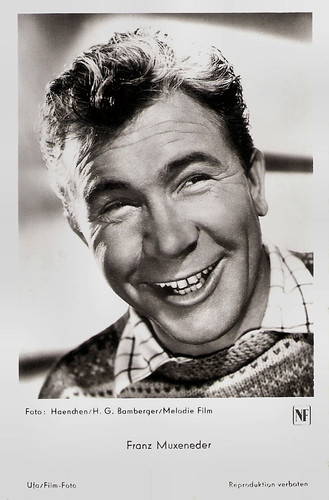
West German postcard by Ufa/Film-Foto, Berlin Tempelhof, no. FK 3132. Photo: Haenchen / H.G. Bamberger / Melodie Film / NF-Film. Franz Muxeneder in Pulverschnee nach Übersee / Powder Snow Overseas (Hermann Leitner, 1956).

West German autograph card by Ufa/Film-Foto, Berlin-Tempelhof, no. F-M-1. Photo: Joe Niczky / Ufa. Signed in 1962.
Bavarian sex comedies
Between 1960 and 1963, Franz Muxeneder was an ensemble member of the Munich Volkstheater. He had a penchant for roles in plays by Johann Nestroy and Ferenc Molnár. In 1966, he performed at the Theater an der Wien.
On the radio, his role as the hare Lodengrün in the children's radio play 'Sängerkrieg der Heidehasen' (The Singing Contest of the Heath Hares) by James Krüss was, according to German Wikipedia, unforgettable. After the first broadcast, the play was repeated many times.
He also appeared in popular TV series such as the Yugoslav-West German series Počitnice v Lipici / Ferien in Lipizza / The White Horses (Hanns Wiedemann, 1966–1967), and Luftsprünge / Jumps (Hermann Leitner, Ernst Schmucker, 1969) starring Luis Trenker and Toni Sailer. His catchphrase in the series was "Sowieso".
By the late 1960s, he often appeared as comic relief in Bavarian sex comedies such as Was treibt die Maus im Badehaus? / Three Bavarians in Bangkok (Sigi Rothemund, 1976) and Liebesgrüße aus der Lederhose 3: Sexexpress aus Oberbayern / Greetings from Lederhosen 3: Sex Express from Upper Bavaria (Gunter Otto, 1977).
Shortly before his death, during the 1986/87 season, he played Frosch in the operetta 'Die Fledermaus' at the Bavarian State Opera in Munich. Franz Muxeneder died in Munich, West Germany, in 1988. He was 67. Muxeneder was buried in his hometown in the Salzburg municipal cemetery.

West German autograph card. Photo: Ellinger, Salzburg. Signed in 1970.
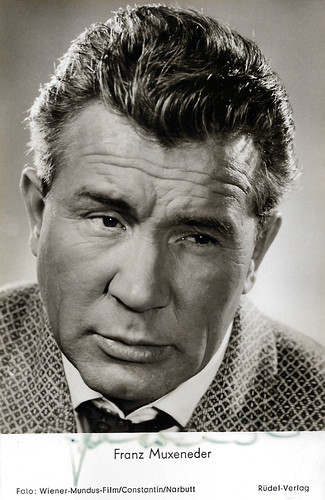
West German autograph card by Rüdel Verlag. Photo: Wiener - Mundus-Film / Constantin / Narbutt.
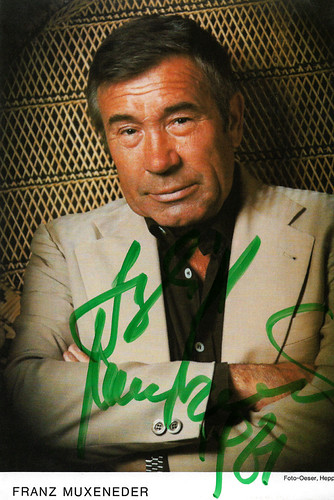
West German autograph card. Photo: Foto-Oeser, Heppenheim.
Sources: Wikipedia (German and English) and IMDb.

No comments:
Post a Comment