Voluptuous, visually stunning Italian film actress Eleonora Rossi Drago (1925–2007) played princesses and temptresses throughout Italian cinema of the 1950s and 1960s. She never found the international crossover fame of Sophia Loren and Gina Lollobrigida, but received respect as a fine actress in leading roles in films by famous directors such as Michelangelo Antonioni, Luigi Comencini and Valerio Zurlini.

Italian postcard by Rotalfoto, Milano. Photo: Ponti - De Laurentiis. Eleonora Rossi Drago in Sensualità / Barefoot Savage (Clemente Fracassi, 1952). The man in the shadow is Marcello Mastroianni.

Italian postcard by Bromofoto, Milano, no. 369. Photo: Minerva Film.

Italian postcard by Rotalfoto, Milano, no. 114.

Italian postcard by B.F.F. Edit, no. 3329. Photo: ENIC.
Eleonora Rossi Drago was born Palmina Omiccioli near Genoa, Italy, in 1925. She was the daughter of a Spanish sea captain and an Italian mother.
At the age of 17, Palmina married a gentleman named Rossi and bore a daughter, Fiorella. The marriage did not last, and Mr. Rossi emigrated to Argentina, leaving his wife to raise their daughter by herself. She found work as a department store mannequin and began actually designing couture clothing herself.
An arresting beauty, she started competing in beauty contests and wound up in fourth place in the Miss Italy pageant. Gina Lollobrigida came in third. The attention lured her to films. She moved to Rome and in 1949 began receiving small film roles while using her married name, Rossi.
Her first two big breaks came with Persiane chiuse / Behind Closed Shutters (Luigi Comencini, 1951) with Massimo Girotti, a melodrama about prostitution, and the highly controversial Sensualità / Barefoot Savage (Clemente Fracassi, 1952) in which Marcello Mastroianni and Amedeo Nazzari violently quarrel over her affections.
Persiane chiuse was considered a strong success. The highly impressed director, Luigi Comencini, went on to cast Eleonora as a female lead in his next film, La tratta delle bianche / The White Slave Trade (Luigi Comencini, 1952), another tawdry melodrama about prostitution that co-starred Vittorio Gassman and also showcased the up-and-coming Sophia Loren.

Italian postcard by Vetta Traldi, Milano, in the series Divi del Cinema, no. 56.

French postcard by Éditions du Globe, Paris, no. 624. Photo: Sam Lévin.

French postcard by Éditions P.I., Paris, no. 483, presented by Les Carbones Korès, no. 27D.
According to Gary Brumburgh at IMDb, Eleanora Rossi Drago "had the makings of a bosomy sex goddess, but she constantly strove to better her acting reputation in classier material". She got the nickname the 'Lady of the Italian Cinema'.
In 1954 she appeared opposite Madeleine Robinson in L'affaire Maurizius / On Trial (Julien Duvivier, 1954), a bleak drama about the miscarriages of justice. In 1955 she won critical notice on stage as Helena opposite Marcello Mastroianni in Anton Chekhov's 'Uncle Vanya' directed by Luchino Visconti.
Her finest hour in the cinema came about that same year with the release of Le amiche / The Girlfriends (Michelangelo Antonioni, 1955). She starred in this rags-to-riches story as a humble girl who becomes a respected owner of a fashion salon.
Among her other standout roles in the 1950s were Kean (Vittorio Gassman, Francesco Rosi, 1956) again opposite Gassman, Suor Letizia / The Awakening (Mario Camerini, 1957) starring Anna Magnani, the Oscar nominated La strada lunga un anno / The Year Long Road (Giuseppe de Santis, 1958) opposite Silvana Pampanini, and the crime drama Un maledetto imbroglio / An Ugly Mess (Pietro Germi, 1959) with Claudia Cardinale.
In the Italian/French co-production Estate violenta / Violent Summer (Valerio Zurlini, 1959), she played a married woman approaching middle age who surrenders herself to a younger man (Jean-Louis Trintignant) during the summer of '43 at the height of fascism. The film earned her the Nastro d'argento (Silver Ribbon award), voted for by Italian film journalists, and the Best Actress award at the Mar del Plata Film Festival in Argentina.

Italian postcard by Turismofoto, no. 63.
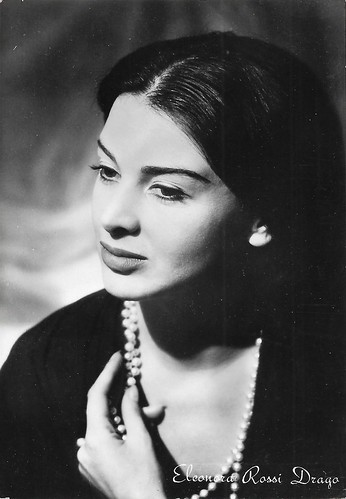
Italian postcard by Rotalfoto, Milano, no. 880.

German postcard by Filmbilder-Vertrieb Ernst Freihoff, Essen, no. 118. Retail price: 10 Pfg. Photo: Franco London Film.
Eleanora Rossi Drago was forced to play provocative roles of lesser quality, roles that usually emphasised her physical attributes or enhanced the scenery around her. While Sophia Loren had Carlo Ponti to promote her internationally, Rossi Drago was less fortunate. By the 1960s she was relegated to such unmemorable adventures, Horror films and Sword-and-Sand spectacles as David e Golia / David and Goliath (Ferdinando Baldi, Richard Pottier, 1960) with Orson Welles playing King Saul, and Rosmunda e Alboino / Sword of the Conqueror (Carlo Campogalliani, 1961) opposite a raping and pillaging Jack Palance.
More interesting were her parts in the anthology film L'amour à vingt ans / Love at Twenty (Renzo Rossellini a.o., 1961), Anima nera / Black Soul (Roberto Rossellini, 1962) and the delightful comedy Se permettete parliamo di donne / Let's Talk About Women (Ettore Scola, 1964) starring Vittorio Gassman.
In 1964, she also appeared in the TV miniseries La Cittadella (Anton Giulio Majano, 1964), an adaptation of A. J. Cronin's novel, 'The Citadel'. Elsewhere, she was pretty much overlooked in the epic ensemble as Lot's wife in the mammoth failure The Bible: In the Beginning... (John Huston, 1966).
Things did not improve in this decade. After appearing in the elegant erotic drama Camille 2000 (Radley Metzger, 1969), in the critically panned retelling of The Picture of Dorian Gray, Das Bildnis des Dorian Gray (Massimo Dallamano, 1970) with Helmut Berger, and in the good-looking Giallo Nelle pieghe della carne / In the Folds of the Flesh (Sergio Bergonzelli, 1971) with Pier Angeli, she called it quits.
Blending back inconspicuously into mainstream society, she married Sicilian businessman Domenico La Cavera in 1973, and eventually retired to Palermo, Italy. In 1989, she returned once to the screen for the documentary Ben Webster: The Brute and the Beautiful (John Jeremy, 1989) about jazz saxophonist Ben Webster. In 2007, Eleanora Rossi Drago died of a brain haemorrhage at the age of 82. She was survived by her second husband and her daughter.

French postcard by Editions P.I., no. FK 3096. Photo: Joachim G. Jung / Ufa.

Russian postcard by Izdanije Byuro Propogandy Sovietskogo Kinoiskusstva, no. 21.250, 1961. Retail price: 8 Kop.

Mexican card, no. 320.
Sources: Gary Brumburgh (IMDb), Hal Erickson (AllMovie - Page now defunct), Wikipedia and IMDb.
This post was last updated on 17 September 2026.
Italian postcard by Rotalfoto, Milano. Photo: Ponti - De Laurentiis. Eleonora Rossi Drago in Sensualità / Barefoot Savage (Clemente Fracassi, 1952). The man in the shadow is Marcello Mastroianni.
Italian postcard by Bromofoto, Milano, no. 369. Photo: Minerva Film.
Italian postcard by Rotalfoto, Milano, no. 114.
Italian postcard by B.F.F. Edit, no. 3329. Photo: ENIC.
An arresting beauty
Eleonora Rossi Drago was born Palmina Omiccioli near Genoa, Italy, in 1925. She was the daughter of a Spanish sea captain and an Italian mother.
At the age of 17, Palmina married a gentleman named Rossi and bore a daughter, Fiorella. The marriage did not last, and Mr. Rossi emigrated to Argentina, leaving his wife to raise their daughter by herself. She found work as a department store mannequin and began actually designing couture clothing herself.
An arresting beauty, she started competing in beauty contests and wound up in fourth place in the Miss Italy pageant. Gina Lollobrigida came in third. The attention lured her to films. She moved to Rome and in 1949 began receiving small film roles while using her married name, Rossi.
Her first two big breaks came with Persiane chiuse / Behind Closed Shutters (Luigi Comencini, 1951) with Massimo Girotti, a melodrama about prostitution, and the highly controversial Sensualità / Barefoot Savage (Clemente Fracassi, 1952) in which Marcello Mastroianni and Amedeo Nazzari violently quarrel over her affections.
Persiane chiuse was considered a strong success. The highly impressed director, Luigi Comencini, went on to cast Eleonora as a female lead in his next film, La tratta delle bianche / The White Slave Trade (Luigi Comencini, 1952), another tawdry melodrama about prostitution that co-starred Vittorio Gassman and also showcased the up-and-coming Sophia Loren.
Italian postcard by Vetta Traldi, Milano, in the series Divi del Cinema, no. 56.
French postcard by Éditions du Globe, Paris, no. 624. Photo: Sam Lévin.
French postcard by Éditions P.I., Paris, no. 483, presented by Les Carbones Korès, no. 27D.
Lady of the Italian cinema
According to Gary Brumburgh at IMDb, Eleanora Rossi Drago "had the makings of a bosomy sex goddess, but she constantly strove to better her acting reputation in classier material". She got the nickname the 'Lady of the Italian Cinema'.
In 1954 she appeared opposite Madeleine Robinson in L'affaire Maurizius / On Trial (Julien Duvivier, 1954), a bleak drama about the miscarriages of justice. In 1955 she won critical notice on stage as Helena opposite Marcello Mastroianni in Anton Chekhov's 'Uncle Vanya' directed by Luchino Visconti.
Her finest hour in the cinema came about that same year with the release of Le amiche / The Girlfriends (Michelangelo Antonioni, 1955). She starred in this rags-to-riches story as a humble girl who becomes a respected owner of a fashion salon.
Among her other standout roles in the 1950s were Kean (Vittorio Gassman, Francesco Rosi, 1956) again opposite Gassman, Suor Letizia / The Awakening (Mario Camerini, 1957) starring Anna Magnani, the Oscar nominated La strada lunga un anno / The Year Long Road (Giuseppe de Santis, 1958) opposite Silvana Pampanini, and the crime drama Un maledetto imbroglio / An Ugly Mess (Pietro Germi, 1959) with Claudia Cardinale.
In the Italian/French co-production Estate violenta / Violent Summer (Valerio Zurlini, 1959), she played a married woman approaching middle age who surrenders herself to a younger man (Jean-Louis Trintignant) during the summer of '43 at the height of fascism. The film earned her the Nastro d'argento (Silver Ribbon award), voted for by Italian film journalists, and the Best Actress award at the Mar del Plata Film Festival in Argentina.
Italian postcard by Turismofoto, no. 63.
Italian postcard by Rotalfoto, Milano, no. 880.
German postcard by Filmbilder-Vertrieb Ernst Freihoff, Essen, no. 118. Retail price: 10 Pfg. Photo: Franco London Film.
Blending back inconspicuously
Eleanora Rossi Drago was forced to play provocative roles of lesser quality, roles that usually emphasised her physical attributes or enhanced the scenery around her. While Sophia Loren had Carlo Ponti to promote her internationally, Rossi Drago was less fortunate. By the 1960s she was relegated to such unmemorable adventures, Horror films and Sword-and-Sand spectacles as David e Golia / David and Goliath (Ferdinando Baldi, Richard Pottier, 1960) with Orson Welles playing King Saul, and Rosmunda e Alboino / Sword of the Conqueror (Carlo Campogalliani, 1961) opposite a raping and pillaging Jack Palance.
More interesting were her parts in the anthology film L'amour à vingt ans / Love at Twenty (Renzo Rossellini a.o., 1961), Anima nera / Black Soul (Roberto Rossellini, 1962) and the delightful comedy Se permettete parliamo di donne / Let's Talk About Women (Ettore Scola, 1964) starring Vittorio Gassman.
In 1964, she also appeared in the TV miniseries La Cittadella (Anton Giulio Majano, 1964), an adaptation of A. J. Cronin's novel, 'The Citadel'. Elsewhere, she was pretty much overlooked in the epic ensemble as Lot's wife in the mammoth failure The Bible: In the Beginning... (John Huston, 1966).
Things did not improve in this decade. After appearing in the elegant erotic drama Camille 2000 (Radley Metzger, 1969), in the critically panned retelling of The Picture of Dorian Gray, Das Bildnis des Dorian Gray (Massimo Dallamano, 1970) with Helmut Berger, and in the good-looking Giallo Nelle pieghe della carne / In the Folds of the Flesh (Sergio Bergonzelli, 1971) with Pier Angeli, she called it quits.
Blending back inconspicuously into mainstream society, she married Sicilian businessman Domenico La Cavera in 1973, and eventually retired to Palermo, Italy. In 1989, she returned once to the screen for the documentary Ben Webster: The Brute and the Beautiful (John Jeremy, 1989) about jazz saxophonist Ben Webster. In 2007, Eleanora Rossi Drago died of a brain haemorrhage at the age of 82. She was survived by her second husband and her daughter.
French postcard by Editions P.I., no. FK 3096. Photo: Joachim G. Jung / Ufa.
Russian postcard by Izdanije Byuro Propogandy Sovietskogo Kinoiskusstva, no. 21.250, 1961. Retail price: 8 Kop.
Mexican card, no. 320.
Sources: Gary Brumburgh (IMDb), Hal Erickson (AllMovie - Page now defunct), Wikipedia and IMDb.
This post was last updated on 17 September 2026.

No comments:
Post a Comment